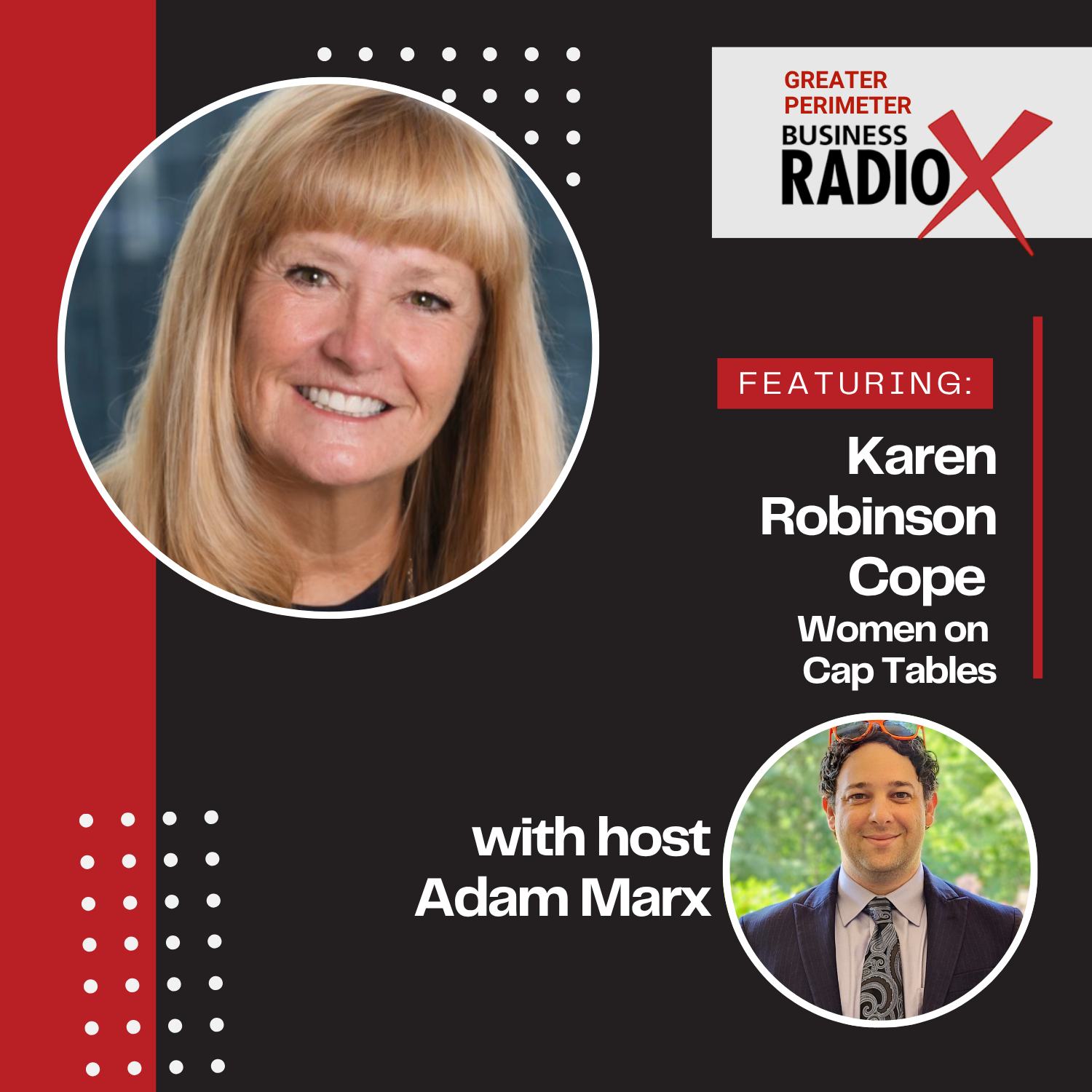

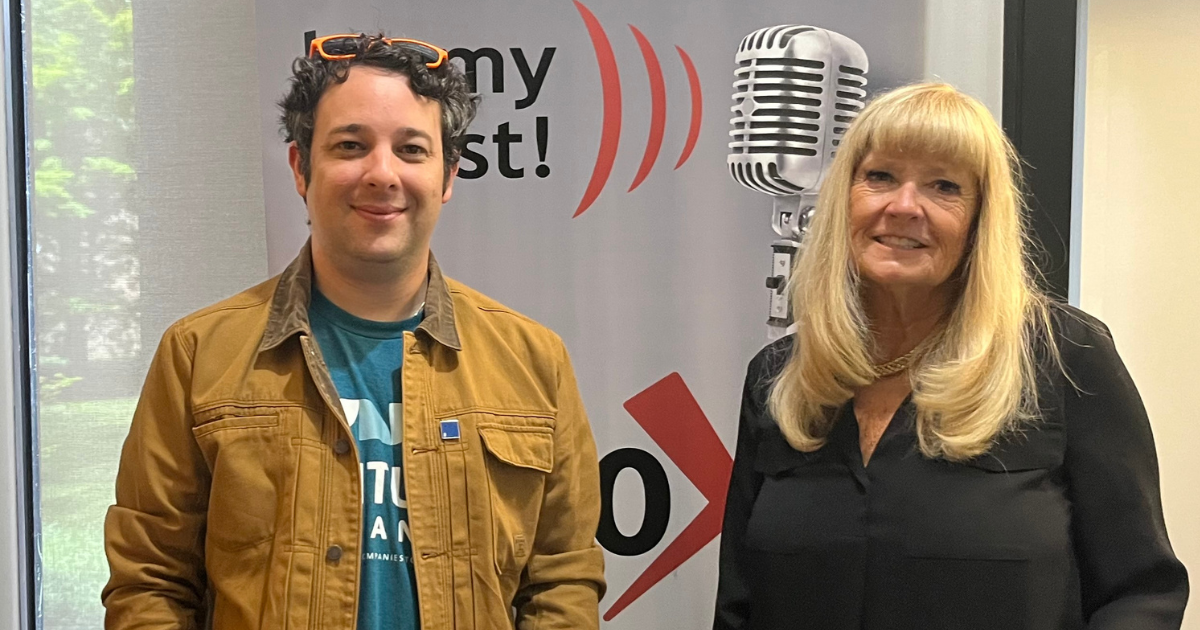
On this episode of Greater Perimeter Business Radio, Adam Marx sits down with entrepreneur, investor, board member, and former CEO Karen Robinson Cope to discuss the evolution of Atlanta’s startup ecosystem, the importance of relationship-driven business growth, and her latest initiative, Women on the Cap Table. Karen shares lessons from raising more than $40 million in capital, investing in startups for over three decades, and helping build a stronger entrepreneurial community throughout Atlanta. Together, they explore how founders, investors, and business leaders can create meaningful connections that drive long-term success.
 Karen Robinson Cope, co-founder of Women on the Cap Table, is an Executive Leader with 25+ years of experience driving operational, sales, and marketing excellence in numerous business environments, including large corporations, startups, and entrepreneurial ventures.
She is renowned for a strategic leadership approach and a proven track record of transforming visionary concepts into tangible achievements, moving companies toward sustainable revenue streams. Karen has a remarkable international sales record, demonstrating the ability to excel in multicultural business landscapes.
She’s an active angel investor across multiple technologies with over 30 investments.
Connect with Karen on LinkedIn.
About Your Host
 Adam Marx is a networking & leadership consultant, speaker, startup advisor, journalist & the founder of The Zero to One Networker.
Formerly the founder & CEO of music-tech startup Glipple, Inc., and as a writer appearing in Crunchbase News, Startup Grind, Mattermark, & others, Adam draws on more than a decade of experiences in the music & startup tech industries to teach others how to cultivate powerful relationships using strategies of patience, consistency, authenticity, & value creation.
As a networking consultant and speaker, Adam has worked with numerous organizations, including Georgia State University, TechStars Atlanta, the Atlanta Tech Village, ATDC (through Georgia Tech), & Startup Showdown, where he’s advised & mentored founders on how to develop magnetic dialogues & long-term relationships.
Adam’s talks include those given at Georgia Tech and Georgia State University, with a keynote at Emory University’s The Hatchery and as a featured speaker for Atlanta Tech Week 2024.
In addition to advising & consulting, Adam sits on the steering committee for InnovATL, cohosts LinkedIn Local ATL, emceed the 2022 Vermont SHRM State Conference, and was a workshop speaker at South by Southwest (SXSW) 2025.
He is currently working on his forthcoming book.
Connect with Adam on LinkedIn and Instagram and follow Zero to One Networker on LinkedIn and Instagram.
 This transcript is machine transcribed by Sonix.
TRANSCRIPT
Intro: Broadcasting live from the Greater Perimeter. It’s time for Greater Perimeter Business Radio. Now, here’s your host.
Lee Kantor: Today’s episode is brought to you by 0 to 1 networker, helping founders, funders, and operators build the strategic relationships and access that move businesses forward. For more information, go to 0 to 1, networker.com. Now here’s your host, Adam Marx.
Adam Marx: Thanks, Lee. I’m so excited for today. You know, I’ve been kind of looking forward to this for the last few weeks. I’m here with one of my great friends, Karen Robinson, co-op board member, retired CEO and a whole laundry list of of other things. I’m gonna let her add to that list right now.
Karen Robinson Cope: Well, first of all, it’s a pleasure to be here. And it’s so cool to see Lee because I haven’t seen you in many years. So it’s great to see you. And Adam, I always love spending time with you. It’s so cool. The orange sunglasses. Yeah, baby. Bring it on. As Adam said, I’ve been blessed. I’ve lived in Atlanta for over 30 years, and in that time I was one of the first female CEOs. Um, that raised a fair amount of money. I raised over $40 million and had some amazing investors. And over the last 30 plus years, I’ve been a board member, a mentor, an angel investor and been very been very blessed. I’ve got some, a lot of exciting non-profits that I’ve also been able to help. So it’s a pleasure to be here. And I’m just excited to have this conversation. Adam.
Adam Marx: Well, I mean, then let’s, let’s get it started. I look, you have so many things going on simultaneously. It’s, it’s kind of exhausting to try to think about what your, your day to day looks like. Um, let’s talk about one of the things that I’ve been kind of itching to talk about already. And we were talking about it, uh, behind the scenes. Um, I want to talk about women on the cap table because that’s kind of like a new thing on the scene. And it’s it’s super exciting.
Karen Robinson Cope: Well, thank you so much. It’s something that I’ve talked about and, um, excited because we just pulled the trigger on it a couple months ago and the response has been overwhelming. Um, when I first raised money and again, this was over 30 years, I was in my 20s and, um, when I went out to raise money, um, it was amazing, but it was a bunch of males, primarily white males. Um, and they were very supportive, but I was a female CEO and it would have been nice to have some females and there just weren’t any at the time. Over the last 30 years for the companies that I’ve raised money for that I’ve been on the board of that. I’ve been, uh, interim CEO of, I’ve tried to continue to find women. What we found is that when women are investors, number one, you actually statistically, they have better results. And that’s been proven. And yet most women are not even aware they can do this. Looking to the future, we see that more and more women are going to be in charge of their finances because their spouse has passed away, or because they’re just living longer. They’ve got some big 401 K plans. Um, you know, some of my closest friends were retired from some of the biggest corporations in Atlanta. And they said, I’d love to get involved in angel investing, but I don’t know anything about it. Um, as if we, Jane McCracken and I got together a couple months ago and realized that this was a great. The timing was now it was right time, right place, and we wanted to do with Atlanta. And it was a combination of both women from corporate America as well as people that you and I are very close friends with. The goal is one goal.
Adam Marx: Mhm.
Karen Robinson Cope: Our goal is to have women write checks so they are on the cap table. We think that will make better companies. And we think that that will help women diversify their portfolio and have access to this new source of capital. We love women founders, but this is not focused on women founders. There’s many groups doing that. And we want to invest in women founders. But our goal is very singular writing women writing checks as angel investors. What we’ve done to kind of reduce some of the risk is, number one, we only work with a lead investor. They’ve got to have a term sheet, and there’s got to be an opportunity for us to invest. It’s um in addition, we’re balancing with education. So we’re having probably 11 meetings this year. We’ve already had three. We have typically an education like Y. Um, an angel investor should be part of your portfolio. How much should you, what’s the risk. What’s the up, you know, what is the upside look like or what it can look like. We also have a case study. So we’ve got some Karen Houghton came in, Houghton came in and it was a phenomenal about infinite giving.
Karen Robinson Cope: We had Viva Finance come in and talk about not not only from their company perspective, but we had investors come in who said, I invested in this company three years ago, five years ago, and here’s why I invested. And then we looked at how they’ve learned and then we our first pitch competition, we’ve narrowed it down to three companies, um, two female, two one female lead CEO and two male. Um, on June 9th we’re going to be, um, letting, uh, them pitch. And our goal is to write at least to one of the companies using an SPV, a special purpose vehicle. Our goal is to write a couple hundred thousand dollars check to at least one of those companies. Um, and then over the next six months, we hope to do at least 1 or 2 other companies. Our goal is to write $1 million of checks in our first year. In the first three months, we’ve gotten 50, um, confirmed accredited investors, female that have said they’re going to write checks, which means we’ve got $1 million portfolio to start with. We’re so excited.
Adam Marx: I, I, there’s so much in that that I love for first we have to get Jane McCracken on the show. I love Jane, she’s she’s a rock star. And, and Karen Houghton too. I mean, I’ve known Karen since since she’s amazing. I met her, I think through through the tech village, uh, network. And there’s so much in this because we often hear about investing in female founders. And it’s I mean, we have to we do have to fix the fact that that investment in female founded and female led companies has gone down. And that’s a travesty. We don’t hear as much about what your singular focus is about helping women become angel investors. Lead rounds get on that cap table. And I think that that’s something that that creates a is complementary to the conversation we’re already having about how do we create more space for women in the boardroom?
Karen Robinson Cope: Yes.
Adam Marx: Female led companies that are getting like serious funding, not like, oh, here’s ten grand now go away. Um, and so I think that this actually dovetails very much with a conversation that’s going on around the metro Atlanta area in the startup and entrepreneurial space. Like we need more angel investors. We need I mean, we hear a lot about VC and VC has has its place for sure. But like, we do need more angel investors and to kind of build out a more robust network, because that’s one of the areas that I think that we are, we’re lagging a little bit in that area. And I mean, you probably see more of that than I do.
Karen Robinson Cope: That’s a great comment. And I think to show that there is a consensus that we need this. Our speakers, our guest speakers at our very first conference were David Cummings. Yeah. And Donnie Beamer and Donnie came from on behalf of Atlanta and said, this is what we need. And David said, let me tell you why this is important. We think the reason why we’re so excited about this is, again, I’ve been approached. I’ve been an angel investor for 30 years. I’ve invested, I’ve had some great wins and some big zeros. And so I’ve always because I had to raise money. But I’ve met over the last two years working with on board, I’ve met some amazing corporate executives who are retired, who have very large 401 s and they’re saying, you know what? I don’t want to go back to work full time, but I really want to make an investment. But I don’t want to be the only investment. I don’t I’m not sure about angel investing. I want to do it, but I don’t want to be the only one. So this is a great opportunity to combine corporate, corporate women with people like you and I. Well, not you, but people like me. That’s fair.
Adam Marx: That’s fair, that’s fair. But but it brings up the question for those of us who are not going to be female angels, right? How do we support this? And in a lean forward capacity, like, I don’t want to sit here and pat myself on the back and say, oh, it’s great. You know, I shared a link. How, how can we be out there and be supporting this for, for what you’re building women on the cap table and the broader Atlanta entrepreneurial and business communities, how do we do this in a proactive way?
Karen Robinson Cope: Thank you so much, Adam. And that’s one of the things I absolutely love about you is always saying, how can I help? What can I do? How can I support so important? I think there are three things we can do. The first thing we can do, and I think this is why the VCs in town are trying to bring us in. So again, just to remind you, we won’t lead a deal. So there has to be an open term sheet with a literally a VC leading it or a strong angel group leading it. Part of that is because we’re 100% volunteer organization. Um, we pay membership fees, but again, that’s enough to keep the organization running. How we can do it is number one, we can, to the extent you have female friends that are at a point in their life where they’ve got some additional cash. And again, what the goal is, you’re going to love this, by the way, at the end of the year, if you haven’t written at least a $10,000 check, we’re going to say we love you, but maybe you’re not an angel investor this year. Come back when you’re ready to write checks. I’m tired of people in town saying I’m an angel investor, and you say, how many checks have you written? Well, I haven’t then you’re not an angel investor.
Karen Robinson Cope: So that’s the first thing. What we’d love to do is to the extent you have women that would like to learn more about this asset class, we’d love to get them involved. There’s a lot of education now. Part of your membership dues is you get to become a member of the ACA, which is the nationwide, and this is a chance you get their content as well as ours. The second thing we can do is we’ve got a group working with partnerships. So I met with Kim Green from Georgia Power just a couple weeks ago, talked to her about it, and Sophia Scott, who was the president of UPS enterprise, she and I are leading the partnership. So we’re going out to this is our superpower. We’re going out to the many corporate corporations here in Georgia and saying, we’re doing this. Tell us the type of technologies, companies that you’re that you would be interested in understanding, learning about, etc., trying to bring those to the table. And again, think about it. If we had, we have some amazing, amazing female executives. And if you were doing a company in logistics and you could get some of that. And that’s one of the reasons the VCs are excited to talk to us. I’m sorry. Go ahead.
Speaker 5: No no no no no no no no, I.
Adam Marx: Have I have so much I want to respond to that because it’s you are underscoring something that I, I try very hard to be very, very specific about when I talk about building networks, when I talk about building relationships. And I was just talking to, um, giving a workshop at the Brookhaven Chamber a couple days ago, shout out to the Brookhaven Chamber for being amazing. Um, because there’s a portion of what you said that has to do with being in the room, even if maybe you’re not ready to write a check, but you’re very interested in unity. If, if you’re a, a, uh, female founder or someone who’s got some, some cash that you may be interested in getting into the investing space, but you may not know where to start or just you’re not ready to be like an angel investor. And and and to come with that on the front end and just say, hey, look, I’m I’m not at this level, but I’d like to be in this room and be around this conversation. I think that’s really a critical portion of this, because there’s so much in knowing how to do investing and how to do it.
Adam Marx: Certainly how to be an angel. It’s the check is almost the easiest part. It’s there’s, there’s all this other stuff that is kind of you don’t see it. I, you know, you see it behind the scenes. And I think what I’m picking up from that portion of what you just said is there’s, there’s a need to underscore. There is a, you know, referencing just being able to sit down at a table with these people and say, hi, my name is, and this is what I’m working on. And like, I’m not here to pitch you, but I love the work that you’re doing. I’d love to learn more about it. I’d love to see how I could help or support, given the resources I have today. Maybe time, maybe financial, whatever those things may be, people remember that. And that’s how you that’s how you scale city wide networks is how you get in the room. And how you stay in the room is by saying, you know, I’d love to meet you where I am today and how can we create a mutually beneficial dynamic?
Karen Robinson Cope: Absolutely. And I think the great thing about this, and there’s a couple of things. Number one, it’s a safe space. So these are all women there. They all have means, but they’re like, okay, help me. Let me ask the dumb question. Let me ask, what are the, you know, are there risk involved in this? How much of a check do I have to write? So that’s the first thing. It’s safe. The second thing is because we’re doing SPVs, you can be I mean, potentially your check size could be as low as 2 or $3000, which is, you know, you and I both know that’s the price of expensive shoes or a handbag. And so you could either have a new computer, a new computer. And so we think it’s a great, safe way to kind of dip your toe in. Our goal is over the next 2 to 3 years that we get 100 women. We’d like to invest a minimum of $1 million a year, a couple companies. Um, and then I’ve already gotten calls from around the country saying, can we bring this to Boston? Can we bring it to Austin? Can we bring it to New York? So I’ve said, no, we’re going to figure it out.
Karen Robinson Cope: Atlanta first. It’s the right mix of corporate women with entrepreneurial women who’ve had some successes. I mean, Lori Brewer is amazing. I could just go, Blair, if I can go on and on of these, uh, Sue bulky, uh, again, Sophia Scott, um, Jackie Chu amazing, amazing women who are, um, who are saying, you know what, I want to help educate. So it’s a safe place. We can write a smaller check, learn and at the same time build great community. I mean, some of the things you’ve probably seen, some of the post, the number of women who are writing about it and saying, I’ve had more fun having. I’m learning a lot. I’m having fun. We drink a little wine, have a little cheese and here’s some great companies and learn a lot. So I am thankful for the opportunity. And yes, we’re raring to go. Let’s talk about it next year and we’ll see how many companies we’ll see.
Adam Marx: Yeah, we’ll see how many. But I have a feeling it’s going to be a lot. And we’re going to talk behind the scenes because I want to know for myself how how I can get involved at the right level. So that’s a conversation that we’re going to have. But we’ll move that to to a to a later, a later moment. But I want to I want to take a step back. You’ve been in the Atlanta business scene, the Atlanta entrepreneurship scene for.
Karen Robinson Cope: A long time.
Adam Marx: But enough time to be a a serious voice, having seen a lot of stuff and having seen a lot of transformations of the ecosystem here. And I want to know just what the beginning part of that journey looked like. And, and just to give us some context for how the the ecosystem has changed not just for female founders, but but for founders and entrepreneurs in general, because it’s changed for me even in the last ten years. It’s amazing to see what it’s been since, you know, 2014.
Karen Robinson Cope: That’s a great question. I think a couple things that I’ve noticed, um, again, you may or may not know, my first company, I did raise 40 something million from it. The last valuation was we were a unicorn before anybody knew what a unicorn was.
Adam Marx: This was before alien Li wrote the essay.
Karen Robinson Cope: Exactly. Correct. Um, we actually did the road show and everything. And then there was this little thing in March of 2000, way before your time that was, uh, basically put that IPO on hold. My husband changed the jet he was planning to buy for a little plastic one, and we went back to Flying Coach, but we sold it. Um, but from that time, I learned a lot. The first thing I learned is Atlanta is one of the most supportive communities you can imagine, both women helping other women, but also men. The second thing I learned that was so exciting that it’s changed is originally contrary to Silicon Valley in Silicon Valley, when people had an exit, they stayed around and did the second. I mean, Marc Andreessen, a great joy, great example, did a second and a third and then became really big investors in Atlanta. When you had an exit, you typically went to Florida for tax reasons and to buy beach house. And so we didn’t have that recirculation of money thanks to people like Tom Noonan. David Cummings are probably the two of the most prolific, have done an amazing job of recycling that money. And David in particular over the last you know what he’s done with Soto. Amazing how many unicorns. He’s been an investor and he’s helped nurture. That wasn’t the case 30 years ago. And so when I look at that, and I think that’s one of the big changes is entrepreneurs making money and then recycling that money, which has been terrific. That’s the second thing that I think has been unbelievable. The third thing is that I have to give so much credit to Andre Dickens, to Donnie Beemer. They’ve embraced the entrepreneurial. And then you look at folks like Karen Cashin, you look at all around Alpharetta, Johns Creek. I mean, Roswell, you look at Brookhaven, you look at, uh, um, all around you have these cities, these communities saying, we’re going to help build this, this entrepreneurial system. That wasn’t the case 30 years ago. You were kind of on your own.
Adam Marx: It’s it’s amazing. One of the things that I think, and I will say this until I go blue in the face, because I think it’s true that, you know, what makes Atlanta different right now for me, from my vantage point, is the sheer amount of accessibility. And what I mean by accessibility is the, you know, having gone to school in Boston, I was out in San Francisco for a while. I’ve been to New York. I did, as you know, I spoke at South by Southwest. So I’ve been to to Austin and seen the Texas scene. And what makes it Atlanta really special right now. And I don’t know how long the window is going to stay open, hopefully for a while is it is remarkably easy compared to like San Francisco, New York, LA to get in the rooms. It’s all in my head in the rooms with people like Alison Eamon, who runs Venture Atlanta, with people like Donnie, people like Karen Cash and Jackie Chu, you know, all these amazing people. And then the people who are working with Let’s Hire academia. So all the people from Georgia Tech and Emory, Georgia State, UGA, Kennesaw, like getting in the rooms with the people who are doing like startup Atlanta and all these various organizations were so lucky to have, whether they’re academically oriented or entrepreneurial, entrepreneurially oriented, it is very doable to get in some of these rooms, to go to an Atlanta Tech Village event and see you or Alison or Ali or any of these amazing people we know and strike up a conversation and create some value.
Adam Marx: Whereas in my experience in San Francisco, and this was even a few years ago, 2017, 1819, frankly, in order to get in the door, you had to already have been a part of like a rocket ship startup or have made a quite a bit of money. You already had to kind of be a name, uh, to get into that space where things happen. And I think one of the things that is making Atlanta very special right now is someone can go run into Donnie Beamer at, at an event or run into Allison or run into any of these people and contribute to the conversation and be in the dialog that is shaping the business and entrepreneurship ecosystem here. And I think that’s exceedingly special. I mean, I think we should double, triple down on that as part of our narrative.
Karen Robinson Cope: I think that’s so well said and you’re so correct. I noticed it when I first became again the and it was a very young female CEO raising money. Um, my mentors were the Judy Norris of the world, you know, the president of, you know, of some of the big corporations. They were so supportive because there wasn’t anybody else. And yet in those 30 years, when you think about again, you’re so right. You can get in front of a, whether it’s any of the entrepreneur, the unicorn successes or it’s corporate America, we are a special place because first off, we’ve got so much of an ecosystem. You’ve got so many of the incubators, the ATD, you’ve got so many of the universities supporting it, and then you’ve got on top of it. What makes us special is you’ve got so many fortune 500 companies from different industries. I mean, you can go to Houston and find more oil company CEOs, but here in Atlanta, you think of the transportation, you think about logistics, you think about financial services. You think about.
Adam Marx: Restaurants.
Karen Robinson Cope: Restaurants.
Adam Marx: Inspired brands.
Karen Robinson Cope: Inspired brands you just on and on. And to have that special and you match it with southern hospitality. And people are very willing to say, let’s figure it out. So I give so much. I don’t think I can’t think of a better place in America to start and build a company than Atlanta, for all the reasons you’ve said. Adam.
Adam Marx: So that being the case, then let’s I mean, let’s double down on that. If if there’s a founder going to any one of these events, whether it’s Atlanta Tech Village event or an Emory Hatchery event or a venture, Atlanta, whatever it might be, what are you then going to tell that particular founder who’s working on something is maybe trying to get the wheels turning, get it off the ground, and that I understand I’ve been there, but how do we help educate these founders on the importance of not confusing their business pitch and knowing their metrics, which they should know with hey, this is the time to build one relationship at a time, methodically, patiently. So when they’re going to any of these events, if someone asks you what you do, tell them. But you should have a different mode than when you’re on stage doing a pitch contest. They should be able to go to these places and understand, hey, it’s okay to come up to, to, to you and to say, I saw that post. I really love this. Can I connect with you? Can I learn more? So what are you saying to those founders and those scenarios? Like how do they thread that needle?
Karen Robinson Cope: Great. Great question. I think a couple things. I think first off, as you said, there’s two different purposes. One is when you’re pitching, what I don’t like is when someone comes up to me and immediately jump doesn’t know anything about me or anything else.
Adam Marx: And the investor.
Karen Robinson Cope: That’s all they see is investor. And they’re saying, and they expect me to pull out a checkbook right then and there. I don’t guess we don’t use checkbooks anymore, but you know what I mean. Ach, immediately.
Adam Marx: I’ll Venmo.
Karen Robinson Cope: You. Yeah. You’ll Venmo me. Um, and I think that’s a great comment. The first thing is, you know, we’ve got two ears and one mouth for a reason. We need to listen. And I think one of the things that so many of. And again, I’ll just go back to so many of these people. Let’s just pick Doug Cummings. If you listen to what he says, it’s brilliant. He’s just got so much wisdom. And if you just have some questions, what I would recommend is have a set of questions. So when you sit down with when you have the opportunity to run into somebody like, you know, a Donnie or whoever a Jen Barnett when you have a chance to meet Jen Barnett. Have a question. Ready. Jen, you were one of the first CIOs or CTOs, female CTOs that raised a lot of money. Tell me about it.
Adam Marx: I mean, I got to get Jen on this show.
Karen Robinson Cope: You got to get Jen. So she is amazing. And she started Startup Chicks 30 some odd years ago, and I was one of the first startup chicks.
Adam Marx: But this is a good example of like, everybody knows everybody, right? Right. And, and, and when I say that, I, I really want people to understand, it doesn’t mean that everyone gets along with everyone 100% of the time, all the time. People are still people. And that’s fine. I learned that from the music space. You can you can have two people who don’t like each other and still say, hey, I’m gonna come. I’m gonna come out, bring a friend, buy a t shirt and support what you’re doing. And you guys don’t have to get along, right? You just have to like, it’s a mutual respect. And, and that recognition helps. I think founders understand how to build networks and how to navigate that people have. There are some people who just don’t want to do business with other certain people, and that’s okay. And that shouldn’t stop anyone from understanding the reality that most people in our ecosystem, because it is so accessible, most people know each other. So understanding how to cultivate your image and your brand is frankly less about how much business am I doing today? Because that could change tomorrow and much more about how am I doing business today? Am I showing up for other people when it’s not my demo day? Right? Am I showing up for people when it’s their thing, whatever, whatever their demo day, their launch, their special event, or even just asking, how can I be involved? And maybe it’s just sharing a link or just sharing a post. And I think that what you said about knowing David, knowing Jen, knowing Karen and all these people, everyone knows everyone. I really want founders to understand and not just founders, but like people in the, in the business ecosystem, because we’re spending a lot of time talking about entrepreneurship, but developing dialogs with people in the corporate space, in the nonprofit space and the academic space. That’s where the new talent is coming. And, you know, it’s I think it’s critical that that listeners understand that reality because that’s how you effectively build a city wide network is by moving between these different kinds of, uh, concentric circles.
Karen Robinson Cope: 100%. And a great example, let me give you a great example. So I actually knew Mark Gallen’s dad, Steve Gallen. He was an investor in an early company of mine. And Mark Gallen, I think is one of the finest entrepreneurs here in town. And here’s why I say that. He found needs. And then he built companies that he knew the corporations in Atlanta would be interested in. He’s done an amazing job and he did this. I’m going to suggest two things. Number one, he did his research. He understood what people needed. And not that you build a company to sell it. I don’t think Mark’s done that. I’ve never done that. That’s the wrong way to do it. You build a great company, but in the process, if you can find somebody who has a need for that company, that’s a great thing. Mark. I just have tremendous respect for because he has done that multiple times he’s looked at and said, here’s a need. I’m building a great company with great executives, with great employees. But oh, by the way, I know there’s a need for what I’m building in the Atlanta ecosystem. Part of that is research. And I think what I always say, and you know that the elevator pitch, everybody thinks it’s the elevator pitch to be able to sell the elevator pitch is also when I get an opportunity.
Karen Robinson Cope: Once I was literally in an elevator with Richard Branson, and I had three floors to ask Richard Branson something, so I didn’t know he would be there. But I always knew if I had an opportunity to speak with someone like that, I would know the question up front. So one of the things I think about your elevator pitch is, what if you had a chance to meet somebody in Atlanta? What would you want to ask them? And if you only had literally one floor to tell them about you, what would you say about you? So again, elevator pitch, doing your research, I think is important. And I think what you said is so right on Atlanta is an accessible Community. But one of the reasons it’s such a successful and we’re building this ecosystem is because people are so willing to give back to listen. But it’s a two way street. It’s give and take. It’s not give, give, give or take, take, take. It’s both of those. And you do that so well, Adam.
Adam Marx: Well, you know, I thank you. I’m. People can’t see I’m blushing right now. But but but I, I you know, it’s when you were talking just now about the elevator pitch, it reminds me of something. Um, if you remember a few years ago, it was very common to hear like the shoot your shot kind of thing. And that is an example of something that I think I agree with in theory, you know, get into the conversation, get into the fabric of the community and, and, and be be present.
Karen Robinson Cope: Right.
Adam Marx: But I think that there’s a tendency to possibly oversimplify it sometimes. And, and I understand if I’m a founder and I hear that Shoot your shot. It’s a very natural, very logical way to think about it where it’s. Well, if I only have one shot, I better know my numbers, know my pitch, get it down pat, and like, you should have a great pitch. You should know your numbers. All those things are true. But I think that where it becomes a little a little oversimplified, is it the that phrasing doesn’t take into account how the cadence of the conversation goes. If you are focused on looking for that mutual benefit and telegraphing to that person, whether whether it’s Richard Branson or anyone else telegraphing to that person, I’m out to yes, to try to raise money for my company, but also to engage with and benefit the broader ecosystem. Right? Take care of my employees, take care of, of great customers and partners and things like that. What you end up setting up for yourself is a dynamic where you never have just one shot. Agreed on the broad context. What you have is lots of shots to go back to that person and say, hey, we gathered more data.
Adam Marx: We hired a new person who’s an absolute rock star. We have a new product. We have a new marketing person who’s helping us crush it. There are a lot of reasons to go back to that person, whether it’s an investor or a collaborator or potential large customer, a UPS chick fil A, Home Depot and say, this is something that we’ve changed and this is why it’s, it’s, it’s going to be a great investment and a great working relationship. That’s how business is. And I think that part of what I want people to understand is, yes, no, the numbers have your pitch, have a reason for talking to that person. That reason could also be, Hey, I love what you’re doing and I want to be on your radar, in your ecosystem, in your orbit, because maybe you are too early for that person. It’s perfectly okay to say, hey, look, I’m too early for for where you guys are, or maybe not in your vertical, but I just, I love what you’re doing so much. I just want to be in your orbit and create some value. And that’s a perfectly good reason to want to open a dialog with someone.
Karen Robinson Cope: Great comment. And I two specific things I would address or I would build on that. The first one is one of the pieces of advice that I always give entrepreneurs is set up a regular cadence of investing, of sending out communication not only to your investors, but I call it your friends, the friends of the firm. And part of that is it gets a discipline that I think is so helpful as you grow the company. But like you said, what may not be right today may be very right. A year from now when you’ve done a couple changes like that. The other thing that, um, that I’ve really learned about Atlanta that is so exciting is that if you’re, um, ask the questions and are honest about it, my guess is even if it might not be right for me, I can say, hey, have you talked to these three people? Which is the other thing unique about Atlanta in Atlanta in, in Silicon Valley, it’s hard because there, you know, it’s just hard. In Atlanta, we can literally you and I know if this isn’t right for this person, it’s right for this. And I think SIG Mosley has done an amazing job. You and I were just thinking the same thing.
Speaker 5: Well, because.
Adam Marx: I saw sig at the create X um, event a few days ago and we were just talking because I, I see him at the demo days and like and sig and I were talking and he’s like, I’m not really writing checks anymore. Maybe he does a few, but he’s not writing consistently the way he was a few years ago. But he’s out there looking at the new companies, looking at the new founders, getting an idea and showing up and consistently. I mean, has already had an amazing career. He doesn’t really need to, but he’s out there nonetheless, really kind of walking the walk. And I think that that’s like a great example of, hey man, just just have five minute conversation with cig. Not about like asking for money, but just, hey, I’d love to hear about your experience. I’d love to just to learn from a 5 or 10 minute dialog. I mean, that’s, that’s enough.
Karen Robinson Cope: And he’s so candid. I mean, he’ll tell you, you know, Karen, I don’t think that’s the really best idea. You might want to think about something else. And he’s really good about saying, hey, here’s who three people you should talk to. And so again, when you can get he’s so gracious with his time and he’s been an investor in some of my companies and I cannot I mean, I as you know, I took over the Ciggies a couple of years ago and we took it. It was I was so proud because we had over 350 people, give or take, saying, we’re here to support angel investors and entrepreneurs because of the the legacy that that Sega is doing over the last 30 years.
Adam Marx: I mean, and, and like the Ciggies are actually a great example of what we’re talking about because it’s not like invitation only anyone could buy a ticket, I think. I mean, they’re, they’re relatively affordable. I think they went for like 60 or $70 last year. So they were not, they were not prohibitively expensive. And for people who are able to do that, you’re in a room with the who’s who of Atlanta tech entrepreneurship, and it’s precisely the time to show up and look to support and look to open 1 or 2, maybe three new conversations with someone you had not met before and not specifically to pitch just to be. These are the rooms I’m talking about. And I think that you’re talking about where conversations just gestate and they build and they build being in those rooms. That’s where you learn about new opportunities that you otherwise would not have seen. Right. And so that accessibility is just crazy that we have that here so consistently.
Karen Robinson Cope: Right? Well, I’d love to take just a minute and talk about, um, just, again, that organic relationships, if you will. So I’ve been, I was on the board for ACG for many, many years and I was at an event, um, about four years ago and it’s one of my favorite investments and, um, the, the executive director CEO at the time said, hey, Karen, we’ve got some new CEOs here. Can you we don’t seem to have enough folks. Can you just go sit with them? I said, sure, so I sat with them and then I met who’s become one of my dearest friends, Keith Marshall. And if anybody knows Keith Marshall, he’s the number one for a brief period of time, was the fastest man in America in the world, I think. Um, he ran the combine and I know for two or whatever, and he was actually brought Todd Gurley to UGA with him. And he was the amazing running back played in the NFL, smartest guy. But anyway, I sat next to him and I didn’t know who he was. I’m not sure he knew who I was. And I was brainstorming with him and he said, Karen, you seem really seem to really understand entrepreneurship. Can you meet me for lunch? And I said, I am so happily unemployed. I am happy to meet you for lunch. So I go to this dive barbecue Jr’s that I love and we were there and everybody’s coming in saying, oh my God, Keith, can you sign my shirt? Can you sign my menu? And I finally said, Keith, are you famous? And he said, no, I’m not famous. Well, of course, there’s 50 Wikipedia things on him, but he built a company and I’m the chairman of the board with Aaron Murray and Mohammed Massaquoi, and, you know, James Bailey, all these amazing athletes.
Karen Robinson Cope: And I say that because I know nothing about sports. I mean, clearly, I didn’t know I kind of knew Aaron Murray was one of the nicest guys you’d ever meet. But I didn’t know anything about Georgia sports and SEC sports and so forth. And I say that because again, I was able to I brought the first investor I brought in was Tim Draper. And it was a great thing because I didn’t know anything about sports. I was I was so impressed with what Keith and Aaron had built that I said, I’ll write the first check you turn. You turned down that job offer for me from a top PE fund in the country. Yeah, I’ll write that first check and I’ll help you raise. My first call was to the Kraft family. Yeah. They were unable to make an investment because of the NFL. Understand it. So I called Tim Draper. Tim Draper has written a seven figure check to them. And in a supportive. I say that because, again, I know nothing about sports. Why I even got involved. Crazy. He’s one of my best CEOs I’ve ever met. He’s brilliant. And I say that because the connection. Yeah, he and I met, we connected. And all of a sudden there were people in Atlanta that wrote checks. There were people on the West Coast that wrote checks. That’s a great example. One more I’ll give you is the other one. I’m a chairman of the board of is a pickleball company. I don’t even.
Adam Marx: Yeah, I know, I always see all your pictures and it makes me think, man, I gotta get in shape.
Karen Robinson Cope: You gotta get in. That’s the good thing about football. You don’t have to be in shape. But anyway, I say this because again, um, the woman, the CEO is 31 years old. She’s like my daughter. She and my daughter are very, very close friend. She’s traveled the world with me. She’s interned with my husband and I for multiple companies. I say this because again, she came back from Dubai and said, I’d like to start a pickleball company. She was there with the World Expo and I said, what’s pickleball? But why not? Um, and I say that because we ended up raising, uh, quite a bit of money, you know, mid seven figure number from Atlanta investors who she had gotten to know through me, through JP James through, I mean, I can go on and on. I say that again because that was a connection that was not obvious. And yet we met. I introduced her to my Atlanta friends. I mean, I could go on and on. Um, you know, the people that invested in the company, just amazing network.
Adam Marx: The last thing I’ll say, we, we have to have a second episode. The, the last thing I’ll say to that point is network building network scaling is nonlinear, correct. And it is like, Just you don’t lose anything by having a conversation with someone and being nice and being gracious and appreciating someone’s time. And maybe you can’t do it today, but you could do it next week. Like you haven’t lost anything and you absolutely haven’t lost anything by expressing gratitude. I have had more doors open to me by simply saying thank you or sending a text. I mean, it is so easy. Everyone should do it at any level. Um, I, I, we have to wrap up, but before we do, I, before we do, I want to make sure that, um, all the people who are listening know where they can contact you or follow you or support you. And, uh, I’m going to let you just kind of drop in whatever information is relevant there.
Karen Robinson Cope: Okay. So I’d love for you. I have been doing, um, some LinkedIn posts over the last couple of months. I’ve become much more active. I’d love to if you’d follow me. And it talks everything about gratitude. It talks about my first job. I guess the one today was or yesterday was. My first job was a maid at motel six, which everybody saw that which everybody thinks is so funny. I was football homecoming queen and valedictorian and student, first female student body president from a big school. And I was the maid at motel six because that’s the only job I could find. But I talk a little bit about the purpose. On the other, the last thing I’d love to leave is, is most people who know me know my passion is really microfinance from around the world. I spent a lot of time doing nonprofits, all kinds of them. I’d love for you to follow me. I’d love. I’m involved with the Himalayan Children’s Charity, which is supporting orphanages. Been been to Nepal with my good friends Bruce and Susan Keenan. I’d love you to. If any of those, um, strike a chord with you, I’d love to get you involved in any way.
Karen Robinson Cope: Linkedin. Karen. Karen. Robinson cope. I’ll send that to you. And I keep saying I’m going to get on Instagram. So in TikTok. So I’ll probably do that. I’d love to reach out. Um, my email is k robinson@ma6.com. Maasai Mara, the Mara after the Mara, the Maasai Mara, and the Mara River in Africa, which is a special place for me. My daughter’s middle name is Mara. Oh, Alexander Mara. So I’d love for you to reach out, give me, give me grace, because I’ve got a lot of emails and I can tell you that, uh, just give me grace. Ping me a second time, a third time and say, remember me, Karen. And most people will tell you that I eventually will, and we’ll get together and we’ll be besties. So thank you for this opportunity. I love you, Adam. I it’s so good to see my good friend Lea. It’s been forever. Met his wife. Uh, thank you very much. And again, happy to anything I can do to help to support the Atlantic community. I’m a big believer in Atlanta.
Adam Marx: I mean, there’s no way to follow that. So so we’re just we’re gonna have you back for sure.
Karen Robinson Cope: I’d love to. Thanks, gentlemen and women. Bye bye.















