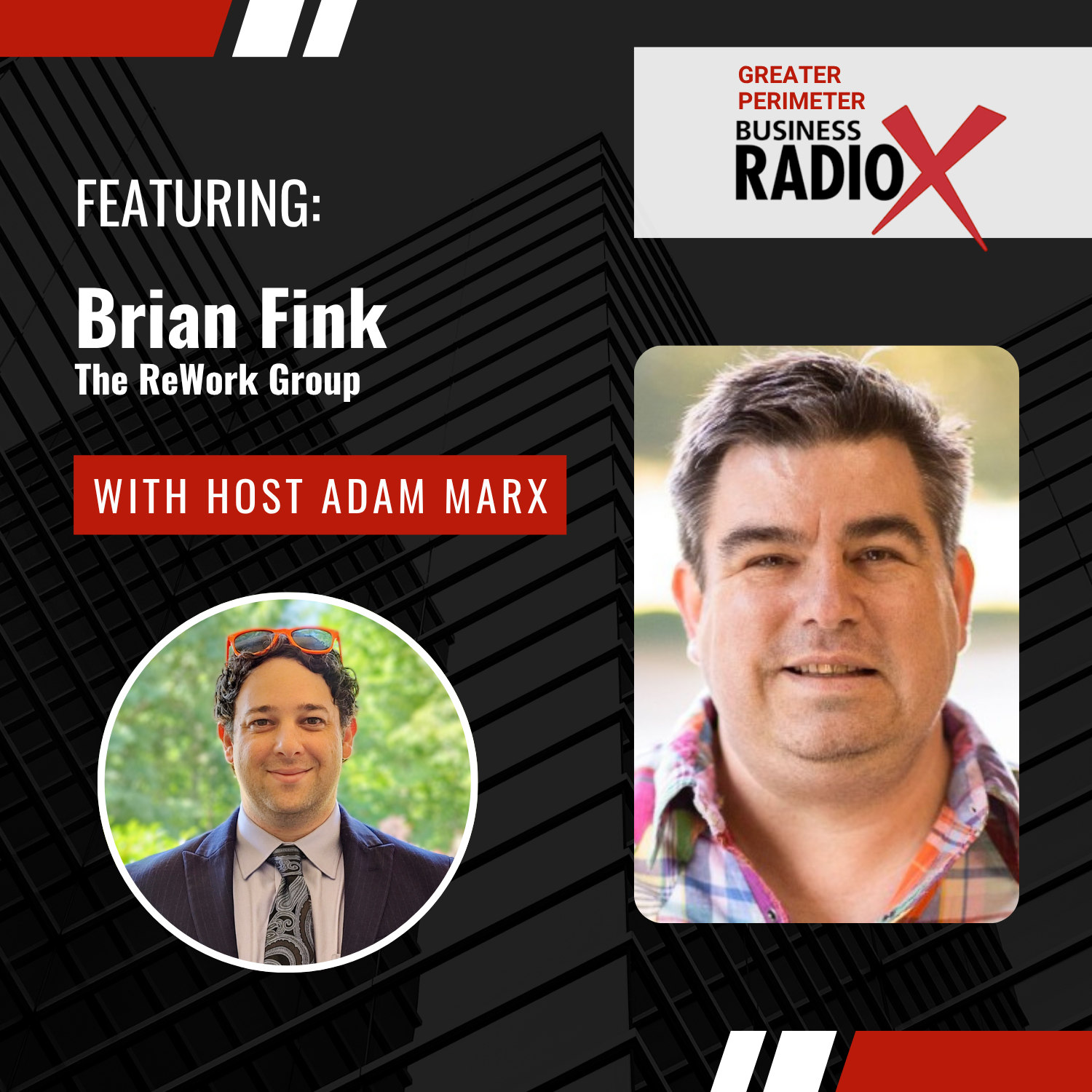

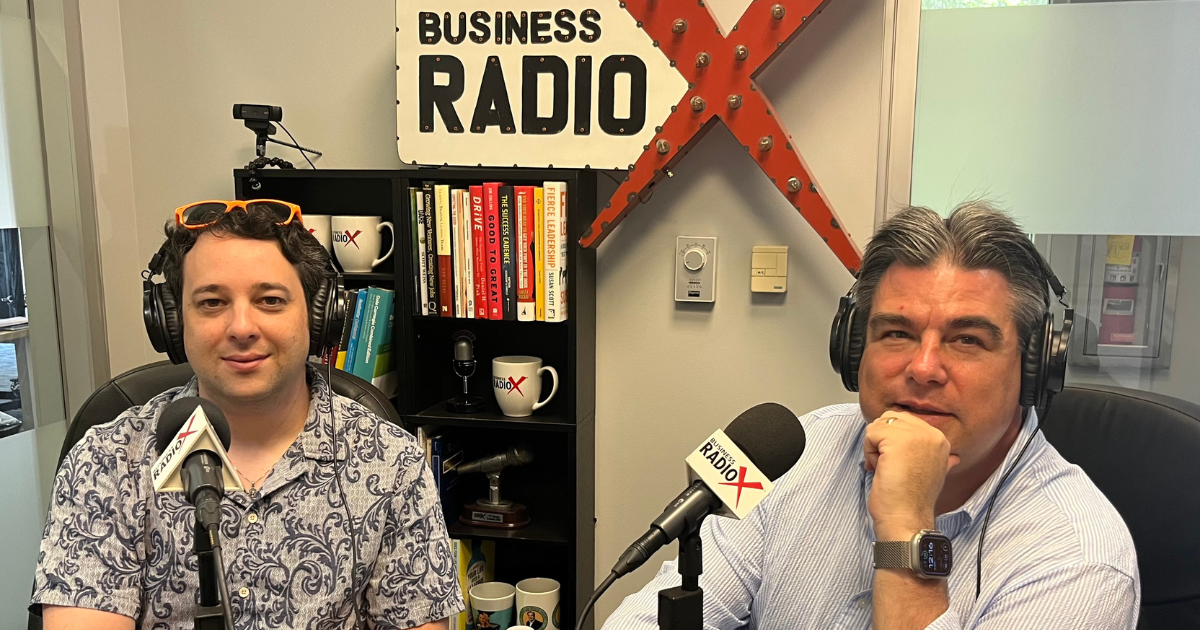
In this episode of Greater Perimeter Business Radio, host Adam Marx speaks with Brian Fink, managing partner at The Rework Group, about talent acquisition and authentic networking. Brian shares how his fraternity recruitment experience at the University of Georgia shaped his recruiting philosophy, emphasizing mission alignment and community building over transactional interactions. Together, they explore the importance of trust, preparation, and genuine relationship-building in both recruiting and networking. Brian highlights that true networking means contributing to communities rather than simply extracting value, closing with the reminder that meaningful connections are about supporting others during their lowest moments.
 Brian Fink is Managing Partner with The ReWork Group. For nearly two decades, he’s helped startups, scale-ups, and global enterprises find the people who build the future.
Whether it’s engineers architecting AI systems, marketers driving growth, or leaders defining culture, Brian specializes in recruiting top-tier talent that doesn’t just fill a seat. They raise the bar.
He’s led searches for companies ranging from early-stage ventures to Fortune 100s, partnering directly with founders, execs, and hiring managers to close hard-to-fill roles. Brian believes great recruiting isn’t just about pipelines and platforms; it’s about business acumen, storytelling, and knowing when to challenge the status quo.
Outside of work, Brian speaks on hiring trends, write irreverent essays about the recruiting world, and moonlights as his daughter’s biggest fan and loudest cheerleader.
Connect with Brian on LinkedIn.
Episode Highlights
- Brian’s background in recruiting and talent acquisition.
- Early experiences in fraternity recruitment and their impact on recruiting skills.
- The importance of authenticity and mission alignment in the recruiting process.
- Building trust and community within organizations.
- Networking as a long-term investment rather than transactional interactions.
- The fragility of trust and the importance of consistent positive interactions.
- The role of deep questioning in understanding hiring needs and organizational problems.
- Aligning personal passions with real problems in the job market.
- The significance of community involvement and giving back in professional settings.
- The ongoing nature of relationship building and networking in business.
About Your Host
 Adam Marx is a networking & leadership consultant, speaker, startup advisor, journalist & the founder of The Zero to One Networker.
Formerly the founder & CEO of music-tech startup Glipple, Inc., and as a writer appearing in Crunchbase News, Startup Grind, Mattermark, & others, Adam draws on more than a decade of experiences in the music & startup tech industries to teach others how to cultivate powerful relationships using strategies of patience, consistency, authenticity, & value creation.
As a networking consultant and speaker, Adam has worked with numerous organizations, including Georgia State University, TechStars Atlanta, the Atlanta Tech Village, ATDC (through Georgia Tech), & Startup Showdown, where he’s advised & mentored founders on how to develop magnetic dialogues & long-term relationships.
Adam’s talks include those given at Georgia Tech and Georgia State University, with a keynote at Emory University’s The Hatchery and as a featured speaker for Atlanta Tech Week 2024.
In addition to advising & consulting, Adam sits on the steering committee for InnovATL, cohosts LinkedIn Local ATL, emceed the 2022 Vermont SHRM State Conference, and was a workshop speaker at South by Southwest (SXSW) 2025.
He is currently working on his forthcoming book.
Connect with Adam on LinkedIn and Instagram and follow Zero to One Networker on LinkedIn and Instagram.
 This transcript is machine transcribed by Sonix.
TRANSCRIPT
Intro: Broadcasting live from the Greater Perimeter. It’s time for Greater Perimeter Business Radio. Now, here’s your host.
Lee Kantor: Today’s episode is brought to you by 0 to 1 networker, helping founders, funders, and operators build the strategic relationships and access that move business forward. For more information, go to 0 to 1 networker.com. Now here’s your host, Adam Marx.
Adam Marx: Wow. Thanks so much, Lee. I’m, I’m, I’m super excited for this because the guest I’m about to bring on, we met, I think back in January, wasn’t it?
Brian Fink: We met back in January and Morgan made that happen.
Adam Marx: That’s right. The Evolve conference. Um, and we’ll talk a little bit about that. But before we jump in, I’m so excited to be here with Brian Fink, the managing partner.
Brian Fink: Managing partner at the Rework Group.
Adam Marx: Yeah That’s right.
Brian Fink: We’re a technology, uh, uh, technology kind of consulting organization. We focus on making sure that individuals and organizations can kind of go next level when they’re hiring for their technical talent and trying to raise that bar.
Adam Marx: So. And so you’ve, you have a background in technology and recruiting and talent acquisition. How did you get started in that space?
Brian Fink: Well, Adam, uh, I am the eternal rush chairman. Damn. Glad to meet you. Um, I, uh, I like to think that everything I needed to know. I either learned in college through classes or everything I needed to know. I learned through my fraternity tops law info at the University of Georgia. Uh, had a really unique opportunity to be a rush chairman three years in a row. Um, I think that it taught me to have very personal conversations with people about what they want to do next and what they want to get out of an organization. Because look, when we’re in college, you know, it’s all about, uh, having a good time. We had the number one GPA on campus, right? That was a big anchor for parents, right? So there are different trade offs that take place in that. And I think that there are a lot of the trade offs that I learned how to emulate or have a conversation about when I was trying to convince a parent to let their child rush our fraternity, or convincing a young man that this would be the next lever to unlock his, uh, his individualism and through a collective action. Um, I think that that really brings together the best of recruiting. And I think that’s where I really got my feet wet. Um, I think that maybe I got my feet wet a little bit in politics, trying to get people on board with different causes. Um, but it really was that fraternity life and fraternity lifestyle trying to figure out what was important to people beyond just going to a party and, um, how we were able to make the next 4 to 5 years of their college career the best 4 to 5 years of their life.
Adam Marx: Well, you know, I love that because, um, I think that there’s a, a pervasive, uh, reputation is sometimes around fraternities, sororities, and similar kinds of organizations, maybe outside the academic sphere, where sometimes people may perceive those, um, clubs or, you know, groups as somewhat exclusionary. But, but and maybe some of them are or are not, but I do, I do love that your perspective on it is really about saying, okay, how do we find the people who are really looking to be a part of, of the message that we’re about and to be inclusive in a way, you know, I think that’s part of recruiting is saying this, this person is going to do really amazing things at this company, or this person has the potential to really click in very well with this team and what they’re working on. Um, how do we get away from like that kind of negative perception and, and look at, look at it through the lens of recruiting as this may not be the right fit in company A, but maybe you’re a rock star.
Brian Fink: Company B you know, Adam, I think it goes back to bringing your authentic self to everything that you do, whether it’s a community, like a fraternity or sorority, or it’s joining an organization, whether it’s public, civic, private that wants to do epic things. It’s about bringing your authentic self and speaking to that message and living your message out loud. I think that sometimes people think that they have to assume one identity to fit into another organization. Yeah. Um, and I think that what we’ve seen over the past six years, really since George Floyd, um, is that regardless of the political context, is that organizations are about retaining great talent.
Adam Marx: Yeah, absolutely.
Brian Fink: And if you want to retain great talent, you have to build some sense of community, you have to build some sense of ownership. And I’m not just talking about the ownership that comes with an equity stake in the organization. You and I are both in startup land. People love the equity stake that they get to have in an organization.
Adam Marx: Absolutely.
Brian Fink: But the reality of it is, is if they’re not married to the mission at the beginning of the journey, they’re not going to be there for the rocket ship ride.
Adam Marx: I love that you use the word mission. And here’s why, because I spend an obscene amount of time thinking about network building, relationship cultivation, partnerships, collaboration, really. I try to expand it out beyond the the typical connotations of the word networking. And I am so obsessed with the word mission and what the connotations of that word are and how they’re different than the connotations of networking. When I look at in front of Anna and you’re going to be polite and Anna is going to be polite and, and magnanimous and like, that’s the shoot your shot, right? Because you’re going to do it as a favor to me. And then if it’s not a 100% fit, you’re going to turn around and say, look, I, I did it, I did it, I.
Brian Fink: Did it on this person.
Adam Marx: Yeah, I did it as a favor to you. But like, maybe don’t do that again because, you know, now we’re making our relationship transactional in nature. And so it’s my job to turn around to that person and say, look, there are mechanisms here. You need to understand this is not about just getting in front of a person or a company just once, because you made your pitch may not land the first time. It’s about understanding how the framework looks so that you can really build out those systems to get in front of those people, those companies consistently, so that you understand how to go fishing. It’s not just give a man a fish, it’s teach a man to fish.
Brian Fink: So Adam, one of the things that I think is unique and is a corollary between what we’re doing, is that we try to operate with trust. Exactly. All right. Trust is a glass jar, and you fill it with little teeny tiny pebbles. Okay. And like, if, if you put the pebbles in there enough times, you build density and you build mass. Unfortunately, if a 15 minute conversation turns into a 20 minute nothingburger, you have launched a giant rock in that jar. That glass jar shatters. Have you ever tried to put a glass jar back together?
Adam Marx: No, I haven’t.
Brian Fink: Because nobody.
Adam Marx: Does. No, because it’s not CSI like.
Brian Fink: Well, this is not Kintsugi, right? Like, that’s not how this works. But like, um, no, you don’t. And then everything’s broken. And where do you start over? Well, you have nowhere to put the rocks. It’s all gone.
Adam Marx: It’s funny because my, my metaphor is the glass castle. It takes forever to build and you smash it and it’s gone in an instant. And this is what what we’re both saying is like, the trust is actually what moves that needle. Because when you are introduced to someone or you understand how to create those access portals, or you end up having that conversation, you end up in a scenario where, yeah, you want to put your best foot forward, but contrary to the shoot your shot mentality, and I understand that mentality. I’m a fan of it, but I think it it gets.
Brian Fink: I’m not a fan of it.
Adam Marx: Well, what I’m gonna say, I’m gonna say I think it gets oversimplified. What I’m a fan of is the, the nature that I think is behind it, which is get into the fabric of the conversation. Don’t stay on the sidelines.
Brian Fink: I agree with that.
Adam Marx: Here’s why I’m going to expand on it is because I think that the shoot your shot mentality, as a phrase, gets over watered down, oversimplified, because when you develop wonderful dialogs, wonderful networks and relationships, you never really have just one shot. You have the ability to go back to a person or an organization or a funding source or a mentor. Over and over and say, hey, look, we we listened. We collected more data. We have a new rock star on the team. We have a new product. We’ve identified a new market segment. You have the ability to show, hey, look, businesses evolve, trajectories go all over the place. And what didn’t work yesterday, you, you listened and collected more feedback and thought more about what the strategy is for tomorrow. It’s all about keeping those doors open. And so that’s why I want people to understand that I’m a fan of the get into the fabric of the conversation portion of that shoot your shot phrasing. But I’m not a fan of the oversimplification that I think a lot of people take away from it.
Brian Fink: All right. So about the simplification, and that’s where I take issue with this. Shoot your shot. All right. Who said shoot your shot? Was it Jordan?
Adam Marx: I have no idea.
Brian Fink: No no no. I’m going somewhere with this. Was it. Jordan. Was it Kobe? Was it Drake? Who was it about? Shoot your shot, right? Was it Eminem? Okay. Was it Jay-Z? All these people? Was it was it Taylor Swift? All these people practice relentlessly, right? So when it comes time for them to shoot their shot, it’s not an unnatural conversation that they haven’t prepared for. It’s a moment in time. Like you said, it’s a building block. It’s a Lego. It’s building that glass castle. Right? So my problem with shoot your shot is the fact that people are like dust off my shoulders. I’m not really going to prepare. I wore a good suit. Why’d you wear a good suit? Were you planning to do something in it? What? What were you planning to do? What? What’s going on here? Right. And it goes back to the same thing as building a community. If you’re going to a happy hour and your sole purpose is to collect business cards, you’re going to get a bunch of business cards, man. Congratulations. Business cards Discards everywhere confetti. But if you’re going to a networking event and you’re walking in with the intention to build one relationship with one person and share your vision and share your purpose, you won’t fail.
Adam Marx: And you and it’s about repetition, consistency. Like any of those athletes, any of those artists, they are spending an insane amount of time developing their talent, developing their craft. And that is something that gets left out of the the conversation when it comes to, I think, talent acquisition and recruiting and network cultivation, all this kind of stuff, it doesn’t just like boom happen just because you need it today. No, it’s it is, it’s the preparation and laying the groundwork. You know, it’s, there’s a lot that goes into the behind the scenes that affects the outcome like anything in life. So so let’s bring this back then to like, okay, a company comes to you and says, hey, Brian, we need to fill this position. Let’s say it’s a sales position or I don’t know.
Brian Fink: Technologist.
Adam Marx: Technologist or a finance position, right? How does that process work? What are some of the things that are kind of behind the curtain that are critically important for listeners to actually know about in that process, to make it the most successful for themselves?
Brian Fink: Just because you have a LinkedIn license doesn’t make you a recruiter, and it doesn’t make you a networker, it requires you to ask a deep question, what is the problem that we’re trying to solve? And why can’t you solve it with the people that are currently on your team? Mhm. Okay. That’s going to unfold a few things. It’s going to unfold. Yeah. What the problem is, that’s the surface level. It’s going to go one degree deeper and it’s going to say ask the question what’s wrong or what’s missing in the organization today that I can add that I can be a value add to. Yes, I’m going to solve this problem over here. But what happens 18 months down the line? Let’s have that conversation. So when I’m having a conversation with Mr. Client, that is the question I’m asking. Because if they’ve got somebody in their organization who can already solve the problem done and dusted, go about your way. What you need is you need to backfill for that individual. You don’t need a new holistic role. And if you’re a career changer or you’re making a shift in your career, what problem do you deeply want to solve? You talked about green tech. I know that’s important to you. I know you went to a conference about that five days ago over in Birmingham, right? Mhm. Okay. How are you helping people solve that problem? You’re doing X, Y, and Z. But if there is nobody who’s capitalizing upon that or nobody who says that’s a problem? What? What are you doing? You’re just burning calories. You’re like, running on a treadmill. No offense to running on a treadmill. I do it at Orangetheory. Shout out to Coach Hannah. I love running on my treadmill.
Adam Marx: So given that very focused mindset that you take to take to the office when you are talking to a prospective client company, potential job candidate, etc., right. How does that then interact with my consistent message of go build networks? And not just that, it should be the job potential job candidates, people looking for jobs, you know, building a network because they want to get a job. I’m a very big proponent of, hey, big companies. This is an investment in building out your organizational infrastructure and understanding so that your whole company, from the sales team down to over to the technology, over to the copy editing. Understand that the very best talent acquisition and retention often comes from just conversations with people and being aware of people who are out there who may be right, what you need, exactly what you need, maybe in the market for a change, or maybe in the market for something that you’re working on. What do you say to a company that may have the mindset of, okay, you place person X, Y, Z with us, we’re done building our network. We’re now just 100% focused on sales.
Brian Fink: I asked this question all the time, what are you putting in? Okay, it’s not about what you’re extracting. Like sales is an extraction business, okay? It’s what you’re putting in. Um, I go to, uh, there’s a Slack channel that’s called, and there’s a community that’s called the tech talk Taqueria, and it is specifically for Hispanic and Latin professionals. Guess what? I’m not Hispanic. I’m not. I know I’m barely a tech professional. Right? The reality away from that joke is when I go to that community, I open up my office hours, my calendars to help people practice for their interview as they’re making their next career move. I do that Friday afternoons from 1 to 4 p.m. eastern. If you’re a career changer and you need help coaching, let me know. But that’s about building community. It’s putting something in, putting something in. So if you’re a sales organization, are you going into the city of Atlanta? Are you putting into public gardens? Are you building that or are you just putting your name on a sheet that says donated by. Donated by. That’s powerful. But showing up as your authentic self, putting those messages into work, putting your hands in the soil, putting your hand in. Not putting your hand out unless you’re going to help lift somebody up. Yeah, that’s that’s building community. The other sales, it’s extraction.
Adam Marx: Well, and I, I just, and I, I, I mean, we’re already running low on time, but I will say this, one of the things that I think about just, it’s like a daily obsession of mine is this kind of how networks spider web out and you don’t know, because I can track this conversation back to the relationship and dialog and friendship I’ve developed with Anna, which I can track back now a couple of years, which I can track back to, you know, LinkedIn local, which changed the branding on that because LinkedIn changed their rules. But looking back, all of the stuff here. And so now knowing a lot of people in the recruiting space, people who she brought to evolve, um, who maybe tangentially Connected to recruiting can all be tracked back years. It’s about continuing the conversation. It’s not like when she and I had our first dialog, it was, oh, okay, I’m having this conversation because I want to talk to Brian one day and have him on my show one day. Right. Which I. Which is, is just kind of a ridiculous concept. It’s you don’t know who you don’t know. And this is something that I think that I, I, I’m thrilled when companies of any size, whether it’s four people or 400 people, when the the company recognizes the more boots on the ground we have, the more conversations we can open up, the more conversations we can open up, the greater we can scale a network of access and a network of different voices.
Brian Fink: I agree with that wholeheartedly. I would say don’t hoard what you think you have. Give away what you think you got.
Adam Marx: And you’ll end up finding people who will absolutely value.
Brian Fink: It and run through walls for you. Yeah. Or want to run with you as you try to run through walls. It’s I.
Adam Marx: I don’t think there’s any better way to, to possibly close this conversation. I mean, the time just flew by.
Brian Fink: Oh, yeah. Yeah yeah yeah. Awesome.
Adam Marx: So we, we, we, we real quick.
Brian Fink: Yeah. For those people who are listening about the Evolve conference, Adam and I met at, it’s a conference for HR and HR and to professionals to exchange ideas. And what you’ve just listened to is an exchange between two people who come from two different walks of life. And I can’t think of a better way to amplify the message at evolve, to help people rise from where they are to where they could be. So, Anna, thank you for putting Adam on my radar. If you’re listening to this in the future on a on a rainy day in Atlanta, I want you to feel some energy.
Adam Marx: Well, and that’s, I mean, that’s just a perfect example because you you did the MC work right for the for the conference? And I did a speaking slot and it was filled with a ridiculous amount of talent and people with different life experiences and perspectives. And it’s just one. And it just it, it is marketed as far as I understand, like, you know, to professionals and recruiting, but just in that niche, the sheer amount of talent and the people who know other people staggering. And, and, and for me is like, I don’t consider myself necessarily a to.
Brian Fink: Your talent adjacent.
Adam Marx: I’ll tell you, I’m a talent, Jason, but this is a great example. I came out of it with so many wonderful friendships and connections and, uh, so yeah, shout out to Anna and Evolve conference and we’ll have to do that again next year. Um, so as we wrap up, tell everyone kind of where they can go find you, support you, what you’re working on, etcetera, etcetera.
Brian Fink: Okay. So hey, I’m Brian Fink, uh, you can find me on LinkedIn as Brian Fink. I will be the first person that comes up, right? Um, number two, you can find me on all major social networks and the peloton at the Brian Fink. And if you want a glimpse into what I’m thinking about and the forward motion that you can take every day to be a better person, go on forward motion D motion at Substack and check me out. And, uh, thanks to Adam. I’ve really enjoyed this conversation. I’ve enjoyed the renewed purpose of making sure that I’m making those viable connections and a viable connection. I’ll leave you with this thought. It’s not what the connection can do for you today, or what they can do for you tomorrow, but what you can do to be in their corner when they’re down in their lowest moment.
Adam Marx: I’m not even going to try and follow that. All right, Brian, thank you so much for being here.
Brian Fink: No no no no no.
Adam Marx: No no no no.















