
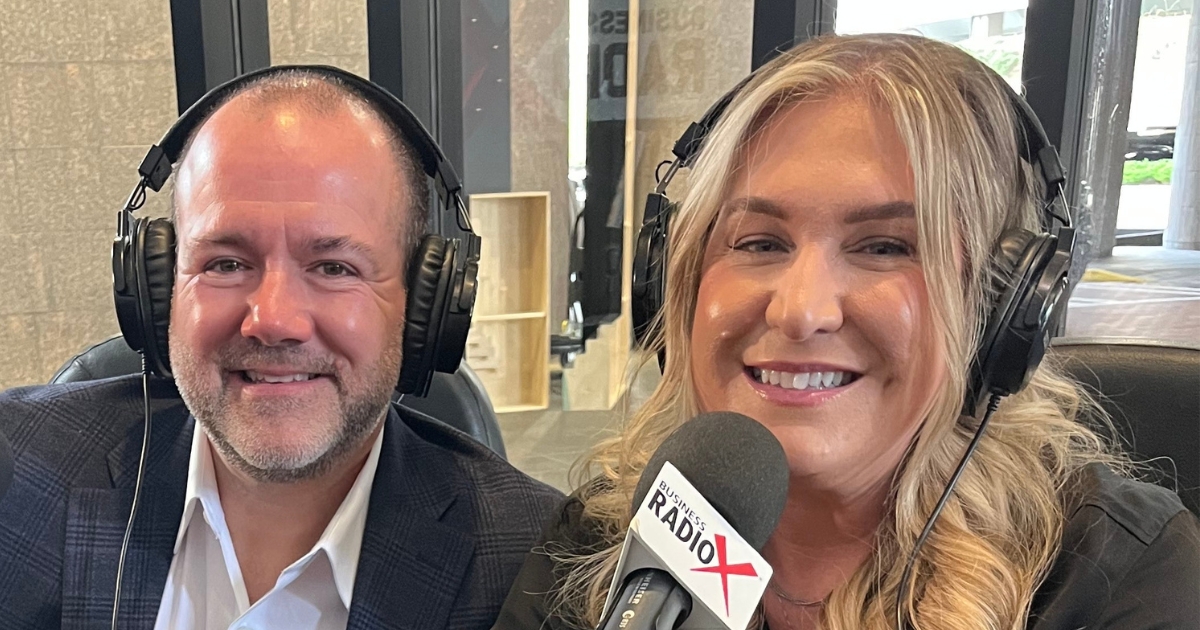
In this episode of Chamber Spotlight, Adam Forrand, President and CEO of the Greater Perimeter Chamber, and Bernadette Pannier, Director of Strategic Membership Investment, discuss the merger of the Dunwoody and Sandy Springs Perimeter Chambers into the Greater Perimeter Chamber. Adam explains the decade-long rationale for the unification, emphasizing a stronger network and better resources for businesses. Bernadette highlights the Chamber’s support for both small and large enterprises, focusing on personalized assistance, community engagement, and fostering connections. The merger aims to create a thriving business ecosystem, advocating for local businesses and encouraging community involvement.
 Adam Forrand, President of the Greater Perimeter Chamber, is a master of relationships. It’s a skill that enables him to sit down at an initial client meeting and come away with a clear sense of who everyone is, where they’re coming from, and what their goals are.
It’s a skill that helps him use that knowledge to map out ways that various and often competing needs just might fit together in a solution.
And it’s a skill that mixes well with Adam’s abundance of creative energy, leading to innovative ideas to meet those needs. And with Adam, an unrepentant optimist who says “opportunity” a lot, there is always a solution. Always.
Connect with Adam on LinkedIn.
 Bernadette Pannier is the Director of Strategic Membership Investment at the Greater Perimeter Chamber.
Connect with Bernadette on LinkedIn and follow the Greater Perimeter Chamber on Instagram.
 This transcript is machine transcribed by Sonix
TRANSCRIPT
Intro: Broadcasting live from the Greater Perimeter. It’s time for Greater Perimeter Chamber Spotlight. Now. Here’s your host.
Lee Kantor: Lee Kantor here. Another episode of Chamber Spotlight. So excited to be talking to some of the leadership team at the Greater Perimeter Chamber. I got Adam Forrand President and CEO and Bernadette Pannier, who is the Director of Strategic Membership Investment. Welcome.
Adam Forrand: Hey, Lee.
Bernadette Pannier: Hey hey.
Lee Kantor: Hey, hey.
Lee Kantor: So I’m going to just throw this out to the room. Let’s talk a little bit about kind of this merger that happened, the coming together of two chambers into the new Greater Perimeter chamber.
Adam Forrand: Yes. We have taken what has been a long conversation, a long period spanning a decade or more, honestly, of two municipally focused chambers, the Dunwoody Perimeter Chamber and the Sandy Springs Perimeter Chamber, and in service to our members to scale and to grow, to provide a greater, stronger network, more resources to serve our members. We have unified into a single regional chamber.
Lee Kantor: So now can you talk about the why behind it? Like there’s city chambers all over the place, but this kind of a regional chamber is there’s a transition involved. Right now. It’s thinking from city to region. Can you talk about the why behind it? Yeah.
Adam Forrand: The why for us is unique in contextualized to this geography as well. When you think of chambers and other parts of the nation, other communities, there’s good reason why a city or a regional chamber would be formed in terms of a boundaries or service area. In our particular case, the central perimeter marketplace has been known nationally for years and years before cityhood for our two respective cities. So as an economy, as a marketplace. There’s there’s maturity. There is equity in the perimeter. And given the fact that we have a significant amount of fortune 500 companies based here, it is a we are a known community, a known business community. And cityhood provided a great opportunity for us to rally around ensuring that our futures within our cities are directed by the residents that are that are managed appropriately. Each city wanted to have a chamber for themselves as well, which is understandable. But as cityhood and those services to the community mature, the service to the business community needed to mature as well. And so this unification of what were two city focused chambers into a more regional chamber that reflects a region that is well recognized nationally, just made sense.
Lee Kantor: And Bernadette, in your role, can you talk about how this region, how do you see it, and what do you see as kind of the best way to serve it for me.
Bernadette Pannier: When I moved here a little over ten years ago, Sandy Springs was my home. So it’s it’s got a special place in my heart because it’s where I started here. It’s what formed my love for this area in Georgia. And coming here and seeing all of the businesses that have moved here and the brick and mortars that are coming back to life, the new developments that are in the area and the dedication of the city management. You can tell that this area is really thriving. And when you hear stories from the individual mayors about how Sandy Springs has less than 3% retail space available at this time for rentals and purchase, that’s a big deal. It’s there’s a reason why businesses like Mercedes Benz are here. They’re it’s thriving. It’s fun, it’s young, it’s inviting. And I’m really excited about the future of what this area is going to be like. You know, it’s it used to be just known for the mall and now it’s known so much more.
Lee Kantor: Now, how, uh, the the region is, is so diverse in terms of the types of businesses here. Like you mentioned, Mercedes Benz, there’s you know, I don’t know how many, but lots of fortune 500 headquarters are here. There’s a lot of kind of enterprise level organizations that hire, you know, that employ a lot of people. They serve a global marketplace, but they’re based here. But then you have, like you mentioned, when there’s only 3% space left, there’s lots of mom and pop, you know, people out there grinding, just trying to, you know, you know, run a restaurant or a hardware store or a hair salon. So how do you create value for each of them and encourage each of those constituencies to become part of the chamber?
Bernadette Pannier: I think the main thing is eyes on them. That assistance that we give for them to be able to have that additional set of eyes, that additional marketing, that additional advertising, that additional support really makes a difference. There is a brand new, uh, taqueria that’s opening in the area here. It’s a family owned restaurant. This isn’t their first restaurant that they’ve owned or opened, but as they’ve gone through the process, the daughters reached out a few times. And every now and then, I think it’s just to be able to talk it out to me and know that she can do that. She can pick up the phone and say, okay, we’re doing inspections tomorrow, and I’m really nervous and I’m not really sure about this. And for me to be able to listen to her and say, do you need me to come? Do you want me to just come hold your hand? Those are the things that I think that they don’t necessarily get in other areas, or from other businesses or membership environments. Right. The chamber is a place that we want you to come for the support that you need, no matter the support. If you’re having problems with your sign getting approved, I can’t necessarily say the phone call I’m going to make is going to help that process happen, but maybe I can find out why it’s sitting on somebody’s desk. Right.
Lee Kantor: It’s not going to hurt.
Bernadette Pannier: It’s not going to hurt for me to make a phone call or send a text message on your behalf as the owner of that restaurant, and if it’s me using you or the chamber, using you as a caterer for your restaurant, or putting an event in your restaurant or your place of business, or if it’s you needing additional education. A lot of small business owners restaurants specifically fail because they got into the industry with the education that they didn’t have. And for us, we come from a place of education. So we specifically curate these leadership programs to make sure that you are going to have the foundation and the chaptered information that you need to be successful.
Lee Kantor: So what are some of the changes as it turns into a regional chamber from individual city chambers? When it comes to maybe some of the benefits to the members, is there going to be more education? Is there going to be more kind of mixers, networkers like, what’s your vision of how you see kind of the value to each of the membership, no matter what level they are. Um.
Adam Forrand: It’s about scale. Uh, is definitely for us that the stronger network, the bigger network, the the accumulation and aggregation of partners and resources are two chambers had complementary sets of of networks and resources so that when we combine them, both memberships got the benefit of, of that scale and that growth. Ultimately, when we talk about scale and growth and stronger networks and stronger resources, it also acknowledges the fact that doing business in DeKalb County in Dunwoody is different than doing business in Fulton and Sandy Springs as well. And so we are also here to help navigate the nuanced differences between the two as well, recognizing that in these communities, they are unique and they are different. We’re here to celebrate them and to also, uh, navigate and operate with them within them as well. And so whether you’re a small business just starting out, whether you are a large global enterprise as well, where you are rooted matters and it is our job to know how and where that matter meets the rubber, where the rubber meets the road on those matters. Right.
Lee Kantor: So now, Bernadette, when you’re going and talking to the the different constituents, kind of give me your elevator pitch for maybe a mom and pop versus an elevator pitch for enterprise.
Bernadette Pannier: For the smaller businesses, the scaling businesses. My conversation normally starts with the what do you feel like you’re missing? Where do you feel like you need the support? Those usually answer a lot of the questions. For me, I tend to do a lot more listening than I do asking questions when I’m talking to the smaller retail space owners and things like that in the area, because they all need something different. Some of them just want a ribbon cutting. That’s all they want. They want to celebrate this huge moment that to them, is just as important as their baby gender reveal or their baby shower. Right. So sometimes that’s just what it is. They come to me and say, listen, I just want the ribbon cutting. That’s all I really want. That’s fine. Absolutely. I will come and celebrate anything you want me to celebrate. Sometimes it’s. I really do need some help with advertising. I need some help with traffic. Well, we have availability on our website for you to be able to put that information on our hot deals page, on our job boards, on our calendar, so that people can see where you’re located and what you’re doing. Other times, it’s about being part of the ecosystem, and that usually drives my conversation when I’m talking to larger companies. If I’m talking to those companies that are in that 5 million and above, it’s about what are you doing for your community? You moved in here.
Bernadette Pannier: You built this beautiful building. You put 500 extra bodies into our traffic. And now what are you doing? Have you invested in the local nonprofits? Have you figured out how to plant trees. Are you trying to drive additional things back to the community? Whatever you do as a business, what are you giving back? Are you going into the schools or are you doing the things that you need to do? Are you dropping off food for our police and for our fire departments? So a lot of times when I talk to the larger companies, it’s about being part of the ecosystem. It’s about being part of the bigger conversation about where the sidewalks are going and where Marta is making stops and how the busses are running. Those are the larger conversations they need to be in, because they make more of an investment in the city financially than the smaller companies will. So it’s about making them understand why we’re important and why we can help drive legislation forward in the area, and that these two cities are sisters. They touch in a bunch of different ways, and most companies don’t sit there and say, I only want to sell in Sandy Springs. I only want to sell in Dunwoody. I don’t want to sell in the other city. They want to be able to bring traffic from one to the other.
Lee Kantor: Now, when you’re talking to them, um. And, Adam, correct me if I’m wrong. When an enterprise level organization joins the chamber, all their everybody joins the chamber, right? It’s not just the senior leadership, right?
Adam Forrand: It is not for all of our members, the businesses, the member, but the representatives. All the employees are members as well. And so whether it is the small, family owned business, we want to be sure that every member of that family in that business has the opportunity and knows that that all services, all supports, all activities, all programs, all events are for every single one of them. And so we start talking about, uh, we talked about this yesterday actually, how depending regardless of the size of the enterprise, there will be salespeople, business development people who would be the best, uh, participants to engage in some of our sales and marketing supports and services. If you’re trying to advance young professionals, we’ve got programs for them. If you’ve got finance professionals, we’re hosting a webinar next week about forecasting in uncertain times, right. The finance and accounting professionals on the team need to know that, hey, we’ve got an additional opportunity for you to learn from another expert, perhaps outside of your sector or your domain or even your own organization, to give you some fresh perspective. And so we’re working hard to identify who our target audiences are, how we tag them within our membership. Because the whole membership within the whole organization, every individual in that organization who is a member can benefit from the things that we do.
Lee Kantor: Membership has its benefits. Huh? It does.
Adam Forrand: Indeed.
Lee Kantor: Now, um, can these enterprise level organizations connect with you and then make recommendations like, hey, it would be great if we had this type of, uh, you know, education Available. Are you open to having those kind of conversations?
Adam Forrand: Absolutely. We’ve had a smaller member, not necessarily a large global enterprise, come to us with his particular expertise in sustainability, with a particular focus that he wants to ensure that even smaller businesses can operate more efficiently, more effectively through sustainable practices. And so he takes his big corporate experience. Even though he is the owner operator of Hounds Town Sandy Springs. His background has ensured that his business operates sustainably and incredibly economically efficient, that he wants to champion that for fellow members as well. And so thus was born our new focus on sustainability and sustainability resources thanks to Kevin Brown. And so those suggestions, those ideas, particularly when when brought with action and support, are always welcome.
Lee Kantor: Now, is there any story you can share? I know it’s a new kind of Uh, coming together. But maybe in your experience in the chamber, working in the chambers, where a success story where a member came to you, maybe at one size and then, you know, joined the chamber and then that helped fuel their growth?
Adam Forrand: Well, we had at our orientation just a couple of weeks ago, we had a solopreneur single employee organization, a bookkeeper who had been with us socially for a couple events and was waiting for the New Year to make that investment in her membership, uh, and came to her first official orientation as a member and stood up in the middle of the event and said, I just want everyone to know that, because now that I was on the directory of members that I picked up two new clients, uh, just because of the trust that was conveyed through membership. And so in that transition from nonmember to member, and her recognizing that that membership does have its benefits and the trust that is parlayed through membership as an Active Now member on our roster earned her two new clients. Um, just by joining. Um, and so, you know, she was over the moon. She was thrilled. It was an immediate ROI for her. Um, and, you know, whether it’s a single employee solopreneur opportunity or if we’re talking about exponential growth versus incremental growth for some of our members, um, we hear those stories often and we celebrate them. And it’s a reminder to us of the of the critical nature of the work that we do for our members and for the business community.
Lee Kantor: Now, does the chamber play a role in attracting businesses to the region? Is that part of your mission?
Adam Forrand: It is. We play a role with our partners in economic development at our cities and in the region. Uh, and that role may change from time to time based upon the opportunity that comes our way. But our job is to as Bernadette spoke to, is to ensure that there’s perhaps an expectation that this business would be, uh, rooted in our community and that we, as a chamber, will help them get grounded in a community that if they choose to land and locate and to expand in the perimeter region, that we are a partner to that as well. But the expectation is that you’ll also be involved, uh, that there’ll be, uh, that they’ll be engagement, they’ll be involvement, that you will understand better the needs of our community, and perhaps the role that that company can play and help solving some of those challenges and issues as well. Right.
Lee Kantor: This isn’t something that you just pay your dues and you’re done. Like, in order for this chamber to really thrive, it requires that there is involvement and engagement. This this can’t just be, you know, a donation, that you just do it one time. You’re finished.
Adam Forrand: No, uh, in community, this is all relationship based. This is all relationship based. And particularly for our larger employers too. What’s at stake for them is not just their consumer brand or their service brand. Right. But but as an employer, if they have growth plans and they need to hire, um, and have have projections for their growth and know that the best talent is within the community that they reside. Um, how they show up in community also ensures that that trust is conveyed, that they’re here for the long run and for the right reasons as well.
Lee Kantor: Right. And and I’m sure all of these companies on their mission statement, they mentioned the importance of community.
Adam Forrand: Indeed.
Lee Kantor: So it’s time to walk the walk.
Adam Forrand: Absolutely.
Adam Forrand: And that’s what chambers as institutions within communities has always been about. Right. Um, is rooted in community for the community, with the community.
Lee Kantor: So now what’s something as you look forward into the year, in the coming years? What are what what would have to occur for you all to be high fiving? Like, this was a great year.
Adam Forrand: Well, as a membership organization. It’s all about growing our membership rank. The role, the roster. There is power in numbers, in scale and growth. Um, while we talk about expanding our capacity and our network and our resources, we also ask our members to show up not just for themselves, but for other members as well. And so with more members comes more resources and and better support in community. And so membership, organization, membership growth at the end of this year, if we have had significant growth like we expect to have in more having more members join us, then that is a that is a double high five. That’s a high ten right there. That’s uh, those are Grand Slams that were born out of singles and doubles and triples. Right. And so that’s what we’re working on.
Lee Kantor: So the metric that matters is membership.
Adam Forrand: Membership. We’re a membership organization. We’re a membership. Uh, we are we’re a business advocacy organization for our members. We are nothing without our members. And so the more members, the better.
Lee Kantor: And, Bernadette, for you, that’s obviously you’re one of the people that are kind of charged with that mission here.
Bernadette Pannier: So that’s a lot of my role. Right. So when we were when Adam and I sat down and started talking about this and we started talking about the growth opportunity in the area, it’s not necessarily just about, you know, signing up members and walking out the door. For me, I wanted to have a bigger conversation. I want to have a better conversation about membership and what that means to the members themselves. The chamber is, Adam said, is a trusted component of every community. And so I wanted to make sure that when you’ve made that investment, no matter the investment that you make, because every investment, every penny we spend is really expensive and it feels it’s an emotional component of your business. I want to make sure, though, that you’re getting the most out of it. So as you come into the chamber, are you coming to the right events? Let’s have a conversation about where your ideal client sits. If you’re telling me you need to be speaking to CFOs, let’s make sure you’re in the room with CFOs. If you’re telling me you’re a boutique and you sell mother of the bride dresses, let’s make sure that you’re around the women that are the mother of bride age. I don’t even know what that age is anymore. But let’s make sure that you’re in the room with them. Let’s make sure that maybe, potentially, you spend a little money on that event and put up a table and show everybody what you sell, or you pay a little bit more and speak in front of that crowd. So I want to make sure that these members aren’t just stamping a stamp on an envelope and throwing a check in the mail once a year. I want to make sure that they’re really looking at their spending and putting it where it makes sense, where it can make impact, and where they can develop a great footprint here in the community so that people say I shop at so and so because they show up for me and those things are important.
Bernadette Pannier: And I, I think we all learned a pretty valuable lesson a few years ago about the importance of small business and communities and how we can support each other. That is the foundation of our country that makes or breaks us as a country. We don’t necessarily thrive and survive on the top 100 businesses. They get our day to day through, but at the end of the day, the I can spend $100 and a very large retail space or $100 in a boutique. I’m making the difference in that boutique, because that boutique owner is going to be able to put food on their table, to turn on their lights and to show up the next day, because I shopped there instead. So shopping local, being involved in local community, those are huge drivers for me and I want the higher end companies the fortune 100, the fortune 500, to come into our community and help us thrive. And when they’re looking at their employees, knowing that they’re doing those things in the communities, making sure that the apartments are built in the right places, transportation is done correctly. Sidewalks are correct. Crosswalks are correct that we have all of the plug ins that we need for electric vehicles. That’s what they’re there for because they have a voice at the table amongst our legislations because they listen to them. But there’s impact. It’s like a butterfly wing. Everything makes a little bit of a ripple as you go through.
Lee Kantor: Effect is real.
Lee Kantor: Now for you, you’re looking to have more conversations with business leaders of businesses of all sizes just to have this conversation, to see where you can help them and where they can plug in to help the community.
Bernadette Pannier: Absolutely. If somebody comes to me and says, hey, I just want to be able to get my voice heard and I need to be on a podcast. Well, let’s have a better conversation. If somebody says, I’ve got a book coming out in September. I need to know how to advertise it. Great. Let’s talk about it. Um, one of my my favorite things to say is some of my best recommendations for the members that we need inside the chamber come for our other members. So as we roll into I can’t believe we’re saying this spring and summer, right. I’ve had members that have come up to me and been like, well, my pool guy quit. I need a new pool guy, and I only use people that are involved in the chamber. So then I go look for a pool guy, right? Or I need a bounce house for my kid’s party this summer I found a bounce house community. So it’s sometimes it’s just those little conversations. The members come to me and say, I need X, Y, and Z and there isn’t a member in the chamber. And maybe I’ve never thought about that person being a member. And I’m like, well, let me go find that company for you. So a lot of those conversations come. The recommendations come from the members, right? It’s their needs. They want to drink the champagne, just like we want to drink the champagne. So they don’t necessarily want to look outside the directory. They just want to go to the directory, put in what they’re looking for and use. Use the person that they know that’s already part of their community. So that’s really fun for me.
Lee Kantor: So if somebody wants to learn more, have more substantive conversation with somebody on the team, what’s the best way to connect?
Bernadette Pannier: I would say my my email and my cell phone is on the website. You could definitely call or email us. Um, I’m on LinkedIn and my contact information is on LinkedIn as well. So definitely look for us there. Follow us on our social medias. We’re building out our Instagram’s, our Facebook’s, and we’re very excited about all the things that we’re posting. So those would be our recommendations I think.
Adam Forrand: Greater Perimeter Chamber. Com and in the show notes too.
Lee Kantor: Good stuff. Greater Perimeter Chamber. Com A lot of big things happening. So uh join now. All right. This is Lee Kantor. We will see you all next time on Greater Perimeter Chamber radio.














