

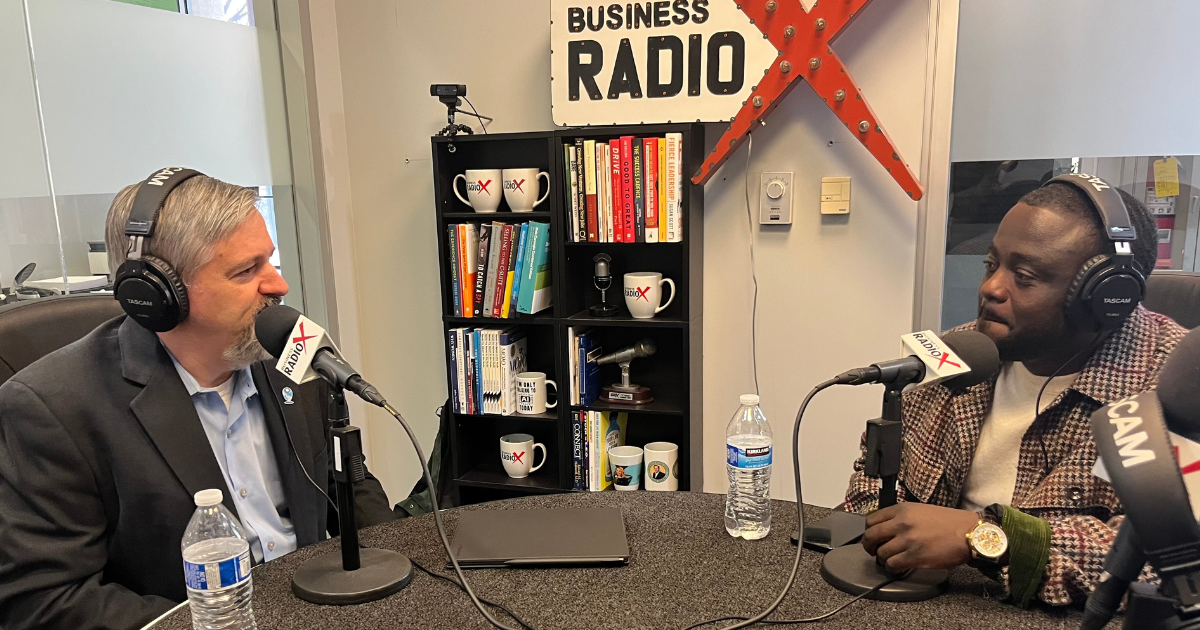
In this episode of Greater Perimeter Business Radio, Erik Boemanns interviews Marcus Azeh, founder of Lavni—a startup improving mental health care access for Medicaid clients. Marcus discusses Lavni’s mission to connect underserved patients with therapists, overcoming compliance and payment barriers. He shares insights on building a scalable platform, the company’s growth, and the importance of data-driven measurement. Marcus also offers advice to fellow founders about resilience, self-care, and staying mission-focused. The episode highlights Lavni’s impact, future vision, and commitment to transforming mental health care for vulnerable communities.
 Marcus Azeh is driven by a passion to bridge the gap between individuals seeking mental health support and the dedicated therapists who provide it.
Lavni is a groundbreaking platform designed to simplify and streamline the process of finding and connecting with therapists who accept Medicaid.
We understand the challenges faced by those needing mental health services and the therapists committed to providing them, and we are here to make that connection seamless.
Connect with Marcus on LinkedIn.
Episode Highlights
- Access to mental health care for underserved communities, particularly Medicaid clients.
- Challenges faced by Medicaid patients in finding therapists due to compliance and payment issues.
- The role of Lavni in simplifying the process for clients, providers, and payers.
- The platform’s impact on therapy session facilitation and client support.
- Administrative burdens on therapists working with Medicaid clients and how Lavni addresses these.
- The business model of Lavni as an intermediary among payers, providers, and clients.
- Growth and traction of Lavni since its launch, including session statistics and clinician involvement.
- Future vision for expanding Lavni’s reach to serve more Medicaid clients nationwide.
- Importance of data measurement and key performance indicators in startup development.
- Personal insights and advice for aspiring entrepreneurs, emphasizing self-care and perseverance.
About Your Host
 Erik Boemanns is a technology executive and lawyer. His background covers many aspects of technology, from infrastructure to software development.
He combines this with a “second career” as a lawyer into a world of cybersecurity, governance, risk, compliance, and privacy (GRC-P).
His time in a variety of companies, industries, and careers brings a unique perspective on leadership, helping, technology problem solving and implementing compliance.
Connect with Erik on LinkedIn, Substack and Medium.
 This transcript is machine transcribed by Sonix
TRANSCRIPT
Intro: Broadcasting live from the Greater Perimeter. It’s time for Greater Perimeter Business Radio. Now here’s your host.
Lee Kantor: This episode of Greater Perimeter Business Radio is brought to you by Mirability. With their new compliance XO service taking your IT risk to it reward. Now here’s your host, Erik Boemanns.
Erik Boemanns: Hello, everybody. It’s great to be here again. And today I’ve got a great guest. His name is Marcus Azeh and he is the founder of Lavni. Let’s just dive right in. Maybe give me a little bit of background about yourself and then we’ll go from there.
Marcus Azeh: Oh, yeah. Um. It’s good. So, um, I’m Marcus. I’m a data scientist by trade. I started off in finance manufacturing and then got into healthcare. So, yeah, that’s that’s it. Pretty much on a high level.
Erik Boemanns: Okay. And so obviously got a start up Lavni, right. Yep. So and that’s Lavni, correct. Um but what what problem did you see that really made you start that. What were you trying to solve.
Marcus Azeh: Yeah yeah absolutely. So mental health is definitely one of the biggest problems we have right now. Right. And access to getting care is even more of a crisis if you have Medicaid, for example, if you have Blue Cross Blue Shield, you can get online, find a therapist that will see you schedule an appointment. That process is easy. Availability is there. Most therapists take that insurance, but if you have Medicaid, your chances of finding that provider is hard. Reason why is most therapists don’t accept Medicaid. It’s too much compliance. The pay cycles are longer, so it’s hard to build a business doing that. So they you know, obviously you want to earn a living doing what they love, choose to see commercial clients because it’s a lot easier to do that in most online platforms. Do you know commercial clients? So leaving approximately 27 million people nationwide without access to care, right? So that’s where we came in. I met my co-founder. You know, she introduced me to this problem, I wasn’t familiar. So how could we fix it? You know, she she’s been doing this for a decade, and we’re just trying to replicate what she did into a scalable fashion. So a lot more people get access to care.
Erik Boemanns: And so you see a lot more people like, who is who are you, I guess, who is your focus? Who are you trying to reach with this?
Marcus Azeh: Absolutely. So specifically who we’re targeting clients with Medicaid, you know, underserved communities that typically haven’t had a chance to find a therapist because it’s so hard on our platform, it’s easy. You get in there. So, for example, when two states right now, when Georgia, when North Carolina and South Carolina, three states got South Carolina, I just called them the Carolinas. So you get on the platform, tells your state, maybe fill out a couple of concerns, get a curated list of therapists that will show up right and match those concerns that accept your your insurance. You’re able to schedule an appointment. Normally they’re available within 48 hours, booked an appointment to see your therapist and start having regular sessions. And that clinician can now see this demographic of clients and provide great care. Because we make that process so easy, they don’t have to worry about, uh, the admin work that is required to see Medicaid clients. So that’s specifically who we see. But if you have Blue Cross and you can still get on our platform and see providers because you know, well, you know, uh, we can we have those commercial contracts as well, but specifically who we’re trying to solve this big problem for clients with Medicaid, Medicare, I gotcha.
Erik Boemanns: And so obviously, you mentioned earlier that one of the reasons that’s hard for them to get that care is just the complication, the the bureaucracy, the overhead of Medicaid, Medicare. Um, but I’m curious, maybe are there are there some stories about individuals who have benefited from this or even maybe from the provider side, like, have you gotten some interesting stories from them about the successes they’ve seen by using the platform?
Marcus Azeh: Oh, yeah. Absolutely. So, um, we have uh, providers now. Right. So. For most providers, depending on where you fall in the spectrum. Right. So for example, um, you would have providers from an associate level provider to a full scale clinician to a psychiatrist. You have all of them. And they have, you know, the years of experience vary. Um, so for a single provider, you know, trying to do this by themselves, they have to think about marketing. How do I get those ideal clients and how do I consistently get those clients right? Because typically a client is in sessions for about six months. Right. Um, so you have to worry about that. You have to worry about admin. You have to worry about credentialing. Um, so you have to get credentialed by an insurance company to be able to see those clients. Um, so it’s a lot of overhead if you’re doing it by yourself and then worry about marketing. So that’s why it’s a lot easier if you get to a platform like Psychology Today or any other, um, mental health platform to be able to get those clients, uh, with us because we’re tapping into an underserved market. Um, the volume is just, you know, um, because now people who didn’t get a chance to get a provider or find a provider and have an appointment, uh, within a reasonable time can now find it so that demand is there.
Marcus Azeh: But also more importantly, is is the time saved, right. Because if you think about it, uh, there’s there’s a massive shortage of clinicians, right? So, um, I think in about 240 clients to a single clinician, and a regular caseload is about 25 to be healthy, 25 clients per clinician. So if you do the math right, that’s not going to scale. Um, and typically it’s because you have all of this documentation you do after, um, sessions before sessions, you have to meet this requirement. You have to, um, assess a client a certain way, document a certain way. So if you have a platform that takes care of all of that in a compliant manner, you have more time to see more clients or provide care to more clients. Uh, and as a result, you earn more money, right? So you can really build a business doing that. So, yeah, several providers on our platform, what we see now is most providers that start with us end up going full time, right, uh, on our platform, just because it’s, it’s easy to just see your clients document, get paid, rinse, repeat doing what you love.
Erik Boemanns: Yeah, absolutely. So obviously you’re fitting in that spot between the providers and the patients. And but I guess maybe if we dial back a little bit and think about from a business perspective, how is that all working? Like how does as a platform work?
Marcus Azeh: Yeah. So, um, Lavni is a platform sits between the payers, right? The payers, the providers and the clients, because you need all of these stakeholders to be able to provide care in an appropriate manner. So what we do for the payers is really bring in transparency. So a lot of fraud, you know we all know about it. What when it comes to Medicaid and a lot of that is um sometimes people will bill sessions. That didn’t happen. That doesn’t happen on our platform. Right. Because we we’re able to provide, um, um, um, a hash key that the, the payers can they have a dashboard? If they opt in, they can verify that session actually happened. When it happened, the CPT code aligns. Right. Because then, uh, you never know how long they were in session for, and someone could be billing something else. Um, on our platform that’s just eliminated. So there’s a lot of transparency. So, you know, you have verifiable proof that this can actually happen. And also, you know, with value based care, one of the things that we do is also track process. It’s one thing for a provider to know that, you know, client is doing well. I see them, of course, I know that because I see them on a weekly basis.
Marcus Azeh: But there’s something else to provide data showing. Hey, this is where we started, this is where we are based on our plan, etc., etc. so bringing all of that just gives insurance companies or payers what they’re looking for, because what they’re hoping obviously is from a business perspective is provide, um, efficient care. So you save money and you still provide the care that is required. Um, and, you know, that’s part of what we deliver to them. Uh, but we wrap all of this around the clinician. That’s the most important stakeholder, because if if they have all of the tools they don’t want delivering care, they don’t want to build that relationship. Um, so then they, they should be supported the most. Uh, but that’s um, so bringing that trust to the payers, uh, making sure that that it is an easy pathway for, for a clinician to be able to start seeing clients, uh, for this payer. Um, um, then enables clients who didn’t have, um, options, right, options to be able to meet that provider, start care, get to a better place in life, be more productive.
Erik Boemanns: Yeah. No, it makes sense. I’m gonna take a step back. We’re using a lot of, like, kind of medical terminology and insurance knowledge. If you don’t mind, maybe just for people who aren’t familiar with that terminology, what is a provider? A payer like what? Define that a little bit more. Yeah.
Marcus Azeh: Absolutely. So so your payers will be your insurance company, right. If you have Blue Cross Blue Shield, that will be your payer, uh, at Medicaid, you know, Peach State, uh, here in Georgia, etc., etc., etc.. Now your provider is your physician, right? Who you go to see, your primary care physician, your therapist, etcetera, etcetera. Um, and then the client is is the patient. You and me. Um, so. Yeah.
Erik Boemanns: Okay. Yeah. Because if you live in that world, those all make sense. But as soon as you step outside of that, it’s like, who’s the payer here? Is it the patient? Is that the insurance, um, or. Yeah. So just gotcha. Helps to define. Appreciate that. Um, so you mentioned a little bit about some of the where the providers are the, the therapists, the programs are basically adopting your platform once they start even more fully. But beyond that, what is the traction that you’re seeing? What is the impact that you’re seeing? And again, if you have some stories to share, that’s awesome.
Marcus Azeh: Right? Um, definitely. Um, so impact that we’ve seen again, we’ve scaled to Georgia, the third state, uh, we launched in 2023. Um, we’ve had over 28,000 sessions. You know, we should hit 30,000, um, sometime next month. Um, and that’s huge, right? Um, impacted, I think, more than 4000 Medicaid clients in those states find care, um, get to a better place, be able to see a provider. Um, so from a volume perspective, that’s that’s what we have. We have a 178 licensed clinicians on the platform right now. Um, and we’re growing rapidly. We have a massive backlog. It just comes with it. Um, and, um, we, um, yeah. So from from that perspective, that’s what I can share. Uh, as far as the difference that we make in the as far as outcomes. Yeah, of course, we’re definitely too early to say that, but we’re collecting that data. Um, and, you know, we we have, uh, some success stories, right, that we’ve seen with cohorts, um, and, you know, um, obviously we have more data. We can, um, definitely say that what impact we’re having. These are the outcomes, uh, for this demographic. It’s too early to say. I mean, 27,000 sessions is is a lot. But as a data scientist, you want a lot more data to be able to accurately say, this is what is happening, right? Because, you know, the sample size is just not big enough, right? If that makes sense.
Erik Boemanns: Yeah. And it’s interesting that you’re taking that data perspective on top of that. Right. So you’re not just connecting the payers, the providers and the patients. You’re also looking at the effectiveness of the program too.
Marcus Azeh: So correct.
Erik Boemanns: Yep. Yeah I think that’s an extra layer that is probably somewhat unique I would think. Um, so you mentioned this too early. So what is your vision? What is that 1218 months look like? Where do you see this headed?
Marcus Azeh: So definitely, um, we want to win Georgia, win a school in Georgia. You know, we’re growing in growth mode right now. Is is exciting. Um, but, you know, outcomes as far as, you know, if we think long term, if we can, um, definitely help, you know, 10 million Medicaid clients, people that didn’t have access to care before, get the care that they need. Because if you think about this on an holistic manner, right. A lot of people go to the E.R. and they don’t they don’t need to be there. Right? It’s a lot happening. You get anxious things that you know, and then next thing, next thing you know, you’re in the E.R. and that bill is, what, $2,000, right? When if you had a therapist and you’ve seen that therapist on a regular basis, a lot more, so you save a lot more. And plus, it’s for emergencies, right? You see how long it takes you to see a doctor when you go to the E.R.? It’s crazy. If you could move some of those people that really didn’t need to be there. Align them more with the care that they needed so they’re not there. That shortens the wait line. It’s a whole ecosystem if you think about it. Um, but being able to prove that with data and be able to really see how you could scale, um, providing appropriate care in in a way that makes sense, right? Economics of it makes sense. You know, it’s profitable, it’s scalable, and it’s effective. Um, that’s what we’re chasing. But yeah, if we can hit 10 million, that would be fantastic. You know, that’s 10 million people that we had a small part to play in, in them getting the care that they need. So yeah. Yeah.
Erik Boemanns: So and I know you and I have met at some of the, um, Atlanta startup community and events and things. And so I know you’ve got a presence in the Atlanta area, but and obviously here today.
Marcus Azeh: Right.
Erik Boemanns: Who needs to hear your message? Who who do you want to reach? Is it the providers? Is it the patients? Is it all the above. Like who who’s who’s your audience?
Marcus Azeh: All of the above. Definitely. But but most like most right now. Right. If you’re a provider out here in in Atlanta website my com um top tab for for therapists Sign up. Join us. Um, join our mission in helping people get the care that they deserve. Um, if your client in Atlanta, you’ve had, you know, Peach State, uh, or you have, uh, care source, you know, you’re just looking for providing that wait time is a little bit is looking out there. Get on our platform. Check us out. Find providers on there. Get get the care that you need. And you know, for the providers um, provide payers which would be insurance companies. Uh, here in Georgia we want to collaborate to see how we could provide, uh, most effective care, but most importantly, getting fraud out of the way. We could save you a lot of money. Uh, if we could just. If you knew for sure that this claim your pain is valid and there’s some backbone to it, there’s encrypted and cannot be changed. Ever is a whole level of transparency that you provide. So excited to be able to, you know, communicate and work. But most importantly, you know well with small company, small in sizes five people doing what we’re doing. Um, so we we really focus boots on the ground. Uh, so, most importantly, therapists, please hit us up. Our clients get on our website. Get the care that you deserve. Uh. Pay us. Let’s start talking and seeing how we could collab, for sure.
Erik Boemanns: Makes sense. Yeah. And I think obviously the all the above. Right. Like, all the, all the attention is good attention. So, um, now one thing I’m always curious about with founders who, who come on here, um, and like, like I mentioned, I’ve seen you at many founder events, so I know you’re involved in that community, but what’s some advice that you would give to other founders, whether they’re in the healthcare space or not? Like what’s something? Words of encouragement, words of wisdom as you’ve done your journey. What what can they be thinking about?
Marcus Azeh: Oh, man. Advice. That’s that’s hard. Uh, what I would say is, you know, something that worked for me when you’re building is, you know, as you iterate one of the steps that I moved a little bit further up the line is when you ideate on a solution, this is what we’re going to do. The very next thing is come up with a good way to measure. How do we know if this is working? How do we know if it’s effective? Because really it’s an experiment, right? Um, you get into this rhythm of doing that at the end, build something, take forever to build it, and you’re like, this is going to work. And then you think about, okay, how should we test it? You’ve wasted a lot of time because then you could, um, incorporate those KPIs early. So you start measuring as soon as you deploy. It saves you a lot of time, saves you a lot of energy, a lot of dev costs. You know, developers know what I’m talking about. Uh, and that just helps. So you start the measuring, you start seeing when things are going left. Pivot. You pivot early. You save a lot of time, a lot of money, a lot of frustration, frustration, learn that the hard way and, um, never do it any other way. Definitely getting your KPIs early. Know what you’re measuring.
Marcus Azeh: Some things are hard to measure, but you could kind of say, okay, well, if we see this and this, then we know it’s working. It’s way better than okay. We build a thing and what’s happening? How do you know if it’s working? Oh, let’s build these KPIs to measure it. So a lot of time iteration. Right. And if you accumulate that over time let’s say you run one week sprints. We run one week sprints. And at sprint you build a product and then you have to test, um, so the next sprint you’re testing, right. You’re building KPIs. But if you just build those KPIs before during that first sprint, you start measuring. And if you accumulate that over time, over 12 months, you’ve lost a good amount of of time, right? So you, instead of running one week, experience the effectiveness of getting one week sprints, um, wasting a week testing. Um, building your test just makes, you know, time is valuable. Um, so save you a lot of time. Uh, say, try that if you’re not already doing it. I think most founders already doing that. Uh, but, yeah, I don’t know if that’s advice, but that’s something that I learned, and it worked for me. And, um, we go a lot faster because of that. Um, we’re lean, but we we ship every week. Every week.
Erik Boemanns: That’s good too. Yeah. Your advice definitely has that that data science perspective. Right. Like like data. Track it, measure it. So, um, one thing and take that thread a little bit further. I’m curious. So obviously we talked a little bit earlier. One of the I think a differentiator is that data focus. Is that something that you brought when you joined, or is this data always been a focus and that that’s kind of how you decided to join? Like obviously you’re a data scientist, so you’re influencing that.
Marcus Azeh: Yeah. Yeah, definitely. I would say, you know, my co-founder Laura, you know, she’s a clinician. She does This is the heart of the business. It’s the way we look at it. Uh, but yeah, I am that. Let’s measure let’s let’s see if this is working right. Let’s build systems to make it more effective. How can we. Because excuse me, there’s this scale problem. Right? Remember the ratio of clients to clinicians. If you’re really trying to solve that problem, you should think about efficiency. How can you maximize optimize what you already have. Um, and, you know, at least help more people and then. Right, iterate that way. So that’s what I bring. But definitely, you know, the compliance aspect of it, you know, with just the code, um, we, we have compliance officers that really help us build. Right. And for Medicaid the right way. And, you know, we’re so grateful to having those people early because you eliminate a lot of time again, iteration. But oh, well, no, do it this way because this is this is how Medicaid wants it. And that’s part of the problem. So, uh, definitely that clinical side is huge, but data is definitely important. That’s how you measure, you know, things that, you know, changing. And now it’s all about data, right? Especially when you think about AI and stuff.
Erik Boemanns: But yes, hey, we got this long and that’s the first mention of AI. So we’ll keep it there for.
Marcus Azeh: Right. Let’s just leave it right there. Exactly.
Erik Boemanns: Um, but I am curious not about AI, but about, uh, I think what others might be curious as well. The name. Where does that come from? What is that?
Marcus Azeh: Oh, yeah. So it’s Haitian Creole for, um, future. Um, so, um, we wanted to incorporate my lab Nia’s. It’s kind of my future. My health. Um, I don’t know. Yeah, that’s how we thought about it. Um, but it was unique. Something different. Um, we wanted it to be something different. Um, and. Yeah, we we gave it there, and it’s been it’s been great. You know, it gets people every time. It’s like, how do I pronounce this right? It’s, you know, people that really think about it and spend some time thinking about the brain, I don’t know. All right. I hope it’s working right.
Erik Boemanns: I mean, it’s unique. So it gives it it does prompt that question. So, um, so awesome. Um, I’ve been talking today to Marcus as of late, and that website is Mylab.
Marcus Azeh: Com correct. Mylab. Com and if you just type in SEO is working awesome, right. So you should all definitely see us.
Erik Boemanns: Yeah. And that’s lab I correct. Okay. Correct. I definitely appreciate you coming here today. Any kind of parting words of wisdom for everybody at home.
Marcus Azeh: Wisdom. Oh my God, I, I’m young. I don’t know if I have a lot of wisdom in me, but I’m gonna, you know, try, um. Ah, man. Um, well, from my experiences, you know, as a founder, um, you belong to a very small community. It’s very lonely as a founder. And, um, it’s hard. Very hard. Right. Um, and but it’s a blessing because you get to create something, you get to solve a problem. I feel like you’re chosen to solve that problem. And if you don’t do it, maybe it’s never solved. Maybe someone else will solve it. Who knows? Uh, and it’s a huge responsibility, and it’s hard, but I think you have to anchor onto that responsibility. If you don’t do this, this problem will never be solved. Maybe never. So get it done and just hang in there. That’s very important. And just let that be. I would say your North Star and you’ll make it right, but it’s going to be really hard. Um, so make sure you’re aligned with your family, right? If you have a family, um, and make sure that you get that buy in early so people can imagine it’s a lot harder than than what you tell people is going to be. But if you prepare them, they can take it, right. And uh, so definitely do that and, um, align those things. And uh, it helps a little bit with the burnout and, and don’t forget about yourself. Right. Because especially at the early stage, you are the company. Um, so make sure you’re giving yourself grace, um, taking care of yourself. Um, taking time for yourself, uh, because your company deserves you at your best. So, um. That’s what I say. Yeah.
Erik Boemanns: That is genuine wisdom, so appreciate that.
Marcus Azeh: Well, thank you, I appreciate that. Yep.
Erik Boemanns: Yeah. Well, again, thanks for coming and looking forward to having you back in a year to hear about the success and how things have gone from there and how that vision is unfolding. But again, appreciate you being here today.
Marcus Azeh: Thank you I appreciate this.














