
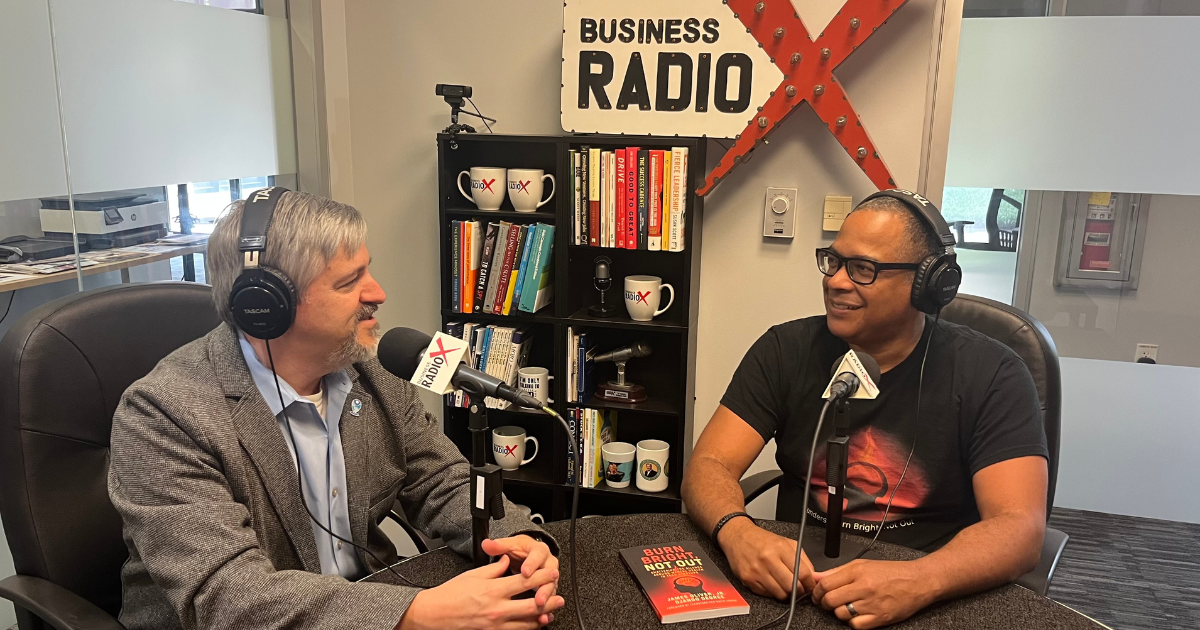
In this episode of Greater Perimeter Business Radio, host Erik Boemanns interviews James E Oliver, Jr., founder of Kabila and co-author of Burn Bright, Not Out. James shares his personal journey as a startup founder, navigating premature twins, financial struggles, and deteriorating mental health. He discusses launching the Kabila Founder Mental Health Fund, which provides free therapy sessions to startup founders who cannot afford help, and his book, which features real founder stories to combat isolation and silence around mental health in tech. James emphasizes that founders are not alone and encourages everyone to proactively prioritize their mental well-being.
 James Oliver, Jr. is the Founder of the Kabila Founder Mental Health Fund, which provides free mental therapy for founders.
He’s the co-author of the book Burn Bright, Not Out: Shattering the Silence around Mental Health in Tech Startups
James is husband to an amazing wife and co-founder of the world’s cutest twins. 
Connect with James on LinkedIn.
Episode Highlights
- The journey of startup founders and the associated mental health challenges.
- The establishment of the Kabila Mental Health Fund to provide free therapy for startup founders.
- Insights from the book “Burn Bright Not Out” focusing on mental health in the tech industry.
- The importance of community and support for founders feeling isolated.
- The role of venture capitalists in addressing founder mental health and the need for a shift in perspective.
- Strategies for maintaining mental health, including therapy and wellness practices.
- The collaborative effort to create a supportive environment for founders through initiatives like Founder Exhale Walks.
About Your Host
 Erik Boemanns is a technology executive and lawyer. His background covers many aspects of technology, from infrastructure to software development.
He combines this with a “second career” as a lawyer into a world of cybersecurity, governance, risk, compliance, and privacy (GRC-P).
His time in a variety of companies, industries, and careers brings a unique perspective on leadership, helping, technology problem solving and implementing compliance.
Connect with Erik on LinkedIn, Substack and Medium.
 This transcript is machine transcribed by Sonix
TRANSCRIPT
Intro: Broadcasting live from the Greater Perimeter. It’s time for Greater Perimeter Business Radio. Now, here’s your host.
Lee Kantor: This episode of Greater Perimeter Business Radio is brought to you by Mirability with their new Compliance Expo service taking you from IT risk to IT Reward. Now, here’s your host, Erik Boemanns.
Erik Boemanns: So I have today with me James Oliver Jr. He’s founder of Kabila. Well, different two different Kabila’s. We’ll get into that a little bit. Right. But just one. Okay. The Kabila, founder of Mental Health Fund in particular, we’re talking about today. I want to just start the conversation out though. You are a founder, you’re a father and also now an author. Put those in order for me. Give me give me that background of that story.
James Oliver,Jr.: Founder, father, author. Well, well, I do like to introduce myself as co-founder of the world’s cutest twins and husband to an amazing wife. And yeah, you know, multi time founder. So I mean, right now, as you mentioned, I recently launched the founder Mental Health Fund, which provides free mental therapy for start up founders who want it but can’t afford it. And we’re doing a variety of things, including a recently launched a book, Burn Bright, not Out shattering the silence around mental health and tech startups, which I think is to date the most important book about founder mental health ever written. And it’s, you know, not and that’s not no shade toward the other really good books out there. But this one is unique because 90% of the net profits from the book go back to support the nonprofit. So it goes to actually solve the problem.
Erik Boemanns: Right? And I did get a chance to read the book. And I think it there’s a lot of good stories, right? That’s kind of the basis and we’ll get into some of that. But maybe what is your own founders story like? How did what led you to today that?
James Oliver,Jr.: Yeah. So we got to go turn the clock back to like 2011. And I was, I was, I was living a thousand miles away from friends and family and living in northeast Wisconsin. And I had this idea to clean out my savings and as a non-technical founder and build a website that lets you turn digital images into removable photo wallpaper so you could, like, cover a whole wall with pictures from your iPhone. Back then, I think it was like iPhone five. It’s like back in the day, right?
Erik Boemanns: Yeah.
James Oliver,Jr.: And so I’m doing that and grinding on that. And then, you know, my kid’s mom wants to have kids. So we did IVF, putting two embryos. And lo and behold, you know, we’re having twins now. Yeah. And I’m running out of money. So I’m like, yay! I’m like, wow, that’s cool. And I’m like, Holy crap. Because I’m like, running out of money. And I’m just like grinding, you know? Yeah. And then so I was like, all right, the only chance I’m really gonna have to have a shot at this thing is to get into an accelerator, which was generator, and it was down in Madison. So I applied, I got in super excited. Generator was going to end the top of April in the case was supposed to be born March 27th. So I’m like, all right, the timing of all this is great. Cool, right? So then go to the doctor routine checkup and the doctor’s like, well, you know, your son’s blood’s doing something weird. If it starts to go backward, we have to do an emergency c section. Otherwise he’s going to die. Right? So check into the hospital next day. They’re like, okay, blood’s going backward. Emergency c section. And oh, by the way, the kids were three months prematurely born, you know, so they weigh 2 pounds apiece. And this was two days before my accelerator was starting, which was a two hour drive each way. Right. So that was my introduction to parenthood and entrepreneurship. And so I’m going through this accelerator and I mean, I cried every day, you know, just you could walk.
James Oliver,Jr.: Hey, good morning James. I start crying, you know, I was waking up 2 or 3:00 every morning. I just couldn’t it was just a lot, you know, I was in there grinding, trying to, um, find a technical co-founder because I was non-technical, as I said, um, and um, my face was, my skin was like breaking out, man. And I was like, I was doing some kind of reverse Benjamin buttons or something. I don’t remember that movie. Yeah. Um it’s crazy. Um, so it was really hard. Um, and I remember in Demo Day, right before I was going on stage, I got a call from one of the angel groups we visited with and he was like, you know, we’re gonna fill your whole round. And I was like, well, what do you mean? Because I wasn’t taking anything for granted? Like, what do you mean? And we were only raising $250,000 back then. Um, and he’s like, we’re going to give you $250,000. And I just after everything I’d been through, um, I just dropped to my knees. I cried, I just thank God, you know, um, but so my daughter came home after six weeks. She was good. My son came home after ten weeks and he still was having some issues, you know, uh, tethered to the machine and all this, all this kind of stuff. Um, but, you know, the kids are good now.
James Oliver,Jr.: And so back then, um, you know, we raised just enough money to fail. Um, you know, the product was brilliant. Like on my own. I got it on a today show like, um, three times good Morning AmErika DIY network money magazine came to the house, did this remarkable article and video and just tons of PR. Um, you know, so pro tip for any founders out there listening. Pr is not necessarily equal cash flow and PR is not going to necessarily solve your customer acquisition problems. Yeah. Better to spend your time getting your customers to tell ten of their friends about your business. Um, so we ran out of money. I had to come back home. So now I’m watching the toddlers still working on my business, um, and just trying everything I could to get some traction with it, you know, because the product really, it truly was brilliant. You don’t get that kind of exposure if it’s a, you know, not a brilliant product. And it was a brilliant product. Um, so I remember before we ran out of money, the investor, if you found out there listening. If you’ve ever had a. Raise your hand if you’ve ever had one of your investors tell you this. I remember he said, I thought I was under the impression they were going to continue to fund us because we were starting to get some traction. And I remember he told me, we’re not going to throw good money after bad.
Erik Boemanns: Yeah.
James Oliver,Jr.: That’s right. Man, you like, poured everything into this thing and somebody tells you that. So anyway, whatever. I went back home. I was watching the toddlers, the twins, and still working on my business. And then I get a message from the investor, hey, like, we like your leadership. We want to give you another $100,000. I’m like, okay, cool. I got some ideas about how to fix the product. Let’s go have some customer segments, you know, but just, it just, it never caught on. Um, so anyway, my, my startups failing, uh, my mental health is failing. Yeah. Right. Uh, the kid’s mother decides, um, to file for divorce. So you put that on top of everything else, that steaming pile of poo I’m managing, right? Um, and I didn’t have good mental health hygiene back then. I didn’t know anything about, um mental health really. Um not really, I didn’t um so I was not doing great, you know, in retrospect, I know, but I mean, I mean, now I know that I was functionally depressed. Um, so, uh, flash forward to 2024 and I’m in, um, VC lab, which is a, a quote unquote accelerator or incubator, whatever for people looking to raise venture funds. Um, so I was in that it was going to be called Kabila Ventures and that was, um, so that was going really well. I was actually making a lot of great progress. Um, I had quite a good amount of signed Loi to invest in the fund. Um, but I was only at about halfway to my target for those Loi because I had a certain target that I wanted to hit when we actually had to raise the fund and close and pull down a certain amount of money, and I knew I need to double whatever I had, so I had like 850 K in those hard commits, right? And like, I need to get to, you know, double that and, um, do a first close $150,000 and then go raise the rest of the fund.
James Oliver,Jr.: Right. So doing great. Then like the new administration came into the white House and like, look, I’m a first, first, first time fund manager, a black first time fund manager. Those two things are very difficult. Um, and I just hit a brick wall. The new administration came in brick wall and, uh, because I been doing much better managing my mental health and wellness and because, you know, my wife is the, um, has the best mental health hygiene of anybody I know. Um, like I just the quality of my conversations with her, with her and just improved my mental health and my self-awareness. She’s incredibly self-aware herself. So I recognized that, you know, when I hit this wall, my mental health was like, Like my brains are starting to get scrambled. You know what I mean? Yeah. And two of the most important things for me every day, um, two of those things are to be a great dad and be a great husband. Right. And I can’t do those things if my brains are scrambled. So I decided to put a pin in raising the venture fund, and I went back to a slide in my deck that was a founder value add slide in my fun deck.
James Oliver,Jr.: And at the time when I put that slide together, it felt like a throwaway slide. But I went back to it because on that slide, it said I was going to provide mental health resources to the portfolio company founders that I invested in. And I said, you know what? I’m just going to spin up a nonprofit because I had some experience with this before I had a community before, um, with some, some black parents who were entrepreneurs and we were doing that and it was remarkably successful. So I knew that that was something that worked really well and I knew how to execute against that. So I, um, I started up, um, the Kabbalah, found a mental health fund to just have thousands of startup founders in my ecosystem. I’m just going to provide this resource for all the founders in my ecosystem while I figure out what I want to do about this fund. And by the way, maybe I can meet some people who have values and vision and mission aligned, maybe who could be investors in the fund. Um, so that’s how I started the founder mental health fund. Um, and the way it works is I suspect that’s your next question. Yeah. Is, um, we, we will pay for, for virtual therapy sessions on the betterhelp.com platform. If founders want that, they have two months to complete their four sessions, uh, or if they have their own therapists, we will reimburse you up to $300. Okay. Um, so that’s the way that works. And we also have, um, you know, getting more resources that we can give to founders. Um, so I’m trying to think about how can I go upstream and help people before they need to go see a therapist or what resources can we provide them? Am in between therapy sessions.
James Oliver,Jr.: So David Coe, who was the CEO of calm, he’s gone now. Uh, they donated 100 premium, um, calm app subscriptions for three months. So we’re giving a bunch of those away. And now partnering with this really amazing mental health wellness, um, AI app called una YUNA and una donated 300 premium licenses. So their primary business model is their B to B to C. So it’s an employee benefit that’s their primary business, which makes a lot of sense. Um, but you could buy the app in the App store for $200. They donated 300 of those. So I’ve been giving those away to founders in my ecosystem. And I actually, I use that thing every day now. It’s, it’s, it’s incredible. It is my mental health companion. Um, it’s, it’s a remarkable, uh, app and AI tool. And just, you know, a lot of people don’t like the AI mental health stuff because there’s no guardrails. You know, but this thing is, you know, CBT, which is, um, oh, cognitive behavioral therapy and DBT. I think I forget what the D says didactic. I can’t remember what the D stands for, but, you know, it’s, you know, by some folks, Harvard trained psychologists who are running stuff up at Harvard and psychology departments and stuff and amazing. So so that’s what we’re doing with that man. And I’m talking for a while, so I’ll be quiet and let you ask your next question.
Erik Boemanns: No, no, we packed a.
James Oliver,Jr.: Whole we packed.
Erik Boemanns: The whole story in there. That kind of your why? Um, yeah. And what I’m curious about. So obviously a lot of founders out there, um, we’ve heard that the word solopreneur has come up recently, which basically means alone. Right. And, and so I think, and as we turn to the book in a bit, um, a lot of founders maybe think they’re alone in their struggles because everybody else, you go to an event, you look at all the successful people, you see the speakers, the panels, they’re all talking about their amazing stories. And you’re like, well, I must be the only one who’s struggling, right? And so I think that’s something that when I read the book, it highlights most founders are not alone in that. And so I’m curious how your perspective on going from that. Am I alone in this to. No, actually, I’m not alone in things like the Kabila Fund are there to help me understand.
James Oliver,Jr.: I appreciate you calling that out in the book. And that is one of the common threads in the book. Um, I mean, David Cohen, who’s a Techstars CEO, wrote the foreword. Um, yeah, he talked about that. Some of the other founders, like I think one chapter was titled you’re Not Alone. Yeah, that’s a common thread. It’s a misconception. Like founders, if you’re a founder and you’re out there, you’re having a hard time, like you’re not alone. You’re not the only one. You know, you have to find your tribe. Um, there are people out there who care and, you know, so I’m actually, I don’t know if I told you this, but I’m actually starting a podcast, um, called the Founder exhale.
Erik Boemanns: Okay.
James Oliver,Jr.: And I’m going to be interviewing founders who have successfully exited their startups and who will come on and talk about their mental health journeys. Yeah. So more evidence that you’re not alone. And I guarantee you those people, when they come on my podcast, they’re gonna be like, yo, if you’re out there and you’re struggling and you feel like you’re alone, like, hit me up. Here’s my email address, I guarantee you that some of those founders are going to come on there and do that, and they will mean it from their hearts. So yeah, you’re not alone. Um, you’re just not okay.
Erik Boemanns: And I think the other thing that I took from the book is part of the reason you have so many different perspectives is, and I think you say this in the book, it’s to see if that resonates with you as a founder, because you might still. Okay, great. I’m not alone.
James Oliver,Jr.: Yeah.
Erik Boemanns: But maybe I don’t need help. Or maybe I can power through this or whatever that psychology moment is. Yeah. But the book says if you find yourself in these stories. Yeah.
James Oliver,Jr.: That’s right. No, like we intentionally. So. So let me go back to how, how the book was written. So, um, it’s a collection of stories from founders and investors just about their mental health journeys. And everybody in the book is doing something that works for them. And we intentionally wrote the book, so there was not prescriptive.
Erik Boemanns: Yeah.
James Oliver,Jr.: You know, I’m not telling people what to do. Like if I was going to tell somebody what to do, I would have interviewed a bunch of neuroscientists and figured out how the brain works and say, do this, do that, don’t do this, don’t do that from a science standpoint. But this ain’t that. Like, that’s probably an interesting book, but this is interesting in a different way. So we’re not telling you what to do. It’s simply saying like, do something like be aware. And the one thing that’s interesting about when you do take responsibility and accountability for your own mental health and well-being, you start to become more self-aware. Like I said at the top, like I recognize those demons, right? My mental health, my brains are scrambled. Like I’ve seen this thing before. I’m not doing that again. I know where that goes, but that takes a certain level of self-awareness to move in that space like that. And yeah.
Erik Boemanns: And the other thing that I thought was interesting is as how do we shift that? So founders, they see themselves in it. How do we shift that conversation to the VCs as well? They know the importance of this in the company. Right?
James Oliver,Jr.: Oh, you just you just you just want me you just wanted me to start fighting this morning. Is that why you asked me that question? I mean, bro, like, um, like.
Erik Boemanns: It’s actually value add to the VCs.
James Oliver,Jr.: To.
Erik Boemanns: Care about.
James Oliver,Jr.: This. Yeah, but the problem here’s the problem. Um, most of them don’t care. Okay. Um, I learned that lesson the hard way this past. So look, there are some who do care, right? You know, you can’t over generalize and say nobody cares. People do care. Like David Cohen cares, right? Yeah. Brad Feld, who’s legendary investor, he wrote a chapter in my book. Brad was the one who started talking about this in 2013 when he was dealing with his OCD and his severe depression. He wrote about that in the book. He was the only one doing that. Yeah. Um, Brad is the one who gave me the $25,000 to start the fundamental Health fund, and he just turned around and did another $25,000 in May for a match for Mental Health Awareness Month. So, I mean, I did a talk with the National Venture Capital Association, which is the lobbying group, trade lobbying group for the VC industry. I interviewed some investors who care about this. So there are some who care, but overall, I’m going to say they don’t care and they don’t. Um, I just and I learned that from fundraising this past May trying to match Brad’s $25,000. I spent a lot of time reaching out to investors and they, you know, they’re not really game to put their time, money or attention to it. And they listen. Everybody has their priorities, I understand that. Um, but I don’t, I don’t think it’s reasonable to expect a founder to crush it and deliver a ten X return if their mental health is trash.
Erik Boemanns: Yeah.
James Oliver,Jr.: You know what I mean. So so I think caring about founder mental health and wellness is a portfolio risk mitigation strategy and investors not viewing it that way. I think they’re missing out on opportunity. Look, at the end of the day the startups are still going to fail.
Erik Boemanns: Sure.
James Oliver,Jr.: Right. It’s still going to be a high percentage that will fail. Um, but it’s just like Mike Ma wrote a chapter in my book and it’s one of, I mean, I love so many of those chapters in that book. I just love the book’s phenomenal. I recommend you get it. But Mike talks about, and he got this from, um, I think Erik Bond from Hustle Fund, who’s a GP over there, general partner. But Mike says that, you know, if you’re, I invest in you and things go south and you’re simply transparent with me about it the whole way. When you go to launch your next startup, I’ll invest in your next startup, right? Like how, how amazing is that? So yeah, writ large, um, uh, investors don’t care. I think that until somebody. I told you he chose violence. Maybe put me at this point with that question, man. Um, I think until someone could come along and maybe this is not even me. I don’t know, maybe not. If someone can come along and do a study that shows draws a straight line from, um, founder mental wellness to startup outcomes, um, you know, up and to the right kind of thing. I just think overall investors are not going to care. Gotcha. They just won’t.
Erik Boemanns: Yeah. Well, and you captured a lot of the key points. The reason I asked that question is I think even in the book you talk about if if a founder isn’t getting the tools they need to be successful, then how is there going to be successful? And if one of those tools is, you know, access to the mental health, right?
James Oliver,Jr.: That’s where you got mental health is health, right? You have to take care of yourself, right? And that’s not to say you can’t white knuckle your way through it and still be successful. But it’s like Nisha Devadas and Nisha, who are the chapter in the book. She’s an investor. She lives in Dubai. And she said, like, everybody wants to be successful, but like, how are you showing up once you’re successful? Are you whole? Are you healthy? Are your brains still glued together? You know what I mean. So I think. I think that matters a lot.
Erik Boemanns: Yeah. The other common theme, and you’ve mentioned a little bit too, I think is I see in these stories in the book, all of them faced a challenge at some point as a founder, that’s you will face challenges. That’s what you signed up for that. Um, but what brought them through to the other side was that a sense of purpose around what they were working on? And I think maybe talk a little bit about that from the book’s perspective and your own perspective.
James Oliver,Jr.: Well, a sense of purpose.
Erik Boemanns: Yeah.
James Oliver,Jr.: Look, man, if you don’t, if you’re not willing to walk across glass to get to where you’re going, you know, metaphorically speaking, of course. Right. But yeah, it’s just it’s not going to happen because, you know, it’s just no, no, no, no, no, no, no, no, all day long. And you have to have a deep conviction in just an unreasonable belief and expectation. It was a Steve Jobs called it reality distortion field. I think you call it that, right? You gotta have that. I mean, you gotta you just gotta have it. So you have to be obsessed, um, with the problem that you’re solving. Because if you’re not, it’s simply going to be too easy to quit when things get hard. Because guess what? Like things are going to get hard just what they do. Yeah.
Erik Boemanns: Yeah. And I think that’s what pulled a lot of the, the guests in your book through was seeing what they were trying, really trying to achieve versus maybe that initial, you know, ten X return, right? If that’s your guiding light, then it’s not going to get you very far.
James Oliver,Jr.: Probably not good. I mean, there’s some there’s always exceptions, right? Of course. Probably not. I’m guessing.
Erik Boemanns: Um, anything else. Like obviously there’s how many stories are in the book.
James Oliver,Jr.: Uh, I think there’s ten. Excluding mine, I can’t remember. So what’s cool about this book? Talk about the book. Sorry, but so we wrote it. So I partnered with a coauthor. There was a guy named Django degree, and Django had this startup called Focus on Words, and he was using AI agents to write books. So he’ll sit down and interview you. That’s what he did. He interviewed everybody.
Erik Boemanns: Okay.
James Oliver,Jr.: Um, for 45 minutes. And based on that interview, he had the agent go write a chapter. I mean, of course he sends it back to, to make sure this had them edit it, put in their own words, all that. So it’s their words, but it’s remarkable and it’s funny. Funny thing he said he tried to do that with me. He goes, man, you said you’re very complex, complicated individual. He said, you keep breaking the AI, AI, AI need you to write your own chapter. I’m like, really, bro? Yeah.
Erik Boemanns: Are there any other themes that you as you wrote the book, as you worked on it, and also as you’re talking about it, themes that came out that you think are worth highlighting?
James Oliver,Jr.: I think so you’re not alone is is a big one. Um, another one was, um, do something right. Just figure out what works for you and do it. So like, I mean, I like to ride my bike. Um, some people, I go to the dog park in the morning, I take my dog, he plays in his little track around the little dog park area. I walk around the track. So I walk, I ride my bike occasionally. Um, some people meditate, some people do yoga, some people pray, some people run, um, Tai chi, whatever. Just just just, um, you know, spirituality, like whatever, just do something. That’s the thing.
Erik Boemanns: And I know to your earlier point, the book doesn’t try to solve the problem. It tries to tell the story so that people find things that resonate with them. Then, as you just hinted at here, there is some advice at the end beyond doing something right, because each person in the story found their own thing that worked for them. Um, was there something in particular that worked for you? Like what was your, was it.
James Oliver,Jr.: Um, so it’s not just one thing. And it’s interesting because it’s like this evolving journey still. Mhm. Um, but, you know, getting a good therapist, right? Like I have two therapists now. I have one for general life stuff. I haven’t talked to her in a while and I have one for toxic high conflict co-parenting drama. Right. And now I’m using this mental health AI app, which actually, I think is keeping me from having to go to the therapist to talk about some of these things. I’m doing that daily, and it’s helped me process it. And I can see tangibly see the benefit of that. So, so that’s what’s, uh, and, you know, getting married to my wife, um, you know, reading some really interesting books. I’ve been really reading. Reading this really interesting book. Um, it’s called a Happy Pocket full of Money. Um, something about quantum physics. It’s like exploring the quantum physics sides of like quantum physics side of prosperity and abundance, like the energy side of it. Yeah, yeah, it’s a pretty deep book. I can only take in like 30 minute doses because I gotta like, go like, I have to let it marinate right a little bit. Um, so it’s a variety of things that, that I’ve been doing. And ultimately I’m finding like the more mindful I am. And it’s like, so I was talking with uni this morning, that’s the, the mental health AI app and it was asking me a question about why do I think things are changing? And I was like, um, I was like, because I’m becoming like the observer now, like of my mind, like I’m catching my mind when it’s doing these things that are not helpful.
Erik Boemanns: Yeah.
James Oliver,Jr.: And so now I’m observing and it’s like, you know, you’re not your mind, you know, you are in control of that, right? So, so just a variety of things, I think.
Erik Boemanns: Yeah, that makes sense. Um, so obviously the book burn bright not out. It’s available. Um, right now I think it’s through all major book retailers.
James Oliver,Jr.: It’s on Amazon.
Erik Boemanns: And on.
James Oliver,Jr.: Amazon.com primarily. Yeah.
Erik Boemanns: Um, and then if there’s other ways. What are other ways people can get involved?
James Oliver,Jr.: Oh, I’m so glad you asked that question. So I just also started a pilot at. We’re doing the founder Exhale walks, where founders can just, you know, move, connect and breathe this kind of tagline. And so I have these, well, people voluntarily initially signed up to volunteer, but now we’re like paying them 50 bucks to just go lead some founders in a walk in their town. So here in Atlanta, um, um, Mark Feinberg, I think Mark’s over at the Hatch Bridge. I think over over at Kennesaw State. Mark runs the walk. Uh, Marietta. Yeah. Um, I’m doing the walk and the Johns Creek Alpharetta area at Newtown Park. Um, uh, Tamara Lucas, who’s the founder of my Panda. She does the walk in Decatur. And then we have Janai Walters, um, co-founder of Inside Connect is going to be doing a walk here in South Fulton. Uh, we have somebody doing a walk in Chicago. We have somebody doing a walk upper West Side of Manhattan. Um, Redwood City, California. So I got this, uh, it’s just a pilot. Now, we did our first walk last month. So we’re getting the bugs out. And I’ll open it up. And if somebody wants to be a well bassador, I’ll be open it up to other cities. I envision that we’ll be doing them around the country, around the world. It’s just no suggestion, no agenda, no pressure, no phony networking. Yeah, just go out and go for a walk and just signaling that we’re prioritizing yourself as a founder and just go meet some other people. And it’s cool to find your tribe and talk to people who get it because your family probably doesn’t. And they’re probably like, what are you doing? Why don’t you go get a job? I’m like, yo, I’m the world’s worst employee. So that’s not going to happen.
Erik Boemanns: Yeah. And how do I find out about that walk with you publishing that?
James Oliver,Jr.: Oh, man. Oh, that’s a really good question. So we’re using Luma. Okay. Right. But the problem with Luma is so I have these calendars, but you can’t really find it unless it’s the scheduling up. So it’s not like this main page. Uh, just find me on LinkedIn. James Oliver Jr um, send me a note when you try to connect and say you heard me on the, on the The radio. The Business RadioX station. And I’ll connect with you. And I could, like, get you the link when we have the next one. That’s the best way we. I need to figure out like a centralized landing page thing for that, but I’m just trying to do things in a way that don’t create more work for me, for sure. You know what I mean? Trying to work smarter, not harder. But yeah, I haven’t solved that one question yet.
Erik Boemanns: And for founders who are looking to take advantage of the, the, um, mental health fund, how do they.
James Oliver,Jr.: Oh, perfect. Yeah. Good question. Thank you. So if you go to mentalhealth.com, um, if you’re a tech startup founder, because we are focused on tech startup founders, um, just go, if you scroll down the page, there’s a button that says get added to the waitlist. You can click on that button. And we have capacity now because we just got some donations last month, and I’ll get you onboarded as quickly, you know, very quickly.
Erik Boemanns: Yep. And then for the people who might want to donate to that.
James Oliver,Jr.: Yeah, same thing can build a mental health.com. That’s right at the top of the page. Be a donor. Boom. Click that button. All donations are tax deductible. Like, you know, the work matters. I can’t tell you how many founders come back and say how helpful these things have been, have been for them. Um, but it takes money, right? So if this work matters to you, if you’ve been successfully exit a founder, or if you’re a founder and you’ve got ten bucks a month, you want to donate on a recurring basis, if you want to donate a couple thousand dollars like it all, it all matters. It all helps and we appreciate it.
Erik Boemanns: Yep. And then I think you mentioned to, uh, the book itself is a source.
James Oliver,Jr.: Yeah. So, um, so I, we said 90% of net profits in the book, but actually I think we, so the way we ended up structuring this with Django and focus on words, he said, you know, just he’s basically donated the book. He’s like, just let me recover my operating costs to make the book. And I think we’re there now. So everything from here on out is going to go right back to the to the nonprofit. So it’s basically going to be 100% of net profits of the book.
Erik Boemanns: So that’s right. So yeah, lots of ways to.
James Oliver,Jr.: Absolutely.
Erik Boemanns: Contribute and participate. Yeah.
James Oliver,Jr.: We got some swag to burn bright Night Out t shirt. So you can find that on the, um, on the website too.
Erik Boemanns: Yeah. And I think just to kind of close the conversation, the, you talked about finding your tribe. We talked about community. Um, I think it’s about prioritizing prioritizing relationships as well as a theme that I’ve seen. So like going back to the you’re not alone, right? That’s a core theme. What’s the, what’s the thing to take away to say, you know, if you can’t get to the walk, if you can’t get to, if you, for whatever reason, aren’t ready to, to, to use the site, like what’s that? Find your tribe. Advice that you give to founders and startup leaders.
James Oliver,Jr.: Oh, I’m sorry. So if if you’re saying you, how do you find your tribe is what you’re asking me?
Erik Boemanns: Exactly.
James Oliver,Jr.: Sorry. Uh, well, I mean, Atlanta, if you’re lucky enough to live in a place like Atlanta, there’s so many startup communities here, right? You got a TV, you got Russell Center, you got Atdc, you know, Tech Square, Atlanta. There’s a bunch of places and spaces here in Atlanta. So like get active, go to those things is, you know, startup Atlanta has like a calendar, I think with stuff going on. Yeah. Um, although, you know, I think as a founder, like you’ve got to be careful of prioritizing your time and not wasting a lot of time doing a lot of things that are really not going to be productive. I’m not saying those things are that. I’m not saying that, but if you want to run around and go on to all these different events, you need to be smart about how you’re spending your time with. That is all I’ll say about that.
Erik Boemanns: Yeah.
James Oliver,Jr.: But yeah, there’s tons of communities here and tons of people here working really hard to make a difference. You know, I think the mayor and those guys are trying to make Atlanta a top five tech hub in X number of years. But if anybody knows the folks from the mayor’s office, I think Donnie Beamer’s on my email list, I’ll say to those folks, like, if you’re doing that, that’s amazing. And what are we doing to address the fundamental health piece of it? Like, I’m certainly game to and keen to collaborate with them around that. If somebody’s listening, you know, can connect with those folks and say, hey, like this needs to be part of the conversation too, because it absolutely does.
Erik Boemanns: Awesome. Anything else you want to share?
James Oliver,Jr.: That’s it man. Thanks for having me on.
Erik Boemanns: Yeah, absolutely. Thanks for being here. Thanks for sharing.
James Oliver,Jr.: My pleasure.















