

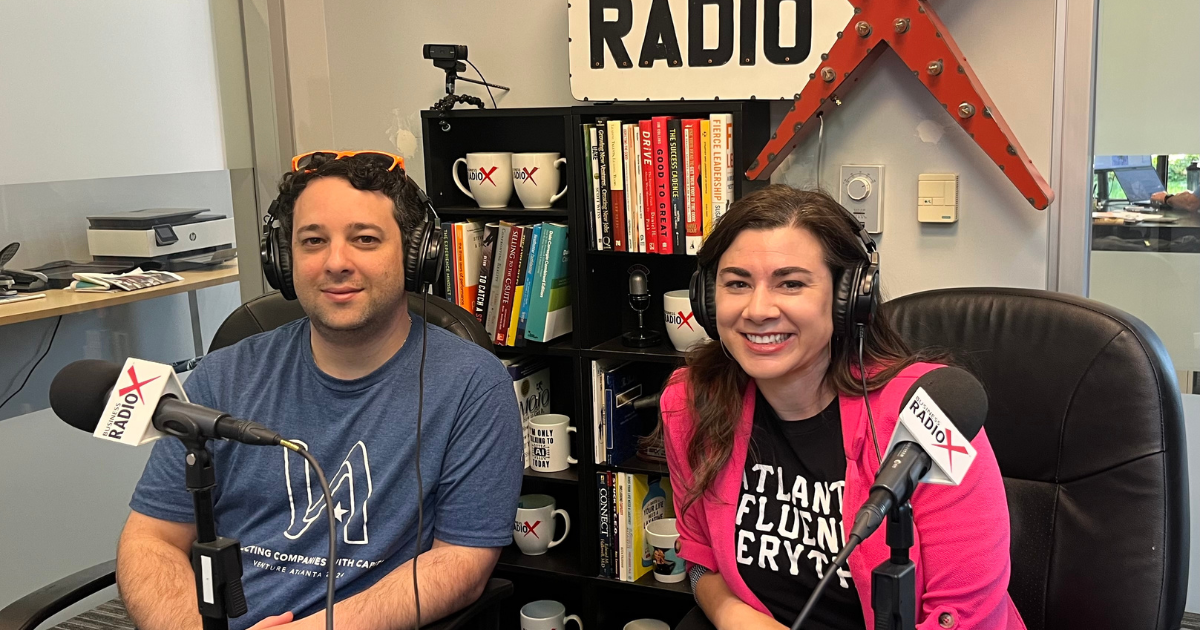
In this episode of Greater Perimeter Business Radio, host Adam Marx sits down with Aly Merritt of Atlanta Tech Village (ATV) to explore startup culture, community building, and networking in Atlanta. Aly shares her unconventional journey from print journalism to the startup ecosystem, discussing ATV’s mentor program, the realities of startup life, and the mental health challenges founders face. Together, they highlight Atlanta’s collaborative spirit, the importance of genuine relationship-building over transactional networking, and why showing up consistently is the ultimate key to success in any entrepreneurial community.
 Aly Merritt is the President of Atlanta Tech Village and a community builder in South Downtown ATL. She has been a pivotal figure in Atlanta’s tech ecosystem for more than a decade. Her startup journey includes Head of Community at SalesLoft, where she also contributed to product management and customer experience, and served as Chief of Staff.
With a background in journalism and a passion for innovation, bolstered by an MBA from Georgia State University, Aly has dedicated her career to advancing local startups and elevating Atlanta’s national profile. She previously organized and emceed ATL Startup Village, fostering connections between entrepreneurs and investors.
As a co-founder of ATL Unlocked, she continues to drive collaboration between startup hubs across the city. With the advent of the South Downtown ATL project, she is driving new interpretations of innovation and helping revitalize Atlanta’s historic business district. 
Aly (sporadically) shares her insights on tech and the startup community through her blog, AlyintheATL.com. Her multifaceted experience, from copy editing to community strategy, uniquely positions her to support and inspire entrepreneurs in America’s fourth-largest tech hub.
Connect with Aly on LinkedIn and X.
Episode Highlights
- Aly’s role at Atlanta Tech Village and community building in South Downtown Atlanta
- Overview of the startup ecosystem and its evolution
- Importance of community and network building for startups
- Challenges and realities of startup life
- Value of mentorship and advising in the startup environment
- Differences between corporate and startup work cultures
- Mental health considerations in the startup community
- The significance of building genuine relationships and showing up in the ecosystem
- The role of networking in startup success and misconceptions around it
- The collaborative nature of the Atlanta tech and startup community compared to other cities
About Your Host
 Adam Marx is a networking & leadership consultant, speaker, startup advisor, journalist & the founder of The Zero to One Networker.
Formerly the founder & CEO of music-tech startup Glipple, Inc., and as a writer appearing in Crunchbase News, Startup Grind, Mattermark, & others, Adam draws on more than a decade of experiences in the music & startup tech industries to teach others how to cultivate powerful relationships using strategies of patience, consistency, authenticity, & value creation.
As a networking consultant and speaker, Adam has worked with numerous organizations, including Georgia State University, TechStars Atlanta, the Atlanta Tech Village, ATDC (through Georgia Tech), & Startup Showdown, where he’s advised & mentored founders on how to develop magnetic dialogues & long-term relationships.
Adam’s talks include those given at Georgia Tech and Georgia State University, with a keynote at Emory University’s The Hatchery and as a featured speaker for Atlanta Tech Week 2024.
In addition to advising & consulting, Adam sits on the steering committee for InnovATL, cohosts LinkedIn Local ATL, emceed the 2022 Vermont SHRM State Conference, and was a workshop speaker at South by Southwest (SXSW) 2025.
He is currently working on his forthcoming book.
Connect with Adam on LinkedIn and Instagram and follow Zero to One Networker on LinkedIn and Instagram.
 This transcript is machine transcribed by Sonix.
TRANSCRIPT
Intro: Broadcasting live from the Greater Perimeter. It’s time for Greater Perimeter Business Radio. Now here’s your host.
Lee Kantor: Today’s episode of Greater Perimeter Business Radio is brought to you by 0 to 1 networker, helping founders, funders, and operators build the strategic relationships and access that move businesses forward. For more information, go to 0 to 1. Networker. Now here’s your host, Adam Marx.
Adam Marx: Thanks so much, Lee. I am so excited for today’s guest. Aly. How long have we known each other?
Aly Merritt: Oh, has it been a decade? More than a decade.
Adam Marx: Oh my God, no. Maybe
Aly Merritt: That just aged me. Never mind. It’s been a year.
Adam Marx: It’s been a year. Okay, so before we get into how old I apparently am, um, who you are, what you do, where you work.
Aly Merritt: Yeah. Ali Merritt, Atlanta Tech Village and also building community in south downtown Atlanta. What I do varies day to day. Sometimes I am acting almost like a kindergarten teacher with a bunch of startup entrepreneurs. Um, sometimes I’m coaching them through a fundraise. Sometimes we’re just there to be a philosophical sounding block on what it is that they’re doing or not doing. And then in South Downtown, we are revitAlyzing and reimagining the original business district in the heart of Atlanta.
Adam Marx: Wow. There’s there’s so much in there. So let’s start first with Atlanta Tech Village, the flagship location in Buckhead. Then we’ll move to South downtown. And through that, we’ll kind of talk about the importance of community and network building because that is so core to what ATV does. So how’d you how’d you first come to ATV? I think I know the background story, but I don’t know if everyone knows the background story.
Aly Merritt: I don’t know that it’s that interesting, but I think that I’m a great example of why startups are attractive to people, because you don’t have to have a background in something to be able to do it. A lot of people like myself just fell into it.
Adam Marx: Me too.
Aly Merritt: Exactly. It’s it isn’t something that you feel like you have to do, like 20 years worth of work in order to get to. Although apparently now you can get an entire degree in entrepreneurship, which baffles me a little bit.
Adam Marx: Well, that was I told you I was on a panel earlier this earlier this week at this Innovate Georgia, which was held at Kennesaw State. And there were people there from, you know, Georgia Tech and Morehouse and, and, um, Mercer. And it’s amazing to me to see how entrepreneurship has grown beyond like when I was in school, it was like a club that had no funding. It was.
Aly Merritt: People watching, like now.
Adam Marx: People like watching Shark Tank and like, hey, man, this, this kind of stuff is pretty cool. And now it’s like, oh, there’s some real like funding and direction there, which is great.
Aly Merritt: It’s a legit profession now, which is entertaining, but it’s of course very sexy on the surface, right? Because you’re seeing like the six year overnight success, quote unquote, where people have been shilling in a basement and, you know, working so hard on something that very suddenly you hit traction. I think that’s the attractive part of a startup is that when it works, it can very suddenly and very quickly work. And so people get the impression that it’s an overnight success. But usually it’s a lot of work behind the scenes for a very long time. So, um, my background, I think I’m on like my third or fourth career, to be perfectly honest. I started as a journAlyst in the print journAlysm world, so I was a copy editor and a page designer.
Adam Marx: Quick, quick aside for anyone listening, what’s print journAlysm?
Aly Merritt: It’s not really a thing anymore, right? Uh, yes, I worked in newspapers, and you have to have somebody to do a couple of things. After the writers write the article, you have to proof it. You have to copy, edit it, and then you have to fit it into the page, which with all of the computer programs now, it just automatically does stuff for you. If you were me. Because again, I’m old, I spent a lot of time being like, this story is two inches too long and we need to cut two paragraphs out of it. And then you have to figure out which part you cut so that the writer doesn’t hate you, because it was their hard crafted, you know, words of wisdom. And so that was challenging. Uh, but it was really fun. And nobody does newspaper journAlysm for the money, right? You’re working nights, weekends, you get paid less than teachers, you’re working holidays. Um, everything’s on deadline. So it’s always incredibly urgent all the time and sounds healthy. I didn’t say it was like a mental health and wellness journey, Adam, but you felt like you were doing something that was important to the community, for the community that you were helping find out what was going on and share it with people and share the news about the world. And so everybody in journAlysm has this like, kind of altruistic aspect to it. And you’re doing something for the love of the thing that you’re doing. Um, unfortunately, uh, the bottom fell out of the newspaper world when right when I moved to Atlanta with my husband and I knew people with Pulitzer Prizes who couldn’t get jobs and I didn’t have one of those. So I definitely wasn’t going to get a job. Um, so I had to kind of reinvent myself, which was humbling and a little bit soul sucking at the same time. Uh, and I did a couple of different things, including working for a company that did the, the professional way to say it is linen management for the healthcare industry, which is really laundry for hospitals.
Adam Marx: Um, still important.
Aly Merritt: It is important. But I was in marketing. You can’t make that sexy.
Adam Marx: That’s a that’s but that’s why we see all these like amazingly cool commercials for like progressive. You’re going into higher education for And what you’re looking to get out of the experience, that is a factor to consider.
Aly Merritt: You know, I think that’s an interesting point. I’m going to diverge slightly. Not that we were going to be really direct in our conversation anyway, but, um, I’m going to diverge slightly because I think that’s an important aspect. So at Atlanta Tech Village, one of our programs is our mentor and advisor program. It is one of the biggest value adds, we’ve been told by our villagers. And we have about 60 advisors on staff who are just giving back for free. This is their time. We swap them for a community membership because we want them to be members of our community and actually work out of the space. And for a very long time, that program was split into mentors and advisors, and that was two different things. The advisors were subject matter experts, and the mentors were meant to sort of pair up and walk a longer path with our startups. Um, what ended up happening is we had a lot of mentors who also were subject matter experts, and they would get used both ways. But the theory behind it was that if you were going to be a mentor, you had to be a former founder, not just an early team member. Even though you carry as an early team member, I can tell you that you bring a lot of wisdom to the to the space. But if you are a former founder, you understand because you have done that job, you have walked that path. And I think this goes back to having the adjunct professors, right? They know what they’re talking about because they do this job. So when you are a founder who is talking to a mentor and you’re like, I don’t know if I’m going to make payroll next week and you have somebody who can say, oh, congratulations, welcome to the club. It’s a rite of passage. It will be okay because they have been there and they have done that and they have not made payroll. That is very different than having somebody who’s never had that experience be able to talk you through it.
Adam Marx: It’s it’s interesting because so, so when I did advising at, at Tech Village, um, I did notice there was that, that kind of, um, I would say divergence, but there were those two kind of groups and it is different. Um, when one lives through certain things. And so when I was doing, advising around like building networks and scAlyng networks way before, I think the landscape has changed actually quite a bit since, since I was at ATV because at the time, and I think that, you know, this, like you were steering a lot of people my way going, hey, you should have this conversation.
Aly Merritt: And that’s kind of my job. Adam. I share a lot of people, people’s directions, right?
Adam Marx: But it was, I think at a time when it was much, much more difficult for people to recognize the differentiation between sales and marketing and network building. And I think that there’s now a better understanding of how all those things are different. They’re all equally important. It doesn’t mean that sales and marketing are not important, but what I’ve noticed is that there’s more of a, more of a, um, an acknowledgment that founders are looking for people who’ve Experience these particular things in a way that is more than theory or reading, reading a number of books or, you know, it’s when you’re part of like 2 or 3 rocketship startups, like you’re, you’re catching the tailwind in a lot of them. And there’s something to be said for being around people who are like, yeah, yeah, I know what it’s like when like all the junk is coming down and like, it’s like, we just need to like, go to the bar and have a beer and start fresh in the morning.
Aly Merritt: And to tell you that there is life on the other side of it, right? You need somebody who has been through the fire and is like, it’s gonna be okay.
Adam Marx: And I also think it’s funny you phrased it that way because, you know, when I moved out of the music industry, um, for a number of reasons, I wrote an article around the concept of there being life after failure. And it was, it was really written in two parts. It was the first part I remember writing like in the dark by myself three in the morning. Just that that really heavy, intense feeling of like, what is going on? What am I doing? And then that second part of it, and if someone reads this article, it’s still somewhere, I’m sure the second part internet lives. I know I’m gonna have to remember to tell, for better or worse. Yeah, really. The second part, I remember sitting in a Starbucks kind of in, uh, midtown somewhere and just like having a large coffee and like the, the vibe is so different. It’s like, okay, what’s next? And I think that part of what we need to do a better job at in the startup space and we’ve been getting better at it is we talk about fail fast and like failure is great and you learn a lot and like, that’s fine. But failure and that heaviness, it also hurts. Sure. And so we shouldn’t gloss over like what it feels like in the moment. It doesn’t make you less of a founder to feel like, oh man, like I can’t just brush it off today. I need like a few days to recover from it. And that’s part of being a founder is acknowledging that emotion and sitting with it for a minute and then finding a way through it in a way that is actually good for one’s mental health, as opposed to pretending like I’m fine. Everything’s great. It was easy. Next thing.
Aly Merritt: Yeah, I for for also better or for worse, I think the the upcoming generations have a much more comfortable relationship with mental health and wellness, which is great in a lot of ways. Yes. Um, I think it’s interesting because I have several friends who are in charge of large teams of the next generation or two down, uh, and not that anybody’s ever actually said this exact phrase to them, but one of them said that they’ve gotten very close to hearing, um, Mercury is in retrograde and the vibes are off. So I can’t come in today. And she’s like, all right, look, I’m here for mental health and wellness, but some days you just have to get up and do it.
Adam Marx: If people could see my face right now, it’s like, look.
Aly Merritt: You could be in a balance. We need to get to.
Adam Marx: There is a well, because the, the, the flip side of it is, I think that when people come into a startup and part of what you were talking about vis a vis being a founder is when someone comes into a startup, whether you’re employee number three or employee number 300, there is already a kind of structure in place. And people who have not had to put that structure together can sometimes forget that someone’s got to be bolting that stuff into place. And it takes time and, and trial and error to figure out, yeah, what does that look like? The infrastructure of a company doesn’t just, you know, pop out of the ground like a daisy. There’s just a lot of, a lot of work that goes into.
Aly Merritt: Them are also bolting that structure together as the plane is flying, like they are building the plane as they are flying.
Adam Marx: On the way down.
Aly Merritt: Yes, on the way down to the ground.
Adam Marx: Yeah. Trying to avoid that, that that bottom of the canyon. Yeah. And, and so like, I think, uh, employees who come in earlier see a lot of that and help with a lot of that and are instrumental to a lot of that, uh, uh, employees are coming a little bit later, may have a harder time seeing it unless they are already aware of like, that’s what’s gone on. So like when someone goes and works at, you know, Home Depot, which is a massive company, someone had to put that structure in place to create those workflows. And it takes time.
Aly Merritt: I think that’s actually a great point. And so I end up meeting with a lot of people who are exiting a corporation. They’ve had 15, 20 years of experience at a corporate company and they want to do a startup because again, on the surface, startups sound really sexy. And so I have to have discussions with them about like, what’s your risk tolerance? Because most startups don’t make it for a variety of reasons that usually have nothing to do with the founding team. There’s a lot of luck involved. Product market fit has a lot to do with timing that you may or may not be in control of, i.e. Zoom and a pandemic, right? You know, they were doing well, but they weren’t zoomed until a pandemic, but nobody can know that that was going to happen. So I talked to a lot of people in corporates and their, their impression of how fast a startup actually moves and how loose the guardrails are and the reAlyty of that are typically very far apart. And a lot of people who have been in corporate structure for a long time struggle with that. They think that they want to be bowling in a bowling alley without the gutter guards, but they actually really liked the gutter guards. They just didn’t know it until they were in a position where they couldn’t handle it. It takes a special kind of like slightly crazy and probably neuro spicy person to be in a startup, frankly. And you know, as all of us are self-diagnosing ourselves from Instagram and TikTok videos at this point.
Adam Marx: Oh, I mean, you do, you do have to be masochistic on some level to want to do this.
Aly Merritt: Yeah. You’re gonna go like, bash your head against the wall a whole bunch of times and be like, okay, that sucked, but I’m gonna keep doing it.
Adam Marx: But, but and like for, you know, the thing is for people who don’t want to do it or feel that it isn’t the right fit for them, like that’s also okay, because there are a lot of us who would feel maybe less comfortable in a more corporate environment. I think people should win where they feel most comfortable. It doesn’t make someone less of a great business person because they like, quote, couldn’t hack it. Like, I just don’t buy into that.
Aly Merritt: No, it takes all kinds.
Adam Marx: It takes all kinds. And, and, you know, I think it’s important because when I was coming into, it’s important to acknowledge that because when I was coming into tech into startups, I mean, this was 2015, 16, 14, 15, 16. It was at a time when like, if you didn’t write code and you didn’t go to San Francisco and move to San Francisco, like you didn’t care enough, you weren’t, you weren’t being serious about your startup. And now it’s gotten a lot better where people are, are in all different cities, um, from like Atlanta to Omaha to the Bay area and like Texas, obviously. And, and so I think that’s really great. But I think that it’s an indication that we need to recognize like great startups are built. Yes. With tech talent, with sales talent, also with graphic design talent, also with copy editing talent, network building talent, like it takes all kinds to create like a very dynamic company that’s going to end up being successful.
Aly Merritt: Sure, you can’t just have the technical talent because half the time the technical talent can’t sell it. And you can’t just have the sales talent because then they’re selling vaporware that can’t be built. And then once you do get past that initial foray, you’ve got to have customer success and technical support to be able to actually get a customer to adopt it, to implement it, to train on it, to be able to use best practices and get the value out of it. Right? Like a lot of customer implementations fail, not because the product isn’t good and the customer doesn’t fit with it, but because there, there wasn’t enough time spent on that Alygnment piece.
Adam Marx: I want to I want to key in on that time and Alygnment because. Looking at network building and how it’s changed in the last 4 or 5, six years since since we’ve known each other. The time component is something that I think a lot of people misunderstand, particularly in the, in the arena of startups where everything is that flywheel.
Aly Merritt: Everything’s fast.
Adam Marx: Everything is fast. And you’re trying to get that, that, that wheel as tight as possible to get the product out there, collect feedback, iterate quickly, which is great for a product that you can effectively control. But building networks is glacially slow sometimes.
Aly Merritt: And it’s not fast.
Adam Marx: It’s not fast. And this is it’s like, it’s a war of attrition between you and your impatience and the people who build Staggering networks are the people who outlast their own impatience. They’re the people who are the actually the the people closing the rooms, not the people who are first to the party, but the people who hang around. And that’s something I think a lot of founders don’t really want to hear, or it’s hard for them to kind of accept that like, this is going to take time. I can’t just give you a list of a thousand people that you can throw into an AI flow and see like, who’s going to be your next investor? Like you need to put in the time to cultivate that dialog.
Aly Merritt: I mean, you probably could, but I don’t think the answer would be correct.
Adam Marx: So you could, I would not recommend it.
Aly Merritt: I mean, at the rate we’re going, I think you could ask AI anything, but, uh, I think that that’s an excellent point. Right. I was at an event last night. I was one of the last people to leave. Um, and some of the best conversations tend to happen at that point in the night, right? You, a lot of the people who are there to put in the face time, um, have now been able to move into a space where they’re a little more relaxed and they can go a little deeper. Um, you know, I was talking to somebody and we discovered we had people in common from ten years ago, right? And that’s always really fun. And we were able to kind of dig into, where were you when this, what happened when this changed all the, the different fun pieces that you have to start talking about in order to build a rapport with person. Um, one of, I think both of our skill sets is finding common ground with people relatively rapidly. And that’s a core skill to being a good networker now. I want to also make the note that when you say networking and I say networking, there’s a whole group of people who are networking and they make sad faces. Absolutely. Right. Yeah. Um, I am clearly not an introvert. And so I will talk to anybody in a room. I’m the person in the grocery store that if somebody is like, I don’t know what kind of flower I should pick. If I’m standing on the aisle, I apparently look approachable and they will talk to me about it. But I know a lot of people here are either extroverted introvert, so they present as an extrovert, but they have to go recharge, or people who are just straight up introverts and they know they need to go to the networking event, but they really hate the word networking and the entire concept of networking, right? Because they’re like, oh, I have to go and hand out some business cards.
Adam Marx: I don’t even think networking is the best term for it. I think it’s the best term that we have right now.
Aly Merritt: It’s just you’re just building community and connection.
Adam Marx: Just have one good conversation. You don’t have to get rid of your business cards. I but I think it’s, I think it’s really critical that founders and startups who are maybe further along in the pipeline raising series B, series C, recognize that. Here’s how the dynamic goes. If you you can have the most charismatic CEO or COO on the face of the planet who are in the early days that those people can do like all the networking, all the outreach.
Aly Merritt: Sure. They’re the face of everything.
Adam Marx: The face of everything. But as you grow series B, series C, now your company’s bigger. Now you have. They have more on their plate, everyone’s got more on their plate.
Aly Merritt: But every single person at your company now has to be that person.
Adam Marx: Precisely because that that that charismatic person, their time to do all those 1 to 1 conversations goes down because they’re running the company and trying to make sure everyone gets paid and the next product is great. And so startups need to understand that integrating network building skills into their entire organization, including their tech team, yes, their sales team, but also their, the tech side of the organization is a secret weapon because it means that the more conversations that all those people can have, whether it’s ten people or a thousand people, the more conversations they can have, the more yes leads they can bring you for for customers. That’s part of it. But it’s also the more doors they can open to potential funding sources, potential PR sources, partnership resources, like the list goes on, high end talent. Like that’s how you attract great talent.
Aly Merritt: That’s how you attract, grow and retain great talent because they’re building their own internal advocacy for your company at that point.
Adam Marx: And what I think startups sometimes mistake is everyone early on, everyone wants introductions. The introduction factory, that’s almost the easiest part. It’s startups who master the maintenance and the scAlyng of networks as their companies grow. Those are the startups that you see in the rooms and consistently at events and consistently at events, not even necessarily with other startups and other founders, but in the rooms, with the journAlysts, in the rooms, with the funding sources. The institutional bankers, like those are the people who get in those rooms and know how to stay in those rooms.
Aly Merritt: But you also don’t know who in that room. They might not be the right person. They may know the right person, right? They may know your next customer. Your next employee. Your next investor. And so you have to approach every single room as it’s, it’s endless possibility, right? And that’s one of the things that I try to tell people when they’re trying to talk about, what do they need to bring to a networking room is you ask how you can help, right? How do you you ask somebody else how you can help. You don’t go in with, I have an itinerary. I have things that I need to get out of this. It’s how can I help you? Because you open up a conversation, then that creates infinite possibility around where to take that conversation. Um, to go super far back here in this conversation to where you asked me how I ended up where I am now.
Adam Marx: Yeah, let’s go back there.
Aly Merritt: Um, this is actually extremely relevant. So I got my MBA at this company and I reAlyzed that what I was missing was the sense of camaraderie and everybody working toward a common goal, not for the money, not for the fame, but because they believed in the thing that they were doing, and newspapers had sort of collapsed at that point, and that wasn’t a possibility anymore. And so I reAlyzed that the another place that you could find that kind of idea were startups. Everybody’s coalescing behind a common goal that they think is really important. And they’re doing it because they believe in it. And so I, Atlanta Tech Village at the time was fairly new. This was 2014. Um, David Cummings bought the building that Atlanta tech village Buckhead is in in the end of 2012, started doing um, with, with entrepreneurs in the building, started renovating it floor by floor in 2013. So in early 2014, I basically showed up at events at ATV until somebody hired me.
Adam Marx: That’s people ask me, people ask me like what I do? It’s like, man, I show up and talk. You show up till people pay me to go away. Like that’s what I do.
Aly Merritt: That is hands down, the number one thing that I try to tell people is just show up.
Adam Marx: I don’t think that people reAlyze how much it makes a difference, and it’s show up when it’s not your thing. Yes, your demo day. Your pitch off like, yeah, show up for those and congratulate the other demo day presenters and whatever. Um, but just consistently show up at events and I always quAlyfy this with, show up with, you know, something that fits within your budget, whatever it is, you know, your wallet is a factor. Your mental health is a factor, your time, your family, these are all factors. So I’m, I’m not advocating for people to run themselves into the ground because at this point, I do get comments like, oh wow, you’re everywhere. You’re just everywhere. And it’s like, no, no, I’m not everywhere.
Aly Merritt: I think you’re thoughtful about where you are, right?
Adam Marx: Because to to try and be ubiquitous is not healthy and not reAlystic.
Aly Merritt: And frankly, it dilutes your personal brand.
Adam Marx: It does, but to create the perception of ubiquity is a lot easier and a lot more, a lot easier to maintain over time. It’s something that startups and startup founders could conceivably do, even as they’re very early in their journey and their funds may be, you know, quite limited.
Aly Merritt: I think one of the benefits of Atlanta as an ecosystem is we have a ton of free events, most of which come with food. By the way, um, we have free events that anybody can attend. We are working hard to ensure that all of the events are on the Startup Atlanta shared community calendar. So you can go, you’re new to Atlanta. You can go, you can figure out where you need to be. All of those events tend to have some version of a Venn diagram of overlap into another event or another space in town, and to your point, showing up to support other spaces and other hubs. You know, I got a sitter and drove super far north of town For me, as somebody who lives in Decatur, all the way up to Alpharetta for carrying cash and formerly tech Alpharetta, now North Atlanta Tech for their grand opening of their new space. Yeah, it was it was like a Thursday. It’s like 4:00. I think I narrowly made it in right before the ribbon cutting. Um, because it was a whole I had to go home, get the kid, hand them off to a sitter and get up there. But it was important to me to be there for her. And then when we had Atlanta Tech Village Sylvan in South Downtown open at 8 a.m. on one of the coldest days. I was there too. I was freezing, it was so cold. It was literally 20 degrees. Like I’m not. That’s not even hyperbole. It was actually 20 degrees. Um, Karen drove down at 5 a.m. to make sure that she was there for my grand opening because I had been there for hers. And that is an incredible feeling to know that people care about you and what you’re doing to that extent, but it also creates this flywheel effect where then when there’s something important to you, they show up for you. You show up for them, and then suddenly a rising tide raises all ships.
Adam Marx: And I think it’s also indicative of, you know, there’s this, there’s this concept I have called the 300 club, um, which is just an idea that occurred to me a few years ago. And I’ve posted about it a number of times. And the concept came to me as like, I’ve been in a number of different communities throughout my career. I was in the music world, I was in the tech journAlysm world. Now I’m in the tech space and, you know, on the LinkedIn space and Twitter before that became a dumpster fire. Um, and it just seemed to me in any given real community that there tend to be 3 to 400 voices, give or take, who are just driving the conversation that day, that week. And they rotate, you know, people kind of pull out, they have other things. Other people come up and introduce new ideas. But there, there’s this group of, of voices and they all tend to know each other. They don’t always all get along with each other because humans are are human. But people like everyone knows everyone. There is a certain kind of dynamic at play where everyone knows everyone. And I think you and I know that that is true in the Atlanta ecosystem. There are a lot of people who just know each other, um, sometimes disagree or do business differently. And that’s okay. But if founders understand how to, how to, how to see that and how to, you know, when I say crack a relationship there, I mean like how to identify those people and create value for them in a way that’s more than, hey, I want free tickets to something or I want free access to this. But just to say, oh, this is, this is a certain echelon of people or a certain group of people that are in the know, they know what’s coming down the road. How to get into that community can be insanely powerful, and it has less to do with asking for stuff and more to do with consistently showing up and trying to support and just trying to be a part of the community.
Aly Merritt: I think of the Atlanta community especially, is a more welcoming and open ecosystem than a lot of other cities. Now, here’s the thing. I think compared to other cities, we’re doing good. We could be great. There’s a lot of room for improvement, but we have a lot of the same goals, and we frequently open our ecosystem and network to incomers who are new. And we don’t do that because we want to get something out of it. We do that because we genuinely want to grow the community. And I hear that a lot of times from people who have come in from SF, for example, and they say, when I go to an event and I meet somebody and they say, I’m going to make an intro for you, they actually do. Yeah. And that does not happen in San Francisco, partially because I think there’s a, an impression of scarcity of resources in SF, whether it’s accurate or not. I think there’s a lot of people who get very territorial in San Francisco around their ecosystem, their options. If I introduce this person, maybe they’ll get a thing that I didn’t. And not that there aren’t. I’m sure people in Atlanta who don’t think that way. But overall, I think the Atlanta community is collaborative, not competitive, and that is our superpower.
Adam Marx: I fundamentally agree with that because it’s the what I call the accessibility factor, which I, I’m just, I’m not looking at at only the money component. Like, you know, there’s a lot more money going on in startups in San Francisco and LA. I mean, but it’s harder if one isn’t a part of a rocket startup already or having had a successful exit, it is harder to get taken seriously out there. And I think, I mean, I don’t know if you actually know the story. Do you know how I met David Lightburn the first time tech village. Okay, so I.
Aly Merritt: Were you on an elevator with him?
Adam Marx: No, I wasn’t, but but I had known through Twitter, um, I knew Adam Wexler, you know, from from prize pics and.
Aly Merritt: Formerly insight pool, by the way. Oh, yeah. He’s our only double alumni graduate out of Atlanta Tech Village.
Adam Marx: Oh, I didn’t know that.
Aly Merritt: Insight pool graduated early on. Adam then spent six years building this quote again overnight success, right? Right of prize pics and came back and built it at ATV again.
Adam Marx: Amazing. So, so Adam and I knew each other just kind of casually. And I vividly remember I was like up in Sandy Springs and like, I was having like mechanic work done on my car and it was, I had like 30 minutes left and then it was free for the rest of the day. And we were just chatting via DM because I think at the time he was kind of commuting between Atlanta and New York. And, and so he’s like, oh, I’m actually down at ATV if you want to come down and like, I’m happy to just kind of have, you know, 5 or 10 minutes. And it turned out it was one of the ATVs, just kind of a community events. And, um, he was great. You know, we had a great kind of just coffee chat and whatever. He said, okay, come inside and meet some of the people. And he introduced me to David Lightburn, who, for people who haven’t met him, is very tall. Uh, certainly much taller than I am. And, um.
Aly Merritt: He does like to call himself the tall David.
Adam Marx: The tall David. And so Adam is, um, proceeding to introduce me to David and saying, oh, yeah, Adam’s done. Um, I like, I’m talking to myself about myself in the third person, but.
Aly Merritt: Not weird at.
Adam Marx: All. Not weird at all. Um, that, that he was mentioning to David that I had done, you know, tech journAlysm and this and that. And he may have seen my stuff on Twitter and David stops him mid-sentence and goes, oh, wait, I know you, right? The guy with the orange sunglasses. Right? You could have knocked me over with a feather. I was like, this is insane because here’s like president of the tech village. And it’s like, what? What is going on? But it’s indicative of two things that Adam was was just generous enough to share his network because I consider I consider both of them to be serious contacts. You know, you know where there’s mutual respect. But he at that time had already made a name for himself. And I was still kind of figuring out what my next play was. And so for someone to be generous with their contacts and be like, hey, come down and be a part of the community and let me introduce you to someone who has like some serious clout, but who also is like, hey, let’s have a conversation. And like, that’s how my, my relationship started with David. And that’s something I think Atlanta is very special with is just in integrating new people. But that’s also how relationships work. It wasn’t like, oh, here’s the president of the tech village. Now let me ask for something.
Aly Merritt: It’s not transactional, right? It’s relationship first relationship forward. And for those who don’t know, David Lightburn is one of the two Davids behind Atlanta Tech Village. David Cummings is the primary founder that everybody knows. David Lightburn is, as he says, the tall David and actually works more effectively than any other six foot eight person I’ve ever seen. I think he like, folds in on himself like a stalk. I don’t actually know how he does it. Um, but they’re both incredibly important in the Atlanta ecosystem. They’ve both built companies here. They’re now helping build not just more companies, but the city of Atlanta. And to your point, the fact that they pay attention.
Adam Marx: Yeah.
Aly Merritt: To the Atlanta ecosystem, to the landscape, um, not just what’s in it for them and their fancy now. And so they don’t know what’s going on on ground level. They know they knew he knew your orange sunglasses.
Adam Marx: Well, it’s well, that’ll be a conversation for another time about the orange sunglasses, but.
Aly Merritt: Which you are wearing right now. I appreciate your adherence to your brand.
Adam Marx: Oh, gosh. Sometimes you gotta, like, lean in and just move with it. But I think it’s really important to, founders to understand because there are like, you know, in an exciting way, there are a lot of people coming into the Atlanta ecosystem. And now the Atlanta Tech Village has built this really phenomenal brand and first in Buckhead, now in with South downtown and, and kind of being part of a real pillar, I think, of the Atlanta tech and startup ecosystem. But I want startups coming in to understand that, like having conversations, the idea of, I’d like to have a conversation with these people, you know, Adam Wexler, David Lightburn, David Cummings or you like these are real possibilities and they can really happen. They will more easily happen when someone comes in not looking for, hey, give me something. It’s come to come to a startup Chowdown come to an event that ATV hosts all the time. And like the David’s are very often at some of these events, come to a, come to the, um, the graduation for like the, the, the, um.
Aly Merritt: It takes a village.
Adam Marx: It takes a village accelerator program and like, just show up and listen to the startups and give some feedback and help the community.
Aly Merritt: And be supportive.
Adam Marx: Yeah.
Aly Merritt: Give feedback, be a first customer. You know, there are so many things you can do. And I think that goes back to you have to just show up, right? One of the things that Atlanta Tech Village believes very strongly is in, um, engineered serendipitous interactions, those collisions that happen in a hallway at the coffee shop, in the elevator, um, and serendipitous interactions don’t happen in a Zoom chat window. They happen in person.
Adam Marx: Well, I mean, that’s what I call it overflows into a concept I have called serendipitous empathy, which is just like, you just happen to be there and like, hey, man, I’m gonna cheerlead for your startup and like, you got some money in today. That’s great. You got a first customer in? That’s great. Someone wants to write an article that’s also great. Like all these things are good things. And it’s it reminds me of, um, because you and I are on the innovatetech thing together and like before that was even a thing. The ATL unlock thing that you did with Jay Bailey, which.
Aly Merritt: We’re going to be doing some, some reprises.
Adam Marx: Some more.
Aly Merritt: Of we’re going to do a reboot.
Adam Marx: So Jay Bailey from, from the Russell Center, who, whom I will never, ever, ever follow on stage because.
Aly Merritt: Oh no, he’s a mic drop.
Adam Marx: No, no, you can’t follow Jay.
Aly Merritt: I have a rule now that if we’re going to be on a panel, I have to go. You have to go first because I whatever he says, I’ll be like, yeah, that.
Adam Marx: Well, I just was on, on a panel. I told you with, uh, with, um, uh, Jen Whitlow from, uh, fusion and Mike Johnson from, uh, ATV and, uh, Quentin Bostic from, from, uh, Russell center. And like, my rule now extends to Quentin as well. He’s so good because I was like, I was sitting next to him and I leaned over. I was like, dude, I’m not following that. Like, like we’re, we’re finished.
Aly Merritt: I have nothing else to say here. You’ve said it all, and you said it in a shorter, more quotable way than I would have.
Adam Marx: More eloquent than I have the ability to be. Um, we’re we’re kind of like running up on time, but but before we do, you know, I want to just kind of tack back to something that’s unique in your journey and in mine, which is the journAlysm thing, because a lot of startups, they want PR, they want that. And it’s, it’s interesting because I happen to see a, uh, this a post from someone in my network who I think currently writes for TechCrunch or for, you know, one of the big Bloomberg or whatever. Um, and this was last summer and the post, which was public, anyone could see it was effectively boiled down to dear startups, please don’t slide into my DMs three days before your product launch and ask me to write something. It’s not that I don’t want to help, it’s that there’s a process and a protocol. I have to do the research. There’s due diligence. I have to, you know, figure out what the story looks like. I have to pitch it to my editor, then I have to write it. Then I have to go through the editorial process. Then we have to figure out how do we Alygn it with your launch? I need three weeks.
Aly Merritt: I mean, but in the age of AI, everybody expects instant gratification.
Adam Marx: Well, the amazing thing about this is that I looked through the comments and it was journAlyst after journAlyst, a tech journAlyst after tech journAlyst saying, oh my gosh, this, oh my gosh, this, oh my gosh, this from all these, some, some of the publications I was familiar with, some of them I was less familiar with. But the point being that all these people are saying, help us to help you. Okay? And so when we’re talking about network building, relationship building vis a vis journAlysm and PR and getting that story out there. It’s, hey, you’re going to have to put a little bit of time into this as well, a few months because that person may have a beat. Their beat may be, you know, agtech or health tech or whatever. And they have a bunch of stories.
Aly Merritt: There’s a schedule, there’s other people coming out in front of you. You are not the only amazing startup in the world. It’s, it’s spending time building that relationship in advance. Right? And then there’s a trust factor. Then the journAlyst that you’re reaching out to trust that you’re not just vaporware, you know that you are a functional startup that deserves to be written about and shared with the world. And I think that goes back to, I spent a lot of time trying to get my startup founders to go meet investors before they’re anywhere close to wanting to raise. Yeah, maybe they don’t even think they want to raise, I don’t care, go meet people now. Because when you add people into your cap table, when they are in charge of some of your equity, you’re getting into a marriage. Yeah. And you don’t really want to be doing this whole like blind date, blind marriage thing with somebody. You want to build a trust factor in advance. You want to have that investor be getting your weekly updates every single week for a year and a half before you go out for a raise, so that they know exactly what you’re doing and you already have a relationship with them.
Adam Marx: And you want an investor who understands this stuff is hard.
Aly Merritt: Yes.
Adam Marx: If it was easy, everyone would run out next week and make $2 million and they’d retire and it would be great.
Aly Merritt: This stuff that you can retire on $2.
Adam Marx: Million, well, you can’t.
Aly Merritt: Anymore. That’s really.
Adam Marx: Optimistic. You can’t anymore. But in theory, they would retire. You want an investor who will take the call and understand, oh, it feels like things are burning down. We’re going to work through this, okay? You don’t want someone just just for the bank account. Yeah. And you know, someone who brings in that support network, obviously the experience and the desire to see that your company grow and, and hopefully achieve its mission, you know, beyond only the sales component.
Aly Merritt: And there are some very good investors who are there for the long haul. Um, not as much private equity. Uh, a lot of private equity is exactly what people think that it is. There are several smaller firms here in town, fulcrum being one of them that I think are great at actually being there for the long haul for the companies they invest in. Most VCs are looking for potentially a follow on, right. And so they’re there for the long haul. But you have to find those people in advance to be able to build that trust factor. Because otherwise you’re meeting with somebody and they’re saying the right things, but you have no way of knowing if they mean it well.
Adam Marx: And the last thing I’ll add is that founders who are early on, um, and I was like this, I don’t necessarily know what kind of financing you might need. An angel is different than a VC is different than institutional banking is different than government grants. Like there are all these different resources for potential financial assistance. Uh, but they all have different flows. They all have different mechanics. And so it’s not like a one size fits all. You may not need a VC. You may need a government grant that gets you over that that first finish line.
Aly Merritt: Yeah. But it also is helpful if you have a VC who already has companies in their port. Oh yeah, that helped already do a SBIR sttr loan that maybe they have a specialty in that and they know how to navigate the process. And so there’s a lot of opportunity in every single relationship, even if the one thing you’re looking for isn’t in that exact relationship. And I think that goes back to, again, asking how I can help. Showing up in a room and just talking to people, getting to know them, learn about their kids, their dog, their life, their travels, you know, there’s so much more to a person. And Atlanta’s really great at building that trust factor so that when we do need somebody to lean on, that relationship is already there.
Adam Marx: I’m not even going to try and follow that. So we’re gonna wrap. Tell people where yeah, there’s the mic drop.
Aly Merritt: Forget about that. Yeah.
Adam Marx: Where people can go find you and support you and support what ATV is doing next and what you all have kind of coming down the road.
Aly Merritt: Yeah, absolutely. Our website’s one of the best places to start. Atlanta Tech village.com. And in fact, we are working on a refresh behind the scenes. Ooh, sparkly new things coming shortly. Um, you can also find us on Instagram, ATL, Tech Village and I also for South downtown, especially South downtown ATL on Instagram is a great place to start because we showcase all the historic finds that we’ve got down there. So now we do real estate. You know, we do a lot of things over here. Yeah, just.
Adam Marx: Yeah, I was.
Aly Merritt: Getting into real estate. It’s fine. I just work here.
Adam Marx: Oh well we’ll talk more about that behind the scenes.
Aly Merritt: Yes. It’s. Listen, it’s fun and exciting every single day.
Adam Marx: I’ll see you at the next ATV event.
Aly Merritt: All right. I’ll see you there.















