
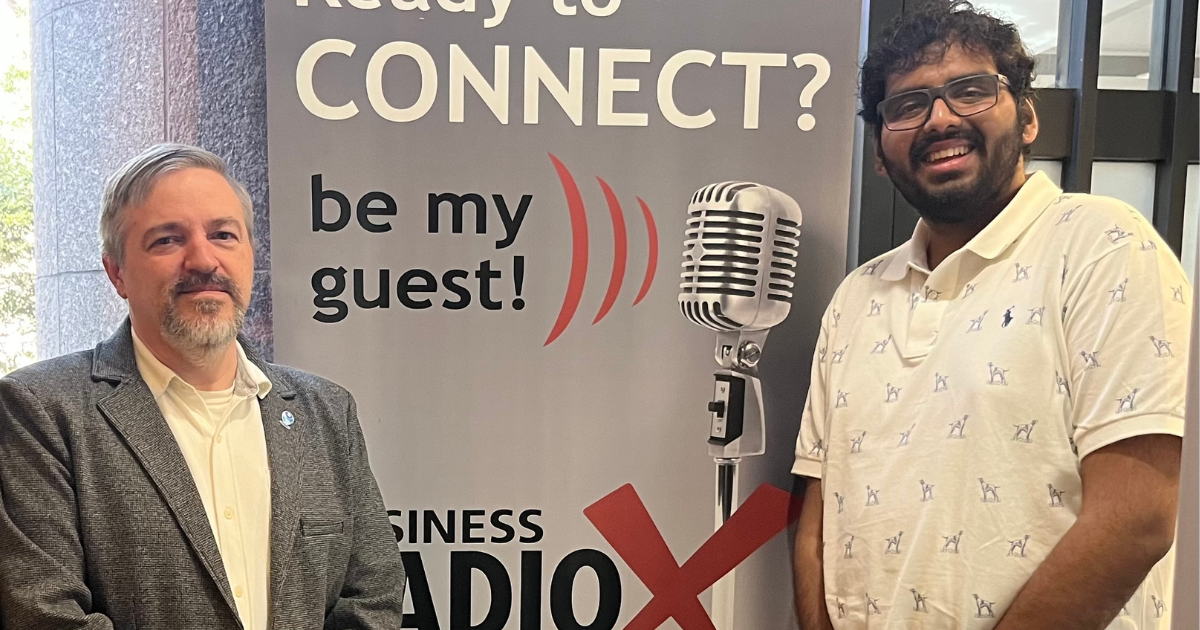
In this episode of Greater Perimeter Business Radio, host Erik Boemanns interviews Anvith Anand, founder and CEO of Abundance Intelligence Corp. Anvith shares how his experiences at Tesla and Figure AI inspired him to tackle inefficiencies in procurement, especially for small and mid-sized businesses (SMBs) seeking government contracts. The discussion covers the challenges SMBs face in accessing government opportunities, the importance of mental alignment in procurement, and how Abundance Intelligence streamlines proposal processes to help SMBs compete more effectively.
 Anvith Anand is CEO of Abundance Intelligence Corp. He is a recent graduate from Georgia Tech.
While Anvith was studying, he did a couple of internships and spent nearly a year at Tesla and another five months at Figure AI.
Connect with Anvith on LinkedIn. 
Episode Highlights
- Anvith’s background, including his education and internships at Tesla and Figure AI.
- Origin of Abundance Intelligence Corp. from a problem encountered during Tesla’s production ramp-up.
- Focus on improving procurement processes, particularly in government contracting.
- Challenges faced by small and mid-sized businesses (SMBs) in accessing government contracts.
- Importance of communication and mental alignment in procurement.
- Government spending on SMBs and the mandates for budget allocation.
- Pain points for SMBs in preparing government contract proposals.
- The significance of mentorship and learning from failure in entrepreneurship.
- Insights on the startup ecosystem and the reality of startup success rates.
- The evolution of ideas into successful businesses through testing and adaptation.
About Your Host
 Erik Boemanns is a technology executive and lawyer. His background covers many aspects of technology, from infrastructure to software development.
He combines this with a “second career” as a lawyer into a world of cybersecurity, governance, risk, compliance, and privacy (GRC-P).
His time in a variety of companies, industries, and careers brings a unique perspective on leadership, helping, technology problem solving and implementing compliance.
Connect with Erik on LinkedIn, Substack and Medium.
 This transcript is machine transcribed by Sonix
TRANSCRIPT
Intro: Broadcasting live from the Greater Perimeter. It’s time for Greater Perimeter Business Radio. Now here’s your host.
Lee Kantor: This episode of Greater Perimeter Business Radio is brought to you by Mirability with their new compliance XO service taking you from it risk to it reward. Now, here’s your host Erik Boemanns.
Erik Boemanns : So, Happy March. I would say it’s a nice spring day, but it’s actually a very cold today as we’re recording this. But, um, today I have with me, I appreciate you braving the cold to come out. Anvith, the founder of Abundance Intelligence. So I’d love to maybe just get a quick background about who you are and then your startup, and then we’re going to dive into the conversation. Sure.
Anvith Anand: Thank you so much for inviting me, Erik. Hi everyone. All the listeners out there. My name is Anvith Anand. I am the founder and CEO of Abundance Intelligence Corp. I am a recent graduate from Georgia Tech. So class of 2025 did computer science there. And a little bit more about me is that, uh, while I was studying, I also did a couple of internships and I spent nearly a year at Tesla and another five months at figure AI.
Erik Boemanns : Awesome. And I think one of those involved a robot, right?
Anvith Anand: Well, depending on whom you ask, all of them involve robots. But yes, AI is currently on the path to build humanoid robots, general purpose humanoid robots. So like the our ever goal of having some a robot vacuum our house, right? Do our chores for the house, fold our laundry, cook for us. That’s the path that AI is trying to solve.
Erik Boemanns : Interesting. However. So Tesla figure AI and then you have abundance intelligence. Tell us a little bit about that because that’s not about robotics.
Anvith Anand: No it’s not. So abundance intelligence actually came up, came out of an experience that me and my close friend at Tesla had. So both of us together. So me as the software engineering intern and him as the technical project manager, in turn, started ramping up the Tesla Gateway production line. So for those of you who do not know, gateway is this box that sits in your house that allows you to connect your solar panel and your Powerwall to your to the grid and your house, and allows you to manage all of that and allows it to stay all of that in sync. And while we were ramping up the production line, like he was just going through back and forth email to procure various different parts to, to ramp up the production line. And we thought to ourselves, there has to be a better way. So Abundance Intelligence came out of the idea, okay, let’s try to solve that problem. Let’s try digging deep and figuring out why is it that in 2026 it’s or I guess back then in 2024, was it so, so much easier to just ship the parts than to send back and forth emails and communicate things that we wanted?
Erik Boemanns : Interesting. And so how has. So from that idea that you had in 2024 to today, how has abundance Intelligence involved evolved? I’m sorry.
Anvith Anand: So first things first. It wasn’t even called abundance intelligence back then, right? So back then, it was just two of our friends working on this project. Lily. For me, that was my senior design project. So the one good thing about Georgia Tech is instead of taking a senior design, what you might have in other universities, Georgia Tech allows you to do pursue your own entrepreneurial path. And my friend and I decided, okay, let’s try and see where this thing goes, right? Because this seems like a problem that needs to be solved. And the best part is we also got $500 to see how we could spend to learn more about the problem. And that’s where it started. So initially we were just probing on both of us coming from a manufacturing background, were like just going around talking with various different people in various different manufacturing fields to understand, okay, what is the problem with procurement? Why is it that everybody in procurement is in communication hell? So that is where we started. And as we realized that we as we started narrowing down our ICP from going from, okay, everybody who’s manufacturing anything to then say, okay, maybe automotive manufacturers or like textile manufacturers and then further refining our ICP down to say, okay, it is not just these manufacturers, but it’s also consultants. Because at the end of the day, what is a consulting company doing? All they’re helping you do is what I like to call communicate mental alignment.
Anvith Anand: Okay, so this we’ve spoken extensively about this off the podcast, but for new listeners here. So what this means is that let’s take a step back and see what all this charade call procurement is about. Every business wants to achieve some goals. And for us, as we humans, as social species, have realized that it is not possible for us to do it alone. So what what procurement tries to solve is to say, okay, how can we bring humans together, collaborate together to solve this big hairy problem? I think back in the Middle Ages or even earlier than that, for early humans, it was, okay, how do we get our next meal right? How do we kill this giant mammoth? So like all of us can eat. But now in 2026, it is more like, okay, how can we solve this ERP problem for our business? And what procurement tries to solve is, from my understanding, is that rather than going out and searching for the best vendor, they’re trying to figure out, okay, who is this vendor who understands the jigsaw puzzle? That is, each company understands what pieces are missing, what pieces are good, where the company wants to go in five years and can come and put that one magic puzzle, one magic last piece to solve the entire puzzle. And all of this is just mental alignment if you take a step back.
Erik Boemanns : I don’t know if you do. You remember the cartoon The Far Side, that comic strip? It was.
Anvith Anand: I might be too.
Erik Boemanns : Young for.
Anvith Anand: The reference.
Erik Boemanns : So when you talked about hunting mammoths, I’m like the mammoth procurement department made me.
Anvith Anand: Think.
Erik Boemanns : There’s lots of, um, if you look it up, you’ll see lots of mammoth hunters in that comic strip. And so yes, the mammoth procurement department all the way. Fast forward now to I think you have your focus is more on government contracting though. So how did you get to that?
Anvith Anand: So that is a really good question. So I would actually like to shout out Miss Montana. She was the one who put me on this path. So initially. So when I started looking at this problem seriously in end of 20 in August of 2025 when I went full time on this idea after graduation is initially I just started saying, okay, where is it that the problem is the biggest, the headiest. And obviously it was in vogue in 2025 with the Department of Government Efficiency to say, okay, how can we make our governments more efficient? How can we bring back trust into our government? So that was always in my psyche, but it was like speaking with Miss Montana earlier this year is what truly shown the light on this space to say, okay, you should be focusing on government because one, it is obviously a big industry, right? It’ll always be. And number two, more importantly, think more local because like, everybody sees a $700 billion budget for the federal government and says, oh my God, like the United States government, biggest purchases are out there. If I could just sell it to them, I’m guaranteed to always sell. But in my mind, like, let’s start thinking more state and local, right? So I believe like last year, the 50 states combined put $3 trillion towards procurement alone. So which if you think about it, that’s a huge, huge number. And all of these are and the best part about these investments is that if they’re focused on small and midsize businesses, they go back right into the community where they serve. So it is not money that is moving out of the state to one other state or moving out of the country to another entity. It is all coming back to our community, where it’s all being spent again and raising the collective GDP of the community.
Erik Boemanns : Yeah. So you mentioned mental alignment before. You mentioned helping procurement be better, right? Whatever the procurement means. And then we talked about government contracting. So the products slash service that you’re working on today, how does that solve this space?
Anvith Anand: Okay, so really good question. Uh, so, so far from my discovery, I have realized that the governments out there want to spend money with small businesses, right? I think, yeah, the federal government has a 23% mandate to be spent on small businesses. And various other states also have different mandates. I think like the state of New York achieved a historic 31% expenditure on government, on small businesses and even the state of Texas. It was a big number, if I can remember it, off the top of my head. I’m sorry for the listeners. Like, I’m totally sorry. Yeah. And even here in the state of Georgia, right. So there was initially a bill that was, that was trying to mandate a 20% or guaranteed spent on small businesses, but that has since been refined to say, okay, rather than outright put that or put that 20% cap or put that 20% goal, why don’t we make it more, uh, interest based to say, okay, where we, where they actually align prime contractors or like these large contractors that you can think of, like think Raytheon or that’s the obviously canonical large contractor to say, okay, anytime you work with a SMB on your, on these projects, we’ll give you a 10% reduction in your taxes.
Erik Boemanns : Okay.
Anvith Anand: So these governments want to spend this money out here with SMEs because they realize the importance of the money flowing within the economy and enriching the local community and. But there are these, but likely like, I think like it was last Saturday, but I was in this meetup for a small businesses around northern Atlanta, and most of them did not even know about these programs. So that is where that is where this, that is the puzzle that Scriber is now trying to solve for abundance. Intelligence Corp is now trying to solve its Scriber. It’s to say, how can I connect these businesses that can, that are able to produce right, that are able to produce goods in a relatively timely fashion? They are they have the skills. How can I be? How can I instill the spirit in them and allow them to meet the opportunity that exists?
Erik Boemanns : Okay. And so small midsize business SMEs, obviously, lots of challenges in that space, right? That’s just nature of, of being an SMB. Which particular pain are you focused on and how are you helping them go after these government contracts that they may not even know about today?
Anvith Anand: Really good question. So right now, the average proposal that is written to to submit for government contract like this even before you awarded. It takes 32 hours to write. Okay, two of those hours are literally just spent in manually searching for documents. Like think about scavenging your old emails, right? Looking at OneDrive, looking at your various different files, pinging your team.
Erik Boemanns : Journey, how can they find you? Where do they reach out?
Anvith Anand: Oh, I am most active on LinkedIn. Just search for LinkedIn with Anand. That’s A n v I t like technology H like Hadi. On with Anand, a n a n d like Delta. And you can reach out to me there. My DMs are always open. Yeah.
Erik Boemanns : It’s okay if you don’t, but did you want to share the website too?
Anvith Anand: For sure. Yeah. And you can find out a little bit more about Scriber on get Scribd.com, that’s G e t s c r I b like beverage R like romeo.com.
Erik Boemanns : Awesome. So I think you shared a few of the surprises, but obviously, is this your first startup or have you done this in the past?
Anvith Anand: This is my first.
Erik Boemanns : Okay, so first startup to two years in a lot of revolution evolution for the the way you’ve been thinking about it and even the way you thought about the ecosystem. But what are some surprises that you’ve had that you’d like to share with other founders out there? Just the things to be aware of that maybe you didn’t, you didn’t know until you knew.
Anvith Anand: Okay, so the classic example that comes to my mind is most companies die within the first 90% of the companies die within the first three years. And every entrepreneur thinks, no, like the 90% stat. Don’t worry, I’m part of the I’m part of the last 10%. And while that mentality, that naivety is what makes a good entrepreneur, you also have to come to terms with saying yes. And like, I’m more likely to be part of the 90% than the last 10%. I’m not saying do not. I’m not saying like, oh, that means like doom and gloom to say, oh my God, I should stop it immediately and go work 9 to 5. I’m just saying, just keep that in the back of your head, right? Just like that is a true fact. Just pay attention to it. Remember that. And the more important part is that it’s okay if you fail once. Like that is something that I never understood. But only now am I understanding this to say, how is it that failure is viewed as a success in the entrepreneur entrepreneurial path? And it sounds so counterintuitive to what you might think, but the only way to experience that, the only way to truly understand it is to experience it.
Erik Boemanns : Yeah, absolutely. People who haven’t actually failed before probably haven’t learned something. Right.
Anvith Anand: So yeah, I was actually going to ask your take on this. What do you think about what I just said and this learning about failure?
Erik Boemanns : Yeah. I mean, it’s, it’s a trope now, right? The fail fast and fail often. And as long as you’re not breaking laws or hurting people, that is a genuine way to approach this because you have to, especially in the startup space, you’re going to get, you said 90%, 10%, right? Most of most ideas are in that 90% not they might be a great idea, but they may not have market fit. They may not have customers. No one else may think it’s a great idea. So all of those ideas when you have them, if you don’t find a way to test them, then they’re just going to say. You’re not going to find out if they’re the 10%. But more importantly, you’re not going to refine them to become the 10%. So you yeah, I even my own business journey has been a lot of refining and re-adapting and refitting because yeah, we all have ideas, but ideas aren’t businesses.
Anvith Anand: I think that’s great. You brought that up. But the other point that I wanted to realize is that every, every entrepreneur has skeletons in their closet. You might think about like Zuckerberg saying, oh my God, like beautiful first idea Facebook initial like easily, like, oh, easily the best minds out there. That’s not true at all. Like Zuckerberg has been building since had been building at least since he was 12 years old. Like even now, Sam Altman all the work, right? Like the essentially the visionary of the future. But he has been in the startup ecosystem since 2008. So I just want to say that it is it’s okay. Like into any to all the new entrepreneurs listening out there and to all of those who have who have had multiple failures or are now successful, I’m sure they will all empathize with the idea to say, your first one is never rarely this success, right? It’s never like I have not heard a single entrepreneur whose first idea became $1 billion unicorn. Everybody has skeletons in the closet.
Erik Boemanns : Yeah. And if they are they such an exception or they they failed elsewhere and just don’t count that. Right. So, um, now this is great. And I just want to say thank you again for coming out. And I don’t know if there’s anything else you did want to share before we wrap up today.
Anvith Anand: Uh, I just want to say thank you so much. Like, uh, being part of this type program and having the opportunity to be your mentee has taught me a great deal. And I just want to put it out there to say, I’m really grateful for the time that we have spent together.
Erik Boemanns : Awesome. Yeah. Likewise, it’s been a great experience. And again, thank you. And, um, here’s to more success. Here’s to more failures and some successes after that.
Anvith Anand: Thank you.














