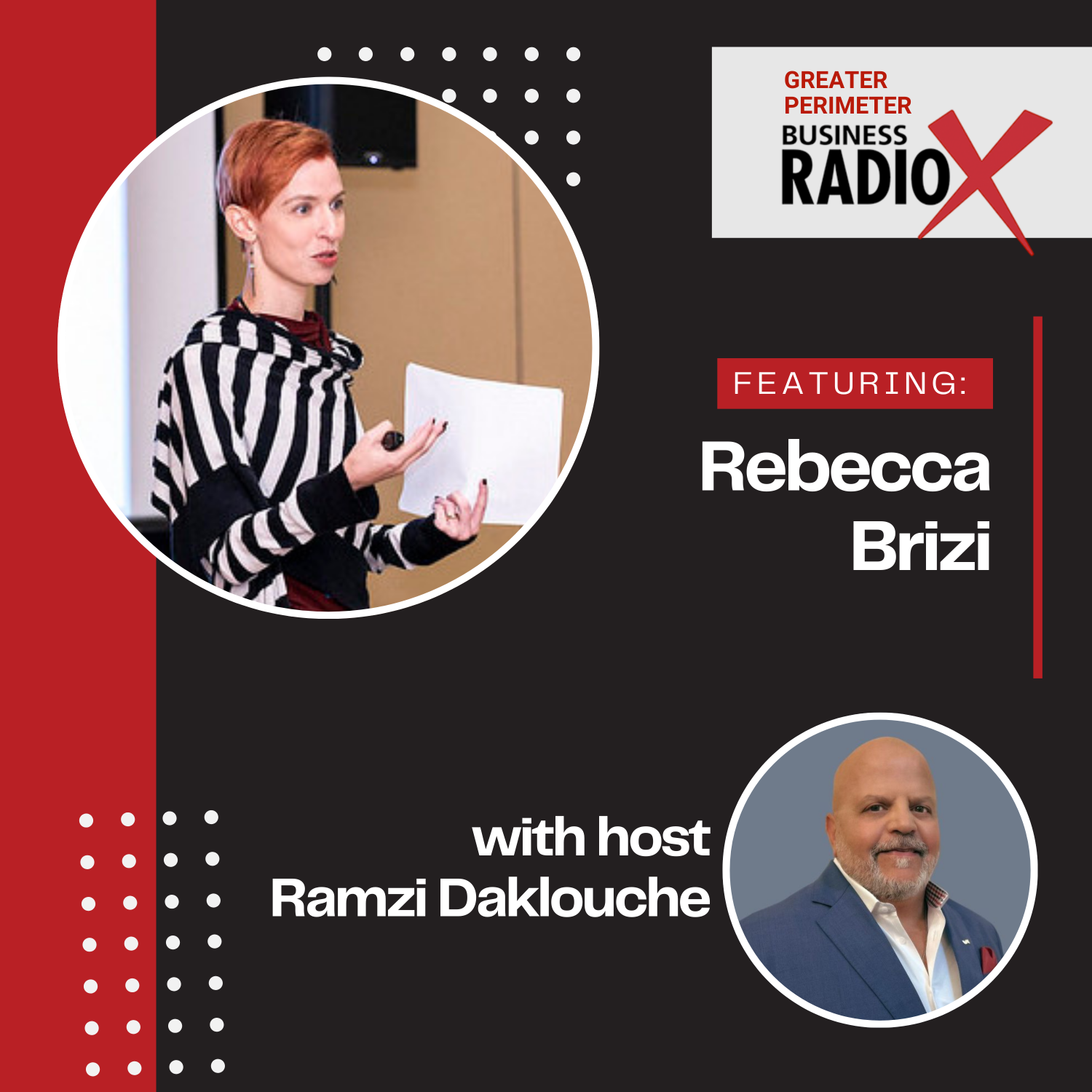

In this episode of Greater Perimeter Business Radio, Ramzi Daklouche engages with Rebecca Brizi, a business strategist and founder of RGB Consulting. Rebecca shares her journey from managing client relationships at a startup to consulting for small businesses. She emphasizes the importance of aligning mission and values with business operations to combat decision fatigue. Rebecca discusses her services, including team alignment workshops and operational strategy development. The conversation also covers the role of AI in business, effective networking, and the significance of referrals. Rebecca’s insights provide practical advice for entrepreneurs aiming to streamline their operations and stay true to their core purpose.

 Ask 12 Italian grandmothers for their tomato sauce recipe, and you will get thirteen different answers. They will all use tomatoes, olive oil, basil… but the quantities will vary, as will the one special ingredient everyone has.
Every business has to have a loyal clients, dedicated employees, and business goals, but the specific recipe is unique to each entity.
Rebecca Brizi examines each business to discover what their special, unique recipe is, and build a plan for all those separate ingredients to function well together, so business owners can focus on what they do best: their craft.
Connect with Rebecca on LinkedIn.
 This transcript is machine transcribed by Sonix.
TRANSCRIPT
Intro: Broadcasting live from the Greater Perimeter. It’s time for Greater Perimeter Business Radio. Now here’s your host.
Ramzi Daklouche: This episode of Greater Perimeter Business RadioX is brought to you by V.R. Business Sales of Atlanta. Your trusted partner in business transactions. Whether you’re planning your exit, preparing for growth, or seeking the right buyer, we are providing expert guidance with transparency and strategy to help you close the right deal at the right time. Learn more at world.com. I’m your host, Ramzi Daklouche. And today I’m excited to welcome Rebecca Brizi, business strategist, speaker, and founder of RGB Strategy. Rebecca’s work focuses on simplifying the day to day reality of running a small business. Her unique approach aligns mission, values and process to build culture, empower employees, and bring the owners vision back to life. You can explore more about her methodology at www.rgbrizi.com. Let’s dive in. Rebecca, how are you today?
Rebecca Brizi: I am well, thank you for having me.
Ramzi Daklouche: So thank you for joining us. I really appreciate you and I’m looking forward to this episode.
Rebecca Brizi: Me too.
Ramzi Daklouche: So before we start, tell us a little bit about yourself. And, you know, how do you start with this? What’s your background like? Nobody kind of wakes up in the morning, say, I’m going to be coach. They had a background. So tell me a little bit about what you do.
Rebecca Brizi: That’s that’s very true. Nor did does anybody or most people, I presume, grow up thinking when I grow up, I’m going to be an operational strategist. So it does kind of happen to you? Yeah. My background, prior to starting my consultancy, I, uh, ran a software business, so I joined a what was at the time a startup. Um, a couple of years into that, I was brought in as a partner, and the first thing I did there, we were very much a startup, and there were three of us. And I was told, we’ve got about 50 clients. They’re large corporations and large law firms. We need to show them some care. But it’s just three of us. So call them up and make them happy. And that’s what I did. And I came from a completely different industry. So it was very much learning by doing. But I would hold up all these clients and essentially say, how is the product, how is the service? And occasionally they would start to say, well, there’s this or there’s that. And I would say, well, tell me more about that. And what I realized was that the other vendors they were working with were mainly large household name type technology vendors were nobody was asking them, tell me more about that.
Rebecca Brizi: And through this, I built very strong relationships with these customers and was able to give a lot of useful information internally as to how we could develop these relationships. Um, we built a strong, as I say, relationship, very high retention. But over the years, as the business was growing, and especially once I came on as a partner, what I realized was turning those skills inward. I was good with the customer relationships, not very strong necessarily in sales and marketing. That’s not where my strengths were. But using that same approach of listening, solving problems internally is really where I started to shine. So as we were hiring people, as we were growing, as we were entering new markets, developing our product, figuring out the strategy for continuous growth and continuous improvement. So that’s what I did with that business for many years. Eventually I moved to the. This was in the UK. I moved to the United States to open a US office for that business. Got to kind of do it all over again, setting up the US operations. Um, and eventually I took my show on the road and do it now as a consultant.
Ramzi Daklouche: That’s awesome. It’s interesting you say you’re not a sales person, because I’m sure you’re very good at it, because anybody that asks the question, tell me more about that are curious in nature, right? Sure. And people like to talk about tell me more about that. So if you ask me that, it’s great because I could tell you all I want about then I’ll buy anything from you because you allowed me to speak and or allowed me to be heard, which is very important. Any sales. Right.
Rebecca Brizi: So to say.
Ramzi Daklouche: Solving so solving problems for people is actually sales more than anything else. So instead of just, you know, uh, you know, introducing a product and just talking about the product and throwing up at people, I used to say, don’t throw up at people. Listen to them. Right. Rebecca, you say running a small business should be simple and fun. What’s getting in the way of most owners today?
Rebecca Brizi: You think that, um, there’s it’s there’s just so much to do. I mean, at the risk of seeming to oversimplify running a small business, there’s so much to do. I talk a lot about decision fatigue, for example. And it’s it’s, you know, managing clients and employees and internal operations and, you know, the craft of the business as well as the management of the business. Think of everything that a large business does. And now all of that has to happen with so many fewer resources. Nobody starts a business saying, well, I really hope that it’s overwhelming and complex, and I don’t sleep at night. And yet, for how many business owners does that become a reality at some point? Yeah. So I so so that’s what gets in the way of it. It’s it’s there are too many options. Sometimes there are too many directions I could go in. There are too many moving parts. There are too many variables. So simplifying that is about putting in place a structure that simplifies that decision making, set some standards, makes it easy for people to know what matters and frankly, what doesn’t. And so only focusing on the things that matter. And the fun part I let let us all have fun on the thing that we have to do with our lives every single day. And and that drives our business, which, um, you know, it’s what we spend majority of our waking hours doing.
Ramzi Daklouche: Exactly. Especially small business. Right? Yes. And I, uh, I see a lot of people from corporate come into small business and they forget that they have an army behind them that can help them with decision making. Yes. And it doesn’t matter if you are a big consultant in a, you know, top five firm, open a bakery. The work is completely different. You don’t have an army. It’s just you.
Rebecca Brizi: Exactly.
Ramzi Daklouche: You and you. Right? Yes, exactly. So. But I think people forget how hard it is to run a small business. Yeah.
Rebecca Brizi: Absolutely.
Ramzi Daklouche: Absolutely. Okay. You often work with clients to realign them with their mission. How do you reconnect someone with the why behind their business?
Rebecca Brizi: I ask them over and over, you know, it’s the five whys, essentially. But, um, what I also find is that often what we think our why is or the first answer to that question, is often aspirational and not always, uh, a reflection of the truth. And so by going through. Yes, but why that and why that. And then also it’s not enough to just figure out what drives us and what makes us happy and motivates us. But putting that in context because, okay, but now you also have to do a run a business and do a thing every single day. So how do we connect that to the service you’re providing and the reasoning behind it, and also make it very tangible? That’s another big thing I talk about a lot is this cannot just be a concept or an idea. This has to be recognizable so that anybody who hears you saying this is picturing the same thing that you’re picturing. Yeah. So don’t. So don’t just let it be words that sound good on paper or that maybe mean something to you alone. You need to also take it a step further and give it that full explanation.
Ramzi Daklouche: Yeah, in small business, you know, the small business is defined differently, right? Some sometimes, you know, a sole entrepreneur is some small business. And sometimes they have ten, 15, 20, 50, 200 people. Still small business. So what’s this sweet point? Because if you’re talking to somebody who has only a few people, he is or she is a technician of their business, they really are not thinking about a mission or a vision. They have dreams maybe, or aspirations just to pay the bills sometimes, right? But how how does it, uh, how do you treat it differently from depending on the size of the business?
Rebecca Brizi: Not not very differently, to be honest. I mean, even with a one person business, I’m going to talk about mission and values with the one person business. I will still build an organizational chart because all of the things sort of to your point earlier that have to happen in a in a business of any size, there are certain things that always have to happen or always need to be accounted for. So those don’t change. The fact of needing these elements doesn’t change much based on the size of the business. What they are will may change, and how they’re rolled out can change. In a business of three people, we work on mission. Everybody’s in the room. We’re doing this together. In a business of 100 people. We can’t bring 100 people together to drive the mission. And yet you still want, you know, the the 95 people who are not in senior leadership to buy into that mission. So the way that that we can embed that in the business looks different. But the element of having a mission, of having values, of making all these things well defined, that doesn’t change.
Ramzi Daklouche: Yeah. Do you find that in small business, specifically in small business, typically the mission reflects the dream of the owner.
Rebecca Brizi: Yes. And that is sometimes part of the problem. Sometimes that’s part of the block is that, uh, that’s when I say putting that into context. If it is a reflection of the dream of the owner, that is a starting point. But then sometimes we have to work beyond that and say, okay, now let’s we need a practicality to this as well. What is realistic? What are the available resources, the people who work for you and with you? What motivates them? Um, what’s going to get them on board with their dream? Is it a dream that you can share?
Ramzi Daklouche: Their dream may be completely different than yours. You have to find a common ground.
Rebecca Brizi: Absolutely. Yeah.
Ramzi Daklouche: Very good. Okay. How can a clear mission and value system impact how a team makes decisions and even reduce decision fatigue?
Rebecca Brizi: Uh, the mission and values of a business, and I when I write values, I use the term guiding principles simply because to me it’s more descriptive of what the value is. It is a, uh, a value, something that’s important to us, but it needs to reflect a behavior. And so that’s a guiding principle, what those two things do. Having those two elements in place, that is the framework for making decisions when the business needs to make a major decision, strategic or even operational. Going back to those and saying, if we make this change, if we do this thing, if we hire this person, make, you know, create this role, enter this new market, does that further our mission? Yes or no? Does that respect and uphold our values, our guiding principles? Yes or no? So that gives a framework to making decisions which simplifies the decision making. There are really two products, shall we say that I that I offer. One is the is team alignment workshops. Those are that’s when I go into a business. It happens in three steps. There’s a planning session with the owners to design the workshop. We then do a company wide or team wide workshop. The purpose there to do a lot of the things we’ve been talking about. And so there are different topics that we use depending on what they need. We pick the right one and do a team workshop altogether. And then there’s output. So I give homework and I review that. That’s stage three. So that’s one option. It’s $2,500. The other thing I do, um, if they want something more hands on, is to design that whole operational strategy. So writing out that mission vision, the org chart KPIs and then implementing that is a six month commitment. Um, we spend three months with the more intense planning and then three months to roll it out so that I’m there as they implement those changes as well and make sure that all happens smoothly.
Ramzi Daklouche: Yeah. Do you work? I mean, most of your clients are at the beginning stage startup clients or are they different stages? And what percent do you think like because the second program you have is incredible for somebody starting company, right? Yes. To build the strategy and also to build the culture, what they expect of themselves, what they expect of employees.
Rebecca Brizi: Yeah. Um, most of my clients are actually not brand new businesses. Um, the some are and but if they are, they generally have, uh, have had a business before and they sort of know, um, some of the basics. What I will say is a brand new business. Um, can engage me. I’m happy to talk to them and see, but I, I if I think they they don’t need me. Um, you know, they might not if they can be scrappy at first, especially if it’s a brand new business. Um, somebody who’s new to doing it. It’s okay to try a lot of different things and figure out what works in those first couple of years. Um, use the resources you have available, even if they’re limited to try a lot. Don’t, don’t don’t get too much into long term commitments for your business. Um, try different clients. Try different way different business models, different pricing, different ways of acquiring clients and start to figure out both what works and what doesn’t, but also what you like and what you don’t. And then let’s talk again in 18 or 24 months, and we’ll start to put the standards in place that because to your point, you know, good values should stay the same for a very long time. Yeah they should so and so take a couple of years to figure out first what what they should be. It’s okay not to know on day one.
Ramzi Daklouche: Yeah that’s awesome. So some of the questions I’m going to ask you now are really just my curiosity. My personal curiosity. I is, you know, been used now in just about every business. How is it used in your business?
Rebecca Brizi: It’s it’s a great support tool. Um, it’s it’s a good starting point for brainstorming. For example, when I’m working with clients, if I want them to go away and do something before our next meeting, I’ll say, go into your I chat tool and ask the AI tool the question. They’ll spit out some statistics, some facts, some ideas. That’s your starting point. So you don’t start with a blank page. Um, so I think it’s a great brainstorming tool. It’s a wonderful research tool. You must check your sources so, you know, make sure you know, you know, your AI tool is either giving you the source or you can ask it for the source so you know exactly what information you’re dealing with. But it’s all there. And it it’s it’s Google but cutting down the time, um, you know, giving you a more.
Ramzi Daklouche: Direct.
Rebecca Brizi: Answer. So yeah, I mean absolutely use it use it to your advantage.
Ramzi Daklouche: Yeah, I actually built the company. Mostly on AI tools and not ChatGPT. I mean, there’s so many of them, right? I mean, ChatGPT is the basic of it, and I appreciate it. Makes me faster, better and clearer.
Rebecca Brizi: And remember that you’re the one putting in the prompts, right? So. So don’t be afraid of AI thinking that it’s going to control you. You control it. To your point, there are all these AI tools out there, and you made them work for you because you knew how to prompt them to do the thing you needed, not the other way around.
Ramzi Daklouche: Yeah, prompting that’s a coaching session should be given by somebody. How to prompt ChatGPT. I think it’s very important. Okay, so I know you do a lot of networking and we all are looking for the same thing that next customer that we can work with. So let’s talk about that a little bit. What advice do you have. You’ve been doing this for eight years now. So you know you have your own way of doing it. You have your own structure of doing it. Maybe you have your own days and times that you like to do networking. Other days you’re producing. So how does it look like for you? Because it’s very important for a business of any size. I think the number one struggle for Struggled for small, small businesses, right? 3 to 1015 people is where do I get my customer? Where’s that next customers coming from? Where do I find them? Right. Yeah. Besides referrals and good reputation that really you cannot beat that. That’s that’s easy one because if somebody refers me 100% now I’m going to get that business.
Rebecca Brizi: Yes.
Ramzi Daklouche: Because of trust between the, you know, the people that referred me. Yes. To the to the new person. But otherwise how do you do your networking.
Rebecca Brizi: It’s so you say retention or sorry referrals and reputation. And I completely agree. To me that’s the foundation. I will grow my business through a good reputation and through referrals. So what can I do that will constantly give me referrals and a good reputation? That’s really my starting point. And so then bringing that into networking, I do network quite a bit. I enjoy meeting new people. What I’ve found is, is um, a the fun factor is important if, if I’m not having this is true for all of us, if we’re not having fun doing the thing we do to market our businesses. We won’t be successful at it anyway. So it’s, you know, finding where I like to network, how I like to network, what kind of structure to your point. Time of day. I mean, that matters if you’re more of an evening person, go to the evening events. Don’t go to the morning event. It’s okay. Right? So be be true to yourself in what will work for you. Um, time management of course is important. So there’s that always prioritizing client time. But so plan ahead. You know I like to do a lot of one on ones with people. I’m not going to organize it for later this week. It’s probably going to be in two weeks. So that I know that the time that I have to assign to clients and other work is safe. Um, but, you know, connecting. If there were one thing specific to networking that I would say is important, it’s being consistent. So be yourself. Be, you know, be the natural person that you are so that you will always be consistent. And so you’re building that reputation that is solid, that doesn’t you know, people don’t have different views of you or see you as completely different person depending on context.
Ramzi Daklouche: Yeah. It’s networking. I’m with you 100%. It’s an art. It’s not really like if you just go to these network events like in Hear chamber once a week, you really it’s like going to church but not praying. Any time after that, you’re just kind of, hey, you go, I’m here. You saw me. I’m done. Right? It is spending time with the one on one’s own stuff. Second thing I really love what you said is structuring your day right. I am not a night person. I’m an early morning person. Right? If I have a meeting after seven, I have to take a nap to make a 7:00 pm meeting because I wake up way too early in the day. So I know me and I’ll do all my networking literally early, early in the morning. And then I can start, you know, the other work. And I know that after 3 or 4:00 pm, I don’t want to talk to anybody. I’m just tired at that. I just wanted to so know yourself. I’m thinking networking. So don’t just accept any networking event or just show up for no purpose. Make sure you’re on purpose with the networking events, right? And how do you work with referrals? Like, you know, like how do people refer people to you? What does it look like? Do you meet a lot of people? Like for me, this is a referral vehicle. What does it look like to you?
Rebecca Brizi: One thing I do say is I appreciate that what I do is, um, can feel nebulous to some people if they’ve never had the experience, if they’ve never done it. Um, it’s it’s, you know, it’s hard to point to business operations and say, see, she she sells this thing. So, um, so one thing I, I’m happy to do, and because I like networking anyway, so it serves me well. I’m happy to be the first conversation with somebody. If you don’t know exactly what somebody needs, I will talk to them. And, um, and perhaps I have what they need, but if I don’t, I can then redirect them to another resource because I keep the CRM, this Rolodex of contacts, and I want to be able to refer to others as well. So that’s one thing I do. I don’t expect other people, those referral partners or sources to be able or to to have to explain what I do in detail or, you know, fully understand it. That’s that’s not their job. So, um, happy to be the first conversation. I’ll hop on a half hour call with anybody, um, and see exactly what they need and pass it on. And that, as I say, serves me well. It helps me serve my network as well.
Ramzi Daklouche: That’s exactly right. Perfect, perfect. Well, listen. Thank you very much. It’s been fun. Fantastic. And I love the clarity of how you coach and what you coach. I think it really comes through. Thank you very much. So, Rebecca, thank you for joining us today. For anyone listening, if you’re a business owner looking to realign your operations with your mission, or if you’re someone who regularly for small business for strategic support, Rebecca is a great resource. You can learn more and get in touch with Rebecca at. And if you are thinking about selling your business or just want to understand your options, feel free to reach out to me Ramzi Daklouche at Business Sales of Atlanta. You can find us at Vrbas World.com. We’re here to help you plan a successful transition with confidence. Again, Rebecca, thank you very, very much for today’s episode.
About Your Host
 Ramzi Daklouche is Principal at VR Business Sales. His mission is to facilitate seamless transitions for business owners looking to sell or scale. The organization’s four-decade legacy in managing transactions, from modest enterprises to extensive mergers, resonates with his expertise in mergers and acquisitions. Our collaborative approach consistently unlocks the true value of businesses, ensuring sellers’ peace of mind throughout the process.
His journey began when he left corporate world to venture into the challenging realm of entrepreneurship. After running their own business for several years and earning accolades for their dedication to service and quality, he decided to establish VR Business Sales Mergers and Acquisitions Atlanta. Their mission is to provide unmatched value through transparency, security, diversity, service, and experience.
At VR Business Sales Mergers and Acquisitions Atlanta, they empower business owners and buyers with clear, honest guidance and exceptional service throughout every step of the transaction process. While their office is based in Atlanta, they offer their services nationally and globally, embracing diversity and engaging with a broad spectrum of communities and businesses.
With decades of industry expertise, they aim to build lasting relationships based on trust and excellence, enabling their clients to achieve their business goals with confidence and peace of mind. Whether they are transitioning from owning their business or moving toward ownership, they’re here to support every step of the way, navigating the vibrant landscape of Atlanta’s business community and National & Global markets for remarkable success.
Connect with Ramzi on LinkedIn.















