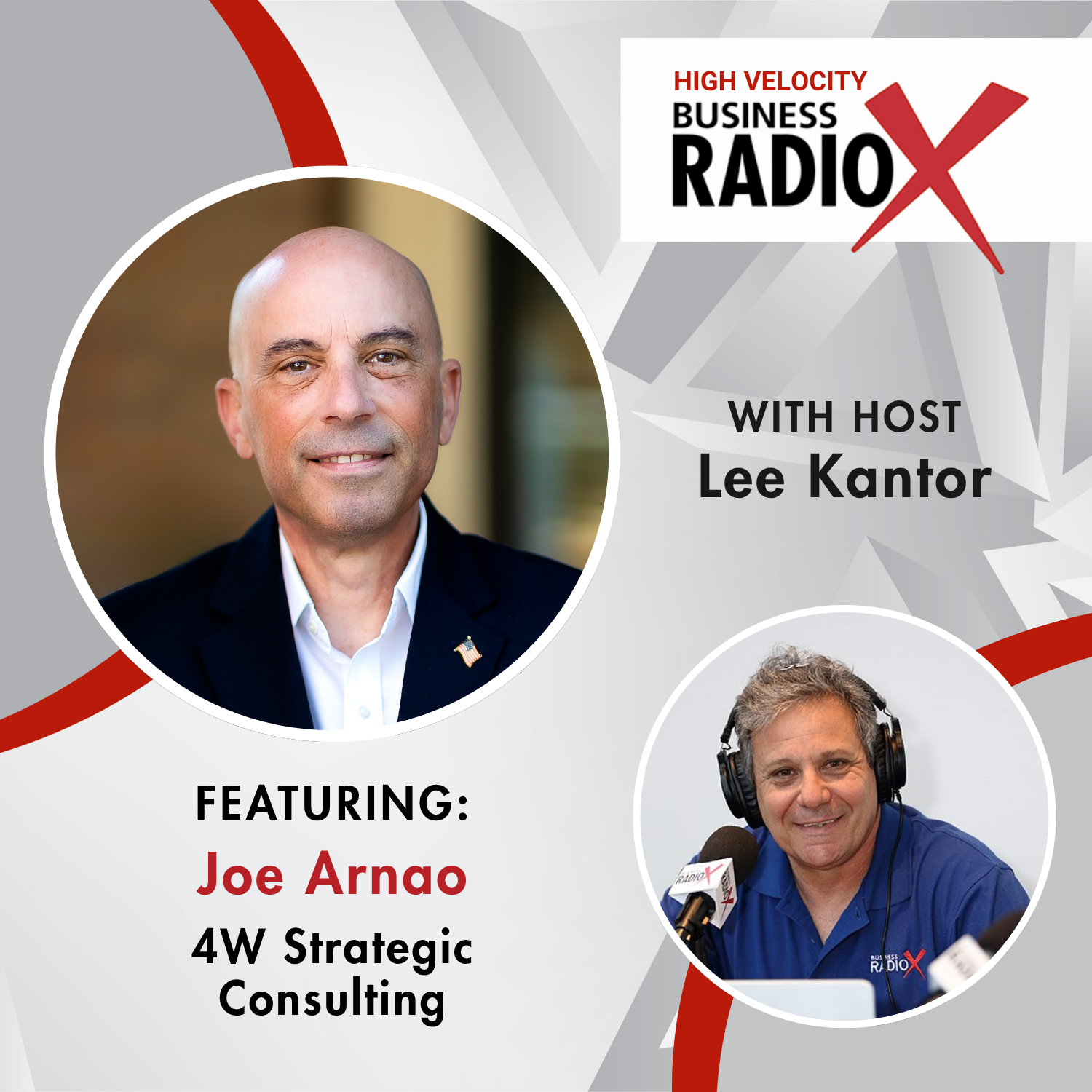

In this episode of High Velocity Radio, Lee Kantor interviews Joe Arnao, founder of 4W Strategic Consulting. Joe shares how he helps real estate professionals and solopreneurs find their next best path by gaining clarity around who they are, what motivates them, where they thrive, and why they are pursuing their business. He discusses the importance of aligning with the right company culture, leadership, clients, and business model rather than simply following someone else’s version of success. Joe also introduces his Bearing Brief, a guided process designed to help entrepreneurs identify their strengths, ideal clients, energy drivers, and strategic direction.
 Joe Arnao is a 20+ year real estate veteran, coach, and founder of 4W Strategic Consulting. The idea behind 4W grew out of his own experience with professional misalignment.
Beginning in 2021, he found himself questioning work that had once felt meaningful. A move from Massachusetts to North Carolina, new leadership roles, and a battle with cancer deepened that period of reflection.
Over time, he recognized the same pattern in many of the agents and professionals he had coached and recruited. They were working hard, but often inside businesses, roles, or environments that did not fit who they were.
That realization became the 4W Framework, built around four questions: Who are you, What do you need, Where do you thrive, and Why does it matter?
 It also led to The Bearing Brief, a guided process that helps professionals uncover what is distinctive about them and build their work around their strengths, values, experiences, and perspective.
Today, he helps professionals gain clarity, make better career and business decisions, and create work that is more aligned with who they are.
Connect with Joe on LinkedIn.
What You’ll Learn In This Episode
- Understanding the importance of finding the right business and organizational alignment.
- Recognizing signs of misalignment in company culture, leadership, and work environment.
- Building a business around personal strengths, values, energy, and authentic identity.
- Moving beyond appearances and social media comparisons when defining success.
- Identifying the who, what, where, and why behind an entrepreneurial path.
- Using self-awareness to determine ideal clients, relationships, and business opportunities.
- Creating a personalized approach instead of following a one-size-fits-all growth strategy.
- Prioritizing genuine human relationships and conversations as essential business activities.
- Developing clarity and confidence to make better career and brokerage decisions.
- Supporting real estate firms in attracting, coaching, and growing the right agents.
 This transcript is machine transcribed by Sonix.
TRANSCRIPT
Intro: Broadcasting live from the Business RadioX Studios in Atlanta, Georgia. It’s time for High Velocity Radio.
Lee Kantor: Lee Kantor here another episode of High Velocity Radio and this is going to be a good one. Today on the show, we have the founder of 4W Strategic Consulting, Joe Arnao. Welcome.
Joe Arnao: Hey, thanks so much. Great to be here, Lee.
Lee Kantor: Well, I am excited to learn about your practice. Tell us about 4W Strategic Consulting. How are you serving folks?
Joe Arnao: So I’m helping people figure out their next best path in their business. It started out in the real estate industry. I have been coaching and consulting with real estate agents for about 20 years, and started this firm to not just recruit agents to other firms, but to help them figure out where their next best path is. If they’re thinking about making a brokerage change, I help them determine is it really something they need to do? If it is, then I help them figure out what that brokerage should be. And we do a deep dive into who they are and what they need, where they should be, and the big why. Why are they doing all this so that when they walk into that brokerage, they’re locked and loaded and they know it’s going to hit or it’s not. And the cool thing is this works with just about any industry as well, right?
Lee Kantor: Now, you mentioned real estate and I guess the nuts and bolts of the real estate industry is choosing the correct or the, the correctly aligned brokerage. Is that a make or break decision for folks in real estate? I’m not I’m a lay person in this area. I don’t know anything about it, but it sounds like that’s the focus of your practice, that you help make sure that people are in the right place.
Joe Arnao: 100%, 100%. It’s real estate for sure. You need to be aligned with the leadership, the people that are around you. The culture has to be right, the support has to be correct. And that goes across just about any kind of company somebody’s going into. If there’s a misalignment in morals or vision, it’s going to weigh on the agent or the employee, and it’s going to hold them back.
Lee Kantor: Now, what are some maybe signs or signals that there is misalignment, that you are not in the right place? What does that feel like?
Joe Arnao: Slotted a lot of people will feel like they’re not being heard. They’re not excited about going into the office and being around the people. The leadership is not available to them. They don’t trust what the leadership is telling them to do. There’s not a lot of respect. The environment might be too aggressive. It might be too laid back. It depends on the person and what they really going to align, who they’re going to align with. And it really affects their energy and their production or their work suffers.
Lee Kantor: Now is this an issue? Is this kind of a leadership issue of who’s running the firm? Or is this just a situation where the employee just has to do a better job vetting where they’re going to work?
Joe Arnao: Yeah. If they you know, the one thing about real estate firms, it’s really quite apparent what type of leadership there is, at least for for me, I’ve been in it long enough. And I think for others, you can see the culture that’s in that company pretty easily. And it is absolutely 100% leadership driven. Now, every firm is not going to hit every it’s not going to check all the boxes for every agent. So there’s a firm for every agent, and it’s an agent for every firm. They’re not always going to be one size fits all. That just doesn’t work. So it’s really important for somebody that’s making that move to evaluate all the different aspects of that company they’re going to, so that their alignment will be correct from the start.
Lee Kantor: Now, you mentioned you’ve been doing this for a long time. Is this something that you’ve just kind of knew at the get go, or is this something that you got a lot of scar tissue? Um, it kissed some, some frogs along the way.
Joe Arnao: 100%. There’s so there’s a lot of this came out of my own misalignment with recruiting and coaching. I worked for some great companies. And what I found is I had more allegiance to the agents than I did to the company. I wanted to make sure the agents are doing the right thing, because they’re the ones that are making the money for the firm, and they’re the ones that it’s their business. It’s their backs that the company is riding on. So I always felt internally more allegiance to helping the agent grow. And the reality is it does help the brokerage. Yet it’s all about the brokerage rules. And sometimes they just didn’t fit. And there was just a often a struggle. And often to some of the, some some of this is built on. It’s a numbers game. Recruiting is a volume situation in some firms where you have to bring in. A lot of people see who sticks, see who fails. And that is an expensive proposition for the individual and the company as well.
Lee Kantor: Now, what is it like, um, in today’s kind of real estate environment, like right now, this isn’t exactly the best time. I would wouldn’t think to be a real estate agent in most markets. How do you know when when it’s a good market? You know, everybody’s a genius and everybody’s systems working because everybody’s making money. It’s it seems easy, but when it’s kind of a rougher terrain, then, you know, you can tell now who is who.
Joe Arnao: Yeah. There is no, I don’t think there’s ever really a good market. There’s always somebody struggling in looking back at 2021. It’s funny people saying I everything was so good in 2021 because they were all making money. 2122 the end of the, uh, beginning of 22. There was so much grief with the agents because the properties were selling so quickly, people were putting in multiple offers, losing deals. They were coming off the market so fast that chasing buyers or bringing buyers around to all these properties, they were they were burning out and they weren’t happy. They were making money. Now it’s, it’s, it is a bit slower in some markets and there’s still challenges. There’s always some kind of challenge that’s going to come up, whether it’s the market scenario or the competition around you. There’s it doesn’t it doesn’t really affect the agents that have their head down and do the work. There are agents having their best year ever standing next to the person who is struggling and barely making it. So it’s really up to the agent and how they figure out how they’re going to make their make their business. And that comes down to being true to who they are Ah.
Lee Kantor: And that’s at the heart of it, right? You have to you have to kind of be honest with yourself because it seems tempting because it’s there by appearances. It looks like this person has their act together, but that might not be the right fit for your type of skills and personality.
Joe Arnao: Yeah, there was one story, an agent in the market I was in. She was, you know, consider her the person that had her face on the park, the, the benches and the, the busses and the billboards. And actually, I think she does have one on the billboard. She handed the check to the photographer, said, hey, can you please hold this till next week? So she didn’t have the money to back up her photographer. So appearances are really misleading in this business. From the social media posts we see, and we all know social media is not that real for a lot of a lot of different things. There’s always somebody out there that’s standing in front of a Mercedes or a yacht and, you know, they’re at the dealership, they’re just pretending to be successful so that they’re hoping that it’ll keep going. And there are agents that buy into that, and they see that as success and it just weighs them down, and they’re trying to figure out how they did it so that they can try to emulate who they are. And those people, if they actually did make it, they made that business because that’s who they are, doesn’t necessarily transfer or translate into any other person.
Lee Kantor: So now are your clients typically the brand new person, or is it the person that’s kind of been through the wringer a bit?
Joe Arnao: Yeah. They have to have some experience. They have to have done at least a year, at least a year of business, you know, a dozen transactions or so. There needs to be. A knowledge of what they’re willing to do, what they’re not willing to do, their non-negotiables, the type of people that are going to rise them up, who they want to be around, what brings them joy in the business, where they’re part of the business they just really dislike. It takes their energy away, and they have to figure out where they’re showing up as their true self. If somebody is teaching somebody how to do door knocking and they’re not door knockers, and they have to go in every day and knock on 50 doors, they’re going to be miserable, and it’s going to show up on every door that gets opened and they’re not going to be successful. So they have to be fully in line with who they are and not try to fake somebody else’s model.
Lee Kantor: So then there’s no kind of magic growth plan for an agent. This is just something you find what works for you and just be relentless and double down on when it’s working.
Joe Arnao: Yeah. So there is that’s where you need to have that experience. So what I’ve developed is I’ve created this product called the bearing Brief, which my clients, not just real estate agents, they go through this process. It’s a guided process that I was using, I use for my clients that now is out actually online, that the person goes through it and it gives them a deep because a deep dive, the more you put into it, the more you’re going to get out of it. It takes about 90 minutes at minimum, and it gives that person a very clear picture of their identity, their brand identity, where that energy is going to come from, where they’re going to have to avoid sucking their energy away from them. It identifies their ideal client so that they know how to brand themselves to that attract that client, and they get a strategic force, four week program to get them up and running from there. So it comes down to like who, who is the person at their core? Where are they going to succeed? What is it that they need? What kind of tactics that they need or tools, systems and, and then why are they doing it? Because the big, the biggest one is the why this business, any business, any entrepreneur will tell you it’s, it’s not easy. So if you don’t have a big why, why are you getting up every day and pushing and creating and dealing with the realities of business? It’s not going to work. It’s not going to work. You can’t you can’t fake that at heart, that fake it to make it doesn’t make sense in this business.
Lee Kantor: And then when you’re saying this business, you’re talking about a business that is kind of, I don’t want to say solopreneur, but it’s driven by an individual. Um, no matter what it is, it might be real estate, it might be a consultant, it might be a business coach, it could be anybody that is that they’re the engine that’s driving the business.
Joe Arnao: Correct. Yeah. Thank you for pointing that out. Absolutely ideal. This this approach ideally is for the solopreneur. And they may have a small team. They are the driver. They are the visionary. And once they get beyond that point, what I’ve found is the agents who are beyond that, and they have a strong structure or an entrepreneur who has a has a structure or a company, the support they already have their vision. They might need a reboot, they might need confirmation, which this does as well. Yet they’re they’re already on their way for the most part. That doesn’t mean they’re not going to have doubts. Imposter syndrome. And, you know, some some heavy, some heavy moments. It’s just that they have a pretty good vision of where they’re heading at that point.
Lee Kantor: So now what happened in your career that gave you this? I don’t want to say a pivot, but at least maybe a different type of lens to say, okay, you know what? I’ve been doing real estate for a long time. This works for real estate. Why don’t I expand to other solopreneurs, people? I can make an impact and coach and help all these folks kind of not suffer as much as a lot of them are. Because like you said, when there’s misalignment, you’re dreading Mondays.
Joe Arnao: That’s right. Yeah. The Sunday horrors. Um, yeah, it came from me. It came from me, like I say, from my own story.
Lee Kantor: But did something happen? Like, did a deal go bad or did a partnership explode or did something happen?
Joe Arnao: A long haul. It was a long haul of. Of not knowing why I was going into work. I just felt this heavy weight that I wasn’t I wasn’t satisfied. I, I had, I was running an area of five offices for a really nice, firm, great firm, and I was president of the association locally, I was president, I was the chair of the local chamber of commerce.
Lee Kantor: Right. So it looks like you’re killing it, right? Like your peers are like Joe’s killing it. Look, he’s doing all this stuff. He’s everywhere.
Joe Arnao: That’s right. And that was not how it felt because I didn’t know where I was going. I, I was in a small area where there was no real growth upward, and I just wasn’t satisfied with what I was doing. So we moved not because of that, but we ended up moving to North Carolina from Massachusetts. And I just rinsed and repeated the same thing. I got into the same type of positions And then I started to realize that this is this isn’t working. This is. I gotta have to figure it out. And one of my last my last employment gig ended. They shifted their way. They were running their business. And I had I had a pivot. And through that, I started to dig into myself, figured out what I wanted to do. And that’s where I came up with the four W’s where, why, and who. And I did that out of order for. But that’s right. Um, and that’s the framework I work with. And because I was digging into myself and figuring it out and that bearing brief, the tool that I had mentioned is what I had used to figure out my path. And then I was talking to a client. He was asking the same questions I had been asking myself. I’m like, wait a minute, I think I have something for you. So I put it together for him. And and it worked right off the bat. And and it’s been successful since.
Lee Kantor: And so that was one of those situations where you were just trying to solve the problem for yourself.
Joe Arnao: Exactly.
Lee Kantor: And then you stumbled upon something that might be useful for others.
Joe Arnao: Yeah. I had this isn’t really this is somewhat relevant. It’s not it’s not the big picture or part of it. In, in 22, I had a little bout with cancer and I got through it. It was curable and it was 5 or 6 months of misery and got through it pretty, pretty good. My attitude during it was great and I came out of it and I was like, okay, now what? Now where am I going? I had already been struggling with like, what am I going to do when I grow up? And then this happens and I come out of that. It’s like, okay, now what? This is, this is this is a waste of time. I’m not getting, I’m not giving anything. I’m not getting any joy out of this. And I struggled through that for another year and a half and finally got into creating my own path.
Lee Kantor: And then when that happened, when you made that, because that’s a big shift, right? You’ve always worked for other people and now you’re like, okay, this is my show, my rules. I’m going to do it my way. That’s freeing in a lot of ways. The wait is now your wait. At least, you know, it’s hard. And it’s, it’s not easy, but at least it’s, you’re, you’re kind of deciding the terms of the deal.
Joe Arnao: You know? Yes, absolutely. This is my this is my first business. It had been a while yet. You’re so right. It is. It is mine. It’s not easy. And what what is great about it is I so believe in what I’m doing because I see the results. And well.
Lee Kantor: You have the why. The why is locked. That’s the thing. In this case, your why is locked and loaded there. There is no kind of gap between what the why is.
Joe Arnao: That’s correct. And you know, it sounds so I sound so adamant about it now because. And I am. And the journey to figure that out was quite a, quite a while. It took quite a while. It took probably four months of knowing I wanted to do something, just not how and what and why. And then I just dug in and and it works.
Lee Kantor: When you get the why, right, everything else becomes easier. It’s when there’s when the why is not there. Exactly. Right is when things struggle because you’re not, it’s not the alignment like you use that word alignment. It’s so key word. Because if you’re not in alignment, you’re a little off. So there’s some friction where there doesn’t have to be friction.
Joe Arnao: That’s right, that’s right. And the, the, you know, the lineman word is, is used so often. So it’s the why the two, the two most important is the why and the who. When you know exactly who you are and what lights you up and what turns you off, and, and you can dig into who you are at the core. And that means I actually help people go back to their childhood to figure out who were they then and what part of that child is still in you that you’re ignoring. And then we take that and then they have their why, the what and the where is going to help is going to come clear by knowing those two. And decisions from there are easier because they know why they’re doing it. They know who they are. There’s confidence. They show up in a room and they are them. They are there and people know it and they recognize it. And there’s connection, there’s energy, and it just starts to flow.
Lee Kantor: Yeah. And the who? You’re exactly right in terms of the who. It’s who you are, but also who you’re not. I mean, it’s to both sides of the coin. You have to have clarity around because you can spend a lot of times trying to be the who for everybody, but you got to be the who for the right people, not the world.
Joe Arnao: That’s right, that’s right. That’s that’s perfect. Who you’re not. And that goes down to comes back to figuring out who your ideal client is or who the ideal people you want to be around. You know, who you want to associate with. And that can be the where, where doesn’t necessarily mean.
Lee Kantor: Geography.
Joe Arnao: The job.
Lee Kantor: Right?
Joe Arnao: It’s where, it’s where you’re going to be. Who are you going to be around, right?
Lee Kantor: Where are you going to put your heart?
Joe Arnao: Yeah, yeah.
Lee Kantor: So now for you, who is the ideal customer? Is it now? It sounds like it’s solopreneurs. It’s not just real estate. I mean, real estate is probably a nice place for you to be, but it’s that’s just part of it now.
Joe Arnao: Yeah. My big my big North star is to help fix a massive problem in the industry. And that’s where the turnover and the, and the failure rate of agents is, is too, too great. And I think that is that’s unnecessary. Now the recruiting systems are broken and I’m trying to change that. And along the way, if I can lift up and help other solopreneurs find their path and build a business that they want the life they want. I’m all in.
Lee Kantor: Now, when you work with in the real estate world, are you working with firms to help them recruit better, or are you working with individuals to help them choose the right firms or both?
Joe Arnao: Both. Both. So what I’m doing is I’m working with firms and There. I’m training them on my process so that they’re going to attract the right people. They’re going to help coach them through my system, and then they’re going to help grow them within their firm instead of having them grow out of their firm. So it’s all about helping them attract, coach and grow agents so that everybody wins. And these are mostly with independent firms where an agent going in, they can grow that agent to far exceed anybody else, including the owner. If the even if the owner is still producing and make that agent so successful and give that agent everything they need because they’re nimble enough that they can they can grow agents and, and keep that business going for them.
Lee Kantor: And that sounds like that’s not normal in, in the industry. It sounds like burn and churn is normal.
Joe Arnao: Yeah. And they they’re always again, it goes back to being a numbers game. And if, if you’re not growing, you’re dying. So everyone wants to keep recruiting and bringing people in. And it’s just it’s almost like fodder. It’s it’s their cattle coming in.
Lee Kantor: So they’re just burning people out. And then the good people aren’t sticking around.
Joe Arnao: That’s right. You know, I have a client right now. He’s disheartened with his firm. He’s a high producer, and he’s seeing his leadership trying to grow the firm by bringing in all these people in that don’t fit. Uh, they just don’t fit. And he knows it. And they’re just spending all this time and money when he’s like, why don’t they spend that time and money on the people who are being productive? Help us grow. Help us get better, and then attract the right people that will fit. So yeah, it can, it can bum. It can turn off others that are producing when they’re, they’re paying attention to just bringing in bodies.
Lee Kantor: Yeah. And it sounds like it from the inside. If you’re the high producer, then it’s obvious to you, but I guess leadership is, uh, either not listening or they just think that this is how it’s done.
Joe Arnao: Yeah. Uh, too often the top, the top gets ignored to a degree. They get the awards, they get the recognition. They don’t always get the, the help that or the support to actually grow even bigger. The middle gets completely ignored and they spend a lot of time on the new.
Lee Kantor: The new right to value the new more than anybody else.
Joe Arnao: Yeah.
Lee Kantor: And that’s the problem. I guess that that to me would be a sign that maybe you need to call Joe is that if the if you’re just constantly bringing new people in and you’re spending your time, energy and resources and recruiting brand new people, and you’ve kind of left behind the rest of the team, maybe you should call Joe.
Joe Arnao: That’s right, that’s right. Yeah. And the smaller firms, they’re they’re they’re. The reason they should call me is because they should not be hiring brand new agents. They should figure out how to attract agents that are experienced and figure out their value and make it attractive for the agents that will thrive in their firm, where they’re not going to have to hold their hand so much. Small firms don’t have that kind of bandwidth.
Lee Kantor: So let’s give some advice for an agent listening. Um, tell me what you would tell an agent. Say they’re like you said they had to be around a year. They’re a year in. They, you know, they paid their dues. They were nothing much happened for the first year as they’re getting kind of the lay of the land, but now they’re starting to get some traction. How do they kind of get that escape velocity so they can kind of level up.
Joe Arnao: They need to stop most. Unfortunately, most agents will blame their brokerage. They need to just really just stop and look at what they’re doing every day. Start tracking their time. Start looking at their, their, their, um, calendar, where their energy’s going, what they’re enjoying. Uh, I mean, I could do a plug here and go to the bering.com. Yeah. Um, but really grab a mirror, look at it, figure out what you’re doing, what doesn’t feel right, what does.
Lee Kantor: What, what should they be doing? What’s the ideal day for a, an agent?
Joe Arnao: Well, there you go. Everyone’s different, right? I mean, some people some people are going to get up at five in the morning and have their, uh, have their workout and start start going and hitting the ground running in that eight. Some are going to have to be putting their kids on the bus, and they don’t get to the gym till 9:00, 930. So every day is different for every person. And that’s one of the challenges when you go to these, some of these coaches and these firms, they teach you one way to do business. And that’s not there’s no one way to do this business. And that’s the beauty and that’s the, the, the anchor in it as well.
Lee Kantor: But are there certain non-negotiable things you have to do in order to be successful?
Joe Arnao: Oh, prospect. You have to be in front of people. If nothing else, you have to be on the phone or in front of people. That’s it. That’s where the money is. Everything else is stuff that that that gets you there. Paperwork. None. You should not be doing paperwork, social media posting. You got to do a little bit of that because you have to be present. The number one thing is to be picking up the phone, talking to people, getting in front of them.
Lee Kantor: That’s so human relationships, human to human interactions is where you should be spending your time.
Joe Arnao: 100%, 100%. That’s where the money is. That’s the that’s the one thing that nobody else can do for them.
Lee Kantor: And then that’s the thing. They probably procrastinate or try to figure out how to delegate or not do.
Joe Arnao: Yeah, absolutely. So a lot of people, it’s amazing the excuses they have to not pick up the phone or not get in front of somebody is. Yeah. And that’s it. That’s, that’s, that’s the number one thing. And you’ll hear people saying, oh, I don’t want to call them. I’m bugging them. I don’t want to send them that email. They get emails from all these people. Um, and they just avoid it.
Lee Kantor: And that’s the, that’s probably the lack of effort in this area is probably what makes most of them quit 100%.
Joe Arnao: And the reason in what I strongly believe, if they had the right reason why, if they knew how to be authentic on the phone and be real and not try to regurgitate somebody else’s script, they would flow. They would. That phone call gets easier, the conversations become natural and things just start to flow, and they’ll start getting in front of people more often. They’ll be going for coffees, they’ll be networking more. There’s just that confidence is lost. And when that confidence is lost, they just can’t pick up the phone.
Lee Kantor: Now, is there a story you can share that maybe illustrates what it’s like to work with you? Don’t name the individual, but maybe share the challenge they came to you with and how you were able to help them get to a new level.
Joe Arnao: Sure. Um, this was a surprise to me. And it’s one of my favorite, uh, veteran agent 30 years in, she was kind of just stagnant. She’s doing well. Doing okay. She’d been with a firm for a long time, and she liked the firm. There’s no problem there. She was just had no energy. She just was doing her thing, and she felt like she was leaving something on the table. So she found me online, which was great. And we started talking and she went through the baring brief, which was at its infancy at that point, and she came out so focused on that. So she did the baring brief. Her first comment was, Joe, every real estate agent should do that. And then we sat down. We talked through what she uncovered, What she was really looking for in a firm now that she had that clarity. And I helped place her with a firm where she is right now. And she is so happy. The broker is so happy that he told me I wasn’t getting paid enough from him because I actually had an agreement with him. Uh, he compensated me for this as well. And yeah, that’s my favorite because it just worked. And, and I play someone this morning when the woman came to me, it wasn’t even a half an hour into the conversation when she told me what she was doing, what she wanted, and how I figured out how she was thinking, I knew exactly where she should go. Now it can’t be that easy.
Lee Kantor: Well, it can be if you know, if you know how the game’s played and you know all the players that it can be that easy.
Joe Arnao: So there was one agent who I didn’t know the players as it was out of my market. We went through the process and he came out of it with such clarity that he had been he had been walking into brokerages and when he walked into the. He walked into two more. After he did the process, he said, those are really good. And this one is it. And he knew he was going to get what he wanted. And he’s starting to thrive because he just knew what he wanted. He had that clarity. He knew what he didn’t want to do, which was a big one because he had been chasing leads and that was not who he is. He’s a relationship guy. So he went through all that, figured out he was questioning whether or not to even be in the business. And now he’s starting to he’s starting to kick in at the firm that he chose that had I did not lead him to that at all.
Lee Kantor: Well, if somebody wants to learn more about your process and your systems. Get a hold of that report. What is the best way to connect with you? Do you have a website? What’s the best way for someone to get on your calendar?
Joe Arnao: If you just want to jump in and try it, it’s the baring brief. It’s the Baring brief.com. It’s 1999. Just make sure you before you spend your 20 bucks, make sure you’re going to spend the 90 minutes. It’s well worth it. And, uh, to get into that. And then you’ll, you’ll be able to connect with me that way. Or if you want to see who I am or how I think I spend a lot of time on my social media, I spend the time is on LinkedIn and you can see how I’m thinking and what I’m writing about. And you can definitely get in touch with me through that.
Lee Kantor: And then, um, the 4wstrategicconsulting.com website is your business, correct?
Joe Arnao: That’s 4wstrategicconsulting.com.
Lee Kantor: Can they get the brief there as well or no?
Joe Arnao: Yes. Oh can they? You know what? No they can’t. So we’re we’re um thank you for that though. We just launched the brief separately two weeks ago um online. So we have not yet connected the two.
Lee Kantor: But at some point they’ll be connected.
Joe Arnao: Yes, yes.
Lee Kantor: Good stuff. Well and bearing is BEARING correct. All right. Well Joe, thank you so much for sharing your story today. You’re doing such important work and we appreciate you.
Joe Arnao: Lee, thank you so much for having me on your show and spending time with me.
Lee Kantor: All right. This is Lee Kantor. We’ll see you all next time on High Velocity Radio.















