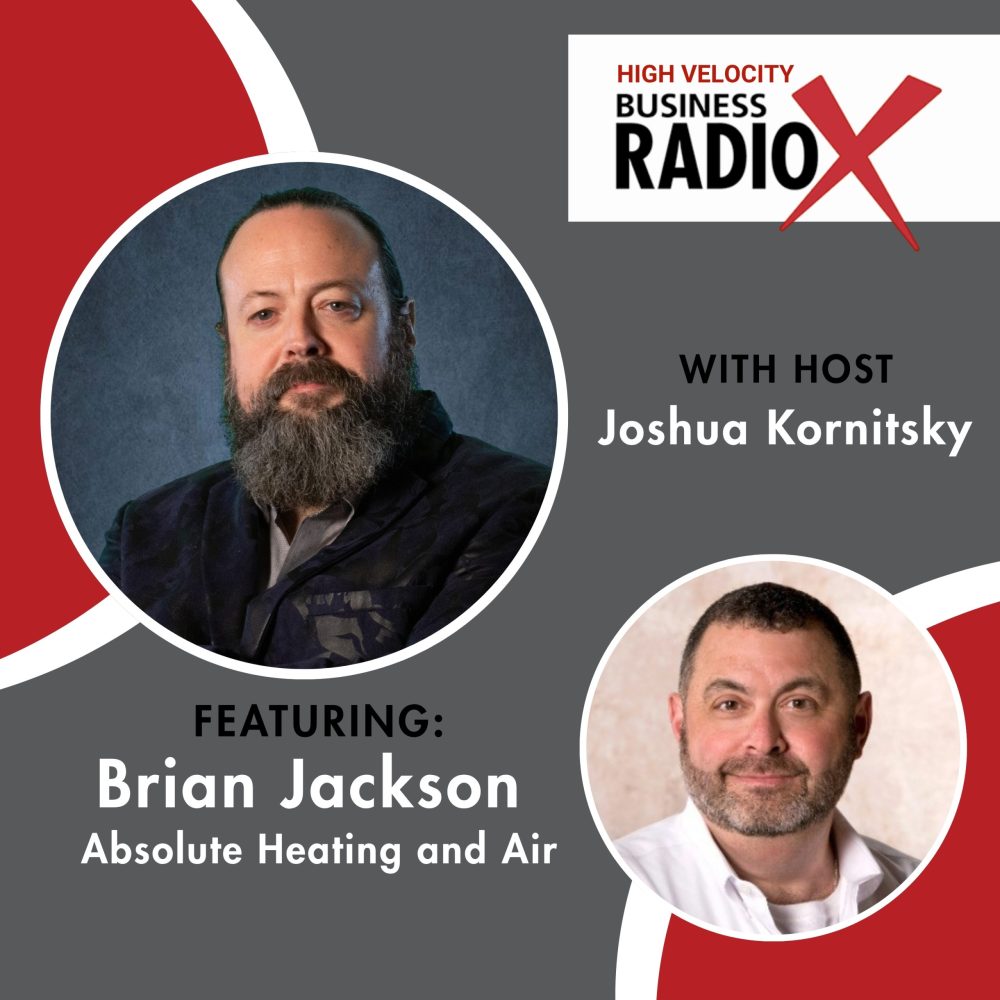

In this episode of High Velocity Radio, Joshua Kornitsky interviews Brian Jackson, founder of Absolute Heating & Air. Brian shares his journey in the HVAC industry, the growth of his company, and the core values—appreciation, education, teamwork, mentorship, and integrity—that shape its culture. He discusses prioritizing employee well-being, fostering career growth, and hiring for attitude over skills. The episode highlights Absolute Heating & Air’s commitment to exceptional service, community support, and empowering employees, offering insights into building a values-driven, people-centered business that stands out in the industry.

 Brian Jackson is a 35-year veteran of the HVAC industry and the Founder and Visionary of Absolute 2020 Inc. and Absolute Heating & Air, serving Morgantown, West Virginia, and Pittsburgh, Pennsylvania.
With a passion for creating a positive impact on people, Jackson attributes Absolute’s award-winning success to a company culture rooted in authenticity, gratitude, and empowerment of the Absolute Team through meaningful opportunities to thrive – both professionally and personally.
Beyond his business ventures, Jackson and his family are avid travelers who seek inspiration through art, music, and cultural experiences. Together with his twin flame, Evelyn, Jackson is now embarking on a new journey – the creation of a nonprofit foundation dedicated to expanding access to wellness resources, educational opportunities for personal growth and behavioral transformation, and programs that foster creative expression and spiritual growth.
Follow Absolute Heating & Air on Facebook, YouTube and LinkedIn.
Episode Highlights
- Brian’s background and experience in the HVAC industry.
- The journey of starting and growing Absolute Heating & Air.
- The importance of core values in shaping company culture and customer service.
- Employee care as a foundation for customer satisfaction.
- The significance of hiring based on values and attitude rather than just skills.
- The company’s core values: appreciation, education, teamwork, and mentorship.
- The impact of a supportive and growth-oriented environment on employee performance.
- The role of transparency and accountability in building trust with customers.
- The integration of community service initiatives, such as the “Hope and Heat” program.
- The philosophy of prioritizing employee well-being to enhance overall business success.
About Your Host
 Joshua Kornitsky is a fourth-generation entrepreneur with deep roots in technology and a track record of solving real business problems. Now, as a Professional EOS Implementer, he helps leadership teams align, create clarity, and build accountability.
He grew up in the world of small business, cut his teeth in technology and leadership, and built a path around solving complex problems with simple, effective tools. Joshua brings a practical approach to leadership, growth, and getting things done.
As a host on Cherokee Business Radio, Joshua brings his curiosity and coaching mindset to the mic, drawing out the stories, struggles, and strategies of local business leaders. It’s not just about interviews—it’s about helping the business community learn from each other, grow stronger together, and keep moving forward.
Connect with Joshua on LinkedIn.
 This transcript is machine transcribed by Sonix.
TRANSCRIPT
Intro: Broadcasting live from the Business RadioX studios in Atlanta, Georgia. It’s time for High Velocity Radio.
Joshua Kornitsky: Welcome back to High Velocity Radio. My name is Joshua Kornitsky. I’m a professional iOS implementer and the host of today’s show. I have with me Brian Jackson, the founder of Absolute Heating and Air. Hey, Brian, how are you?
Brian Jackson: I’m doing phenomenal. Josh, how about yourself?
Joshua Kornitsky: I’m doing pretty good myself. It’s been a good day so far. Uh, nothing but wonderful dynamic conversations. So, Brian, tell us. Ah, Jackson, is what you’ve told me to call you just so that anybody listening doesn’t get confused. He’s told me to call him Jackson. Jackson, tell us a little bit about absolute heating and air.
Brian Jackson: So absolutely, heating and air is a business that I started back in 2013 as a side hustle. I was uh, you say having an early midlife crisis working for a company in Pittsburgh. Going back to school for psychology at 40 plus years old. Because I had recognized in business that that was my my passion was psychologically, you know, how to inspire people, how to engage with clients, things of that nature. And I returned to Morgantown, West Virginia, which was close to where I was born and raised, to finish my degree at West Virginia University and started. Absolutely. It was originally an absolute area, which became absolute heating and air as a means to pay my bills while I went back to college.
Joshua Kornitsky: So did you have previous experience in in air conditioning or HVAC?
Brian Jackson: Yes. So, uh, I was working for electrician first thing out of high school. I had had mechanical experience in high school, uh, working with my dad on some projects, uh, for our church also, um, uh, had a Billy construction class in high school, which I performed a lot of electrical work in. And so I pursued electrical work out of high school rather than going to college. Even though I had a desire to go to college, I wasn’t sure what I wanted to do. Figured enter the workforce first and figure that out, and ended up in the Washington, D.C. area, working for a apartment management company that sent me to school for heating and air conditioning. I returned to West Virginia in 2 or 1994 to start my first heating air conditioning company. I was 21 years old, barely knew shit about what I should have known starting that business, but I had, uh, I think maybe it was a naivete that took away any fear. Does that make sense?
Joshua Kornitsky: Sure, sure. You don’t know what you don’t know, so it’s hard to be afraid of it.
Brian Jackson: Right. And so, because I didn’t have a fear for starting a new business at 21, I didn’t have a fear for, uh, getting into aspects of heating and cooling that I had never done before. I navigated through that with confidence somehow at that early age.
Joshua Kornitsky: And so that was 1994.
Brian Jackson: That was.
Joshua Kornitsky: 1990. Okay. Go on. I’m sorry.
Brian Jackson: So I had that business for 12 years. Uh, obviously starting at a young age without the business background, with only three years of HVAC background. I made a lot of mistakes. Uh, as I grew that company but still reached a level of success that was that I can be proud of in 12 years. That a lot of people my age would not have been able to do.
Joshua Kornitsky: And 100%.
Brian Jackson: Yeah. It’s. And so it was a learning experience where after I sold that, then I made some more, uh, let’s say inappropriate life choices. That took me down a different path.
Joshua Kornitsky: But then we all take those steps, and it’s the only way we learn.
Brian Jackson: Then, uh, return to HVAC by working for a contractor in Pittsburgh that had been friends with. Yeah. So it was, uh, I recognized that the company that I was working for in Pittsburgh was basically limiting my growth, not just professionally, but I think in other aspects of my life, it was causing some friction. I was already going back to school to pursue a degree in psychology, so I decided to return to Morgantown, West Virginia, which was close to where I was born and raised, and finished my degree in psychology at Western University. Uh, my son at the time was going to Fairmont State University in West Virginia for business degree, and so he was working for me part time, uh, basically running apps to air as a side hustle, to provide income, to pay the bills while I was getting this degree in psychology. But, uh, the people in Morgantown knew me and, uh, some of the surrounding area because of the business I had previously. And word got around quickly that I was back in town. And so organically, we were growing the business with almost no marketing. And because of, you know, at the time, I didn’t even really appreciate the full scope of how important infusing the culture and mindset, the core values of what I had into the company as a whole. But it was almost happening naturally without even having that understanding from a larger perspective.
Brian Jackson: And one of the most important things that resonated with me as we started to hire employees was something Richard Branson said. Richard Branson, being the founder of Virgin Records, Virgin Mobile, Virgin Airlines and probably my favorite billionaire in the world. He just seems like a fun guy and I hope to meet him someday. But, um, he said that the customer is not the most important person in your business. The employee is. And if you take care of your employee, you will never have to worry about your customers. That resonated with me on a deep level, because I was always hypersensitive about customer satisfaction in my previous business. And so as we grew and I treated my employees like my customers, and because I did that and took care of them, I appreciate them. I engaged with them on a level beyond just what the work was or what their career was, but actually cared about them. That they in turn cared about the customers. I didn’t the amount of time that would be taken for me to engage with a customer who was upset was insignificant, because I had infused that culture in my team that day to take care of the customers. And so that, I think, is the core of how we were able to grow. Absolute error successfully.
Joshua Kornitsky: So this lesson from Richard Branson of of treating your employees well so that your customers are treated well by your employees, was was the foundation of that in your previous business that you discovered that or was it just sort of inherently who you were? Because that’s a pretty profound realization. And it certainly seems like as as you’ve explained, your your growth has been positive and strong. It seems like it’s made a really big difference.
Brian Jackson: Yeah, I would have to say my own core personal values in relation to customer service comes from obviously my parental upbringing, a spiritual aspect of my upbringing. Um, I would even say there was some genetics involved in that. Um, so it came very naturally to me to want to have my customers be happy. It was very natural for me to want to always do the right thing and do the best possible job, even when I was inexperienced. And I can even think today. You know, looking back 30 plus 35 years ago, I can see jobs that I did at that young age, 21 years old, starting my first HVAC company that look absolutely terrible. Well, and it still bothers me today because I can see that image in my mind. I was like, I wish I knew more then so I could have made that look more beautiful and or maybe work more efficiently, whatever the case might be. But it’s like, that’s just my natural desire to always do the best possible job for somebody. And so it may not come natural to everybody. So that’s a very defining line in our culture today with absolute human error is if somebody doesn’t have that as a core value, that they appreciate a client enough to do that, or they appreciate a team member enough to, uh, help them out and gain that knowledge and ability to perform that way, then that person is not going to fit the culture absolutely well.
Joshua Kornitsky: So that, to me, brings up the concept or the thought that I get that, you know, what the right thing to do is? And I get that you’re hiring people that understand your perspective to the best that you can convey it to them of how important things are. But how hard is it to teach people to understand what the right thing to do is? And are you able to if if you’ve got a technician that’s in the field, if they don’t know, do they know who to call to get guidance?
Brian Jackson: That’s important. Yes. And I think the core values we have at absolute are are the initial point that helps to resolve a lot of that. Uh, we have guys that come to us who have a fear based mentality from places they’ve been before, like, if I do something wrong, I’m going to get yelled at, okay? Or if I get put into a place where I’m challenged, I’m not going to have support. And we see that. And when they come to absolute error, it’s like a a breath of fresh air for them, because now if they do something wrong, they’re coached.
Joshua Kornitsky: If they not just smacked right.
Brian Jackson: It’s like.
Joshua Kornitsky: Metaphorically.
Brian Jackson: Uh, and we proactively try to fill in those gaps ahead of time. But of course you can’t fill them all in. So when a mistake is made, there’s no, uh. Strong. There’s no, there’s no there’s definitely no yelling. There’s no, uh, this demeaning type of discipline. It’s about coaching, mentoring and lifting that person up so they can know what to do in that situation next time. What? They face a challenge where they need support. They’re not wondering, do I have something to rely on? They have a chain of command they can go to that. They’re going to have somebody that can support them through that challenge.
Joshua Kornitsky: And I think it’s critical, because I don’t want to lose sight of the fact that that I’m going to go on a limb here and say, you install heating and air systems, right? That’s the primary focus of the business. If if I’m a customer or a potential customer listening to this, it tells me that if if you’re who I engage, well, obviously we want all of our technicians to do work without error. If there is an error or if a problem manifests. That wasn’t part of the initial understanding. It sounds to me like you’re going to do what’s right for for the customer, as well as for the employee.
Brian Jackson: And the the opportunity that opens up to do the right thing and satisfy customer when they don’t even know is happening is huge. Because if you’ve got a technician who’s made a mistake, he can. Maybe he knows he can put a Band-Aid on it and nobody will ever know he made that mistake. But he knows eventually that could come back on the company.
Joshua Kornitsky: Right?
Brian Jackson: They have worked at places where they’re fear based. Um, and situation is going to allow them to Band-Aid it because they know they’re not going to work there forever. So they don’t care what happens to that company when they leave. So when you instill an environment of a place of safety where that employee knows that when they make a mistake, they can call their supervisors, say, hey, you know, I messed up, uh, I put my foot through somebody’s ceiling. It’s in this area where they don’t know it’s at. I could probably patch it. They’ll never see it. But that’s not how we work. It’s like we’re going to proactively go to that customer and say, hey, I hate to tell you this, but I put my foot through your ceiling. I’ve already called my boss about it. We’re going to get a painting and drywall contractor out here in the next couple of days to take care of this for you. It’s like. That’s once our new team members, our new hires, recognize that that’s how we operate. That changes the entire dynamic.
Joshua Kornitsky: So it certainly sounds like the culture first model makes a gigantic difference in really what impacts how well you satisfy your customers 100%. And in doing that, can you help us understand what is it you look for when you’re looking for, uh, technicians or employees to help them to make sure you’re aligned and that the people who you service your customers will ultimately have their expectations fulfilled. What is it? How do you how do you sift for that?
Brian Jackson: So ultimately, um, and you might be able to help me with this. It’s the, the idea of, Uh, filling a seat with who? And not with a skill set or a idea. It’s about who is the right person as a what are the values? You know, what are what do they think of when it comes to their fitting in within our team? So obviously, as a HVAC company, skills are important and certain aptitudes and abilities are important. But the most important is what is that person’s attitude and their desire to grow and get better. Right? That’s that’s that’s the who of what we look for is who fits that model. So we might be looking at a technician with 20 years experience that knows everything that needs to be done mechanically. But if they aren’t willing to be a mentor, if they aren’t willing to own up to their mistakes, if they aren’t, uh, an honest person of integrity, they are not going to survive it. Absolutely. And so when we look for that. Who? That person who adheres to our core values or at least aspires to. We recognize that not everybody’s perfect, especially when we bring new people on. And they’ve had negative experiences in the past with employers. We’re going to have to make sure they understand what those values are and help them work towards that.
Brian Jackson: And so, I mean, this sounds like a great time to just share the core values, if it’s at least if you please, if we could do that. So, um, as you know, we’ve been working with you, uh, through this process of, uh, really redefining our core values. We had one set of core values that was customer facing and a slight variation of that that was internal that we use for the team, and we found success in using that. But, uh, within the past year, we’ve recognized the need to really enhance that and to combine the two so that we’re really giving the same message to our clients that we are to our own team members. That’s great. And, uh, we were actually getting ready to launch, uh, or present these new core values to the team next week. So this is pretty exciting to be talking about here. Share with us. So the first one is absolute appreciation. And so obviously appreciation is something that we can all appreciate as a core value. But absolute gives it like this higher level in my opinion. Obviously that’s the name of the company. So that plays a part of as well. But um, absolute appreciation to me means you are not just thinking of the appreciation. You’re not maybe even just expressing in words, but you are now showing appreciation by what you are doing with your behavior, right? So if you appreciate your team members and you see they’re struggling on a job, they don’t have to ask you to jump in and help you.
Brian Jackson: Just proactively know you’ve got to get in there and help them. Or at the end of the day, you finished your job and you know there might be some other team members out there still working. And instead of just going home because, you know, you can, you call the office and say, hey, is there anybody out there that needs some help? I’ve got an extra hour here. I can jump in on the job if you need me to. That’s showing true appreciation for your team when you proactively look for those opportunities. Same with the clients or the community that were communities that were involved in. When you start to really appreciate what these customers are doing for us, allowing us to grow as a company and what each individual team member is able to do because we have such a great client base, then we show appreciation for that. We give back to the community because we appreciate that we exist in that community and that we have this opportunity of growth within that community. So obviously we want to show that appreciation.
Joshua Kornitsky: So it sounds like you’re encouraging them to to sort of live that appreciation model and to demonstrate it and show it at all times. Um, it’s a pretty spiritual approach to, to an HVAC company, but I think it’s fair to point out that I. It’s borne of you. Correct?
Brian Jackson: True. And it’s been enhanced through other I mean education. In fact, our previous, uh, internal, uh, core values are really centered around education involved teamwork, education, appreciation and mentorship. Those were the four core values of our internal team up until now. And so appreciation being one of those original four, is now the one of the top of the current and new, um, core values. Um, and so one book that I would like to recommend to the listeners is, um, conscious capitalism. And uh, it’s written by, I think it’s John Mackey, uh, who was the founder of Whole Foods and another economist. I can’t remember his name off the top of my head, but that book really spoke to me in how you need to infuse a spiritual ideal into your culture of your team so that you are, In fact, it also reminds me of the book Good to Great, where you have a level five leader who puts other people first, who doesn’t seek the attention that they’re they’re the ones that created all this and made all this happen, but they’re giving that credit to their team. That’s conscious capitalism. It’s like you’re looking at the spiritual perspective of how does the community, uh, how does the value of the community benefit this business and how we operate the employees, the investors, even the vendors? That’s something I see a lot of contractors, you know, they’ll beat their vendors up for the lowest price. They they, uh, get upset with them, uh, just put a lot of stress on that relationship. Whereas I’ve approached my vendor relationships where I appreciate them, too, and I’m not necessarily looking at the lowest price for my vendor. I’m looking at who is the vendor that’s going to treat my customers and take care of me the way I need to be taken care of, to take care of my customer. Sure.
Joshua Kornitsky: And so, I mean, that translates to A happy customer who has been well served by someone who is conscientious in the work that they’re doing.
Brian Jackson: That’s even how we set ourselves apart when it comes to a sale process, that when we can speak about our vendor in a selling process, that why we chose the equipment we sell. Uh, one example is, uh, client A, their air conditioner goes out on a Friday afternoon when it’s 90 degrees.
Joshua Kornitsky: That never.
Brian Jackson: Happens. You get family coming into town because they’re having the birthday party, the house on Saturday afternoon. We call our vendor and tell them the situation and ask if we can get a piece of equipment delivered to the house Saturday morning so we can get this accomplished for them. I know for a fact previous vendors that I’ve used may have said something like, well, we’re going to have to charge you $200 and you’re going to have to drive here to get it. And, you know, you got to be here right at this time to get it. And or others that may say, well, you’re out of luck. You gotta wait till Monday. But this particular vendor that, um, I’ll mention their name and you can edit out later if it’s.
Joshua Kornitsky: If it’s up to you, as long as you’re good mentioning it, then we’re happy to.
Brian Jackson: Have a Hamburger Corporation as the vendor I’m speaking of. And specifically, uh, uh, their location in Clarksburg, West Virginia. Uh, who? The manager there, Scott Yates. Shout out to Scott and the regional manager. Um, CJ uh oh. Luke CJ’s last name. He’s going to hate me for that. We’ll never tell Cameron, CJ, Cameron love both of those guys. And then our, uh, our territory manager Adam, it’s like those guys genuinely care about taking care of people. So they take care of us, which empowers us, take care of our client better. And so that example of I call hamburger and tell them, hey, this is our situation. This is the client situation. They proactively offered to bring that piece of equipment to our job site on Saturday morning and meet us there at 8:00 so that, uh, we have that client’s AC up and running. I think it was like by 1231 in the afternoon, so that when their birthday party started later that afternoon, now their house was starting to return back to a cool conditioned area. And it was like, that is an example that I relate to people when we’re talking about why we are setting ourselves apart, because the equipment we choose is not just because of the name on the equipment, it’s not because of the features of the equipment. It’s because of the value that that distributor brings to the table. If you, as a client and using a homeowner has a problem, they have our back. They’re going to go above and beyond, not just for us, but for you as the homeowner.
Joshua Kornitsky: You know, Jackson, it sounds like, uh, that the secret you’ve uncovered is, uh, honestly an ancient business concept called dignity and respect, right? Where you treat your vendors and your employees with dignity and respect, and in return you receive it. It’s it’s somewhat golden rule like, but clearly it’s making a difference because it’s. Yeah, because of the level of care you’re demonstrating internally and externally. Your organization continues to grow.
Brian Jackson: And again, it goes back to that same book that I mentioned earlier that I read prior to starting this business. I read it while I was in college for, um, the psychology degree. I was actually in a sociology class. I read this book. And I’d highly recommend that for anybody who appreciates how culture, core values, and a thread of spirituality within a business can help it thrive and be sustainable and even self multiplying. I mean, all those things, in my opinion, require that thread of spirituality and that this conscious aspect of capitalism within that business. And I think it’d be a very valuable read to anybody who is in tune with that thought.
Joshua Kornitsky: And how does it translate to customer satisfaction. Are your customers happy customers? Do you have a couple of good reviews?
Brian Jackson: Oui, oui. 5.0 in the Morgantown area with. I think we’re just now about to hit 1000 reviews, which is only strongly with more than we have. Yeah. And, uh, we have A+ rating with the Better Business Bureau. We’ve been voted by the community as the best in Morgantown five years in a row. Um, it’s constant positive feedback from our clients. And, you know, a lot of times an owner, uh, or even a higher level manager within the HVAC company, a lot of times taken with resolving customer unhappy customer issues. Right.
Joshua Kornitsky: Right. Somebody dedicated full time to solving that.
Brian Jackson: And that’s very rare for us. Um, it obviously happens. We’re not perfect. But even my my management team is so capable of handling that that it never has to come to me as an the owner, I might notice I get all the, uh, the emails every time somebody leaves a review so I can catch a, a low review if one happens to come in, which is rare, but as soon as I see that it’s boom, it goes out to a thread for all our managers to see, and somebody is on point to take care of that situation.
Joshua Kornitsky: And pretty quick mitigation.
Brian Jackson: I would say. I would say it has to be at least two years or more since I’ve ever had to personally talk to a client about a negative situation, because my team is so well equipped to handling those situations and the. So I’m in a privileged position where I now only have to have the positive experiences with my clients when I’m in a community activity or a fundraiser or things of that nature, and I’m engaging with people that use our services and get to hear all that positive feedback of how happy they are with our what we do.
Joshua Kornitsky: So it sounds like, uh, you, you don’t win your business by being the cheapest in town. You simply win it by being the best.
Brian Jackson: Right. Um, I’ve it’s like I almost don’t even think about price, which obviously you have to be conscious of it and and fortunately, I got, uh, uh, my key sales and, uh, finance, uh, director. And he’s also a business partner, and it’s like, uh, he’s very aware of the price structure and keeping that, you know, a great value for our clients. But I’ve always felt like if I’m focused on keeping my employees happy and they keep the customers happy. You know, there’s obviously a cost to that. Of course, if we’re going to maintain a high level of, uh, skilled people that fit our culture, they’re going to expect good benefits, good opportunities, good pay scale. Uh, and so we provide that. And for and using customer in their home, some of them, most of them appreciate that there is they’re not going to get the cheapest price and get the highest quality. In fact, I’ve always said that there’s only three things you can get when you make a purchase, and you have to pick two of the the most important to you because you can almost never have all three.
Joshua Kornitsky: What are those three?
Brian Jackson: You can get a high quality product. You can get high quality service of that product and you can get a low price, but you can never have all three. So you might have a low, uh, good quality product at a low price, but maybe that company is the one that doesn’t call you back when you need service, right? Right. Where they get their for service and they really don’t know what they’re doing. There’s a lot of good companies out there on the install side, but on the service side there’s some things to be desired. And so we like to be around where we can encompass both all aspects of what we do for our clients. But the point being that client has to choose really what is important to them. Do they want a quality product? Do they want a reliable service where they know that their equipment is being taken care of to where it’s running at peak efficiency? So they’re saving energy. Their air is being cleaned so that they have less dust in the house. Their kids are getting sick less. Those are the aspects that a lot of times customers aren’t aware of. And that’s where the education part of our culture is educating the customer what those choices are, so that if they need a lower price, there are options, but they understand you know what they might lose as far as efficiency your air quality is concerned, or if they want to invest in the higher level and have all the bells and whistles, they can do that. But it’s important that we’re educating the client about what those options are, not making the decision for them and educating them so they can make a confident decision, knowing where the right company for them.
Joshua Kornitsky: Well, and it sounds like the motivation behind the education is exactly that. You want to give them the option to make the decision. It’s not just the top price. Every time. It’s it’s you have choices.
Brian Jackson: We can segue that right into our second core value, which is empowering people. It’s like some some, uh, when you hear that empowering people right from the jump within a company situation, you think empowering your employees to to grow in their careers? Possibly. But we define empowering people also with our client base in community as well, because when we educate a client, we are empowering them to make a better decision about their home and their investment.
Joshua Kornitsky: 100%.
Brian Jackson: I educate them when we educate the community about. In fact, one thing that we have at Absolute Error is a program called Hope and heat. So every fall we look for individuals within the community that might be in need of a better heating system, but they don’t have the resource to get it. And so a lot of times we’ll partner with another organization like United Way is one that we partner with on this to identify who those people are and provide quality heating systems for them at no cost. And so we partner with vendors to do that. And so we are now empowering the community to be better for the individuals living there. Because of that aspect of what we do as a company.
Joshua Kornitsky: I mean, that’s making a difference in your community. It doesn’t get much better than that. So and what’s the next one?
Brian Jackson: Integrity in action.
Joshua Kornitsky: Um, Integrity in action. In action. In action.
Brian Jackson: In action.
Joshua Kornitsky: In action.
Brian Jackson: Okay. And I felt it was very important to establish the inaction part of that. Because if you just say we’re a company of integrity, that can be very generic. Anybody out there can say we have integrity. You should use us because you can trust us. We’re we’re an honest company. Those are words, right? Yes. What is integrity in action? That means we are proving that we have integrity when and that’s that’s where it comes down to the accountability, owning our mistakes, being upfront with the customer. Um, one example is, uh, we have, uh, a policy of a lifetime workmanship guarantee. So if if there’s a problem at any point in the future of a system that we’ve installed that we recognize as a result of something we did incorrectly when it was installed, we will cover that, whether that’s 10 or 15 years down the road. But it doesn’t matter.
Joshua Kornitsky: That’s pretty unique in the industry.
Brian Jackson: And that’s I mean, that’s that expresses our confidence that we’re going to do things right to start with. Right. We know that the likelihood of something like that happening is so minimal because of the quality of our service and products and because of the culture that we had, that guys want to do things the right way, and they know they have a space to reach out for support when they’re unsure of something that we have that confidence that what we provide for that client is going to be a lifelong investment that they can rely on. And so in the rare occasion that we have to follow through on a lifetime workmanship guarantee, we’re okay with that because it’s it’s it’s.
Joshua Kornitsky: Very who you are.
Brian Jackson: Very likely that’s going to happen. The only way I can think of that stands out in the moment was one where, um, we had installed new air conditioning system for somebody, and about a year later there was a leak on one of the braised joints that our technician had raised. We covered that repair for free. That’s normal. It was like within the first couple of years. But the technician that braised, it did not do a very good job of braising it. And about year 4 or 5, at least again, now it’s outside of the standard labor warranty, right? They never would have known that this was a problem that was a result of the original deficiency on how that joint was braised, but we just owned it. It’s like we could charge that customer whatever we needed to and said, you know, you have a leak. It needs repaired. Here’s the cost and do the work and get get paid. But we proactively go to that customer and say, hey, look, this is actually the same leak you had three years ago. Our guy must have not did that great of a job repairing it, unfortunately. We’re going to take care of this for free. Normally it would have been, you know, $1,200. Whatever. They present the price and say we’re going to waive that for you because this is a result of our workmanship guarantee. That’s so you can you can see where that can. Clients can be frustrated when their AC doesn’t work, obviously. And when you come to them and say, hey, you don’t have to pay for this repair, even though it’s our fault. They mean at first, the first thought, maybe I’m irritated because you guys should have fixed this right three years ago, but now you’re telling me they don’t have to pay for it? They never would have known otherwise. It was our fault. And we’re. That’s that’s true. Integrity in action.
Joshua Kornitsky: Couldn’t agree more. And and it’s interesting as we’ve gone through your core values, uh, this is a nontraditional way of demonstrating why you excel at what you do and why people should pick up the phone to call you when they have a need for install, repair, maintenance, or any of those things around heating or air, because you’re putting your your integrity on the line, saying these, these are the things that are mattering to us and therefore they will translate into excellent service and good value, ultimately long term for the customer. So integrity in action. Is there another core value.
Brian Jackson: Yes. So we have four. And the fourth one is progress with purpose.
Joshua Kornitsky: Okay.
Brian Jackson: So obviously um anybody that an employer has on their team, they want to see them progressing. I would hope all employers are that way.
Joshua Kornitsky: Ideally, but some are not. And I’m sure that you’ve seen that through your time in in industries that electrical and HVAC, not everybody’s appreciated.
Brian Jackson: Right. And I think my biggest reward as the owner of Absolute Heating and Air is seeing young people come into the business at entry level and grow and excel in their career wherever that takes them. In fact, uh, one example is a young man by the name of Paul Barlow, and I’ll send this to Paul so he can see it later. So Paul was one of the original Numbers to absolute error. In fact, I’ll flash back to 2013. Actually, this would have been 2014. So, um, I’d started the business in 2013 when I went back to the college at WVU and Paul was also at WVU. He went to high school with my son. They were good friends. So Paul’s in college, friends and college. Paul’s working at Lowe’s. Uh, and he would help us out on occasion with jobs. We needed extra hand. But then once my son graduated, I asked him, I said, uh, you want to dissolve this business that we’ve been working on here, or do you want to grow it? Because I was fine with either one at the point in time. My my interest was in psychology. Heating and air conditioning was my background. And I wanted to move forward with something in the psychology field. And I was fine with moving to the other side of the country if I needed to. But he said, you know, I got to think we got something good going here. Let’s grow this. And so I’m basically have moved forward, creating a legacy for my son that has now evolved into a legacy for every individual that works for us. So I’m flashing back now to May of 2014, and it was the Tuesday after Memorial Day of that year. I just remember this very distinctly, and we had five of us sitting around my dining room table. There was myself, my son, Paul Barlow, I just spoke about, and then two other guys that had just recently started working for us. And that was the true what I believe, the true onset of what absolute error was going to become. And I just realized I saved the wrong year. That was 2019.
Joshua Kornitsky: No, no one knows. But, you.
Brian Jackson: Know, 2018. But, um, 2013 was when we started in 2018 is when my son was graduating college and we were having this conversation. And then at that dining room table there, Paul Barlow was part of that original foundation of what became who we are today. And I remember at the time, Paul, you know, just out of college, he had some mechanical background. His family was in a construction business, so he was had some skills. But one of the first jobs I had him on, uh, he had, uh, a piece of conduit he was about to cut with a reciprocating saw over top of this, just newly installed, uh, laminate flooring had barely any space between that saw and the flooring.
Joshua Kornitsky: Something bad was going to happen.
Brian Jackson: And of course, he stopped in there. A week later, he somehow cut through the court of a reciprocating saw, a circular saw he was using. So just to show you the, the, uh, the green level Paul was on when he started for us back in 2018. So by 2024, Paul was without a doubt our top technician. Top selling technician. Um, he was on track to make $200,000 in 2024 Because he hit 100 K by the end of June. He was extremely valuable in the growth of our business, not only in what he was producing for the company as a service technician, but as a mentor for others and what he could show other people as they grew. And it kind of got blindsided in July when he told me that he was leaving to start his own business. And in prior years, if that would have happened, I would have been stressed out. Losing a top guy like that. It’s a big producer and a good mentor for our team, but I always knew that Paul had that ability and I don’t want to hold anybody back. And this is why that fourth core value progress, uh, with purpose is very important. I’m not going to hold back anybody from pursuing their career. In fact, back when some companies were having people sign non-compete agreements. Of course, they’re not legal now. But back then, when a lot of companies were doing that, I would not do that. It’s like, what if I can’t provide the space for you to thrive? Why am I going to prevent you from thriving somewhere else?
Joshua Kornitsky: Right.
Brian Jackson: Makes no sense to me.
Joshua Kornitsky: I couldn’t agree more. So you gave him that room to grow?
Brian Jackson: Yeah, I gave him that room to grow. Uh, we had a very amicable separation. He started his own business. Uh, we refer work to him. Sometimes he refers work to us. Sometimes. Uh, and there will always be a door of opportunity for him to return if he ever desires to do so. Um, and so a lot of respect there for Paul as an individual, how he handled the situation and how he’s growing as a family man and a father today. And, uh, I and my son’s the same way. You know, obviously, my son, uh, as, as, uh, this part of the legacy that I’m leaving to him, he’s he’s a solid part of absolute air. And he’s, you know, that top technician I’d say on a lot of aspects. Brandon, my son, um, exceeded Paul on, like, the customer service level, the understanding of our culture and the how we’re infusing that across the board. Paul had his own niche where he was just very focused on customer satisfaction within the home and how he performed in the home, and he excelled at that. So it’s like you got to start appreciating every aspect that every person brings in that business, and how you can help them to progress to their place in their career with purpose.
Brian Jackson: And one way of doing that is identifying unique abilities. Sure. Um, and it’s like we’re not trying to put round pegs and square holes. We’re looking at, you know, if somebody comes to us as a service technician, I’d say the more likely example, somebody comes to us on the installation side of the industry, right? But they have a desire to be a technician. We’re not forcing them to stay as a installer. We’re going to start to phase them into opportunities to taste what it’s like to be a service technician and see, that’s right, that’s right for them, or even within the office environment if somebody in a customer service role, but they feel inclined to pursue something more on the HR level or accounting level. We want to open up those doors of opportunity for them, because ultimately, the way I define a unique ability is something that you have passion for. You love doing it and you’re good at it, right?
Joshua Kornitsky: Absolutely.
Brian Jackson: So and you can have things you’re good at, but you just don’t like doing them. You have things that you really love to do, but you’re not good at it at all. And maybe you just don’t have the.
Joshua Kornitsky: Capacity.
Brian Jackson: The capacity to ever do it in an efficient way. And so once you identify that thing that you have passion for, that you love and you’re actually good at it. That’s what we want to help you to identify so that we can create your career path in line with that. So you’re not just thriving financially with the rewards we can provide. Absolutely. But you are thriving mentally and emotionally that you’re coming home from work in a better mindset to engage with your family. You’re able to spend a more relaxed weekend because you’re not stressed about what occurred during the week. It’s like that’s the kind of environment we want to provide for our team.
Joshua Kornitsky: So all of this leads me to one final question. Are you hiring because it sounds it sounds so. So what are you looking for? And I’m joking, but not right. You’ve laid out why absolute heating and air would be a fantastic place to work. What is it you look for? For the folks that that join your team?
Brian Jackson: So with the release of these new core values, these enhanced core values, next week, they will become part of our hiring process.
Joshua Kornitsky: That’s great.
Brian Jackson: We we will share these core values and how meaningful they are to us as a company in that interview. And we will ask that person, do you feel you have these values or share these values, or at least aspire to have these values? And if they hesitate with that, that doesn’t mean that they wouldn’t. Maybe they’re just. They want to be sure, but that they could even answer that question. Um, with a with a fake. Yes. But they’re not going to come back to us when we when we really present this core values with passion, that this is who we are as a company. This is our culture, and they know they don’t fit that box. I don’t anticipate they’re going.
Joshua Kornitsky: To know I agree with you. They’ll they’ll self-select out.
Brian Jackson: Right.
Joshua Kornitsky: And because it’s a very clear and persuasive argument that this is who we are.
Brian Jackson: Right. And so that’s the first thing we look for is does this person have the ability or the aptitude, the the mindset to fit our culture. Then we’ll look at what skills they have that can be used within the purpose of what we’re hiring them for, or what their aptitude is to an ability to learn that skill set in a short period of time. Um, so it really comes down to, you know, the who. Uh, of who fits the culture, who fits the values. And then we figure out what position within the company makes sense for what might align with their unique abilities.
Joshua Kornitsky: It it sounds like it would be a great opportunity for anybody at any stage, because there’s room to grow and and not just room to grow, encouragement to grow.
Brian Jackson: So and we’re we’re on that path. So every truck we get wrapped now is that we’re hiring on it. All the, uh, ads that we have for recruiting, they’re running consistently throughout the year. Because of that culture we’ve established, we’re now naturally attracting quality people.
Joshua Kornitsky: So if somebody is interested in applying, how do they where do they go? Who do they call?
Brian Jackson: Uh, go absolute Eircom is the website, and there’s a link on the homepage to a careers page. And they can either upload and submit a resume through that link. Or they can just fill out an application, either one. Um, so that would be step one. Um, that’s how to find us.
Joshua Kornitsky: And if we are interested, if someone listening is is interested in, uh, having you come out to install, repair, maintain. Same thing, same website. Go. Absolutely there. Uh, is there a website?
Brian Jackson: There’s. I think every page on the website has a submission form where they can, uh, have a digital request for somebody to call them. There’s also a link on the website where they can actually just go ahead and schedule the appointment without even calling the office. Or they’re always welcome to pick up the phone and give us a call. So, um, in fact, uh, if just to put this out there, we do have a, uh, a toll free number eight, three, three in the number four absolute. So just eight through three four absolute. And they can hopefully remember that and give us a call. But, uh, get the, uh, in respect to the hiring and our growth. Uh, we’re based in Morgantown, West Virginia. We’ve always done work in southeastern Pennsylvania. Uh, but we are growing closer to Pittsburgh. We’re looking for some quality people in the Pittsburgh area as well because we want to. We have intentions of launching a marketing campaign in a select portion of Pittsburgh in October of this year, and we’ll need some people to, uh, start generating that growth there as well.
Joshua Kornitsky: That’s fantastic. Well, Brian Jackson, founder of Absolute Heating and Air, I cannot thank you enough for what, for me was an incredibly inspiring discussion around your core values and why it makes your organization not only a great place to work, but a great place for your customers to seek service because they’re going to get unbelievable attention to detail and an incredible experience working with a company that seems to genuinely care.
Brian Jackson: Can I make one last comment?
Joshua Kornitsky: Absolutely.
Brian Jackson: Core values. This is where this goes back to our original conversation about taking care of the employees, who they take care of the clients and empowering them to do so. When our technicians or our installers or our customer comfort advisors in a home and they encounter a situation that maybe they haven’t encountered before, and they’re looking for how to make a decision for that client that’s in the best interests of the client and the company. These core values are structured so they can reflect on that. They they consider. What is absolute appreciation mean? What does it mean to empower people? What does it mean to have integrity and action and progress over purpose? And when they reflect on what those values mean, that should give them the tools to make that decision without having to reach out to a manager, unless it’s something beyond the scope of what they feel comfortable with. So they always have the resource of the team to reach out to. But we’re our intention with these core values is that gives empowers our team to make better decisions on the spot that are of value to the client and the value of the company, without having to wonder or be concerned about whether or not they’re making the right decision.
Joshua Kornitsky: It seems like it is a fantastic organization to do business with, because you’re giving your folks the autonomy to do what’s right, and it doesn’t get any better than that.
Brian Jackson: Thank you for recognizing that, Josh. That’s definitely what we’ve been trying to build. And as each day we’re not perfect, but as each day progresses, I feel just getting better and better all the time.
Joshua Kornitsky: Again, thank you. Brian Jackson, founder of Absolute Heating and Air. I’m Joshua Kornitsky, one of the hosts here at High Velocity Radio. We look forward to having you join us next time.














