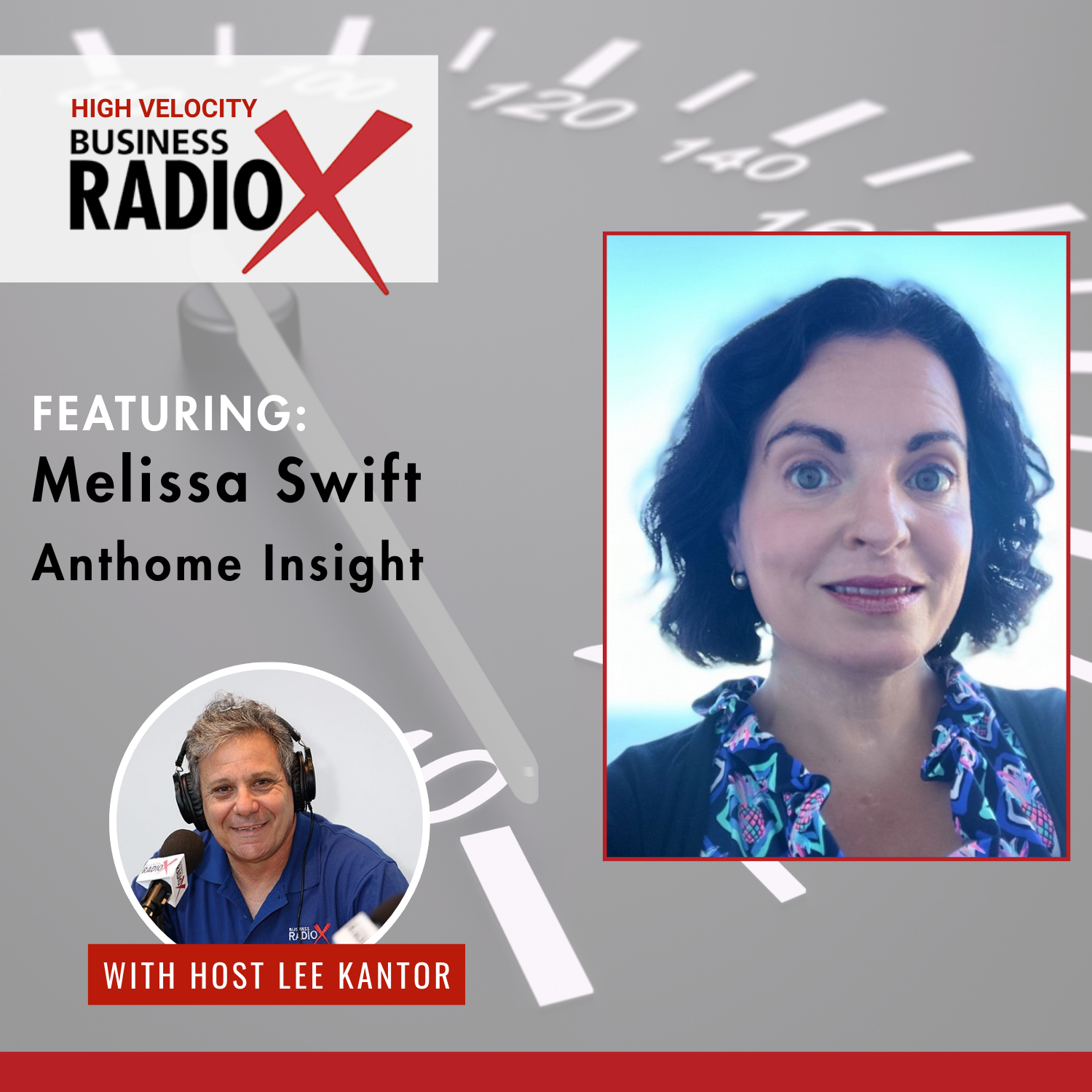


 Melissa Swift is the founder and CEO of Anthrome Insight, a consultancy focused on organizational and personal effectiveness in the digital age.
She is the author of Work Here Now: Think Like a Human and Build a Powerhouse Workplace – and is at work on a second book for Wiley, title soon to be announced, available June 2026.
She writes a quarterly column for MIT Sloan Management Review. A recognized expert on work, workforces, and effectiveness at work, Melissa has been quoted in the New York Times, Wall Street Journal, Financial Times, and Newsweek, and appeared on NPR.
Connect with Melissa on LinkedIn.
What You’ll Learn in This Episode
- About Anthrome Insight
 This transcript is machine transcribed by Sonix.
TRANSCRIPT
Intro: Broadcasting live from the Business RadioX studios in Atlanta, Georgia. It’s time for High Velocity Radio.
Lee Kantor: Lee Kantor hear another episode of High Velocity Radio and this is going to be a good one. Today on the show, we have Melissa Swift. She is the founder and CEO of Anthrome Insight. Welcome.
Melissa Swift: Great to be here.
Lee Kantor: Well, I am so excited to learn what you’re up to. Tell us about your firm. How are you serving folks?
Melissa Swift: So we are a people consulting firm, really laser focused on this question how to be effective in what is a pretty crazy world of work these days. And a lot of what we do is very research driven, very data driven, but quite practical and pragmatic. So the the goal here is to say, okay, work’s gotten a little crazy. What can you do to cut through the clutter and really make individuals effective teams, effective companies effective.
Lee Kantor: So when you’re saying crazy, what are some of the things you’re talking about?
Melissa Swift: So one aspect would be what’s called work intensification, which is work that’s simply gotten to be too much, you know, too many tasks per hour, too emotional, too interdependent, too many crazy processes. Work has also gotten very chaotic, I think, representing, you know, an outside world that gets ever more chaotic by the moment. Another facet would be that works gotten more transparent. And this is an interesting one because it cuts both ways. It’s it’s great that, you know, we have more information at our fingertips, but not all of the information is stuff we always want to hear or handle. So, you know, what we do at Anthem Insight is really help organizations. And, you know, again, individuals get to a place where, you know, I can be effective despite the 20 million email pings or, you know, all of this information that my team is struggling to absorb or whatever, all of these kind of chaotic, modern working conditions look like so.
Lee Kantor: Who was the ideal client for you?
Melissa Swift: I would say, you know, our work tends to really focus on organizations that are that are going through something. And that might be something really positive, right? It might be some great technology transformation or a merger and acquisition or, you know, exploring a new market, growing the business. Or it might be challenging times, you know, you might be in a place of contraction and, uh, you know, laying people off. You might be, you know, retrenching for an uncertain future. But, you know, I think the common thread is an organization really going through a big change and then understanding that that’s the moment to tune up on some of these basics about how to get work done, that, you know, it’s hard enough day to day, but then let’s say you’re trying to implement some great new technology. You know, people are in so many meetings and grappling with so many emails back to back that they’re just not Equipped to do the things you’re asking them to do. And that’s the moment when we can really come in and help. Uh, you know, again, as I said, based on on data and evidence, not cute theories. We’re very practical.
Lee Kantor: Now, what is kind of the symptoms? That there might be a problem at one of these organizations, you know, right before they contact you?
Melissa Swift: Well, usually the tell is that, you know, they’ve done all of these things to increase productivity or get to better outcomes, and the things don’t seem to work. So, you know, we implemented this great new system. We’ve gone through this big digital transformation. We completely reorganized. We bought this other company. You know, we’ve done all these great things. And the answer isn’t that the great things didn’t work on their own, or that they’re not going to work on their own. The answer is that the pipes are a little bit clogged, and all the great stuff you’re doing isn’t going to have the impact you want it to have without kind of some fundamental cleanup of just how how work gets done. You know, the the basic stuff of work in 2025 is a little bit weird and broken. And if you can again come in and address some of those pieces and make things simpler and clearer for folks. And, you know, again, and we work all the way down to the individual leader level, you know, it may be about as an individual leader, just making things simpler and clearer in your own job. And then for your team, that’s when you get some of the breakthrough progress that you would have expected from the bigger, cleverer things you’re doing.
Lee Kantor: So you mentioned research is important. Can you explain your backstory and how you kind of discovered that research is kind of at the crux of a lot of this.
Melissa Swift: So it’s interesting. I’ve conducted an array of research studies across an array of topics over the last, let’s say, decade or so. Everything from, you know, why do certain members of the C-suite not like each other to, you know, what actually makes for a great leader in the digital transformation context to, you know, what makes for a truly healthy organization? Um, and I think the the common thread is that the data usually tells us sort of 80% of what we already might suspect, but need data driven support for. And then 20% of the time you get those really kind of surprising and interesting conclusions that, um, you know, that that advance your understanding of the, of the topic. So I’ll give you an example. When we looked at, um, in a prior role, what makes for a great digital leader? A lot of it is what they don’t do rather than what they do. Do they? They step back, for instance, and create a context for their teams rather than being over their team’s shoulders. And so you get some of these research driven insights like that and you go, aha. This can actually help me give people a different practical path. And that’s I think what’s energizing and exciting is, you know, you can make all the cute consulting frameworks you want, but if you really have some hard data on things people can do differently, that’s that’s the holy grail. It’s super exciting.
Lee Kantor: So when you’re beginning work with a client, what do you do to kind of create that baseline so that you can see that you kind of achieved whatever the outcome they desired.
Melissa Swift: So what’s important is, you know, I always look at this, it’s like a like a Top Chef challenge where it’s, you know, you have to cook with the food, only the food that’s in the pantry. And so the food that’s in the pantry is going to be different at every organization. So what you want to do is come in and say, okay, what are the data sets that you have that really tell your story. And so there are some typical ones, you know, workforce movements who’s getting hired and how long do they stay before they quit and what level do they rise to, blah blah blah. You know, that’s that’s a great one. Um, engagement surveys are also a great tool, particularly because we often don’t mind that data well enough. So, you know, we look at things like the overall engagement scores can be interesting and telling, or they can be totally unhelpful. But then there are questions in engagement surveys, things like, I have the tools I need to do my job. That’s a very boring question with a lot of good information behind it. So what you do is you come in and you say, okay, it’s the sort of meta question, what data do you have that’s really going to tell me your story in simple and clear terms. And that’s, I think, how you set a good baseline. You know, you can also use them. You know, we do have some proprietary surveys and things like that. But I like to look to the organization’s own data first because again, a lot of the time most of the stories are already there.
Lee Kantor: So when you’re working with the organization, they see there’s a problem. You come in, you do a survey, you kind of get the lay of the land. Are you then. Now giving them. Okay. Here. A do a, B, C and d do you execute it on their behalf or is this kind of your letting them know kind of where they stand and give them recommendations. And then they kind of have to execute like where does the service begin and end?
Melissa Swift: I think one critically, some of it depends on what the follow up looks like. So in developing the recommendations, which is the part that we always do do, we’re really extremely focused on breaking patterns. So every organization like your family, you know we do the same silly things in families over and over. Your friend group right. You do the same silly things over and over. Companies are the same way, right? And this this the Freudian repetition compulsion. Companies do the same silly things over and over. So what we like to say is okay, all right. Here are data driven conclusions. What is going to break the patterns that got you to this point, right? What is going to set up new positive patterns for you and what’s going to break some of these cycles? So once we’ve developed those recommendations, depending on what the follow up looks like, we have an extensive network of partners that we work with. So you know, let’s say, you know, we need, you know, wonderful coaches or you need someone to do redesign some jobs. Whatever the the ask is, we’ve got this terrific network of folks who help execute on that. Um, or there may be cases where we say, you know, look, Armstrong can really carry this one all the way through to the ground.
Melissa Swift: Um, and in either case, we stay highly connected and make sure, again, that you’re doing that critical step of breaking patterns. The pattern breaking is, is really the the essence of where consulting recommendations often go wrong. Oftentimes, you know, we say okay, well, you know change these things. Well okay. Well we tried that 20 times and it didn’t work. Or you know, we give, um, advice that’s so sort of generic. And particularly in the people’s space, it’s very easy to come back to kind of these very generic myth recommendations. So we try to be extremely provocative and say, okay, we’re dealing with, you know, this is this. These are issues around human beings and how they get work done. What’s going to really change that? And let’s be as provocative as possible, and then let’s come up with an execution plan that you’re actually going to do. And that really equips the organization to participate in the execution themselves as well. Because I think that’s the other um, that’s the other challenge is, um, when organizations are insufficiently involved in the sort of the execution tale, they don’t own it and it doesn’t stick. So we believe that part is crucial as well.
Lee Kantor: Now, it sounds like a lot of the work you’re doing is going to impact the company culture. Um, how does that work? And do you work alongside the culture, or is this something where sometimes the culture needs to be disrupted as well?
Melissa Swift: I think And cultural disruption. It’s a fantastic question. Um, cultural disruption is nine times out of ten. A piece of the solution. Because again, when you think to a pattern breaking where the patterns come from, the patterns are the culture. The two are so woven tightly together at the same time. You don’t want culture to be the reason why the work was unsuccessful. And so the danger is that you don’t want to sort of like run up and slap the culture in the face because that’s that’s again, thinking about a sustainable execution that’s not going to work. So what we focus on is, okay, what is the least that needs to change about this company’s culture to get the change in work that we need? And, you know, so that that might be okay. We’re not going to change the behavior of every single leader in the organization. Right? That’s that might not be a realistic expectation, but can we get them to communicate a bit differently on email. That’s an example of a more realistic, culture changing suggestion, right? Because if everybody actually wrote their emails a little bit differently, that would change company culture. And that’s that’s actionable, particularly when you give people some really strong templates for how to do it. But it’s not it’s not so extreme that the very culture you’re trying to change will stop you from from changing it.
Lee Kantor: So now, as part of your service at the end of the, um, the course of action. There’s another kind of research done where you’re seeing, okay, this worked or this didn’t work, or where do we go from here? Like, is it bookended? Is research kind of the book ends.
Melissa Swift: You have to and you have to build research into the, the tail even that the company is going to end themselves. Right. So there, if they don’t have a way to constantly check on their own progress long after you leave, again, you’re not going to get that sustainment. So at the end of the day, yes, you want to measure on a data driven basis at the end of the project. You know, what can what data hallmarks can we look for to say that we genuinely made progress. But you also want to leave the organization with some super concrete ways that they’re going to measure it going forward. So, you know, you’re going to look at this engagement survey question, but also your this business outcome. I think that’s that’s the the other critical piece about measurement is that you can have all these lovely warm and fuzzy people measurements. But if the business isn’t impacted and you don’t have a way to measure that business impact, again, you’re not going to get the sustainment on changes and work. So we try to both, you know, measure that within the scope of the existing work, but also to to leave folks with, you know, some really concrete, uh, you know, ways to do that going forward.
Lee Kantor: So if you were building a company from scratch, what are kind of the must haves And the things you wouldn’t want to have in building that kind of, uh, workforce that’s going to be productive and thriving.
Melissa Swift: And building a company from scratch. I mean, I love I love this question. Um, because this is, you know, this is what people are doing live in the startup ecosystem all day long. I think from scratch, honestly, build with an excess of simplicity. And I know that sounds like a weird answer. You know, you’d expect something more about sort of empowerment or et cetera, etc. but a lot gumming up people. It’s really making them exhausted and frustrated and burnt out is just excess complexity that doesn’t serve a purpose that you know, we’ve built. Okay. You know, you have 15 direct reports or, you know, there. Think about what Jamie Dimon was complaining about, about having to take things through too many committees. The way to stop that at, you know, the organization gets to, you know, big, complex, multinational size is at the beginning being extraordinarily, almost minimalist about how you set things up. Don’t you know it’s fun? It looks fun and clever to set things up in a complex way, but it’s actually unhelpful to, again, people doing the work. It’s unhelpful to your technology, too. By the way, that’s the that’s the interesting thing. Everything you do in terms of simplicity and clarity helps people, and it helps you set up the technology that enables those folks, you know. So, for instance, if you set up really simple ways of thinking about your data from the beginning, it’ll be easier for an AI to help you with that data down down the road. But this is, I think, the step that you know, often gets missed is that simplicity and clarity are just really fuel human kind of creativity and innovation and and thriving.
Lee Kantor: Now, what do you recommend to organizations, um, on how to manage the Dei situation nowadays where a few years ago, die was something almost a must have in a lot of organizations, and that was an important component of how they were providing value to their people. And now it’s almost, uh, you know, a word you can’t speak aloud. So how do you help organizations manage through this change?
Melissa Swift: So what’s important is, again, focus on the business outcomes that are being sought. So if the business outcome, let’s say, is innovation, you need people with different thoughts. You can’t have everybody thinking the same and successfully innovate. It’s that clash and that contrast that drives innovation. So when, you know, just build backward from the business purpose and say, okay, well how do we engineer things like our interview processes for new hires or promotion processes to bring people up the chain to make sure everybody doesn’t think exactly the same? And by the way, we have to keep everyone. We need a group of people all thinking differently. We need them all in the same conversation. And how do we keep everyone in the same conversation? How do we run meetings such that everybody speaks and these die themed questions, right. This is just like how to run a sensible business. And I think when we tie it back to business outcomes and we make it about running a sensible business, and how do we make sure we don’t fall victim to, to groupthink or the loudest voices only that’s those are the right business questions to go after. And, you know, you stay out of some of the political questions around what should this all be called? Or how should this all be done? You know, just focus on the business thing you’re going after.
Lee Kantor: So when you kind of are laser focus on the outcome you desire, um, you’re going to be doing things that are going to be more inclusive. If you want to get that outcome, if you truly want to get that outcome.
Melissa Swift: Absolutely, absolutely. You know, I always think about one of the things that one of the interesting facts about Enron, which was that I think, like the whole executive team belonged to the same country club or something like that. And that’s part of why they didn’t have that youthful dissent that could have saved the company. So that’s that’s what you’re managing against it. Just make sure everybody isn’t agreeing with each other all the time because again, that’s you don’t get the cool ideas. You don’t get the risk management. You know, there are a whole bunch of things that, if we all think the same, don’t go as well. And so, you know, design design for that. And and you’re good.
Lee Kantor: Right. But that takes a level of humility in order to and vulnerability in order to, to kind of look for, um, differing opinions. A lot of people are happy when everybody agrees. You know, that’s it seems like that’s the path of least resistance. But I’m hearing you say that you need to have that kind of dissent.
Melissa Swift: Simply because, you know, even if you don’t. Ultimately it’s not. It’s not saying that you have to agree with every dissenting opinion, but if you don’t have any of them, you know, you miss things. And that’s what today. I mean, with everything operating at the speed and the complexity we’re operating at. You don’t. Your worst fear should be missing things. And you should be engineering around. Let me make sure I’ve you know, I’ve kind of got all the possible scenarios in my head. And that’s where, you know, a culture of of constructive and respectful challenge, I think is a great asset for a company. And I’ve seen that done really well within some organizations. Where to your point, there’s a level of humility in leadership where they can say, okay, you know, let me let me hear why you disagree. And again, they don’t have to always agree. And they don’t I think that’s one of the great myths, is that you have to hear every disagreement and agree with it and act on it. You don’t. But not being exposed to those contrasting points of view, that to me creates a business risk, right?
Lee Kantor: That’s where the problem is. You should be allowed to say whatever you want to say, but don’t assume that I’m going to act on everything you say.
Melissa Swift: Oh, not not at all. And I’ve seen leaders go very wrong that way. By the way, if you are sensible, you know, sensitive to every little breeze that blows every different way. You’re not a leader that’s strong in your skis, right? You are not displaying decisive, thoughtful leadership. You know, what is it they say? Like the essence of strategy is what you say no to. You should be good and okay to say no. But if you don’t know the range of what’s possible, you know, then again, your danger is your competitor does.
Lee Kantor: Now, you wrote the book work here. Now think like a human and build a powerhouse workplace. Um, can you talk a little bit about how that came about?
Melissa Swift: So work here now is really about what can we do to, you know, sort of fix some of these little nits in the ways that we work. That, again, just enables us to be both more productive and have healthier workforces. You know, I firmly believe in the intersection of that, that Venn diagram. I don’t think it has to be an either or. Either we get maximum value out of people or those people are happy. I believe that there’s this kind of really nice central ground and work here now is about how do you find it. So it’s things like I talk about in the book The Work Anxiety Monster. You know, you need to we all have this voice in our head that’s like people are lazy, people are slow. You, Melissa, you’re lazy. You’re slow. Right? We do it to ourselves. And shutting down some of those anxious voices inside our heads and not running organizations that way and saying, okay, you know, I believe people will do the right job again when we set up the work properly, if we change some of our fundamental beliefs again, you know, it’s if you look at technology growth over the last few decades, it’s been exponential. If you look at actual productivity growth, it’s so much slower. And the gap is how we organize work and how we think about our workforces. So work here now is really about, you know, how can we shift that thinking to do all of that a lot better?
Lee Kantor: Now, how do you feel about the kind of the different generations in there? Um, our looks and the way they’re approaching work.
Melissa Swift: It’s a great question. I believe that, so I’m Gen X, right? My personal stake in this is I think work has changed a lot during my lifetime. I think a lot of that’s been technology driven, uh, some good, some bad. And what’s interesting is if you’re Gen X, you you kind of you’ve had the real ringside seat to all this change you’ve watched. You know, we started using email early in our working careers, things like that. If you’re older than Gen X then, you know you’ve kind of locked in on work in a different time. And if you’re younger than Gen-X, you’re getting dropped into a workplace that’s changed a lot in a relatively short amount of time. Right. The like, let’s say the Gen Xers working lifetime, you know, 25 years, 30 years, whatever. And you’re having a like an interesting reaction to it. You know, you’re going, well, why do I need to be in 12, 30 minute meetings in a day? But if you’re older than Gen X, you’re going, well, you’re going to be in the meetings your boss tells you to be in. If you’re Gen X, you’re going, oh geez, I don’t know. And that’s where we get some of this really interesting generational contrast. And I know specific generation is is right or wrong. Um, it’s just that because we’ve been through a time of rapid change, you get what looks like a lot of polarization between generations at this exact moment.
Lee Kantor: So, so how do you kind of manage that? How do you manage the the younger people, uh, nowadays that are like, look, I’m leaving at five because, um, me and my friends are going to the movies and this movie’s just come out, so, you know, that’s a non-negotiable. We’re like you said, maybe older generations are like, you just stay until the work’s done.
Melissa Swift: Until the work’s done. Yeah, well, some of it is generations being all being open about their working style. Like, one of the things that I do personally when I manage folks is I actually talk about how I get work done, that. Yes. You saw me leave at 530, uh, because I had to go, you know, pick up my daughter from aftercare. Right. And this is my reality as a working mom. Um, but then I there was some stuff that was left to be done. So after I put her to bed at, you know, this would be the past of my daughter, not the present. But, you know, after I put her to bed, I got back on email at nine. Right. And I worked from nine to whatever. And because that worked for me. Right. Um, and just being really transparent about I got done what needed to get done. I used that flexibility properly and, you know, you may have a different version of that, right? You may be a super early riser, so maybe your version is not working from 9 to 11 p.m.. It’s like you get up at four and work from four till six.
Melissa Swift: God bless. It’s not me, but some. Again, some people’s circadian rhythms and lifestyles work that way. So I think some of it is just more transparent on working styles and trade offs. And okay, if you that’s the trade offs you want to make because you want to see the movie. Fabulous. Go for it. These are the timelines on what to do. So you figure out how to make it work. And this is my example of this is how I make it work. And I think sometimes just giving that gritty lifestyle clarity I’ve gotten a lot of feedback. Oh my god, Melissa, that’s so helpful. I literally did not understand how you get things done. And if we can all communicate a little bit better about that, then again, it doesn’t have to be like, I win, you lose. It’s like it can be a win win. Things can get done on time and people can have the lives they need. It’s just you have got to understand the constraints on one side, and then I think you do need some visibility on how the older generations actually get things done right.
Lee Kantor: And it goes like you said earlier, the foundationally communication and clarity are so critical because without those, then you get these kind of resentments and then you create kind of that, uh, the hostile environment in the, in the office. When it does, it’s not necessary really.
Melissa Swift: Yeah, exactly. I mean, I think a lot of the, the, you know, cross-generational crossfire is to your point exactly that just a lack of communication and misunderstanding and, and, you know, again, that’s where the kind of over communicating and letting people see a little bit about what’s behind the curtain. I think is, is the right move. And again, it is tougher for the older generations because we did not have like the leaders who were my role models in general, didn’t model that clarity. That is something that I’ve talked to a lot of Jenks colleagues. We are having to come up with that script ourselves. And that’s that’s an interesting moment.
Lee Kantor: Right. Well, back in the day, it was like I hired you. You’re supposed to know how to do all this stuff, so you figure it out. And now this generation is like, well, tell me what needs to be like. It’s more hand-holding in that regard. And as long as you’re clear and you can communicate properly, I think everyone’s going to get the outcome they desire.
Melissa Swift: Absolutely. And acknowledging that in some ways this generation requires more communication because, again, with technology and everything in the equation, I you know, I look at what my working day looked like when I was fresh out of college versus some of these folks, and they needed a little more communication because we have made things a little more complicated. And, you know, it’s okay. That’s okay. Communication, again, is what smooths the waters and what’s what keeps us all running.
Lee Kantor: So if somebody wants to learn more, have a more substantive conversation with you or somebody on the team. What is the website? What’s the best way to connect?
Melissa Swift: So a few different ways. I am very active on LinkedIn, both as myself, Melissa Swift and also for the company Anthem Insight, our website, and Throw Insight. Uh, there’s the older book work here now, and I have another book coming from Wiley in June of next year. That will be a bit more on the side of talking about personal effectiveness in this crazy world of work and what you individually can do.
Lee Kantor: Well, look forward to talking to you about that next year. Well, thank you so much for sharing your story.
Melissa Swift: Thanks so much.
Lee Kantor: All right. This is Lee Kantor. We’ll see you all next time on High Velocity Radio.














