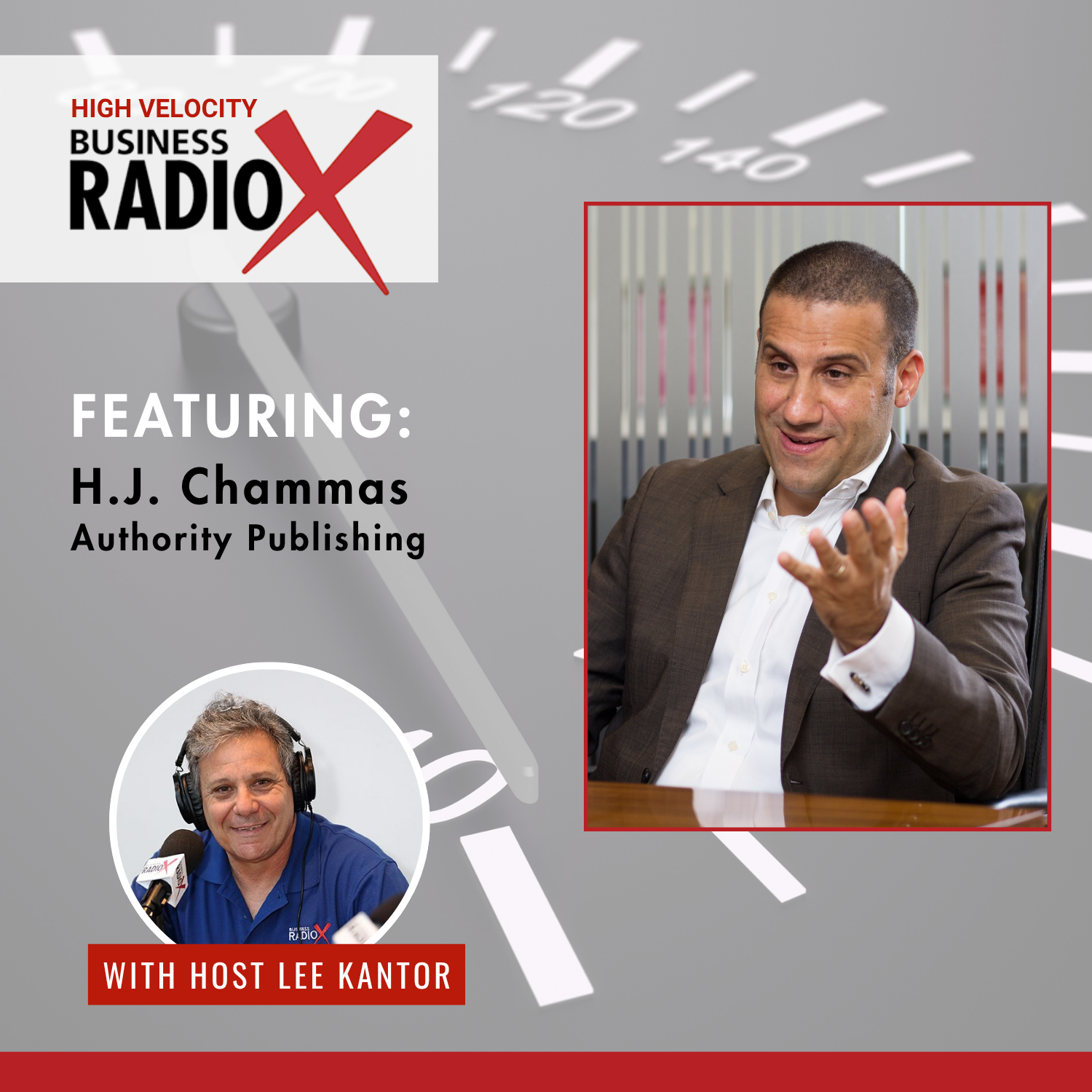

In this episode of High Velocity Radio, Lee Kantor interviews H.J. Chammas, Founder and CEO of Authority Publishing, about how coaches, consultants, and business owners can leverage books to establish authority, build trust, and grow their businesses. He shares his three-pillar strategy—Publish, Promote, and Monetize—and explains why understanding the target audience, creating valuable content, and consistently promoting a personal brand are essential to turning a book into a powerful business growth tool. Drawing from his own publishing experiences, Chammas emphasizes that success is not measured by book sales or bestseller status alone, but by the meaningful impact a book creates and its ability to generate opportunities for high-value services.
 HJ Chammas is a four-time bestselling author, entrepreneur, and Founder & CEO of Authority Publishing, where he helps coaches, consultants, and experts turn their knowledge into authority, credibility, and business opportunities.
His journey into publishing began with a $65,000 mistake that taught him an important lesson: publishing a book is one thing, but making that book work for your business is something entirely different.
 Today, through his Publish, Promote, Monetize framework, HJ helps experts strategically position their books, build their personal brands, and attract opportunities beyond book sales, including high-ticket clients, speaking engagements, and partnerships.
He believes a book should be more than something you sell. It should be an asset that helps sell your expertise.
Connect with HJ on LinkedIn, Facebook, and X.
What You’ll Learn In This Episode
- Leveraging a book to establish credibility and position yourself as an industry authority.
- Applying the Publish, Promote, and Monetize strategy to turn a book into a business growth asset.
- Understanding target audience pain points, aspirations, and needs before developing a book.
- Differentiating your book through audience research, unique methodologies, and strategic positioning.
- Promoting your personal brand and message instead of focusing solely on book sales.
- Using books to build trust, nurture relationships, and attract high-ticket clients.
- Integrating publishing, marketing, and monetization to create long-term business opportunities.
- Measuring publishing success through client acquisition, audience impact, and business growth rather than bestseller status alone.
 This transcript is machine transcribed by Sonix.
TRANSCRIPT
Intro: Broadcasting live from the Business RadioX Studios in Atlanta, Georgia. It’s time for High Velocity Radio.
Lee Kantor: Lee Kantor here. Another episode of High Velocity Radio and this is going to be a good one. Today on the show, we have the founder and CEO with Authority Publishing, H.J. Chammas. Welcome.
HJ Chammas: Hey, Lee. Thank you. Hey, great being on the show. Thanks for having me.
Lee Kantor: Well, I am so excited to learn what you’re up to. Tell us about Authority Publishing. How are you serving folks?
HJ Chammas: So, Lee, what we do in a nutshell, we work with coaches, experts, and consultants to allow them to monetize their high ticket services. And how do we do that? By elevating their authority figure through a published book that’s well positioned to the right audience. And that really delivers value to their Audience, so they become known for their services. And this makes the whole thing easier for them to sell their high ticket services.
Lee Kantor: Now, I’ve interviewed a lot, probably hundreds, if not thousands of coaches and consultants. And they all kind of say they’d like to write a book. And they all maybe even say it to the point of one day I’m going to write a book, but very few of them actually go through the process. You know, it’s a lot easier to say you want to be a writer than actually writing. How do you help those folks kind of get the book done and, and not only get it done, but get it done in a way that has an ROI for all the time it takes to write it.
HJ Chammas: Yeah, that’s a great question. So what we do basically is we work with them to really understand their core services. But most importantly, we help them understand who is their target audience. And when I say that, what I mean is they need to answer two main questions. And we do have them on that research as well. So the two questions are what makes them wake up at 2 a.m. in the morning. Otherwise what’s the biggest challenges or pain points? And the second question is what are their aspirations? And once we understand that audience and what they want to read about this is when we come back to the author and we start doing the mapping, the mapping. What I mean here is the methodology that experience their journey. If you if, if I may say so, we start to map all of that from the audience lens, from the target audience lens, from the reader’s lens, so that we make sure the book and its content is delivering transformation and is delivering value. And guess what? When when a reader sees that the author understands their challenges, understand their pain, and really is guiding them in that transformation, the trust tank gets filled up. And that when. The trust tank is filled, is filling up, it makes it easier for those coaches, experts and consultants to start converting that high ticket services.
Lee Kantor: So then the book, um, is the, the book then isn’t really the objective for the book isn’t really to become, you know, sell a million copies, but it’s to sell $1 million worth of services.
HJ Chammas: Exactly. Let’s look at it in that simple way, which is a better scenario, selling a thousand copies of a book with the royalties that say $5 at best, that’s five K in that simulation, or selling maybe 100 copies of a book, but getting ten leads and then eventually getting a client for a $30,000 consultancy. So which is a better equation? You definitely would agree with me that selling 100 copies and getting a 30 K customer is way better than selling 5000 copies and only earning from the royalties.
Lee Kantor: Now. Yeah, absolutely. Now, is there also kind of, um, maybe some mythology built around what a best seller is the number of books that actually means and what is realistic for most especially consultants and coaches when it comes to books, you know, um, number of copies actually sold.
HJ Chammas: Yeah, definitely. I’m going to also debunk a couple of myths. So being a best selling author, I believe it’s a marketing gimmick for a bit of ego here and there, but that’s okay. We like people love to have it. I don’t think this is what’s gonna get us the, the, the, the, the, the right conversion. But just to answer your question, a best selling author have a couple of, let’s call them milestones. That’s what we call the Amazon best selling author, which is the easiest to get. And I believe everybody can get that if their book is well positioned, if they do the right marketing, if they do the right, you know, positioning for the book and how to reach their audience. But the higher level ones are, for example, the USA today bestselling authors and the New York Times bestselling authors. So what’s the difference to get to an Amazon best selling author, you could be selling a couple of hundreds a month, but on a consistent basis. And you could become an Amazon best selling author. But if you want to move to the USA today bestselling author. Now, the the window, the time window here is about a week. You need to sell anywhere between 5000 to 7000 copies within a week. And that’s not only online, it’s between the book retailers, bookstores, and different formats of the book. And to get to the to the New York Times best selling author, you need to exceed the 10,000 copies across channels and formats within a week. So as you could see that the stakes become higher or the the threshold is higher When you move from Amazon to USA Today to New York Times bestselling author.
Lee Kantor: Now, when you’re talking about, um, units sold, are you talking units of an e-book, units of a hardback book, a paperback? Like what is what is a book sale? How is it defined?
HJ Chammas: It’s defined across platforms and across formats. When I say formats, it means you could you should be selling from e-book, audiobook, print, which is paperback and hardcover. So you could, you should be getting a mix of all of those formats to qualify for that. And when I say across channels, if you talk about the USA today and The New York Times, it’s not only Amazon or Barnes and Noble, it’s also the different bookstores within, within a certain, uh, across different geographies.
Lee Kantor: So is it global or is it just in the country that you’re trying to get the best seller from?
HJ Chammas: Now the, the most focus is USA is America. So when because at USA today@amazon.com or at the New York Times bestselling author, you might have guessed that it’s basically nationwide across the US.
Lee Kantor: Now, you mentioned that even at the New York Times or the ones that are more difficult to achieve bestseller status, the amount that they have to sell. Couldn’t it be I don’t want to say that people do this, but maybe it seems that it’s possible to do something like this. Like, say you’re a celebrity and you have a book deal, couldn’t you just have your team purchase whatever the thousand or 5000 books yourself, or through a network of people that know and like you in order to get that New York Times bestseller status? Yeah.
HJ Chammas: Look, a lot of people are trying to game the, you know, just to see like, how can we decode all of that? So in my opinion, having bulk sales from a certain entity doesn’t count. So when we say 10,000 copies plus should be 10,000 different purchases from 10,000 different, you know, let’s say orders, let’s say, and this makes it quite difficult for one person to orchestrate all of that. Now, of course, if you’re a celebrity status, you have lots and lots of followers. You could be doing your own marketing, inviting your followers to do that. But just to gain the process and have your own team purchase your own books, I don’t see that happening. Maybe some people have tried that, but even if it happens, I don’t think it’s right now.
Lee Kantor: But for folks who care more about an ROI from the process, it’s a lot better to use kind of your book as a calling card rather than, um, try to do all this kind of stuff you have to do to, to achieve that status. That seems more of a vanity status than anything that really is going to generate business for you. Yes.
HJ Chammas: Yes. And that’s why I told you in the beginning, I’m not pro like, hey, I’m best selling author or whatever. It’s all about, I believe. And that’s from my own experience. I’ve been after being a big failure, by the way, it’s not about how many books I sold, it’s about how many people I’ve helped, how many people I have to make a transformation. How many people have impacted? When you start moving, you know your compass from inside about you and how many copies to how many people have you helped? The whole equation changes and then the universe starts paying this back to you by allowing you to really serve people beyond the book.
Lee Kantor: So let’s talk a little bit about your backstory. You’ve you’ve got a lot of this experience through your own scar tissue of going through this process, right?
HJ Chammas: Yeah, exactly. So, so it all started for me, like, you know, just to give a small context here, I was one of those poor guys who left his country as an immigrant with only 300 bucks in my pocket. And what happens here? Climb the corporate ladder in the in the financial crisis of 2008 and nine, I was tagged in the office as the stupid guy. And the reason was everybody was going out of real estate while I was the only guy going into real estate. So, uh, long story short, in a couple of years I, I amassed a decent portfolio of properties and that allowed me to, to leave my corporate world work. Now, this is where the story started. I, I had a lot of ego. I thought I was the next Robert Kiyosaki in the world. And I thought I wanted to write the next Rich dad, poor dad. And this is where the publishing system started to call me. I was naive. I just wanted to I had ambitions and I didn’t know how the publishing industry works. So I paid 65 K for a very famous publisher, which I’m not going to mention names, of course. And that what happened there is that 65 K went all down the drain when it started to reflect on that and started to reverse engineer all those successful authors who did it right. My, my challenge was initially I was looking at how many books I sold. I was looking at how can I benefit from that? This was all about me. But when I shifted my attention about them, my audience. How can I make impact when I’m not in the room? How can I make impact? You know, and and really help people have to make transformation. The whole equation changed for me. So even though I got the bestseller status and that happened on a couple of books, but it’s not relevant. What was relevant for me was how many people I was able to work with to serve and really help them make a transformation in their lives.
Lee Kantor: So when you shifted your attention to, um, generating value for the people that matter most from you rather than let me, you know, maybe come up with a clever title and just build a book that sells a lot, then everything changed.
HJ Chammas: Exactly. I learned the hard way that publishing a book and building a business around the book are two different things. And the second lesson here was for me that a good product or a good book in that case doesn’t guarantee a successful business. However, positioning and, and, and understanding your audience and offering them value matter much more than that.
Lee Kantor: So now, um, let’s talk to the coaches and consultants and business owners out there that have a business that they’re proud of and that they’re serving people. What should they be doing if they want to follow the path that you found to be successful when it came to, um, publishing a book that actually makes money and doesn’t just stroke your ego?
HJ Chammas: Yeah, sure. Before we start with that, let’s face the challenge most of those experts and consultants face. They have a lot of expertise, but the the problem is they need a better way to communicate their expertise. They already have. So expertise is what they know. But authority is what their market or what their audience recognizes them for. And that’s why I call the book is like a business card 2.0. Now, to answer your question, it all boils down to me after my failure and really just to find the strategy, how to do it right. It’s a three pillar strategy, which I call publish, promote and monetize. And you have to think of them as a tripod. They coexist together. So starting with publish, I believe this is where most of the failure Happen is a lot of us nonfiction authors, be it an expert or a coach or a consultant. We love to write about what we know best, and that’s our passion. That’s our journey. And I understand all of that. But the problem is, and this is really the advice for anyone here. We often disregard who our audience is. As I mentioned. So we need to start with researching that audience. Once we do that research, we need to make sure that all of our content will really offer value. Otherwise, said, we need to offer solutions to real problems.
HJ Chammas: And those problems are based on our research, not based on our you know, what we believe or assume things. Once we have that right, positioning everything as follows. Now, when it comes to the publish, now we have. We need to understand also how the whole marketplace works nowadays with the, with with Amazon, Barnes and Noble and all the, the major book retailers, If you think about them, they are search engines. So that means also for our book, which is the title, subtitle, description and the metadata, we need to understand how SEO works so that we need so that the way we, we, we, we, we tackle the book that the way we write the description, we make the book discoverable. What I mean here, if somebody who doesn’t know us, they’re searching for a solution for something. We need to understand the language they use and embed that language in our listing be the title, subtitle, description, so that we allow the algorithms of those platforms to make our book discoverable for their searches. And that’s a very important thing. Now, after they publish, I believe this is where the problem start. Almost 95% of authors, when they publish a book failed. And the reason they failed is they never promote. They think, I’m done. I’m an author.
HJ Chammas: I’ve published and the book and the world will discover my book. And to tell you the reality, nobody will do if you don’t really promote. Now, for those who promote. Also, most of them fail because they promote the book as the product instead of promoting their message, their transformation, and promoting the personal brand, their authority figure. You have to think about it like this. When you start promoting your personal branding, this becomes the launchpad based on which you could later on promote the book and launch the book and also launch your business. And that’s, that’s, you know, that’s a game most often people miss. They start to promote the, the product, the book, and never their personal brand. My recommendation here, please make sure that your personal brand is really well promoted. And when I say that, it means showing up on podcasts, showing up out there, be on stage in communities, uh, start sharing your message. Allow other thought leaders to speak about your message. So all of that and getting nominated for literary awards, all of those will allow us to borrow credibility until we have enough people who’ve heard about that message. And this, you know, this kind of it adds up. It compounds until they’re ready to start promoting their book. Everybody goes to promoting the book first instead of promoting themselves as the as the asset.
HJ Chammas: And the third thing about monetization, the reality is most people think royalties will. What what will put money in their bank? And I tell you, and I’m telling you from my own experience, I have at certain period, 8 to $12,000 of royalties a month. And if I want to hide the reality, people think, wow, the guy’s doing great. But the reality is I’m investing that amount of money to get all those books sold. Because for me, it’s not about the book itself and the royalties. It’s about I want to get my message in as many hands as possible, because this is where monetization is, where I could sell my high ticket services, and this is what really counts. So it’s really important that we need to see that monetization and weave it in instead of the book. And I don’t mean to have it like a sales brochure. It’s about really showing the transformation within the book so people can trust you. And when people can trust you, they start a conversation with you. And this is really the most important thing to convert when you start a conversation. They can see if you can help them. You could see also if you could help them and the conversation will move in the right direction if you’re a good fit.
Lee Kantor: Now, is that kind of one of the mistakes that folks make? They think that this is a set it and forget it. And it’s really a relationship building tool.
HJ Chammas: Yeah, most of them think, I’m gonna set it there and the world will discover it. Discovered. But I really tell you, I haven’t seen that happening. Unless you’re a famous authority, you have hundreds of thousands of followers. And of course, you could publish a book and just mention it on social media, on your email list, and you could have the traction you need. But for most of us, it doesn’t happen.
Lee Kantor: Right. And that’s, I think that’s the the thing that they see a famous person do they think if I just do the thing they did, then I’m going to get the same result the famous person got.
HJ Chammas: Exactly. And in reality, it doesn’t happen.
Lee Kantor: Right. So there has to be a different strategy for most people that don’t have the mega audiences that famous people have.
HJ Chammas: Yep. Right. And that strategy, as I mentioned earlier, it starts with the promoting your personal brand, promoting your message, promoting the transformation you’re delivering before you promote the book.
Lee Kantor: Right? Because the book is just one tool in your tool belt, you’re ultimately selling yourself.
HJ Chammas: Exactly. So I always tell them, don’t sell the book, sell what the book says. And what the book sells actually is your services is the transformation you make.
Lee Kantor: So now in your work with Authority publishing, how do you implement that strategy for yourself? So you’re obviously on this podcast where we’re talking about, um, your firm and how you do what you do, but how do you like what’s kind of the, the day to day, week to week activities you’re doing to help get authority publishing kind of seen by the people you need to have know about you?
HJ Chammas: Yeah, we follow a very simple marketing approach. Never complicated actually. You don’t invest in ads as a lot of people might think, oh, we need to invest in meta and ads here and ads that we don’t do that. We follow a very simple approach, which is we publish content, be it, uh, articles, be it books. We have our own books, Uh, be it showing up on podcast, this is all long form content that allows us, allows us to communicate our message. So all of that content, if you keep on doing that consistently, and a lot of folks don’t do that consistently, they do a podcast here and an article there. And instead of having really something very well organized, the more you start showing, sharing that content, people start to relate to you. People start to to go with the journey that you’re communicating. And, and, uh, what happens here is this is what we call inbound marketing. So we’re sharing content and some people will come to us. They want to have a conversation. The other, the other strategy we do is outreach, which is basically a lot of the authors we help, they become our brand ambassadors. They start to get us referrals because they, their friends are going to ask them, hey, how did you do that? Can you can you guide me? Can you refer me to the publisher or the marketing agency who helped you And this kind of outreach works. Brilliant. Because when somebody comes to you and they kind of being referred by someone they trust automatically, this is puts you in the right mindset with them. And, and for the outreach, also what we do, we have our own sales team. What they do is they show up in certain communities and certain events where our target audience is and they start to establish rapport with them. They really network with them. They add value to them, and all of that starts bringing us the right people on board. It’s a very simple strategy. We don’t do more than that. And for the last four years or so, we’ve been growing like as never expected for us.
Lee Kantor: And then but you think kind of as a rule, if you’re in professional services, if you’re a coach, a consultant or a business owner, having a book is kind of a must have. Nowadays you have to have something like that in your hands if you want to really grow and position yourself as an authority.
HJ Chammas: Yeah. And the thing is, Lee, think of it like this, that a high ticket client, which is the client of those coaches, experts and consultants rarely make a decision based on a single ad. They need confidence in the person they’re hiring. So that means that we need to earn that trust. Now, a book, what happens with the book and the magic of a book is it allows potential clients to spend several hours with us through the book, with our ideas, before meeting us. At that time they spent with us. When they show up on a call or on any other touchpoint with us, they know us because they’ve been involved heavily with us. They invested their time with us, and the book allows us or allows any author to introduce framework, to demonstrate their expertise or their experience, and answer questions to the audience that they know that it’s on their mind. And all of that really compounds so that when they when, when they have a conversation together, they already kind of be converted. So they’re not going to do a hard sales call. No, they’re going to just add value in those conversations because the book did all the pre-selling for them. And that’s why I think it’s really magical.
Lee Kantor: Now, when a person is doing their first book and they’re that coach, consultant or business owner, or is there an exercise or some tools you can share for them to help make sure that that first book is going to really hit the mark and is going to be a bull’s eye, rather than them thinking that this is a good idea for a book or what should they, how do they go about writing that first book? How do they know what is the appropriate subject matter that’s going to elevate their firm to that authority status that they hope they they become.
HJ Chammas: It all starts with the audience. Understand your audience way better than they understand themselves. And nowadays, with all the AI tools, with all the Google tools and SEO tools and the Amazon tools, you name it, we could quantify that. Now it’s easier than ever to quantify what’s on the mind of our target audience. What are the questions they want answered? So everybody, I really see almost a lot of the folks out there miss on that. They just they start with themselves about what I know best instead of starting with them. And the second mistake I always see in authors, they want to be the heroes. It doesn’t work like that. Your audience is the hero and you are the guide. And when you establish that relationship, that means you understand them and you’re going to guide them. They will. They will start to follow you. They start to trust you. And that trust is the is the first threshold we need to surpass to, to, to really build the relationship with them.
Lee Kantor: Right. But if everybody is, uh, having those kind of same framework of thinking, wouldn’t every business coach each have a book that is similar? Like, how do you kind of craft a book that it hits a bullseye with your intended audience while kind of explaining how you would do things a little differently?
HJ Chammas: Yeah, love, love the question. And that’s maybe something I missed to answer earlier. When we start with the research, as I mentioned earlier, we need to map the content, which is the content, meaning the methodology of the author, their expertise, their know how, their journey versus the what the audience wants to read about. But that’s not enough. Now, the third axis, if you think of it in that way, we need to research other books out there. And why is that important? Because if we’re going to be another Me Too book, that means we’re going to offer the same content, the same methodology, like every other author was out there. We’re going to be noise in the market. Now, while there will be a common topics to cover, we need to have that sweet spot, which is what we as the author is offering to the table. We’re adding something new to the table and that becomes the sweet spot. And guess what? That’s what that thing that’s going to differentiate us becomes more or less our personal branding. We become known for that thing. And this is the basis on which we develop our personal brand.
Lee Kantor: So how does it work for authority publishing? Like why should I partner with Authority Publishing? Then just go to the Amazon website and say, I’m an author. Just walk me through putting a book in your system.
HJ Chammas: Yeah. So what we have our office on the three pillars publish and promote and monetize and publish. We have them understand the audience, the problem they’re solving. We have them map their methodology. We have them position the books strategically and also to structure that content from the reader’s eyes. Now, a lot of of publishing agencies out there, they stop there, they publish the book and you’re on your own. We don’t do that. We hold the authors hands and we start promoting the personal brand with them, and then we start promoting the book with them. So we help them. We we have them to use the book to support credibility and recognition. We help them even through podcasts, speaking engagements, editorial coverage, reviews, and being in the relevant channels. So actually, we promote, we have them promote the authority behind the book. And the third pillar on monetization, a lot of the folks out there get stuck there. So we even help them on what, uh, what is the ecosystem that needs to be connected to the book? Okay. And create opportunities for readers from within the book to engage with them through that ecosystem. And we build those funnels for them. We built those, those, uh, maybe, maybe, uh, it could lead to a consultancy, to a coaching to a training to speaking or to partnerships. So we get immersed in their world, in their ecosystem to understand what should be the journey from of their readers and coming into their business. So no author is like the other one. So we need to really immerse ourselves into their own business, into their own life, to map all of that with them.
Lee Kantor: So it’s not so your, your ideal client isn’t somebody who wants to publish a book. Your ideal client is somebody who wants to differentiate themselves and grow and build a machine that’s going to help them get to a new level. It isn’t necessarily to just be another author.
HJ Chammas: You’re right. If they want to be an author, they don’t need us, by the way. And, uh, if they want to know what we do, that’s why I offer my book for free called publish, promote, monetize for those who just want to publish their book without the need of anyone on any other publishing house. I recommend they do it on their own, but it’s not the winning game. Okay, you’ve published a book you have. You could say, I’m a published author and that’s it. But if you really want to build a business on the back of your book, it’s more than that. It’s about going to the publish, promote, and monetize journey to build your personal brand and authority so that you could monetize your high ticket services.
Lee Kantor: So if somebody wants to learn more and get a hold of the book, get a hold of you, what is the website? What is the best way to connect?
HJ Chammas Yeah. So basically I’m offering that book for free for all the audience of your show. They could, they could connect with us on authoritypublishing.com, so authority-publishing.com. And if they want a free copy of the book, is authority-publishing.com/book-ppm. And I will share that link with you as well by email, if you could share it with them as well on the description of the show. Uh, they could read the book and there is nothing hidden inside of it. Whatever we do in our agency is written out in the book. So they could follow the step and start, you know, publishing on their own without meeting anyone and paying high ticket services for those who need to take that further. And they want really a partner to, to have them promote the personal brand and have them monetize their high ticket services. Also on our website, authority-publishing.com, they could schedule a call with us. It’s only a clarity call. We tend to understand their business, their vision, and we see if and how we can help them.
Lee Kantor: Well, hey, thank you so much for sharing your story today, doing such important work. And we appreciate you.
HJ Chammas: Thanks to you for having me. It was was a great, great chatting with you.
Lee Kantor: All right, this is Lee Kantor. We’ll see you all next time on High Velocity Radio.