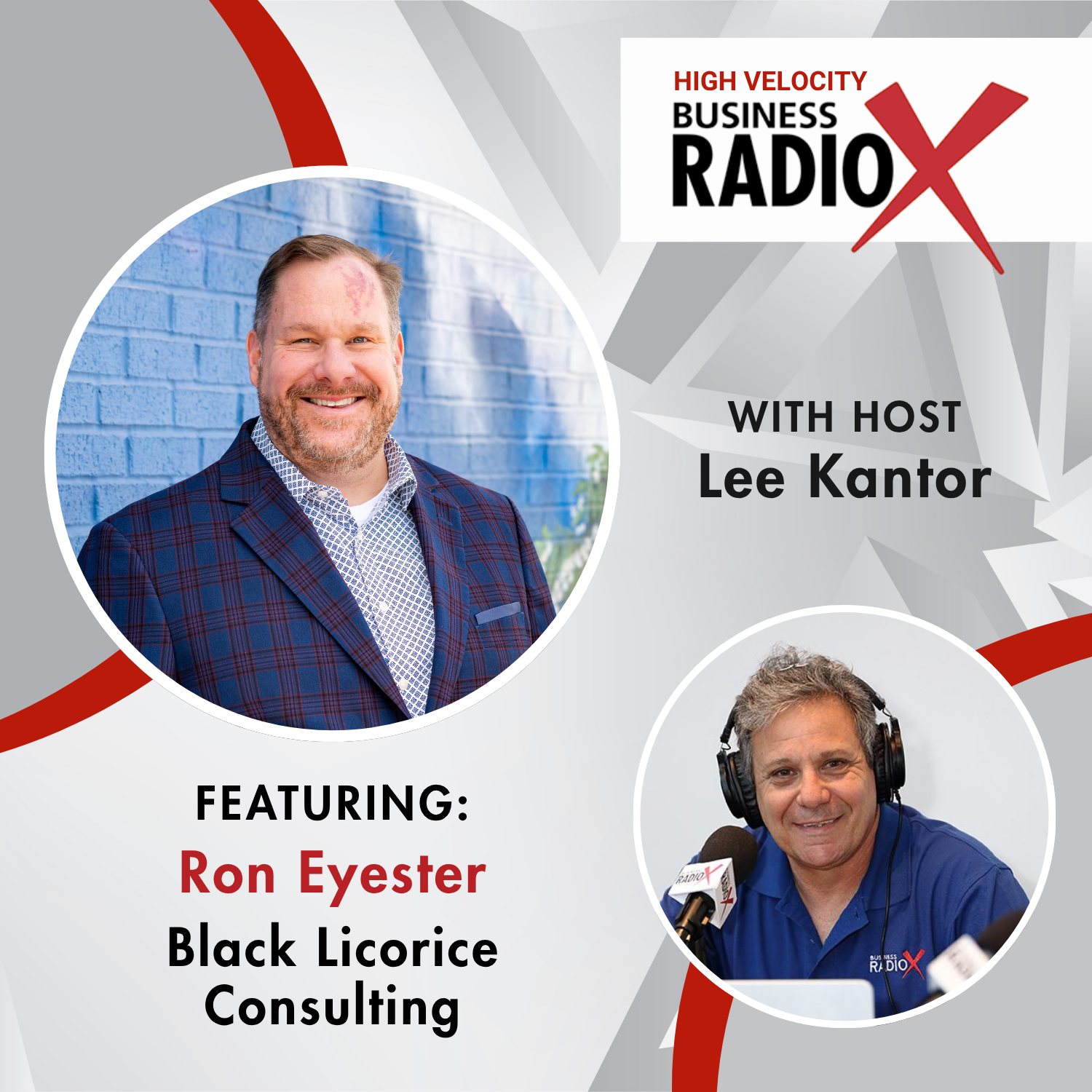

In this episode of High Velocity Radio, Lee Kantor interviews Ron Eyester, Founder and CEO of Black Licorice Consulting. Ron shares how hospitality-driven leadership, employee development, and strong workplace culture can transform restaurant operations and customer experiences. He discusses the importance of developing soft skills, empowering teams, creating consistency through leadership, and building organizations that prioritize people as much as profits.

 Ron Eyester is a hospitality consultant, leadership coach, entrepreneur, and recovering restaurateur with more than three decades of experience in the restaurant industry. A former chef and multi-unit restaurant owner, he built and operated several Atlanta concepts, including Rosebud, The Family Dog, Timone’s and Southern Bistro, earning a reputation for creating distinctive neighborhood and community driven guest experiences and people-centered cultures.
During Atlanta’s early farm-to-table movement in the 2000s, he became a strong advocate for supporting local farmers and producers, helping pioneer an approach that paired high-quality, seasonal ingredients with approachable neighborhood dining.
His restaurants demonstrated that exceptional food, genuine hospitality, and strong community relationships didn’t have to be reserved for fine dining establishments, helping build loyal guest followings and lasting partnerships throughout the local food community.
Today, he is the founder of Black Licorice, a consulting and coaching company dedicated to helping hospitality businesses develop stronger leaders, healthier workplace cultures, and more sustainable operations. Through leadership training, executive coaching, and organizational development, he works with restaurant owners, managers, and entrepreneurs to build businesses from the inside out—starting with the people who make hospitality possible.
A passionate advocate for servant leadership, his work focuses on employee engagement, accountability, discipline, and the belief that investing in people is the most effective path to long-term success. His coaching style blends practical operational experience with lessons learned from both professional achievements and personal setbacks.
Beyond hospitality, he is an outspoken advocate for recovery and personal growth. Now more than eleven years sober, he openly shares his journey through addiction, recovery, entrepreneurship, and reinvention. His experiences have shaped a leadership philosophy rooted in humility, resilience, self-awareness, and continuous improvement.
He is also the author of the newsletter Unwrapped, where he explores leadership, hospitality, culture, food, music, sports, and recovery through thoughtful essays and personal reflections.
Equal parts coach, storyteller, and recovering smartass, he’s known for speaking candidly, asking uncomfortable questions, and using humor to make difficult truths easier to hear. There’s a good chance any conversation with him will include a Grateful Dead lyric, an Allman Brothers story, or a soccer analogy that somehow makes perfect sense.
He often describes Black Licorice the same way he describes the candy itself: most people don’t like licorice, but the people who do really love it. He considers that a compliment. Whether he’s coaching leaders, discussing recovery, or talking hospitality, he shows up with authenticity, curiosity, and the belief that growth starts when we’re willing to tell ourselves the truth.
Connect with Ron on LinkedIn.
What You’ll Learn In This Episode
 This transcript is machine transcribed by
 TRANSCRIPT
Intro: Broadcasting live from the Business RadioX Studios in Atlanta, Georgia. It’s time for High Velocity Radio.
Lee Kantor: Lee Kantor here. Another episode of High Velocity Radio and this is going to be a good one. Today on the show, we have the founder CEO with Black Licorice Consulting, Ron Eyester. Welcome.
Ron Eyester: Hey, thank you so much. So glad to be here.
Lee Kantor: Well, I am excited to learn what you’re up to. Tell us about Black Licorice Consulting. How are you serving folks?
Ron Eyester: So we are a hospitality driven business that primarily focuses on employee development and leadership skills. We do our share of traditional restaurant operating consulting. But as I mentioned, you know, we’re really trying to dig deeper into showing operators, you know, how important it really is to kind of focus within the four walls of their business, and that starts with their staff. And I know firsthand as an operator, a lot of times training and development takes a back seat to whatever the most immediate urgency is in a restaurant. And before I launched Black Licorice, I was working as the director of operations for a restaurant group in Brookhaven, and I was working with a management team that was a bit younger than me. And sometimes that would be frustrating. And instead of, you know, kind of having this mantra like, you know, these younger generations just don’t understand. I kind of took the time to start developing this leadership curriculum where I could really focus on these timeless principles of hospitality and figure out ways to get them to better resonate with these younger generations of employees.
Lee Kantor: Do you think that there’s a disconnect? Because a lot of the people who are putting restaurants together specifically are more kind of accountant, like people in numbers. People in the hospitality is hard to, you know, put a number around in terms of specific, oh, I if I do this, this will happen.
Ron Eyester: Yeah, I think it’s a combination. I definitely think you’ve got operators that are going to find it challenging to quantify what we do in terms of developing leaders and enhancing training methods and procedures. I also think we really have this need within the industry because again, not to disrespect or disparage these younger generations of employees, but there’s definitely a gap in soft skill development. You know, technology has obviously been our friend and our advocate in so many ways, but there are also elements of technology that come at a cost. And part of that cost is the human experience. And as sophisticated as the industry may become in terms of technology, to me, hospitality, the core of hospitality is always going to be how effective and how genuine the human element is within each business.
Lee Kantor: Now, isn’t that going to separate kind of the great from the good? I mean, being a good restaurant, having quality food, that’s kind of table stakes nowadays. I mean, you can’t even launch without having that part of your business kind of solved. So really the only way to differentiate is by service.
Ron Eyester: Yeah, absolutely. I mean, I think you make a really good point. I mean, I, I can’t really speak for too much beyond the Atlanta market, but having spent 25, 30 years in this market, restaurants specific Atlanta is as fiercely competitive as it’s ever been. And yeah, in order to set yourself apart, you know, I also think it’s conveying to the general public that going out to eat shouldn’t purely be a utilitarian experience. You know, we have so much going on with our lives. There are so many hectic things that we could be contending with on a daily basis. It would be great if each of us could recognize the importance of kind of stepping back and truly understanding what a dining experience is or can be, and that that doesn’t necessarily need to translate into fine dining expensive, you know, you could go to any restaurant and create an experience that’s going to allow you to kind of reset, appreciate just enjoying a good meal, sharing the community of others around you. Um, and a great operation is going to be able to bring that front and center when people go in to dine.
Lee Kantor: Yeah, and I agree. It doesn’t have to be fine dining because I mean, I live here in Atlanta also, and I eat a lot of, uh, a lot of, uh, restaurant time I spend on Buford Highway and. Oh yeah. And there’s not a lot of fine dining on Buford Highway, but there’s a lot of memorable meals on Buford Highway.
Ron Eyester: Yeah. And I think, you know, we could take so much from other cultures, you know, not to veer the conversation in that direction, but, you know, a lot of these other cultures truly understand the importance of food and the importance of community surrounding food. Um, and I think taking a trip down Buford Highway is effective in reminding all of us of that.
Lee Kantor: So now let’s talk about your consultancy. Are companies hiring you because they sense there’s a problem or they’re not sure? Like, what is usually your kind of point of entry in a new relationship?
Ron Eyester: Uh, that’s a great question. I mean, to be honest with you, a lot of operators, they, you know, operators that I don’t know might bristle at the idea of a consultant because not everybody, most people do not want someone to come into their business and quote unquote, tell them what to do. Um, so for us, you know, we’ve only been up and running for just under 18 months now. Um, again, I’ve got an extensive hospitality network within Atlanta. Um, I’m actually working on a pretty big project in Jupiter, Florida right now that came through a network connection. Um, so our point of entry right now a lot of times there’s been an operator bringing us a specific challenge and us focusing on that challenge and then also being mindful, you know, how can we try to incorporate the black licorice leadership fundamentals into what we’re doing? Um, even if it’s something like, you know, menu development or recipe development or costing out a bar menu, there’s going to be ways for us to show the operator that, hey, um, if there’s a little bit more of an emphasis on training and development and empowering your people to take more of a sense of ownership in what they’re doing, then we can get these processes to move better, more efficiently, more effective, and ultimately more beneficial for the guest. Um, so that’s kind of, you know, right now our methods are very organic. Um, we write a weekly or excuse me, a bi weekly newsletter that has had a great response.
Ron Eyester: Um, and honestly, as I launched this and I started putting this curriculum together, I drew a lot of inspiration from one particular author. His name is Matthew Kelly, and two books he’s written many books. Two books that really resonated with me were Off balance and another book called The Culture Solution and Off Balance. Um, a, it, it dispels this whole idea that we can separate our personal and our professional life. Um, and it also talks about how investing in our own personal leadership skills and becoming better versions of ourselves every day can have a profound positive effect on how we perform professionally. Um, so a lot of what I’m doing is incorporating some of that and, and bringing that to the attention of operators. Um, so because the reality is the way operators deal with their staff now is drastically different than it was five years ago, ten years ago, 15 years ago. Um, I think our industry is also challenged with the idea of captivating people and inspiring him to want to be in this business, because we’re still kind of recovering from some post Covid effects where people realize, like, this is a really hard way to work and make a living, and there are a lot of other alternatives out there that could be more financially beneficial to them. So, you know, getting great people to stay within this industry is also a challenge unto itself.
Lee Kantor: When you mentioned that you were influenced by an author, I thought for sure you were going to say the guy who wrote the book Unreasonable Hospitality, because it sounds like you’re borrowing some pages from that book.
Ron Eyester: Oh, yeah. Wilkie is also definitely an inspiration. Um, I love the book Unreasonable Hospitality and honestly, the book that really became that that came before all of this, was a book written by restaurateur Danny Meyer called Setting the Table. Um, and the gentleman who wrote Unreasonable Hospitality actually worked for Danny Meyer for quite some time. Um, and that’s the book that really kind of got my gears going in this direction, and that was quite some time ago. I love unreasonable hospitality. I think there’s a lot of great things I can pull from it. Um, you know, a restaurant like 11 Madison Park is not your everyday restaurant. So some of it, you know, how, how I’d be able to apply some of that to what I deal with on a daily basis is a bit of a challenge. But he has certainly I you can’t even say sparked ideas. I mean, he has laid down a tremendous foundation for people to really, truly see the importance of hospitality. And one thing that we’re trying to build upon on that kind of spirit or mantra is this idea that elements of hospitality go far beyond restaurants. There are many, many businesses that can find themselves more successful by embracing certain elements of hospitality and how they look at the quote unquote, guest experience. Um, just the idea of using the word guest versus customer is a very fundamental kind of idea to where, you know, you’re, you’re, you’re being very appreciative of somebody giving your business the opportunity to serve them.
Lee Kantor: Yeah. I think that this kind of thinking goes, I mean, I’ve been reading books the Nordstrom way talked about Nordstrom and instilling this kind of feeling the, the books about Ritz Carlton. It sounds like it’s kind of in a similar vein where you’re empowering your people to just be human beings, that’s all. Just treat the guest as a human being, how you would treat your mom. And then it’s things just change just philosophically. Then they don’t, they feel empowered to do the right thing. They don’t they’re not worried about getting in trouble.
Ron Eyester: I agree 100%. I actually think the process starts. You know, what precedes that is how operators and businesses treat their staff, right?
Lee Kantor: That’s the first customer of the owner is their staff.
Ron Eyester: Absolutely. You know, so, you know, if you’re inspiring that within your staff, then the guest experience gets that much stronger.
Lee Kantor: Right. But it’s had to be congruent all along because if you’re, if your owners are telling you, hey, you know, um, one pickle instead of two, uh, you know, you’re sending a certain message to the team.
Ron Eyester: Yeah. And that message, you know, I think again, one of the biggest challenges is how operators and managers look to, you know, a, I think one of the fundamental errors that’s occurred over the past 5 to 7 years is that we stopped teaching people how to lead, and we were solely focused on teaching them how to manage. And because of that, I think there was a loss of ownership, empowerment.
Lee Kantor: Um, it’s trust. It’s trust. At the end of the day, they’re so afraid of mistakes or they’re not empowering their people to just be human beings, just have a culture that it’s obvious of what the right thing is. And let your people be people.
Ron Eyester: Yeah, absolutely. We’re all flawed and there’s no getting beyond that.
Lee Kantor: So now, um, is there anything you can share, like examples you’ve learned through your life in this area where you’ve seen a difference being made, taking this kind of thinking in and executing it in a restaurant setting or in a hospitality setting. You know, an anecdote that’ll make some of this come alive.
Ron Eyester: Uh, yeah. You know, a, you know, I’m also 12 years sober. And so the whole sobriety process has had a huge impact on me personally and professionally. Um, a getting sober within the restaurant industry is certainly a yeah.
Lee Kantor: You that increases the degree of difficulty to achieve that.
Ron Eyester: It certainly can. Um, you know, so to me, I’ve gotten countless, countless, um, Lessons in sobriety, but the two that are most prolific is just the level of clarity that I’ve gained. Um, and humility. You know, I do think in order to be an effective leader and in order to captivate people that you are leading, you have to be able to display a certain level of confidence. And sometimes that confidence can get misconstrued as arrogance. So I think that’s something we always have to be mindful of as leaders, but then also allowing yourself to become vulnerable so that to your point, the people that you’re leading and even the guests in the restaurant are able to understand and recognize that human element within you, that you’re not there like a machine, quote unquote, you know, dictating the terms of what’s going on. Um, and again, my experience with the restaurant group in Brookhaven, I was really grateful to work with managers that were, they were between, you know, 7 to 12 years younger than me. And I grew up in the industry where the expectation was seven days a week if necessary. 65, 70 hours a week.
Ron Eyester: Um, you know, constantly putting work first. And I’m proud of the work ethic I’ve always had, and I am proud of the drive and the sense of purpose that this industry brought out within me. But I look at some of those other managers I worked with, and I was in awe of their ability to, to really, you know, quote unquote. You know, I don’t want to say clock out, but that you you can’t just constantly be engaged. You have to allow yourself to get detached or push away for a little bit so that you can constantly be gaining a good perspective on what you’re doing, and also treat yourself right personally so that you can serve the business better. Um, you know, these people that I worked with, you could definitely tell that they liked hospitality. They loved the guest experience. Did we go about doing things certain ways differently? Absolutely. But I think the ability for me to become a not just a mentor, but a student also was really valuable and really gave me the really gave me the incentive and the clarity to pursue what we’re doing with Black Licorice Consulting.
Lee Kantor: Now, how do you work on the communication and the clarity? Because I think that’s where, um, a lot of miscommunications and errors in judgment happen. Like the owner thinks one thing and it doesn’t trickle down to maybe the boots on the ground and they think it’s something else. So how do you create kind of that congruence between what the owners are thinking and the level of service that the people on the front lines should be delivering? Because that’s critical. If you have a misalignment there, then the game’s over.
Ron Eyester: Yeah. So I think it’s a great question. I think it’s I think I can give you multiple answers. The first for me personally as the consultant, I think it’s really important that we serve as a conduit and a bridge between ownership, um, middle management and some of the hourly employees. You know, ultimately, I think it’s important that we’re empowering the management to be the consistent voice to the hourly employees because, you know, hearing multiple voices can, can breed confusion. Um, honestly, it’s also this idea of consistency. Um, I can’t remember where I read about this, but I ended up writing a newsletter about the idea of embracing boredom. And a lot of times in our industry, like if you’re in the back of the house, you’re a chef, you know, you’re really inspired and enamored with the idea of constant creativity, working with great ingredients. Um, on the front of the house. It could be working with great wine or spirits. You know, rarely do people find themselves excited about embracing the boring and consistent elements that actually make the operation move forward. So I think a real value to us is constantly shining a light on those things.
Ron Eyester: Um, and we talk about discipline a lot and it’s kind of ironic. Um, my, I went to college at the Citadel in Charleston, South Carolina. I’ve got a little bit of a military background. I can’t say I love that time. Um, however, it definitely had a positive impact on me. And a lot of times when we think and we talk about discipline, the very word itself kind of evokes negative connotations. Um, whereas if you really look at discipline for those of us who are disciplined to do all the things that we quote unquote should be doing, it allows us the space and the freedom to do other things that we potentially will love. So I think making people understand that is really important. And then finally, as it pertains specifically to a restaurant is this idea of overcommunication cascading messages. You know, you never like hearing this. Well, I didn’t know. I didn’t hear that, you know? So it’s really a constant battle to make sure that the information is getting to the people. Um, and that it’s getting to them consistently and repeatedly if necessary.
Lee Kantor: Yeah. I think that that’s a great point. And a lot of leaders forget they think that, oh, I said it once, so then I’m good. But, um, it’s important to, and you see it in sports teams all the time. They have a mantra or they have something they say over and over again, or they say it a little differently every week or every month. And it’s just to keep everybody focused on the thing that’s the most important thing. And because people are people, they forget. So if you just kind of hammer it in a slightly different way to get all the facets of it that it’s going to stick, you have a better chance of it sticking.
Ron Eyester: No, absolutely. Um, and, you know, that’s really, that’s especially challenging these days because all of us are inundated with so much information and so much content that, you know, it just makes it that much more difficult, you know, for us to be able to make sure that these people are getting the information that they need to do better. Simple as that, right?
Lee Kantor: But that’s where a consultant like you can come in with fresh eyes and kind of breathe life into a situation that maybe has kind of gotten into a rut. And it is kind of the same record playing over and over again. You can, uh, maybe take the heart of what they’re trying to accomplish and maybe communicated in a little more effective manner.
Ron Eyester: Yeah. And I also think, you know, another value to a consultant that I think it takes a while to show this to other people, um, is we’re able, we want to partner and collaborate with our, with our clients. We want to fully understand what they’re doing, what they want to do. However, we also come into each scenario with a very distinct level of objectivity. And as a former operator myself, I used to own four restaurants. And as you would imagine, right before I got sober, I went to rock bottom. I pretty much lost everything I had. Um, and that time in my life was very difficult. And had I done it differently, I’m glad I didn’t do it differently because I think I’m exactly where I’m supposed to be. But looking back, had I not been so emotionally connected to my businesses, I would have been able to make sounder decisions. And that’s another very kind of murky water to navigate, because I have the utmost respect and awe for these operators that are fully invested in their businesses, and they’re almost an extension of themselves. But at a certain point, you need some level of objectivity that’s going to prevent you from making decisions that are purely based on emotion.
Lee Kantor: And also, and also, you have to have somebody that knows what good looks like and is possible, not something that they just heard or read about like that. Yeah. Somebody who’s kind of walked the walk.
Ron Eyester: Oh, absolutely. You know, I tell a lot of our clients and potential clients and it is true, we don’t walk into any scenario with this preconceived playbook of solutions, you know, because we don’t even know exactly what your challenges are yet. However, I have a very ample playbook of learning from my mistakes. And again, speaking to the clarity and the humility of sobriety that really has allowed me also to, to, to better hone my, my skills to anticipate issues and problems. And that’s a lot of value to another operator is being able to see things that they’re not quite able to identify yet, whether it’s from a lack of experience. It also can be surely based on the fact that if you’re an average operator, you may be spending between 50 and 60 hours a week in one location. After a while, it gets extremely difficult to see things exactly how they are. You’re you’re you’re basically looking at it the way you want to look at it, for better or for worse. And so that’s definitely a challenge that a fresh pair of eyes and a different perspective can really help be a supportive level of guidance for an operation.
Lee Kantor: Now, is there a story you can share that maybe illustrates how you work with somebody? Maybe share, um, don’t name the organization, but or the restaurant, but the challenge they came to you with and how you were able to help them overcome it or get to a new level.
Ron Eyester: Yeah. I mean, I can tell you right now, like this project I’m working on in Florida, um, you know, I think it really speaks to, um, full circle. You know, I was brought in there by a gentleman that I had worked with with another Atlanta restaurant group. You know, so he knew what I was capable of. Um, you know, asked me to go down and take a current, you know, a look at the current operation. Um, unfortunately, it really was facing a lot of challenges. And, um, you know, after spending some time, um, identifying the challenges, also identifying possible solutions, trying to implement a few of them, you know, we came to the, we came to the conclusion that we had to make some pretty profound changes to the point where we rebranded the operation. Um, so I think it was, you know, being able to assess the, the operation really objectively. Um, and then building trust within that process to where, you know, they were ready to go down that path with us and allow us some creative freedom and latitude to really have input on what that new brand should look like, and then showing them the infrastructure that needed to be installed in order for this to, to, to give it an opportunity to succeed. Um, because again, great food, great service. They are certainly paramount, but you have to have infrastructure installed so that you can maintain consistency. And that’s where I’m always going to shine the brightest light. Um, and I think that really resonated with these gentlemen who operated businesses outside of hospitality. Um, so I think they understood the fundamental of, of, of that statement, this idea that again, it’s not about the flash in the pan or the pomp and the circumstance. It’s really about understanding what consistency looks like. Um, and understanding the, the fundamentals that help galvanize that, that consistency.
Lee Kantor: Now, do you have any advice for the, uh, leader out there that’s struggling with kind of implementing this type of trickle down leadership to their whole organization. Is there some low hanging fruit? If you were trying to develop young leaders that you would recommend people do.
Ron Eyester: Besides call black licorice?
Lee Kantor: Exactly.
Ron Eyester: I couldn’t help myself. Um, I think young leaders, um, they have to, like we talked about earlier in the conversation, they have to really, truly understand the human element to all of this. The human that they are, the human that their, um, their employees are, um, they have to always be willing to learn every day. Um, they have to be willing to reinvent stuff that isn’t broken, you know, uh, I’m, I’m somebody who always wants to look at something and see how we can make it better. And sometimes in order to make it better, we have to completely break it down and start over. And I don’t think we can’t be afraid to do that. We can’t think that that’s a setback. Um, I also think again, speaking directly to younger generations, we want people to invest themselves personally and what they’re doing, but they have to understand that the feedback or the scrutiny that they’re getting is not a personal attack. Um, that that is first and foremost and encouraging people to get better isn’t necessarily telling them that they’re not doing a good job to begin with. Um, I think that sometimes gets lost in translation. So, and again, with all the resources that are available to people, you know, I always encourage people to read, listen to podcasts. You know, don’t be afraid to get an outside perspective on things.
Lee Kantor: So if somebody wants to learn more about black licorice or get on your calendar, uh, is there a website? What’s the best way to connect?
Ron Eyester: Yeah, absolutely. blacklicoriceconsulting.com. Um, we’re also on social media at Get Black Licorice. So yeah, come check us out. Um, you know, we’re, we welcome any opportunity to collaborate and partner with people and, and, you know, help make them better, uh, but also make us better at the same time.
Lee Kantor: And then what is your ideal customer look like? Who’s the best fit client for black licorice?
Ron Eyester: Um, I think the best fit for us, um, are again, people who are going to, um, be willing to embrace the process that it is to implement change. Um, and people who truly understand what collaboration is because again, collaboration definitely requires a great deal of vulnerability. Um, we want to work with people who don’t need to be the loudest voice in the room because we don’t want to be the loudest voice in the room. Um, We want to be able to provide direction and guidance. But, you know, we we really want to empower the people to be able to take that guidance to the next step and not be afraid to maybe make a couple of mistakes along the way. You know, knowing that those mistakes that that’s where the lessons truly live and the friction of change is really the most valuable part of the overall equation.
Lee Kantor: Well, Ron, thank you so much for sharing your story today. You’re doing such important work and we appreciate you.
Ron Eyester: Thank you. Lee. I really enjoyed being able to chat with you and, uh, look forward to connecting at some other time in the future.
Lee Kantor: All right, this is Lee Kantor. We’ll see you all next time on High Velocity Radio.















