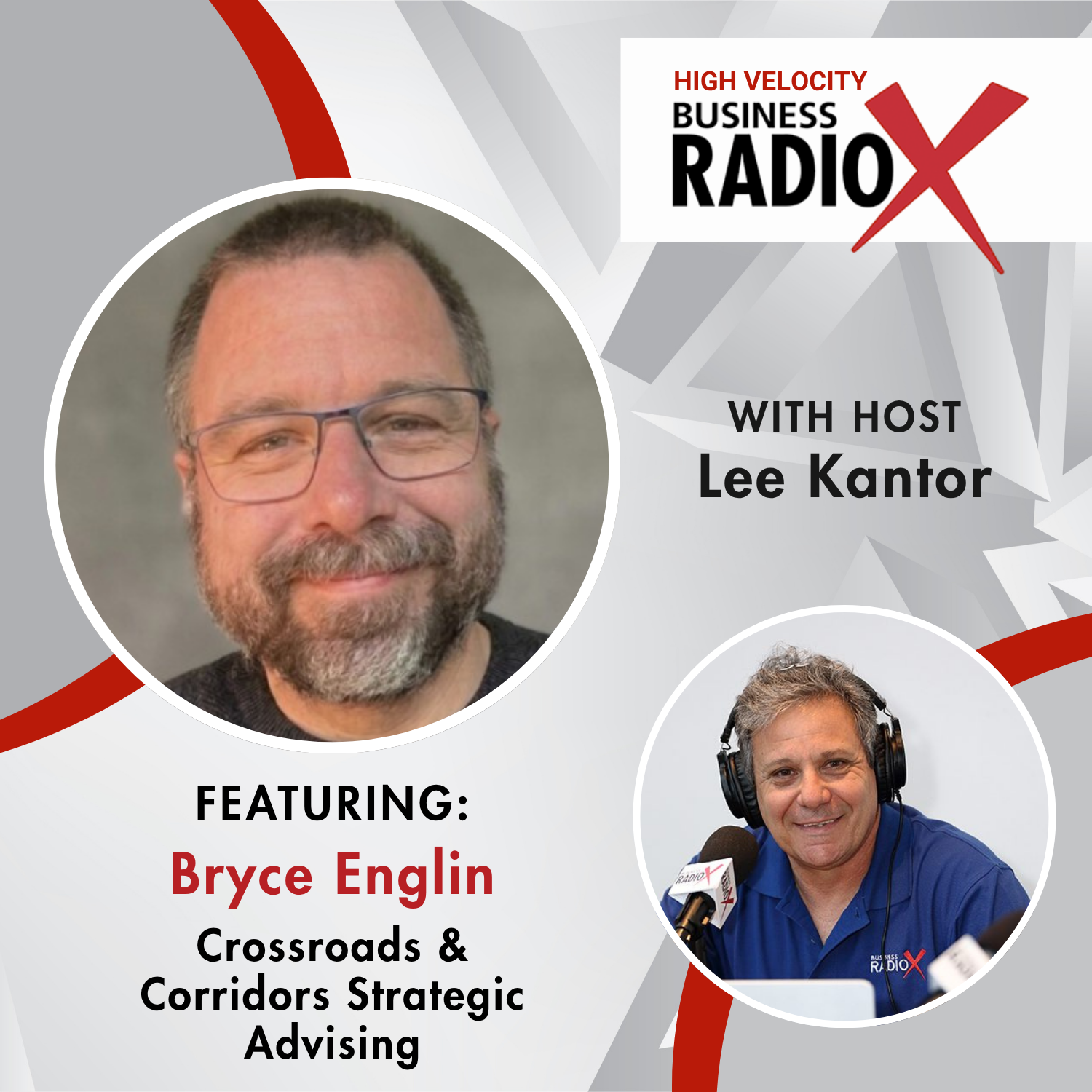

In this episode of High Velocity Radio, Lee Kantor interviews Bryce Englin of Crossroads and Corridors Strategic Advising about overcoming human friction in organizations and navigating complex business challenges. Drawing on his 20-year career in the United States Air Force and his experience in consulting and coaching, Bryce explains how self-awareness, trust, emotional intelligence, and clear communication help leaders overcome obstacles and improve collaboration. He highlights the importance of understanding the people and dynamics behind organizational challenges, building strong relationships with stakeholders, and addressing problems without resorting to blame.
 Bryce Englin is the Founder and Principal of Crossroads & Corridors Strategic Advising, an executive advisory firm dedicated exclusively to diagnosing and resolving The Human Friction Point across defense primes, industrial enterprises, and international partnerships.
He brings more than 30 years of dedicated Department of Defense experience across two distinct chapters: a distinguished 20-year active-duty career on the enlisted side of the United States Air Force, followed by a decade serving within the defense civil service and defense contracting sectors.
Over his military career, he spent 14 years assigned and deployed overseas throughout Europe, the Middle East, Central Asia, and East Asia, mastering bilateral security cooperation, acquisition education, and frontline diplomatic negotiations.
To address the systemic roots of institutional failure, he pairs three decades of operational mastery with rigorous scholarship, psychometrics, and developmental science.
He holds a PhD in Organization and Management, executive credentials in Public Policy, professional training aligned with the International Coaching Federation (ICF), and advanced certification across the Hogan Assessment Suite (HPI, HDS, and MVPI).
At Crossroads & Corridors, his entire focus is de-risking The Human Friction Point—the critical fault line where perfect engineering diagrams, multi-million-dollar contracts, and strategic intent collide with unstated cultural assumptions, derailed leadership behaviors, and bureaucratic resistance.
Connect with Bryce on LinkedIn.
What You’ll Learn In This Episode
- Understanding human friction and its impact on organizational performance.
- Building trust through ethical leadership, vulnerability, and emotional intelligence.
- Using self-awareness to navigate leadership challenges and overcome personal barriers.
- Identifying underlying issues in complex business processes and stakeholder relationships.
- Applying a coaching approach to encourage collaboration and develop effective solutions.
- Improving communication and alignment across teams, departments, and organizations.
- Navigating cross-cultural negotiations and complex business relationships.
- Addressing organizational challenges without blame while leveraging individual strengths.
 This transcript is machine transcribed by Sonix.
TRANSCRIPT
Intro: Broadcasting live from the Business RadioX Studios in Atlanta, Georgia. It’s time for High Velocity Radio.
Lee Kantor: Lee Kantor here another episode of High Velocity Radio and this is going to be a good one. Today on the show, we have Bryce Englin with Crossroads and Corridors Strategic Advising. Welcome.
Bryce Englin: Thank you Lee. It’s great to be here.
Lee Kantor: Well, I am excited to learn about your practice. Tell us about Crossroads and Corridors, how you serving folks.
Bryce Englin: So very interesting thing. And it’s just something that’s kind of really started to emerge. So when we we start to think about it, the idea behind crossroads and corridors is, uh, every community has a crossroads or every decision has a crossroads. And there’s always corridors of decisions within the crossroads. And the idea is to focus in on strategic advising across. There’s about four different strategic points that I’m looking at specifically, uh, to focus in on trying to work through the human friction point as I refer to it.
Lee Kantor: So what’s your background? How did you get involved in strategic advising?
Bryce Englin: Thank you for asking that question. The great, great question. So to share a little bit more, I am a United States Air Force retiree. I serve on the enlisted side, retired as a E-7 or master in, uh, 19 or in 2016. So I served from 1996 to 2016. 14 of my 20 years were, uh, overseas. So I, some of the places I’ve lived and I always love to tell this story is been stationed in Turkey, Iceland. I did two tours in Japan. So north part of the country, Misawa Air Base, southern part of the or I’m sorry, near Tokyo Yokota Air Base. I also was stationed at two U.S. embassies in my career, so stationed at the U.S. Embassy in Cairo and the U.S. embassy in the country of Djibouti, which is a country, a small country down in sub-Saharan Africa, surrounded by Ethiopia, Eritrea and Somalia. I also was deployed to Kuwait the day nine over 11 happened, and ten years later would leave eight days after my daughter was born to head off to Afghanistan, where I served in Helmand province. But throughout this I’ve accumulated, and since retirement, done consulting and instruction, worked in different branches of academia. And I started looking at my network and looking at things, and I realized I got this really great network. I’ve got this aspiration to help people. I’ve spent the last year having an opportunity to work with some amazing people from all across the spectrum. So I’m thinking, why not do this?
Lee Kantor: So when you had that thought, obviously you were at a crossroads, right? This is a crossroads. Did you deploy your methodology to help you make this decision?
Bryce Englin: I did actually. That’s a great question. Um, I sat there and I started realizing, and when you start to think about the human friction, you have to push through the, uh, the fear, uh, two fears that I like to call it. One being the imposter syndrome. Uh, why should I be here? And the second you’re actually putting yourself out there. Holy wow. I’m kind of doing this. So that’s what I, uh, what I, I have to remind myself consistently that it’s okay. This is the opportunity. And a lot of this has really come into, uh, into view when I, when I start to look at the human friction point because I’ve seen human friction in action. And that could be, uh, one of my favorite things. And this is one of the consulting areas that I think is important, and especially as I have gone down the road of pursuing my international coaching federation, uh, the ICF certification, which, uh, I know one of your former guests, uh, Catherine Brooks and I are both, um, Catherine’s a lot further along than I am in the coaching. I’m working towards my getting my a c c as we would call it. But, um, I really find that, um, when we look at the human friction point, there’s a lot of times where companies, businesses, senior executives, middle managers, processes come up against the friction. So I was like, look, I want to be out there helping people, doing it, coaching it, being the thought partner in the room to help these guys. So I realized that I have to get up over my own hurdle if I want to be out there doing this.
Lee Kantor: That’s, uh, that’s some pretty good self-awareness on your part to kind of understand that you are kind of the service you’re selling is you got to kind of live into the service in order to demonstrate the proficiency in delivering the service.
Bryce Englin: I agree. And if you don’t have a sense of self-awareness, it you’re going to find yourself up against another human friction point. Um, matter of fact, I would even venture to share that as I’ve worked towards getting my Hogan certification, Hogan being a, a big five psychometric tool that 75% of your, uh, corporations use in, uh, succession planning to determine how other. So there’s three scales. How others see them. The derailers. Uh, what are the potentials of awareness and then your MVP, what you value. And when I went through the training and I got that, that, that tool really helped me to enhance the self-awareness. But even as I’ve gone through my coach training and had the chance to learn from, uh, from BJ Radomski, um, and the team at the coach Training Academy. And BJ was taught by Thomas Leonard, who was the founder of the International Coaching Federation. Um, it’s even enhanced my own self-awareness. And I would say that self-awareness for, for many CEOs is sometimes a challenge because for many of them, it’s very lonely at the top, I found and even for many sports athletes, even with college sports today, we have many, uh, quarterbacks and, and people think that they understand what the pressure that’s going on, but most don’t realize that it’s very lonely for these guys. They have teams telling them what they think they want to hear, and sometimes they just need a real person to be honest with them, treat them like a real person. And I almost feel like that’s one of the areas where we can help, especially when you’re dealing with the personal side of the human friction point.
Lee Kantor: Now, have you gotten to the point where you have that avatar of that ideal client for your firm? Do you kind of know who you want to be talking to more often?
Bryce Englin: Great question. So that’s, uh, so there’s four different lanes that I’m looking at here. One being, uh, eventual podcast focusing and talking with high level leaders narratives around the human friction point. How did they. How did these guys leaders really focus in and get through that? The second one is the first lane, which is advisory and working in the area of security cooperation. Foreign military sales. So, uh, national defense sector might sell you know, the US government wants to sell something to a partner. They will have industry there. We’re trying to get the deal across. You know, you’re trying to get the deal across the the path and it never ever, ever worked as well as we would for two reasons. One, it’s never the process is never linear. Most treated linear because they want to check boxes and follow checklists. Second, most never think about the the other person or the other stakeholders thing. So my goal is when we run up against these friction points and that could even be excluding. You know, I know I talk about national defense. It really could talk about any specific area where there is specific friction. You’re trying to negotiate a high level deal. You’re trying to negotiate rights to get your product into a company. Maybe you’re trying to strike an agreement with a bigger company or small business. You want to get your items into a target or you’re trying to get that. How do you do that? How do you sell that? There’s always those small lower level friction points that come up, and it’s usually not the system. One of my, my favorite quotes, uh, comes from, um, former scientist w Edward Deming. Deming always highlighted that 94% of the problems are not the system, it’s the people in the system. And that comes about from research he’s actually done.
Lee Kantor: Now. Um, can you share maybe some stories or a story from your work that might kind of resemble some of the work you would like to get down the road? Is there some challenge you helped, uh, somebody within your, in your previous life or you don’t have to get into the specifics, but maybe, um, get into what the friction was and how you were helped, helped kind of smooth that out.
Bryce Englin: Okay. So one story that comes to mind is we, I saw a company one time and they’ve got this great new capability they’re getting ready to, um, bring out and they had so many thousands of orders, but they’re, they’re not even to a prototyping yet. Um, and we were talking and as I’m listening to him, my, my mind is automatically thinking, okay, you guys are looking at scaling up, you’re gonna have to have these out by, I can’t remember the date, the end of the 2020s, maybe factory lines. And all I’m thinking about is as they’re getting ready to scale. Um, I’m thinking about all the headaches and challenges that are going to happen, especially when you move from a small cap to a mid cap. Organizationally, it, it’s kind of sometimes just start throwing folks wherever and we’ll just let it sort out. So as I start to look at this and I started thinking, and I mentioned to him, I said, yeah, my approach is to help organizations mitigate all these different challenges or friction around the human friction point as they come in. I had a person respond back to me, oh, we don’t need that. We hired a couple of consultants to come in. Well, consultants are great and all, but a consultant is going to come in and charge you 50 grand. I’ll just use a number. They’re going to give you a slide show, but are they going to be able to ask the hard questions? What’s the follow up look like? So those are the you know, so that’s one of the things that I, that I think about.
Bryce Englin: Um, the other one is and you try to tell someone in a bureaucracy where everything is kind of linear when they’re sitting at the table with a foreign partner. Foreign partners do not want 30 people in a room. I’ve seen it. I’ve seen the energy. It really is very off putting from a cultural standpoint. When you try to advise or share thoughts. Most organizations do not want to listen. That’s why I think you have to kind of flip to a coaching approach, because you start to ask questions and you start to help them come to the realization on their own. And the intent I want to highlight here is this is never meant to be done from a place of. Personality, but um, drawing upon Covey. Stephen Covey, the author of the seven Habits of Highly Effective People, one of my favorite books, the character ethic. My. My intent and everyone I tell. Whether it was a former Heisman Trophy winner that I’ve worked with the past year, uh, high level athletes who play in college, every piece of advice I’ve given them, coached with them on, uh, current, uh, I have a current client. She is a CEO, a chief development officer in a company. The goal is to help about growth and to be as ethically foundational from a character standpoint as possible. So that’s how I try to do things. How I’ve seen it tend to work out there. It tends to go more off a personality and metrics as opposed to actual hard work up front.
Lee Kantor: Now, when you’re working with your clients, how are you discerning, um, maybe their desire for a consultant to come in and fix something or give me a deliverable, as opposed to maybe the holistic need of a coach to ask the right questions so that I am prepared to go and do what I can do.
Bryce Englin: So that has that is a great question. First and foremost, I believe that has to be done on the front end. So when we say when we say the front end, we could jump straight in and get to work. Create a deliverable. Or what we can do is I can spend two, 1 or 2 sessions with you. We can talk, I can get to know you. I can get to hear your perspectives and just be in listening mode. We can then start to formulate what might be a good plan. So asking more questions up front and doing a lot more harder work up front, I believe is and it becomes a lot of it really is going to depend because the more complex the issue, the deeper you have to go. Well, the deeper you have to go into the structure to find the issue, the more higher levels of trust you have to establish with the different stakeholders. So I believe that if you build the rapport up front and this is the most critical aspect of it. If you do that correctly up front at the beginning, it’s going to create less headaches and eliminate a lot of these different human friction points downstream.
Lee Kantor: Now, do you have any advice for somebody, uh, if they wanted to be able to build that up front, what are some do’s and don’ts?
Bryce Englin: So one of the do’s is. If you’re meeting with a coach or consultant or you’re meeting with someone focusing on building trust, um, from the coach side, you have to do it with solid character and ethics. And this is something that I have learned and have seen come into play, especially as I’ve been working towards my PhD with a focus on organization management, is that if you do things not from a position of trust or character, people are going to pick up on it. On the flip side, you have to have the person in that position has to be open and vulnerable. I know, and I realize it. It’s easier said than done. But when you apply this idea of seeking first to understand and then be understood, which is aligned off of Covey’s A step five, which aligns with step four, habit four of win win. I firmly believe that when we do that, that’s what creates the fluid trust mechanism and the value that’s going to help us get to that point. If we don’t have the trust and we don’t have the vulnerability, we don’t have the ability to employ solid emotional intelligence, we’re not going to be able to get much done.
Lee Kantor: Now is a maybe adjacent or cousin of trust. Uh, clarity in communication.
Bryce Englin: Lee I love. Were you thinking, man, I love where you’re thinking. Yes. There are times where perhaps the issue is not trust, but it is. Somebody needs clarity. They just need, you know, you’re a CEO or C-suite and you’re sitting there, you’re you’re working on CEO succession, maybe, like we said, trying to create this deal with, uh, a partner on a merger. And you’re, you’re kind of running up against risk. You’re, you’re in that fight or flight mode. Sometimes just having a coach or a person who can just, you can kind of unload and share your thoughts with in a trust environment can sometimes be be that provision that provides the trust and clarity provides that clarity that you need or that, and that communication. Um, and I think that question also aligns well with what we are taught when focusing in on the ICF core competencies. We focus in on creating this container of space. So providing, you know, providing a space to the client, but also establishing high trust and maintaining solid ethical foundations to, to help the client realize that, hey, when they’re meeting with us, I’m going to give you space to talk and I want to hear what you have to say.
Lee Kantor: Now, when you’re working with somebody or potentially working with somebody, is there a triggering event that occurs where they’re like, I better call Bryce and his team? Like is like, what’s a signal or a sign for somebody out there that might be struggling but hasn’t really been able to articulate the type of need they have to solve the problem they’re struggling with. Is there a kind of usually an event that happens that kind of says, okay, if this happens, then you better call Bryce.
Bryce Englin: Great. Great question. So a couple things that come to mind. Let’s say your company is looking at a default and you have to figure out how to cut costs. Well, I’m going to cut costs because I’m in the hole on my budget. Business has not been good. I got a I’ve got a gap. And oh, by the way, I’m gonna have to lay off people. Well, how do you do that? How do I restructure? Another one is partner nations yelling. You know, let’s say they’re frustrated. They’re agitated. Um, and folks are at their wit’s end. Um. Yeah. One of my favorite things that I always like to look at when they’re at their wit’s end, we get people who will, you know, talk about, we see production lines being held up. Most of the time. Everybody thinks it’s it’s the process or, you know, it’s the people holding it up. Well, we’re the expectations clarified. Um, where the gaps, you know, are you over risking the situation? Those are things that would automatically come, come to mind when you feel like you’re kind of up against a wall. I’ve actually had clients I work with who they’re like, I feel like I’ve kind of lost my edge. Okay, well, let’s talk about it. Well, what does that look like? It really isn’t. They haven’t lost their edge. They just are kind of like they see a wall in front of them. They just don’t know where to go. So sometimes it’s just talking to them, hey, this is what I’m hearing. But a lot of times it’s just when folks feel like they can’t go any further or they feel like everything is falling apart, usually that happens much later than you would expect or want it to happen.
Lee Kantor: Now, can you talk about how kind of living through what you’ve lived through in working in so many different environments and cultures? I mean, you were playing the game. It wasn’t easy mode. You had as much chaos as a person could possibly encounter. How do you translate the ability to navigate that kind of chaos? And I mean, especially the different cultures, I don’t want to make that seem like that’s no big deal. That adds a whole other layer that most business people here in America that are dealing with other Americans aren’t even. That’s not even they don’t even think about it. But can you talk about the ability to navigate that complexity and how that’s going to help you serve your clients better?
Bryce Englin: So first off, great question. Big question. And let me start off by saying it depends. Um. I would love to be able to give clients listening a, a real hey, yeah, we do it this way, but nothing is ever linear. When I say it depends, the first thing is what is the container or the environment we’re dealing with? Are we dealing with a contract that has sticking points the partner is dealing with? Are we, you know, are you dealing with, uh, not knowing how to get into the entry point? Are you dealing with, uh, a certain individual within their countries, um, within their countries hierarchy or leaders? Are you dealing with a certain way of thinking? Is it a company in some, in some instances that’s a subsidiary of the government? You know, that there’s a 51% government owned, 49%. Is it one where you’re trying to create a agreement of, hey, in order for us to do business, the company wants some investment. They want additional investment. It. It would be great to say yes. I would love to be able to give you a firm answer, but those are a few things. A lot of the determination of where we want to go requires knowing the specifics and specifics for me means you’ve got to get down into the lower levels. As I say it, I could sit here and I could be mad. Yeah, I’ll be macro as I want to, but when we want to get to the heart of the problem, to solve it from the macro level, we have to see where what’s causing it at a more micro level.
Lee Kantor: But isn’t that some of the value that you’re bringing to the table? Is the ability to have lived through that complexity and knowing you got to ask a different question here. This is it might appear that this is what you think you know, but there’s something else kind of underlying here. This is a better question to ask at this point.
Bryce Englin: Yes. And I would assess that based on the situation. If the if they’re asking, well, what should I ask? Well, I’ll give you ten different ways to look at this. We’ll spin it ten different ways. I can look at something through ten different lenses. That’s, that is something we, I can definitely do through crossroads and corridors is sit there and help you find ten different ways to look at the ten different levels. And most of that, my approach to that is when we start getting into the fractional issues, is to try to get that done in a very short time. Um, and I’ve got this network, great network of people I work with if I don’t know what the problem is, but I’ve got somebody else, I know I’m going to be able to connect people to that. And when I say networks, I’ve got people who know what it’s like to work in the higher echelons in these different areas as well too. So I view everything through an abundance mentality as well too. But when you’re up against this friction point, and I get it because deadlines, we want to hurry and move. That is something that I really love to do, is if somebody was to come to me, rice, I need this solved in two hours. Okay, let’s, uh, let’s look at it. Tell me what it is. Give me two hours of your time. Yes. I need you to sit in the room with me. Break this down. I’ll throw stuff back at you as a trust partner in this thing and say, well, what do you think of this? And let’s see if these different entry points can work.
Lee Kantor: Yeah. I think that you, you bring such a unique skill set to the table, and especially with kind of the, the new tools that you’re adding to your tool belt. I mean, it seems like, you know, with the right folks, you can really make a substantial impact in a short period of time.
Bryce Englin: Thank you. Yeah I do. I firmly believe this is a this is the one area where I’ve noticed, uh, the friction point, human friction points where the where things collide, whether it’s relationships in business, um, cross-cultural negotiations, negotiations in general. It almost seems like this is kind of the one area where there’s the biggest struggle at and, and I’ve got different lenses and ideas of how I look through that, but it really all always begins with friction and the chaos surrounding the collision of, of things within the system itself.
Lee Kantor: Do you remember when you kind of coined the phrase human friction point, like what occurred that you were able to connect those dots in that way and articulate it in that simple manner?
Bryce Englin: So probably about over the last month or so, I’ve been operating under a framework known as systematic modern coaching, which is kind of where my dissertation is going. But that doesn’t sound that doesn’t sound very businessy. So I had a meeting with a colleague one day, and as I was talking with her, I started to kind of clue in on this. Wow, yeah I am. We’re focusing in on human friction. And it just kind of started to merge there in my mind strategically.
Lee Kantor: And then once you kind of say it, then it’s like, wow, that’s, that’s easy to grasp. People can visualize it. You know, once you say it, it’s understood like that, you know, that Polly, whatever word that sounds like a consultant word. That’s not a human word.
Bryce Englin: Yes. And it becomes a little easier to, to look at the human friction point through a lens of risk strategy operation, uh, functional execution. We always talk about breaking down stovepipes. Well, um, the human friction point is probably one of the biggest headaches that I think every organization, whether you’re in the C-suite or in the middle level, mid management level, um, when you’re dealing within a matrix and siloed organization, the human friction point is probably the biggest challenge out there.
Lee Kantor: Now when you’re working with people and you’re kind of defining these human friction points, are you at some point when you’re working with a specific person on a specific challenge, do you kind of name like this human friction point? That’s Bob over in HR?
Bryce Englin: No, we’re not, we’re not. We are not going to get into personnel finger pointing. We’re going to say, sounds like we’ve got a struggle across these things. Is it, you know, is it maybe the system is. Yeah. What we want to do is we want to diagnose not the individual. Specifically, we want to diagnose what the actions are that are causing that human friction point. Human friction points can come across multiple different things. But yeah, from from the perspective of emotional intelligence and, and character and empathy for the, for the person. And I believe dignity is, is vitally important here, um, that the human friction point has to be on the system, not the individual. Um, because for all we know, Bob may have a crazy personality, but at the same time, Bob might be the hardest worker and the guy who has the greatest knowledge. So how do we, how do we utilize Bob’s strengths and try to realign and help Bob work within the system?
Lee Kantor: Right. But you’re helping your client kind of either get through or over around the friction point, right?
Bryce Englin: Yeah, yeah. Bob might be the friction point, but what we want to do is we want to definitely stay away from finger pointing. What the specifics of the. If it’s a person, we don’t want to. We want to be real careful and we want to use character based approaches. Um, because every friction point, whether it’s a human friction point of the story. But yeah, to help the client figure out how to leverage that. And I love, and that’s where I think the coaching aspect comes into play. Because when you’re the thought leader asking the question, well, okay, it sounds like you’re, you’re having a clash with this person comes to mind with that. Have you thought about how to orchestrate through that? Um, and those would be kind of the questions I would, I would ask in a very trusted, uh, trusted, um, 1 to 1 session with the client.
Lee Kantor: So what do you need more of? How can we help you?
Bryce Englin: How can Business RadioX help me? Well, what are we going to be doing? Uh, I think I hopefully am going to be meeting with you guys later this week, and we’re gonna see if, uh. Well, uh.
Lee Kantor: Aside from that, how could what is your firm need more of? Let’s put it that way.
Bryce Englin: Oh, ah, thank you for asking that question. Um, so I’m looking actively to get in involved and engaged with clients and definitely would love to open the door and start getting, getting this idea out there to start helping those folks who need those, uh, low level 1 or 2 hour consultants, you know, start building some of that credibility, right?
Lee Kantor: So you need clients that are struggling with maybe complex issues. Um, and, and they need kind of some strategic advice and that advice might be consulting and it might be coaching or it might be both.
Bryce Englin: Correct. Yeah. So it’s just helping them, um, in the area of what I would even classify as touch. Touch consulting to start. But I also am open to helping them work through some of these long term, uh, things over a period of time as well.
Lee Kantor: And then you’re typically interacting with C-suite. Is that who your first point of contact usually is?
Bryce Englin: Yes. Matter of fact, um, the C-suite are the guys I want to talk with. And the reason I say that is because they’re usually the folks in, in the business who know what the big friction points are. They know where they want to go, they know where the disconnects are at. And it’s a lot easier to get in and spend time with them, helping to isolate the and get solutions out immediately.
Lee Kantor: Now, if somebody wants to connect with you, what is the best place to do that? Is it LinkedIn or do you have a website?
Bryce Englin: So so I am out on LinkedIn. I do have a profile on Neumi as well to my coaching profile with all, all my information. I am getting into the position where I should be setting up the website, um, and other things here very soon.
Lee Kantor: And then if somebody wants to look you up, it’s Bryce Englin, BRYCE ENGLIN.
Bryce Englin: Yes, on LinkedIn as well.
Lee Kantor: Yep. And noomii is noomii.com and they can just look your name up there and they can find you.
Bryce Englin: Correct? Yes.
Lee Kantor: Good stuff. Bryce. Well, congratulations on all the momentum. Uh, you’re doing important work and we appreciate you.
Bryce Englin: All right. Well, thank you, Lee. I appreciate the opportunity to come in and talk on High Velocity Radio today.
Lee Kantor: All right. This is Lee Kantor. We’ll see you all next time on High Velocity Radio.