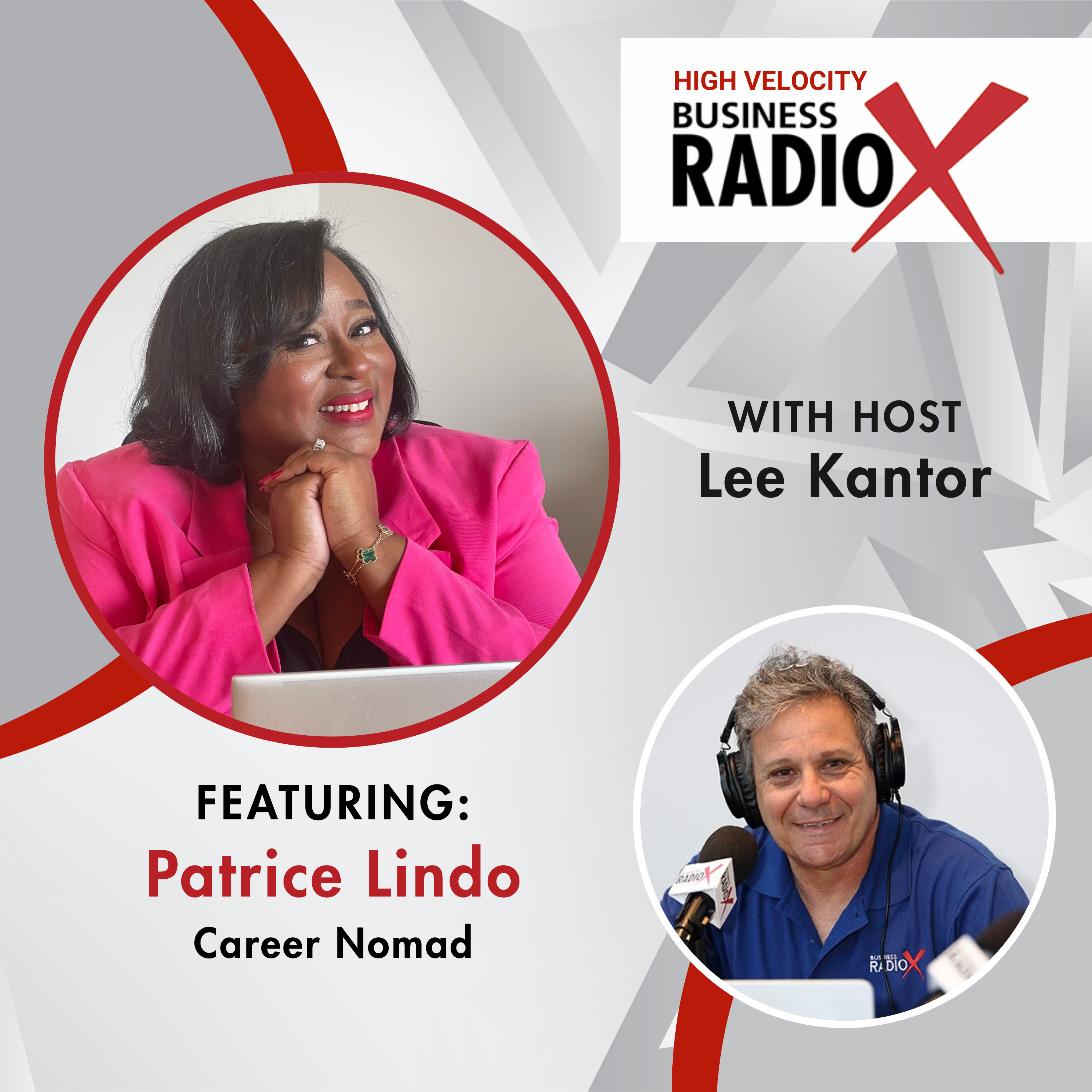

On this episode of High Velocity Radio, Lee Kantor interviews Patrice Lindo, CEO of Career Nomad, about navigating the rapidly changing labor market shaped by AI. Patrice discusses how Career Nomad helps organizations and individuals adapt to workforce disruptions, reframe work around outcomes, and communicate value. She shares insights from supporting students and workers through job transitions, emphasizing transparent communication, strategic impact, and personalized support. The conversation highlights the importance of trust, adaptability, and empowering people to thrive in an AI-driven economy. Patrice also outlines her triage-inspired approach and invites listeners to connect with Career Nomad for guidance.

 Patrice Williams-Lindo is not your average career strategist. As the CEO of Career Nomad, she’s a no-nonsense advocate for companies that want to break out of the talent retention rut and build a reputation for resilience and adaptability.
With over a decade in high-stakes consulting and a proven track record in the restoration and insurance sectors, she brings fresh, fearless insight to her audience.
Connect with Patrice on LinkedIn.
What You’ll Learn In This Episode
- The impact of AI on the labor market and workforce development.
- Challenges organizations face in implementing AI technologies.
- Employee fears and misconceptions about AI replacing jobs.
- The importance of reframing work from task completion to outcome-focused value.
- Strategies for individual contributors to advocate for themselves and articulate their impact.
- The role of transparent communication in building trust during AI implementation.
- The significance of involving employees early in the AI adoption process.
- The need for organizations to help employees understand and communicate their value.
- Examples of Career Nomad’s approach to supporting students and workers in transition.
- The importance of strategic thinking and precision in navigating the modern job market.
 This transcript is machine transcribed by Sonix.
TRANSCRIPT
Intro: Broadcasting live from the Business RadioX studios in Atlanta, Georgia. It’s time for High Velocity Radio.
Lee Kantor: Lee Kantor here. Another episode of High Velocity Radio, and this is going to be a good one. Today on the show we have the CEO with Career nomad, Patrice Lindo. Welcome.
Patrice Lindo: Thank you so much, Lee. It’s a pleasure talking to you. I’m looking forward to our chat today.
Lee Kantor: Well, I’m excited to learn what you’re up to. Tell us about Career Nomad. How are you serving folks?
Patrice Lindo: Oh my goodness. Well, as the founder of Career Nomad, we are working at the intersection of workforce development, leadership and AI. We basically help people and organizations navigate this uncertain labor market that’s moving faster than the speed of light, right? So we don’t have the systems to support it. And we’re trying to figure out what that looks like.
Lee Kantor: So who is your client? Is it the organization or is it the individual?
Patrice Lindo: Both. Both. Both both. Because what’s happening is that right now we’re not facing a talent shortage. Right? People are looking for jobs. We’re facing what they call a crisis. We have people that are being laid off. You know, AI is coming in and people feel like it’s taking their jobs. So, you know, as people are being told to reskill, upskill, pivot, we’re figuring out what they need to do next. Right. Because that slower, more predictable economy is gone.
Lee Kantor: So let’s take each constituent one at a time. And let’s start with the organization. What is kind of the pain the organization’s having where career nomad is available to help them? What what’s kind of their challenge that they’re dealing with where they need your help?
Patrice Lindo: Absolutely. So from an organizational perspective, right. Leadership is literally changing real time. It’s not just about the title in these organizations. It’s about what people need to do within this fast changing, you know, world as it speaks. So how can they help their employees? You know, that’s coming in every day to do their jobs as they know it, do it efficiently. Right. So, you know, how do we get people to understand that AI isn’t eliminating jobs wholesale, right? It’s basically just exposing those roles that were never clearly defined in the first place. So how do we help those organizations lead in a way that people can trust, so to speak, what’s in place to keep them employed, to keep them employable, and to help them innovate in a way that hits the bottom line, which is what the organization is ultimately care about. So we help them to navigate that, you know, how do they communicate to their employees? How do they let them know what they need to stop, start and continue? How do we, you know, have that conversation if in fact, their employees are going to be, you know, let go? What does that need to look like in a way that develops that sense of trust and also can, you know, match the changing needs as it relates to our, you know, our economy and the world as it’s changing.
Lee Kantor: So what does that kind of pain look like in the what’s happening kind of boots on the ground in that organization that they can recognize symptoms, that maybe they have an issue that they need your help with. Like what are they seeing? That should be kind of to you, a red flag, but to them might just be like a yellow flag.
Patrice Lindo: So the red flag would be, oh, you know, we got this new AI tool everybody’s going to use, for example. I don’t know, Claude, let’s just say or ChatGPT. And they’ve gotten it at the enterprise level, and you have a whole sector or sectors of your organization that don’t even know where to begin. So it gets to the place where the rules have changed and people don’t know what to do. And here it is. The organizations like, see, we are 21st century. We have brought in all of the amazing technology that AI has to offer, and you have people that are very mistrusting of it and feel like, oh my goodness, AI is taking my job. So it’s a red flag to the people that are on boots on the ground. But for the employers, it’s a yellow flag in a good way because hey, we’re getting ready to level up. So the conversation is more like teaching the organizers or the people within the organization that AI can be a multiplier, right? It teaches your your employees how to be clear, how to be strategic, and how to amplify the good work that they do. In other words, the messaging is that AI doesn’t replace people. It replaces ambiguity. So how should they be doing that differently? Right. Talent. You know, helping to teach people what the impact is that they need to do, not just complete tasks. If people are confused, they don’t know how to innovate, for example. So basically teaching them how to give career clarity as a retention strategy for those people that you actually want to keep.
Lee Kantor: So what I’m hearing you saying is that the organization thinks, hey, we’re being, you know, keeping up with the times because we’re leaning into this and we’re doing you a favor. This is helping you. Yes. And the employee is looking at it as like, oh, you’re just trying to replace me. And here I am just going to train some AI person to replace me.
Patrice Lindo: Correct? Correct, correct. So how do we bridge that? Excuse me. How do we bridge. Bridge that conversation. Because a lot of times, you know, people have been in these jobs for X number of years, you know, meeting their daily tasks and assignments and, you know, basically getting things over the line. Whereas now, you know, you can automate, for example, those tasks. So how do we rebrand them in a way that the work that they do still lands impact in a way that not only builds whatever the relationships are that your organization is building to sell whatever it is that they sell, but also in a way that people feel like they’re getting the employees feel like they’re getting something out of it as well, so you can recognize people truly for the value that they’re already delivering.
Lee Kantor: And so that’s so if an organization is thinking about implementing some AI solution, it’s probably a good idea to talk to you before they do that rather than to triage kind of something where you now have a trust issue after the fact.
Patrice Lindo: Absolutely. So take people on that journey. And when I say on the journey, it’s less about asking permission. It is still directional, like, hello XYZ employees, we have great information to share with you. We are going to be implementing AI. We’ll start out with a pilot, we’ll do X number of people in this particular department and then we’re going to roll it out. But again that communication right. That transparency in a way that it makes sense so that people feel less blindsided and more that they’re a part of the journey. That’s usually what decreases the level of anxiety and builds that credibility and trust.
Lee Kantor: All right. So let’s switch gears to the individual contributor. Um, when you’re working with that person, what are those conversations look like? Are are they kind of also living in this moment of fear? And they’re kind of not, you know, they’re kind of losing faith on all the expertise they have that it’s not going to be ready for the next kind of wave of technology.
Patrice Lindo: Absolutely. It typically starts there because here it is. They have, you know, met the moment where they have kept up their end of the contract, right, their end of the bargain, where they show up to work every day. They do their specific, you know, assignments and tasks and, you know, they’re they’re meeting, you know, kind of the need where they knew it to be. And so all of a sudden now it feels like the rug has been pulled out from under them because the things that they used to do now, you know, a machine, quote unquote, can do. And so then we have to reframe that to conversation. One of the things that I talk to them about is what are the outcomes, though, of the work that you do. So for example, if you take, let’s say nursing, for example, if you’re a nurse, excuse me. And you used to let’s say, you know, distribute medicine and take patients temperatures and maybe their blood pressures and that sort of thing. Now the hospitals may have brought in, let’s say, a robot. Right. To do those things. Now you can focus on, for example, the actual health of that patient as opposed to their, you know, vital signs.
Patrice Lindo: Not that the vital signs aren’t important, but the time that it would have taken you to do that, you can actually sit down and say, well, okay, if this patient has, let’s say, a particular heart disease or, you know, maybe they’ve broken a hip, you can find out what it is that they need to do to impact the outcome of getting that patient healthily out of the hospital, because before you still are expected to do that, but you were so mired down with those tasks, you were less focused, less able to focus on that. So it builds capacity. So we reframe that conversation conversation to capacity and outcomes. And what we found is that once people really take a step back from what they’re doing, they’re like, wait a minute, I have already been doing it. It’s just reframing the conversation. And that’s whether you’re in health care, education, consulting, you know, you name it. It’s just a matter of becoming less task oriented and more outcome focused and being able to articulate that now.
Lee Kantor: Do you think that that’s kind of at the heart of things that folks have been, I guess, kind of misguided in the in the way they’re defining their value? They think their value is completing 14 tasks during the day when their value is kind of like you described, is improving the outcome of the patient. That’s that’s the value. Not doing the 14 things. The 14 things were just kind of what you had to do in order to do the other thing.
Patrice Lindo: Correct, correct, correct. And I don’t know that it was misguided. I would say it’s a sign of the times, right? Because there have been times in our society where busyness, right, like motion was the thing to do. Like, oh my gosh, they’re running around like a chicken with their head cut off. Whereas to be honest, if you took a step back and really, you know, took as opposed to the 5000 foot view, the 20,000 foot view, we always should have been talking in terms of outcomes. But the way that society was set up, that was not necessarily rewarded. But now we’re being forced to evolve, right. So what is it? What’s the difference, so to speak, that you being in a particular role makes, for example. So if you were a consultant and you know, you worked with clients to, let’s say, figure out how to make their process more efficient, let’s say if they were, you know, producing beans. Well, at one point, you know, people used to count the beans, you know, figure out the quality of the beans and then figure out which could be packaged. Well, now you can have that first half, you know, automated, and you can talk about maybe different markets that could use your beads, or maybe different uses for the beads. So this is where your inner entrepreneur, um, within organizations can really come to life. And so I think, you know, there were a few that did that before, you know, relatively speaking. But now that the shift has happened, right. So I, I call it less misguided and more evolved.
Lee Kantor: Now the, the genie’s out of the bottle, right. Like this is not we’re not going back anymore. This is you. You better accept this and and learn how to leverage it rather than complain about it. Right.
Patrice Lindo: Absolutely. No. You’re absolutely right. She’s definitely going not going back in the bottle. And you know this is a reckoning of sorts right. It comes to a place where if you can translate your value in a way that is meaningful to the person or the entity that you’re talking to. So think about, let’s say, performance conversations at the end of the year, if you can translate what you’ve done over that year or that whatever that marking period into value that that, that boss, you know, can appreciate for that organization. Then you don’t have an issue. It’s those that are, you know, kind of vague, not really sure they’re talking about, like you said, the 14 tasks that are suffering at this point. So you got to get on this bus because it’s left the station for sure.
Lee Kantor: Now, is there any advice that you would give, uh, kind of an individual contributor right now? What can they do to kind of elevate themselves into one of those people that are the the people that the organization is going to invest time and resource into? What can they do to upskill in order to kind of leverage this moment?
Patrice Lindo: I’d say your very first step is to turn invisible work into visible value, because there isn’t an algorithm, right, that’s going to come and advocate for you. You you are your own best advocate. So if you think of your career as an ecosystem, you can create your own stability. You can talk about, you know, this is what you’ve done over this marking period. And these are the outcomes you’ve driven. This is how you’ve increased value. This is how you’ve collaborated with other, other groups. For example, in your organization. This is how you’ve gotten, you know, more efficiency, um, you know, when it relates to your work, but you have to speak in terms of outcomes that meet the goals of that organization, um, of that team, um, of that particular industry, whatever the case might be. But you’ve got to share those distinguishing characteristics. So it’s less about, oh my God, I work, you know, 30 hours a day. And, you know, I’ve done a hundred things. It’s like, no, at the end of the day, what did those things mean? Who did they benefit. And it basically creates this ability you’re looking forward to. Right. You know that optionality that you know, you’re not a one trick pony, so to speak. But these are the things you drive. So for example, Um, when I work in consulting, I talk about not just how I’m going to coach, for example, my team, but I also talk about how infrastructure, the infrastructure that I’m building as it relates to change management impacts, you know, an 800 000 person organization or talk about how in healthcare, you know, this one tweak can make this particular difference. And so you again, you live outside of your title and really build beyond that into the ecosystem of whatever industry you’re working in and the impact that it creates.
Lee Kantor: Now, from the company standpoint, what advice would you give them when they’re kind of, um, dealing with their talent to get the most out of them, to keep them and keep them happy, and to attract the right folks to the team.
Patrice Lindo: They need to help their talent articulate impact, because that’s not quote unquote normal yet that’s a learned behavior. So I’m going to date myself. But do you remember, gosh, probably now maybe 20 or so years ago when they started talking about lean and the different belts you could get or, um, project management, professional certifications. Again, that was something that, you know, leadership had to bring into the conversation because you had onesie twosie people doing it. But as leaders began to talk about the importance of having these certifications and what that could do for forward progression, not only for organizations but for individuals, people took that advice. So they definitely have to help articulate what impact looks like, sounds like what they’re expecting, not just, hey, did you do your ten tasks because it teaches people how to not only be clearer about what they do, but also be strategic about the work that they’re doing.
Lee Kantor: So now, is there a story you can share that can demonstrate the value you provide when you’re working with either a business client or an individual?
Patrice Lindo: Absolutely. So one of the things that I’ve done most recently is that I have a framework that’s called Built different. So it basically means understanding the system that you’re operating in and then moving accordingly. Not louder, not faster, just smarter. So it’s not hustle culture, it’s precision. And so there is, um, an academic organization that I am currently working with. And as I work with them, one of the issues that they have is that typically in this particular, um, university, people would be sought out, right, based on the way that they, uh, the work that they’re doing, companies and organizations would come to their students and say, hey, we need you. We want you. You know, there’s a waiting list. Like, do you have more people? Well, as the economy has changed now, what’s happening is that you have people that are working full time that are going to the university in the evening. You have people that are just out of school that have gone through the program and are getting ready to graduate, and both of those populations now need support getting jobs because you have the people that are working full time that in some cases may have been laid off or have had a reduction in force, or they have an impending layoff. Then you have students that are graduating, excuse me, that the job market just isn’t there because of all the changes happening in the world. And so I had to literally bring to them in a way that it would make sense to them that they can support their student.
Patrice Lindo: And by that I mean we had to be super strategic. What can we do to support their students that are, you know, unfortunately, dealing with forced transitions? And then also how can they prepare their students that are getting ready to graduate in a way that makes sense? And so as I work with them, one of the things that we do is consistently talk about how people can show up. What is the work that they need to do? What are the conversations that they need to have? And so based on that, I outlined a small time bound concept where they intentionally, practically have a shared responsibility of making the connection to that school meaningful but manageable as they anchor the work that the students do. So basically, the students we are looking to retain their current employment or reposition them effectively after job loss. We help them to translate their prior experience into credible, market ready roles today. And then we help to reduce employment related stress. Right. That usually, you know, impacts in this case academic performance graduate performance. And then basically how can they navigate this in their labor market. So the initial cohort had uh seven students. So it was a small it was a pilot that we are going to scale. And then we targeted specific students within this, um, a university that are invested, but that really fit the use case of either being recently laid off or at some elevated risk.
Patrice Lindo: And their adult learners that are balancing work and family in school. And so through doing that, we did a workforce readiness assessment that focused on their employment stability, their transferable skills and any, you know, market positioning gaps. Then we did, um, I think it’s three. Yeah, three different stabilizing sessions where we addressed like job retention strategies and unstable markets. We talked about how to reposition themselves after layoffs or any sort of disruption, and really helping them to get that narrative clarity. The ones that I was talking about before, how to speak to their impact, um, in a way that demonstrates value and experience and direction. And it went really, really well. Like we had two people that had been laid off. They were able to find additional employment. We have some of the students that are currently in school that are getting ready to graduate, that were able to get internships, so it really helped them to get to a place where they were positioned in a better direction for their career in a clearer way. They had like market aligned, um, conversations so that when they were talking with prospective employers that they were demonstrating that outcome value and they had realistic next steps. You know, as it relates to how to plan specific to their circumstances.
Lee Kantor: Now, is there, um, a niche or a best fit client for you, or is your work kind of industry agnostic?
Patrice Lindo: It’s industry agnostic because what we found is that, you know, when people think less from an individual contributor and more from an industry professional, regardless of what that industry is, that’s what begins to create that stability. So I work with individuals and organizations that, um, they come to me with their problem, and then I help them figure out what their space is, because usually it’s that insecurity and instability that’s brought them to me. So once we can sit down and have some sort of assessment, like I was saying, you know, to see where they are as far as readiness goes, figure out how to stabilize them and then basically what their plan is right to roll it out. So it’s basically triaging them similar to what would happen in an emergency room, but with respect to their career or with an organization with respect to supporting the um organizations, employees or students in the case of a school.
Lee Kantor: So what is the best way to connect with you? Is there a website or socials that.
Patrice Lindo: Um, absolutely, absolutely. Across all socials. You can find me at the Career Nomad. Um, and then website is Career Nomad. Org.
Lee Kantor: Well, Patrice, thank you so much for sharing your story today. You’re doing such important work and we appreciate you.
Patrice Lindo: Thank you so much for having me, and I look forward to speaking with you again in the future.
Lee Kantor: All right. This is Lee Kantor. We’ll see you all next time on High Velocity Radio.














