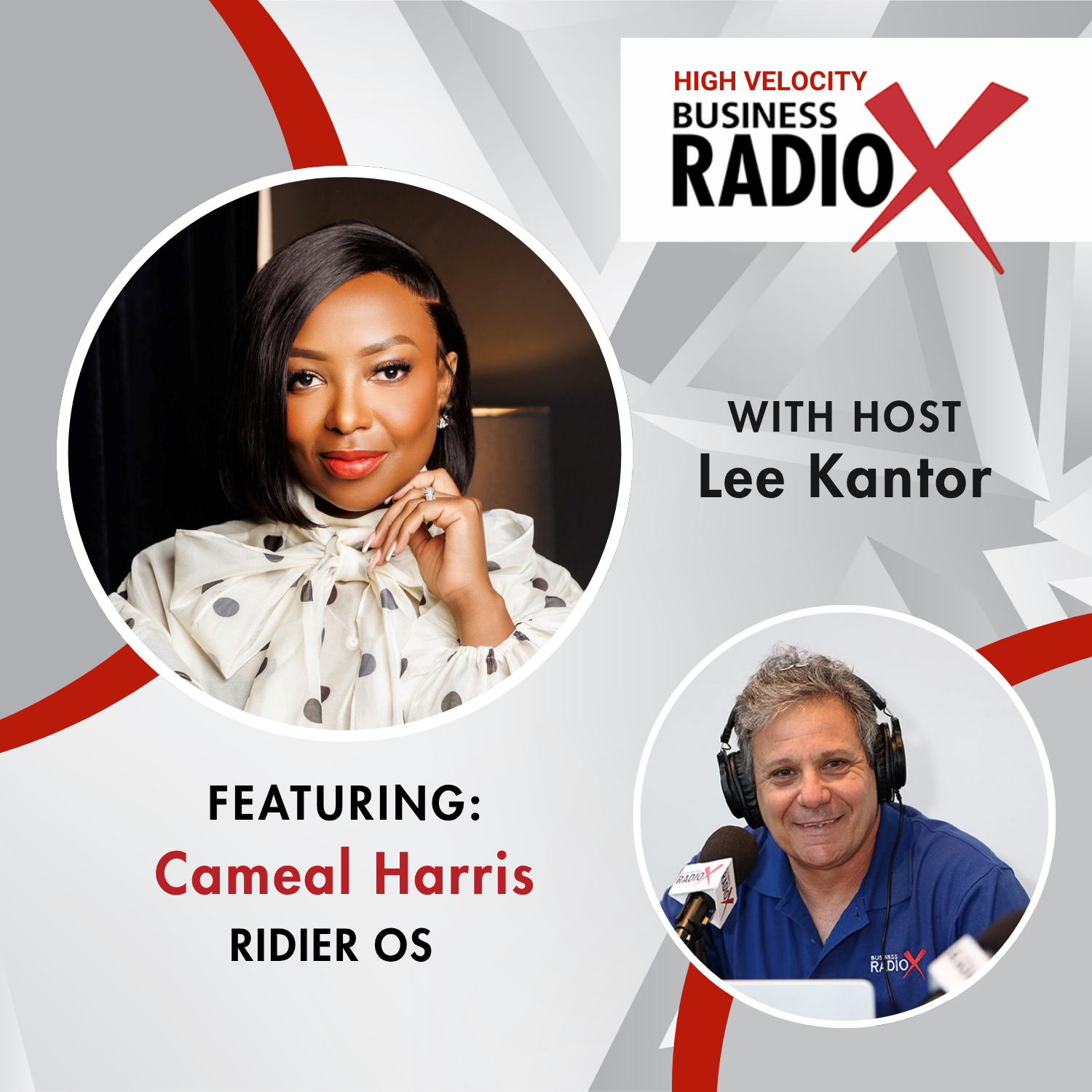

In this episode of High Velocity Radio, Lee Kantor interviews Cameal Harris, CEO, tech founder, and organizational transformation strategist at Change Activate. Cameal discusses the importance of putting people first when navigating organizational change, technology adoption, and cultural transformation. She shares how understanding employee experiences, addressing change fatigue, building psychological safety, and strengthening communication can help organizations overcome resistance and achieve lasting results. Through a people-centered approach to change management, Cameal helps businesses identify hidden challenges, support their teams, and turn major transformations into successful, sustainable outcomes.
 Cameal Harris is a tech founder, organizational psychologist, transformation strategist, and CEO focused on redefining how organizations navigate change in the AI era.
She is the creator of RIDIER OS, an AI-powered organizational transformation platform designed to help companies predict resistance, strengthen employee adoption, and improve the success of transformation initiatives.
Her work sits at the intersection of artificial intelligence, organizational psychology, behavioral science, psychological safety, leadership, and the future of work.
She brings a distinctive perspective to the rapidly evolving workplace: while traditional change management often emphasizes processes, timelines, and implementation, she focuses on the human signals that determine whether transformation takes hold.
Through her work, she explores how organizations can better understand employee behavior, build trust, navigate uncertainty, and create environments where people and technology can adapt together.
As a Black woman building in technology, she is also a voice on entrepreneurship, innovation, leadership, and the future of work. She speaks to executives, founders, HR and people leaders, and transformation professionals about the human side of AI and what it takes to lead organizations through continuous change.
Her thought leadership focuses on AI and human behavior, organizational transformation, psychological safety, employee adoption, leadership during uncertainty, and the future of work.
Connect with Cameal on LinkedIn.
What You’ll Learn In This Episode
- People-Centered Change Management: Prioritizing employee experiences and perspectives when planning organizational transformation.
- Recognizing Change Fatigue: Identifying the effects of constant organizational changes on employee engagement and readiness.
- Strengthening Trust and Communication: Establishing clear expectations and psychological safety across all organizational levels.
- Driving Technology Adoption: Supporting employees through training, implementation, and post-launch stabilization to maximize technology investments.
- Recognizing Hidden Signs of Resistance: Identifying employee disengagement, silence, declining productivity, and withdrawal as potential warning signs.
- Building a Healthy Organizational Culture: Making culture a leadership priority rather than leaving it solely to HR.
- Turning Transformation into Measurable Results: Using stakeholder analysis, employee feedback, and structured 30-, 60-, and 90-day plans to achieve sustainable change.
- Balancing Business Goals with Employee Needs: Aligning organizational objectives with workforce capacity, resources, and practical day-to-day realities.
 This transcript is machine transcribed by Sonix.
TRANSCRIPT
Intro: Broadcasting live from the Business RadioX Studios in Atlanta, Georgia. It’s time for High Velocity Radio.
Lee Kantor: Lee Kantor here another episode of High Velocity Radio and this is going to be a good one. But before we get started, it’s important to recognize our sponsor, Business RadioX. If you’re a coach or consultant who is tired of selling and ready to lead by serving, set up a call with Stone Payton at brookstone.com to learn how to give local leaders a voice and become the premier connector in your market. Today on this show, we have CEO, tech founder and organizational transformation strategist with Change Activate, Cameal Harris. Welcome.
Cameal Harris: Hello, hello, hello. Hi, Lee. Thank you so much for having me here today. I’m so excited.
Lee Kantor: Well, I am excited to learn what you’re up to. Tell us about change. Activate. How you serving folks?
Cameal Harris: Oh my goodness. Change. Activate is a place. It came from a place of just admiration and love for. For people. I’ve been working in organizational transformation for a number of years, and I was seeing a lot of gaps in how we deliver transformation. And that is the tenant of what Change Activate is built on is to truly ensure that we are diagnosing and understanding the problem, so we can have the people’s perspective at the forefront of how organizations operate today.
Lee Kantor: Now, in your experience with change, change is one of those things for humans that we know it’s going to happen, but we we’re not super fans usually like we like things the way they were. So how do you kind of help an organization, You know, manage those kind of it seems like now there’s a change every day. Like if you’re paying attention to technology, yesterday’s AI is not the same as last week’s AI. So so how do you help them kind of just even accept the speed of the change that’s occurring nowadays.
Cameal Harris: Right. But, you know, first, I feel like we need to understand the people, right? Why are they feeling the way that they are feeling? That’s the bottom line. The way that I work that is quite different from other consultants is that I call myself a practitioner. And just as you would have your doctor and you go to your doctor because you’re not feeling well, and the doctor send you to go do labs, and then you bring those labs back to the doctor and the doctor say to you, hey, Lee, your labs are not looking good. But you said that you’re feeling, you know, really crappy. And you’re like, well, you know, I’m eating a lot of sugar at night and a lot of cookies, and I haven’t been exercising. And the doctor was like, oh, so it’s a lifestyle issue. So the doctor now takes your labs and the doctor takes what that interpretation of you guys talking together and they come up with a plan. That’s the same way that I work in organization. What I do is I seek to diagnose and understand. So so what change activate does is we look at both qualitative and quantitative data interpretation. We do deep stakeholder analysis. We understand how individuals are actually experiencing things and change in the organization. Then we come together with leaders to do a sense making workshop that then leaders, what they walk away with, with that 30, 60, and 90 day plan with benchmark. So that is how we, we help organizations to manage, change and manage those resistance is we seek to first understand and we seek to first diagnose and interpret together.
Lee Kantor: Now, when you’re seeking to understand is the understanding primarily at the leadership level, because there’s a lot of times there’s a disconnect with the frontline people, the people who are kind of doing some of the the hard day to day work. And then the leaders have kind of a in their head, they think it’s a certain way, but the people that are boots on the ground see something else.
Cameal Harris: Right. Well, I’m a people’s champion. You know, um, I look at this in a couple of ways. Yes. The end users is experiencing whatever is going on. It doesn’t even have to be changed. It’s just being, being at that organization. They’re experiencing a certain way. But I feel like a population that a lot of times we tend to forget our middle managers and supervisors. These folks are absorbing everything that’s coming from upper leadership, and then they have to deal with, you know, everything that’s coming with from front line employees. So when I when I look at diagnosing and understanding is from all the layers. Lee. I look at what the the the end users employees are experiencing. You know, how are they experiencing the organization? What could be different? Those deep rooted issues. But I also look at my middle managers because when we when, you know, middle managers tend to be the one that are experiencing or supervisors. Most of that stress at work, if you would agree. I also look at it from a sponsor, um, point of view, which is our, our leaders, but I focus really deeply on my middle managers and my end users.
Lee Kantor: Now, um, how often do you find that maybe communication or lack of trust is at the heart of the issue more than any specific change that, you know, the, the middle managers and the front line, they hear, you know, this new, the, you know, the leader read a, a book and now there’s a new way of doing things. Mhm. And then the middle managers like, here we go again. And then they just don’t, you know, they stop believing after a while, or they know this is going to pass in two weeks when he reads another book. Right.
Cameal Harris: Huh. Man. You know, this this is is actually a pretty major problem, right? Um, a lot of times, like you said, the leaders read a book. Here’s a new way of working. Everyone needs to get along. And then when it seem like people are not really getting along the way, they want want it to, they call that resistance, right? But the thing is, most of the most employees actually, I just read this data point from the Gallup poll from it’s 2025 data point that says that only 40% of US employee agree that they know what is expected of them at work. Lee that means that, you know, 53% of people don’t even know what these leaders are expecting of them. So the first thing that I would say is that, yes, communication is one of those big issues, and leaders need to ensure that their expectations are clear. And there’s something that’s so interesting that you mentioned the the constant change and the constant shift to, to, to a way of working. And there is something in the practice that’s called change fatigue. And leaders have to understand the degree of change that an individual is able to go through at a specific point in time. And that is a lot of what my work does is part of that diagnosis. I’m able to truly understand the change, fatigue and help leaders to figure out, is this the right time to go through this huge millions of dollars of, of change, you know, and whether or not that that change will be adopted?
Lee Kantor: Yeah. Haven’t you seen organizations where, you know, some good sales person persuades them to buy some multi-million dollar software that’s going to make their life easier. And then they don’t, you know, tell them how to integrate that into the workflow of their organization. And now all of a sudden, everybody has to deal with the ramifications of this new system.
Cameal Harris: Right. Um, especially now in this time of AI, it feels like organizations are moving towards the next new and shiny thing. But so little effort has been put in place into true training and adoption. Worse and even worse than even that is that leaders and corporation believe that the project or, you know, driving adoption ends at go live, but little emphasis is been has been placed on that hyper care section of the project. And the thing is, like when a system or whatever, it is a process and this new shiny thing go live and companies spend millions of dollars on this. When that employee, even if they did minimal training, because, you know, companies are thinking they can give people two weeks training and that that is it. When someone goes back at that desk and the program team leaves, and that integration team lead, that tech integration teams leave and people are unsure what to do and they feel stuck. They go back to that old way of working naturally, of course, because it’s faster and it’s something that they’re comfortable with. And then there is leakage in the company’s finance because they just spent millions of dollars on this tool that no one is actually using.
Lee Kantor: Yeah. And especially in with AI, they think they’re buying $100 a month license, and their and their employees are cranking out all these token use that is, is causing this super expensive monthly burn of AI dollars, and they don’t even know how to use it. They don’t know AI is a blunt instrument. Ai in your HR department is different than AI in your sales department. That’s different than your IT department. That’s different in your marketing department. Everybody uses AI differently and it’s you can’t have a AI policy. It has to be kind of customized to how it’s being used in each team.
Cameal Harris: Exactly. You see, the thing is, Lee, I am 100% for AI, I use AI, I built with AI, I have a, a software that’s called Redeemer. And we the heart of that system is called PSR, which is psychological safety intelligence. Right. And that is where we differ though, because this AI is built for the people, not built for the corporations, it’s able to surface all of those things that individuals are dealing with, like lack of trust, lack of psychological safety, etc.. And we constantly, because I am a people first consultant, I do transformation. It was built in the way that it evolved with the people, and it will keep the people as part of that entire process. So I feel that is something that organization needs to think about. Like when you’re thinking about this, this new and shiny AI, how is this system supporting our people, right? How are we bringing the people along for the journey?
Lee Kantor: So what are some, um, maybe signals or signs from a leader that they should be paying attention to, that things are off track, that maybe there is resistance? Are there some things that maybe the, the leader has made a decision and it’s spreading out through the organization like a virus and they think everything is great, but maybe it isn’t great. Maybe it’s a bad virus, that it’s doing some damage. What are some signals or signs for a leader to pay attention to? To know that things might be off the tracks a little bit.
Cameal Harris: I love this one. You know, it’s so interesting that you ask this question. I was just speaking to a colleague today, and she was telling me on this project and other leaders, they think it’s going fantastic, right? But there is this guy that’s been there and we’ll say like long term employee has all the knowledge. So if this person walks off and there’s no one else that can do his job, he’s taking all of that with him. Um, what this individual did was they, he told the consultant, which is my colleague, that he’s retiring and she mentioned it to them that did you know that like, you know, John or Paul, let’s just give him a random name is retiring. They’re like, oh, no, he’s not. The thing is, he was planning on retiring because they’re bringing in this new system. He’s figuring out like, look, like I don’t have time. I am like 60 years old. I’m not trying to learn something new. I’m out the door. The thing is, what leaders think a lot of times are signs is when people are complaining. But it’s actually the opposite is when people get real quiet, they get real quiet and they pretend like they’re they’re adopting, they pretend like they’re being compliant. But those are some of the signs that leaders need to focus on is just it’s just when things when people are stopped raising their hands, when people are start pushing back, when people are stop asking questions. And I feel like that, that those signals show up even outside of work, you know, we can have a friendship or a relationship and we have someone that constantly try to talk. Are you constantly trying to tell someone, hey, this is what I would like. I’m not happy with X, Y, and Z. And they always say that it’s when that person goes quiet, then you know, things are really serious. So it’s the same thing in the organization. When people are going quiet, they’re taking more time off. Um, they’re disengaged, productivity is dropped, but maybe they’re not even complaining. It’s, it’s, it’s at that point, it’s probably too late, unfortunately.
Lee Kantor: Yeah. I mean, it’s true what you’re saying. How many people have family members when that same thing is happening, when you have a sibling that all of a sudden is quiet, then you’re like, okay, something’s up. Something’s up, something’s up.
Cameal Harris: They’re not calling. They’re not taking any calls. Right. Going to family.
Lee Kantor: Something not good is happening. Something not good is happening.
Cameal Harris: It’s, you know, people are people everywhere we go. So it’s the same signals in the organizations, right?
Lee Kantor: But a lot of leaders are like, oh, good. No one’s giving me a hard time. So it must be everything’s fine. You know, they, they’re, they want to look the other way. Right. And how many.
Cameal Harris: And, and the thing is, that is a lot of what my work uncover. Remember, I talk about that diagnosis piece, right. So I am able to surface those things that that you you cannot see on the surface. It’s kind of like an iceberg. You know, there’s things that think of the iceberg on top of the iceberg. We think of things like the things that they are seeing, like you mentioned, signal people are being quiet more. They are calling out, um, they’re disengaged. But under that iceberg are those things are what they’re truly, truly dealing with. Like those human issues, maybe lack of trust, psychological safety, feeling of loss that they’re not going to have competent to do to do this specific task. And the, the part that really stands out with my job is it’s not only the work that I do is not just for transformation, it’s for organization, culture, period. And leaders need to invest in their people because at the end of the day, we are the customers that we’re serving, our people and the people that are in are the ones in our organizations, our people. So we need to truly understand how to manage those human behaviors.
Lee Kantor: Yeah. If you’re not investing in your culture, your culture is going to form without, without any input from you. So you might as well have some input and do something about it and, and make it as healthy and productive as possible. Because just because you’re not thinking about it doesn’t mean things aren’t happening in it. So culture is critical.
Cameal Harris: But the whole organization has culture a part of their, um, yearly investment. How many?
Lee Kantor: Right. None. They just talk about it like it happens by itself and it will happen by itself. But be proactive and shape it in the direction you want it to be.
Cameal Harris: Exactly. And a lot of times they will think, oh, we already have HR. Hr can deal with that, but HR is already busy dealing with all those compliance issues and sometimes those HR professionals are not necessarily trained in how to handle resistance, adoption, transformation and culture revamping, you know, so it is important to me. It’s like, how can you not invest in your culture?
Lee Kantor: Right? I it boggles the mind. And to me, that’s the leaders kind of one of its biggest things that has to get right is to make sure that everybody is buying in on the vision and the mission of the organization. And you want to leave that to HR. That’s a leader problem. That’s not an HR problem.
Cameal Harris: Exactly. But guess what, Lee, you know that. So the Gallup latest data showed that companies are losing. It’s costing them more or less $9 trillion when it comes to employee disengagement, nine, almost $10 trillion, like it’s costing companies big money, big bucks.
Lee Kantor: Yeah, I It’s one of those things where the the successful companies are getting it right. And these ones that are struggling, it’s not even on their radar because it doesn’t show up in a spreadsheet. Like that’s something that it’s one of those things that are hidden in plain sight.
Cameal Harris: Right. It’s sad.
Lee Kantor: Now let’s, let’s talk about how you kind of deliver your work. What is it like to work with you and your team? What does an engagement look like? First, let’s start at the beginning. What is the way? What is the challenge or the pain point where somebody’s having an issue and they’re like, I better call Cameal and her team. What? What’s usually that first kind of, um, engagement.
Cameal Harris: The first kind of engagement. So I have, I see two different clients. One, those individuals are companies, a large organization. I work a lot with those large fortune 500 companies that are going through major transformation, either our technology transformation or merger and Acquisition, um, whatever it might be. A lot of times these project leaders think that change, organizational change management is something that they don’t need. They think it’s a bunch of fluff stuff. Um, they think, well, you know, we just need to settle some communication and training. And when they call me is when they are having low adoption and it’s just a nightmare and they’re realizing that they are about to lose millions of dollars that they spend investing in this tool on my another client that I have would be an organization that’s having high turnover rates. Um, and they’re trying to figure out what is going on in the culture that is creating this. So that would, it’s usually a trigger, unfortunately, when things go bad and they don’t call me before that, they reach out to change activate. Now my team and I have combined, um, over 40 years of experience working in large organization coming from um, large consulting firms, some of the biggest and, and, and, and well, most well known ones in the world. And what we do, we come in and we truly, um, truly, we go through a discovery period where before we even begin our, our, um, our project where we go through that discovery period to understand who are those stakeholders are, what are actually those pain points. So we can create a detailed plan for our client. The next thing we do is a stakeholder analysis or stakeholder analysis. We look at who are those different stakeholders in the organization like different departments, um, what they care about, what are some things that worry them? What keeps them up? Um, you know, how they will be impacted by whatever change or whatever is happening in organization and see what other sentiment that there might be.
Cameal Harris: The next thing that we do is we start collecting data. So we do a mixed method. We either a lot of our, um, our customers or um, our clients, they use my tool prettier, which is run on sigh, which is psychological safety intelligence. And it’s a tool that is that employees are able to interact with, and they give us different data points for us to see where trust and psychological safety and clarity is breaking down. But another thing that we actually do is we do interviews. So we go into, um, we look at the different departments and we, we pull out different subset or different groups from that departments and we ask them interview questions, you know, very natural, um, to really get a sense of what people are, are feeling. And a lot of times people tend to talk to someone outside of the organization versus a manager. And everything that people said to us is completely confidential. We also do some, some, um, some survey, um, you know, some data Collecting. And then we. We set, we set up a eight hour workshop with the leaders. And we bring all that data. And together we co-create a plan, after which we give the organization a plan. They get a 30, 60 and 90 day benchmark. And I do, um, frequent check in to help bring them along that journey and to ensure that they’re meeting those benchmarks. So that’s what it looks like working with us at Change Activate.
Lee Kantor: Now, is there a story you can share that maybe illustrates what that looks like in real life? Don’t name the organization, but maybe share the challenge they came to you with and how you were able to help them get to a new level.
Cameal Harris: Sure. So a organization that I can think of is an organization in manufacturing. Um, now they came to me because they were going through, they were switching from a legacy system. When I say legacy, I mean a software within the organization that people have been using forever. Sometimes mix our multiple different software and they were switching to S four Hana, so S four. Hana is quite popular and there’s a lot of switching going on now because they’re moving from that old legacy SAP system to this new system. Now the problem that they were having is they had an issue with capacity. So the people that they needed to do the user acceptance testing and the training and championing the, the change. And those were the same people that were expected to still do their day to day job. Um, and people were being really resistant and starting to complain. And this alone was a union environment. So with a union environment, there’s things that you have to take into consideration. You have to take into consideration how many hours that you’re having, the people working the week you have to take into consideration, is this going to be an additional new skill.
Cameal Harris: And how are people being compensated? So what we did, we came in and we deep dive and look at our stakeholder analysis. We we look at our risk to people, our risk to operations. And then we come together and create a workshop and, and set up a change management team, a change management network within the organization who would be able to carry this change along. We also look at um, um, individuals capacity and resourcing. So help the organization figure out, you know, what resourcing they will need at a specific time and whether or not they need to backfill or hire temp workers in the meantime. And also organization to see what is the risk if they don’t really do this thing the right way, the transformation. And in the end, um, we were able to have 90% adoption. People were trained. And because we provide such a white glove experience, we stayed, stayed on after even go live for a period of three months just to ensure that we help with that stabilization and that adoption of the new tool.
Lee Kantor: Wow. The impact is real if you do this right? Yeah, it makes a big difference.
Cameal Harris: Mhm. And we we love people and we care about what we do. So that makes a difference too.
Lee Kantor: Now you mentioned manufacturing. Do you have other sweet spots in which you work or is this kind of industry agnostic at this point?
Cameal Harris: Um, we work with all industry is, is just that right now, a lot of the work that we’re getting is in manufacturing around like that’s four Hana changes, but we work in all industry.
Lee Kantor: And, um, if somebody wants to learn more and have a more substantive conversation with you or somebody on the team, what is the best way to connect? Is there a website?
Cameal Harris: Yeah. So you can go to change activate. And that is spelled just just like how it’s pronounced. Um, a changeactivate.com. You can also, if you want to learn more about me and all the great things that I’m working on, just visit my personal website, camealharris.com. And my name is spelled camealharris.com. Just fill out a form, we’re on social media, we’d love to hear from you. And yeah, that’s how you would reach out to us.
Lee Kantor: Well, Cameal, thank you so much for sharing your story today. You’re doing such important work and we appreciate you.
Cameal Harris: Oh thank you Lee. I appreciate you having me on today.
Lee Kantor: All right. This is Lee Kantor. We’ll see you all next time on High Velocity Radio.