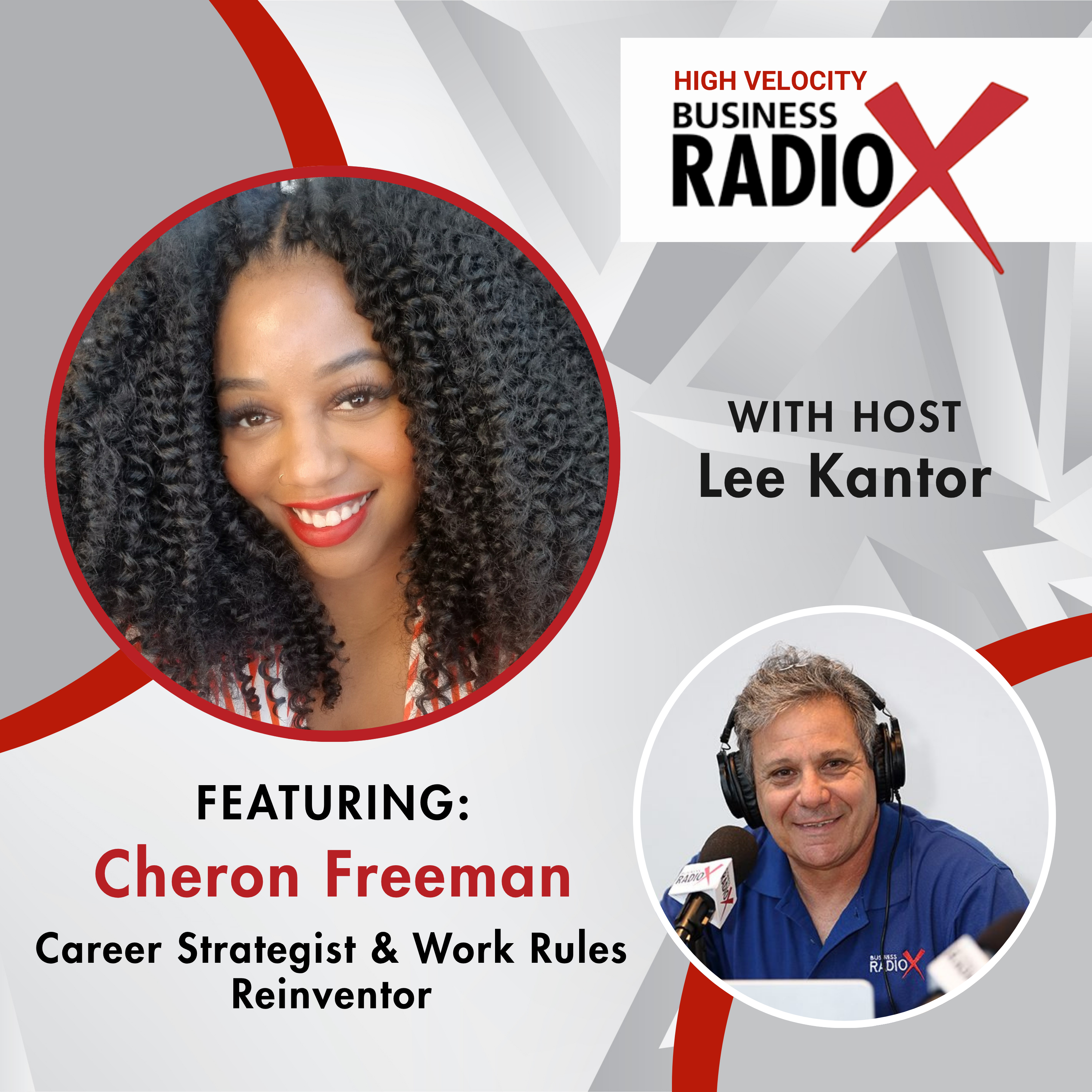

In this episode of High Velocity Radio, Lee Kantor interviews Cheron Denise Freeman, a career strategist and work rules reinventor. Sharon shares insights from her background in corporate HR and coaching, focusing on helping professionals navigate career transitions, layoffs, and career pivots. She discusses her “30 Days 30 Stories” experiment, which explores reinventing work rules through daily storytelling. Sharon emphasizes the importance of self-reflection, strategic job searching, and experimenting with new approaches to work. She also highlights the value of coaching in overcoming limiting beliefs and achieving career growth.
 Cheron Freeman is an ICF PCC Credentialed Coach with fifteen years of experience helping professionals reinvent their careers and thrive in the workforce. With a Bachelor’s degree in Human Resources and Sociology and hands-on experience in recruitment and HR business partnering across corporate, start-up, and private organizations, she brings an interdisciplinary lens to the intersection of work, society, and technology.
She has coached more than 500 professionals worldwide, specializing in career pivots, confidence building, and skill translation, turning education into measurable workforce outcomes. She also creates scalable resources such as the OH SHIFT Career Newsletter and the 30 Days / 30 Stories Work Rules Reinvention Experiment, sparking conversations about reimagining work in today’s tech-driven world.
At the heart of her work is a simple belief: education is transformation and when mindset, technology, and human connection align, extraordinary results follow.
Connect with Cheron on LinkedIn.
What You’ll Learn In This Episode
- Career transitions and their various forms (layoffs, internal moves, full career changes).
- Strategies for approaching job searches proactively after layoffs.
- The importance of self-reflection and clarity on career goals.
- The concept of “choosing yourself” in the context of career decisions.
- Exploring alternative career paths, including freelancing and entrepreneurship.
- The impact of emotional and mental aspects during career transitions.
- The “30 Days 30 Stories” storytelling experiment and its insights.
- The distinction between hypervigilance and true high performance in the workplace.
- The significance of experimenting and reflecting in personal and professional growth.
- The role of coaching in helping individuals confront limiting beliefs and achieve career goals.
 This transcript is machine transcribed by Sonix.
TRANSCRIPT
Intro: Broadcasting live from the Business RadioX studios in Atlanta, Georgia. It’s time for High Velocity Radio.
Lee Kantor: Lee Kantor here. Another episode of High Velocity Radio, and this is going to be a good one. Today on the show, we have Career Strategists and Work Rules Reinventor with the Organization, Cheron Denise Freeman, welcome.
Speaker3: Thank you. Welcome, Lee. I’m excited to be here.
Lee Kantor: Well, I’m excited to learn about your practice. Tell us about being a career strategist and work rules reinventor. How did this come about?
Speaker3: Yes. So I have been, I like to say, in the people business for the last 15 years. I started my career in corporate human resources, partnering with executives at various different companies. And then about ten years ago, I ago. I got into professional coaching and my niche. When I went to coaching school, I went to Ipek. For those of you that are coaches that are listening, shout out to you. And my niche was transitions. I love helping people navigate transitions because you get the opportunity to not only help them see the future, but also bring their past right past experiences and skills to the present to be able to navigate and compound upon what they want to do in the future. So that’s kind of what led me to become a career strategist. And the work rules inventor is the experimenter part of myself. I have a newsletter called Old Shift Newsletter, and I have been running an experiment. It was called 30 days, 30 stories. It was storytelling experiment where I was going back to all these rules that I was taught when I first entered my corporate career about work and how to approach work and how to reinvent some of those rules, especially in 2025, in a technology driven work world. I found that a lot of those rules were just not applicable. So I was doing a spin on how can we reinvent the way we approach work in our day to day lives so that we have more fulfilling careers and fulfilling transitions, navigating the unknown as well.
Lee Kantor: All right. So we’re going to get into all of that. But let’s start with the transitions. Is the transition. Um, should I stay at my company or should I be an entrepreneur? Or is the transition, should I stay at my company and and try to get a promotion? Like what is kind of the scope of the word transition in, you know, in a career?
Speaker3: Great question. So it can be especially in 25,, 2025. It could be a layoff. So we call that like a forced transition. It could be transition company to company. It could be an internal transition within your company. So I want to go from this department I want to go from it to to supply chain. Right. Or it can be as well career to career. So I’ve spent some time where I used to coach software engineers into a new career. So let’s say they used to be a teacher. Now they wanted to become a software engineer. Then I helped transition them into that new career as well. So that’s what it encompassed.
Lee Kantor: So now when a person, let’s kind of give some advice to the listener. So if you are transitioning and you were saying, okay, you know what, I just got laid off. Um, I’m not going to kind of complain about it. I’m going to make some moves. Right? I got to be proactive and I have to take action here. What are some of the do’s and don’ts for the people that are just recently laid off?
Speaker3: Okay, so the first thing that I say and I actually just did a workshop on this, but you really need to get clear on what it is you want. I call this a method of choosing yourself because so often when we are laid off, we have so many emotions, right? But we don’t really know what we want to do next. We don’t even know what we liked about our previous job, but we didn’t like about our previous job. So I say, after you’ve had like maybe a week or two to clear the emotions because I do think you need time for that. It’s actually sit down and say, okay, what did you like about your previous role? What did you not like about your previous role? Right. What do you want to do next? Does that still exist in the labor market? Because right now we have a lot of changes going on. So sometimes people are doing work what they were previously doing at their company. The opportunities just don’t really necessarily exist in the labor market. A lot of them for it right now. Um, and what what do you value? What’s important to you? Right. Where are you at in your stage of life? Your cycle of life? Do you need to work remote? Do you enjoy working on a team? Do you? Is there a certain salary that you need? I recommend that you get clear on all of those things, and you actually do that work prior to just applying to jobs, because if you apply to jobs and you approach applying to jobs just from the survival instinct of I just need money, I just need anything, you run into the most roadblocks and you also run into burnout very quickly. So that would be my advice.
Lee Kantor: Yeah, I think that’s great advice because I think that’s kind of most people’s knee jerk move is to I’m just going to start applying. And you know, I was this. So I’ll keep I’ll just keep applying for that, the same thing. And then it’s like it becomes one of these groundhog days where you get frustrated. No one’s hiring this. Like you got to kind of think bigger picture and you got to really align it with what you really want out of your career. Right? Like you can’t just approach this as like, I’m just going to take the next thing that comes about because you’re going to be in the same situation, you know, in, in just a few months.
Speaker3: Absolutely, absolutely. But I have compassion as well, because, you know, I work with professionals, a lot of professionals. We’ve worked in corporate America, and corporate America tells you that you’re not good enough unless you’re performing. And so a lot of times that like applying to ten jobs a day, you know, sending 20 messages, like all these different things. People do it because it makes them feel like they are performing something. But in reality, alignment and performance don’t have anything to do with each other. They don’t go together. I would say they’re going through a massive breakup right now. So yes. Right.
Lee Kantor: And you got to get the strategy right. Because if you’re just applying and you might get one of these things and, and it might not be a great fit for you, it just might check a couple of the boxes. But if it isn’t checking kind of the main boxes, then you’re, it’s you’re just going to be frustrated in six months.
Speaker3: Yes. Yeah, absolutely. And I’ve been there before. I’ve done it. And there’s nothing like you get into a whole brand new job, a professional role, and six months later you’re like, oh my gosh, what have I done? Um, but, uh, yeah. So you, you have to be able to get out of that survival lens for at least a week, right? A week or two to really ground yourself and feel okay with being enough to ask yourself those questions. A lot of times we don’t want to ask ourselves those questions as professionals because deep down inside we don’t think we are enough. We don’t think we’re enough. We don’t think we deserve to have our needs met. So we go into performance and and the job searching and looping.
Lee Kantor: Now, when you’re working with your clients, like you made the transition at some point from working in a corporate to I’m an entrepreneur and I’m betting on myself. Yes. Do some of your clients kind of have that same aha moment that, hey, maybe I’d be better served if I just went the entrepreneurial route rather than just get back on this, um, you know, hamster wheel again.
Speaker3: Yes. I mean, I work, I work with a lot of coaches, I work with a lot of leaders, and sometimes they might not be full blown entrepreneurship, but maybe it’s freelancing. Maybe it’s it’s fractal work. Um, like there’s so many different ways that you can support yourself nowadays that is in between, you know, a traditional, traditional 9 to 5, uh, as well as like full blown entrepreneurship and setting up business systems, um, contract work. So, yes, I do work with a lot of people that definitely do that in between. Or they say, hey, this is what I’m going to do overall, especially if they know that they need to make a full career pivot, meaning going from one career to another career. Right? Like if I’m going from a public school teacher to now, I want to become a business analyst, right? That’s that’s a jump. That means that there’s typically some income or some different ways that you have to generate income in the, in between, right, in order to make that full transition or transformation.
Lee Kantor: Now, ideally, are your clients coming to you before they make the transition or shortly after they’ve been transitioned? Maybe, you know, outside of their control?
Speaker3: I would say both, but I would say the one thing that that people come to me, typically they’re at they’re in some form of transition, meaning they’re at the point where they’ve tried a lot of different things, they’ve tried what they’re used to doing, and it’s no longer working. That’s when they tend to come to me.
Lee Kantor: Right. So they’ve tried some things. So the transition might be kind of emotional or mental where they’re like something’s got to change. It hasn’t changed yet. But in my mind it kind of has the beginnings of change. So I want to talk to somebody that can maybe help guide me to a next step, maybe proactively, rather than when it’s outside of my control.
Speaker3: Yes. Yeah. Once they get to me, it’s typically totally like the mental emotional part of the change because we live in the information age now, right where you can get information anywhere. So yeah, they’re not typically coming to me for more information. They’re coming to me for guidance and insight on how to navigate themselves through the change so they can get to the other side.
Lee Kantor: Now, at the top of the show, you mentioned the we talked about this work rules Reinventor and I am a big fan of doing experiments. Can you share a little bit about what led you to doing this 30 day experiment, and kind of the results from doing the experiment now, and also our experiments now? Part of just what you’re going to do kind of on a regular semi-regular basis moving forward.
Speaker3: Yeah. So what led me to this is, um, I just had a dream one night and I was like, oh, I should do an experiment where I’m telling stories from my career and and how I’m reinventing myself. Because working in human resources, working in the people business, I have just had a lot of eclectic experiences, and I had a lot of wisdom that I felt like I really wanted to share with other people. Also, it was a way for me as well to kind of take my experiences, take my pain, and turn them into a platform and something to share. So it started with back in 2021, I had a program that I was running called relaunch, and it was for professionals 30 and up that felt stagnant in their career. And part of the module that I worked with clients on for that program, we did an activity called Career Hauntings, where I had them write down like over the last like 5 to 10 years, right. What’s that one thing that had happened in their professional career that they, like were just stuck on or they always remembered, right? Maybe it was a low performance rating one year. Maybe it was a conflict that they had with a boss one year. And so what I did was I threw my newsletter every day.
Speaker3: Right. I would present a topic that I was reflecting on. So one of the big ones I talked about was hypervigilance versus high performance. And what I realized with working with hundreds of clients through transitions and myself, is that a lot of times our approach professionals at work, especially in corporations, we tend to think we’re performing when we are not, when we are really doing is being hyper vigilant. So what this looks like is you go into a meeting, right? Let’s say it’s ten people in the meeting and you are focusing on and paying attention to what Johnny is saying to Sam. You’re thinking Sam is cutting off. Johnny, you, uh, are not listening because you’re thinking about how Johnny is overstepping his boundaries on your project, and now you’re going to have to, you know, rebut whatever Johnny is saying so that you can feel like you still are good and you’re a good performer and no one is trying to f you over. Okay. These are conversations I used to have all the time when I worked in human resources and throughout my career, and people would feel like they were really performing while doing that. And what I realized is that is not performing. That is just a it’s a trauma response.
Speaker3: It’s just you analyzing the room to see who is a threat. And because you are good at that or you’ve gotten good at that, people will professionals will say they are problem solvers because they have the ability to do that when that is not really solving a problem, nor is that actually high performance. And so, you know, I talked a lot about and I experimented with myself on an everyday basis. Right. How do you move through that every day when you’re at work? How do you catch yourself when you are stepping into hypervigilance? Right. When you are projecting yourself onto a colleague, when you are just feeling nervous or maybe insecure about a presentation that you have coming up, or a conversation that you’re having with your boss and not equating it to, you know, woe is me, or, you know, they have it out for me. And I think it’s a really, really big thing. And I found for my audience that a lot of people struggle with this on an everyday basis, but they just don’t talk about it. It’s not talked about. And so it’s really hidden behind. I’m a high performer. I’m performing what I think is expected of me when really they’re just hiding behind fear.
Lee Kantor: Yeah, I think that your insights are spot on, and the way that they came about is very interesting to me. Um, when you were doing the experiment, I know the, the results and what you learned are, are great and important. I think there’s also, uh, a nugget of importance for other people to think about is just the concept of doing a 30 day experiment on something. Um, when you. I know this came to you kind of in a dream, the idea of it. But when you were kind of creating what that 30 day experiment was going to be and how you were going to execute it, can you talk a little bit about that? Because I think running 30 day experiments is a great mindset shift for a lot of people, and it’s healthy to be doing this on a regular basis to kind of test ideas that you think Um, might be beneficial down the road, but you don’t want to commit to it full time. So by doing an experiment, it allows you it gives you kind of guardrails and allows you to safely try something new. Um, because it might really be beneficial. And if it doesn’t, you just move on and do another experiment. But can you talk a little bit about kind of how you structured this experiment? And, um, you know, because a 30 day commitment to anything is not easy. That’s not nothing.
Speaker3: Yeah. I mean, I think it goes back to what you mentioned earlier about being an entrepreneur or the creativity embedding on yourself. And what I found is the only way that I could really set some foundation right now to bet on myself was to do something over extended period of time. And so the structure, the system that I used for this experiment was LinkedIn, right? That platform and was my newsletter. So I used my newsletter as the structure and the system to be able to put that out on an everyday basis. And because it’s one of my natural talents, uh, in terms of the format of the experiment, I would tell a story, I would tell a story every day, and I still am on, like what may have occurred that day. How, how how were things showing up for me? And then at the end of that story, I would say, hey, here’s today’s experiment, right? This is what I was doing. So that, say the hypothesis was moving through fear, right? The question was, can you move through fear and still show up? You know, here were the results, right? This this story is my results. And then I would pose a question back to my audience to be like, hey, this is a question that you should ask yourself about this topic as you move through the next day. So that was my system. Overall, I picked a platform. I used my newsletter and then also I use creative storytelling and literally kind of the, you know, the science method at the end to really structure these stories and structure the experiment. I also should say that I am an experimenter. I love to experiment. I firmly believe that you have to be in the day to day. You have to be in the process. And I learned that a lot as well. From working at a startup company and working with startups is what I love. It’s about the process and the everyday. It is not just about the outcome all the time. And so that also is the reason why I was able to navigate through that.
Lee Kantor: Now why did you make it public? A lot of people do kind of these experiments, but they do it privately so no one sees. Hey, you know, that didn’t work out. Like, why was it important for you to publicly share kind of the good, the bad, the ugly of this? Because you’re going when you say this publicly, I’m going to do this. Then there’s an expectation that you’re really going to do this, or else you’re kind of breaking a promise and no one wants to be that person. So talk about the making it public component of this, because that’s what a lot of people or most people don’t really have the they’re not willing to be that vulnerable and share that intimately with the public.
Speaker3: Yeah. I mean, I think for me that was very important because at a certain point, if you if you’re going to share, if you’re going to sell your ideas, if you’re going to be a thought leader, you have to you have to get out of your ego. You have to get out of whatever emotional tie you have to being safe and not being willing to be vulnerable. And so for me, really, this experiment and really creating shift newsletter was my way of actually doing that and getting comfortable with Expressing an expression through writing. I love writing, I love expressing, I’m very creative and so holding myself to the fire, right? Building that momentum on an everyday basis. To me, if there’s anybody that’s listening that’s struggling with that, I will recommend you do something like that because it builds some momentum for you, it builds the confidence for you. And if you’re ever going to become bigger than just yourself, right? Or share something with the world that’s bigger than yourself, you have to be able to create that momentum for yourself. You have to begin to think that you have bigger impact and something to say that’s more than just for you. But I do do a lot of it for myself as well. So there is a balance, I do both.
Lee Kantor: Now, you mentioned the background with tech firms and startups. Can you talk about your ideal client profile? Are they somebody coming from tech or do you have other niches, niches? Or are you kind of um, industry agnostic?
Speaker3: Yes, I would say, you know, on the, on the people side. Right. People strategists, because I also have my human resource background. I really, really, really enjoy working with startup tech companies and helping their leaders, um, align their people to their systems, to their technology systems. I love that technology systems and products like that is my that’s my intersection between work society. Right. And and technology. So I really, really enjoy that. On the career side, my, uh, biggest client and who I work with the most is just professionals. What do I mean by professionals? Meaning that you have either went to school, right, some form of school, you have degrees, and you have actually put hours and experience into mastering a craft. And I say it that way. And I even talked about in my experiment because I think that’s very, very important. There are a lot of professionals I’ve noticed that have just gotten caught up in a job, and so they’re no longer actually investing in their craft to the point that now a lot of younger, especially Gen Z workforce, they don’t even believe in mastering a craft anymore. It’s all about just what’s the next best thing or just getting a job. And I feel like that’s a lost art profession in the field of study is still incredibly important to me, and building that and taking the time to do so and having patience, I don’t believe in that quick fix, you know, what can I do? Who can I get around? Uh, what can I say to be seen in this light so that I can just move through without having to do the work right? I think it takes investment, sacrifice and a level of mastery and time put in. So I work with professionals, mostly 25. I would say to 45. That’s really my age range.
Lee Kantor: Now, how do you deliver this coaching and training? Is it one on one? Do you do group? Do you do workshops? Do you do kind of lunch and learns like how are you delivering all of this to your clients?
Speaker3: So I do one on one. I also do workshops. Absolutely. I do group coaching. I also contracted out to companies as well to to deliver this type of content.
Lee Kantor: And is there a story you can share that maybe illustrates the impact you can make on somebody, maybe somebody that you work with, don’t name who they were, but maybe name the challenge they had before they got to you, and then how you were able to help them get to a new level.
Speaker3: Yeah, absolutely. So I had a client. This was this was during Covid that enrolled in my relaunch program. And they had been in their career for over 15 years, they worked in a niche industry and they had climbed themselves up to a manager role, and they were in a corporate manager role, and they really wanted to be director of their department, and they had just had a new VP that was hired over their area, and they were trying to figure out how to get out of this manager role and into a executive director role. And they had went to their VP and was like, hey, I’m interested, I’m interested in being an executive director, right. And their executive director had shared with them to a degree that they were looking for somebody who really thought strategically, thought strategically, and was innovative and that they really felt like this person, like they were a good worker, but they weren’t really strategic and innovative. And so this was crushing for this client of mine Mind because they have put all this time, all this effort right into their career, into these roles, and now they’re being told that they just are a good worker, but not necessarily, you know, the best to become a executive director. So we ended up doing some work together.
Speaker3: They went through my program, and what we found was underneath this and why it cut so much was that they had this belief, right, this work belief that had been instilled with them from family, that if you work hard, that’s all you need to do. Just work hard. If you work hard, everything will pan out. And essentially, this was the first time they had to confront that belief that, oh, that’s not necessarily really real, right? They have been working hard. And this person is like, no, we don’t need work hard. We need innovation and creativity. Um, so they were able to shift that mindset through our work, follow back up, and they ended up landing the director role. So that is a client success story that I always love to talk about and just shows the power of what it’s like when you actually confront some of those beliefs that you think, uh, and they did. They had gotten this person to a certain point in their career. Right. But when you you get to confront them when you’re feeling stagnant and move that energy into more of what you want and start to think bigger picture and outside of the box to really get what you want.
Lee Kantor: Yeah, the impact is real. I am such a proponent of coaching, and I think that coaches do amazing work, and I wish more people would invest in them. I wish more companies would invest in them on their people. I think the benefit is tremendous. The upside is so much higher than any of the risk of taking that action.
Speaker3: Yes.
Lee Kantor: Now, Sharon, if somebody wants to learn more and maybe connect with you, or read your blog or or just, uh, hire you. What is the website? What is the best way to connect?
Speaker3: So the best way to connect with me is on LinkedIn. You can find my page. It’s under my name. Um, Sharon Freeman I’m also on Instagram and TikTok under at Denise. C h e r o n. Denise. And so those are the best ways to actually connect with me. Reach out if you have questions or if you want to book me.
Lee Kantor: Well, thank you so much for sharing your story. You’re doing such important work and we appreciate you.
Speaker3: Thank you so much, Lee. It was a pleasure to be here.
Lee Kantor: All right. This is Lee Kantor. We’ll see you all next time on High Velocity Radio.














