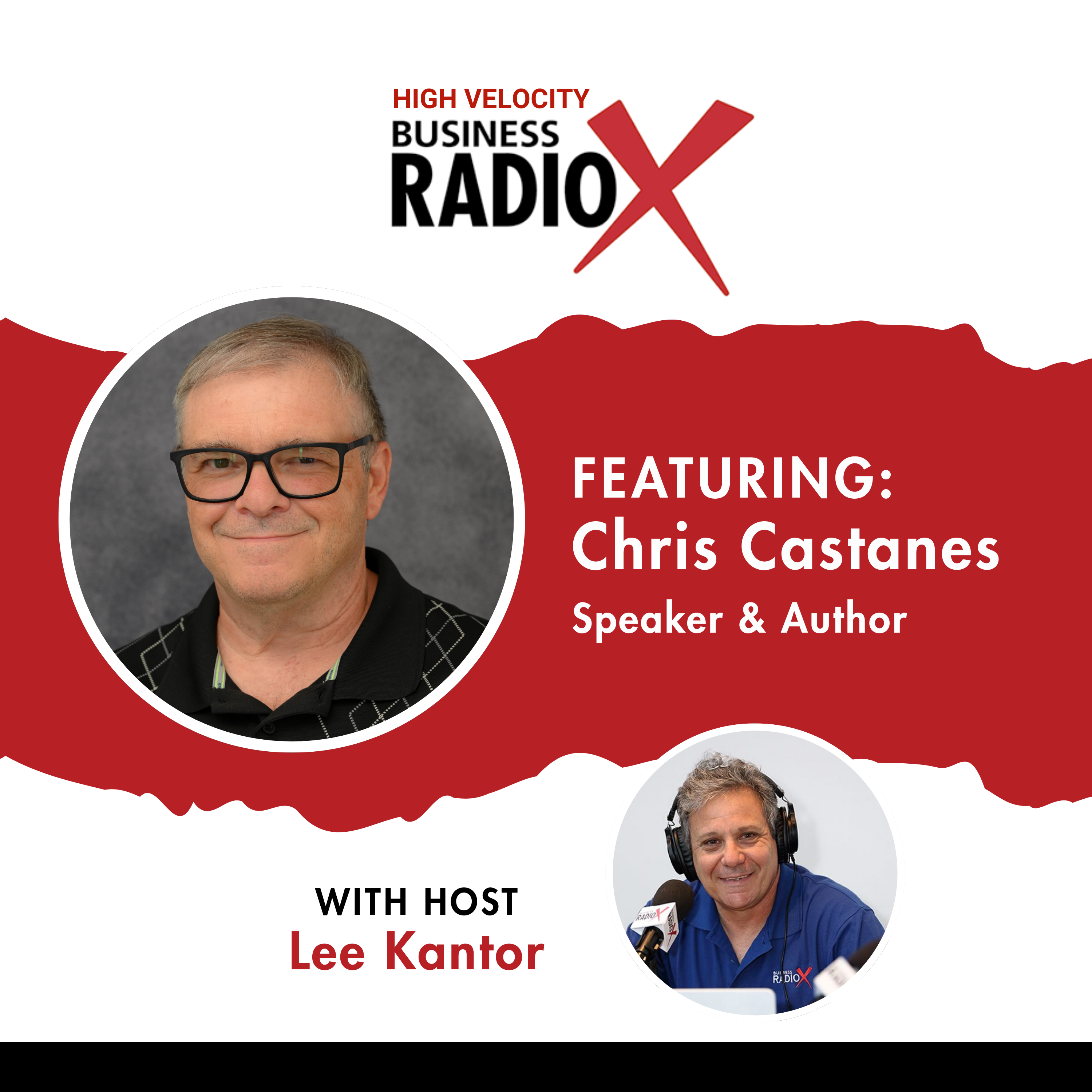


 Chris Castanes is an award-winning insurance agent, author, podcaster, and engaging speaker. With more than 30 years in sales and marketing, he shares sharp insights and humorous “dumb stories” in his newest book, Nearly Motivated. He also serves as president of Surf Financial Brokers, a life and health insurance agency.
Connect with Chris on LinkedIn and Facebook.
What You’ll Learn In This Episode
- How to get your message to the masses
- How to make a networking event work efficiently for you
- Why humor is helpful in sales
- How is selling like dating
 This transcript is machine transcribed by Sonix.
TRANSCRIPT
Intro: Broadcasting live from the Business RadioX studios in Atlanta, Georgia. It’s time for High Velocity Radio.
Lee Kantor: Lee Kantor here. Another episode of High Velocity Radio, and this is gonna be a good one. Today on the show, we have speaker, author, business owner Chris Castanes, and he is with Surf Financial Brokers and you can find him at Chris Castanes. Welcome, Chris.
Chris Castanes: Thanks for having me. Lee.
Lee Kantor: Well, I am excited to learn what you’re up to. Let’s start with your business. Tell us a little bit about Surf Financial Brokers.
Chris Castanes: Surf Financial Brokers is a life and health insurance agency that basically just run more or less virtually. At this point. We have a website and set it up to where people can either get things straight from the website or they can set an appointment and if they need help, or if they want to talk with me or one of my other insurance agents, and we just do it that way, we ever since Covid, we’ve been working that way. And it’s and it’s been pretty good and we’ve, you know, licensed in about 6 or 7 states. So we help out a lot of people with life insurance and disability and long term care and cancer insurance and dental and vision and all those fun things like that.
Lee Kantor: And, um, that experience kind of led you to your speaking and writing career.
Chris Castanes: Well, before that, I was already writing books. I wrote my first book, 2017, and I’d been speaking a little bit around the same time, so they just kind of worked side by side. And when I’m with a client on an insurance client, I kind of throw out that I’ve written some books, and if I’m with a helping someone, a sales agent, I might mention that I sell insurance. So, you know, they just kind of work together like that.
Lee Kantor: So was this kind of orchestrated? Like, had you always had these desires as you were kind of building your career, or did they kind of just evolve as you were kind of, uh.
Chris Castanes: It just kind of happened. The first book was was really more of a lark. That was just something I wanted to do and write a book. And then when I did it, I said, oh, maybe I should do a little bit more speaking on that subject. And so I started doing that and was going out and talking to some sales groups and, you know, real estate offices and things like that. And, um, eventually wrote a second book after Covid or during Covid. I actually was blogging a lot. And then I turned that blog into the second book. And, um, so, you know, it just kind of worked. That worked out. It wasn’t something I had planned out, but it worked out pretty good.
Lee Kantor: So a lot of your writing is about kind of, um, marketing, selling things like that, right?
Chris Castanes: Yeah, it’s mostly tips. Uh, sales tips, uh, how to network properly, how to, you know, work a room. Uh, marketing tips, advertising how to save money. You know, just getting your head in the game. All kinds of little topics. Uh, and we cover a lot of that on my podcast as well. And, um, so, you know, try to keep it short and sweet and give you some things that you can do now. Not a long game for the most part, except for networking is usually a long game. But that’s how we we let you know that in advance.
Lee Kantor: So now as kind of, uh, theme throughout or maybe just an element of all of your work is humor. Um, how did you stumble upon using humor in something that a lot of people would think is serious? Uh, business selling in and helping people in the manner you do?
Chris Castanes: Yeah. So I’ve, I’ve always kind of been, I guess, the, the funny guy. And, um, years ago I did some stand up comedy, uh, locally here in the North Myrtle Beach, Myrtle Beach area and, um. And when I realized that that wasn’t the most lucrative career move in the world, I just kind of pivoted a little bit and I just incorporated it into my sales talks now. So I my books have some funny stories in them. Uh, when I talk to a sales organization, I gave a talk last week at the local chamber of commerce and throw in a couple of funny examples of things that have happened to me and, you know, people, people here sales talks and tips and tricks and things. And sometimes you see their eyes glaze over, but when they when they laugh a little bit, it helps, uh, it makes them retain the information a little better, especially if they have a funny example to go by. And as far as the insurance side, you know, with my with my insurance agency, we’re really talking about some pretty serious subjects when we talk about life insurance and disability and things like that, you know, like, you know, let’s talk about what’s going to happen if you die or if you get seriously sick or something to that effect. So it just kind of lightens the mood a little bit if you can throw a little bit of humor. You don’t want to be over the top funny, but a little bit just gets their guard down a little, you know, and people get defensive when they’re around salespeople. So if you can just get their guard down just a tad, you can you can just feel the tension in the room drop a little bit.
Lee Kantor: Now do you recommend that just everybody try humor or is this something that, um, you got to kind of have a gift for?
Chris Castanes: Uh, anybody can can have a little bit of humor. Uh, it’s just a it’s a judgment call most of the time. And most it’s good to be able to read the room and understand if someone wants to hear a joke or if they might think something’s funny. And like I said, it doesn’t have to be a routine. It can just be a couple of little jokes that you throw in even. I’ll give you an example, as I have a, um, if I’m working with someone and I. I’m taking the name of their spouse down. You know, I’m just taking a fact finder and I’ll say, well, what’s your husband’s name? And they’ll say, Bob. And just really innocuous. I’ll just go, like, was Bob behaving this week? And that just kind of they giggle a little bit and they’ll go, oh, he’s trying or something. That’s just very small humor, but it just helps lower the temperature in the room. And so that’s all it takes. It doesn’t take a over the top joke or a comedy routine. Just a little comment. Very not going to offend anybody. And something like that gets people, oh okay, you’re that guy. You’re gonna ask me how my if my husband’s behaving. So it just makes people relax a little bit.
Lee Kantor: Now, you mentioned a couple of times now reading the Room. Do you have any advice or, um, tips around how to read a room? Are there things you do and don’t do or things you look for.
Chris Castanes: I don’t really know if there’s a skill set there. That’s just something you have to be able to do. You know, if you walk into someone’s home and they’re obviously stressed out about something, that’s not the time to, you know, it’s better to ask a question like, hey, is everything okay? Um, rather than dropping jokes. Um, but then sometimes they’re just, you know, they’re just light and you can tell that they’re happy to be there, or they’re just looking forward to getting it over with. If we’re going to talk about some business and, um, you know, or I’ll call on a business, I’ll might be out. I say it’s a new business. I walk in just to say hello and introduce myself. And they you have to kind of pick up. You can kind of pick it up real quickly, but it’s not going to be a sign on the door saying we’re in a bad mood today or anything. So it helps if you can just figure it out. But most people know that ahead of time. I think I would hope so.
Lee Kantor: Now, you mentioned your business now is pretty virtual. Um, do the people you work with are they also having virtual, um, relationships, or are their relationships more face to face and in person?
Chris Castanes: It depends. Um, you know, I’ve got one, one agent that works for me. She don’t work for me, but she works with me. And she does a lot of Medicare supplements. So a lot of the people that she sees are in person because it’s an older clientele. They’re not really, uh, you know, skilled or comfortable doing zoom calls. And then I’ve got other agents that that’s all they want to do because they’re talking to somebody three states away. And so it just depends on who you’re dealing with and what the audience is and, and, and who your customers are going to be that day. And how how comfortable the agent feels also. So with my own personal production, a lot of it is over the phone. Zoom calls. But at the same time, if it’s somebody locally here, I’m more than happy to get in the car and meet them at a coffee shop, or go to their home or business wherever they want.
Lee Kantor: And then is the is that kind of the way the industry is evolving? Is there kind of a mixture now an insurance person is going to have kind of a a portfolio of virtual and in-person relationships as they grow their book of business?
Chris Castanes: It might be I haven’t really studied it. Um, but I do know that, you know, we’re doing a lot as a society. We’re doing a lot of stuff online. I mean, even today as we’re recording this at Cyber Monday, um, and we do a lot of, you know, people buy car insurance all over the phone or online or they’re doing banking online, and they’re more comfortable with that than they were, say, ten, 15 years ago. So it’s it I think in a lot of ways, people will get on the computer in the middle of the night. You know something? They couldn’t get to sleep because they remembered that they, their spouse has been nagging them about dental insurance or something. And they can go to the website and look up different plans, and they don’t have to. Some people just don’t want to talk to an agent. So I try to make it as comfortable for everybody. You know, it’s really what the what the client wants. And logistically, if I can physically be there, I’ll do that. But if not, we’ll do a zoom call and figure it out. Or sometimes it’s just a phone call. We don’t even get online. So whatever the client I can, however I can get the client, uh, situated is whatever I can do best for them.
Lee Kantor: Now, in your work, are you like, who is your ideal, um, kind of reader of your books or listeners to your podcast or, you know, buyers of your speaking services? Like who is that ideal client for you?
Chris Castanes: Um, I prefer Helping people who are like entrepreneurs, small business owners, solopreneurs. Those are the people that, um, I can relate to because I’m like that myself. I’m also a 1099, you know, contracted an agent. And so I like working with realtors, uh, other salespeople, mortgage brokers, people who are out there that are paying their own bills that, um, and they’re trying to figure it out as far as marketing, um, joining networking groups, things like that, getting their head in the game, just a lot of that kind of tips and tricks and you know, how to how to make a brochure on your own on a budget so you’re not having to spend a lot of money. Because a lot of times for us solopreneur kind of people who work from home, it um, any, any money you spend comes really out right off the off the top. And it it. We have to be very careful with our budgets and when it comes to marketing and advertising, and I try to just help out in that way, you know, give them some direction. I don’t have a giant corporation funding me in the background. I don’t have anybody giving me money for marketing or advertising. So I can relate to that. And I understand what they’re going through. So I try to help them out and give them that kind of, you know, information that whatever I can share with them.
Lee Kantor: And when you’re when you’re sharing kind of a go to market strategy, are you, um, helping them kind of build those in-person relationships or are you helping them build those online relationships or some combination?
Chris Castanes: It depends on what they’re what they’re working on. So if they’re, you know, if I get a real estate office, of course they’re going to mostly be in person because they have to go out and physically show a home. Um, but then sometimes I’ll get somebody and they’ll say, well, I’m really trying to go more virtual. What I what advice do you have? And if I, you know, if I can help them out there, I will, um, you know, it’s just a matter of trying to figure out there again. What’s that? That, uh, salesperson or business owner, what are they trying to do? And you have to sit down with them and ask questions. And just like selling insurance, you know, you do a fact finder and just find out, you know, what’s your goal? Where do you want to be in three years? Where do you want your business to be? What is the market look like? Asking all these questions and then trying to figure out something to help them out as much as possible? Um, but most of the time when I’m speaking to, say, real estate groups, we talk about networking, how to get out there and find people. A lot of these people have never had a formal sales training class, and if they pick up my first book, they might get one right there. Hopefully. So we’ll see what happens.
Lee Kantor: So let’s let’s break it down. So for the first the for the group of people that are listening or the individual that’s listening that wants to build more in-person relationships and to grow their business through kind of face to face marketing and networking. What advice would you give them? What’s the low hanging fruit for an individual in, um, in that situation?
Chris Castanes: Yeah, in that group I would tell them, you know, go to your local networking, uh, groups if you can find them, or Chamber of Commerce, uh, anything like that. And the battle there is usually like trying to find people to talk to. That’s usually the hardest thing is, you know, especially when you’re first starting out, the you probably spend 80, 90% of your time just prospecting and trying to get your pipeline filled. And then what do you do? You know. Do we? How do you find those people? Where do you market them? How do you, um, approach them? So in my case, for instance, I’ll take people that I meet online or in person at networking events and just invite them out for some coffee. And usually they’re like I said, they’re small business owners, they’re entrepreneurs, they work from home. And so I’ll just say, hey, you know, I’m, I’m an insurance agent, but I also want to learn about your business. Why don’t we meet for ten, 15 minutes at a cup, you know, get a cup of coffee. I can tell you what I do, and I really want to hear about what you do. That usually will work.
Chris Castanes: You can get about. I don’t know, it’s probably about a 30% batting average. 40%, if you’re lucky on that. And you can you know, it’s just the goal is is micro goals. You know, like the first goal is to join the network group. And then from there try to set some appointments from that and to remember that when you’re doing these things, not to dismiss people summarily and say, well, that guy’s not going to help me, because that person, even though they may not be interested in what you’re selling, knows other people who may be in the market for what you’re selling, and then you want to make yourself as referable as possible. So that’s the kind of information we try to share with people when we when I go out and talk or, you know, have a book signings or anything like that, or I speak to a group, uh, we just try to go through the process of what they’re doing, and it’s all, uh, not every industry is going to be the same, but there’s generally the same skill set that’s transferable. It’s just you have to tweak it a little bit from one industry to the next.
Lee Kantor: So now, um, you mentioned that it’s the beginning of December and, um, we’re in the beginning of not the beginning, but we’re in the kind of the holiday events, a season and a lot of chambers of commerce are having kind of end of year get togethers. How would you recommend attacking, um, a chamber mixer at the end of the year where everybody’s being brought together? Is that a sales opportunity for you? Like, how would you kind of, um, strategically go about getting the most out of that event?
Chris Castanes: Yeah, I pretty much the same way as I do any other time of the year, honestly. Um, my what I’ve learned over the years is that people will go to chamber mixers or after hour events, and they’ll bring a stack of business cards, and they’ll deal them like they’re dealing poker. And and then they go home and they go, man, nobody called me. I gave out all my cards and, you know, blah, blah, blah, and they’ll complain when actually you have to take it at a different angle and say, I’ve actually done this. I’ll say, I don’t even have any cards with me. Can I get your card After I’ve talked to someone for a few minutes, I’ll say, can I get your card? And I’ll just give you a call in the morning tomorrow morning, and we’ll set an appointment and we’ll go get some coffee, if that’s fine with you. And that right there alleviates a whole lot of, uh, problems, because the next day when you call them, they know who you are. They know why you’re calling, uh. And they’re more than happy. You know, when you leave there, they already know that they’re going to you’re they’re going to get a phone call to go get some coffee in the following week or two.
Chris Castanes: So if you do that approach and just say, how about giving me your card? I’ll give you a call in the morning. We’ll we’ll grab some coffee and we’ll, you know, just see if we can network together, try to make it non-threatening. Don’t say, I want to sell you something. Just say, I want to learn about your business or what you’re doing and go from there. That’s the first goal is just to make that appointment. Then at that appointment you can dig a little deeper. So that’s the way I’ve always worked. It That is just to, uh, put the ball in your own court instead of giving them a business card and knowing that when they get home, it’s probably going to go into the trash. Um, and also what I’ll do is I’ll go home and I’ll immediately look them up on LinkedIn or another, you know, some networking site if I can, and see if I can connect with them. That helps to just kind of gives yourself a little bit more credibility.
Lee Kantor: Now, when you enter into one of those events, at any given one event, are you looking to meet 20 people? Ten people, five people, two people. Like, how do you like what’s a good event?
Chris Castanes: Well, and it depends on the size of the event. So I went to a, um, a mixer a couple of months ago, and I think there was probably about 20 people showed up. And it was not, not a, not a huge turnout. So I was like, okay, if I can get 7 or 8 cards here, you know, if I can get 7 or 8 business cards, that’s kind of doing something, because a lot of those people I’ve already talked to. If it’s a bigger event, I might aim for 15 or 20 cards. And you know, there again, they know I’m going to call them. And out of that 15, I might book 10 or 12 appointments. So it’s just, you know, you have to kind of gear it and be a little realistic. If I go to something and I’ve already talked with half the people I know, I’m not, it’s not going to make, you know, setting a goal of ten people and five of them I’ve already talked to. It’s not really going to be too realistic, but it’s just set your, you know, set your goal. Look at look around, see who’s there. And you go, man, it’s really bad weather. Nobody’s going to show up for this one. So just kind of make that quick adjustment on the fly. It’s you know there’s always you fight the what do they say live to fight another day sometimes.
Lee Kantor: Now what about online. Do you have a strategy maybe around LinkedIn since a lot of your folks I would imagine are, you know, on LinkedIn, are business people using LinkedIn.
Chris Castanes: Yeah. I like to, um, go on LinkedIn and look for people there. Like I said, I’ll drop them a note and basically the same approach, just say, hey, you know, thanks for connecting. Once you get them connected with you, the new ones. Um, if I, if I have, I’ll give them a week or so. I don’t want to come right out of the gate and start pounding them over the head, but I’ll just drop them a note and I’ll say, hey, we’re both local, you know, let’s grow. Go grab a cup of coffee and I can share my work with you, and you can tell me more about what you’re doing. Maybe we can network. And that’s all I’ll say. And I get about 10% of those will come back and say, yes, that’s fine. And and I’ve either I’ve either gotten sales or referrals which are just as good for me. So it really helps in that regard. Not, uh, having to go out and prospect too much and wear out my car and all that and burn gas. If I can sit at home and meet, set 3 or 4 appointments just from LinkedIn, that works just as well for me, so I enjoy it. Um, it takes a little bit of practice. It takes a little bit of getting used to how things are on LinkedIn. You’re not going to get as high of a batting average and success rate, uh, virtually or online. But you still it doesn’t cost you anything, so it’s just as good for me.
Lee Kantor: So do you have kind of a daily discipline when it comes to LinkedIn or even in person or a monthly kind of, uh, do you kind of build a schedule that says, okay, every day I’m going to spend 15 minutes on LinkedIn, or every week I’ll spend an hour, like, do you have kind of a regimented schedule when it comes to this, uh, networking, whether it’s virtual or in person?
Chris Castanes: Uh, well, virtually what I do is I just get up every morning and, and I have a bunch of different things I do online and I’ll. But when I get to LinkedIn, I’ll, um, look to see I always have at least five LinkedIn. What do you call it? Connection requests. I always keep about five of those floating, and once they get about five, 5 or 6 days old, I’ll take them out. I’ll withdraw that invitation and they’ll just get recycled again in about 60 days. And the ones that say yes, like I said, then I’ll come back to them in about a week and just drop them a note and ask them if they want to grab some coffee. But in person, uh, I don’t really go out prospecting that much anymore. I unless it’s a networking event and I keep my calendar pretty much filled with any and all free networking events I can find. I’m not a big fan of the ones that cost an arm and a leg. But we have so many free ones around here and you can make anything. A networking event. I’ve networked at weddings and, you know, all kinds of stuff like that, but you can, you know, if it tomorrow. I’ve got, um, one in-person networking event and one online networking event. So I try to keep my my schedule filled with those things and any kind of zoom calls people want to make. We have groups that we’re in. Linkedin has some awesome groups that, uh, have their own little groups there online. So you can get online and talk with people that and, you know, other countries sometimes. Not that I have a lot to offer them, but uh, specifically to insurance. But I can also say, hey, by the way, I’ve written a couple of books, might help you out. And I’ve had people in England and Europe buying my books, which is interesting.
Lee Kantor: So what do you need more of? How can we help you?
Chris Castanes: Um, I’m, you know, anybody who wants to just visit my website and kick kick the tires or listen to the podcast. I’m. I’m always appreciative of everything. I try to just be grateful for whatever comes to me. And, uh, I’m always happy to reach out and help other people. That makes me feel good, especially this time of year.
Lee Kantor: So if somebody wants to connect, what’s the coordinates? What’s the best way to get Ahold of you and connect?
Chris Castanes: Oh, LinkedIn is awesome. You can just look me up. Chris Castano’s I don’t think there’s a whole lot of Chris Castano’s out there and and, um, just look me up. I think it says humorous sales speaker or something on my profile, and, um, I’m I’m always happy to connect with people on there as long as they’re not trying to sell me something. You know, that’s the that’s the thing when you get these random connection requests and, and literally as soon as you say yes, you start getting inundated with, with things into your inbox from them. It’s typically a bot. And don’t be afraid. Don’t be afraid to connect or disconnect or whatever they call it. Um, but yeah, everybody else, if you’re, you know, legit and you want to connect, I’m happy to connect with you.
Lee Kantor: And that’s, um, Chris Casanas c h r I s c a s t a n e s.com is your website.
Chris Castanes: Yeah, yeah.
Lee Kantor: Well, Chris, thank you so much for sharing your story today. You’re doing such important work and we appreciate you.
Chris Castanes: Well, thanks for having me. And if I can help you guys out, um, please let me know. And, uh, and I and I’ve been listening to your podcast, I appreciate it. It’s you’ve got a lot of good information out there for people.
Lee Kantor: Well, thank you very much. All right. This is Lee Kantor. We’ll see you all next time on High Velocity Radio.














