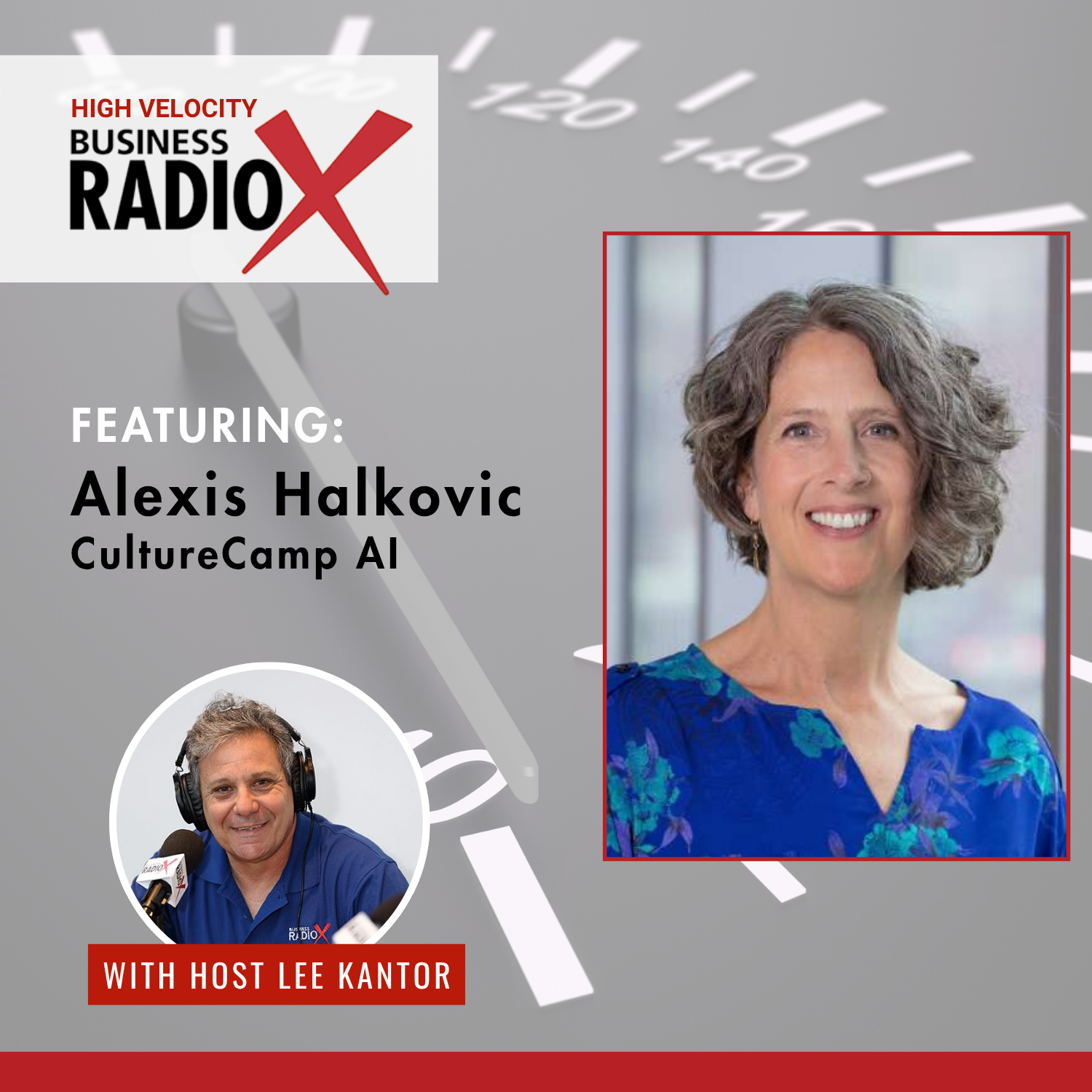

In this episode of High Velocity Radio, Lee Kantor interviews Alexis Halkovic, Founder and Co-CEO of Culture Camp AI, about the critical role organizational culture plays during periods of major change. Alexis shares how Culture Camp AI helps coaches and organizations uncover hidden cultural dynamics through assessments that create shared understanding, improve communication, and reduce workplace friction. The conversation explores how culture impacts productivity, employee engagement, and the successful adoption of new technologies, particularly AI. Alexis also discusses the importance of psychological safety, change management, and using data-driven insights to help teams navigate transitions with greater clarity and confidence.

 Alexis Halkovic, PhD is a social psychologist, leadership coach, and co-CEO of CultureCamp AI, a platform that identifies the underlying patterns affecting how teams work, so organizations can work more effectively.
She spent a decade in operations leadership at Goldman Sachs before earning an MA in Social/Organizational Psychology and a PhD in Critical Social Psychology.
She brings a systems lens to culture, conflict, and decision-making. With a strong interest in ethics and technology, she leads the Coaching Ethics Forum’s AI Open Source Ethics Collective.
Connect with Alexis on LinkedIn and Facebook.
What You’ll Learn In This Episode
- Understanding the impact of organizational culture on communication, engagement, and overall performance.
- Leveraging shared language to reduce conflict and strengthen team collaboration.
- Creating psychological safety to support teams through change and uncertainty.
- Identifying hidden team dynamics and workplace friction through culture assessments.
- Applying effective change management practices to support successful AI adoption.
- Utilizing coaches as neutral facilitators during organizational transitions.
- Measuring team and culture progress through data-driven insights and AI-powered tools.
- Recognizing key moments to evaluate culture during leadership changes, mergers, and technology implementations.
- Avoiding common pitfalls associated with poorly communicated AI initiatives.
- Building organizational resilience and adaptability through proactive culture management.
 This transcript is machine transcribed by Sonix.
TRANSCRIPT
Intro: Broadcasting live from the Business RadioX Studios in Atlanta, Georgia. It’s time for High Velocity Radio.
Lee Kantor: Lee Kantor here another episode of High Velocity Radio and this is going to be a good one. But before we get started, it’s important to recognize our sponsor, Stone Payton Managing Partner with Business RadioX. If you’re a business coach who is tired of being a best kept secret, set up a call with Stone at bookstonephone.com to unlock your perpetual prospect pipeline. Today on this show, we have the founder and co-CEO with Culture Camp AI, Alexis Halkovic. Welcome.
Alexis D Halkovic: Hi, Lee. It’s good to be here.
Lee Kantor: Well, I am so excited to learn what you’re up to. Tell us about Culture Camp AI. How are you serving folks?
Alexis D Halkovic: Sure. A culture camp is, um, we are a startup that we have an organizational culture assessment that is designed to help, uh, coaches and other, um, professionals work with organizations who are going through major change to add clarity into what’s going on under the surface when there are, you know, big changes or other types of challenges going on in an organization. So, you know, in my, in my world, assessments are extremely helpful because they can just give a lot of clarity, but they also give people a shared understanding of the situation that they’re experiencing together. So when and when you’re looking at something from a team perspective rather than from an individual perspective, it helps to unlock some of these ways that we get stuck thinking about. This person is going about it the wrong way, and I’m going about it the right way and creates possibilities so that we can recognize that there are values to what everybody’s bringing to the table. And then you can work from there to, you know, make plans to work together more effectively and leverage all of the, the strengths that that different people are bringing to the table.
Lee Kantor: So now is this for the organization or is this for coaches to use to help them when they’re dealing with organizations?
Alexis D Halkovic: We are primarily focused on working with coaches at the moment. We are in our kind of we’re working through some proofs of concept right now with some coaches going through big change management processes. So yes, we are working with coaches because it’s it’s really beneficial to have an unbiased, outside perspective when you’re going through these kinds of changes. Um, and, and coaches do deal with these types of scenarios a lot. And of course, one of the big types of scenarios that we’re experiencing with big change now is, is with AI and how companies are trying to incorporate artificial intelligence into the way they work.
Lee Kantor: So what’s your back story like? Why are you the right person to be bringing this to the market?
Alexis D Halkovic: Well, I my background is that I, um, I have over a decade of experience working in change management, big change management, um, in banks international, um, international, uh, Changes migrations of work functions overseas, for example. And and also I trained I have a PhD in social psychology. And social psychology is what we look at is the way systems affect individuals and groups. And so that’s very much applicable to the way that people feel and experience culture in an organization.
Lee Kantor: So then, uh, when you got done with kind of that corporate enterprise side of your business and became an entrepreneur, uh, you were kind of the right person to bring these kind of different ways of looking at the same problem together because of that unique lens that you have. Um, you know, with the enterprise background, plus marrying that with the kind of the social psychology background.
Alexis D Halkovic: Yeah. Um, and also I have a great team. I’m not doing this alone. The, the other folks who started, um, culture camp, uh, Tim Walters and CJ Grimes in particular, um, have a lot of experience with startups and with building technologies using artificial intelligence. So they’re the technological and the business side of things. And I’m more of the, you know, thinking about the coaching context. I’m also a coach, um, and, and how to best think about what the challenges are and how those can be addressed. So now it’s a partnership. Yeah.
Lee Kantor: So how did kind of the assessment get built?
Alexis D Halkovic: The assessment, um, honestly, the assessment was built in a previous version of, of this business, an, a company called round Peg that was built by Tim and CJ a number of years ago. And that was used successfully in a lot of, um, organizations, but the focus was on, um, on the hiring process and so screening people for fit. And this version that was a number of years ago, that business was sold and the product was eventually, you know, integrated into some other things. Um, and Sunsetted. So the assessment is now available. And now we have different tools, technologies. We have AI. Um, and we’re approaching a different problem. So looking at, you know, how do we use an understanding of culture to navigate change?
Lee Kantor: Now when you’re having conversations or when your coaches are having conversations with organizations and emphasizing kind of culture at the heart of this, um, is that something that they’re like, oh yeah, where have you been all my life? Or is this something that that takes a little bit of convincing.
Alexis D Halkovic: That is a great question you’re getting at, I think something really importantly that a lot of people don’t look at culture, they don’t think about culture, they think about productivity, they think about, um, profits and efficiency and those types of things. And they often forget that culture affects all of those things. Culture affects the way people work together, the way people communicate, the climate, the way people feel, engagement, um, how people resolve conflict. And so yes, you are right. It takes some, some convincing that this is something that is important to, to address.
Lee Kantor: Now, isn’t culture one of those things where if you’re not kind of proactively doing things to support a healthy culture, a culture is going to form like it happens, whether you’re being proactive about it or not. So you might as well kind of be proactive and try to shape it to the best of your ability to be at least in the form that you would aspire it to be if because otherwise, like people are gonna, it’s like my background is in marketing. So I always look at things through that lens. And to me, culture and branding are the same or similar in this respect in that your, your company has a brand, whether you do anything to tell people about it or not, the customer is going to have an opinion and they’re going to put a brand on your brand. So you might as well be proactive. The same with culture. You should be doing things that are building the culture you would like, because otherwise it’s going to form just based kind of chaotically and randomly about what everybody’s doing in your organization.
Alexis D Halkovic: Yeah, yeah, exactly. And I love that analogy that people are going to put a brand on you if you don’t, if you’re not proactive and just like you have a culture, whether you’re aware of it or not, And that culture could be a benefit, a huge benefit to the organization and to your operations. And it can be, um, a big pitfall, a big thing that you’re missing out on in terms of, you know, how do I get people to work together more proactively? How do we develop more clarity around the ways we’re working and expectations? You know, all of those things. It’s, it’s really about, you know, values in action. Um, and people often attribute it to things like personality, like the founder’s personality, but everybody in an organization contributes to its culture. But certainly, you know, founders and CEOs have a much bigger impact on culture than, um, than other people.
Lee Kantor: So now, um, when you have organizations kind of go through the assessment, uh, can you share maybe some of the aha moments or the moments where they’re like, that’s not like maybe they don’t believe the results. Like, because I would imagine it’s rarely. Yeah, that’s who we are. Or yep, that makes perfect sense. Like there, I would imagine that it uncovers a bit of friction somewhere in there for sure.
Alexis D Halkovic: Yeah, it’s very interesting. It’s so individual depending on the team. But I did go through the assessment with the team, um, who you know, we go, we first, I kind of asked everybody, every individual on the team how they would describe the team and their role on it. And there was a lot of information that was really valuable in that piece. And then when we pulled out the the culture assessment information, which gave a culture type, which is, you know, um, collaborate, cultivate command and competence and, um, And then also shared values and conflict values. So those are kind of the three big things that we discussed during that debrief. Um, we, when I talked about what there were a few different conflict values. And one of them that I brought up, which was, um, a focus on the big picture versus attention to details that just brought up this huge conflict that had been going on within that team about like, one person is trying to like make us all think about this one thing that we don’t care about, and we just want to move on with the big picture. But once they had this shared language to talk about it, it no longer became this big source of friction. It was like, oh, it is important to think about both of these at different times. And maybe by overly focusing on big picture. We are missing out on something crucial that we need to address. Now, this was a technology team. Um, and so sometimes that happens. I’ve had other teams where they are very harmony oriented, and they didn’t want to acknowledge that there were any conflicts at all. And so sometimes that takes a little bit more work on the part of the coach to, to really get to know that team. It’s going to be it’s going to vary depending on, you know, you’ve got a bunch of people who are super outspoken versus no, no, no, no, we don’t have conflict. Nobody here rocks the boat. You get really different data. So it’s interesting.
Lee Kantor: And is one of the, uh, maybe major takeaways from going through the assessment and, and talking about it is kind of getting everybody on the same page when it comes to a common language and communication and clarity of messaging, because that to me, is really at the heart of a lot of issues that people aren’t kind of speaking the same language, or they’re all making assumptions that are different from one another, and it never gets to the forefront. And this gives a place to kind of everybody kind of read from the same song sheet. Now, now we can maybe communicate a little more effectively.
Alexis D Halkovic: Absolutely. Yeah. That’s exactly the way I would have said it. It’s like you took the words right out of my mouth. But, um, yeah, no, I agree because then it also shifts it from being this is a, this is about culture rather than, this is about blaming individuals for the way that they perform their work. That is not, um, the way that I perform my work. So definitely having shared language and a shared understanding of the dynamics create space to be able to address those things more effectively and then create a plan like, okay, now that we understand this, what are our goals and how are we going to work towards those together?
Lee Kantor: And then, and, and it doesn’t only create a space, it creates kind of a safe space where it’s, I’m, I’m kind of comfortable in sharing maybe these things that I’ve been holding in a little bit.
Alexis D Halkovic: Definitely. Yeah, absolutely. And I think that’s, I think that’s one of those things that people don’t think about. Again, as you mentioned earlier, you know, people don’t necessarily go, yeah, let’s work on culture. Um, they don’t also recognize the importance of creating a safe space for people to discuss the challenges they’re facing.
Lee Kantor: And be vulnerable like that. There’s so much I, you know, just as humans, there’s a lot of fear and and it sounds good for other people to be vulnerable, but maybe not me. I don’t have to. I don’t want any of that on me. But other for sure other people. But, you know, to create that environment where I have enough confidence that like, there’s not going to be really a negative ramification of me sharing or being myself in order for all of us to get the outcome we all desire. And if there’s clarity around whatever that true North is and we’re all in and believe in it, then it just creates a just a more productive environment, I would think.
Alexis D Halkovic: I totally agree with that. And I think that’s why having, again, having a coach take a take a team through this kind of process is, is really effective. The coaches are trained to do that kind of thing, but also they’re not in the thick of it. You know, if you try to have somebody from within the organization perform this, unless they already have created that psychological safety that you’re talking about. Then they’re not going to have it, and you’re not going to be able to make that progress.
Lee Kantor: Right. And there and then people are going to see maybe a hidden agenda or they’re doing this for this other reason, like it’s better to have kind of a neutral party, I would think, do this an honest broker that is in there for the purpose of executing it rather than, you know, Bob for marketing because he read a blog post about it, you know?
Alexis D Halkovic: Yeah. And Bob may be a great person, but, um, probably not the right person to take a group through this kind of change.
Lee Kantor: So now how does the, what’s the AI kind of element of this? Where does that kind of layer into this whole, uh, methodology?
Alexis D Halkovic: Well, the AI is in a few different ways. Ai is being used. It’s an AI native application. So it’s being used in the development, you know, and that’s of course, newly enabled technology. Um, and then there’s the ways in which the coach can follow up with the team is, is using AI tools so that you can develop, you know, surveys and check in and say, how, how are you doing? How are we benchmarking against this particular goal that we set? I mean, and the other piece of it is really putting a lot of transparency into, we are measuring something that is specific, important specifically to this team based on what they uncovered about the way they work together. And that’s what the coach is measuring progress against. So the AI tool enables the communication back with the other team, but it also allows you to define what you’re measuring so that you can have transparency, you know, for whoever the client is within the organization who is supporting that engagement. So we can say, look, we’ve actually set this particular goal. Let’s say we wanted to increase engagement. Engagement is a little challenging to measure. So how are we defining engagement? That’s the thing we’re measuring. And we’re going to track that over this period of time. And so it’s doing a few different things there.
Lee Kantor: So so there’s an assessment to tick things off. But then there’s kind of future assessments to kind of monitor the progress.
Alexis D Halkovic: Yeah. And it’s not necessarily more of the same assessments. It’s more of tracking progress against the goals that are made based on the revelations that came about due to going through this assessment and the debrief and talking through, you know, what does it mean that we have these particular Shared values are that most of us work in a collaborate, you know, or a collaborative style, and that we have identified that this particular. Conflict is really, um, making an impact on our team a negative impact. And now we want to do something about it. So it’s providing a level of transparency that’s often difficult for coaches to provide to their clients. Um, so it’s taking away kind of the, the ambiguity around what are we really achieving and being able to measure it.
Lee Kantor: And then, um, so then that way the client can see progress with their eyes. It’s not just, it feels like we’re making progress.
Alexis D Halkovic: Exactly, exactly.
Lee Kantor: Now, what are the types of organizations that this, uh, would be best used for? Like you mentioned, technology, I would imagine that’s kind of low hanging fruit, but are there other types of industries and organizations that this is a good fit for.
Alexis D Halkovic: I mean, it’s pretty industry agnostic. It can work in any industry just because that challenge of, you know, understanding the dynamic of what’s going on with this team can happen in any it really in any industry. So you can have challenges if you’re working in marketing like yourself or if you’re, you know, if you’re working in, I don’t know, higher education even. Um, but yeah, we’re, we’re looking at organizations that are implementing big technology changes at the moment, but it could be also, I’m working with a client who they’re getting a new, um, executive director. So that’s another type of big change, right? You have outgoing people who’ve made a big impact on, on the culture and you have someone new who’s coming in. And then you have these teams who have been there for a long period of time. And, um, and you want to be proactive in that moment and say, how do we set ourselves up for success when we’re going through this big transition? And that happens to be a nonprofit, but I don’t think the industry matters so much as being at some inflection point where a big change is going to, is there happening or is about to take place?
Lee Kantor: So that’s kind of the point of a good point of entry for this. Um, would be if there is a transition, like maybe a merger acquisition or a big hire, um, maybe that’s a good idea to plug this in either right before or right after to kind of get the lay of the land. So then you have kind of a base mark to a benchmark to move forward.
Alexis D Halkovic: Yeah. And to get clarity to be like, okay, how can we be on the same page and, and navigate the stress of this particular situation, right? Because when there’s an AI implementation, a firm wide AI implementation, then people are going to be nervous about their jobs. So there needs to be a way of getting people talking and really being and building that safe space that you talked about earlier where you can say, hey, you know what? I’m really concerned that this technology is yes, it’s about efficiency, but efficiency can also be linked to downsizing. Where do I stand in that? That can be a trigger to send messages to senior management like, you know, you haven’t communicated adequately or you haven’t communicated the information that these people need to hear in order to feel safe and, and, and being that’s going to change the way people engage with their work. So if you feel like you’re about to lose your job, that is not a way for people to be engaged, trusting, productive, or to even care about what’s happening.
Lee Kantor: Right. And that’s something, I mean, I’ve, it’s almost getting to the point where I do so many interviews with business leaders that, um, it’s almost that I have to talk about AI at some point. Like it’s, it’s now a law in the conversation, but it’s, yeah, I’ve just heard so many stories about kind of people trying to implement AI as this blunt instrument. And it just, it creates, if it’s not done, it’s not thought out. Um, it just either it can exacerbate a potentially negative situation, make things a lot worse quicker because like you said, if I don’t have, if there’s not trust in the organization and you’re like, here’s a guy, you know, go forth and prosper, you know, figure it out. And then all of a sudden I’m like, well, I’m training my replacement. Like they’re like, you’re, it can open up a really negative can of worms if it’s not kind of communicated effectively. And it just, you have to do stuff ahead of time. You can’t just throw it out there and let your people just try to figure things out. There has to be more direction and guardrails built in.
Alexis D Halkovic: Yeah, yeah. It’s change management just requires so much communication. And of course, when you’re implementing AI, it really needs to be thought out much more strategically, you know, and ask questions about, you know, what do we want, you know, this organization to be? And, um, how do we think about the people who work here? You know, those things really need to be considered. In addition to all of your questions about operations and efficiency, or whatever other pieces might be seen as more important. But, you know, but all of it’s important, right?
Lee Kantor: And AI is such a broad tool. Like AI for marketing is different than AI for HR, which is different than AI for accounting. Like those are. It’s a different thing in each case. And if it if it doesn’t, if people don’t have direction, it’s going to be a mess.
Alexis D Halkovic: Yeah, that’s, that’s definitely true. Because when you say AI, it doesn’t mean the same thing to each group.
Lee Kantor: It’s totally different. It’s literally totally different.
Alexis D Halkovic: It’s not working. Yeah. I’m working on, um, I teach at CU Denver and one of the, I’m working on this summer AI community of practice and the way that Educators think about AI is completely different than the way people in startups think about AI. You know, it’s just it’s just different questions that we’re raising in that context. And it’s so important to, to reckon with that, you know, what does this mean here and now in this organization and what’s going to change?
Lee Kantor: Right? But that’s the thing, I don’t think that no one knows for sure what’s going to change. But once your people start playing with it and start implementing things, if they don’t have direction, somebody, you know, some of the smart people in the outlier people in your team are going to figure stuff out that you there’s no way you could have anticipated. I mean, it’s just that’s how it works. And then a lot of people are going to underutilize it. And then some people are going to be, you know, super users doing these crazy things that are really impactful. Like it’s just, it’s a blunt instrument. It’s just And it’s hard for an organizational leader because they don’t know how to use it all, and they have no idea how to use it for every single team in the instances they’re using it.
Alexis D Halkovic: Yeah, yeah. You’re describing kind of the default of just like letting an AI model out there and, and seeing what happens. And, and that’s, um, like you said, you’re going to have people who are gonna really excel with that. And I think when organizations see that they’re, they’re very likely to say, well, Jim Bob is a wiz. So let’s make him be responsible for how AI is used in this particular division. Well, implementation is not the same thing as an individual user. It requires more structure and more support than, than that.
Lee Kantor: Yeah. And just because he’s good at using it doesn’t mean he’s good at showing anybody else how to use it. I mean, those are two different scales.
Alexis D Halkovic: Yeah, yeah. There is a lot of community use of AI and sharing of, you know, the way people are using it. For me, this AI community of practice has been invaluable because it is a community working together and also sharing our concerns as well as the recommendations that we have and the trial and error that we’ve gone through. And so that’s been really helpful in my learning arc. There’s also a ton, a ton of learning that I’m doing independently. And, um, that’s the other thing. It can, it can suck down an enormous amount of your time.
Lee Kantor: Right?
Alexis D Halkovic: It’s like, oh, here’s this panacea. Well, first you’re going to spend a huge number of hours, you know, just setting things up and figuring things out. So yeah, it’s got all kinds of, um, you know, complications.
Lee Kantor: And that’s why you need kind of a Sherpa. You need somebody kind of to help guide you through this. And that’s why I think that your solution is so powerful. Um, so what do you need more of? How can we help? You are looking for more coaches to, um, you know, get, get on board with this and be part of the community. Are you looking for more organizations that want to implement this? What can we do to help you?
Alexis D Halkovic: Yeah. If we can get some more coaches, um, to go through a proof of concept with us, basically to take a client that you have that’s going through some kind of change through the full, um, coaching engagement lifecycle, um, using culture camp, we will, um, support a coach, a coach through that. So we’d really, yeah, we definitely would like to get a few more. Um, you know, we’ve got space for about five, uh, more coaches to go through that. That would be, that would be great.
Lee Kantor: And then these coaches like what, what is kind of the ideal coach? It’s a business coach that is focused in on culture or focus that has, um, kind of what types of clients like? Well, I’m just trying to draw a picture for our listeners so they can say, oh, that’s me.
Alexis D Halkovic: Yeah for sure. It could be. Well, if we, from what we’ve talked about, it could be an executive coach who’s working with a leader in an organization that’s getting ready to go through a change. And you’re saying, hey, you’re getting a new, you know, C-suite person. Let’s get some, um, let’s do some work to pave the ground to make a really effective transition. So like, if you’re going through a big change, you know, you’re in an executive coach and you’re, you notice that this organization is going through a major change your coach that Specifically focus on implementations of different technologies that change the way people work. Um, or if you’re a team coach. And I think those would be three of the, um, great possibilities.
Lee Kantor: And if somebody wants to learn more, what’s the website? What’s the best way to connect?
Alexis D Halkovic: Yeah, it’s culturecamp.ai. And you can email me at alexis@culture.ai.
Lee Kantor: Well, Alexis, thank you so much for sharing your story today. You’re doing such important work and we appreciate you.
Alexis D Halkovic: Thank you so much, Lee. This has been a wonderful conversation, and I really appreciate the opportunity to talk to you and your audience.
Lee Kantor: All right. This is Lee Kantor. We’ll see you all next time on High Velocity Radio.















