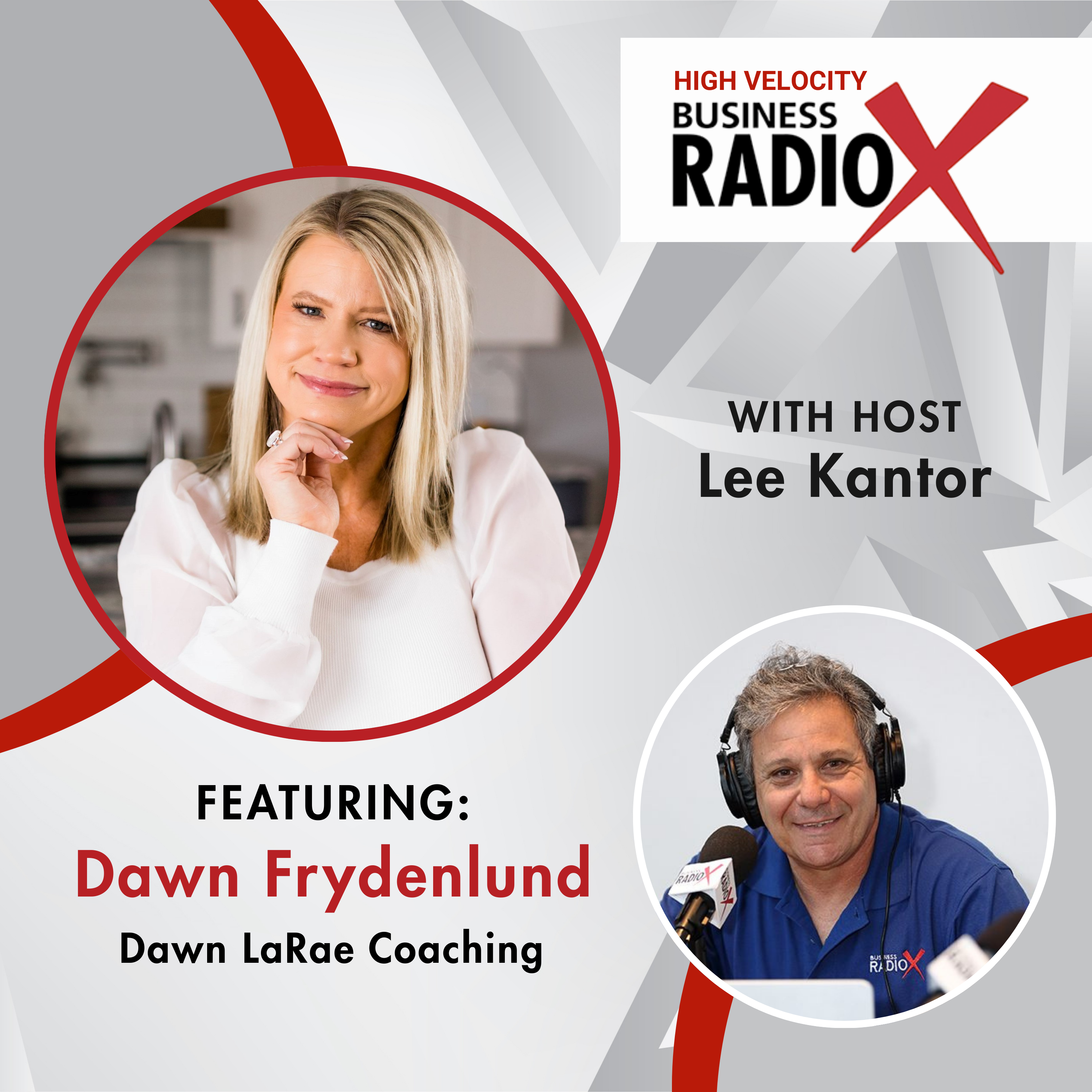

In this episode of High Velocity Radio, Lee interviews Dawn Frydenlund , CEO of Dawn LaRae Coaching, who specializes in guiding midlife women through career transitions. Dawn shares her own journey of two major career changes, explains the signs of career misalignment, and highlights the importance of mindset and support. She discusses her coaching approach, including the “mindset power pivot,” and announces an upcoming group program. Dawn also shares a client success story, emphasizing the value of self-belief and aligning work with personal strengths and values.

 Dawn Frydenlund, CEO of Dawn LaRae Coaching, LLC, is a dynamic leader and coach who has successfully navigated two major midlife career transitions—first as a CPA and auditor, then as Director of Patient Experience in healthcare. With over 20 years of leadership experience at Mayo Clinic, Dawn understands firsthand the challenges and opportunities that come with redefining one’s professional path.
Now, as a coach for midlife women and an inspirational speaker, she empowers women professionals to embrace change, rediscover their strengths, and step into new seasons of purpose with clarity and confidence.
She is a Certified Professional Coach (CPC) and Energy Leadership Index Master Practitioner (ELI-MP) through the ICF-accredited iPEC program. She is also certified in Emotional Intelligence (EQ-i) and holds a Master’s degree in Organizational Leadership from Saint Mary’s University.
Her mission is to guide women through transition with practical strategies, deep self-awareness, and unwavering encouragement—helping them transform midlife into a season of empowerment and growth.
Connect with Dawn on LinkedIn, Facebook and Instagram.
What You’ll Learn In This Episode
- Most common obstacles holding midlife women back from their dream careers
- Mindset strategies that can make the most impact for women wanting to make a career change
- Your Career Clarity and Confidence Program
 This transcript is machine transcribed by Sonix.
TRANSCRIPT
Intro: Broadcasting live from the Business RadioX studios in Atlanta, Georgia. It’s time for High Velocity Radio.
Lee Kantor: Lee Kantor here another episode of High Velocity Radio, and this is going to be a good one. Today on the show we have Dawn Frydenlund. She is the CEO with Dawn LaRae Coaching. Welcome.
Dawn Frydenlund: Hello, Lee. Thanks for having me.
Lee Kantor: Well, I am so excited to learn what you’re up to. Before we get too far into things, let us know about Dawn LaRae Coaching. How are you serving folks?
Dawn Frydenlund: So Lee, I am entirely focused on midlife women and really, the midlife women that I’m working with are women who they found themselves a bit at a career crossroads, so they are not feeling like they are authentically themselves in their jobs, in their careers, and it’s just starting to come up for them in midlife. So what we’re finding is a lot of women have spent the first part of their careers really growing in their careers, moving up the ladder, accomplishing, etc. and then we hit this point in midlife and there’s this natural evolution for us to then step back and look and think about, how do I want to live the rest of my years in my career? And they want to be a little more intentional, and they want to be more authentic. And so I’ve built a program and I can talk about that whenever you’d like, but I built a program which really helps them step back to the beginning to make sure that as we move through, we’re getting them to a place where they feel like they’re stepping into careers that really were meant to them, for them.
Lee Kantor: Now, are there kind of some symptoms or signals or triggers that are clues that, hey, maybe I am at this point of transition, are there things happening that they can say, you know what? That’s that’s happening to me. Maybe I should contact Don.
Dawn Frydenlund: Yeah. I think it’s really always just following what is happening intuitively within us. And, you know, sadly, as midlife women, we have this tendency to not put ourselves first. And so what I like to say, for women that are feeling an inkling and feeling this pull for something more, that there is something there and they deserve to at least explore it so that they can get to the end of their career and look back and say, you know what? I was exactly where I was meant to be. And I used my strengths, my values, and my passion to really do good in this world and in the work that I was doing.
Lee Kantor: So, I mean, are most people kind of that intuitive or are they just kind of going through life? And then something big happens. They’re like, oh, I should have been paying more attention to that.
Dawn Frydenlund: I love that question because I think we do have it within us. And as we get older, I feel like we are tapping more and more into that intuition. And so it is really an honor when I step into these conversations with these women that have been brave enough just to make the phone call to say, hey, Don, I just want to talk about this because they’re listening. And so, you know, I can say there there are a lot of signs. Lee. I mean, it can be signs. Just feeling completely burnt out in the burnout isn’t necessarily a I’m working a lot of hours, but the burnout is more around. This isn’t aligning for me. And so some of the alignment issues that we talk a lot about are our strengths maybe aren’t being leveraged where we’re at, or our values are no longer a match. And this one is really more powerful than I think people realize when they are working in an organization, and maybe at one point in time their values did align, but then suddenly they’re realizing they’re not. And this can cause like this really? Um, I want to say a deep pain like, within us because we may be asked to perform or act in ways that just don’t align with who we are and what we believe in.
Dawn Frydenlund: And those are our values and our values. I, I believe they’re, they’re they’re like a glimpse into who we are. They’re a glimpse into our soul. They’re everything we stand for. So what happens, sadly, is these women will come to me and we’ll explore this. And rather than seeing this as a mismatch in values, what they’ll see it as, is something wrong with them. And so we really have to work through that separation so that they know this isn’t not necessarily this isn’t them having the wrong values. It’s just not a match where they’re at. So there is this emotional toll. And I think that is one thing that’s really important for women to look at and not ignore. Um, but it can also stem into physical signs within their bodies where they’re not sleeping, where they’re feeling tension, they’re having stomach issues, etc.. And then I think the other thing I really like women to think about and look at is relationship issues. Are they struggling in their relationships because the strain of the work they’re in is really taking its toll on them, and they can’t be present. They can’t be their best selves with the people they care about the most.
Lee Kantor: Now, how did you land on this niche with was this kind of, uh, what do you mind sharing a little of your backstory, how we got here?
Dawn Frydenlund: Sure. I was going to say how I landed here is because this is me. Um, and it’s, you know, it’s a bit of a funny story in hindsight, some of it with some hardships in between, that those hardships are really what push me forward into making my own midlife career changes. So I’ve made two pretty significant changes in midlife. Um, one was at 43 and one was at 54. So I actually started my career as an auditor, a CPA, and I worked at this big fancy firm. And you know how I got there? It’s probably a good question. I think when I was young, I grew up in a small town. I was first in my family to go to college, so I had really humble beginnings, and I just wanted to do something that would make my family proud. And I wanted financial stability. I wanted to be in a better position than my parents were, and I was good at math. I was good at accounting. And so I thought, well, that’s what I’ll do. And then what happened? And I hear this from a lot of women that are of the Gen X age, is we get into these spaces, these professional work places. We’re working hard, we’re moving up and we’re raising the family and we’re managing the household, and we’re doing it all.
Dawn Frydenlund: And we don’t know how to stop and look to think about whether or not this is we’re meant to where we’re meant to be because we are there, um, really just doing the best we can. And we don’t want to let anybody down because that’s kind of in our DNA, too. We like to put everybody else first. So for me, I stuck it out for 20 years, and I really spent most of those 20 years looking, reading books, taking assessments and just always feeling like this isn’t it, this isn’t it. But I couldn’t leave. I felt like I needed to stay there for financial reasons. Um, but the reality was I was not in any way, shape or form connected to the strengths that made me. Me and my strengths really are more around people relationships. Um, I often get called the cheerleader, you know, so I have this optimism. I’m very future focused, and I’m an innovator. And so I have all this energy. And so this is me and I’m working as a CPA auditor, and it’s just not a match. So I’m not matched in my strengths. And in fact the strengths I bring to the table, they’re not even valued. So I ignored the signs for, like I said, 20 plus years. And then when I was in my very late 30s, um, my daughter, she was ten years old, I was an audit manager at a large healthcare facility, and she was diagnosed with cancer.
Dawn Frydenlund: And she is now nearly 20. But, you know, those are those moments in your life where everything can change. And it did for me. Um, it reminded me how short life is. It reminded me that I want to live in integrity with who I am, and that includes in my career, because I want to make a difference in my career as well. And so as I’m living in the health care system with her and, you know, recognize them also an employee there. Um, but I’m not working. I have a year off with her taking care of her. And I cannot believe all of the patient stories I heard and I saw and I could see these unmet needs that patients had for more human connection, for better systems. And it was almost like I couldn’t not see it. And I saw within myself that I had a lens that not everybody had. And there was something in that experience that caused me to shift and say, I want to use the gift that I have, the gifts that I have in my career. And so when I came back a year later after caring for her, I was like, I can’t.
Dawn Frydenlund: I can’t stay in this position as an auditor. Like there is no interest that I have in being here. And so I got a coach, and this coach really helped me get honest with what I already knew about myself. And we explore different careers. And so for me, I ended up going back to get a master’s degree. And then somehow the universe stepped in and there was an opportunity as a director of patient experience in my organization. So this was my first big career shift from auditor CPA to director of patient experience. And honestly, everything aligned. My strengths, my values, my passion. I was just like I was on a high. I didn’t know you could work in a job and be so connected to it and to see your natural skills come through. And so I was there for ten years. And then what started happening is for me, I started seeing organizational and cultural changes. And there was a growing disconnection between my values and their values. And that’s why I’ve built values into my program, because it is such an important part of knowing if you’re in the right career and with the right organization. Sadly, I did ignore those signs for quite a few years because there is that Gen X part of me that that part where we don’t quit.
Dawn Frydenlund: Um, we can be pretty stubborn. And I also just rationalized my own needs. But then part of me recognized that if I stayed on this path, I would continue to become someone that I was not. In in the the balance in all of this was knowing that I had already learned this lesson. I had already learned this lesson, that it is critical to be aligned with who you are. So I made the decision. And then at 54 years old, I made the change to step into this role as a CEO and career coach for other women. And so for me, this feels like home. Like when I say home, I mean home, home, home. I’m aligned with my values. I’m aligned with my strengths. I’m aligned with my passions. And I could use everything I learned in my coach training to help me make these transitions and to keep really my mindset as strong as it could be to get through the shift of working as a corporate employee to working as an entrepreneur. And so what I did is I took everything that I learned through my experiences over the years, and what I believe is truly critical in knowing before making a big career change. And I built that into the program to really help other women do the same thing.
Lee Kantor: I think you bring up an important point here. Sometimes you need help and sometimes you need a helper. Um, you know, everybody’s bombarded with so much information, they think that they can just power through things on their own because there’s just so much information overload. But sometimes you need another human being by your side to help guide you.
Dawn Frydenlund: I agree with that. Um.
Dawn Frydenlund: And I especially feel that way for midlife women because, you know, sadly, over the years, I feel like we’ve lost a little bit of track of who we really are. And, you know, philosophically, I have a couple beliefs around this, and one of it is just who we’ve been trained to be in our lives. We really for most of us, we’ve been trained to put everyone else first. You know, our families and we come second. We’re the helpers, we’re the supporters, and we sacrifice for everyone else. But the other reason that has become a little more clear to me is most of us were entering into the workforce during a time when it was really still pretty male dominated. And so when we stepped into that, we had to put on our own mask, so to speak. Maybe, um, how do I want to say this limit a little bit of the real authentic person? We were kind of tame it down in order to fit in and move up in this workplace that had already been established and structured by men. And so I think through all of that, that we’ve lost sight of who we really are. We’re trying to fit in to everything that’s around us and put everyone else first. And so it is pretty surprising to me sometimes when we sit down and we start going through their strengths, their values and their passion, and we do assessments and we have exercises and we really dig into this and how they feel about themselves after we’ve went through all of those. And this is 1 to 2 months we’re working on this because they suddenly look at themselves as a valuable, um, professional again. And they they see their real self and they’re excited about that real person that’s in front of them in the strengths that they bring, which may not align with the strengths that everybody else wants them to have. But it’s who they are. It’s what they are. And knowing that and owning that builds them up in a way that has been much more powerful than I anticipated.
Lee Kantor: Now, is there a story you can share about maybe somebody you worked with? You don’t have to name their name, but maybe share the challenge that they had or the struggle they were going through when they came to you, and how you were able to help them get to a new level.
Dawn Frydenlund: Yeah, I would.
Dawn Frydenlund: Say, um, one of the women I work with, um, she came to me working in a position. She went into nonprofit. She had left a great corporate position and thought, I’m going to go into nonprofit. I want something with more meaning and purpose. Sadly, though, the position she stepped into was really meant for more than one person to, um, manage. The pressures were high, the expectations around, um. Uh, I think I would say effort, um, was really much more than one person could navigate. And at the same time her up line was not feeding her any, you know, positive reinforcement about the work and the impact she was making. And so when she came to me, she felt pretty defeated. Um, she felt like she, um, it was her that there was weaknesses that she had, um, that, you know, it was that it was more her than it was the position that had been created that really would be difficult for anybody to step into. And oddly enough, um, the predecessors before her did not last long in those positions either. So, anyway, um, we step into these conversations, we start digging into our strengths and our values and our passions. And what she’s starting to realize is that this isn’t her.
Dawn Frydenlund: This is a mismatch. What they’re looking for in terms of productivity and numbers is not something that matches with the kind of person that she wants to be in the job. And so the best part of the story is she decided to start interviewing for some different positions outside of the nonprofit world, which she wasn’t sure she’d want. And she went in to interview, and it was a HR position, and the owner of the company interviewed her, and they were 15 minutes in and the owner said, why are you not applying for the director position? And she was like, well, I don’t know. She had undervalued herself. She then the interview switched over to the director position, which was several steps up from the position she was interviewing for. And lo and behold, she got it. She’s been in that position for about a year now, and she she is successful in the position. She is passionate about the work. She is challenged in a way that feels good because it it has been aligning with her strengths and her values. So that’s one of my one of my favorite stories.
Lee Kantor: Yeah. That’s so important to really, um, help people aim a little higher. A lot of times, people just aren’t aiming high enough.
Dawn Frydenlund: Exactly.
Dawn Frydenlund: And it’s one of the reasons why we step into a lot of mindset work, um, in my program. Because, you know, sadly, women are coming in and they’re, you know, they they’re fearful. They’re, um, they don’t believe in themselves enough, um, to make a career change, to take a step up. And so the work we do around mindset is critical. And again, this is a big part of the program. It’s, um, 1 to 2 months. We’re just working on mindset before we even talking about exploring different careers. We have to spend time in the mindset now.
Lee Kantor: Is there any advice you can share or tips or strategies that a person listening right now could, uh, start working on when it comes to mindset, some mindset strategies maybe that help folks just kind of get some relief of the suffering and maybe can move their themselves forward a little bit.
Dawn Frydenlund: Well, I’ll tell you one that really sounds simple. Application is a little more complicated, but it’s easy to write down and then go back to. And it’s I call it the mindset power Pivot because it is so powerful. And the premise of it, it’s based on a cognitive model and psychology actually. And the premise of it is that our thoughts and beliefs drive our emotions, which drive our actions, which ultimately drives the outcomes in our life. So sounds very simple, right? But the key around all of this is our thoughts. It all starts with our thinking. And so if our thinking is I’m not good enough, I. I could never make a leap like this. What will other people think? Who am I at this age to make a change like this? If our thoughts are sitting in a space that are not going to support us to move forward, we will not move forward. And so as soon as we can grab, hold and take control of our thoughts, then we are going to have an emotional reaction to those thoughts which will then drive our actions. And so one of the things that I will sometimes talk with women about is thinking about what would be like. They come to me, they’re feeling really down. We think about what would be a powerful thought if I pathetically, I could have a powerful thought, or what would another person in this position who felt powerful? What would they be thinking? And we explore that and we try it on for size. And then we start exploring what emotions come up for them when they think about that thought. And then we can move into actions. And so these are all things I practice it myself honestly, because in the days where I’m not in my highest mindset or my highest energy level, I also will go through this process and think through it myself as well.
Lee Kantor: Now is there um, the way that you work with your clients, are you helping kind of build a community amongst the clients as well, or is this kind of primarily coaching, coaching them individually or in a group setting?
Dawn Frydenlund: Um, so what I’ve done up till now has been individual, but I’ve had a few women say that they believe they could find value in working and supporting each other in a group. So I have developed a group program. We’re looking at launching it in 2026, and it will really include all of the components of my current program, but we will work through it together. And so it’ll be starting with identifying, I like to call it the The Journey of Rediscovery. So getting back to what are your strengths? What are your values? What are you passionate about? What lights you up? And then we move into the mindset work. And I actually in that space I use a an assessment called the Energy Leadership Index. And this came from my coaching program, Institute of Professional Excellence and Coaching. And it is it is actually Forbes has ranked it as one of the top 11 leadership assessments. And it’s really powerful. And so we take them through that because it taps into mindset and it taps into really that mental energy. And if they can place themselves in certain energy levels, it will help propel them forward. So that is a next component of it. And then we move into the, the the excuse me, the exploring that exploration stage of what could be and several exercises. Um, we do and probably the most powerful one is our visioning exercise. And then finally we move into Actioning. So we create a mid-life career action plan. We develop accountability metrics. And so I have that in my one on one program. And it is also going to be in my group program in 2026.
Lee Kantor: So if somebody wants to learn more about any upcoming events or get on a wait list for this program or just contact you about coaching, is there a website or is there a best way to connect?
Dawn Frydenlund: Yeah. So I would say my website or my LinkedIn, um, my website is w w w Coaching.com and then LinkedIn is Don Freeland.
Lee Kantor: And Don Laray coaching is d a w l a r e.com.
Dawn Frydenlund: Yeah. Yes it is.
Lee Kantor: Well, Don, thank you so much for sharing your story today. You’re doing such important work and we appreciate you.
Dawn Frydenlund: Oh thank you Lee, again thanks for having me. And thank you for highlighting all these wonderful entrepreneurs out here. We’re really trying to do good work in the world.
Lee Kantor: Absolutely. It’s my pleasure. All right. This is Lee Kantor. We’ll see you all next time on High Velocity Radio.














