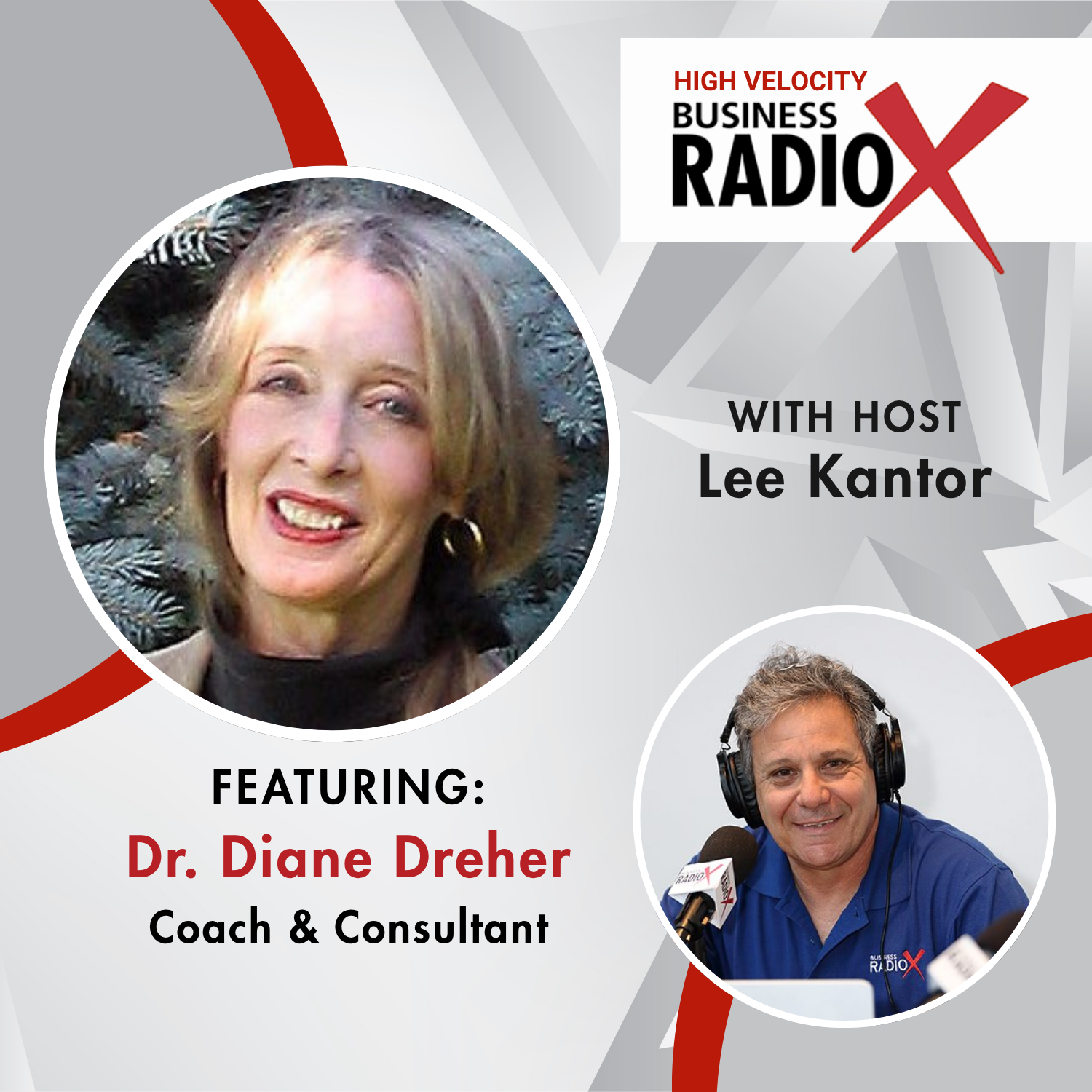

Diane Dreher, PhD, PCC, is a positive psychology coach, professor of Diane Dreher Coaching & Consulting, LLC and author of The Tao of Inner Peace, The Tao of Personal Leadership, The Tao of Womanhood, Inner Gardening, and Your Personal Renaissance.
A graduate of the University of California, Riverside, she has a PhD in Renaissance English literature from UCLA, a Master’s degree in counseling from Santa Clara University, and PCC certification from the International Coaching Federation.
She is a regular blogger for PsychologyToday.com, professor emeritus and associate director of the Applied Spirituality Institute at Santa Clara University and senior research advisor/lecturer for the Positive Psychology Guild in the United Kingdom.
Connect with Diane on LinkedIn and Facebook.
What You’ll Learn In This Episode
- About Diane Dreher Coaching & Consulting, LLC
- Her mission
 This transcript is machine transcribed by Sonix.
TRANSCRIPT
Intro: Broadcasting live from the Business RadioX studios in Atlanta, Georgia. It’s time for High Velocity Radio.
Lee Kantor: Lee Kantor here. Another episode of High Velocity Radio, and this is going to be a good one. Today on the show we have Doctor Diane Dreyer and she is with Diane Dreher Coaching and Consulting. Welcome.
Dr Diane Dreher: Thank you Lee.
Lee Kantor: I am so excited to learn what you’re up to. Tell us about your practice. How you serving folks?
Dr Diane Dreher: Oh my gosh, I do lots of things these days. I guess we all need to. I’m a positive psychology coach, researcher, and author. I do individual coaching and workshops. I give I do research on hope. I write books and articles to help people discover their strengths and move forward in life with greater direction, joy and hope.
Lee Kantor: Now, for folks who aren’t familiar, do you mind sharing a little bit about positive psychology. Um, what are kind of the the principles behind that and what attracted you to it?
Dr Diane Dreher: Oh, yeah. Okay. Well, about around the year 2000, a group of psychologists, including Martin Seligman, who had been elected to the presidency of the Association of Psychology AA, decided that psychologists had been looking at dysfunction. They’d been studying depression, attention deficit disorder, anxiety, mood swings, all the problems that people have, and they hadn’t really studied what helps people flourish. You know, they’d been looking at the dark side of human nature, which is there, but they hadn’t really focused on the bright side. So since then, there have been lots of studies of what helps people flourish positive emotions, obviously. Goals. Hope. Relationships. In fact, Martin Seligman has an acronym Perma, which is Positive Emotions. You know, a sense of engagement, relationships, positive relationships, meaning, and a sense of achievement or accomplishment. And that positive psychologists have been branching out, but they realize that we need to have the light in our lives. You know, we need to have something to look forward to. So that’s what’s been happening in the field of psychology. Positive psychology.
Lee Kantor: So how did your career path lead you to that? Did you sample the other kind of types of psychology to pursue? And then you landed on this one like because it resonated. Like what? How did you get here from there?
Dr Diane Dreher: Oh, wow. That’s a great question. My background I’m now a professor emeritus of English and associate director of the Applied Spirituality Institute at Santa Clara University. And I’m a senior research associate in the Positive Psychology Guild in the UK. But to get there, I started out majoring in English because I found a lot of inspiration reading Renaissance literature when people were discovering themselves in the world on a new level. So I got a I went to UC University of California, Riverside for my bachelor’s degree, UCLA for my master’s, and PhD in English Renaissance Literature. And for years I taught Renaissance literature and creative writing at Santa Clara University. But my students kept coming to me asking for advice. And I felt like, okay, I need to know more. So I went back to school at night while I was teaching during the day, earned a master’s degree in counseling from Santa Clara University and got really excited about, again, health psychology, positive psychology, and how I could help my students really discover the power within them to go out and make a difference. I also got a coaching credential from Mentor coach. I’m now a professional certified coach with the International Coaching Federation, and I use positive psychology techniques in my coaching. I ask all of my clients to take a short survey to discover their strengths, to set goals, to develop a sense of agency and possibility, and to really move forward with positive energy, which we need a lot more these days.
Lee Kantor: Now, um, I’m a big believer in focusing on strengths. Um, but there’s another side of the coin where they say that it’s important to work on your weaknesses. What do you say to that?
Dr Diane Dreher: Oh my gosh. Um, there, you know, obviously we need to be aware of our strengths and our weaknesses. Like, for example, if a person really wants to be a professional basketball player, but is about five foot three. That may not work okay, because, you know, I went to UCLA when Kareem Abdul Jabbar was there as Lew Alcindor. Standing in front of me in the lunch line. And I looked up at him and thought, oh, wow. We have certain innate tendencies and and, you know, strengths, physical strains, intellectual strength, artistic strengths. Uh, and we need to be aware of those and also be realistic about what’s possible for us. But if we spend too much time focusing on our weaknesses, uh, we don’t see the possibilities in front of us. There’s a a philosophy in business, uh, consulting called appreciative inquiry, where people go. I did this one time, uh, with a group going through transitions, trying to figure out what to do next. If they look at what didn’t work, they can’t really begin to think about what could work. So Appreciative Inquiry takes people through, uh, you know, inquiry, looking at what worked in the past. When in your company, did you feel a real sense of joy, energy and purpose? And, you know, success, a sense of camaraderie, what was going on, what was a bright spot, and collect all these insights from people and then use those to help them plot their way to a more possible future. And then along the way, with appreciative inquiry, the, uh, the problems, the weaknesses get taken care of because they’re they’re moving through, a plan that really moves them toward achieving their strengths. Does that make sense?
Lee Kantor: Yeah, absolutely. I’m with you on that. I think more time spent making your strengths stronger is a better use of your time.
Dr Diane Dreher: Yeah. And there’s research that shows that. Absolutely.
Lee Kantor: Now in your work with your coaching and consulting, is that primarily with individuals or do you work with companies as well?
Dr Diane Dreher: I mainly work with individuals one on one, but I do, uh, give kind of presentations and workshops to groups. I did a recent presentation on hope for relay for life in my community, which is a group of cancer survivors. And so there was a group, and it was fun to to sort of, uh, give a presentation on hope and have people set goals and respond and all that. So I like to work with groups. I guess it comes from my many years as a college professor. I like to work with a group of people and bring out what we collectively can come up with together.
Lee Kantor: Now, when you’re working with your coaching clients, what is kind of the the challenges that they’re struggling with where they’re like, I better call Doctor Diane because I need some help here. I’m I’m frustrated. I’m not getting to where I want to go.
Dr Diane Dreher: Mm. Good question. Um, people come to coaching and my coaching clients reflect this when they’re at a transition point in their lives, when they. I have a lot of people who have, uh, recently graduated from college, and then they’re trying to find their first job. And this is a transition point or, uh, sadly, uh, a number of people who are currently unemployed and figuring out what do I do next? Or a person who, uh, was trying to finish writing her dissertation, and she’d never done that before. So I was her dissertation coach, and we had a big celebration after she finished and became a doctor. You know, uh, client name. So, um, when when people are. Yeah. Well, they’re wrestling with a new challenge and they don’t really know where to go, and there’s there are no roadmaps. So collectively in a coaching partnership, we create the steps and we discover the path together.
Lee Kantor: Now, how do you discern when a person should go down a path for coaching versus going down a path with like some psychologist or somebody, um, in that, in that, um, kind of field?
Dr Diane Dreher: Oh, yeah. Very good question. Um, the International Coaching Federation says that coaching clients are creative, resourceful and whole. There are people who, uh, are functioning, You know, they may be frustrated and confused, but they don’t have a major psychological dysfunction that they’re wrestling with. If, uh, and I’ve had to do this, actually, if I have a person who comes to me as a client, we have an intake interview and seems to be chronically depressed or have a bipolar, you know, dramatic ups and downs. I’ll refer that person to a therapist.
Lee Kantor: Now, when you’re working, when you’re working with your clients, are you sometimes their first coach they ever had, or is coaching now so ubiquitous that people are having it earlier and earlier?
Dr Diane Dreher: I’m usually their first coach. There are a lot of people who get referred to me through the alumni office at a number of universities. And so I’m their first coach. Or they get referred to me by mentor coach where I did my training.
Lee Kantor: Now, what are kind of some of the do’s and don’ts when starting with a coach for the first time? How do you prepare them to get the most out of that interaction?
Dr Diane Dreher: Okay, well, I have an intake interview. I ask them what their what they want to get out of coaching, what their goals are. But first of all, I assure them that everything we we say, uh, either in person, you know, zoom whatever is confidential. Because without trust, there can be no, uh, no coaching. I mean, it has to be just as as, uh, as meeting with a therapist is confidential. So also meeting with the coaches confidential. And I ask them for permission to coach them at that point, because that’s something I have to do. Uh, in terms of my coaching, uh, background. And then we talk about, you know, what they want, what they’re looking for, what their goals are, what’s been stopping them. And I very often take them on a visualization, having them tell me visualize where they are now, and then going up in a helicopter and looking at where they’d like to be, and describe that in as much detail as possible. Because I’m a firm believer in the the power of positive visualization and also actually putting it into words, expressing what it is they want. And how does that feel? And then we look at the distance between where they are now and where they’d like to be, and the steps they need to take to get there and any roadblocks that might come up. And then coaching is a partnership. So I work with them on their timeline. We meet as often as they would choose, and we check in about the action items that they choose for themselves at the end of each session, and then at the beginning of the next session, they give me a progress report and we move forward.
Lee Kantor: Now, do you think that this type of support and accountability, this, you know, hearing people and listening to what their challenges are, that this type of interaction, this coaching dynamic is something that more and more people should at least try, especially in today’s uncertain world that we live in. There’s so much chaos. It seems that people do need kind of fresh eyes on things.
Dr Diane Dreher: Yeah, I feel like we need, uh, we need partners, we need mentors. We need, uh, people that can, you know, have our back, listen to us, give us unconditional positive regard, as Carl Rogers would say, and believe in our possibilities. Because, uh, as you just pointed out, our world is very confusing, very challenging, and it’s very easy to lose hope.
Lee Kantor: So what do you say to the people that are kind of at that point where they’re losing hope?
Dr Diane Dreher: Oh, well, um, I actually have done research on hope, uh, which has three strategic steps. So I tell them what those steps are. My colleague Dave Feldman, who’s a clinical psychologist, and I published a research study on Hope in 2012 which took the the psychological definition of hope, which is positive attitude and positive action. And there are three steps in hope theory goals, pathways which are steps to the goal and then a sense of agency or motivation. And we took a group, groups of students through these three steps had them write down their goal, had them write down three steps to their goal. And, uh, an obstacle that might come up for each step, and then an alternative that they could take for each step. And then we led them through, uh, some encouraging, uh, possibilities. How could they build their motivation? How can they confront some something called the inner Critic that visits a lot of us when we’re doing something we don’t really know how to do and we haven’t done before? Okay. And tell ourselves. Yeah, but the last time I did something, you know, look at your past achievements, I did it. Then I can do this now. Give yourself positive self-talk. Um, have little affirmations that you can put by by your desk or up on the, uh, your mirror in the bathroom.
Dr Diane Dreher: Have have a friend that you can share goals with, you know, build and and take care of yourself. Get enough sleep, enough good food, enough exercise to keep your energy up. What can you do? Goals. Pathways. Agency. So we took our participants through this. Had them visualize themselves with their goal after they’d written down all the steps and taking each step, meeting each obstacle, overcoming each obstacle, building a sense of momentum and visualizing themselves reaching their goal. Hey, terrific. We got significant results in goal, achievement and hope. And, uh, our article was published in a positive psychology journal and has had over 500, uh, acknowledgments included in other studies throughout the world, because these three steps really work. So I, I tell my my clients, this is hope. Really these steps work. We can all do these things. They’re simple and but to focus on positive attitude and positive action and to take these actions can really make a difference. So I have my clients set goals steps, and if they try something and it doesn’t work okay, what else can they do? And you just keep moving forward because it’s too easy in this world to get distracted, depressed and just give up.
Lee Kantor: Yeah, I was when I was younger, I, I read a book called Hope is Not a Strategy, but it sounds like you figured out a strategy for hope.
Dr Diane Dreher: Yeah. Um, the concept of active hope was developed by C.R. Snyder, a psychologist at the University of Kansas, which has these three component parts goals, pathways, and agency. And Snyder was the dissertation advisor for my friend Dave Feldman. Apparently, Dave told me that Rick Snyder used to go around and ask all these successful people what what they did to get to where they were and, you know, leading a successful life and all these different fields. And they all had these three components. They had set a goal. They had, you know, developed steps to reach the goal. And they did things that that built their sense of motivation or agency. So he had these three components describe them, developed a hope scale that you can take to see how high your hope is. And what Dave and I did was we applied Rick Snyder’s definition to active steps which help people build hope.
Lee Kantor: It’s so funny that people, a lot of people, have all this negative self-talk within them. The first move is something negative usually, and then there’s so much value to having this positive self-talk and reminders of all the positive things you’ve done and all the accomplishments that you’ve made in your career or life, and that all the hard things you’ve done and people just either they forget it or take those for granted and they dwell on the negative.
Dr Diane Dreher: Yeah, we have psychologists who pointed this out. We have a negativity bias all human beings do. Because when we lived in, uh, you know, the jungle, as it were, uh, and you heard some strange noise, you’d have to expect the worst. Instead of having a sense of curiosity and saying, oh, what is that? You know, because it could be a snake that could bite you and, you know, be rattlesnake. That would be pretty fatal. Um, so it’s a survival tactic. You know, there’s there’s a part of us that that looks for threats and that scans for threats, and that can save our lives in an emergency. But if we let it become a constant in our in our way of looking at life, then we don’t see the possibilities. You know, we need to be able to open ourselves up at the appropriate time, which is most of the time we’re not in a survival mode. But, you know, our negativity bias puts us there unless we have something that we can do, like building active hope to counteract that.
Lee Kantor: Or having conversations with people like you.
Dr Diane Dreher: Yeah, or people like you. Yeah. In fact, one of the ways of building motivation is to hang out with positive people, be each other’s cheerleaders, as it were. My friends and I got through grad school at UCLA by doing that. Uh, when I first got to UCLA, I graduated from Riverside in June, and in late August, I moved to LA to begin graduate school in the PhD program. And I was a first generation college student I had. Nobody in my family had had, uh, you know, gone to college and, uh, let alone in a PhD program. So I was visited by the inner critic which said, who do you think you are? You can’t do this. And furthermore, at orientation, most of the other grad students in my class already had master’s degrees. So I thought, oh, gosh, this is this is challenging. And then we had a test in one of our classes and I thought, okay, what can I do about this? So I invited all my, uh, accomplished colleagues with master’s degrees to my apartment for a study session and said, I’ll bring pizza. You know, come over, let’s my place. Let’s all study together. I figured I could use this session to, uh, pick the brains of my smart friends so I could survive the exam. Well, what happened was we all helped each other, and we became a very close set of friends. And we went through grad school meeting, celebrating, sharing our our wins, sharing our struggles, and that that sense of community was such a positive aspect of grad school. And it happened because that was that was my strategy to pass this one test, because I figured they all knew more than I did.
Lee Kantor: It sounds like a variation of Benjamin Franklin’s, uh, strategy of, um, asking for a favor in order to make a friend.
Dr Diane Dreher: Yeah. Yeah. Um, in fact, one of the one of the things I also believe we need more of is a sense of community and companionship, a sense of support, which since Covid, uh, really eliminated a lot of our neighborhoods. I don’t know about where you live, but a lot of places that I used to go, the coffee shop. I used to have lunch with my friend Tina is closed. The local pharmacy has closed. Uh, a lot of restaurants closed because during Covid, people didn’t go anywhere. They just stayed home and had things delivered. And understandably, because, you know, there was a threat to, uh, their lives. But now, uh, a lot of what is what was familiar to us has gone away. And we have to rebuild community. And if a person is moving to a new town or a new place or a new job, that person community doesn’t just happen. We have to build it. And that’s part of what it takes to be a whole, you know, flourishing human being is to have a sense of community.
Lee Kantor: Yeah, I think that there and people have to relearn how to be part of a community, too. It’s it’s different than an online community. An in-person community is a living, breathing thing. It’s it’s different.
Dr Diane Dreher: Yeah, absolutely. Late. And again, there’s really interesting research by a psychologist named Barbara Fredrickson who talks about the importance of cultivating community, even what she calls micro-moments of connectivity, which, uh, was, you know, waving at a neighbor, uh, exchanging a kind word with somebody that you meet at the grocery store or whatever. She’s found that these little split second probably, you know, small connections can strengthen the immune system and lower the sense of inflammation in both people, you know? So, uh, I read Barbara Fredrickson, and I’d be walking around the neighborhood with my dog waving at neighbors.
Lee Kantor: Yeah. Having a dog is a great way to do that. That’s a an easy way to, uh, get yourself out of the house and interacting with folks.
Dr Diane Dreher: Yeah. And just, uh, I. Frederickson has also found that if enough of us do that, there’s a kind of a ripple effect that can bring a sense of connection and positivity to an entire community. So I wave at my neighbors thinking, hi, it’s good for me, it’s good for you. It’s good for all of us.
Lee Kantor: Yeah. You’re improving the the value of your neighborhood. Yeah.
Dr Diane Dreher: With just a simple gesture. Right. I mean, it’s not really altruistic because it benefits us, too. So it’s a win win.
Lee Kantor: So if somebody wants to learn more about your practice or connect with you, what is the website? What’s the best way to learn more? And we didn’t even get time to talk about all your books, but I’m sure on your website is information about those as well.
Dr Diane Dreher: Sure. My website is comm, which is d I e d r e h e uh. And it has my books. It has As meditations. My blog. Uh, positive insights about what we can all do to, uh, to help make our our lives more positive, to help us achieve our goals, to help us discover the power within us and around us to flourish.
Lee Kantor: Well, Diane, thank you so much for sharing your story today. You’re doing such important work and we appreciate you.
Dr Diane Dreher: Thank you, Lee, and I appreciate being on this wonderful program, and I’m very happy for all the positivity that you spread out there to everyone who’s listening.
Lee Kantor: All right. It’s been a joy. Uh, this is Lee Kantor. We will see you all next time on High Velocity Radio.














