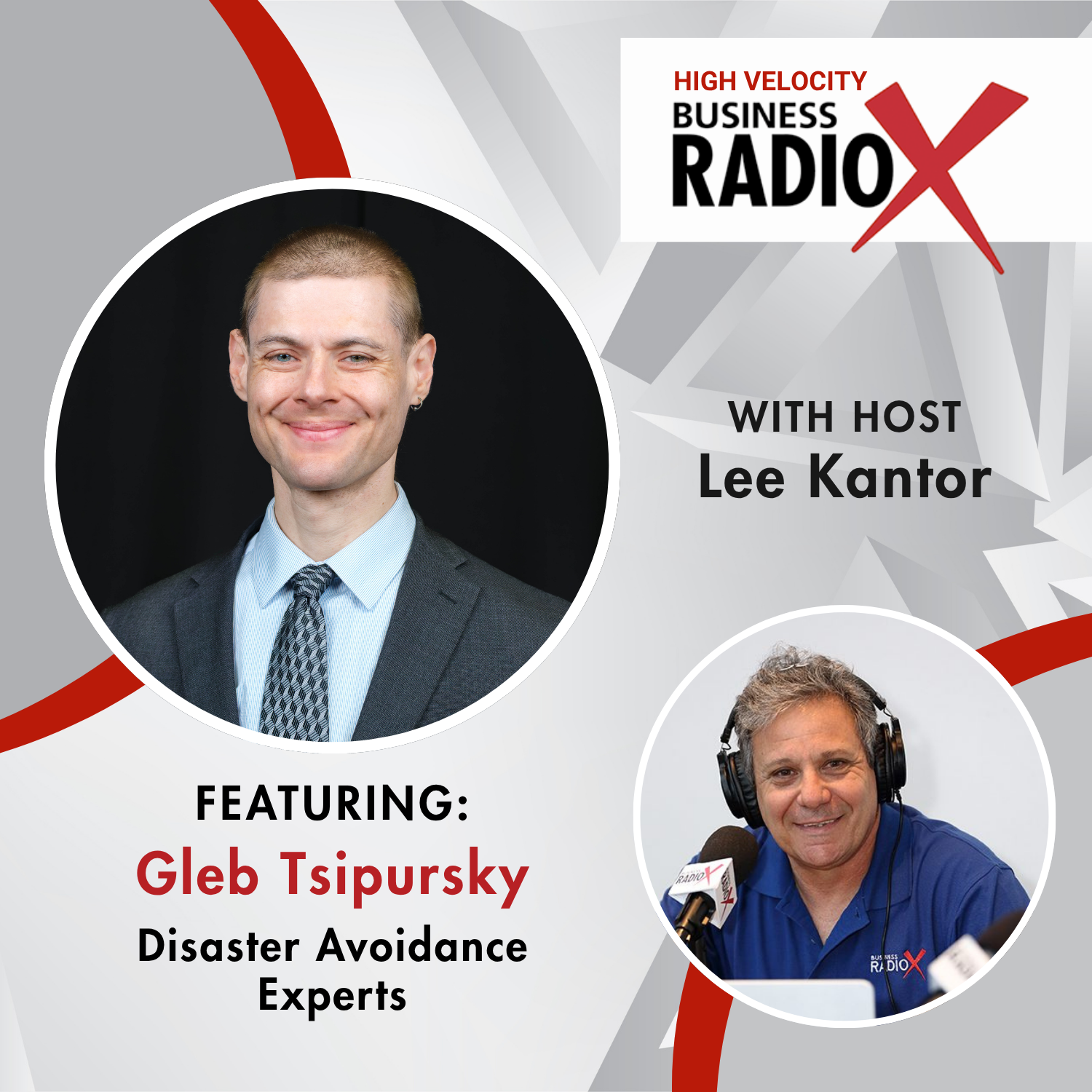

In this episode of High Velocity Radio, Lee Kantor interviews Gleb Tsipursky, CEO of Disaster Avoidance Experts, about helping business leaders make better decisions and avoid costly mistakes amid rapid technological change. Gleb shares why traditional technology adoption strategies often fail with AI and explains how organizations can overcome employee resistance by taking a people-centered, bottom-up approach. He discusses the importance of empowering employees to identify AI opportunities within their own workflows, addressing job security concerns, and using AI to improve productivity and drive business growth. He also shares a real-world example of how customizing AI tools around employees’ needs can lead to greater adoption and meaningful results.
 Dr. Gleb Tsipursky, a behavioral scientist called the “Office Whisperer” by The New York Times, helps tech-forward leaders stop overpaying for AI while boosting engagement and innovation.
He serves as the CEO of the AI consultancy Disaster Avoidance Experts. Dr. Gleb wrote seven best-selling books, and his newest book is The Psychology of AI Adoption at Work: From Resistance to Results (Georgetown University Press, 2026).
Prior to that, he wrote ChatGPT for Leaders and Content Creators (2023). His cutting-edge thought leadership was featured in over 650 articles in prominent venues such as Harvard Business Review, Fortune, and Fast Company.
His expertise comes from over 20 years of consulting for Fortune 500 companies from Aflac to Xerox and over 15 years in academia as a behavioral scientist at UNC-Chapel Hill and Ohio State. A proud Ukrainian American, Dr. Gleb lives in Columbus, Ohio.
Connect with Dr. Gleb on LinkedIn.
What You’ll Learn In This Episode
- The risks of relying on intuition when navigating unfamiliar business and technological changes.
- The differences between traditional technology adoption and successful AI implementation.
- The importance of a bottom-up approach that empowers employees to identify practical AI applications.
- Strategies for addressing employee resistance, job security concerns, and professional identity challenges surrounding AI.
- How organizations can use AI to improve productivity while supporting business growth and workforce expansion.
- Practical ways to manage AI costs, choose appropriate models, and maximize business value.
- The role of employee involvement and customized workflows in driving successful AI adoption.
 This transcript is machine transcribed by Sonix.
TRANSCRIPT
Intro: Broadcasting live from the Business RadioX Studios in Atlanta, Georgia. It’s time for High Velocity Radio.
Lee Kantor: Lee Kantor here another episode of High Velocity Radio and this is going to be a good one. But before we get started, it’s important to recognize our sponsor, Business RadioX. If you’re a coach or a consultant who is tired of selling and ready to lead by serving. Set up a call with Stone Payton at bookstonephone.com to learn how to give local leaders a voice and become a recognized authority in your market. Today on the show we have CEO with Disaster Avoidance Experts, Gleb Tsipursky. Welcome.
Gleb Tsipursky: Thank you very much for inviting me. It’s a pleasure.
Lee Kantor: Well, I’m excited to learn what you’re up to. Tell us about disaster avoidance experts. How you serving folks?
Gleb Tsipursky: Sure we help people make the best decisions to avoid business disasters. That’s our focus. That’s our expertise. I’ve been in this business for about 27 years, since 1999. My goal is helping leaders adapt to the future of work, because leaders can make great decisions about what they know, but it’s as the workforce and the area, technology and everything else changes. They started making serious mistakes, and my expertise is in helping them avoid these mistakes. With everything that has to do with how the future is changing. So right now, my focus is, of course, on AI, and my newest book is called the The Psychology of AI Adoption at Work From Resistance to Results. It’s published by Georgetown University Press. It’s a peer reviewed book, and I’m sharing with leaders the kind of mistakes they are making with AI adoption.
Lee Kantor: So. But historically, when you started this disaster, avoidance was, uh, a little different. What kind of disasters were people avoiding when you started?
Gleb Tsipursky: Mm. So we were avoiding various forms of disasters. Technology was changing. We had of course, the growth of the internet was becoming a major issue. And people, the new generations, the millennials and so on. That was the kind of things that we were talking about. Then as technology changed and people changed and the workforce changed. We talked about those topics, and as hybrid and remote work became powerful, we talked about those topics. And so that’s what we focus on. Whatever is changing, whatever is new. That is the goal to help leaders make good decisions. Because like I said, they know what they know well, but their intuitions are going to lead them into trouble when they get into new territory.
Lee Kantor: So are there any lessons from previous disasters that are relevant today, or is this every disaster? Uh, and whenever a change transformation happens, they’re their own thing or, or is the, you know what they say, you know, history may not repeat, but it rhymes.
Gleb Tsipursky: Right? So the key is for leaders to learn not to simply trust their intuition and not go with their gut. You know, leaders are often told to go with their gut trust, their intuition. And again, it works in situations that are similar to the ones that are in the past. Where it doesn’t work is new situations and leaders trusting their gut, their intuition in new situations is what often leads to disastrous decisions. And so that is the basic fundamental lesson to learn.
Lee Kantor: So if you shouldn’t trust your gut, what should your first move be? Is it just to educate yourself of what’s happening in the transformation. So at some point you can trust your gut.
Gleb Tsipursky: So let’s use the situation with AI as an example and talk about some of the challenges and decisions that leaders make. Because just talking abstractly about it, I think is not going to be so helpful. So let’s think about previous technology adoption. When you think about a technology initiative, like let’s say you’re rolling out a CRM or something like that, the way to get value from a customer relationship management software is to have everyone use it in the same standardized way. And so you need to roll it out from the top down and have standardized operating procedures for everyone to use the CRM in a standardized fashion. You need to give everyone training on how to use it, and you need to get people to comply with using it in the way that you train them on how to use it. And that is going to be a system that is going to be reasonably effective. You. If you can get people to comply with it, which you can with enough pressure and time. And so the challenge there, the resistance to change will come from people learning complex new system and changing their existing habits, neither of which people like to do. Now let’s think about AI. What is AI? Ai is really the first tool that challenges our identity as human beings. The thing that we bring to the table intelligence. So our intelligence, what’s our brain? It’s an information processing system. We have been trained by the totality of our past experience to have a certain model of the world in our heads. That’s what the brain is. And then we get new information. We engage with that information, and we make decisions, and we predict what the future will look like based on this information.
Gleb Tsipursky: And we generate content and we behave in a certain way. So we take certain actions. Now, artificial intelligence is kind of like that. It’s trained on the whole of the world’s past data, and it has a certain model like Claude Opus 5.5. And then it’s able to integrate, interact with new information to make decisions, take actions, and reinterpret the world and generate content. So it’s not like a typical technology. Typical technology has a very specific narrow use case and a very specific way you use it. Ai tools are very broad. They’re very flexible. You can use them in pretty much they can do anything you can do with the computer. So the right mindset for AI adoption is not the typical technology adoption. It’s not roll it down from the top and have everyone learn how to use it. But that’s what leaders are adopting. What they’re doing is they’re getting a cloud account for everyone, and they’re teaching people how to do prompt prompting, just, you know, put in prompts and then they’re hoping that that will result in efficiency, but it doesn’t. Because what needs to happen with this tool is people need to figure out their own use cases. And like a CRM, which is a very narrow set of use cases, you need to figure out your own use cases. You need to figure out how to uncover your workflows. It doesn’t know what people on claims do for insurance, or auditing or underwriting, or just giving a training for an insurance company. They don’t know what people in sales and marketing do. They don’t.
Gleb Tsipursky: That’s not something that they know. So the people in each of those areas, each of those operations, needs to figure out how to use AI to adapt their own workflows, to adapt it to their workflows. You’re essentially hiring a new executive assistant for everyone, and the goal of everyone should be to train their executive assistant to build a digital twin of what they’re doing. And so that is the right mindset if you don’t have the right mindset for AI adoption. You get what you’re getting. So, for example, a recent study from MIT showed that something like 95% of AI initiatives by AI pilots are failing to scale. They’re failing to show return on investment. Boston Consulting Group studies show that 60% of AI initiatives show little to no material impact on the bottom line. Only 6% have a real material impact on the bottom line. Mckinsey, in a study, reported that something like 80% of AI initiatives of companies report individual productivity from AI tools, but only 6% report any substantial impact on the bottom line, and only 37% report any impact on the bottom line. And that’s all resulting from leaders using their previous intuitions, their emotions about what feels right to adopt AI tools like a typical software technology. So this is the specific and concrete example of what I talk about in my book, the where. The key here is not the technology. Technology is great, but the key is the psychology and the reasons for people’s resistance to it is different. And people need to be much more motivated and engaged with it than the previous technology adoption, because they need to uncover the right workflows for it.
Lee Kantor: Now, when you do, when you deploy this bottom up strategy of allowing the front lines to use it in a way that’s most effective for them, and then the people higher up learn from them. Um, how do you handle kind of maybe some friction or distrust amongst the frontline saying all I’m doing is training my replacement. And, um, you know, once I get my executive assistant to know exactly what helps me that what’s stopping this my, my organization from just getting rid of me.
Gleb Tsipursky: Fair question. So there are two things that leaders need to do as part of this approach. And one of the crucial things that they need to do is make sure that there’s widespread communication and policy and decision making and orientation to the extent that they get additional productivity from AI tools to focus on growth instead of cutting jobs. And that’s a decision that they can definitely make and carry out. So there was a recent study from Stanford showing that companies that are more AI forward compared to companies that are less AI forward over a five year period, grow over 9% faster in their revenue, but also grow their headcount 6% faster. So they are doing more with less 9% versus 6%, but they are still growing their employee headcount because they’re seizing market share away from less effective companies. In fact, a recent Wharton study showed that companies that focus on measuring their reduction in resources used only 13% of them. Of the ones that are measured are high performers, whereas those focusing on measuring metrics around growth, 37% of them are high performers. And so this is definitely a commitment that companies. The last one the large majority of companies can make to focus on market share and seizing market share away from less effective companies and actually hiring employees because they need more employees for market share, because they’re growing their market share.
Gleb Tsipursky: So that’s one and that’s a company wide policy. Now you should also, at the managerial level, have more individual conversations with these folks. And I call this the psychographic profile of AI alarmists. And by the way, this is based on over 100 consulting projects, 600 focus group responders, 10,000 survey responses, and over 50 interviews with people from Microsoft, Uber leaders from Microsoft, Uber, Experian and so on that are described in depth in my book The Psychology of AI Adoption to Work From Resistance to Results. This is in chapter six. And so these AI alarmists. The second thing that you need to do for them is have those individual level conversations and tell them that, hey, I understand you’re afraid. As you point out, you’re training your own replacement. But the reality is that we’re going to keep people around who are going to be the most effective, who are going to be the most productive, we’re going to be the most successful. And those are the people who are using AI tools, if you like, after a workshop, after people that I do on AI adoption, people easily save over two hours of work that they previously did manual transferring it to AI tools, and they can do more work as the company grows.
Gleb Tsipursky: And so they’re able to keep up with the growth of the company. And it’s a mutually reinforcing, self-supporting cycle. And so the people who stick around and who we’re going to keep around are going to be the people who learn how to use AI tools in the most effective manner, who will train their digital assistant, their executive assistant, their digital twin in the most effective manner. Moreover, it’s not only inside the company. So recent Price Waterhouse survey, Cooper survey, PwC PricewaterhouseCoopers survey showed that those with domain expertise plus AI skills command a 62% wage premium compared to those with just domain expertise. So like I said, I was doing a training for an insurance company. If you have a claims adjuster who has AI skills compared to just the claims adjuster, you get a 62% wage premium. And same thing for accountants. Same thing for salespeople. So you have more security, both inside the company and outside the company for your job, for your career. If you learn how to use AI tools effectively.
Lee Kantor: Now, a recent article by Scott Galloway mentioned that since 2022, Amazon, Apple, alphabet, Microsoft and Meta have been growing revenue at more than 50%, but their headcount has been flat. Don’t you think that’s a ramification of AI?
Gleb Tsipursky: I definitely think so. But you have tech companies are sort of a unique beast. And so recently Microsoft announced that they’re that they’re looking to lay off or buy out a quarter of their workforce. So these are companies that are using AI in a very different way than the large majority of companies that we’re talking about. So the companies that are the big seven, they are not the kind of companies who I’m working with and the company’s kind of companies I’m working with are SMEs, small and medium enterprises. And they’re these companies are not trying to like, are not the level of growing their revenue and laying off their workforce. They’re much more look like the study that I mentioned before from Stanford, which looked again at these companies, and they saw that these are companies that are growing their top line revenue, but are also growing their headcount. And these are the big seven are honestly, in a business where it’s not really it’s very cutthroat. And they are trying to seize market share. They I mean, like talk about Microsoft, right? Like they announced that they are trying to lay off a quarter of their workforce, like they’re kind of dominant in their market share in their, let’s say, word processing, you’re not going to get or like PowerPoint, you’re not going to get more market share in that market. So the only thing they can do in order to improve their bottom line is lay people off. But that’s not the situation for the vast majority of companies that aren’t like the big seven, that tend to be monopolistic, essentially dominant in their marketplace.
Lee Kantor: So what advice would you give a leadership in the companies that you serve when they’re noticing that their maybe budget for tokens have been increasing? You know, maybe faster than they anticipated?
Gleb Tsipursky: I would tell them not to use tokens and budgeting in budgeting like that. What they want to focus on is the regular business seats that are $20 per month for cloud anthropic and not not try to talk with Max, of course. And part of the training that I give companies is how do you keep within budgets and use the right models? Because honestly, the reason that people run out of model of tokens is because they’re using models that are too smart to do all the tasks. Some tasks you don’t need, the smartest models. You can use Cloud haiku instead of Cloud Opus to do a task. And that is definitely something I recommend that their employees need to get training in. How to use AI tools in the most effective manner, and then stick to the $20 per month seed only expand tokens to the power users who really need it based on the them demonstrating that they would provide business value for them to get additional tokens, and that they’re using their existing tokens effectively.
Lee Kantor: So you mentioned that you work with small to mid-sized companies. Is there a niche within that? Do you have? Uh, yes.
Gleb Tsipursky: Professional and financial services are my sweet spot. So those are the ones I tend to work with most.
Lee Kantor: Now. Is there a story you can share that maybe illustrates what it’s like to work with you and the impact that that can bring to an organization. Don’t name the organization, but maybe share the challenge they had when they met you, and then how you were able to help them get to a new level.
Gleb Tsipursky: Happy to. So we talked about like the kind of anxieties that people experience. One of the things is job is anxiety about job loss. Another is threat to their professional identity, where people are experiencing threats to who they are as professionals because of AI tools that their companies are providing and the kind of activities they’re trying to automate. So, for example, with the I was mentioning this insurance company that I was working with. And so before I started working with them, they got a vendor who built them a tool that did claims interpretation. So claims interpretation, meaning the claims would information would come in and previously claims adjuster or the manual process that a claims adjuster would go through the 80 form. So there are about 80 forms under which they write insurance. It would find. And each insurance is written under 2 or 3 of these forms, like a main form and a couple of riders. So they would go through the main form and a couple of riders and they would see what’s covered or not, and they would give an interpretation of what’s covered or not. Well, this vendor built a tool or provided tool that did that interpretation and advised the claims adjuster on what was the right course of action. Now the claims adjuster. Now that tool worked fine in terms of like doing quality job, but the claims adjusters really did not want to use it because it threatened their sense of who they were as professionals.
Gleb Tsipursky: It threatened their certainly their jobs was one thing that they were worried about. But just as importantly, it threatened their identity as professionals. It’s like, well, if this tool can do claims adjusting, like, what do I do? I’ve put many years into this. And so they either refuse to use it or they did so much double checking and reading the underlying documents that they weren’t actually spending less time. When you assess the cost of the tool because the tool was quite expensive. So maybe they were saving like 5% of their time, but the cost of the tool was eating up that amount of time that they were saving. So came in and saw that and I’m not so that that was after the vendor. So then this company brought me in and instead of trying to push these people to use this tool more, I did a survey. We did a survey on what are the things that you dislike? What are the things that you would like to automate? How, what would you like to get off your plate? And then we focused on building tools and, and showing these people how to use these tools and customizing it to their needs. But we’re centered on the things that the people wanted to get off their plate. They wanted to automate. They were finding annoying, for example, the claims adjusters. They were proud of doing the interpretation, but then they found annoying actually writing the claims letter, which involved copy pasting the legal language from the underlying form.
Gleb Tsipursky: So there’s like a form and a right and a couple of riders, they had to copy paste that language, get it right in the letter that they would be sending, then transform that language, rephrase it into a way that the insured would actually understand. And that was just not fun for them. That was just not pleasant. And they really disliked that aspect of the job. So we helped them figure out how they can train their AI tools, like we built prompts and agents that provide the skeleton for those workflows, and then each person in the claims department customized it for their own needs because different people on claims department dealt with different kinds of claims letters. And so they customize it to their needs. And then they were quite happy to hand off their work. And this tool was widely used without like this, like double checking that that kept the previous tool not usable essentially. And this tool was widely adopted and people were actually happy to use AI tools as a result. And this is just one example. There are a number of other examples in this claims company and so on. And so that’s the kind of work that I recommend actually doing with AI tools. And this is the approach that I recommend taking.
Lee Kantor: So if somebody wants to learn more, have a more substantive conversation with you or somebody on your team, what’s the website? What’s the best way to connect?
Gleb Tsipursky: Well, they can get a copy of my book on Amazon or Barnes and Noble or anywhere books are sold. This is, like I said, traditionally published with Georgetown University Press. It’s available everywhere. The psychology of AI adoption at work from resistance to results. If they want to connect with me, they can connect with me on LinkedIn. I’m available there, and they can also get a free copy, a free sample of the book on my website where they can also connect with me. disasteravoidanceexperts.com/aibook. So for a free copy, for a free sample of the book, go to disasteravoidanceexperts.com/aibook.
Lee Kantor: Well, thank you so much for sharing your story today. You’re doing an important work. We appreciate you.
Gleb Tsipursky: Thank you so much. I appreciate you as well, Lee.
Lee Kantor: All right. This is Lee Kantor. We’ll see you next time on High Velocity Radio.