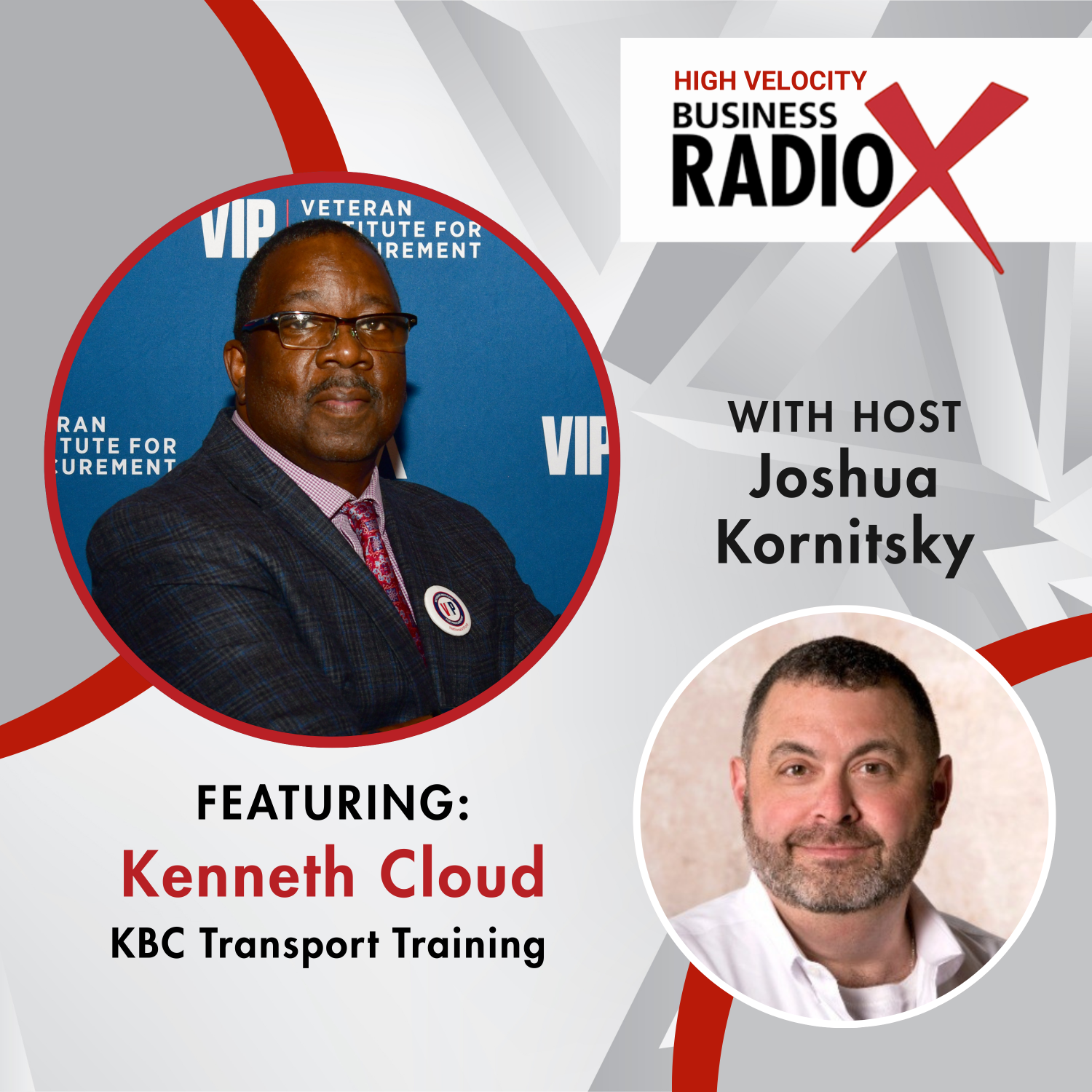

In this episode of High Velocity Radio, Joshua Kornitsky is joined by Ken Cloud, founder of KBC Transport Training. Ken shares his journey from military service to innovating commercial driver training with advanced simulators. The discussion covers KBC’s comprehensive six-week program, its unique apprenticeship, and support for veterans through the SkillBridge program. Ken highlights the importance of skilled, empathetic instructors and the strong demand for truck drivers. The episode emphasizes KBC’s commitment to high-quality training, veteran support, and the essential role of truck drivers in the supply chain.
 Kenneth Cloud serves as Director of KBC Transport Training LLC, a veteran-owned transportation training and workforce development company delivering advanced driver qualification, safety, and compliance solutions for mission-critical industries, including aerospace, defense, public transit, and infrastructure operations.
Under Mr. Cloud’s leadership, KBC Transport Training has evolved into a specialized provider of FMCSA-compliant, simulator-based, and risk-focused training programs designed to meet the operational demands of secure facilities, airfields, spaceports, and high-reliability transportation environments. The organization supports employers responsible for ground support equipment, shuttle operations, fuel and service vehicles, logistics transport, and personnel movement within controlled and safety-sensitive locations.
Mr. Cloud brings deep expertise in commercial transportation operations, safety management systems, and workforce readiness. He has led the development of CDL Class A and Class B programs, defensive driving and refresher training, and customized operator qualification pathways that integrate advanced driving simulators, performance assessments, and regulatory documentation. These solutions help aerospace contractors and government agencies reduce risk, improve operator performance, and maintain compliance with federal, state, and site-specific requirements. 
A key focus of Mr. Cloud’s leadership is workforce pipeline development. He has expanded KBC’s capabilities to include apprenticeship and employer-aligned training models supporting Department of Defense SkillBridge participants, veterans, and civilian workforce development candidates. These programs are structured to deliver job-ready operators trained to operate within strict safety protocols, security controls, and operational standards common to aerospace and defense environments.
Mr. Cloud’s strategic vision emphasizes innovation, accountability, and partnership. By aligning training outcomes with employer performance metrics and mission requirements, he continues to position KBC Transport Training as a trusted partner for organizations supporting aerospace operations, national defense, and critical transportation infrastructure across the United States.
Follow KBC Transport Training on Instagram.
Episode Highlights
- Ken’s background and transition from military service to the transportation industry.
- The founding and mission of KBC Transport Training.
- Use of advanced driving simulators in training commercial truck and bus drivers.
- The importance of comprehensive training programs, including classroom instruction and hands-on experience.
- Partnership with the Department of Defense’s SkillBridge program to support transitioning service members.
- The need for qualified instructors with strong teaching skills and the ability to connect with students.
- The significance of addressing the driver shortage in the trucking industry.
- Compensation and career opportunities for commercial drivers.
- Common misconceptions about truck driving, including the differences between over-the-road and local driving.
- The role of professional training in enhancing safety and quality in the transportation workforce.
About Your Host
 Joshua Kornitsky is a fourth-generation entrepreneur with deep roots in technology and a track record of solving real business problems. Now, as a Professional EOS Implementer, he helps leadership teams align, create clarity, and build accountability.
He grew up in the world of small business, cut his teeth in technology and leadership, and built a path around solving complex problems with simple, effective tools. Joshua brings a practical approach to leadership, growth, and getting things done.
As a host on Cherokee Business Radio, Joshua brings his curiosity and coaching mindset to the mic, drawing out the stories, struggles, and strategies of local business leaders. It’s not just about interviews—it’s about helping the business community learn from each other, grow stronger together, and keep moving forward.
Connect with Joshua on LinkedIn.
 This transcript is machine transcribed by Sonix.
TRANSCRIPT
Intro: Broadcasting live from the Business RadioX Studios in Atlanta, Georgia. It’s time for High Velocity Radio.
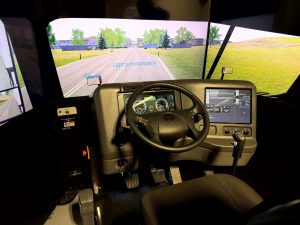
Joshua Kornitsky: Welcome back to High Velocity Radio. I am professional EOS implementer and your host, Joshua Kornitsky. And today I’m doing a special remote podcast, uh, from one of the coolest places I’ve ever been. So I am here with Ken Cloud. Ken is the founder and CEO of KBC Transport Training in Sandy Springs, Georgia. Ken’s a veteran, but he works with the US Department of Labor Apprenticeship System and the Department of War Skill Bridge program to help transitioning service members build careers in the transportation industry. His organization uses advanced driving simulators, which I already got to try, and I have some pictures that I’ll put up, uh, to do hands on training and to prepare the commercial truck and bus drivers for real world conditions. Drawing on experience from technical college System of Georgia and Marta. Ken is focused on developing skilled drivers and improving safety across the transportation workforce. Ken, welcome. Thank you so much for inviting me down here and for showing me some of the coolest technology I’ve seen in a really long time.
Ken Cloud: Thank you. Josh, I appreciate you having me on your show.
Joshua Kornitsky: It’s great to talk to somebody who’s trying to do so much to help so many. So let’s begin at the beginning. Let’s go all the way back. Kind of what led you into transportation? Because you’re not a tech wizard who built the cool stuff. You’re a truck driver and a transportation guy that brought it all forward.
Ken Cloud: Absolutely. Long story short, I actually stumbled into this industry.
Joshua Kornitsky: Okay.
Ken Cloud: Tell us. I had plans to go into the aviation industry, and I wound up joining the military, joining the army between age, ages 18 and 19, and they offered to, to me a heavy duty, um, mechanic course. Okay. And so I said, well, what the heck? This I’m young. I’ll take a look at this. Got into, uh, automotives in the, uh, military whatnot. Uh, been in it ever since, uh, learn how to drive the deuce and a half trucks. Fun in the jeeps, driving a five ton trucks. And I decided, you know what? This is not a bad career. I think I can do something with this career, whatnot. So I got into that and stayed in it my whole entire life.
Joshua Kornitsky: So you mentioned in passing to me before, but I want to ask a little bit about you. You spent time working with Marta. You spent time with the technical college system of Georgia. Tell us what you were doing there, because I think that adds a lot of, uh, a lot of insight into how you got to where we are now.
Ken Cloud: Absolutely. So I originally started as a diesel mechanic, diesel tech. And so I went to work with Marta during the Olympics in 1996 Olympics. And we had so much fun. I was chasing busses up and down the highway left and right at that time too. You know, we had class five license and so I had the ability to be able to drive that type of equipment. Plus, I still had the military training right from driving the trucks and whatnot. So working along with Marta, doing the Olympics, chasing busses, working on busses, kind of gave me a little relationship to start working with the busses and whatnot from there. I think I after the Olympics was over, we were all scuffling, trying to figure out what we were going to do with our lives. Well, I had a class five license, so I went ahead and went to work briefly with the City of Atlanta Motor Transport. Okay. I worked over there for about five years and that’s what got my CDL license. I got my CDL license through the City of Atlanta Motor transport, believe it or not. Uh, when CDL came out in the early 90s, I was one of the first people grandfathered into that program.
Joshua Kornitsky: From the class five.
Ken Cloud: From the class five’s okay. As long as you didn’t have any moving violations, they grandfathered you right into the CDL program. You did have to take the written test, so I took the written test to do the endorsements. The passenger endorsement has met and the tanker’s endorsement. And so from there, I became over the road truck driver. I wanted to get out on the road and start driving and see what that was like. And so I started driving for a period of years. Uh, as I got out on the road, started running from, I think from Atlanta to, uh, Utah, uh, pretty much ran all over the great 48 states here in America. And then from there, um, a funny thing happened to me. I took a little break because I had became an owner operator. Right, right. And I took a small break from trucking, I think maybe about a year off or whatnot. And then I had some military benefits that I wanted to use. And I wound up going over to one of the local technical colleges because you had to be enrolled into the technical college in order to utilize the benefits. Right.
Joshua Kornitsky: Okay.
Ken Cloud: I went over there and I ran into a friend of mine over at, uh, Atlanta Technical College that was teaching automotive program. And he said, hey, don’t. Didn’t you become a truck driver? I was like, yeah, we, you know, work with each other, with City of Atlanta motor transport. He said, well, the CDL program needs some help down there. Why don’t you help them out? I’m like, I’m just here to get some military benefits, you know? Right. I didn’t come here to get a job, but he, he talked me into going out, going out to the CDL department and work with these guys part time. I went down there working with a part time. Part time turned into full time. Full time. Turned into one year. Full time. Turned into two years. Full time. Turned into three years. And then they needed somebody to eventually run the program because the guy that was running the program was leaving. I had the background, I had the experience. Next thing you know, I’m running the city of Atlanta, not the city of Atlanta, but the state of Georgia CDL training program.
Joshua Kornitsky: Wow. So is that when KBC transport was born or did that come next?
Ken Cloud: That was KBC transport was in the works. Uh, I worked with the State of Georgia Technical College System of Georgia developing programs. I developed the first online training program for CDL. Because what happens? The state wanted the all programs online. You know, we were getting a little bit more high tech in the world. And so the state wanted everything online. Uh, long story short, I started developing that program and it started giving me ideas about creating my own program because the state was wrestling back and forth with, uh, me, not me not able to do this and not able to do that. And, uh, and so long story short, I wound up having a project that the state wanted me to go over the model to work with martyr. So they wanted me to go over there and grab this contract from martyr or whatnot. Now, my mind was thinking, how much money is going to be in this thing for me, right? And so, uh, in the process of going over there to sit down and talk with martyr about bringing a multi-million dollar contract back to the state, you know, I had somebody tap me on the shoulder and say, hey, you got an astronomical amount of experience and whatnot. Why don’t you come over here and work with us? Because we had found out that the program wouldn’t it wouldn’t work with the state at that time or whatnot. Marta was in a really big hurry or whatnot, so I wound up going over there working with Marta, and in the process, I’m developing my program behind the scenes and whatnot because I know eventually, you know, I’m getting a little bit older. I got some ideas that I know that I wouldn’t be able to unfold those ideas on the job.
Joshua Kornitsky: Sure. Well, because you have so many restrictions in that line if you’re working for them versus when KBC transport training is born, your private sector, you can do what you like.
Ken Cloud: And you know, I wanted to do a lot of different creative things that we’re doing now. One of them is simulation. State would never let me get a simulator. They didn’t they didn’t believe that simulators were necessary. And I always knew that simulations got to be necessary because when I took a course in aviation school years ago, first thing they put us on was simulators, right? They put us on these little.
Joshua Kornitsky: It’s proven. It’s a proven track to get you up to speed and you kill a whole lot fewer people and you damage a whole lot less expensive equipment.
Ken Cloud: Right? I’m going around preaching simulation, simulation, simulation. So the idea was to go ahead and create my own program. I met with a guy that was running a program, the National Minority Trucking Association, at that time, and he encouraged me to say, listen, you got to go ahead and put that boat in the water. And so you got to get that boat placed in the water as fast as you can.
Joshua Kornitsky: And and I’ve had the opportunity, as I said, Ken, let me try out the simulator. Um, and it is surprisingly realistic, down to the point that I could feel the sway in the wheel from the wind and from the road. Um, but I mean, there were, I didn’t even count how many hundreds of variations of vehicle transmission situation, condition. Um, and all of that has to be better than putting someone live in a vehicle and putting them on the road the first time because as I said, a whole lot less damage, a whole lot less injury.
Ken Cloud: Right?
Joshua Kornitsky: Right. Um, so KABC transport training is born as, as you said, and as I had the pleasure to experience, you have the, the simulator, but who when you first started and we’ll talk about the work you do with the Department of War and with Spielberg and all of that. But who were you serving initially? Just local municipalities.
Ken Cloud: Just local municipalities, uh, individuals coming in. Um, just interested in getting a commercial driver’s license. Uh, these are the people we’re reaching out to, uh, workforce development. Um, anybody that basically wanted the CDL license.
Joshua Kornitsky: And, and is, uh, KABC transport training open? If somebody just wants to get a CDL, if I decide that I want to be an over the road trucker, is that something I can come here and do?
Ken Cloud: Absolutely. Uh, our program is a U.S. Department of Labor apprenticeship training program, so we’re a little bit different than the average CDL school. Okay, we will train you with a to get a commercial driver’s license, but our program is a bit longer. Uh, most CDL schools are about two and a half weeks, uh, two and a half weeks long. You got a license, you pass. Oh, I did, you know, that’s terrifying.
Joshua Kornitsky: But so what’s different?
Ken Cloud: Okay, six weeks plus and then the apprenticeship, you actually go for a whole year.
Joshua Kornitsky: With a trucking company. You connect them with.
Ken Cloud: The pair, you with a trucking company, or we take you up on our wings and we train you.
Joshua Kornitsky: Okay.
Ken Cloud: And basically what happens is eventually you will get paid while you’re in the apprenticeship training program. That’s the objective is to give you on the job training and give you some paid to, um, you know, to kind of hold you down a little bit while you’re training.
Joshua Kornitsky: Well, and it seems to me that you’re probably putting, uh, I wouldn’t speak ill of anybody else. It sounds to me like you’re putting high quality drivers on the road.
Ken Cloud: We put some good top quality drivers on the road that actually know what they’re doing.
Joshua Kornitsky: So now I want to ask you, uh, Why? Because it is what first drew my attention. I am not a veteran, but I learned about the skill bridge program. So would you talk about what that is and who that helps and who qualifies for use of that program?
Ken Cloud: Absolutely. Skill bridge Program is a wonderful program initially created by the Department of Defense, which is now the Department of War. It allows a returning service member that’s getting out of the military that has at least six months left on their contracts to come back into the civilian world and train, uh, for skill, like commercial driving for six months. Uh, the Department of War will pay their salary for six months and allow them to come down here to KABC transport training to train with us. And what we do is we pull six months worth of training into them. If they want to continue into the apprenticeship program another six months, we allow them to stay for another six months so that they know exactly what they’re doing. We want to make sure that we give our military personnels the top level skills, you know what I mean? So that because when they come back from serving this nation, right, uh, they deserve a high paying job. And so absolutely make sure that we pour into them so that their skill level is up at top tier. And then we can send them to companies like UPS, Fedex, uh, Martin transport and even mortar.
Joshua Kornitsky: Okay. And is there much of a cost for returning service member?
Ken Cloud: Uh, no. Uh, the Department of War pays all of the expenses. They pay their salary for six months. So that’s like a six month vacation. And then they come down here to KBC if they don’t have a place to stay. We do have hotels that work will work along with us. We actually put them up in hotels and whatnot. Yeah.
Joshua Kornitsky: And, and just because we did touch on it, but it was a little bit ago. You are an Army veteran yourself and thank you for your service. Does does your personal service experience help you work with some of these folks? Because I imagine as someone who didn’t serve My imagination tells me that they’ve got a different perception of the universe than I do. And I imagine you have to help them in that transition as well.
Ken Cloud: Well, I know exactly what they are going through. When a service member is getting ready to get out of the military that lasts six months, you’re in panic mode. You know, because if you have a family now, you got to figure out how you’re going to be taking care of your family because you’re getting ready to go from having a salary to no salary. And so now you got to figure out the next six months, how are you going to make this thing work? And so my experience getting out of the military where we didn’t have skill bridge, I had to come out here and look for a job, right? You know, and it was tough for a minute. You know, I had just came from overseas. I had just spent the last, what, four years, four and a half years over in Germany.
Joshua Kornitsky: A little different.
Ken Cloud: Yeah. And I come back and you guys are driving at 55 miles an hour. I’m used to running 100 miles an hour. Now I got.
Joshua Kornitsky: Legally, it’s important to point out legally.
Ken Cloud: Legally, and I got to slow the pace down so that I can figure out how to take care of my family and everything. And so I really understand the plight of the veteran, you know, because when you come back to civilian world, things are totally different. It’s like you stepped into a on another planet.
Joshua Kornitsky: I can only imagine. And thank you for offering that to our service members, because that’s an incredible program up to and including helping them find a place to stay.
Ken Cloud: My pleasure. That’s awesome.
Joshua Kornitsky: So one of the other things that we talked about before the show was, was what you need. And right now it sounds like you’ve got a specific need for instructors.
Ken Cloud: Yes, absolutely. My specific need is for well-trained instructors. I’m dealing with a lot of military personnel coming into, uh, coming into the program. Uh, a lot of these, uh, military personnel, they’ve already driven military vehicles, uh, just like myself. I was used to driving, what, 915 semi-automatics going through the mountains of, uh, Landstuhl over in Germany.
Joshua Kornitsky: Okay.
Ken Cloud: And so I knew what driving an 80 ton tank on the back felt like, and how to strap them down the whole nine yards. But what I didn’t know is that civilian transition. How does this translate into civilian military vehicles are different. And so what we need is well qualified instructors that are seasoned instructors that know how to react with people.
Joshua Kornitsky: So is it. I presume it’s beneficial if they have military experience.
Ken Cloud: They got military experience. It’s a plus. If they don’t have military experience, it’s fine. The biggest thing is knowing how to teach people, knowing how to handle people, you know?
Joshua Kornitsky: So what makes an ideal trainer for you? We said ideally, military experience. What else is beneficial? What type of training? Any type of.
Ken Cloud: A people person. Okay. I like people that are people, people, persons, right? People that can understand. Because at any time I can have a student in here that’s going through a crisis. So you can’t be hard on them. You got to be able to know when to put them to the ground and then back up off of them and whatnot. You know, be a bit more sensitive. I like instructors that are sensitive. Not all the time. Do you really need, as we say in the military, a grunt instructor.
Joshua Kornitsky: Okay.
Ken Cloud: You need somebody that can sympathize with what these students are going through or whatnot, because that makes the training. Driving trucks is stressful. So we need to be able to have some instructors that know how to dial the stress level down and be professional. Professionalism. Professionalism is job one with us. We we have a zero tolerance policy with this program. Okay? We don’t tolerate any foolishness from instructors and or the students. And so we always have to be respectful of one another because we’ve got different people from different backgrounds, different walks of life. So we need somebody that is very, very versatile. And some of that can deal with a lot of different people. That’s why we do love military instructors, because you’re used to dealing with people from around the world and you have that versatility built into you?
Joshua Kornitsky: Yeah, that that would make perfect sense to me. Um, so a background in instruction, ideally military instruction, but I have to presume there’s a lot of process in what you do, which processes is a key part of iOS that I teach. But process to me is also how you get the right and best things done every way. So if they’ve got a checklist for what they need to do and in full transparency, when I sat down in Can simulator, the first thing he did, whether he realized it or not, was took me through a checklist. Right. Um, and it spoke directly to that process part of my brain. But if I know that I have to check the ignition, if I know that I’ve got to hold the brakes down before I turn the truck on and then let the pressure build, all of those things are things that make a great truck driver. Just be able to get in the car, the truck. Right? That’s not I didn’t learn any of the driving skills. I’m happy to say I didn’t crash. A couple of times came close, but but but I drove both a truck and a and a bus in in the simulator. And no one died, which made me very happy.
Ken Cloud: And you drove articulate a bus too? A big, long one.
Joshua Kornitsky: I will put that on my virtual driving resume. Um, so we will look for instructors. We’re looking for students. If, if your military, uh, if you’ve already transitioned out, are there programs or opportunities for soldiers who have, who have left the military?
Ken Cloud: Yes, absolutely. So we are a VA certified, we’re certified by the Veterans Administration to process, uh, VA, GI Bill benefits. And so if a veteran, uh, and even if a veteran veteran doesn’t have the GI Bill benefits, we still are certified through Georgia Department of, well, not Georgia Department. It’s, uh, Worksource. Georgia. Okay. Which is the, uh, Wioa, which is the Workforce innovation Opportunity Act, which are federal funds. So we can send veterans through the Wioa program. For training. And we can also process the GI Bill if they have the GI Bill. So.
Joshua Kornitsky: So. So there’s a lot of opportunity. That’s fine. And not having to pay anything.
Ken Cloud: Pay for veterans.
Joshua Kornitsky: That is amazing. Yeah. Um, so a few other questions that occur to me just as we’re talking is how when did your first, um, CDL graduate hit the road? How long has it been?
Ken Cloud: Uh, first CDL graduate was back in, uh, 2017.
Joshua Kornitsky: Okay, so approaching ten years on the road and, and do you know how you know, do you stay in touch with some of your students to know how they’re, how they’re progressing in the world?
Ken Cloud: Oh, do we stay in touch at any day? One will be knocking on the door at any in any minute now. Uh, because we do interact with the all the previous graduates and I rehire some of the previous graduates too.
Joshua Kornitsky: That’s awesome.
Ken Cloud: So we have I love tracking them. It’s kind of like, um, your children, you know what I mean? Oh, you gotta.
Joshua Kornitsky: Believe.
Ken Cloud: Me. And they never come back. Some of them come back because they want to learn how to drive. Now. They learn how to drive trucks. Now they want to get into busses.
Joshua Kornitsky: Okay.
Ken Cloud: And so they’ll come back or they want to get into the truck business, or they want to get into the bus business or the or what do you call it, straight truck business box trucks. Okay. And so we do have programs where we teach them how to be in business for themselves, how to go after the government contracts.
Joshua Kornitsky: And I just realized that I neglected to mention something that’s really important. It’s not all simulator work here.
Ken Cloud: It’s not all simulation. First stage is classroom, right? Second stage is simulator, third stage is in the actual vehicle.
Joshua Kornitsky: So they’re there and I have not seen them. But there are actual vehicles here. And I think that’s a key differentiator.
Ken Cloud: Yes. So we actually train them on, uh, live trucks and live busses. Uh, that simulator gives us a peace of mind knowing that, uh, we’ve gotten past stage one, which is the fright stage. Well, years ago, when I was with the technical college system of Georgia, the biggest problem we had is, uh, you’re sitting over on the passenger side. The new student is on the driver’s side, and you’re getting ready to put that student on the highway for the first time. Well, nine times out of ten, the students are going to have a panic attack.
Joshua Kornitsky: I, I had a panic attack, so I can certainly see that.
Ken Cloud: Exactly. And so the simulator is going to remove that panic attack because now the student is used to a just like an airline pilot. Did we check the air brakes? I mean, not, but next did we check the steering? Did we check this? Did we check that? So they got these 1234567. Ten step process. I’m getting on the highway. And so it makes it much easier and simpler for them because nerves is the is the worst thing that you have to worry about getting on the highway.
Joshua Kornitsky: And I have to imagine because you have the real world experience that. Do you also coach them on. You know, I know there are regulations that I’m not familiar with, but there are regulations about how long. And over the road, trucker can stay behind the wheel without taking a break. Do. Do they get the opportunity in the simulator to experience longer driving?
Ken Cloud: So we can take them through the mountains?
Joshua Kornitsky: Oh, wow. Okay.
Ken Cloud: Give them going up, up mountains, 6% grades coming down, 6% grades. We even give them the opportunity to know what it feels like for a runaway ramp. Oh, you know.
Joshua Kornitsky: I’ve seen them. Thank goodness. I’ve never seen one used. But I’ve seen.
Ken Cloud: Truck drivers have actually had a chance to see runaway ramps out on the road, but they’ve never had a chance to experience what it’s like to go up a runaway ramp. So we give our drivers the experience on the simulator of going up that runaway ramp that mustn’t be afraid to take it.
Joshua Kornitsky: So you can answer your question. My wife and I have always wondered if you have to use one of those. Does it require a tow truck to get you out of there? Yeah, I kind of figured. But we never knew. We’ve thankfully, we’ve never seen it used. But I always wondered. So last couple of questions, Ken, because I, I, I happen to know from my own background. Um, long ago in the automotive industry, just what an incredible amount of cargo travels via truck, right? I mean, well, in excess, even if it arrives via rail or arrives via ship, the train and the boat don’t take it to the warehouse. Who takes it to the warehouse? It’s a truck.
Ken Cloud: Exactly.
Joshua Kornitsky: So is this a growth opportunity for people? If if you’re considering getting a CDL.
Ken Cloud: This is a huge career growth opportunity. I tell people all the time in the trucking industry, there is no other industry where you can come in as a student today. Tomorrow you gain some experience, you become a professional driver, and the next day, little or nothing. You can invest into your own business, right? You know.
Joshua Kornitsky: Because if you’re, if you’re an owner operator, and then some people even make that leap into becoming entrepreneurial owner operators and then their own in multiple trucks and having multiple drivers.
Ken Cloud: Exactly.
Joshua Kornitsky: Um, and and I don’t think we are anywhere near the capacity needed to satisfy the demand.
Ken Cloud: No. Not yet. We are so far away. We’ve last account was it was like 150,000 drivers short. And I’m sure the numbers are way higher than that.
Joshua Kornitsky: I can only imagine. So. And and obviously you can’t know, but if you were asked what’s what’s an income range for, for a truck driver.
Ken Cloud: A normal entry level range coming out of school is somewhere between 45 and 55,000 a year.
Joshua Kornitsky: And then it just goes up from there from there.
Ken Cloud: Ups is holding the big cards. They’re holding the they’re doing what UPS is 36 to 4042 bucks an hour on drivers.
Joshua Kornitsky: Wow.
Ken Cloud: Yeah.
Joshua Kornitsky: So there’s definitely opportunity. And if you don’t have the desire to be an owner operator, it sounds like there’s plenty of people willing to hire you.
Ken Cloud: Plenty of people willing to hire you. All you got to do is get the CDL license and you can go to work right away.
Joshua Kornitsky: Anything that you can think of that our misconceptions people have about driving a truck.
Ken Cloud: Yeah, there’s a lot of huge misconceptions about over the road drivers. You know, it’s really tough to drive over the road. No. If I had the opportunity to go back out on the road, I would. I would be over the road driver. Okay. Because local drivers and I know a lot of people want to get into local driving over the road drivers. It’s more laid back. You got plenty of time to plan your schedule. Local drivers, what you got to get up at 5:00 in the morning. You got to get to work by 6:00. You got to make it through the traffic, got to make all your stops, and then you got to rush back home again, back through the traffic at 430, 5:00 and back home again. A couple of hours of rest. Take a shower.
Joshua Kornitsky: Sounds a lot more stressful.
Ken Cloud: Exactly. It’s a lot more stressful. Local versus over the road. Over the road is laid back. You get a chance to go shopping at all the different Indian trading posts. You know, that’s awesome to see the country. You can see the Grand Canyon, Las Vegas and all these other beautiful places. It’s a vacation is what it is. You’re getting paid to travel.
Joshua Kornitsky: That sounds like a pretty good gig. I can’t thank you enough for for the service to our service people, for the service to our community, to the service, for all of the products that are that are in the pantry at my house right now. Because all of those ultimately passed in one way or another through a CDL license driver. That’s right. Uh, and nothing, nothing moves without the trucks moving. So you keep it going. And thank you so much for what you do. Uh, any other final thoughts? Anything we should have talked about that we might have missed?
Ken Cloud: Yeah, I’ll our motto is, if you bought it, we brought it.
Joshua Kornitsky: Oh, I like that.
Ken Cloud: I want to thank you very much for allowing us to share with you today on your program.
Joshua Kornitsky: Absolutely. It’s a pleasure. And, uh, I can’t wait to see what’s next.
Ken Cloud: All right. Thank you very much, Joshua.
Joshua Kornitsky: My pleasure. So my guest today has been Ken Cloud. He’s the founder and CEO of KBC. Excuse me, KBC Transport Training in Sandy Springs, Georgia. He’s a veteran of the Army. He works with the US Department of Labor apprenticeship apprenticeship system. That’s a hard one. And the Department of War Skill Bridge program to help transitioning service members build careers in the transportation industry. His organization uses really cool and advanced simulators, but also has the real trucks out there for people to put their hands on. He’s got a ton of experience, both real world on the road. Also behind the scenes, working with places like Mada and the technical college system of Georgia. Uh, Ken Cloud, thanks for all you do. We appreciate it.
Ken Cloud: Thank you very much, Joshua.
Joshua Kornitsky: My pleasure. My name again is Joshua Kornitsky. I’m a professional implementer of the entrepreneurial operating system. And your host here on High Velocity Radio. Thank you for joining us. We’ll see you next time.
Speaker 1: Broadcasting live from the Business RadioX Studios in Atlanta, Georgia. It’s time for High Velocity Radio.














