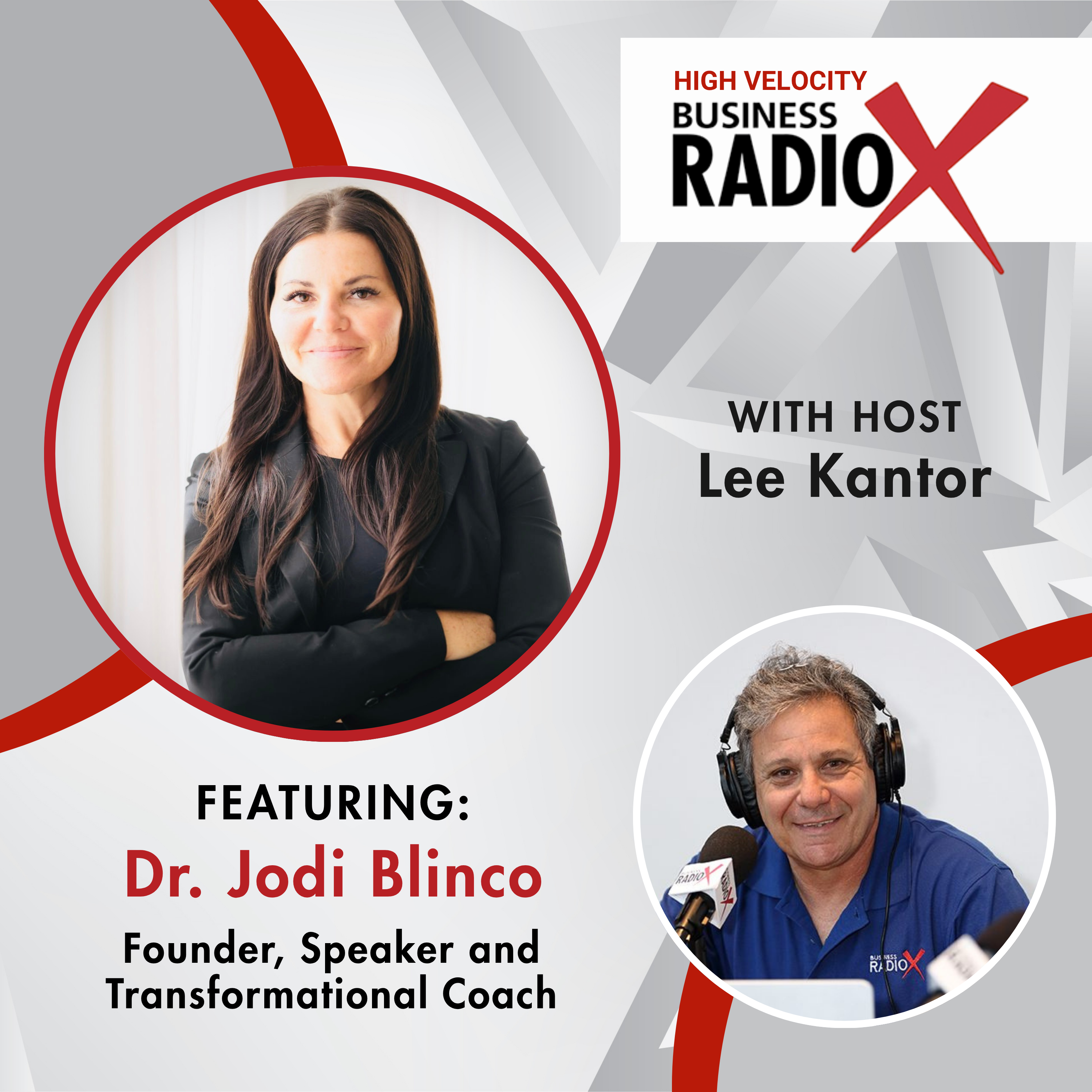

This episode of High Velocity Radio welcomes Dr. Jodi Blinco, transformational coach and founder of ZenLeader, for a deep dive into building authentic leadership through holistic practices. Dr. Blinco shares how her groundbreaking approach combines mindful movement, customized coaching, and tangible skill development to support individuals and organizations facing rapid change, stress, and the need for genuine connection in today’s workplace.

 Founder of The U School, ZenLeader, and Author of Inner Alchemy, Dr. Jodi Blinco is a coach, speaker, and pioneering educator, who has become an iconic leader for transformative personal and professional growth.
For over two decades, Dr. Blinco has been at the forefront of innovative training and coaching methods, fostering a love for learning, and providing impactful mentorship to students and professionals alike.
As a vibrant and compassionate educator, her consulting, coaching and workshops go beyond traditional lectures – they are life-changing experiences that have touched countless lives along her journey. Holding a Doctorate in Education, Masters degree in Business , and a Bachelor’s degree in Business Administration, Dr. Blinco has an academic background that continually shapes her unique perspective on success, leadership, and personal transformation.
As an avid advocate of holistic wellness, Dr. Blinco is also a Certified Yoga Instructor, has owned a yoga studio and has traveled the world teaching inspirational and wellness workshops where she incorporates these healing practices into her comprehensive approach to personal development.
With an unwavering passion for transforming lives, Dr. Blinco’s mission is to empower and inspire others to realize their fullest potential, overcome life’s challenges, and achieve personal as well as professional fulfillment.
Grounded in action and fueled by the desire to make a meaningful impact, Blinco is an inspiration to all who encounter her work. Her genuine passion, unwavering courage, and relentless pursuit of knowledge is a constant reminder that hard work, dedication, and perseverance can, indeed, change the world for the better.
Connect with Dr. Blinco on LinkedIn.
Episode Highlights
- The creation of ZenLeader and its fusion of corporate experience, coaching, and yoga studio practices to serve leaders and teams.
- How ZenLeader customizes programs, including workshops and group coaching, to meet the needs of frontline staff, sales teams, and middle management.
- Insight into Dr. Blinco’s unique sales conversation structure that helps professionals close with authenticity, focusing on service rather than pressure.
- Success story of coaching a client’s middle management team to achieve an 88% increase in customer conversion rates.
- Announcement of ZenLeader’s new brand and website, designed to offer organizations self-service access to masterclasses, workshops, and resources.
 This transcript is machine transcribed by Sonix.
TRANSCRIPT
Intro: Broadcasting live from the Business RadioX studios in Atlanta, Georgia. It’s time for High Velocity Radio.
Lee Kantor: Lee Kantor here. Another episode of High Velocity Radio, and this is going to be a good one. Today on the show, we have a speaker and transformational coach with ZenLeader Dr. Jodi Blinco. Welcome.
Dr. Jodi Blinco: Thank you. Lee. Thank you for having me.
Lee Kantor: Well, I’m excited to learn about your practice. Tell us about ZenLeader. How are you serving folks?
Dr. Jodi Blinco: Well, ZenLeader, um, was really a creation from my own lived experience, both in the corporate world as well as, uh, the yoga studio. Um, and so what I’ve, what I’ve done is I’ve taken, uh, my passion for coaching and developing others and my passion for mindfulness and and wellness and really put that together in an offering that serves people through our ZenLeader master class. So that’s really an autonomous way to plug into holistic practices that help you become a stronger, um, a stronger leader, and also tapping into holistic practices in your life so that you can calm the chaos, manage your stress, and really just stay aligned with that authentic version of of who you are. And we also offer one on one group coaching, keynote sessions, workshops. Uh, again, the intent is as nowadays, the, um, there’s so much happening in our world and in the workplace, there’s a lot of unknown. There’s a lot of fear, there’s just a lot of distraction. And ZenLeader is designed to help folks find that calm in the chaos and also continue to elevate and climb and grow through their authentic power and their authentic voice.
Lee Kantor: Now, you mentioned, um, a yoga component. Is this part of the practice as well? It’s not just me talking to you or you asking me questions. There’s actually some physical movement and exercise attached to this.
Dr. Jodi Blinco: Uh, there can be. Yeah, there can be, um, that usually shows up mostly in the on site or the virtual workshops. If a company wants to include that in their offering. We customize our programs, uh, for the frontline middle level management and sales teams to really meet the organization where the needs are. Uh, some organizations, uh, Paychex, for example, is a client that we’ve worked with in the past, uh, with their sales team on, you know, finding their confidence mantras and, uh, that mental resilience when things get tough in the sales world. We also did the physical practice because it was an on site workshop where we did some yoga and had fun with it. Um, so to answer your question, it’s not included in every program, but if a client or company wants to include it and offer that to their employees as a way for them to. We do a really fun one called yoga at your desk so you don’t have to roll out your mat or change clothes or anything like that. Um, it’s just a, uh, it’s a component there to help people more think about being present in the day to day, being mindful, moving with intention. And yes, if they want yoga, we can design and plug in a little bit of yoga to their customized workshops.
Lee Kantor: So in these organizations that you work with, what is kind of the what’s what’s happening in the organization where they’re like, I better call, uh, Dr. Blinco and her team, uh, because we’re struggling with blank.
Dr. Jodi Blinco: Yeah, I, you know, we really serve three primary groups and organizations. One is your front line, um, staff that are interacting with with your customers, your sales team and your middle level leaders. The reason being is those folks, uh, oftentimes there aren’t a lot of organizations that have structured onboarding for new hires and structured skill development for those areas. Sales skills, frontline customer interaction skills, and mid-level management is also a gap in the industry, where we don’t see a lot of nurturing or care or skill development. Teaching people how to become leaders. And, you know, for ZenLeader, also balancing the stress that that comes with that. So that’s really the problem that we’re working to solve with the offering. One of the things that also makes us different is This skill development portion of what we do is designed to develop folks so we can make an impact on the organization’s bottom line. And a lot of learning and professional development programs aren’t able to make that connection through their offerings, through the skill development. So that really is part of the return on investment. The ROI to the organization is this isn’t just a training program or a professional development program. We are holistically developing your people with the intent to take care of them, and also take care of your bottom line.
Lee Kantor: So how do you kind of demonstrate the ROI to an organization, to how do they like, what are the baseline metrics and what are the metrics you compare to at the end?
Speaker4: Yeah, for each group it’s.
Dr. Jodi Blinco: Going to be a little bit different. So um, but if we’re just talking in generalities, really working with them to identify the key performance indicators of of those three groups. So what are the metrics that we are using to define define success for a frontline, uh, customer service or customer relationship specialist. What are the metrics for sales and and middle management? Um, sometimes organizations don’t have those clearly defined defined for those different roles. So that’s part of um, the coaching and consulting that we can also partner with the, the organization on, because that’s really foundational. If we don’t have those, then it’s it does become challenging to anchor the professional development and that work into a very tangible metric or, or return. But for example, if we’re talking about a sales team, things like outreach, appointments, conversions, um, when we teach, uh, sales skills, One of the things that, um, we really focus on, which I don’t know, that a lot of sales trainings programs do this, but we really focus on helping that individual have a sales conversation authentically with that business or with that client, and teaching them a structure for how to navigate that. I think a lot of times the risk with sales conversations is people feel like they’re being sold to, and nobody likes to be sold to. Uh, you know, human beings are nature is we can we can sense that we can sense inauthentic inauthenticity. And so, um, working with the sales team, developing those skills, also teaching them things like mental resilience and mantras and crystals, uh, and yoga and, you know, the holistic side of that, bringing the skill with the with the holistic piece really focuses on helping to drive those key metrics that we have defined with the organization that they want to get out of this investment that they’re making, or we are working, um, to design a program that, um, addresses the indicators that are already in place.
Lee Kantor: Now, how is this a methodology that you developed yourself and put your own kind of secret sauce on, or is this somebody else’s methodology that you’re delivering?
Dr. Jodi Blinco: It is mine, actually. Um, yeah. I uh, about, gosh, almost 18, 19 years ago now. I started down a path in, in, in a sales role. And I really, really struggled in that role. I struggled to have an authentic conversation. I struggled to really connect with the person on the other end of the phone or face to face, because I was never really taught a sales structure or one that really felt accessible and comfortable and authentic to me. So through that really tough learning and that experience, um, I developed my own conversation structure, uh, or conversation map, if you will. That really takes something as fluid and intangible as a conversation. And it provides it provides some infrastructure to it so that, um, it keeps you from getting lost in in the discussion, you have an idea of where you’re going in the conversation and then figuring out the core skills that go with navigating and progressing. That conversation is, as you said, really the secret sauce. And, um, that is, uh, what has been developed and, and really what I’ve done in multiple different industries. Um, one, my background is in higher education. And so I’ve developed a similar product, um, for, uh, higher education institutions, coaching and developing their mid-level leaders inside the institution and also the front line recruiting staff. Um, and then, uh, obviously ZenLeader, which is can, you know, be used in higher education, but really is designed to serve other industries and also has that holistic component. And, you know, the holistic component is also a lived experience. It’s um, as I progress in the corporate world, um, moving up into different roles, the, the stress, the the seeking approval of, um, people above you, really burning yourself out, running yourself ragged, uh, your own self-talk that sometimes, uh, doesn’t work in your favor. That’s that holistic component that ZenLeader brings in addition to those very tangible, hard skills.
Lee Kantor: Now, do you mind if we go a little deep and zoom in on the sales component? Because sales is something that’s close to my heart, and I think it’s an area that there’s a bunch of people that don’t feel comfortable as salespeople or even kind of wearing that salesperson hat. Even though that more and more organizations, everyone has some sales responsibility. Um, do you mind sharing a little bit about how you help a person who maybe feels kind of icky, labeled as a salesperson or is very hesitant, um, to sell? Um, just just from an emotional standpoint, it’s hard for them to get past that kind of, um, like, they don’t want to feel like that used car salesman stereotype, but they want to help people, you know? So it’s a, you know, even in your business as a, as a coach and a leader that you are, somebody’s got to sell something or nobody or nobody eats. So.
Speaker4: Right.
Dr. Jodi Blinco: Yeah. And I think, um, I struggled with that, that feeling myself and my coaching practice now and in the ZenLeader practice now, I know that I that comes up almost daily. So it’s a very that feeling that you talked about that kind of icky feeling or I don’t want to be I often hear I don’t want to be pushy. I don’t want to be aggressive. I don’t want to sound too salesy. That’s usually what people are sharing with me when we’re talking in coaching conversations. And I completely understand that. And I actually applaud, uh, folks for for saying, hey, I, I want to help people, but I want to do it in a way that feels aligned and and feels like me. I don’t want to say things that are in a script that I’m being told to say, that feel, you know, that I wouldn’t respond well to if, if, if, uh, I was on the other side of this and I think that’s to answer your question, that’s, that’s kind of step, step one of helping people through that particular, uh, feeling is imagine you on the other side of however it is, you’re closing a conversation now, um, I’ll focus just on the closing part of of the conversation. But any sort of interaction is going to have stages before you get to that closing point.
Dr. Jodi Blinco: But the closing one is where I see a lot of folks get stuck, and they’re not really sure how to end the conversation. And they they get stuck because they don’t want it to feel, again, too salesy or icky or whatever word we want to use. And so, um, step one is thinking about how what would I respond well, to if, if it were me on the other end of of this conversation, the other thing that I have found, the other tactic that I’ve found to be very helpful, uh, for the person in who’s having these sales conversation and the individual that you’re talking to, um, selling a product or service is to if we’ve managed and, um, progressed the conversation in a way, uh, up to the closing point where we are learning about that individual, learning about really what they need and where they are in that decision making process. If we’re doing that as a lead up, the the end or the closing part of the conversation really becomes a a plan. And if in your brain you think about the close as what is the plan that we are going to take as a next step, the the word plan takes that kind of weird charge out out of the interaction.
Dr. Jodi Blinco: And it might be that that person you know isn’t ready to take the immediate next step. But if we’re able to have a conversation that sounds something like. So we’ve talked about a lot today. The next step would typically be to do x, y, and z. How do you feel about taking that next step? Are you ready or do we need to um, maybe look at a different timeline for you? It’s a that the plan is about clarity for the person on the other end of the phone. And that question. Uh, I actually call it a wedding proposal. Um, because it’s kind of the end of the conversation where both the person that you’re talking to and you know that something’s got to happen. It’s time we, you know, we’ve talked. It’s it’s time to make a move. And oftentimes that move sounds like, well, can I call you in a couple of weeks or can I send you an email or, you know, if you’re if you’re going for a more hard sell it. It sounds like, well, how about I, you know, or when do you want this to move forward? Or when do you want to make this money and that? I’m never a huge fan of that.
Dr. Jodi Blinco: But, you know, the wedding proposal concept and the plan concept is we’re asking a question to get a yeah, I feel like I’m ready to take that next step or we get a no, I don’t feel like I’m ready. Okay, no problem at all. Talk to me about what feels comfortable for you as a next step. So I know I took you way down in the weeds there, but but thinking about how would you want to be handled, and then also repositioning that closing part of the conversation as as a plan and engaging with the other person to build that plan together and having it truly be about them. I think that’s that’s the third takeaway that I would offer. People can feel when it’s about you in the interaction, even if you try to shine it off and make it sound and look and appear as though it’s about them. If it’s if you’re making it about you, they know that. So that plan and that closing part genuinely has to be about what’s best for the other person. And if they feel that authenticity from you, you’re able to have way more honest, clear discussion about where they are and where they’re not and and go from there.
Lee Kantor: Yeah, I agree 100%. I think when you reframe selling into helping or serving and you’re just there as an expert in what you do and you’re just want to hear what their challenge or problem is, and you want to see if you can help. And and if you can help, it might be with your product. It might not be, but you just want to be clear and yourself in trying to help somebody. And, you know, maybe we’ll do business down the line. But maybe we won’t. But I’m trying to help you get what you want, rather than I’m trying to sell you this thing I have.
Dr. Jodi Blinco: Exactly. Exactly.
Lee Kantor: Yeah. I think that reframing is so important. And if you can get someone to reframe selling to helping and serving, then it doesn’t feel icky. You want to help people? Everybody wants to help people.
Dr. Jodi Blinco: Mhm.
Lee Kantor: So what’s your biggest need right now. How can we help you. Are you looking for more clients. Do you need more um consultants helping coaching. Like what do you need more of?
Speaker4: Yeah.
Dr. Jodi Blinco: So we’re really excited. Um, ZenLeader has just gone through a rebrand, and the new site and brand will be launching next week. Um, I really am proud of the work that’s been done there, just to help articulate the messaging of who we are, what we do, who we serve. So I would say keep an eye out for that. That’s that’s number one. Um, but you know, what we can use help with right now is just really continuing to expand and grow and serve and, and be able to offer, um, our programs and our masterclass and workshops to as many organizations who are, are looking for support and developing their people and also taking care of their people at the same time.
Lee Kantor: Now, you mentioned, uh, at least you started or worked with a lot of higher education. Is there a niche that is a sweet spot for you, or is this kind of industry agnostic that this will work with any size organization or any type of industry?
Speaker4: Yeah.
Dr. Jodi Blinco: Great question. Uh, I would absolutely say it’s industry agnostic, um, because of the customization that we do in our discovery calls and in the front end of the conversation, working with the the leader that brings us in or human resources, whoever that is, to take our framework, take our structure, but then again, make it work for the workforce, the KPIs, the the industry. Um, and you know, the the way that the, the products have been developed, um, we’re able to scale with our, our online masterclass. We’re also able to scale scale with, um, with group coaching sessions. Where where it becomes a question of capacity is if an organization wants to do a lot of one on one coaching, uh, we still offer that, but but really, I would say our, our sweet spot is in the the group coaching sessions, the workshops, the speaking, the masterclass. Uh, and again we’re able to meet each organization and client where they are because of the customization that we can do within the curriculum and within the offerings.
Lee Kantor: Now, is there a point of entry? That’s a usual starting place for these organizations. Are they coming in to have you come as do a talk or lunch and learn, or a workshop or training session for a specific thing, or is it. It could be anything.
Dr. Jodi Blinco: It really could be anything. The new website will offer so much more clarity to the products and services in that point of entry that that you talk about. Um, so again, I’m really looking forward to that launching. Um, if someone is clear that they want, uh, a group coaching session or a group workshop, we offer those both on site and virtually. The new website will have the, um, the topics or the workshop sessions that you can choose from, descriptions. It shows pricing. So it really allows a self service for clients to be able to take a look at where are we, What are our needs? Can you meet them with what is on the menu, so to speak? And if we’re not sure what product or service we need to to engage with, um, the, the discovery call to really figure that out is that that point of entry. And quite honestly, I always recommend that a client starts there. It’s a 30 minute conversation. We’re really able to talk about where where is the organization, what are the needs, what are they thinking as a starting point? And if they’re not sure, be able to offer some recommendations. And then again, go through that customization process. And then once we’ve got that figured out, um, we, we go, uh, and go right into the uh, organization, um, just really as an extension of the leadership team, as coaches, as personal trainers, if you will, um, to help with that skill development in real time in the day to day.
Dr. Jodi Blinco: So it’s not a one and done where you attend a a workshop and then it doesn’t really go anywhere. We work really hard to make sure that the learning is integrated, because that’s really where the ROI comes from. That’s where the value comes from. I think we can all relate to taking courses or classes online and or going to a conference, or going to a luncheon and learn. It becomes a check the box activity, uh, that we work very, very hard to make sure that that is not the coaching model that that we are providing, because let’s be honest, nobody really gets a whole lot out of that. Or if if you do, uh, it’s it’s a very small percentage of people that are really going to take that information and do something with it. So that’s, that’s really important to clarify as not only the point of entry, the intention, but also the the outcome, which is important.
Lee Kantor: Now, you mentioned that, um, it’s your work is kind of industry agnostic. What about size of organization? Is there a certain size sweet spot like is this for startups or do they need to have 100 or more employees? Like like what’s a size organization you typically work for?
Dr. Jodi Blinco: Yeah, there really isn’t any limit until we’re getting up into, you know, tens of thousands, right?
Lee Kantor: Like from a a limit standpoint. But what about a starting standpoint? Like would you go into a five person, you know, accounting firm, or is this something like for larger enterprise level firms?
Dr. Jodi Blinco: No, we’ve had just as much success in the smaller firms. And um, quite frankly, in the smaller firms, you’re you’re able to offer some of that one on one coaching, more of that personalized attention. So by all means, a startup is is just as accessible, um, to our, our programs. And we want to be able to serve those folks just as much as the organization that has 100 500 plus employees.
Lee Kantor: Now, is there a story you can share about a client you work with that don’t name the name of the organization, but maybe share what the challenge was they had, and then how you came in and helped them get to a new level.
Dr. Jodi Blinco: Yeah, yeah. I um, so I’ve already talked about sales a little bit. I’ll talk more about the, the middle management group. Um, and I’ll just, you know, say that oftentimes what I see in organizations is, um, if they promote from within, they typically promote people who are really strong individual contributors in their roles, or if they are bringing somebody in from the outside, um, you know, that that individual obviously has to learn the ropes of the organization, but, you know, you don’t know what kind of development they’ve had in a, in a leadership role. And I would offer that, that mid-level leadership is so important because they are the one influencing your people who are interacting with your customer base. They are the closest to those folks, and oftentimes they haven’t been taught how to transition into a leadership role. What skills do you need to be an effective leader and manage vision and purpose and have difficult conversations? And so, um, one, one client in particular that comes to mind, uh, again, oftentimes roles aren’t clearly defined and not just a job description. I think, you know, people have job descriptions, but how are we defining our the skills that, that, um, we determine, uh, mean success in a role. And then how do we quantify that both qualitatively and quantitatively.
Dr. Jodi Blinco: So helping helping an organization make sure they have that foundation in place, which then leads to creating a coaching culture, teaching leaders how to be able to do that. That’s going to impact, um, metrics and sustain them long term. So we’re teaching leaders how to be coaches, how to develop their people, in which case, um, you know, in this in this particular example that I’m thinking of, uh, we were able to increase customer conversion by, I think it was 88%, uh, on average in any industry, we’re looking at about 3 to 5%, because we’re starting with that middle layer. That’s going to be, again, creating that culture, creating the vision, doing the coaching and development of the staff or in in cases, often not doing it because they don’t know how. Um, so we’re really offering that wrap around support to not only teach them how to be leaders, but help them develop the skills, help them to execute, and then also help them along the way when they doubt themselves, when they second guess. Be their coach. Be in their corner. Uh, to be a sounding board and also help them through the the real life day to day conversations that you don’t always know how to have, or what to do or how to navigate.
Lee Kantor: Yeah, the impact is real. I mean, that’s the thing. Um, it’s so important, I think, for organizations to really consider partnering with coaches and coaching firms like yours, um, where you need fresh eyes on things, you need people that have been there and done that and can help you get to new levels that maybe you couldn’t even imagine getting to.
Dr. Jodi Blinco: Yep. Absolutely.
Lee Kantor: Now, if somebody wants to learn more, have a more substantive conversation with you or the team. I know the website isn’t officially launched, but maybe by the time they hear this, it will be launched as, uh, can you share the websites? The best ways to connect?
Dr. Jodi Blinco: Yeah, absolutely. So, ZenLeader. All one word, all lowercase. Zen Uh, we do have a website up right now. It’s just that the, um, the elevated, uh, rebranded one, uh, will be up next week. Uh, so middle of October, we will be live with more of those self-service, um, options. Uh, but Zen, uh, is our website, and ZenLeader official is on Instagram, uh, Facebook and LinkedIn.
Lee Kantor: Well, Dr. Jody Blinko, thank you so much for sharing your story today. You’re doing such important work and we appreciate you.
Dr. Jodi Blinco: Thank you, thank you, Lee, thank you for having me.
Lee Kantor: All right. This is Lee Kantor. We’ll see you all next time on High Velocity Radio.














