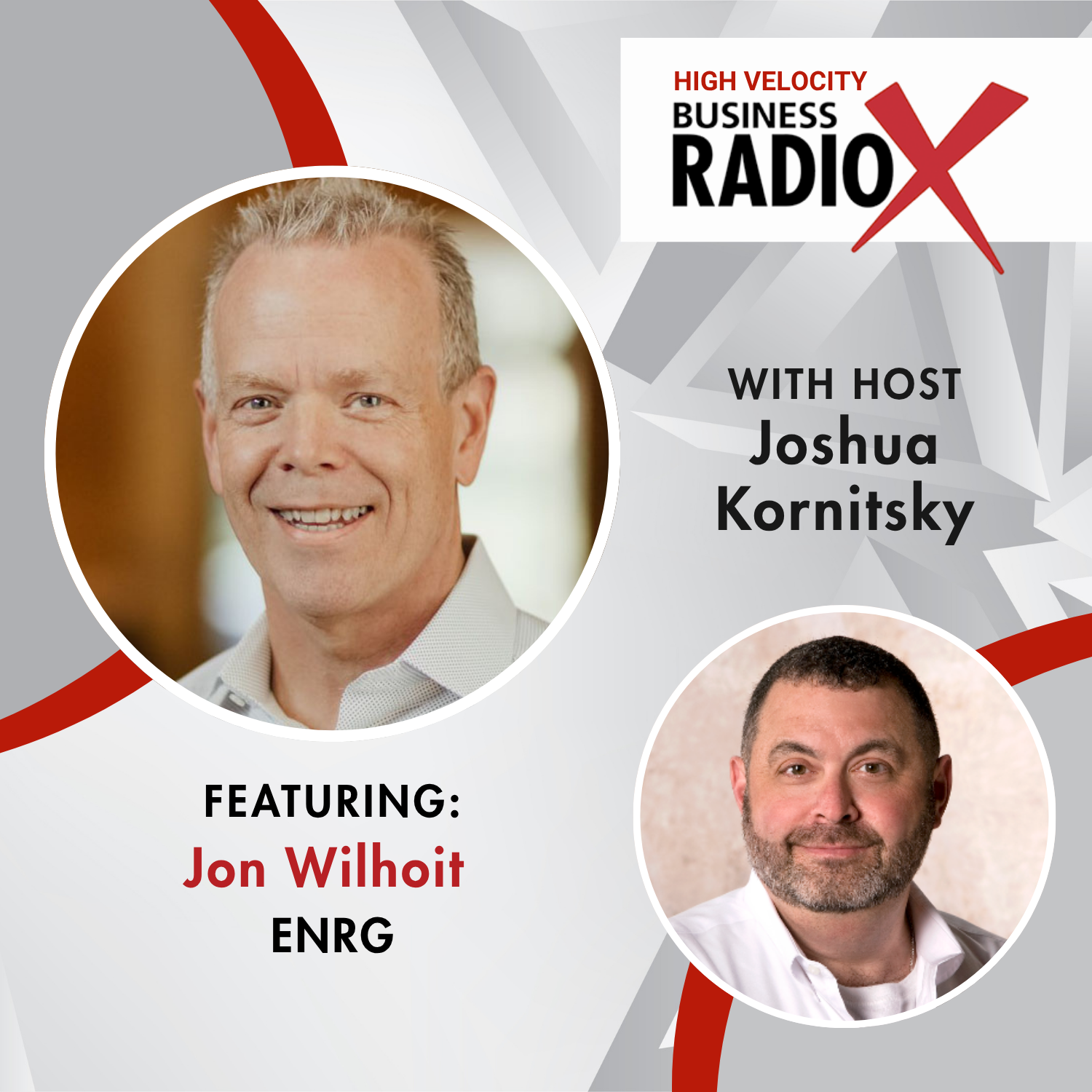

In this episode of High Velocity Radio, Joshua Kornitsky interviews Jon Wilhoit, an Atlanta-based EOS implementer. Jon shares his entrepreneurial background and how he discovered the Entrepreneurial Operating System as a practical solution for common business challenges. He announces the launch of Atlanta’s second ENRG community — a free monthly peer group for small to medium-sized business owners to share ideas, solve problems, and support each other’s growth in a confidential, non-selling environment. The group follows an EOS Level 10 meeting format and kicks off September 11th.

 Jon Wilhoit is an Atlanta native who attended the University of Georgia and subsequently earned his MBA from the University of Texas.
His career spans more than 30 years and includes time with entrepreneurial software companies and over a decade operating his own executive search business. Jon’s company, Elite Sales Professionals, became a market-leading niche firm helping small software companies secure top-performing sales talent.
Today, Jon applies the experience he gleaned from his own business, his customers, and employers to guide growth-oriented businesses to utilize EOS to overcome the barriers to success they inevitably face.
Connect with Jon on LinkedIn or jon.wilhoit@eosworldwide.com
Episode Highlights
- Introduction to the Entrepreneurial Operating System (EOS) and its significance for business owners.
- Jon’s background in entrepreneurial environments and executive search.
- The launch of the ENRG community for small to medium-sized business owners.
- Structure and purpose of the ENRG peer group meetings.
- Importance of confidentiality and trust within the ENRG community.
- The value of peer support and collaboration among business owners.
- Common challenges faced by small and medium-sized businesses.
- The role of EOS implementers in guiding businesses through the EOS framework.
About Your Host
 Joshua Kornitsky is a fourth-generation entrepreneur with deep roots in technology and a track record of solving real business problems. Now, as a Professional EOS Implementer, he helps leadership teams align, create clarity, and build accountability.
He grew up in the world of small business, cut his teeth in technology and leadership, and built a path around solving complex problems with simple, effective tools. Joshua brings a practical approach to leadership, growth, and getting things done.
As a host on Cherokee Business Radio, Joshua brings his curiosity and coaching mindset to the mic, drawing out the stories, struggles, and strategies of local business leaders. It’s not just about interviews—it’s about helping the business community learn from each other, grow stronger together, and keep moving forward.
Connect with Joshua on LinkedIn.
 This transcript is machine transcribed by Sonix.
TRANSCRIPT
Intro: Broadcasting live from the Business RadioX Studios in Atlanta, Georgia. It’s time for High Velocity Radio.
Joshua Kornitsky: Welcome back to High Velocity Radio. I’m your host, Joshua Kornitsky. And today I’m joined by Jon Wilhoit, an Atlanta based EOS implementer who helps entrepreneurial leadership teams build stronger, healthier businesses. After a career including building companies, leading executive search firms, and working with growth oriented software organizations, Jon really found his calling as an EOS implementer, helping business owners grow, gain clarity, accountability, and long term traction. Today, he’s launching Atlanta’s second ENRG community, creating another place where entrepreneurs can build meaningful relationships and support one another’s growth. Welcome, Jon.
Jon Wilhoit: Hey, Joshua. Good to see you again.
Joshua Kornitsky: It’s a pleasure to have you here. And I want to learn all about ENRG, but just to make sure that everybody understands a little bit about your background, kind of give us your origin story. How’d you get here and, and what, what makes you so passionate about the work you’re doing?
Jon Wilhoit: Yeah. It’s interesting. I’ve always worked in an entrepreneurial environment for the most part. I had a couple of stints at some larger companies, but in sales, a lot of that is entrepreneurial too. And I’ve supported a lot of entrepreneurial businesses. And it’s funny, even when I owned my own executive search firm, as I worked in some other software companies, I recognized that, man. All the problems that I dealt with, they dealt with. So, you know, cash flow issues, employee issues, people not getting along, friction. I mean, just all the different things that come up. And you realize that, man, there’s a real need out there for business owners to have some support mechanisms in their wallet that they can go to that can help them turn things around and make sure that they’re operating on a really, you know, right, uh, right way. So that’s where EOS just really rang the bell for me because it’s such a, you know, simple set of tools that are frankly not that easy to, uh, to, to take and work with. And that’s where we come in as implementers. Right. Um, but it just works. And when I saw the, the productivity that counterparts were, let’s stop there. I want to come, let me come, let me. Sure.
Joshua Kornitsky: So do you want me to ask it again or do you want to just pick it up because I need a clean place to edit it in?
Jon Wilhoit: Yeah. Let me hold for a second. I’m going to come back to, um. You know, that’s where EOS.
Joshua Kornitsky: Sure.
Jon Wilhoit: Fit the bill. So, uh, so that’s where EOS just really rang the bell. It was just something that came to me through some friends. I evaluated it at first it frankly looked almost too simple, but then I started to hear the success stories around it and I realized, God, man, this thing is powerful. And within that, now that I have been an implementer for a while, I realized that there are people out there that are using iOS. There are people that are interested in iOS, and they need a group around them that frankly, speaks the same language. And that’s where this ENRG community comes in. So our group that’s up in the North Fulton Alpharetta area, is the largest ENRG community in the country out of about 80. So we realized, wow, man, there’s there’s room in Atlanta, uh, for another one. So, so our new chapter is going to be down in kind of that Battery Galleria area.
Joshua Kornitsky: Very good. And, and for those of us who don’t know what is ENRG.
Jon Wilhoit: Yeah. So ENRG, it’s a, it’s a free group to join and participating in participate in. It stands for entrepreneurial networking resource group. And think of it as a peer group of other business owners that want to get together, share ideas, help each other solve issues, and really build a support group around them that, like I said within the iOS world, speak the same language. And so the meetings are set up just like an iOS quarterly meeting. So you kind of get a, a mini conference, you know, once a month where you’re going to learn some things that, that apply to your business. There’s no selling this going on, but instead, it’s just a way that you can get together with other business owners and share ideas in a framework that everybody is familiar with.
Joshua Kornitsky: So what surprises people when they go to their first meeting?
Jon Wilhoit: It varies. So if they are already, you know, utilizing iOS as their operating system within their company, they, they come to the first meeting and are kind of blown away with, wow, I get another bite at the apple with a group of people that are bringing ideas from outside my company. So there’s no, you know, history, there’s no familiarity that walks through the door with their business that may present something of a rut. Now they’re getting the benefit of those other business owners who are bringing an entirely fresh set of perspectives on the business and on the issues that they might, might happen to have. Uh, if they’re unfamiliar with iOS, they get a taste of an Elton. And that is usually the thing that really kind of pops the court for people is when they walk into a meeting, they’re like, wait a minute, meetings can be this productive all the time.
Joshua Kornitsky: How dare you?
Jon Wilhoit: Yeah, yeah. It starts off with not letting people just, you know, word vomit their, their, their intro to each other. It’s not allowing people to take their issue and make it the priority of the day. It’s about the group, you know, coming to the table and saying, hey, this is, this is the way things are going to be most effective and efficient in this meeting, and we’re going to pound through as much material as we can. And it’s just, again, super impressive to them.
Joshua Kornitsky: That I mean, it certainly sounds like it’s going to make an impact on somebody walking in for the first time, whether they have experience with iOS or not. Um, yeah, just diving in a little bit more around ENRG itself. Is it intended for specific types of businesses, for different types of business owners? Who, who is the target that you’re hoping you attract?
Jon Wilhoit: Yeah, it is open to anyone. I think that, uh, as a group, it’s probably most effective for business owners that are kind of in the iOS world, for example, they probably have, you know, ten, 15 or more employees, but it’s probably not for an executive at a company with a thousand employees. It’s that small to medium sized business owner who wrestles with problems, you know, ranging everything from, hey, we make lousy decisions. Our, our, our issues come up again and again and again. There’s people friction. We’ve got people that maybe, you know, we’re not not great hires, but they’ve been around for a long time. So all the gamut of issues that small businesses deal with tends to be fairly similar within a bandwidth of size. Some of this, you know, this bigger than that. Golly, they’re wrestling with compliance and SEC issues. Sure. Somebody that’s a solopreneur, they don’t have employees that they’re having to wrestle with. You know, they, they really have a subset of problems that are a little different. So kind of that middle small to medium sized business ground is, is really, you know, where we see things landing the, the best.
Joshua Kornitsky: And so understanding what I understand about us, but assuming that anyone listening to this may not be the first thing that that jumps to my mind is, okay, so now we know who we are best positioned to, to offer assistance to, with, with what you’re doing with ENRG. Um, let’s talk a little bit about mindset and attitude. What, what should someone coming to a meeting, um, where does their head need to be? Because chances are as, as you’ve already spelled out, they’re juggling a lot of issues. They may not yet realize everybody else has similar issues, but where should their their head be when they come to this, uh, ready to, to jump in and give answers, ready to jump in and ask questions.
Jon Wilhoit: Yeah. So let me, let me kind of frame the meeting itself. So they have an idea of kind of the agenda and that will, will flow into that. So the agenda, like I said, is very much like a level ten meeting that we would have, um, as a quarterly or that they would have on a weekly basis. So everybody introduces themselves quickly. It’s not a sales pitch. This is not like one of those networking meetings where you get 45 seconds to, sure, hey, here’s my perfect customer. This is simply, you know who you are and what you do and what your company does. Um, after that, we’ll usually have some content that would either be perhaps, you know, me delivering a deep dive on the accountability chart tool within the iOS framework, but it could also be information from a sponsor. For example, uh, sales acceleration is one of the sponsors of the ENRG world, so they may come in and deliver information about, hey, here’s the, you know, the best way to set up a comp plan or how to hire better sales people, things like that. So it’s, it’s presenting information, not selling. Um, after that, we go into, as you know, the acronym IDs. Ids stands for identify, discuss and solve or identifying the root cause of issues, discussing those and presenting a solution. So we list issues on the board from the participants that are there. We prioritize the top three. We go after those in order and then we go to the next three.
Jon Wilhoit: Somebody coming into the meeting should have the mindset that you and I are familiar with, which is open and honest. I’m here to be open. I’m open to people’s feedback, and I’m going to present honest feedback in a respectful way. It’s certainly okay for somebody to come observe early on, but the more they participate, the more benefit and value they’re providing their peers, and the more they can expect to receive from those peers when they have an issue that needs to be solved. So ENRG has four core values that we operate by. Um, we’re givers number one. So this is about helping first. This is about come prepared to offer insight and your expertise to help your, your community peer group be better business people. Um, we’re growth minded, so we want to come in and be prepared to, um, you know, receive information, but focus on how we can help other companies grow. It’s about being in community with each other. So being respectful, open, honest, um, and then having an abundance mindset that, you know, we’ve all got to take some risks and, and maybe do some things that are, are going to be helpful for somebody else. And, and, you know, there’s room for everybody to be successful. But one thing that I think is really important, we very much subscribe to the idea that you have to come into this committed to the idea of confidentiality.
Joshua Kornitsky: So why is that?
Jon Wilhoit: Well, in order for this to be really effective, a business owner has to be open to the idea that they can share meaningful issues that they need help resolving if they’re going to come in and hold back and only share superficial issues. I get it. It’s a competitive landscape out there, but they begin to trust this team that they have within the ENRG community to say, I can really, you know, put some things out there and get real help on. So it’s been super, you know, interesting in the the North Fulton group to hear some of the problems that that come up, everything from marketing strategy to hiring strategy to, you know, utilization of AI. I mean, it’s just been wonderful to see that these people are walking out of there with great ideas about how to make some shifts in their, their operation to get better results.
Joshua Kornitsky: Well, and you touched on something, Jon, that that I think is, um, it’s a universe you and I both have familiarity with, but I don’t know that everybody else does. And I want to make sure that we expand on it a little bit. Explain, if you would, the value of sort of that peer counseling or peer community. Because when we say peer in this context, we’re talking about what.
Jon Wilhoit: Yeah. So these are other business owners, again, of companies that that are probably of a similar size.
Joshua Kornitsky: Okay.
Jon Wilhoit: So I like to, to paint the picture of how a lot of companies have, have grown up and you’re obviously going to be able to relate to this because you see it, you know, within your clientele. I’m sure, you know, a business owner is excited. They’ve got some expertise from whatever they’ve done in the past and idea has percolated to the surface. They decide, I am going to launch this business. And the business could be, you know, anything. But let’s say it’s a small manufacturing operation. They’re bootstrapping things. They’re trying to figure out how to how to make progress. They maybe bring someone in that was, uh, you know, a friend or a partner or a colleague from before. They’re working almost as a partnership. They still need some more help, maybe in the warehouse. So they hire Marvin. You know, and Marvin is a guy that maybe they went to high school with. And he’s got two qualities they really appreciate. He’s available and he’s inexpensive.
Joshua Kornitsky: There you go.
Jon Wilhoit: So Marvin comes in and he’s doing the things that they need him to do. And the company continues to grow. And they hire a couple more people. And one day that business owner wakes up and they realize, man, it’s been seven, ten years. I’ve got 20 employees. Half of them are marvins. They were available at the time. They were the right price, but they really haven’t grown with the business. A lot of them don’t get along. None of them really seem to understand where we’re trying to take the company, and it’s impeding my ability to handle quality.
Joshua Kornitsky: Yeah.
Jon Wilhoit: So produce cash. I mean, all the things that go into truly running the business. And so when that business owner walks into an ENRG meeting, they’re immediately realizing I’m not alone. These problems that I have are problems that other people in this community have already solved and can help me solve. And I don’t need to try to pretend any longer that everything’s fine. Because let’s face it, we walk into a you meet a business owner at some function or, you know, out on the golf course. How’s business? It’s fine.
Joshua Kornitsky: Everything’s great.
Jon Wilhoit: Yeah. It’s great. You know, and then, you know, six months later, they’re calling you and you find out that God, they’ve at their burn rate, they’ve got, you know, four months of business left before the cash is gone. And if they had. Right. Right. So fine, fine as such a bad place to be.
Joshua Kornitsky: Is it as as someone who has, uh, attended the, the other chapter multiple times as you’ve watched people, um, come to realize the value of, of that peer advice, uh, that peer guidance, uh, do you see lights go on? Is it something that, that you can feel the difference, the shift in the room when people are getting the help they need?
Jon Wilhoit: Yeah. And I think a lot of times the, the light bulb that goes off is the fact that there are other people out there who truly are interested in helping them. And then they come back, you know, a month later and they’ve established a relationship now. So they’ve, they’ve gone beyond the ENRG meetings to really say, God, this is somebody that is worth having a periodic conversation with. And it goes both ways because they’re bringing experiences to the table, even though it might be some of their issues that we’re wrestling with. Um, they step up and say, hey, look, I’ve got some experiences that might be helpful to you as well.
Joshua Kornitsky: Makes perfect sense. So. So let me ask you this, Jon, because you’ve invested your own time and your own ENRG into launching this community. Uh, what are you personally most excited about?
Jon Wilhoit: So, Josh, that’s a great question. As you know, you know, one of our core values at EOS is help first.
Joshua Kornitsky: Sure.
Jon Wilhoit: And I’ve always been very active in the organizations that I’ve been a part of. Um, with EOS, this was a way that I think that, uh, there’s a path for me to give back to some of these companies. So they, they need help. I think that it’s something that people need the right environment to plug into, where they become more receptive to help. It’s a place they can come and participate, uh, build relationships, but they’re not walking in the door as. Oh, you know, poor me, I’m. I’m the victim. They get to walk in the door as. Hey, I’m here to form relationships and help others just as much as this is going to help me, so I see that for me as a way to kind of create that environment. You know, there are a lot of peer groups out there. Let’s face it, they’re, you know, some of them cost as much as $25,000 a year. And. I’m not knocking those. There is a whole spectrum of peer groups out there. But this is one in which people that are at least iOS interested come and will learn the iOS framework. They’re going to learn the benefit of a lot of the tools. And again, not that we’re selling, but that is some of the content. I’m not going to hide that. Sure.
Joshua Kornitsky: Um, well, it’s the structure you use to impart the lesson. So it only makes sense.
Jon Wilhoit: Yeah. Yeah. It works. And it’s, it’s powerful. And, uh, you know, iOS is so giving of the, um, you know, just the content that we make available on iOS worldwide. Sure. So this is to me is just an extension of that. And there will be companies that come in that maybe are, um, not large enough to embark on an iOS implementation. And great, we can hand them off to the Leap Academy. There’s resources and an opportunity for them to move in that direction. But I love seeing, I love that’s why I was an executive search guy, man. That’s why I started that firm. Oh, I don’t know what it is about kind of the whole business matchmaking thing, but I love doing it. So I love seeing people that get together in groups like this and do form relationships and friendships and, and help each other. Yeah.
Joshua Kornitsky: So if, if I have you on again next year and we’re looking back, what would you say would need to have happened over the course of this next year to to say it was absolutely worth doing?
Jon Wilhoit: I would love to see a core group of people in the group. And when I think of Core Core group, I’m thinking, you know, probably 15 business owners that have really formed a nucleus for this new chapter. Um, I don’t, I don’t have a driving goal to make it the biggest chapter in the country.
Joshua Kornitsky: Sure.
Jon Wilhoit: I want it to be a chapter where there are just really solid business people in there who are humble, who come ready to accept help and are willing to be open and honest and put real issues on the table. Uh, and that they are also willing to be forthcoming and help, you know, some of their counterparts and will speak truth to them. You know, not not hiding, not, you know, um, sugar coating anything, but really providing meaningful feedback that helps them advance their businesses. And so if we’ve got a good core group of people and they are really collaborating with each other and providing great feedback and insight, to me, it’s a huge success. That means other businesses are becoming more successful.
Joshua Kornitsky: And that helps everybody. Yeah, that’s, that’s I, I’ll, I’ll do anything I can to help support you in that goal because it certainly sounds like it would help all of our communities. So last question. I’m, I’m putting myself in the shoes of somebody who’s hearing this and, and, um, frankly, it sounds a little too good to be true. And it sounds like it’s just a hook to bring me in as a prospect. And you’re telling me it doesn’t cost any money? Uh, what would you encourage them? What would you say to them? For somebody who’s a little skeptical about all that you’re sharing, uh, being available and open to them free of charge with nothing but a set of rules to help you keep orderly. What would you what would you tell them if they’re skeptical of this?
Jon Wilhoit: I would say, just email me. I’ll send them the information, you know, and it’s kind of funny. Joshua, you and I know this, and I hope that everybody that’s listening understands this about EOS implementers. Honestly, we don’t sell. No, because if I sell somebody on iOS and they’re not ready for it, I’m going to have to spend an elaborate amount of time forcing them, badgering them to do the work that it takes. And that’s not healthy. It doesn’t benefit them. They’ve got to want to be a better business. They’ve got to be interested in iOS. And if they embrace it and decide to embark on the journey, I will help them, you know, with everything I’ve got. But I am not going to drag them in. And if I detect that, that’s the case. So so I don’t want to sell them on ENRG. I don’t want to sell them while they’re at ENRG. I want to help them be a better business because this means better for their employees, better for their vendors, better for their families.
Joshua Kornitsky: That’s, that is a true statement to, to demonstrate who you are. Jon. Uh, than I could ever have said about you. You’ve just said it yourself because you’ve demonstrated your own core value of, of helping first. So, uh, I certainly think ENRG is worth anybody’s time to go explore. And I would strongly recommend it for anybody that’s even interested in learning more about it. Can can you tell us, Jon, um, you, you gave us the, the general geographic location, do you have times, dates? Do you have a way to sign up or not yet or.
Jon Wilhoit: Yes. So we are going to be meeting the second Friday of every month.
Joshua Kornitsky: Okay.
Jon Wilhoit: Our first meeting is scheduled for September 11th.
Joshua Kornitsky: Okay.
Jon Wilhoit: Uh, They will be from eight in the morning until 930.
Joshua Kornitsky: Oh, so it’s it’s really succinct.
Jon Wilhoit: Yeah. And, um, like I said, if they email me, I can send them a link to the, uh, microsite for this chapter. Okay. And my email address.
Joshua Kornitsky: We’ll, we’ll share both your email and the microsite, but please go ahead and give it.
Jon Wilhoit: Yeah. My email is Jon JON, there’s no h. So Jon dot Wilhoit WILHOIT at EOS worldwide.com.
Joshua Kornitsky: And we’ll publish the link to the microsite as well, because I’m sure that’s a bit long to get people following, as well as your email address so that people can find it. Jon, is there anything else that you want to add today?
Jon Wilhoit: No, man, it’s always great to see you and talk to you. And I’m sure I’ll, I’ll see you, uh, at our next Atlanta meeting.
Joshua Kornitsky: Absolutely. Um, well, again today I was joined by Jon Wilhoit. He’s an Atlanta based EOS implementer. He helps entrepreneurial team, entrepreneurial leadership teams build stronger, healthier businesses. After a career that included building companies, leading executive search firms, and working with growth oriented software organizations, Jon found his calling, as you heard yourself today as an EOS implementer, helping business owners gain clarity, accountability, and long term traction. He came today to share with us about the second ENRG community launching here in Atlanta. First meeting will be on September 11th. Thank you again, Jon, for sharing all that information and your perspectives and why you do what you do. We appreciate you.
Jon Wilhoit: Great. Thanks, Joshua.
Joshua Kornitsky: My pleasure. I am Joshua Kornitsky, your host here on High Velocity Radio. Thank you for joining us. We’ll see you next time.















