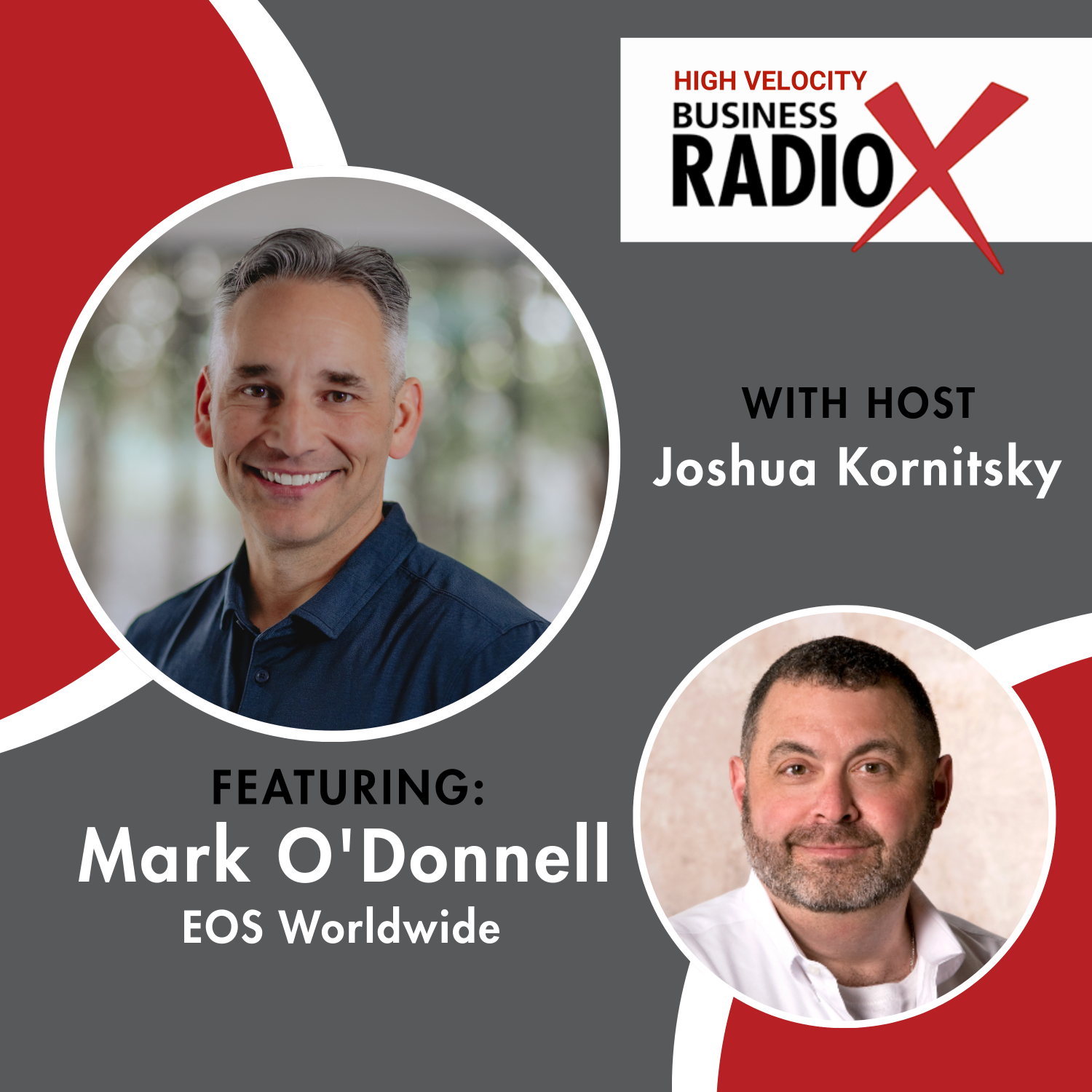

In this episode of High Velocity Radio, Joshua Kornitsky interviews Mark O’Donnell, CEO of EOS Worldwide. They discuss how EOS helps entrepreneurs and leadership teams clarify and achieve their business visions through a proven operating system. Mark shares insights on the importance of aligning personal passion and purpose with professional roles, overcoming entrepreneurial challenges, and the power of focus. He outlines EOS’s ambitious goal to impact 100,000 companies by 2035 and highlights tools for delegation, issue-solving, and building intentional cultures, offering practical advice for business growth and leadership.
 Mark O’Donnell is a highly successful entrepreneur, CEO, and Expert EOS Implementer. He is the current Visionary and CEO of EOS Worldwide and has also served as Head Coach for the company. With over 100 companies under his belt, Mark has helped numerous companies achieve their goals and get what they want from their businesses.
As a serial entrepreneur, Mark has founded and sold multiple successful businesses. His passion for helping people live their ideal lives led him to his current mission of assisting 1,000,000 people with tools like those found in the Entrepreneurial Operating System (EOS).
Mark is a lifelong learner and an alumnus of Albright College, Northeastern University, and The Wharton School at the University of Pennsylvania. He lives outside Philadelphia, PA, with his wife, mother-in-law, three children, and his one-hundred-pound dog, Blue.”
Connect with Mark on LinkedIn.
People: Dare to Build an Intentional Culture
https://a.co/d/52Htj2F
Data: Harness Your Numbers to Go from Uncertain to Unstoppable
https://a.co/d/23ano61
Preorder:
Issues: Remove Friction, Fast Track Your Growth, and Ignite Your Greatness
https://a.co/d/jiJYJQi
Episode Highlights
- Overview of EOS Worldwide and its mission to assist entrepreneurs and leadership teams.
- Discussion of the current entrepreneurial landscape and challenges faced by businesses.
- The importance of a stable, first-principles-based operating system in navigating complexity.
- EOS Worldwide’s ambitious goal to support 100,000 companies by 2035.
- The significance of delegation and the “Delegate and Elevate” tool for entrepreneurs.
- The concept of aligning personal passion and purpose with professional goals.
- The idea of the “adjacent possible” in innovation and continuous learning.
- The EOS approach to issue-solving and the DIKW model (Data, Information, Knowledge, Wisdom).
About Your Host
 Joshua Kornitsky is a fourth-generation entrepreneur with deep roots in technology and a track record of solving real business problems. Now, as a Professional EOS Implementer, he helps leadership teams align, create clarity, and build accountability.
He grew up in the world of small business, cut his teeth in technology and leadership, and built a path around solving complex problems with simple, effective tools. Joshua brings a practical approach to leadership, growth, and getting things done.
As a host on Cherokee Business Radio, Joshua brings his curiosity and coaching mindset to the mic, drawing out the stories, struggles, and strategies of local business leaders. It’s not just about interviews—it’s about helping the business community learn from each other, grow stronger together, and keep moving forward.
Connect with Joshua on LinkedIn.
 This transcript is machine transcribed by Sonix
TRANSCRIPT
Intro: Broadcasting live from the Business RadioX studios in Atlanta, Georgia. It’s time for High Velocity Radio.
Joshua Kornitsky: Welcome back to High Velocity Radio. My name is Joshua Kornitsky. I’m a professional EOS implementer. And your host. My guest today is Mark O’Donnell. Mark is the visionary and CEO of EOS Worldwide, and he has elevated his passion for for helping entrepreneurs get everything they want out of their business to a level that it’s all he does every day. And Mark is really here to help us understand how EOS Worldwide is dedicated to helping leadership teams clarify, simplify and achieve their visions. Mark is the author of People Dare to Build an Intentional Culture, which is part of the EOS Mastery series. Data. Harness the numbers. Harness your numbers to go from uncertain to unstoppable and then coming in April. Issues. Remove friction, fast track your growth and ignite your greatness. Also part of the iOS mastery series. Welcome, Mark. I’m so happy to have you here today.
Mark O’Donnell : Great to be here. Thanks for having me.
Joshua Kornitsky: Thank you. Um, so I want to begin at the beginning and ask you something that may seem silly, but, Mark, how do you define your role as visionary at EOS Worldwide?
Mark O’Donnell : Yeah. So generally it’s really the five bullet points on the accountability chart. Really the the one that people have, uh, sort of out of the box, if you will, right. As, as a visionary. But ultimately it is creating and inspiring the vision, taking it to the next level, enrolling implementers and the EOS Worldwide team into that vision and being the face of the company. So I do a lot of work, a lot of writing, as you mentioned with the books, I do quite a bit of podcasting and social media posting and all that kind of stuff, really just driving top of the funnel awareness to iOS as a system and as a method for getting everything you want from your business. I own big relationships and creative problem solving and things like that, so that’s generally my role. It’s not that I am the only source of vision. And as the third visionary at iOS Worldwide, it was really inherited right from Gino Wickman to Mike Patton. And now to me and taking that to every corner of the earth, that’s really what the role is more of an evangelist, I suppose.
Joshua Kornitsky: And actually, I would tell you that that’s the one that I think most clearly communicates because it’s on you more than anybody, to carry that vision out into the world. And also talking about the future, which we’ll get to in a little bit. But I want to start by asking you about the current entrepreneurial landscape that’s out there right now. And and I know that you have seen, uh, really from small companies all the way up to enormous organizations. When you look towards the future of that ecosystem, what do you see? How do you see EOS helping? Right. Sure.
Mark O’Donnell : And, you know, I’ve had a little conversation prior to starting the show, which is that EOS is based on first principles. And I want to start that conversation really rooted in that as a fact, or at least as far as we can see it. And so just to define what I mean by first principles. So it’s sort of like physics, right. It’s taking in removing all the superfluous things and deciding on what is signal versus noise, and you’re just removing everything until you can’t remove anything else. And then it just works over and over and over again because it is proven so. It is simple. It’s like gravity. It just works and there’s nothing really you can add to it that’ll change or modify it and make it meaningfully better. And so it’s just that, that sweet spot where it’s that solid foundation. All right. So and when Gino was creating this system and we get knocked by competitors all the time like, oh, they only have these 20 tools in the toolbox. They don’t add or create anything new, which is not necessarily true. We do add things as we go, but it is all based on experience and it’s all based on lever pulling, showing a tool or a concept to a client. And let’s go try that 100 times, a thousand times and make sure that we consistently get the results that we expect over and over again. So in other words, it is proven to work for any type of client in any environment that gets them clear on what they want from their business, and then they can go and execute on it in a more clear, focused way so that we’ll just accept that as the basis of first principles as it relates to business operating systems and tools.
Mark O’Donnell : Right. And when we look at the the macro environment that we live in, there’s just a ton going on. There’s a lot of noise all over the place, a lot of change with AI, you know, how is this going to affect my business? We have tariffs in some cases, you know, at the beginning of 2025 and a little bit now where people are very uncertain, there’s a tremendous amount of uncertainty that exists. And that’s been the case all throughout history. It’s nothing unique whether it’s AI or the internet or, you know, electricity or the steam engine, or the earliest I could find someone complaining about technology and how it’s going to ruin their life in the future is over with 600 BC, where someone was complaining about the introduction of the sundial. Like, it’s going to ruin our lives, our jobs are going to be disappearing. And you know, now we have to actually show up at a certain particular time and and our whole way of living is over. And so, you know, this is just human. And so the role iOS has in this turbulent environment that has always existed, it will always exist into the future, is to be that stable, first principles way of operating a truly great organization. It can be a business, it can be a nonprofit. It can be any organization where people are coming together to achieve a common goal. Eos is a proven system and method where they can systematically get what it is that they want. So that’s what I see. Our role is providing that simple, clear, proven, first principles based method to achieve and get everything you want from your your business.
Joshua Kornitsky: And thank you for that explanation. And as you look into a longer term view of how, say, over the next ten years, EOS might impact an ecosystem in just the United States, we’ll talk about the rest of the planet in just a little bit. But just in the US, what are the goals for the next ten years?
Mark O’Donnell : So our goal is our ten year target is 100,000 companies running on EOS by 2035. Right. And so 100,000 companies were at 31,000 right now. And I just want to sort of kind of give you the, the full view of what the impact that looks like.
Joshua Kornitsky: And that’s what I really and.
Mark O’Donnell : Yeah. And and so for implementers like yourself, there’s about 900 US implementers today. We’ve worked with 31,000 companies. And so we can just kind of do the math there and say, all right, 100,000 companies. The average client stays with an implementer about two years. The average implementer works with about 150 companies in their entire lifetime. Uh, in because about 10% of our clients will not make it through two year journey, about 80% will graduate from the process by design in, uh, that two years, and then 10% will stay with you forever. And so what ends up happening is implementers sort of go offline. You’re not adding that many focus days anymore. I think Geno hasn’t done a focus day in 7 to 9 years or so. He has, but he has a book of clients still to this day. And so when we think about that, we need about 5000 EOS implementers to achieve 100,000 companies running on EOS. So we’ve got about A5X increase required in order to to hit that number. The average company we work with, the 3 to 8 people at the helm of the business, the leadership team.
Mark O’Donnell : But the average company size is about 47 people. And so when we think about 100,000 companies by 47, we now are starting to positively impact the lives of of millions because they’ve got family members. And we just see this over and over and over again, that when a company is running on EOS, they’re basing not only their business in first principles, they start to base their life in first principles. They’re happier, they’re freed up to work according to their highest The contribution, the the dent in the universe that they can individually make and that starts to go into their families, that goes into other aspects of their their life. And so we’re we’re really excited about the impact that we can have over the next ten years. And we also know that about ten times the number of companies running on us with an implementer are self implementing. They’re using our tools and they are really making a difference. Um, we do know that they get better results when they do use an implementer, but not everyone has that luxury. And so we’re still making an impact nonetheless.
Joshua Kornitsky: Well, and I think of the fact that terms like level ten, terms like IDs are already becoming ingrained in the business community because as you as you intimated at at 31,000, working with an implementer, there’s probably five times that, if not more, that are familiar with our tools, that are using them in some form or fashion. As that 100,000 number gets closer and closer. I have to think that that the impact of the common language and the impact of the common concepts will permeate a whole lot of businesses.
Mark O’Donnell : Yeah, there’s no doubt about it. And we’re seeing that already. And so a lot of that common language around business starts in universities. And so we’ve got quite a few universities that are using traction and other books in the Traction Library as curriculum for MBA students. And so we start to see that common language being just part of how you run a truly great organization. And that’s ultimately the goal, is that every business owner, every future entrepreneur, everyone who goes to business School comes out and understands that in order to run a truly great meeting, I’m going to run this thing called a level ten meeting. And that’s the goal. And so we’re incrementally making progress around that. It it’s going to take about 3% of the population apparently is the tipping point where it becomes a mass movement. And really a movement is what it is that we are creating.
Joshua Kornitsky: So I agree with that. And I and I think that as as us continues to build momentum, it will bring more and more, as they say, the rising tide will lift all the ships. Um, but I want to zero back in on something, because I think you do have a really unique perspective from from the seat that you’re in, not just because you’re the CEO and the visionary for us Worldwide, but because you’ve been an entrepreneur yourself. When when you think about being an entrepreneur and you think about, um, the frustrations that an entrepreneur, particularly in a time of, let’s just say great change, which is a fair statement, I think. Right. When what are the things that that the commonalities that you’ve seen that help the entrepreneur realize that, that they’ve pushed as far as they can push and they’ve got to reach either for a lifeline or some help or find a different way forward. What are some of those common roadblocks that you see? Because I think one of the things that I encounter when I talk with all sorts of business leaders is they don’t realize they’re not alone.
Mark O’Donnell : Right. Right. Well, I think. I’ll take it back to why you become an entrepreneur in the first place. A mentor of mine once said, you know, entrepreneurs have this perfect combination of ignorance and ego. And you know, they they are too dumb to know they can’t write. They’re just totally ignorant to the fact that what you’re trying to do, the probability of you winning is near zero, like so. But you’re doing it, and then you have the ego side of that that says, I could do this. Like, let’s go. We’re gonna go do this now. And so that’s the kind of person you have who’s just this driven human who, despite all odds, has the belief in themselves and the people around them that they can create something of value in the world and for people. Right. So they’re creating value for themselves. They’re creating value for the world. And they have this combination of let’s go do it right. There’s really this driven person. And so once they get started they start to hit these hitting the ceiling. Right. They start to not achieve the profit that they want.
Mark O’Donnell : They start to lose control Of the business. They really they’re just hitting the the ceiling. There are people they can’t find the right people that fit with them. And so and they’re trying all the things right. They’re there because they’re this driven human. They’re reading all the books, they’re joining all the peer groups. They’re doing everything they can to break through the ceiling, where they just have this sense of being stuck and frustrated, and they’re living in this chaos that they’ve created. Right, right. And. I kind of going back to first principles is that because they’re reading all the books and they’re joining all the groups, we need to simplify it for them so that they can systematically look at and understand where they start and where other people need to begin. Right. And so they we call the the tool, the delegate and elevate tool. And which I think is just one of the tools that we teach that is underrated if possible. Right. And it’s an important tool that we teach. And I say it’s underrated because I’m not sure everyone fully understands the power of it.
Joshua Kornitsky: Delegation is scary.
Mark O’Donnell : Delegation letting go is scary. But a lot of it is. It is scary to let go. But why is it that way? Well, I believe that every human was put on this earth. You’re the only one like you that has ever existed in the world, and the only one like you that ever will exist into the future. And so you’re it, right? You’re it. And so you. But we get kind of piled on as we go through life, and we say yes to a bunch of things that we shouldn’t, and we really lose our purpose in the world. Like what? What is unique about me and and what is the thing? The only thing that just I can do in this point in time in history with the skill set that I’ve been been given. And so when you think about it in those terms, you are taking away all the things that are not you, so you can be unlocked and free to operate according to your highest contribution. So I think what happens to entrepreneurs when you go through that process? It’s you’re going through this level of self-awareness, exposure, your identity is being formed or redefined, and ultimately you end up as your six year old self. Right? But as an adult, um, so my point with that is that that is the scariest part is really to come to grips of. There’s one thing that is my highest contribution, and I’m going to live in that upper left quadrant of things I love to do and I’m great at, and it will be refined over time because we’re not perfectly accurate when we started out. And so things you just keep shedding, shedding and shedding until you are living in that highest contribution. And so that when you start with that entrepreneur and then you work your way throughout a leadership team, the amount of impact that just that tool alone can have on individuals, families and companies is miraculous. I mean, it’s just when we see it, it’s amazing. So hopefully that answers the question at least a little bit.
Joshua Kornitsky: I think it does. And I think the the real message that you’re delivering is that you’re not alone. Right. That what you as your own self, as an entrepreneur, Mark experienced is the same thing that literally millions upon millions of men and women are experiencing every day. And there is a lifeline.
Mark O’Donnell : Right? There is a tool. There’s people who are going through the same process. And that’s why we sell out the US conference every single year, is because we’ve got this big group of people who are going through the journey at the same time, right. They’re going through that self-discovery process. How do I create an organization? How do I group a bunch of people together who are on the same mission as I am? Um, and so it it creates a sense of community. It creates a sense of I’m just normal. This is what humans do. And so, uh, yeah, it really has a big impact.
Joshua Kornitsky: So we’ve touched on this a couple of times, and I just want to ask as, as you look towards the future and you look towards as put on your visionary hat and you envision how, um, the leaders of the future, the next generation that is rising up, how how can you speak to what their needs are and what is it that EOS can do to help someone who is earlier in the journey, or knows that they are destined to take over the family business at some point down the road. What can we do to help them prepare?
Mark O’Donnell : I think the first step there is something that we call the personal core focus, and we wrote about this in the people book. And so it’s really an intersection of your delegate and elevate tool. So you create a laundry list of all the things that you’re doing. You get really crystal clear on your four quadrants love great light good. Don’t like but good don’t like. Not good. And then how does that align with your your passion, your purpose? I mean, even I and I kind of look at um, core focus. We say purpose cause or passion. I’d like to reverse the order and say passion is sort of like step one. That’s rookie level. A purpose is step two. And that’s you’re making some external impact. It’s Make applying that passion and using it for good. But then it causes and it brings everybody in and they’re pushing that forward, that purpose even further into the world without you. So you got to get really crystal clear on your purpose, your cause, your passion, which you can, uh, your unique value that you bring to the world and defining that for yourself as best you possibly can as early as you possibly can, and then have that update that quarterly and make sure that you’re always operating in your own individual personal sweet spot.
Mark O’Donnell : And then you’re either creating a company around that which as an entrepreneur, or you’re joining a company that is in line with your personal core focus. And what we, uh, when we wrote about this in the people book, and I’m not sure it’s completely obvious and I hope it’s not, is that we’re actually breaking down the idea in the construct of a company and saying, you are you’re really a company in its ideal state is a collection of people who have a shared their personal core focus matches the core focus of the business. And if you’re not a fit in that organization, that’s okay. You’re just going to come out of that and go get attached to another company who is more in line with that, who has a role within that organization that you get one has the capacity to do it. Um, sort of your personal niche, if you will. Right. Uh, and so, uh, that’s kind of the way that, um, we’re, we’re thinking about that. And so for the young people out there, get really clear on that as early as you possibly can and know that it is not set in in time. It is what I refer to as the adjacent possible. Are you familiar with the term the adjacent possible?
Joshua Kornitsky: I understand it semantically, but not as a common phrase. So where is it from?
Mark O’Donnell : So it’s really how innovation occurs, how learning occurs. And, uh, the best way I can describe it is imagine you’re in a room, you walk through a door and you’re in this room and there’s three doors in front of you. And in that room, you, you know everything there is to know about what’s in that room. You’re experiencing it. And you have three doors in front of you. Which one do you open? Pick one of the three.
Joshua Kornitsky: Number three.
Mark O’Donnell : Number three. Why? Because it doesn’t matter. You just open a door, you walk through it, and now you’re in another room. You’ve learned everything you need to know about that room. And you’ve taken with you everything in the room that you came from. And you’re presented with three more options. You just open up another door and that’s how you’re really going through life is that as you are taking action, as you are engaged in learning and growing. With that core focus as a filtering mechanism, you get, you refine, you tweak, you hone, refine. It is a never ending process. And you know, that’s why I don’t believe in retirement. Because, you know.
Joshua Kornitsky: A pretty good teacher, Mark, I gotta tell you.
Mark O’Donnell : Um.
Joshua Kornitsky: But but it it it brings to mind something that I’d love to get your perspective of. And I want to be conscious of your time. Um, is is simply the fact that in in so many ways do you how important is that one step forward when when I think about iOS, when I think about the impact that I’ve seen it have, the analysis paralysis, the we’re not moving off this issue until we’ve talked about it to death, the idea that it has to be a perfect solution. Do you believe that iOS lightens that load and helps people understand that it’s about moving that ball just one yard further down the field.
Mark O’Donnell : Yeah. And that really comes into issues and how you process and solve issues and sort of the, the ten commandments of, of issues solving, uh, which I hope everybody, uh, preorders issues book and goes deep dive into that. And as it launches in in April of, of this year of 26. And the answer is we lay out the framework to solve that.
Joshua Kornitsky: Um.
Mark O’Donnell : But the team construction matters a lot. What I mean by that, uh, with Colby profiles. Right. And so, uh, we have fact finding follow through, quick start and implementer as sort of the three modus operandi that people just instinctually take action. Right. And so if you have a team that is overindexed on. Everybody’s a bunch of fact finders. They have a never ending amount of energy to gather data to gather facts. And so unless there’s some another team member that says, hey, we’re going to go do this now with some quick start, you’re probably going to be stuck. And so oftentimes it takes an implementer or some third party to say, all right, enough is enough. You’re not going to learn anything more sitting here in this room because you’re in that room, right? You’re in that one adjacent possible. We got to go through to the next door in order to learn more, in order to create, um, the result that we ultimately want. So that’s really step one is you got to understand that team, uh, construction, which we do work pretty hard at creating really high performing teams. Um, then I think when we identify the word issue, right, is it’s an obstacle, it’s a barrier, it’s an opportunity. Yes, it’s a problem. It doesn’t it’s not a negative connotation the way we talk about it. It is anything that is unresolved. Anything you need to do something about is is really an issue. So it’s anything that is left unresolved in the business preventing you from getting what you want. So it’s both positive negative. It’s really a neutral thing.
Mark O’Donnell : Sure. Um, the way I teach teams is the decay matrix. So the decay matrix is data, information, knowledge and wisdom. Okay. So when we think about fact gathering and data, we’re just collecting data points. We don’t really have, um, any real interpretation of what that data is. And we move to the next level. It’s information. So we’re taking that data and we start to have some meaning attached to it, but we don’t necessarily understand it quite yet. Knowledge is data. Information going to knowledge is about how do we interpret this data. How do we take action on this? But it still doesn’t really have too much impact. Wisdom only comes from experience. The only way you can have true wisdom inside of an organization, which you need to get what you want from it, is experience. So we’ve got to take action. We got to go do some stuff. And what when we finish that, then we look back to say, okay, what did we learn? Knowing what we know now, we’d do differently. And we just become the learning team quarter after quarter. And we do this in every single session. When we review the last quarter’s rocks, we say, okay, here’s the full accounting of how we did. What did we learn? What would we do differently next time? And so we’re creating these worlds in which we are creating wisdom inside of an organization, if that makes sense. And of course, you can make a joke out of it. Dick KW. Um. The answer is you don’t want to be a dick.
Joshua Kornitsky: Fair enough. You need the W.
Mark O’Donnell : Right? You need W’s where all the goodness comes from.
Joshua Kornitsky: Fair enough. Uh, last question mark. If I’m a brand new entrepreneur, what is what’s one takeaway? What’s one thing you would tell anybody starting out right now that would be, um, beneficial for them moving into the future?
Mark O’Donnell : Yeah. Focus is the number one power law in the universe. It is the only thing that matters. And so if you’ve got product market fit right, you’ve you’ve creating something that that people actually want to buy. Focus on that one thing forever. Uh, and it is the number one power law, both individually and from a business perspective. And if you can nail that, uh, you’ll do quite well for yourself.
Joshua Kornitsky: That’s fantastic. Thank you. Mark. I really appreciate you joining us and taking the time. My guest today has been Mark O’Donnell, the visionary and CEO of EOS Worldwide. He and everyone at EOS Worldwide are really focused on wanting to help you get everything you want out of your business. Mark O’Donnell is the author of People Dare to Build an Intentional Culture Data. Harness your numbers to Go From Uncertain to unstoppable. In coming this April and available to preorder on Amazon. Issues. Remove friction, fast track your growth, and ignite your greatness. I look forward to reading it. Mark, thank you again for joining us. I’m your host, Joshua Kornitsky. I’m a professional EOS implementer and host here on High Velocity Radio. We’ll see you next time.














