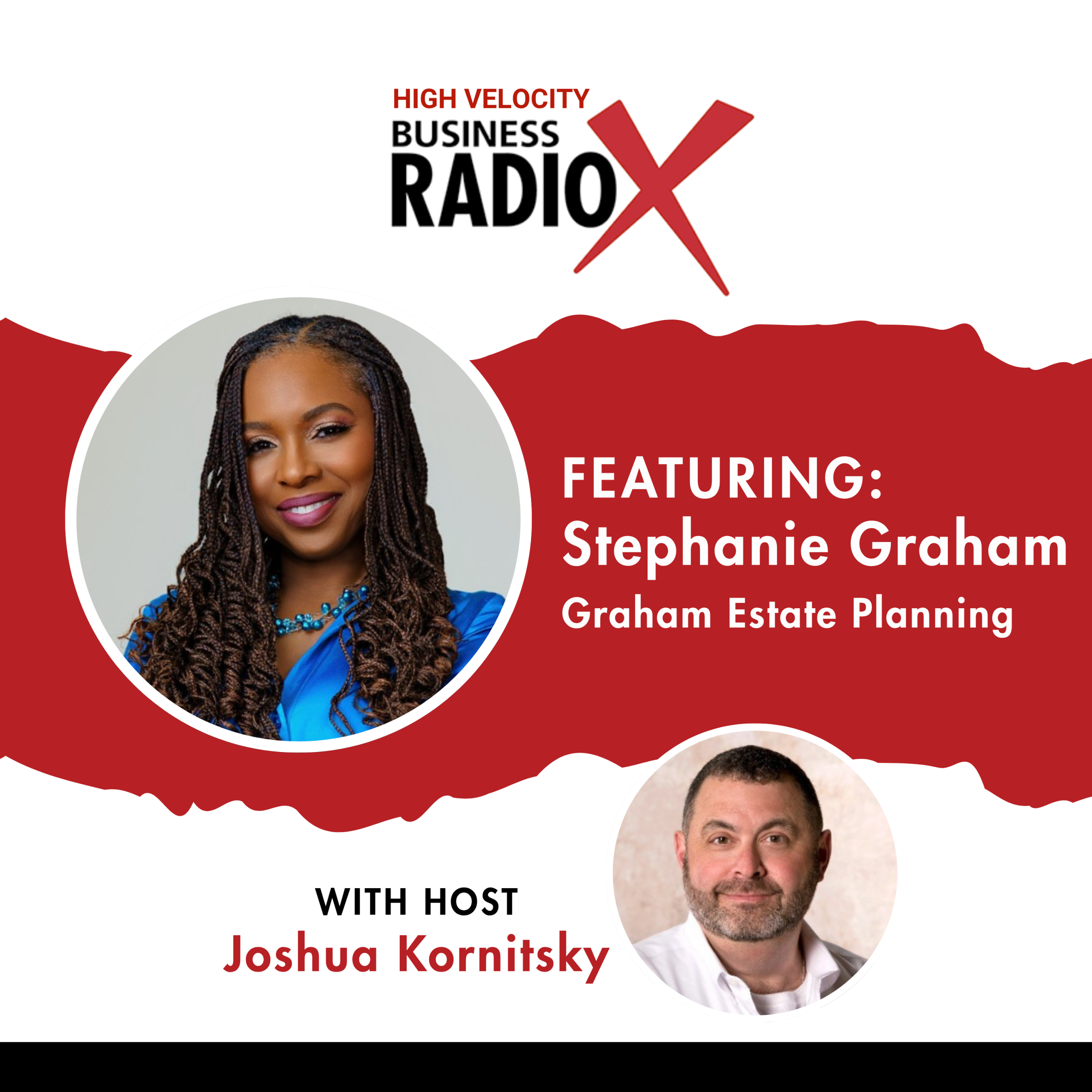

In this episode of High Velocity Radio, host Joshua Kornitsky interviews estate planning attorney Stephanie Graham, founder of Graham Estate Planning. Stephanie shares her personal motivations for entering the field and debunks common misconceptions about wills, powers of attorney, and property deeds. She emphasizes that estate planning is essential for everyone, not just the wealthy, and explains the risks of DIY wills and outdated beneficiary designations. Stephanie also highlights the critical importance of business succession planning for entrepreneurs. Her core message: estate planning is an act of love that protects families from unnecessary hardship and conflict.

 Driven by the loss of her family’s matriarch and the strife that followed, Stephanie Graham founded Graham Estate Planning in 2017.
A former prosecutor with a business degree, she combines legal expertise with deep personal insight to help families and businesses navigate estate planning and avoid conflict.
Connect with Stephanie on LinkedIn, Instagram and Facebook.
Episode Highlights
- Importance of estate planning for everyone, not just the wealthy
- Common misconceptions about wills, powers of attorney, and property deeds
- Differences between estate planning and business succession planning
- Emotional and practical benefits of having a comprehensive estate plan
- Risks associated with do-it-yourself wills and the need for professional legal guidance
- The role of beneficiary designations in estate planning
- The impact of estate planning on family dynamics and relationships
- The necessity of regular updates and reviews of estate plans
- Consequences of not having a succession plan for business owners
- The significance of clear communication about estate plans within families
About Your Host
 Joshua Kornitsky is a fourth-generation entrepreneur with deep roots in technology and a track record of solving real business problems. Now, as a Professional EOS Implementer, he helps leadership teams align, create clarity, and build accountability.
He grew up in the world of small business, cut his teeth in technology and leadership, and built a path around solving complex problems with simple, effective tools. Joshua brings a practical approach to leadership, growth, and getting things done.
As a host on Cherokee Business Radio, Joshua brings his curiosity and coaching mindset to the mic, drawing out the stories, struggles, and strategies of local business leaders. It’s not just about interviews—it’s about helping the business community learn from each other, grow stronger together, and keep moving forward.
Connect with Joshua on LinkedIn.
 This transcript is machine transcribed by Sonix.
TRANSCRIPT
Intro: Broadcasting live from the Business RadioX Studios in Atlanta, Georgia. It’s time for High Velocity Radio.
Joshua Kornitsky: Welcome back to High Velocity Radio. I’m professional EOS implementer Joshua Kornitsky. And today my guest is Stephanie P Graham. She’s the founder of Graham Estate Planning. Stephanie focuses her practice on estate planning, probate and probate litigation, helping individuals, families and business owners protect their assets, navigate complex legal matters, and plan confidently for the future. Whether she’s designing an estate plan, guiding a family through probate, or helping a business owner prepare for a successful transition, her goal is to provide practical legal guidance with a personal touch. Stephanie, welcome to the show.
Stephanie Graham: Thank you for having me, Joshua. I’m excited to be here today.
Joshua Kornitsky: I’m so happy to have you here. And I have about a million and a half questions, and some of them might might touch on 1 or 2 things that that hopefully you have expertise in because I have a lot of curiosity, but I also make a lot of assumptions. And the law is something weird about assumptions. But before we get to my questions, I want to start by asking you your background. How did you get to this place and decide on this type of practice? What? What drives you?
Stephanie Graham: Very good question. So when I attended undergrad, I worked through a bank for about six and a half years while working through school. And I had the unfortunate opportunity to observe several older women who were customers of the bank, who showed up to cash their checks and learned that their accounts were wiped out by their powers of attorneys. Oh, wow. So that encouraged my interest in estate planning. And when I attended law school, of course I was exposed to everything but my fourth year out of law school and my first year in a private firm, very dear friend of the family died, and I was living in New York at the time. She was visiting in North Carolina and she died due to hospital negligence. Um, and we had to establish a probate estate in order to sue the hospital in North Carolina. So that was my first exposure to probate. And then fast forward, I think about ten, 12 years later, my own grandmother passed away and there was no planning in place. And though my family will not say that there was any resentment or a dissension between the family, we have no longer celebrated Thanksgiving. And so I started my practice four months later, because that’s when I had a clear picture of how this affects the family unit.
Joshua Kornitsky: It. Speaking from my own personal experience. It’s funny when you’re talking about family on one hand and finances on the other. Uh, how that often can get awfully contentious. Uh, and obviously that’s everybody’s family and everybody’s financing. So, so let’s jump right in. And let me ask you, what’s the difference between the concept of, of estate planning versus what would be like, we, like I mentioned in the introduction, um, like business succession planning, are they the same thing or are they different things or do they have different focuses?
Stephanie Graham: Yes and no. Uh, so the estate planning side is a group of documents or a collection of documents that help provide for while you are alive and continue upon your death, such as your will and your trust. You have your healthcare directive and financial powers of attorneys that are effective while you are alive. That’s for your personal life, but your estate plan in conjunction with your business succession plan works together. But they are two separate things, though. Business succession includes estate planning. I hope that makes sense. So the business succession side is your will, and your trust can address the fact that you own a business radio X, but your business documents must control who runs Business RadioX upon your death.
Joshua Kornitsky: Then. I mean, I think that makes it clear, but you hit on something that that was both personal and quite expensive to me, and I and I want to shine a light back on it. You said something really important about the estate planning and will planning and power of attorney for when people are alive. My family learned a very expensive lesson making assumptions about powers of attorney. And when the family member died, we were not aware that a power of attorney doesn’t exist once the individual is gone. Is that. Well, let me ask rather than tell, is that the correct way to. It no longer has enforceability.
Stephanie Graham: That’s absolutely correct. It’s funny that you mention it because we had a TikTok post go viral, because I shared that little 32nd clip. By the way, powers of attorney or null and void when the principal passes away. Uh, and it is shocking the number of people who aren’t aware, but with my bank background, I take a lot of things for granted. But you are correct. Um, so when the person, the principal passes away, it is the will that picks up where the power of attorney left off. But if you don’t have a will in place now you’re scrambling, right? And so people come to us all the time. And you can imagine Joshua asking for Will. And I explained to them, you will need your financial power of attorney and your healthcare medical directive long before you need the will, but the will only comes into place when you pass away.
Joshua Kornitsky: Well, and and I’m I’m asking, not telling, because in our case there were, and I don’t recall the type of account, but we were caring for a family member who had left us in, in a long term, like 401 K type account had left directions and beneficiaries. Um, however, there was no other documentation. So the as I understood it and please help me understand it, the financial institution can only follow the directions it has as beneficiaries, correct?
Stephanie Graham: That is correct. Uh, if you say that you’re going to give your 401 K to Cookie Monster in your will or trust, but then your, uh, insurance policy actually states earning, earning is going to obtain, uh, the proceeds. And that’s one of the things we follow up on with our clients and the design meeting, we asked them, do you have a life insurance policy and when is the last time you updated it?
Joshua Kornitsky: So that brings up the the next question, which I think you just answered. You must have to keep an eye on or help your clients keep an eye on a lot of moving parts.
Stephanie Graham: Correct. We try to with our office, once you we give you a lot of information up front. We provide a survivor’s checklist as well as a little statement as to what to do, because there have been stories where folks will have a will in place and the executor they named not typically qualified, right, because it’s a fiduciary duty, but the executor went into the home and the decedent and started giving things away. Oh, based on the will without understanding it had to be filed in probate court. So we try to reach out within six months of your trust and say, hey, by the way, did you fund your trust? And then every year we try to reach out either by email or a letter or just a, you know, a thank you, a holiday card. Have you funded your trust? Has anything changed just to keep it top of mind? And we plug into our clients heads during the consultation and the design meeting and the signing. Don’t just put your binder on the shelf and forget about it. You. You have a duties. You have a to do list that we need you to take care of. So yes, lots of moving parts.
Joshua Kornitsky: So you just made me think of something and I want to ask it in a careful way. Um, when you, when, when I hear the term estate planning and when I hear the terms, uh, you know, the, the binder that has this comprehensive plan in it. Um, Stephanie, is this just a rich person’s problem?
Stephanie Graham: Absolutely not. It is everybody’s problem. Absolutely everybody’s problem. Who gains assets. And when I first started, interestingly, Joshua, a lot of men in particular would say in the audience, why should I care? I’ll be dead. Well, when a man passes away, it is really his family that completely falls apart. Uh, for lack of a better term. All h e double hockey sticks. Okay. Because he has kids, he has investments, etc. that folks don’t know about. So no, no, it’s not a rich person’s problem. It’s everybody’s problem, especially if you own a home, right? If you own a home and you don’t have an owner with joint rights of survivorship, it’s got to go through probate court. If you own a home and you don’t have a transfer on death deed, it has to go through probate court. And if anybody objects, it’s frozen. No one can find out about your mortgage. No one can talk to the lender. They might not even know who to pay and how much to pay. And that’s how people lose their homes. So it’s everybody’s problem who owns assets. If you get up and go to work every day because you want a better life for your family and you’re contributing to a 401KA pension and you’re buying real estate. It is your problem too.
Joshua Kornitsky: So that leads to what must be the most important question. What are some of the other common assumptions people make that are just wrong? Because everybody, most speaking on behalf of the non attorney portion of America, we were all educated by television. And it may shock you to know. Not that good of a teacher. So what are some of the assumptions that people make when it comes to the the long term planning or wills or deeds or homes?
Stephanie Graham: I think the best one is one that you just touched on that it’s for rich people. Uh, no, it’s for everyone. So that’s number one. Number two is the, uh, myth or misconception that your spouse automatically receives everything when you pass away. That’s not true. Uh, the third. Is that your deed to your home or any of your real estate property? If you have another person named on the deed, that person automatically inherits the real estate. That’s not true. And the fourth is if you pay the mortgage and the taxes on the property of somebody who died, you automatically own it.
Joshua Kornitsky: Would that be nice? I haven’t heard that one.
Stephanie Graham: Exactly. It’s a fourth of misconception and it’s absolutely not true. Now you have a lien. If you do that, you can file a lien. Sure. Get your money back. But you do not automatically own the property.
Joshua Kornitsky: Man, I don’t like 15 houses. I just go around finding unpaid taxes. Uh, yeah, I can see the flaw in that one. But the other things like when. So if you can elaborate a little with regards to, um, you know, a married couple who own a home, it doesn’t just go to the husband or wife.
Stephanie Graham: It does not. And at least four times a year I’ll make a random reel that just says, check your deeds and stop waiting until your partner passes away to learn that you do not own the house outright. So there are different titles on the deeds. If it’s named Jack and Jill and there’s nothing else, then Jack owns 50% and Jill owns 50%. Even if they’re married. So if Jack has children prior to the marriage, now Jill is going to own Jack’s interest. With Jack’s children. Um, so the only way.
Joshua Kornitsky: Unless there’s something that supersedes.
Stephanie Graham: Exactly. Which is joint tenants with rights of survivorship. And if it’s just you on the home, same thing if you’re married, but your partner moved into your home and you haven’t changed anything, they are not necessarily entitled to half. It really depends on how many children you have. So now your children are going to inherit along with your surviving spouse, because only your name was on the deed. So essentially, if you don’t put a plan in place, the government has one for you.
Joshua Kornitsky: Oh, that’s always a good idea.
Stephanie Graham: And that’s what falls into place when you don’t examine your deeds and the ownership of your property, especially as your relationships change. If you’re married and you get divorced, if you’re single and you get married. Yes. So challenge.
Joshua Kornitsky: So do you, um, do you offer checkups? I don’t know what the what the right terminology would be. So, you know, if, if you helped me draft whatever it is I need to protect my family. Mhm. It sounds like it’s not one and done.
Stephanie Graham: That’s correct. Uh, we try to encourage them not to be one and done and to check their documents every three years. Uh, primarily changes are going to be because of your change in marital status, not necessarily your home, as long as you obtain a new deed for the new property to move it into the trust. Uh, but yes, it’s not one and done. They have to be diligent. They shouldn’t forget about it. Still, there are almost 80% of Americans who still won’t put a plan in place, even though 80% of Americans own a home. And that home literally is frozen. We’ve had clients that lost the home because they had to go to the probate court, and probate court took two years because of the backlog. When the owner.
Joshua Kornitsky: So what what happens to that house for those two years?
Stephanie Graham: In that particular case, the state took it because of the taxes and the family. They can’t do anything. Now, on the one hand, Josh, you you can pay any bill and the lender, anyone will accept your money, but.
Joshua Kornitsky: They’ll always take the money stuff. Exactly.
Stephanie Graham: But if you don’t know how to find the lender, you don’t know how to find the loan number, then you’re stuck. And so those homes just disappear. Uh, and that’s why I try to encourage people put a plan in place, even if you think you don’t have anything for two reasons. One, to avoid the nightmare that is probate court. And two, just imagine my my favorite analogy. Joshua is, you know, you have a person in the house who either can’t find the ketchup or the mayo every single day, like at least once or twice a week. There’s like, where’s the ketchup? And it’s right in their face. Right. Right. So imagine you pass away. You’re the person who tells them every day what the ketchup or the mayo is, but you’re now gone. They’re still looking around Joshua. They’re still looking around for you to tell them whether ketchup and mayo is. And that’s what an estate plan does for your family. It allows them to grieve in peace. It gives them a checklist. It gives them a to do, to focus on. Um, and that’s the most important part of estate planning in my opinion.
Joshua Kornitsky: Well, and you make a really good point. Uh, earlier you were saying in the example of, of when, when a man dies, but it really applies, I’m sure, in either direction. This is about taking care of your family and the needs of your family after you’re gone. But the other part that jumps out to me, I’m the youngest of five. And I think about I believe that my siblings and I will all have an equitable division of all our parent’s assets when that day comes. But I’m guessing that’s not always the case.
Stephanie Graham: That is correct. And, um, my favorite line when people come to my office is my family isn’t like that. That’s my favorite line. Because then I tell them, well, who do you think is in probate court? It’s not mom and Dad. It’s not grandma and grandma or aunt and uncle. It is your siblings. And so, um, here’s an example. Uh, you being the youngest of five. Joshua, let’s just say, for argument’s sake, that your parents gave you everything because you were the youngest and.
Joshua Kornitsky: And the best.
Stephanie Graham: And then the oldest didn’t receive anything. Sure. So let’s say your parents put a plan in place, and now they’re giving the oldest child everything because you got everything when they were alive. Well, you might have a temper tantrum in court because Mom and Dad would never they would never do that. I’ve had real life stories like that. So. And and those situations happen because the family doesn’t talk to each other to give them to avoid these surprises. So they make up stories in their head if they see something different and if you don’t talk to them. Um, and so I think it’s very important to have those conversations and, and back to the men dying versus women with the woman. And, and I’ve only been doing this for ten years and practicing law for 30. Okay. But when a woman passes away, nine times out of ten, her kids fight each other. But when a man dies, his kids fight the surviving spouse.
Joshua Kornitsky: Interesting. Well, and that’s that’s a that’s real world observation, right? But I mean, it just opens more and more questions in my head. So forgive me if I’m driving down rabbit holes here, but I think people will. I’d like to think that I’m asking questions that that would occur to other people. Um, and I know you can’t answer everything, which is why you’ve got to work with folks one on one. But it is a, you know, if I come to you and you draft a will or an estate plan or both, is that document confidential?
Stephanie Graham: Well, if I draft it, it’s confidential in my office. And I’m only going to hand that document to the client. Uh, we often have people reach out after the client is gone, who will make random calls to estate firms. We can’t give out that information. The attorney client privilege is not voided when you pass away. So it’s confidential until I give it to the client and the client gives it to whom they want. Now, a lot of clients, they want to give a copy to their executors, uh, or, or their, the power of attorney should have it if it is effective immediately. However, I’m also a former prosecutor, Joshua, so I think differently than the average estate lawyer.
Joshua Kornitsky: Okay.
Stephanie Graham: And I’ve seen things. So I don’t want you to give your estate plan to your executor. I want you to store it with the court because you just never know what’s going through that executive’s head. Ten, 20 years later, you don’t know if they’re in a financial bind before you pass away. You just don’t know. And typically, fraud is family. Assault is family. Most crimes are family. So start with the court or just tell them you keep it with your other important documents, but you don’t want them to be in a position where they can alter it.
Joshua Kornitsky: Well, and that was really, I think you just answered the other half of that question. So in my mind, you know, again, assuming that my parents recognized my superior ability as their child to take care of them and they decide to leave everything to me, um, no one is aware of that until I’m asking Masking until the will is needed. Correct. So as long as they make that decision and sign off on all of the appropriate forms, it’s not public knowledge to anybody unless they care to share it.
Stephanie Graham: Correct. It only becomes public once it goes to probate court and then within 48 hours, investors, everybody in that county can gain access. And in fact, I once had a real estate agent show me a website that shows her all of the probate estates, including the attorneys that are retained, are retained on the case within 48 hours. So yes, it’s not public until it’s filed up. But then everybody knows who your heirs and beneficiaries and what your assets are. And again, I’ll go back to you should talk to your family before you put that in place. So there are no surprises when Joshua inherits the entire estate. For instance, Warren Buffett, you know, he isn’t he one of the richest, not the richest billionaires in the country. He did not prepare trusts. He prepared a will. But before he signed it and executed, he spoke with his three children, who are in their 50s. At least they were at the time when he had his will in place. And he told them, I intend to give 95% of my wealth to charity. Do you have a problem with it? So even though that’s not technically in writing that he had the conversation, it is that conversation that will prevent one of the three from filing an objection in court and saying, my father would never give 95% of his estate to charity. Someone, one of my siblings influenced him. But those arguments automatically go out the window because now they’re not surprised.
Joshua Kornitsky: Well, and so in without going into the details of of our own experience, uh, we had used an off with, with regards to the family member I referenced earlier, we had used an off the shelf, uh, filmmaking piece of software And, you know, it costs 50 bucks. And and she signed it and we had it all notarized and everything. And it was made in accordance to her wishes. Uh, in our circumstance, the language was not appropriate for the state of Georgia. And even though it was a notarized signature, we still ended up in a probate court. We had to spend a lot of time and a lot of money, even though everything was crystal clear and spelled out and signed by her. So sometimes DIY uh, you know that the attorney we had retained. It was before I knew you, uh, the attorney we had retained had said, well, the, the X number of thousands of dollars you spent to get to here could have been solved with a couple of hundred dollars with me before she died.
Stephanie Graham: Exactly. And thank you for sharing that story because people take that for granted, especially in the age of ChatGPT.
Speaker 4: Oh, sure.
Stephanie Graham: Ai, which tells you what you want to hear as opposed to the actual law. And the notary, they don’t know what a will even looks like most of the time. I had a client not too long ago appear in the office with what she thought was a valid will, and she said, but it’s notarized and everything. So there were two issues with it. One, she was the one who took down the information from the purported spouse. So that’s violation number one. And number two, the notary that she actually paid told her that she notarized it, when in fact, there was no line on the document for the notary to actually sign her name and stamp, and she could have easily drawn a line and stamped it, but she charged her and didn’t do any of those things because there was no line. So you have to be careful with who the notaries are that you use. So that’s a good example, is there’s a huge case going on. I won’t say what county, I’ll just say Georgia, where the family used a do it yourself. And the challenge with it was one of the siblings was in the room. So we won’t talk about your situation, but that that’s the other sibling knew that, right? And even though they know that their parents personality would never allow anyone to influence.
Joshua Kornitsky: As you’ve said, my family’s not like that.
Stephanie Graham: And that’s really all she had to do was say such and such was in the room when mom had her will prepared. And and that will is thrown right out the window.
Joshua Kornitsky: Didn’t know that at all. That’s another common misconception, and I do. There’s one other one, and I took a note because my assumption. But I gather just from this this discussion, I’m wrong. Um, I think of a deed kind of like the title to a car. You don’t get the title to the car until you’ve paid the car off is a deed. Not that way. So in other words, I wouldn’t have the deed to my house because I have a mortgage on my house.
Speaker 4: Right.
Joshua Kornitsky: But in deed, in the context you’re explaining, it is what? Just who the legal owners are?
Stephanie Graham: Pretty much. Uh, you don’t have to have, um, the house paid off to transfer a deed into the trust. Um, now, a transfer on death deed is just. It’s a document that’s not filed until you’re dead. But yes, the fact that there’s an outstanding mortgage is not going to prevent that transfer from being effective. If there’s a law in place regarding mortgages where your, um, your natural heir is allowed to step into your shoes for the mortgage. Because think about it, even with foreclosures, you have to be pretty bad. Like it has to be like six months because there’s more trouble for the bank than these changes and come after you and change it from your parent to you, than it is to just let you step into their shoes. They just want somebody to pay. So yes, it’s different than a car.
Joshua Kornitsky: But it sounds like it’s case by case too, that you I don’t want to leave this discussion with someone having an assumption that, oh, we don’t need to do anything.
Stephanie Graham: Right.
Joshua Kornitsky: Um, yeah, it’s it’s complicated stuff. And and I don’t mean to oversimplify it, but most of us don’t speak the legal language you speak. So it does seem like it’s particularly difficult for people to figure it out on your own, ChatGPT or no.
Stephanie Graham: Absolutely I agree. And people will say, you know, you’re a lawyer, you’re going to say that, well, ten years ago I would tell everybody to obtain a will. Now fast forward almost ten years in with grandma state planning. I have four trials that are based on wills. So wills are not the best way to go. If you have a complicated estate and a complicated family or any contention in the family at all, like any at all. Just don’t do it because a will must go through probate court and be filed, and that allows all the heirs to file an objection.
Joshua Kornitsky: That’s that’s really, really important guidance. So I do want to ask a couple of questions Just because it’s the kind of guidance that that I would never offer professional anything other than, oh, we, you just you just moved into shadow. That was, that was that was the witness protection program. Yes. That was pretty funny because I, I, I looked away to think for a minute and I looked back and you were in silhouette. Um, so here just I’ll tell you what I’m going to ask and you can tell me if it’s good. I want to ask a little bit more on, on kind of the business succession planning, because I figure that’s an area that people probably, you know, again, I don’t have a multi-million dollar business. Why do I care? Um, all right. So we’ll, we’ll pick it up clean and. So Stephanie, I do want to ask one other question. Not to provide guidance to my own clients, but to better understand it. And when they ask, I can tell them to, to reach to someone like yourself. I work with entrepreneurial businesses. Now that that can be an individual who owns a food stall, that can be a company of 30 people, you know, they kind of range all over in in size and in value and in profitability and in dollars. Um, but as, as generally as you can for a business owner, what type of things do they need to think about? Because I get it, if you’re, if you’re a one person operation, there’s probably not as much as a big organization, but, but what are the types of things you help them understand or plan for?
Stephanie Graham: I help them understand that if they have a heart attack yesterday, and I don’t like to say today or tomorrow, if they had a heart attack yesterday and they had outstanding invoices and employees to pay, who’s going to step into your shoes and handle that? It cannot be your financial power of attorney. It has to be a member of your LLC or your corporation. Um, and so that’s what I tell people. I think there are a handful of us that prepare for death. Joshua. But I don’t think anyone prepares to be ill. Sure.
Speaker 4: In fact.
Stephanie Graham: It happens to be two years ago. So who can immediately step into your shoes, file that notice of leave, get you out of that trial? That’s what business succession is. Who’s collecting on those invoices? Because your third parties who owe you money, they’re not going to give the money to just anyone.
Speaker 4: Sure.
Stephanie Graham: So maybe they already wrote the checks, but who’s going to collect the check? Who’s going to deposit the check? Uh, who’s going to write the checks for your employees? For those who are like Oprah, my understanding is she still writes her own checks, so she became ill. I’m pretty sure she has a plan, but everybody does not have a plan as to who will step in while you’re still alive, but you can’t function. Uh, so your operating agreement should be in place. You shouldn’t just have the articles of incorporation. You should have a clear operating agreement that determines who steps into your shoes, whether it’s a secretary, a CEO, vice president, um, you should have a buy and sell agreement in place. So if you have multiple partners, you have three partners and one of you passes away, the partners who chose to be in business with you, they don’t want to be in business with your son, um, or your spouse. So they are able to buy out your share and give your family the cash. So those are some of the documents that should be considered when you own a business. Uh, for those who, and I don’t want to say those who care, because if you start a business, I’m sure you care. You just haven’t thought about it tomorrow.
Joshua Kornitsky: Well, so the way that this lands on me as you explain it is. Boy, that first, my first, hottest boy, that’s a lot of paperwork, but I’m sure it’s also paperwork that you have experience in that you assist them with. But the other side of it, and I want to explain, uh, a terrible myth as as an EOS implementer, the worst myth I’ve ever encountered, and I’ve encountered it more often than than not, is organizations who believe that they don’t need to have HR in house because we’ll just get sued and pay the $50,000. Seems in their head to be a solution versus hiring someone to protect the company and its assets. That’s that that’s that’s akin to only buying a patch for your raft after you get a hole in it. Uh, and it may not be a good strategy. And the reason I use the analogy is, is it occurs to me that, yes, it, it, it may take some time and may be a great deal of paperwork, but I have to imagine, and you can speak to this, the alternative is how long and how expensive of a legal fight. If my 30 person company has none of what you just said, and I’ve got two business partners, how does that usually play out?
Stephanie Graham: Well, I don’t have personal experience with that, Joshua, but I know several, uh, attorneys that have had that experience, and $50,000 is way below the mark that they would be hitting. Um, HR is one of the most important areas you do want to establish in place to make sure you are not violating any of the federal laws regarding hiring, firing, training. And even though Georgia in particular is an at will state that HR comes into process for a lot of things. I currently have a COO myself and she happens to have an HR background. Um, and so she considers things that I would not have even thought about. For instance, and I know this, this is a little lame because I work all the time. I love my job and I love what I do. And she said, uh, Attorney Graham, I just want to remind you that Independence Day is coming up and it’s a national holiday. That is all she had to say. And I got the clue. Now mind you, I have a list and it’s out there and it’s on Google. But I up here, I totally forgot about it. And right then and there I said, I welcome. Look forward to you all having the weekend off, uh, you know, on Friday and in fact, we even shut down early on Thursday. But had she not been there, it would not have been a natural thing. Right. And then your staff, they won’t say anything to you. They’ll go talk to a lawyer.
Speaker 4: Sure.
Joshua Kornitsky: Well, and let me clarify my question, because I can understand why you picked up on the HR thing. And what I really meant is if I’ve got a 30 person operation and I don’t have an operating agreement and I don’t have all of the documents that would aid in that transition, that’s what I was asking, you know, how does that play out in in three owner situation when, when none of those documents exist because they were too troublesome or too expensive? How does that scenario typically play out, which I’m sure you have experience with?
Stephanie Graham: Yes. So the business stops just like the mortgage. It’s just frozen. And someone, whether it’s one of the partners or someone appointed by the court, someone will have to file an emergency, um, administrator in order to step in and take over the business so they can continue to run while the estate is worked out and they can step in for a 30 person business that without a 30 person corporation, the practice alone is like 2 to 4 years for an appointed administrator because they have 100 cases.
Speaker 4: Right?
Stephanie Graham: And your case is not at the top of the chain. But if you put a plan in place, that person who you put in place, they only have your estate to look out for. So the short answer, Joshua, is that the business is going to freeze and no one is going to get paid.
Joshua Kornitsky: And it seems to me that a healthy business can can very quickly degrade and fail without proper planning. And just in the same way that you have to have insurance on your building. It seems to me that that you’ve got to have a transition plan and stable corporate documents in order for your company to be able to thrive without you. Maybe you win the lottery rather than anything bad befalling you. But yeah, I, I appreciate your insight into that because I think that that’s an often, uh, I work with a lot of entrepreneurs who grow very quickly and they grow organically and often they don’t know what they don’t know. And the type of guidance you’ve just offered is one of those things that, that unless they’ve had some experience with it, it’s not going to occur to them that they need to attend to these things. And, and again, I’ll ask, are these things that you help your clients with? If they come to you saying, you know, we don’t have a, a plan for this or even operating agreement for the organization. Is that within what you offer?
Stephanie Graham: Yes, Joshua, we will prepare an operating agreement and help them get organized with all of their business. But we also have referral partners. As I explained to my clients, I’m going to charge a lot more because I choose to stay in this lane, but I can handle the operating agreement because I used to do business litigation when I first came out of law school after prosecuting. Right. Uh, so we have referral partners who have these packages for businesses that they do every day. So they’re going to have a succinct package. So yes, we help them, but we also have referrals. And for anything around the corporation, even for E s which you offer, if we can’t help you, we have a list of referrals that we send our clients to if they need a CPA or bookkeeper, even if you need a counselor for grief counseling when you lost someone or your kids lost someone, we’re going to help you. 360 degrees here.
Joshua Kornitsky: That’s fantastic. And, and it genuinely sounds like you. You put an awful lot of yourself in your heart into your business because lawyers aren’t. And I and I haven’t cracked, nor will I crack an attorney joke. I will simply say you are not known as an industry for having a particularly big heart. And it sounds like you put a lot of yourself into what you do.
Stephanie Graham: Yes, I do. And I think from my own experience, I think a lot of us have a big heart, but because we’re taking on so much of the world, sometimes we have to put up a wall so it’s not affecting us daily, emotionally, if that makes sense. I’m an empath, but estate lawyers also focus on the wealth, and I want people to focus on the family because I think if you focus on keeping the family unit together, the wealth will automatically take place, and the number of families that fall apart without a plan is just really it’s heartbreaking. It’s heartbreaking. And I tell people, I was meant to be a teacher, not a lawyer. So I think that that makes the difference in my personality.
Speaker 4: And I think.
Joshua Kornitsky: It comes across because you’re not, you’re not, uh, just giving us information. You’re explaining it.
Stephanie Graham: Yes.
Speaker 4: Yes.
Stephanie Graham: So I joke about that all the time that people have attorneys that they are paying, and then they call me for free advice and I have. Why do you ask your lawyer that you’re paying? Oh, I don’t feel comfortable asking them.
Joshua Kornitsky: Seems to me then they probably have the wrong lawyer.
Speaker 4: Yes. Um.
Stephanie Graham: And of course, I never say hire them and fire me.
Speaker 4: Of course.
Stephanie Graham: Figure it out.
Speaker 4: Yeah. Yeah.
Joshua Kornitsky: So so last question. Um, and I will publish when we publish your interview, we’ll have your website and whatever, whatever other contact information you want shared. We will publish all of that with, with the podcast. Um, but if you could offer one piece of advice to anybody who has none of what they, the what we’ve discussed today. Done. And it it can, uh, and I don’t think this is a shock to you. It can be paralyzing. It can be overwhelming. And, uh, I again, I’m sure you know this. No one really enjoys talking about when they’re not here. What, what advice would you offer to, to anybody who’s like, yeah, I’ll deal with it next year.
Stephanie Graham: That’s a really good question. So I remember when I was married long, long time ago, and my ex husband used to say, what would you do without me? That was a very important question that I didn’t see the importance of it at the time. But I think it’s a very important question for families to consider. Um, what would they do without you? Think about it that way.
Speaker 4: Right.
Stephanie Graham: What would they do without you? You’re running and getting the groceries, filling the car. So what do you think happens when you’re not here. Um, that’s that’s the primary reason I think, for me. What would you do without me? And I’ve had a client. Excuse me. Break down crying because everybody doesn’t understand this, right, Joshua? This is why you’re doing this today to help educate people.
Speaker 4: Absolutely.
Stephanie Graham: But she fell apart because it was so overwhelming with everything she had to do. And she had to deal with her husband’s children from the prior relationship and the assets. And she started crying and she said, why would they do this? Why wouldn’t they put a plan in place? Didn’t he love me? That’s what she said to me. Didn’t he love me? So they equate it with love. They fall apart. So imagine you’re not here. You’re gone. And they have to figure out what to do with your 200 pairs of Jordans that you collected, or your Rolex watch, your art collection, your jewelry, your 200 pairs of your five cars. Imagine a person having to live without you and having to deal with all of your stuff. And I call it stuff. It’s stuff. It’s stuff. It’s heartbreaking.
Speaker 4: It.
Joshua Kornitsky: Yeah. And it is. And you put I thank you. You articulated it very well. Uh, it’s overwhelming. And I’ve been through this a couple of times with my in-laws and, and my own, uh, dad. Uh, it is overwhelming. And thankfully the, the, in our case, the information, the guidance for, for most of it was in place for the other side. Uh, it cost us a lot of money to get everything taken care of. So, uh, I, if I could sum my opinion of this discussion is an ounce of prevention is worth a pound of cure, right? That, that that absolutely.
Speaker 4: Just, just.
Joshua Kornitsky: Taking a few minutes and a little bit of time and, um, and walking through it with you is going to shed a lot of light onto a lot of things for a lot of people. I, I can’t thank you enough, Stephanie. And, uh, I appreciate all of the knowledge that you were kind enough to share. Um, as I said, we will share all of your links, but would you like to tell us what’s the best way for people to reach your, your, um, your firm?
Stephanie Graham: The best way to reach our firm is through our website, Graham estate Planning. And you can also call our office at 88841 wills, which is 4194557. But of course, we’re also on all the social media. And if I could just add one.
Speaker 4: Thing, Joshua.
Stephanie Graham: Imagine, imagine when I made this statement, what would you do without me? Imagine you’re leaving behind a five year old child.
Joshua Kornitsky: And, and unfortunately, it happens too often.
Speaker 4: Yes.
Stephanie Graham: Exactly. And no one is necessarily looking out for the five year old child. If you didn’t put something in writing. Everyone is trying to get a piece.
Joshua Kornitsky: And that terrifies me.
Speaker 4: It is. It is. So yes.
Stephanie Graham: Find us online.
Joshua Kornitsky: All right. Well, we’ll share all of those links when we publish the the the interview. Thank you so much. Again, my guest today has been Stephanie P Graham. She’s the founder of Graham Estate Planning. Stephanie focuses her practice on estate planning, probate and probate litigation, helping individuals, families and business owners protect their assets, navigate complex legal matters, and plan confidently for the future. Thank you again, Stephanie, for sharing your knowledge, your wisdom, and your insight. We really appreciate it.
Stephanie Graham: Thank you for having me, Joshua. It was a lot of fun.
Joshua Kornitsky: My pleasure. Again, my name is Joshua Kornitsky. I am a professional EOS implementer. I work with entrepreneurial organizations to help them grow in scale. You’ve been listening to High Velocity Radio. Thank you so much. We’ll see you next time.















