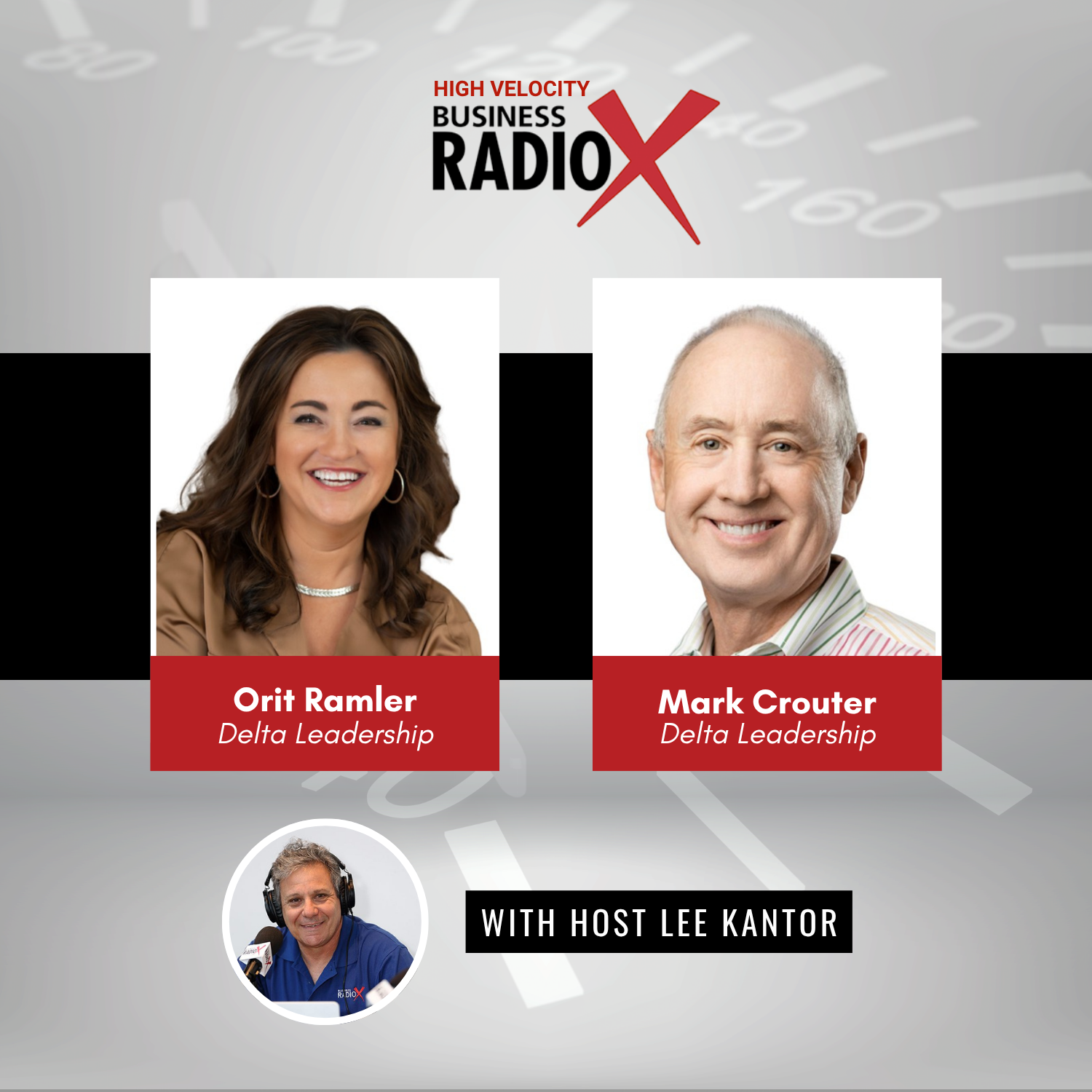

The weakest leadership domain may be the one many organizations overlook: helping people understand how their work connects to the team, the organization, and its stakeholders. On this episode of High Velocity Radio, Lee Kantor speaks with Mark Crouter and Orit Ramler with Delta Leadership about the research behind their six-domain leadership model—and why trust and credibility make it possible for people to take initiative. They discuss how organizations can support honest risk-taking, learn from mistakes without abandoning accountability, and spot misalignment before it becomes a crisis.

 Orit Ramler is the CEO of Delta Leadership Inc. and an esteemed executive coach and leadership development expert with a rich global perspective, having lived in seven different countries.
Orit’s journey began as a learning specialist and the founder of a thriving educational toy company. She held impactful roles in the not-for-profit sector, where she spearheaded community engagement initiatives and raised $7.5 million for a transformative community center.
As a certified coach, Orit is dedicated to empowering emerging leaders, executives, and organizations to transform their internal narratives and drive positive organizational change. She partners with leaders across industries to enhance strategic vision, foster accountability, and lead with purpose.
Orit is the author of the best-selling book The Box of Life: A Guide to Living with Purpose and Preserving What Matters Most, and offers workshops and coaching services to inspire individuals to reflect on their legacy and values, enhancing their personal and professional impact.
 Mark Crouter is a career and leadership coach with Delta Leadership. He is a member of the International Coaching Federation and holds the Professional Certified Coach credential. He helps clients who are at a career crossroads to gain clarity and insight into their talents, priorities, and career options.
He partners with them to define a personal vision for their future and to create actionable strategies for becoming the next great version of themselves. Mark brings more than forty-five years of management and leadership experience to his coaching practice.
In his earlier careers, he held technical and leadership positions at the MITRE Corporation and at two management and technology consulting firms, Impact Innovations Group and Booz Allen Hamilton, supporting federal customers.
He also served 21 years as a Naval Officer and aviator in a range of operational, staff, and leadership assignments.
Follow Delta Leadership on LinkedIn.
Episode Highlights
- The Six Domains of Leadership model and its research-based origins
- Building leadership credibility, trust, community, and influence
- Leadership as a learnable skill, regardless of title or formal authority
- Applying leadership principles in military, business, and other settings
- Encouraging initiative, learning from mistakes, and balancing accountability with psychological safety
- Recognizing leadership gaps through feedback, self-awareness, and 360-degree assessments
- Improving communication, role clarity, and alignment during organizational change or growth
- Leadership development through coaching, workshops, consulting, and coach certification
- Supporting succession planning, team alignment, and organizational culture
- The value of embedding leadership development into an organization over time
 This transcript is machine transcribed by Sonix.
TRANSCRIPT
Lee Kantor: Lee Kantor here. Another episode of High Velocity Radio and this is going to be a good one. But before we get started, it’s important to recognize our sponsor, Business RadioX. If you’re a coach or a consultant who is tired of selling and ready to lead by serving. Set up a call with Stone Payton at brookstone.com to learn how to give local leaders a voice and become a recognized authority in your market. Today on High Velocity Radio, we have some of the folks from Delta Leadership, Orit Ramler, the CEO, and Mark Crouter. Welcome.
Mark Crouter: Thank you.
Orit Ramler: Thank you Lee. It’s great to be here.
Lee Kantor: Well, before we get too far into things, or maybe you can share a little bit about Delta Leadership. How are you serving folks?
Orit Ramler: Absolutely. So Delta Leadership is a global concierge leadership development organization. We bring leadership solutions and we offer that through a leadership model that we will share more about that a at 360. Leadership assessment, leadership coaching, executive coaching, workshops and training all based on the six domains of leadership model.
Lee Kantor: So was this something, uh, that Delta leadership invented? Is this kind of your own methodology, or is this something that’s built on the framework for of someone else?
Orit Ramler: Great question. So yes, we have a model that was developed over 25 years ago at Duke University, at the business school by Professor SIM Sitkin and Alan Lind, and it was based on a need to find a model for leadership that is a actionable, that can be practice, that is based on a set of behaviors that create leadership effect. So is A proprietary model that was created by Delta leadership and everything we do is around that model.
Lee Kantor: So what did something happen that that they said, hey, we should come up with our own methodology here. Like, was there, um, kind of a precipitating event that caused this partnership of theirs to get into this business?
Mark Crouter: Yeah. So the origin story, Lee is kind of, um, that Alan and SIM, both of them, uh, distinguished professors at the Duke Business School, uh, were reading other people’s work about leadership models and leadership prescriptions. And at 1.1 of them said to the other, you know, I think we could do better than this. Um, rather than just teach other people’s models or criticize them, let’s come up with one that we can stand behind. Um, and so they really started researching not just leadership and management, which kind of came out of the 20th century, but really broader in terms of how people influence one another, not just in organizations, but in all kinds of walks of life. So they looked at not just management and leadership narrowly, but but psychology and sociology and other fields where you could look at how, how people influence one another. And so that’s how they kind of came up with this.
Lee Kantor: So it was what did they so they have a hypothesis and then they tested it in real situations. Like how did that come about to kind of prove the hypothesis?
Mark Crouter: It was actually done through developing, uh, looking at a number of different types of behaviors and effects. And their hypothesis was not specifically about, you know, how these effects would cluster or how the behaviors were clustered. The model was developed based on kind of empirical evidence of what they learned from different influential behaviors. So it didn’t start with a preconceived notion of, you know, these are the different areas that we have to look at. But by looking at different types of behaviors and different types of effects, they found that they tended to cluster into these different areas. So it was really, I would call it a bottoms up kind of a research. Not not so much top down.
Lee Kantor: So they were looking at what already existed. And then just kind of curating that and, and kind of figuring out what things that what they had in common, the successful ones.
Mark Crouter: I think that’s a good way to put it. Yes. Curating it. Yeah.
Orit Ramler: And I will add that it’s constantly being researched. Right. The research has not stopped because leadership is evolving as well. So every time we have a leadership assessment, you can look at a there are peer reviews and you can look at the mean and the norm really what’s happening with leadership these days. So it’s constantly evolving based on data that we are collecting. The model is the same and we are evolving really understanding how our behaviors impact others, how we are influencing.
Lee Kantor: So could you share a little bit about the different domains?
Mark Crouter: Sure. So it ended up with with six. Um, and they’re labeled, uh, personal leadership, relational leadership, contextual leadership, inspirational, supportive and responsible. And within each of those domains, there are subdomains. I won’t detail them all. But the key effect of personal leadership is credibility. So leaders have to have credibility with the people they lead, not just subordinates or direct reports, but with peers and even with managers. So people need to believe in the leader’s competence and kind of know what they can count on from you. So it’s all about your your personal credibility. The relational, uh, domain is behaviors that actually demonstrate care and respect and fairness and understanding of someone else’s priorities and perspectives so people feel valued. And the resulting effect of that, if you do that well, is you build trust. And trust is kind of at the foundation of the model. Um, without that, almost nothing else really good happens. And then the third domain, which is we call kind of in the base of the pyramid is contextual leadership. And contextual leadership really, um, is about making people feel and understand how they fit together, how they’re part of a sense of community, um, where each person’s work relates to other people’s work, how the team’s work relates to outside stakeholders so that we don’t just have people feeling like they’re a cog in a machine, but they’re actually an integral part of something that’s more cohesive. Um, I’ll just stop there for a second. Uh, when those three.
Lee Kantor: Okay. Well, is there, so you mentioned trust, is that the linchpin? Without that, then none of them, the rest kind of can effectively take place.
Speaker 4: Correct.
Orit Ramler: So we have the pyramid. Think about a pyramid with the three domains at the bottom, with trust being the center, the relational. So if there is not trust, would you follow someone that you don’t trust? Will you be influenced by someone that you don’t trust? So the reality that each domain has its weight and they all interact, but the center of the pyramid is that relational domain. Mike, do you want to add to that?
Mark Crouter: Well, I would just add to build on that literally and figuratively. The domains above that are called supportive and inspirational leadership. And those are the sort of mid-level, actionable areas where people actually feel empowered to take initiative, where people feel energized to set high aspirations. And all of that is based on having the credibility and the trust that the leader has to embody.
Lee Kantor: Now, you mentioned that this was developed not just in a business setting, but in relationships. It was kind of much more broad and more holistic kind of view of leadership that that’s true, right?
Mark Crouter: Yes. In fact, we find that that people can exercise these kinds of behaviors in any relationship where they want to be influential. In fact, Lee, you know, one of the most powerful findings is that when you can influence people as a leader without direct authority, without supervisory control or mandates, it’s even more effective. And so we encourage people to think about how they can exercise influence even when they don’t have direct authority.
Lee Kantor: Now, how do you fit some of kind of maybe the military environments where fear is an element of leadership?
Mark Crouter: So that’s kind of a trigger word for me. I will share with you that I had 21 years as a military officer. And in that whole time, I don’t recall ever giving or receiving orders based on fear. I think that’s a sense that people have outside the military. I think it’s just as true in the military as anywhere else, that leadership and followership are based on those, those characteristics that we talked about. Um, yes, you do have authority over people. And if they don’t obey orders, you can certainly punish or sanction them. But that’s the last thing in the mind of most military people. They’re there because they want to do a good job. They want to operate as a team. And in my experience, fear has very little to do with it. It has to do with whether you actually trust your leaders, whether you know that they have your interests at heart and whether they can build that sense of community and cohesion.
Lee Kantor: Well, I mean, I’ve interviewed lots of coaches over the years, and a lot of them have military backgrounds. And something that some of them have said to me is that while they might want a more humanistic way of managing and leading. From that standpoint, there is still a contingent of maybe old school or different ways of leading more directly, more directly. And, um, that might lean on fear or fear like emotion to get the person to do what the person wants. And there is some friction. I mean, I don’t think that that’s never happens. I think it happens or maybe it happened more frequently in the past than it does today.
Mark Crouter: No, I take your point completely, and I would call that maybe not a fear based leadership, but authority based leadership. And when you have formal authority early on, when you get leadership, authority and responsibility, whether it’s in the military or elsewhere, because I’ve had more than 20 years in business as well. Um, you get immature leaders who use that authority and that sense of control because they haven’t really learned to develop the other. So certainly it happens. But to me, I call that immature leadership.
Speaker 4: Yeah. Think about.
Orit Ramler: This. We are thinking about leadership not being a title. Right. And we truly believe that you can lead a new lead from wherever you are. And so this is not about the person who has a title, who is the leader. We really believe in empowering everyone to lead.
Lee Kantor: So you believe that everyone can lead. It’s just a matter of educating them on how to do it effectively.
Orit Ramler: Leadership is can be learned, developed, and no matter where you are, you can influence the right way. So it’s not about giving orders. It’s not about management. It’s really about influence. And it is very important to learn that from day one and to believe that you are a leader. If you decide to execute the behaviors that can have a good a proper impact in others, right?
Lee Kantor: So in your experience with organizations, what is kind of the precipitating effect reason that they come and talk to Delta leadership? Does something happening internally that is a trigger or a signal or a sign that, hey, maybe we need outside eyes on this.
Speaker 4: So it’s yes to both.
Orit Ramler: We have people coming, organizations coming with different needs. Few of them. It’s because that’s the culture of the organization. They really want to empower everyone to a lead, to have an impact in the organization. So it’s part of the culture. They adapt the six domains of leadership as the model, the language that they use across the organization. And it brings awareness to everyone and empowerment. There are other organizations who will come to us to work with emerging leaders. They identify talent. They want them to a to have greater influence in the organization. There are others who are coming with a specific need where either it’s about strategy, communications or change, right? Change is something that is happening. I like to call it evolving more than change because it happens with us or without us. Things continue to evolve, and many organizations want to be on top of it and understand that everyone is on the same page. Everyone understands where we’re going, what their role within the organization. Or it can be a crisis where I hopefully always say that you call us before the crisis and not during, but in some cases, we need to intervene there too, and help people A work together and strengthen teams and communication internally.
Lee Kantor: Do you. Do you work with a lot of, um, maybe private equity firms or firms that work in a lot in the mergers and acquisitions when there’s two cultures coming together. So this way that everybody can get on the same page.
Orit Ramler: We had a few clients that come to us when we need to align cultures, align organizations, um, and, and build a stronger culture that, that will help during mergers.
Lee Kantor: So I would imagine that when you can teach the domains and get everybody kind of on using the same language that you can have better and clearer communication that’s going to help the organization be more healthy and have a stronger culture.
Mark Crouter: I would say that’s true. And I would add that as a wreath says, it gives them the language and the vocabulary. So if they sense there’s something missing, some opportunity, it becomes something less general and more specific. So they can actually kind of pinpoint or narrow down where can we focus to improve this area of our performance. So it’s not just developing leaders so leaders can create high performing organizations. Um, so for example, if you have an organization where people seem reluctant to take initiative, that’s a very specific domain where we can talk about managing blame control and providing kind of a safety net for people to be able to take initiative and know that they’re, they’re not going to be punished for making an honest mistake. Uh, so it helps them really narrow down where can we have an immediate effect on something that will be impactful for our organization?
Lee Kantor: Do you see that a lot where there’s organizations, uh, you know that on one hand they might say, oh, we’re, we want to be innovative and we want to push the envelope and which requires doing experiments of which some of them fail. But when something fails, then that person is somehow, I don’t want to say punished, but maybe they don’t get the promotion or they get, you know, placed in an area that isn’t as attractive as it was like to, to make sure that they’re they’re doing what they’re saying that’s important.
Mark Crouter: Mhm. I have thought about that, but what do you think?
Speaker 4: Absolutely.
Orit Ramler: We we blame is something that we call blame control. We don’t like to blame. We want to be supportive enough that people can make mistakes, that everyone in the organization can take risks. Yes, we have a safety net. We work together. But when you lead, you know that there is room for things to happen and room for growth based on that.
Mark Crouter: Yeah, I’ve been in organizations. Maybe you have two that would say we reward risk taking. Uh, but when it really gets down to brass tacks, what they reward is successful risk taking. They don’t really reward unsuccessful risk taking, which is the real test that I think that you’re talking about. You have to be able to support unsuccessful risk taking as long as you can, as they say in Silicon Valley, fail fast and learn from it.
Lee Kantor: Right. And it takes a special organization that is okay with that and celebrates, you know, almost the failures as not failures. But now we know we learn something to not do. And that’s valuable too. And a lot of times I’ve seen organizations that only want the winners and they don’t want, you know, the, the, the scars that it takes to get the winners.
Mark Crouter: Mhm. Yeah. And you can’t just, you know, reward failure continuously. I mean, um, you know, when, when somebody tried something three times in a row and it hasn’t worked, it’s time to do something different. But that doesn’t mean it’s their fault.
Lee Kantor: Right? But that’s. Don’t you think that’s cultural? Like, these are cultural, cultural issues.
Mark Crouter: Absolutely.
Speaker 4: Yes.
Orit Ramler: And we need to add the word accountability to that. Right. So if we have failure without accountability, it’s one conversation. But one thing that we really highlight in our model, it’s that self-awareness, right? Remember that we are speaking about sets of behaviors that create an effect in others. So it’s not just what I believe I’m doing. It’s also how you see what I’m doing, how how you perceive my behavior. And when we talk about failure, one of the things that I want you to know is that I’m learning. I’m accountable. And it’s not that there is something that went wrong and I’m turning my back to it. So helping our clients have that accountability and really understanding what happened, why, why it happened, and what I can do about that. It’s part of the approach.
Lee Kantor: And it sounds like you also do it kind of in a not a blame first manner. This is we’re just trying to get this information, which is kind of agnostic and we’re learning from it. And, you know, sure, there has to be accountability, but really for the organization to thrive, we need information. And this is giving us information. So it’s not something that you should be penalized for necessarily.
Mark Crouter: Right. And I would add, we talked about the baseline competencies and domains of credibility, trust and, and context that provides that foundation where people can take initiative because somebody has given them a sense of what their guardrails are, and they have a common set of expectations in which they can make those kinds of decisions. And not just we’re not encouraging people just to do crazy things, but do things that fit within that idea that, okay, if my boss tells me that it’s okay to try something new, I know I can trust them to have my back up to a point, but to understand what that point is, are we all aligned toward the same goal? Are we having a shared expectation and understanding of how our roles fit together? All of that helps make that supportive leadership more effective.
Lee Kantor: Now, is there any advice you could share with an organization that might not be there? Like maybe in the leader’s mind, they’re a certain way, but maybe the the people on the front lines don’t feel that way. And there is a disconnect, is there? First of all, is there some is there a symptom or a signal for the leader to know that, hey, maybe there is misalignment. And number two, if there is misalignment, what are some of the maybe baby steps they can take to, um, you know, improve the situation?
Orit Ramler: So I, the, the signals, I like to think about the signals and the noise that the leader needs to differentiate. Um, and the self-awareness allows you to listen to the signal of what’s happening, right? You can see that by the morale people showing up, sharing their voice a not a culture of fear. There are different signals that you can pay attention to a, that the most important thing is to take that time to really scan the environment to, to really see how people are responding to your behaviors. We have a great leadership assessment, a 360 that provides a lot of that information because it’s not only speaking about who you are as a leader, but it’s also telling us how those who see your leadership are, are, are, how they are doing in the environment that that is around. And the steps to take is awareness first acknowledgment, right? And that accountability comes understand the context in which things are happening. A and, and then intervention in some way knowing that we can change behaviors. And that’s, I think one of the nice things about leadership is that we are not telling you, this is who you are. This is the personality trait or this is how the organization is. We are telling you, let’s look into our behaviors and what can be adjusted, what can be learned, what can be changed.
Lee Kantor: Is that is that a best practice to do? An assessment of 360 assessment on a regular rhythm?
Orit Ramler: Yes.
Mark Crouter: I don’t know about a regular rhythm. I think there are certain events where it really is very valuable. If somebody is new in a leadership role or that role has changed significantly, maybe the team composition has changed. Um, something that would, uh, necessitate actually taking the pulse of the leader and the organization and their relationship. So we have many clients who are in that position of maybe aspiring to the next level of leadership role and they want to grow into it, but first they have to demonstrate it in the role they’re in. In other cases, maybe somebody is new in a role or new in an organization. Or like I said, the team composition has changed. Um, so, um, as Reid says, change is constant and evolving. So what we’re trying to look for is where are those kind of inflection points where leaders can actually have the opportunity to make some substantive change and see the effect? The thing I would add it go back to your previous question, Lee. Um, the research actually shows that of the thousands of people that have gone through this assessment process, the single weakest area tends to be in that contextual leadership where people don’t really understand how their roles fit together.
Mark Crouter: They don’t understand how their team fits with the rest of the organization. And my own experience, this is a bit anecdotal, I know, is that that’s because in many cases, those of us who kind of grew up managing and leading in the earlier decades didn’t understand that that was part of our job, that we thought that if you just put the org chart together and people saw what their role was, they would understand that context. But that’s not the world that we live and work in anymore. There’s too much ambiguity, too much complexity. And so you have to constantly be checking, you know, do people understand how their roles fit together? Do they understand the impact of what they do on other people? Um, so to get back to kind of what you asked about, what are some key things you can offer is don’t assume that people know what you know as the leader. That’s the biggest mistake that a lot of leaders make is they assume that other people know what they know and not share that. And in fact, sometimes even overshare it.
Lee Kantor: So in order to really get the most out of working with the Delta leadership or any type of coaching or, um, kind of the work that you’re doing, don’t you have to have kind of a longer term view of what you’re trying to accomplish? Like this has to kind of fit into the DNA or the fabric of the organization to have lasting change. Otherwise, I could see some organizations just bouncing from tactic to tactic based on, you know, a new book somebody read.
Mark Crouter: I would agree with that. And I often caution the folks that I coach, um, don’t make this, you know, going back to the workplace with, you know, the new bright, shiny object that I just learned about because then it sort of becomes, you know, what’s what’s Lee’s new trick of the week or trick of the month or something like that. Um, and we find that the best effects are when organizations do this, not just for one person at a time, but perhaps teams of people that work together or people at the same management or leadership tier so that they’re not coming back to their workspace in isolation, that they’re doing that as part of a maybe supportive program of leadership development. But even even when you have an individual that’s going through it by themselves, the coaches will work with them to understand what’s reasonable. Now you know you’re not. We talk about moving the needle, not, you know, turning the whole ship around. But what can you do now that you can actually take steps to make immediate improvements. See how the process works, practice it, and then repeat that.
Orit Ramler: And I will add that all our coaches are certified in the six domains of leadership model. So they are certified coaches who specializes in this. So everyone who is working with us in any team organization, they have a coach that understands the model and help them embody the model because it’s behaviors that you gain and learn.
Lee Kantor: So can we talk a little bit maybe of best fit client for Delta leadership? Um, it sounds like it’s kind of industry agnostic. I would imagine for profit nonprofit, a lot of organizations would benefit from what you’re coaching and teaching. Mhm.
Orit Ramler: Yes. We work with all industries technology, healthcare, academia, nonprofit government, regulatory agencies, among others. A and in different stages, from the C-suite to emerging leaders and anyone who is ready to grow their influence and impact in the organization.
Lee Kantor: Now, when you’re working with these different groups, um, what how are you delivering what you do? Is it kind of one on one coaching? Is it group coaching? Do you form cohorts? Do you do workshops, training? Um, it sounds like you’re also certifying coaches in there. Um, is that within the organization or is that external coaches that go into organizations?
Orit Ramler: So we, we certified coaches who come either HR professionals, talent development or already certified coaches. We certified them in them in the six domains. We do consulting for organizations. And many times we start with consulting. And from there it changes to coaching, a team building and workshops, and even licensing the six domains of leadership within the organization. Sometimes we are called just for a coaching leadership coaching with within our model. Sometimes we come and do leadership development workshops. We have a few different workshops that we cover, and we also have self-paced virtual courses on the model. And from there, many times we a the next step will be to have leadership coaching.
Mark Crouter: I’ll give you an example without naming the organization. It was a government executive who had gone through a leadership program that included this model and coaching. And she went back to her organization and convinced them that they needed to send more senior leaders through the program. And so we actually developed a cohort program for them specifically.
Lee Kantor: Now, is there another story you can share that maybe a company came to you, or a group came to you with a challenge that something was wrong and that you you came in and were able to maybe help them get that solved and help the organization get to a new level. Is there a story along those lines that you can share?
Orit Ramler: I will share one of my not for profit, a that is growing very fast. And they had to think about not only succession planning, but also a with that growth understanding that they had a the right people on the bus to drive to the next stage. So they called us in to make an assessment on their leadership. We started with some consulting recommendations, assessment for all the leadership, then coaching, and we realized that the main thing that they had to do is team alignment, team alignment to make sure that the different people that they already had on the bus understand what are the roles in order to understand where they are going towards and adjusting some of the roles, as well as bringing new additional talent to the team.
Lee Kantor: So if somebody wants to learn more, have a more substantive conversation with you or somebody on the team, is there a website? What’s the best way to connect www.delta.com?
Orit Ramler: That’s our website. And I’m always happy also to have anyone who wants to reach out to us to contact me directly at or at Delta leadership.com or RIT at Delta leadership.com.
Mark Crouter: Yeah, the website has a lot more information on the model on the programs that we offer, including. We’re rolling out right now some self-paced online courses that people can take if they choose to do so, just to get introductions to some of the things we’ve been talking about. And all of that’s available on the website as well as additional information.
Lee Kantor: So what do you need more of right now? How can we help you? Do you need more folks to to get certified as a coach? Are you looking to expand the kind of coaching roster?
Mark Crouter: Actually, I think we have at the moment a good roster. We’ve got probably 50 coaches that we work with as independent contractors mostly. And um, the business is somewhat cyclical. So what we, what we really want is for people to know about the value of the model and the assessment. It’s not as well known as some other models or assessments in leadership that maybe have been around even longer or have gotten more publicity. So one of the reasons we out, you know, reach out to people and organizations is so that they’re aware of this and can see how it differentiates from other leadership development programs that they might know about.
Orit Ramler: We are the best kept secret in many ways and with great impact globally, and we are in great momentum of growth. Yes, we love certifying a new coaches always, because the more that we can share this model with the world, the better. We believe that better leaders build better organizations that build better communities, that build better societies, that build a better world. So that’s our mission. And the best way is to let everyone know that we have an incredible model that has been around for more than 25 years, research based, that you can act on Monday morning, you will be ready to show up as a strong leader, and there is no need to wait for that.
Lee Kantor: Is there a a typical first project that you all work with? Folks you mentioned consulting as kind of the the way you you get into some groups and organizations. Is there something that’s happening first that that is usually the thing that gets people to reach out to Delta leadership.
Mark Crouter: A lot of times it’s referral by word of mouth. Honestly, it’s people have been through the process and understand it, and they know one of us or one of our coaches, and so they want to learn more about it. So word of mouth is still very effective.
Lee Kantor: Good stuff. And then the website one more time is Delta leadership.com for all things Delta leadership.
Mark Crouter: Right.
Lee Kantor: Well all right. And Mark, thank you so much for sharing your story today. You’re both doing such important work and we appreciate you.
Mark Crouter: Thank you. Lee, it’s been good talking with you.
Lee Kantor: All right. This is all right. This is Lee Kantor. We’ll see you all next time on High Velocity Radio.