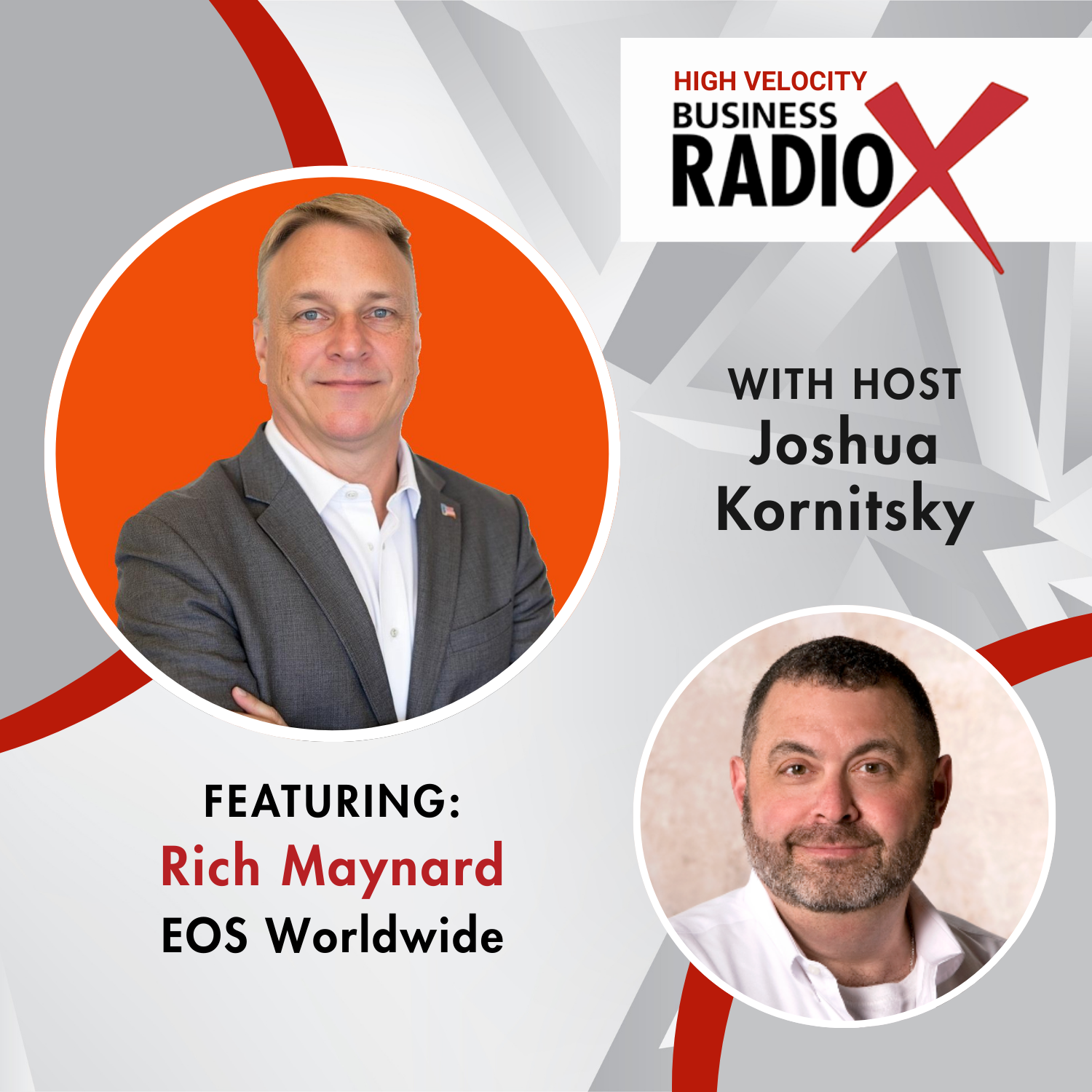

In this episode of High Velocity Radio, host Joshua Kornitsky interviews Rich Maynard, a sales coach and EOS implementer. Rich shares his journey from the Navy to manufacturing, sales, and ultimately helping businesses implement the Entrepreneurial Operating System (EOS). The discussion explores how EOS clarifies vision, instills discipline, and fosters healthy leadership, especially in family and cross-generational businesses. Rich explains the EOS process, tools for aligning teams, and real-world examples of organizational transformation.
 Rich Maynard’s story starts in the Navy on board an Aircraft Carrier and the realization that when the ships deploy, 2,500 of the 5,000 sailors on board have never done anything like that before. Structure, process, and accountability!
That love of structure and process stayed with him as he moved through his career in manufacturing leadership and sales roles. Ultimately, he found a passion for helping others realize their best lives while building a practice as a sales coach. This is where Rich began to work with entrepreneurial companies and their leadership and sales teams.
Facilitating more than 1,000 sessions with owners, leadership, and sales teams revealed a particular group of clients who were more open, honest, and vulnerable than others and, frankly, were happier and having more fun. These teams were also implementing EOS in their businesses.
This discovery made Rich realize that EOS combined his love of structure, process, and accountability with his passion for helping entrepreneurs and their leadership teams get what they want most out of their businesses and live their best lives.
Connect with Rich on LinkedIn.
About Your Host
 Joshua Kornitsky is a fourth-generation entrepreneur with deep roots in technology and a track record of solving real business problems. Now, as a Professional EOS Implementer, he helps leadership teams align, create clarity, and build accountability.
He grew up in the world of small business, cut his teeth in technology and leadership, and built a path around solving complex problems with simple, effective tools. Joshua brings a practical approach to leadership, growth, and getting things done.
As a host on Cherokee Business Radio, Joshua brings his curiosity and coaching mindset to the mic, drawing out the stories, struggles, and strategies of local business leaders. It’s not just about interviews—it’s about helping the business community learn from each other, grow stronger together, and keep moving forward.
Connect with Joshua on LinkedIn.
 This transcript is machine transcribed by Sonix.
TRANSCRIPT
Intro: Broadcasting live from the Business RadioX studios in Atlanta, Georgia. It’s time for High Velocity Radio.
Joshua Kornitsky: Welcome back to High Velocity Radio. I’m your host, professional EOS implementer Joshua Kornitsky. And my guest here today is Rich Maynard. He’s a sales coach and a professional implementer of the EOS system based out of Greenville, South Carolina. Good afternoon. Rich. How are you?
Rich Maynard: I’m good. Joshua, how you doing?
Joshua Kornitsky: Doing well. Thank you. So happy to have you here today. So tell us a little bit about yourself. What’s your background? Where are you from?
Rich Maynard: Well, I grew up in, uh, in, in the Detroit area, and, uh, left there in the, uh, a while ago. Joined the Navy and, you know, thank.
Joshua Kornitsky: You for your service.
Rich Maynard: And see the world. They are not lying. Um, but what they what the recruiters don’t often talk about is the world is 73% water. So.
Joshua Kornitsky: So you picked the right way to go.
Rich Maynard: Yeah, yeah, you can pick the. They say the old slow boat to China. I was actually on that boat.
Joshua Kornitsky: There you.
Rich Maynard: Go. It is quite a voyage.
Joshua Kornitsky: Thank you again for your service.
Rich Maynard: No, but I got settled in Greenville in the Greenville area about 30 years ago. And, um, have, you know, found a found a local girl, and now I have southern children, so.
Joshua Kornitsky: Wow. So.
Rich Maynard: Been married 28 years.
Joshua Kornitsky: That’s fantastic. So tell us about your professional background. What? What brought you to where you are today? What drives you?
Rich Maynard: Yeah. So, uh, as I mentioned, I was in the Navy when I was, when I was younger, and, uh, I don’t know how many, uh, how many of your viewers have ever been in the military? You know, in the military or or been around aircraft carriers, but a lot of people seen Top Gun in the movies, and and what, what most people don’t realize is of the five or so thousand people that are on one of those ships every time it deploys, fully half of that crew has never done that before. Wow. And they’re all about 19 years old.
Joshua Kornitsky: So, wow.
Rich Maynard: So that that structure, process, discipline, accountability really stuck with me as I left that, uh, left the military and went into my civilian career where I moved through, uh, some roles in manufacturing. Actually, I was in the photographic world working for Fujifilm.
Joshua Kornitsky: Okay.
Rich Maynard: If you happen to have any pictures hanging on your wall around your desk that have Fuji on the back of the paper, that’s what we manufacture here in South Carolina. And, uh, and at our peak in 2003, before the digital revolution, we were manufacturing, uh, 1,000,000m² of photographic paper a day.
Joshua Kornitsky: Wow.
Rich Maynard: In complete darkness. Because it’s photographic.
Joshua Kornitsky: So it has to.
Rich Maynard: Be lights.
Joshua Kornitsky: Off. Right?
Rich Maynard: And again, so, you know that theme of structure, process, discipline, accountability. You know, when you’re running around a factory with a bunch of moving parts and heavy equipment and there’s no lights on, you got to be pretty good about that stuff. Um, so ultimately, I moved through several roles there, and some, like a lot of salespeople, found one day, woke up and found myself in a sales role.
Joshua Kornitsky: Okay.
Rich Maynard: And moving through and and really enjoyed sales and, and uh, you know, getting to know customers and building those relationships. And that led me to a coaching, uh, position with, with a sales coaching organization, which I love. Uh, just that’s that’s where I developed a real passion for the entrepreneurial world and small and medium size businesses. And you look at the economy around the world, and, uh, big business is great. But, you know, the small the small businesses really are the, the beating heart of our economy. And I just love helping them, no question. Yeah. But so as I was working with those guys, I realized that about 40% of those clients of mine, I did more than a thousand coaching sessions with them. And and about 40% of my clients were just different. They they struggle with the same things everybody else was. But they got better quicker. They were more successful, and they enjoyed the process and each other more than the others did. And I thought, what is what is going on with these people? And then they were all using similar terms. They were using things like l10n and rocks and scorecards and vto. And so I started to uncover what this language was and discovered it was iOS or the entrepreneurial operating system. So my favorite clients for implementing iOS in their business, as they were getting this training that we were going through. And that just led me down the path of really understanding what iOS is. And it just brought together that passion for small business and small and medium sized business and the structure, process, accountability and discipline that that I saw in my military and and my manufacturing career. And I just I kind of felt like I found my home.
Joshua Kornitsky: That’s fantastic. Um, and it sounds like you may not have gotten where you were going, but you ended up where you needed to be. Uh, it’s my favorite quote from Douglas Adams. But let me ask you, because obviously, you and I speak a common language. One of the things that I think is important, though, is to help people understand who is iOS four. How does it help. And again, us is the entrepreneurial operating system. But but explain it so that people will understand what it is you do.
Rich Maynard: So EOS the entrepreneur operating system, it really it’s a simple set of practical tools that helps instill three things in a business. It’s it’s vision, traction and healthy. And vision is just about getting everybody on the same page with where you’re going and how you’re going to get there. Traction is about instilling that discipline and accountability. So everywhere you look in the business, everybody’s actually executing on your vision. And healthy is working with leadership teams to help them be more open and honest with each other, solve real problems to to make their lives better. Because a lot of times they’re just not that way. Um, and then what we find is, as goes the leadership teams, so goes the rest of the organization. And ultimately through the EOS journey, everybody in the organization gets on the same page. They’re all rowing on, you know, on the same direction, pulling on the same end of the rope, and life gets better, the business is more successful, and everybody begins to enjoy their lives and live the life they want and studying instead of their, you know, their business, running their life.
Joshua Kornitsky: Thank you. That gives it some context for folks that are hearing it and helps them better understand. So in your experience, you know, what are some of the biggest impacts you’ve seen on on the leaders that you work with as you’ve helped them instill the EOS model into their business?
Rich Maynard: Yeah, there’s a couple of really striking examples that I have that that highlight where where EOS has had an immediate impact. One of the things we we do, we call it vision building. So we answer, we answer some questions to help people define where they’re going and how they’re going to get there. And one of the big things that we get out of that is, is what are the most important things that you need to be working on in the immediate future? We call this we call these rocks. So what are the big things that you need to be working on in the next 60 to 90 days and one owner. We went through this initial vision building step and he had a pet project he was working on that had taken a lot of resources and money from the company. As he was building this, this, it was a great innovation for their business. But as we lay it out, all their priorities and all the issues they had to overcome in the immediate future. We went through this prioritization and he realized, hey, this thing that I’ve been pouring a bunch of resources into is not the most important thing for our business.
Rich Maynard: In the next 90 days, there’s 4 or 5 other things that we really need to shore up. So when we do get this thing off the ground, it launches well. So he put that on the shelf for the immediate future solidified, set these rocks, set these priorities, and solidified the most important things to get done. And then at the end of that quarter, when those things got done, he brought it back out and it became the you know, now it’s the most important thing that he needs to do. The the the funny or the I guess the, the eye opening part was his team at the end of that first day, looked at him and said, I can’t believe you were the one who put that on the shelf. We’ve we’ve been wanting to do that, but we know it’s your project. And we were kind of like, okay, this is yours. But they all agreed that it was the right thing to do, and it really freed them to take advantage of that innovation at the right time.
Joshua Kornitsky: So you’re helping the leaders learn how to prioritize?
Rich Maynard: Well, the first thing is we help them get everything out on the table, okay. So you can’t solve you can’t prioritize if the issues are not out there in front of you. And then we help them prioritize. And it’s really we we are more facilitators. One of the things that a core belief within the US community is 95% of the answers are already in the room. Our job is to facilitate those conversations, teach the tools that we use and coach them in their use. We don’t. We’re not the we’re not going to come in and tell you how to run your business, because we don’t know how to run your business. But what we do know is how to implement these tools and how to facilitate the conversations to make sure that the right things are being brought out in the right time.
Joshua Kornitsky: Okay. That makes sense, right? So what happens when you encounter an organization that that’s cross generational? I know something like 70% of the small businesses in America are family businesses. So I’m sure from time to time you come in and it’s an organization where, you know, the older generation might be on their way out or is already out, and the new generation comes in. How do you work to transform an established organization, and what are some of the challenges that you encounter?
Rich Maynard: Well, that’s a great question. And one of the I have a client that I’ve been working with that exactly like you said, it’s it’s the, the the first the the founders of the company and his partner. They have stepped back. They’re more in a board kind of advisory role, and the son has taken over as president of the company. And it’s a great company. It’s been successful. It’s it’s it’s a it their stock, which is why they’re using us. They’re trying to break through a revenue and organizational ceiling that they’ve hit. And one of the one of the areas they’ve been very successful is historically they are a very solid. Their core values are very solid. And what core values are is just a it’s just a simple set of terms that define who they are at their core, their, you know, like they’re they’re resourceful, they’re respectful, they’re responsible. So that defines the kinds of people that they want to be around.
Joshua Kornitsky: So did they already have those or is that something you worked with them okay.
Rich Maynard: Yeah. So they had their core values and they all believed in them. And so we went we we even in that case, we still go through an exercise that at the very least is going to validate that what they have is actually true within their organization, because a lot of times the owners or the founders, they sit in a room and they’re like, here’s who we are, or here’s who we want to.
Joshua Kornitsky: Be sure.
Rich Maynard: And sure. They hang them on a wall and they never talk about it.
Joshua Kornitsky: Mouse pad core values.
Rich Maynard: Yeah. So so these guys actually lived their core values. And this exercise we went through validated exactly that. They do truly live the core values that they had set out to build over 17 years. But it also illuminated that they they identified another core value that makes them that is part of their DNA that makes them successful, that wasn’t listed. So not only do we validate the three they had, we added one. But what was interesting was so I asked the question, well, we went through this exercise. What’s different? And one of the leaders on the team, she said, you know, these have always been the owners core values. And we’ve we’ve always lived them and appreciated those core values, but they were always theirs. But now that we’ve gone through this exercise, I feel like they’re mine.
Joshua Kornitsky: That’s awesome. And updated for the current generation.
Rich Maynard: Exactly. It’s like, yes, these now we own them and and it really, you could just see them settle back in their chairs and just take in the fact that this is theirs. Now it’s no longer the previous owners. They own it now. It was incredibly powerful.
Joshua Kornitsky: That’s amazing. And it does kind of cross that bridge, right. Or it bridges the gap between the the outgoing and the incoming. And for a company of any size to stay successful, you’ve got to both have continuity and preservation of what was. But stay tuned in to what’s happening now, because, you know, I, uh, occasionally encounter people that are in industries like say, film, paper or, you know, photo paper production. And it’s not that it doesn’t exist anymore, but it certainly doesn’t exist at the scale that it was at, uh, I ironically, you know, what was mass produced now becomes a niche item. But that’s just reality. You’ve got to help people understand that they got to stay up to date, because if they just stay fixed in the past, uh, things will go by them. So what does it look like when you engage with someone from an EOS perspective? What’s that process that you work through? Do you just sign them to a contract and get in there and tear the place up? How does it work? No.
Rich Maynard: So that’s what’s a little unique about the way EOS implementers engage with clients. We don’t have any contracts. We don’t we? You know, one of the things we say is our services are guaranteed. It’s like, well, what does that mean? It’s like, well, so we we work on a, on a kind of a daily session. We scheduled sessions. And if you get value at the end of that session, then we get paid. And if you don’t get value then don’t pay us. We don’t deserve it. You know, our goal is to help you and, uh, recognize the the what is going on in your organization and where the strengths are, where the weaknesses are, and then help set you up with the tools that we have to be successful in the future. And if you don’t get that from us, then we didn’t do our job. So that’s that. And then as far as the the process we go through, there’s kind of a there’s a you’ve got earlier. The 92nd version of the OS is there’s also a 90 minute version where we there’s no charge, we get in front of the leadership team, and we invest our time with the leadership team to just lay out the whole process and all of the tools. We just want everybody in that meeting. It’s really is iOS are the right fit for your organization? Am I, as the implementer, the right fit for you? You know, sometimes we implementers, uh, or, you know, a leadership team might not, you know, feel the implementer. So we always want them to to use iOS and we’ll make introductions to others if it’s not a good fit.
Joshua Kornitsky: So is is that 90 minute meeting like deep intensive or more like a 10,000 foot overview?
Rich Maynard: It. Well, it’s pretty intensive. We go through all of the tools that we have at a high level, and then we take a deeper dive into each one to to illustrate how it can affect the the issues that are going on in that business. And we do spend time on the front end understanding what’s going on. So when we do run across, well, here’s a particular tool that may address the challenge that you’re facing in your business. So it’s tailored to the individual organization. But we want to make sure they get a full picture of what the EOS model is.
Joshua Kornitsky: So you’re laying out a roadmap for him.
Rich Maynard: Yes.
Joshua Kornitsky: Okay.
Rich Maynard: So the last part of that is is what is the process look like? And there’s, there’s, uh, as we as we open that up and unpack that, it really starts off with three days, about 30 days apart where we go in and we first help them gain traction. And so we want to get them moving. We want to get them making decisions. We want to get them solving problems, setting priorities, priorities, priorities. So they’re actually moving in a direction. Because a lot of times what happens is people have this vision, but they don’t have any traction. And vision without traction is is just hallucination. So we want to get them moving in the in a direction. And then in the second day we start to crystallize that vision. That’s where we start looking and answering some what are our core values? What’s our core focus? What’s our ten year target? And then we build on that in the third day with what’s, you know, how are who are we going to reach. Are we going to talk to what are we going to say to them? And then, you know, what’s a three year picture and a one year plan? And what is the most important thing we need to get done in the next 90 days to tie all these things together? So that’s the the three day journey that we go on over about a 6060 day period.
Joshua Kornitsky: Right.
Rich Maynard: And then from there they’re they’re into execution mode. And we meet with them once a quarter to to look back at the past quarter, learn from it, look at the look at the current situation and set the next priorities for the next quarter. And then really spend about half a day really just we call it, uh, I identify salt or discuss and solve issues, okay. Through the things that are tripping them.
Joshua Kornitsky: Up and you help them understand that process.
Rich Maynard: Yep. Well, we facilitate that process.
Joshua Kornitsky: Okay.
Rich Maynard: Which in in this in the same sense as we facilitate we’re equipping them to do that when we’re not there.
Joshua Kornitsky: That makes sense. Um, so one question, going back when we were talking about sort of that generational shift and, and that’s not always family, right. That could just be, uh, leaders leaving and new leaders coming in. And, and companies sort of find themselves in states of flux, I think these days probably more often than maybe in the past, because a with no critique of any particular, uh, group of, of age or what have you, uh, it’s become a more transient workforce where people will move in and move out. So how do you make sure you’ve got the right people in the right seats in the organization with that type of upheaval.
Rich Maynard: So that’s a great the the right people. Right seats is a is a cornerstone of. And you may recognize that from the book Good to Great by Jim Collins, which is a fabulous book. Um, but it really tells the story of you have to get the right people in the right seats, because if you if you don’t, you’ll never achieve a vision that you have. Um, so how do we we use a tool we call. Well, there’s a couple of tools. The first one, we call it a people analyzer. And when we when we look at we take we take those core values. And that’s the right people side of things. Do they actually meet and live up to our core values? And what’s and what’s really interesting is everybody defines their core values differently. So a core value fit for organization A is not necessarily a core value fit for organization B. So we look at the unique organization and say, well what makes this person right for you. That’s the that’s the first step. The second step we look at is we have a tool called the accountability chart. And a lot of organizations have organizational charts. Right. The difference is, in our accountability chart, we highlight not only the seat. We take a structure first approach. We highlight well, what what seats do we need in this organization. But we also identify the the five core responsibilities or things that seat is accountable for. And then when we finally put somebody put a name in that seat, one do they do they match our core values? Do they exhibit our core values? Do they live up to who we are? Are they the people we want to be around and that we want our customers to encounter? And secondly, do they get their job? Do they get those five roles? Do they want it? Do they, you know, so they, they, they, they have the, the genetic encoding that they this is what they wanted to do. This is like I get to I wake up in the morning and I get to go do my job, not have to go do my job.
Joshua Kornitsky: Makes sense though. But it makes a difference. So okay, so no, no, it makes sense because if they’re aligned to the core values and they understand what’s being asked of them, they’ve got a lot more clarity than probably a lot of places offer as employment. Right?
Rich Maynard: Well, and it’s more than just being aligned. It’s do they get it? Do they want it? And do they have the do they have the capacity for it. And that that capacity is measured, measured in a bunch of different ways. It’s time. It’s do they have the training? Do they have the, you know, innate abilities. You know. So that’s and that’s how we start evaluating people. And and if, if it’s a core value fit and they’re missing 1 or 2 things, well then we put a plan in place to help them overcome it. And if they don’t, well, we try to find another seat for them because finding the right people is hard.
Joshua Kornitsky: So what happens if you’ve got a seat that you don’t have the right person for?
Rich Maynard: If it’s a wrong person?
Joshua Kornitsky: No, no you don’t. I mean wrong person to. But I mean you just don’t. You you go through this exercise to understand the roles. You understand the accountabilities of the roles. But what if you don’t have someone currently employed that fits that. Who takes that seat?
Rich Maynard: Well, somebody has to take that seat. Somebody has to be accountable for those roles. And that’s the difference between an organizational chart and an accountability chart. So that stuff still has to get done. So somebody has to do it. And in one case I was working as another second generation client. The the son had come in and taken over and he was the president. He was also the sales manager and he was the finance guy. So he was handling.
Joshua Kornitsky: All the.
Rich Maynard: Money. He was handling the sales team. He’s trying to be the we call it the visionary, the the big thinker. And he had his head down in the business trying to do the small thinking too. And they were stuck. And as soon as we laid out the accountability chart and started saying, well, who’s who’s actually in these seats today? And it was like, oh, well, there’s the and the rest of the team looked at him and said, well, do you see the problem?
Joshua Kornitsky: So so he was his own roadblock.
Rich Maynard: He was the roadblock. And he freely and he’s like, ah, 100% see this? So he actually he had two members of his team step up in the roles that they were not currently in, and they all agreed. You’re going to take this responsibility and you’re going to take this responsibility. And it took two seats off of his shoulders, which freed him up to one be, uh, effective in the seats he was in. And also, it took two days a week out of his schedule of things that he had to do because somebody else was now doing that. So now he he was able to become that big thinker, and he kept the finance role. So he was able to dive into the finance of the finances of the business and really understand them. Huge change for him personally and for the business. They’re they they’re just on a path that is they’ve never seen before.
Joshua Kornitsky: So us basically gave him some freedom.
Rich Maynard: That was the biggest thing for him. His biggest impact was I actually have time to breathe and I’m not. Not everybody in the business isn’t waiting for me to do something so they can act. And so that we call it letting go of the vine. The sales role, he had somebody come in, you know, and it’s one of his team members right now when we when we start looking at what are the issues of the business. Well, one of the issues is do we fill that sales and marketing seat with somebody from outside the business? So that’s an issue. But it’s not one of the most important issues to solve in the next 90 days. So it goes on a list. It stays there until it’s either not an issue anymore or they stop, or they decide it’s the most important thing and they and they put it on the list to be solved. But right now they’re doing okay. 90 days from now, that may become a thing, and that may be one of the most 3 to 7 important things that they need to accomplish. And then it’ll go on that list.
Joshua Kornitsky: It sounds like it’s a pretty transformative process.
Rich Maynard: The biggest thing that I’ve seen happen one. Everybody knows what their job is and what everybody else’s job is, so they get to understand that they know who is responsible for what, they know who’s accountable for what, and they also know where they’re going. So in this process, we answer those questions. Core values core focus, our ten year target where where are we going. And then where do we need to be just three years from now in order to answer that or to begin on that path? And then what do we need to be in a year? And now everybody’s pulling on the same end of the rope, rowing the same direction. The entire leadership team is is on board with it. It just becomes very transparent. Everybody solving problems for real.
Joshua Kornitsky: That’s fantastic. So so who’s EOS for? If someone’s listening to this and they’re thinking, you know, this sounds great, but I don’t I don’t know if it’s for me. Who’s it intended for.
Rich Maynard: It’s intended for privately held businesses that are anywhere from 10 to 250 people. Um, you know, one of the things that, you know, when you gather kind of a litmus test, if you gather your leadership team together and you can you can set the direction and make changes to the website, that’s probably who, uh, who should look at iOS.
Joshua Kornitsky: Okay.
Rich Maynard: And the people that are stuck, it’s, you know, we’ve reached that, you know, we’ve made it to ten employees or $5 million in revenue or $2 million. But we don’t. We’re just we keep bumping against the ceiling. We don’t know how to get past it. That’s a that’s a $5 million ceiling. That’s a $20 million thing. That’s a $50 million ceiling business, as we call it, hitting the ceiling. Every once in a while, they just reach the capacity of how the business is designed. So how do you change that? You’ve got to change the methodology that you’re using. Otherwise you’ll never break through that capacity. And that’s what iOS helps people do.
Joshua Kornitsky: Well, I mean, it sounds fantastic. So when when we publish we’ll obviously have all your information. But Rich, how do people get in touch with you?
Rich Maynard: Uh, the EOS worldwide website has an implementer directory which you look up Rich Maynard or South Carolina. I’m in there, but Rich Maynard at EOS, Richard Maynard at EOS worldwide.com.
Joshua Kornitsky: And again we’ll, we’ll we’ll put that on our site as well when, when we push out to all the platforms. So people will be able to access this. I can’t thank you enough. I really appreciate it. Last question Rich how big of an area do you service?
Rich Maynard: So right now, uh, nationwide, uh, one client in Texas, one client in California. I’ve got a client in the in the upstate. And, uh, you know, a handful of others that are in the area.
Joshua Kornitsky: So you go where you need to go.
Rich Maynard: Go where? Go where the where, where the need is. And, uh, it’s it’s really satisfying work. When when you see people like I mentioned that, you know, sitting back and realizing, wow, this, this value, these values, this vision, this company is ours now, it’s not the previous owners, even though they love them and they’re still part of it. But I just love that that those aha moments that when people become free of the past and they can actually see and recognize that the future is possible.
Joshua Kornitsky: That’s that’s a great place to end it. Thank you Rich. Again, my guest today has been Rich Maynard, uh, sales coach and professional EOS implementer. I appreciate your time. Rich, thank you for coming on. Uh, my name is Joshua Kornitsky. I am the host of High Velocity Radio. I, too am a professional EOS implementer, but I always enjoy talking to my associates like Rich. Thank you, Rich, and appreciate having you on, and we’ll have you on again in the future.
Rich Maynard: All right, Joshua, thanks a lot. I really appreciate it.














