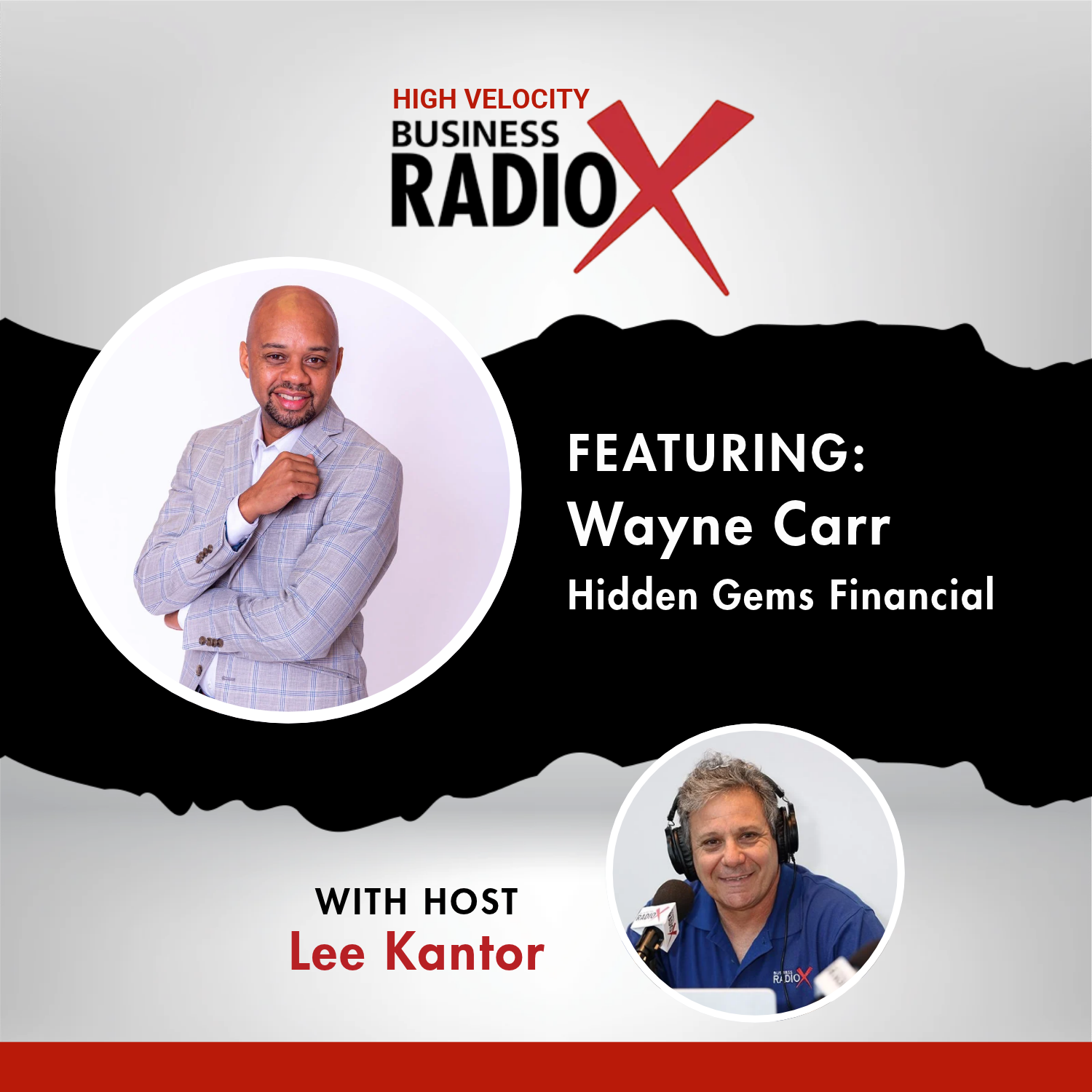

In this episode of High Velocity Radio, Lee Kantor interviews Wayne Carr, Senior Financial Architect at Hidden Gems Financial, about helping individuals and families build, protect, and grow wealth through strategic financial planning. Wayne shares how whole life insurance, trusts, and infinite banking can create opportunities for financial protection, tax efficiency, and long-term wealth accumulation. He also highlights the importance of managing cash flow effectively, developing personalized financial strategies, and using insurance as a foundation for retirement planning and building a lasting financial legacy for future generations.

 Wayne Carr is a Financial Architect and the founder of Hidden Gems Financial. He grew up in Ohio, lives outside Tampa, and is a father of two.
He has worked in financial services since 2004 and in insurance since 2015, and he holds a Bachelor of Science with a focus in finance and economics.
He loves sports, and he’s an avid sneaker collector. He brings the same eye to both: know what’s worth keeping, and build for the long run. He hosts the Mining Gems podcast and helps families, business owners, and entrepreneurs see where their money goes and put every dollar to work.
Connect with Wayne on LinkedIn and X.
What You’ll Learn In This Episode
- The role of insurance as a foundation for comprehensive financial planning and wealth protection.
- The benefits of participating whole life insurance and its connection to infinite banking.
- How trusts and strategic financial structures can help protect assets and preserve generational wealth.
- The importance of managing cash flow efficiently and making money work across multiple financial vehicles.
- The differences between traditional financial planning and an insurance-based approach to wealth building.
- How personalized financial strategies can support individuals at different income and wealth levels.
- The value of understanding financial options early to create long-term security and a lasting family legacy.
 This transcript is machine transcribed by Sonix.
TRANSCRIPT
Intro: Broadcasting live from the Business RadioX Studios in Atlanta, Georgia. It’s time for High Velocity Radio.
Lee Kantor: Lee Kantor here another episode of High Velocity Radio and this is going to be a good one. But before we get started, it’s important to recognize our sponsor, Business RadioX. If you’re a coach or a consultant who is tired of selling and ready to lead by serving, set up a call with Stone Payton at brookstone.com to learn how to give local leaders a voice and become a recognized authority in your market. Today on this show, we have Senior Financial Architect with Hidden Gems Financial, Wayne Carr. Welcome.
Wayne Carr: How are you doing, Lee? How are you?
Lee Kantor: I am doing well. I am so excited to learn about your practice. Tell us about Hidden Gems, how you serving folks?
Wayne Carr: So Hidden Gems Financial is just that. I like to, uh, bridge the gap and expose people to the things that are typically hidden in plain sight or the things that they’ve heard about that didn’t necessarily know that they had access to were or were as easily attainable as they are. Things like, like trust, mitigating taxes, effectively protecting their family and growing money tax free, different things that, that people here that are typically buzzwords and people gatekeep the, the how behind the what and providing the context. And I, I kind of like to put it all out there because I came from a world also where that was the general perception. And I’ve been fortunate enough to be exposed to different rooms and different conversations that people typically don’t get access to when you come from lower middle America. So my mission is to, to bridge that gap and just help people push through that proverbial ceiling and show them that it’s just that.
Lee Kantor: Can you share a little bit about your background in financial services? What’s your backstory?
Wayne Carr: Absolutely. I started I’ve always been a math person. It’s always been numbers. I was that kid that that kind of followed grandma and mom around the grocery store and, and added and tried to, tried to add up what the total would be when we got to the register, but I didn’t really understand taxes. So I was always a little bit off because some things get taxed, some things don’t. So numbers has always been my thing. And then I obtained a bachelor’s of science focused in an individualized degree, focused in finance and econ, and from there went into banking in 2004 and was in banking pretty consistently until 2015, where I discovered insurance. And insurance kind of allowed me to marry that desire for numbers, that background and exposure to finance and econ And married under one umbrella, and essentially put together custom financial strategies that help people do a myriad of things around finances that that they typically overlook or just don’t know are accessible and are feasible for them given their situation.
Lee Kantor: Now, in my kind of work, I interview a lot of folks in this space. They’re one of a few that are kind of insurance. First, can you talk about why having a perspective from an insurance point of view is a better or maybe the benefits of that versus somebody who comes from traditional financial advising?
Wayne Carr: Yeah, I think I think Tom Hegna says it best in stating that insurance should be the cornerstone of everything because everybody is building something. And while you’re building, you need to protect those that you’re building for and protect yourself. Because if if something happens before you get to that goal or that next rung, then you’re left trying to figure out how to how to kind of pick up the pieces. So that’s, that’s first and foremost. The other thing is, is I don’t have the restrictions that a lot of other people have when they go the securities route and what they can talk about, what they can do. I’m not bound to specific products that a company might require you to present, or these boxes that they put you in based on product sweeps that they put together. If you fall in these different categories, though, I understand those because of my background in finance and econ and my exposure to just banking, overall understanding how money works, I can kind of take a holistic approach and make recommendations that people normally wouldn’t, because I’m not fee based. Yes, I’m commission based and I would love to work with you, but I also have a healthy network of people that that operate in those respective spaces that I have no problem referring people to understanding that the law of reciprocity kind of overrides everything and to, to whom much is given, much is expected. So it’ll come full circle at some point.
Lee Kantor: So if somebody working with you as kind of the financial architect of their, um, retirement or their, you know, um, kind of financial path forward, what does it look like? How do you build your team? Um, I’m assuming there’s other people you mentioned referral partners that you work with, um, like who’s on the team and what does it kind of look like on a, you know, maybe an annual basis in terms of the meetings that you, um, recommend having and the recommendations you make for your clients.
Wayne Carr: Sure. First of all, I have an open door policy, so you can call me anytime to talk about the entire, the entire strategy. Or we can talk about anything that you might be thinking about. Once you’re working within the strategy to help you kind of walk through the next step or the next phase of something that you might be pursuing. But it really just starts with a conversation, much like this one, where I develop in kind of an understanding of what your goals are, what you want to accomplish, what you’ve already done, what you know, kind of closing the gaps of understanding and talk high level about what a strategy might look like for you. And then from there, if, if it makes sense, we’ll continue the conversation and start to put the pieces together and figure out what it might look like in black and white. Who else we need to bring into the conversation or who else who you should go talk to instead of speaking to me, given where you are. But it really just comes down to having a very a very free flowing conversation where we just discuss things openly. No sales pitch, none of that. Just really develop an understanding of of who you are, what you want to do, and how I might be able to help you to figure out if it’s a, if it’s a good fit or even if, if it’s of value to you. And then from there we decide how we’re going to work together and what that might look like and start to put those pieces in place now.
Lee Kantor: Um, what is kind of the ideal client profile for you? You mentioned not, um, I’m assuming you’re not working with the mega rich, but maybe the, um, up and coming folks that are starting to build some wealth, is there a range of kind of financial wealth they have to have in order to make sense to work with you?
Wayne Carr: There’s, there’s actually not. And that’s the other difference between working with me and some of the other people that you might have interviewed before. I don’t I don’t have a flaw per se. It’s really a mindset and somebody that’s open to looking at things differently because I’m not I’m not risk averse, but my thing is, is really figuring out the most efficient way to manage the funds that come into your ecosystem. So I guess to answer your question directly, I have I have some initial clients, some college athletes, I have a few professional athletes, and I have a healthy array of clients that work a 9 to 5. So it’s really all over the spectrum. And it’s, it’s for the most part, organic. And people are come to me on a referral basis, kind of like, hey, I worked with him and this is what he did. And then from there, we just again, go back to that discovery, that discovery phase and figuring out how I might be able to help if I can help and if it makes sense.
Lee Kantor: So is there something that no matter where you are in your kind of, um, financial lifespan, that the information you’re sharing is foundational? Like this is kind of what the foundation of your financial plan should include, Or is it something that once you, um, get to a certain point, then this becomes a must have more than a nice to have.
Wayne Carr: It’s, it’s, it’s a little bit of both. It’s, it’s very much foundational with regard to those that may not have been exposed or haven’t had those conversations. But once you get to a certain level, you definitely want to start thinking about creating tax shelters and protecting assets through trusts and layering different things like insurance policies inside of trusts and stewarding your cash through something that that kind of protects your money and makes it private so that it so that it’s not susceptible to lawsuits or different things that tend to separate people from their money. So there’s a number of different phases where we can enter the conversation, but the sooner the better. We always say the the best time was yesterday. The second best time is today because tomorrow’s not promised.
Lee Kantor: So what? So what are those kind of early, um, insurance conversations look like for somebody who isn’t as savvy about leveraging insurance policies as you are?
Wayne Carr: Yeah, it really comes down to the money that comes into your ecosystem and storing it. You can’t insure money, but you can ensure everything else and running it through the proper type of structure first. Like there’s, there’s two, two very famous families, the Rothschilds and the Rockefellers. Very few people know that the Rothschilds actually amassed more wealth than the Rockefellers. But we have books like what Would the Rockefellers do because they had a structure in place. So putting a structure in place that that stewards the funds that come into your ecosystem so that they start off operating efficiently, first and foremost is kind of that foundation that you alluded to before and then building from there. And you can continue to add them different policies as you ascend to different income levels, or we can branch off into different vehicles like brokerage accounts where or Roth IRAs, different things where the money comes here first. So you can put it to work inside of the policy and then borrow from it. The difference between good debt and bad debt, and then throw it into a Roth or a self-directed IRA or something else where you can essentially double dip and have it working for you in multiple places. And then again, depending on where we are, where you are, we might look at leveraging the equity in your house to bolster your buying power, because now you control that and it’s putting the equity in your house that you built to work somewhere else and using other people’s money. And that’s really what using an insurance structure first, putting the money in, it’s the easiest way to utilize OPM that a lot of people hear about, but think it you have to get to a certain level before you can gain access to it, when you can really create that leverage at any Socioeconomic status that you exist at.
Lee Kantor: So when you’re talking about trust, is that something that you and your team handle, or is that one of those, uh, outside, uh, referral partners that you mentioned?
Wayne Carr: It’s a referral partner that, that does structure those trusts on my behalf so that I can make sure that it’s done properly. It’s not, it’s not something that I necessarily want to get into. And one of those things that I definitely want to lean on somebody else’s expertise where just understanding it is, is enough for me and what it can do for somebody in regards to strengthening and protecting their legacy. But I don’t I definitely refer that out to, to a referral partner.
Lee Kantor: So then the trust is where a lot of these, um, things live, like the insurance policies live within the trust.
Wayne Carr: That’s ultimately where they end up, uh, the trust as the owner and the beneficiary to create that kind of that waterfall effect and that layer of protection. It also also comes into play when when we’re looking at protecting assets estates. And then there’s the private family foundation play that very few people are are aware of, surprisingly, because just establishing a private family foundation for someone for the right person helps them decrease their tax burden by 30%. Because it’s a private foundation, you don’t have to have a board of directors. So you maintain complete control, but you can offload 30% of your income, decreasing your tax liability, and still have control of those funds to invest and grow as you see fit for the benefit of that private family foundation. And also in some counties, it’s a way to eliminate your property taxes, if you’re counting subscribes to that, to that, that play or that rule, if you will.
Lee Kantor: Now, is there kind of a go to insurance policy that you recommend, or is it something that’s customized based on whatever the needs of your clients are.
Wayne Carr: It is customized, but the framework itself is a is a mutually assured whole life policy through a mutual company that pays dividends instead of interest. And it’s mutually owned, meaning that you’re buying a stake in the company by taking out a policy as opposed to it it being governed by people that are answering to the shareholders, things of that nature. But a whole life policy mutually, mutually assured. And obviously it has to be structured properly so that we’re satisfying what’s known as rule 7702 and consistently buying the minimum amount of insurance so that you can maximize the leverage that you can create by overfunding it very much like paying your your mortgage payment, which is your principal and interest, and then paying extra on the principal to increase the growth and equity. We’re doing the same thing inside of that policy.
Lee Kantor: So what comes first, the trust or the whole life policy.
Wayne Carr: That’s a great question. It they can happen simultaneously. It really it depends on, again, where you are. If you have other things that need to be protected by trust, we may lead with the trust because the policy has to go through an application process. It’s fully underwritten. So we may lead with the trust while we’re getting the policy in place. But it’s 6 in 1 hand, half a dozen in the other. The policy itself is is private. It only becomes an asset when you need it to. Like if you’re trying to qualify for a mortgage and you want to highlight the cash value as an asset to show that you’re, you’re worthy. But other than that, it’s not something that’ll show up anywhere unless you make it known. So it’s private by nature, but the trust adds that extra, that extra layer of protection when it’s owned by the trust. But at the very least, the trust should be the beneficiary because it allows you to govern things after the fact, which is where trust come become invaluable in regards to keeping a legacy alive.
Lee Kantor: Now, I’ve seen, uh, some things on social media referring to something called infinite banking. How does this kind of fit into that? Or is this totally unrelated to that kind of, um, methodology that’s floating around social media?
Wayne Carr: Yeah. Infinite banking is, is that strategy where you leverage a participating whole life policy to steward your finances. And it really just creates that infinite loop where your money is constantly working for you. And you can wash, rinse, repeat, as long as, as long as you’re alive where the money comes in. I personally put a credit card in front of everything. So I would say a solid 80% of my cash flow goes into a policy first, then it becomes available within 14 business days, and then I manage everything from there. So I put a credit card in front of everything to amass the points on the credit card, and then instead of depleting my cash and paying a credit card bill like most people do, I borrow from my policy to pay my credit card bill. So at the very least, if I am carrying a balance, I’m carrying it in my policy and not on the credit card at a nominal interest rate versus the 22 to 38% interest rate that a credit card typically charges. But infinite banking is the insurance policy itself. But it’s being being misconstrued in the media to and watered down to have people believe that you can use any cash value insurance where that’s just not the case. A whole life policy has a unique consistency to it. It’s slower growth than some other vehicles, but it’s consistent because it hasn’t missed a dividend payment in 120 years. And it gives you unparalleled liquidity, giving you access to about 7,580% of that capital within 14 business days, as opposed to having to wait five, seven, ten years to borrow from it. And it also doesn’t have that rising cost of insurance that that other vehicle that’s commonly marketed as infinite banking, as infinite banking does, where your cost of insurance is consistent here and is not predicated on the crediting that happens in that other vehicle to offset the rising cost of insurance or outpace the rising cost of insurance.
Lee Kantor: So that’s one of the ways that you kind of protect your clients from not having to wait in order to break even is by.
Wayne Carr: Absolutely.
Lee Kantor: Right, because that’s a big differentiator, right? Because in a more traditional manner, they, they wouldn’t get access that quickly.
Wayne Carr: Absolutely. Absolutely. It’s kind of like, um, I call it, I use a treadmill analogy a lot when I’m explaining the difference between the two and why one is infinite banking and why one isn’t. Because we’ve all, most people have been on a treadmill. You set it at a certain pace and you run at that pace until the time runs out. But if you stop running, the treadmill doesn’t doesn’t stop. It keeps moving, and you kind of end up on your face. And that’s what happens in that vehicle. If the crediting doesn’t keep up with the pace that you’re running at, then your money kind of falls on your face. And that’s, that’s not a comfortable place to be.
Lee Kantor: So what was it that, um, got you along this path? Like what did you you’ve been doing this for a hot minute. What was the, was there a moment that you’re like, oh, this is kind of the unlock here that gets that solves the problem? Like, did something happen? Or how’d you discover this and, and decide to kind of lean into it?
Wayne Carr: It, it came about because of the background in finance and econ, and I wanted to go into financial services and then the background in banking where I just I just loved helping people understand how to leverage their finances differently. And when I was, when I was introduced to insurance, it was through your, your typical term, whole life universal. And I fell in love initially with the IU l because I thought it was an amazing vehicle. But then I quickly started to recognize the gaps in it with the rising cost of insurance, the limited access and it’s a long term play and a great secondary product. But people need results now. And someone introduced me to participating whole life and the light bulb went off like, this is something that everybody can use, that everybody can benefit from. So I just shifted my focus to getting it in front of as many people as possible. And if you’re open to open to the different way of thinking about about your finances, about money, and about how money flows through your ecosystem, then I think this is hands down the best way to protect your family and to solidify or provide a foundation for your wealth building. Because again, I’m not trying to change everything. I just want you to understand that if your money goes here first, how it dramatically changes everything else that happens after that.
Lee Kantor: Now, if you’re at the stage of building wealth, um, how does the strategy differ than somebody who has, you know, $1 million in a pile already in a financial advisors hands, like how does how does it differ working with you?
Wayne Carr: It’s, it’s really it, the structure changes. Obviously the structure changes and the things we put around the structure change. So someone asked me recently about about an annuity, a very similar question. If somebody has $1 million in an annuity, what am I recommending? Well, if they already have that million dollar pot and they’re shifting, they’re trying to shift risk, then one of the things that people typically do is roll it over from a brokerage account where it’s typically sitting. Those type of people don’t leave money in savings accounts or money markets and put it into an annuity. I may bypass the annuity altogether and do it into a single as a single lump sum into the whole life policy and have it grow consistently there, because it’s immediately going to multiply that million dollars that you were looking at leaving to the next generation is going to multiply it until to maybe five, $10 million, just because you’re buying insurance so that you can still utilize it while you’re alive. But ultimately, when you pass away, it’s going to by proxy pass tax free to the next generation. And hopefully at that point we’re having a conversation around trust as well. But if it’s in a tax deferred account and it’s not advantageous to pull it across the threshold, then we may do the same thing by rolling it over into a tax deferred annuity and using the free withdrawals to fund the insurance policy that way, and then having them, instead of drawing from the annuity draw from the policy itself in the form of loans, of course, so that we don’t disrupt the growth of the money that’s going into the policy.
Wayne Carr: And that way the money continues to work inside of the policy and then to sustain their lifestyle as they transition into retirement or as they continue to navigate through retirement. And then if you’re just starting off, it’s really about figuring out where the money comes from and then where it goes. Like I had a client recently that was putting money into, into utma accounts, um, brokerage accounts for their children into a self-directed Roth for themselves and to their employer’s 401 K. And then he had a few different car payments and loans in addition to the credit cards that he was paying on and throwing extra money on as well. So we just rerouted those funds to the policy first. So now his family is protected as well. If anything happens to him prematurely because he’s the breadwinner, and then he still borrows from the policy to make those payments. But now that money is working for him inside of the policy, in addition to providing that umbrella for him and his family in his early 30s, so that when he does get them paid off, he can just replenish the policy on his own terms. Because it doesn’t it doesn’t automatically trigger a monthly payment. You just maintain the policy and you can replenish the policy as you see fit. So now his paycheck goes into the policy first, and then he distributes it out to the different pots as he sees fit and then replenishes the pot when he gets paid.
Lee Kantor: Now, when you’re young, the policy, I’m assuming, is much more affordable than if somebody. 60. Can you talk about the difference in kind of the upfront cost, if you were going to make such a change even later in life?
Wayne Carr: Absolutely. And, and it’s not as it’s not as problematic or as much as an issue as you might think, because what we’re doing is we’re reverse engineering the policy. So when we have the conversation and figure out how much money comes into your ecosystem, we’re figuring out how much you can allocate to the policy first and foremost. So if it’s 30,000, 50,000, $100,000 a year, regardless of of what that number is, it’s really about figuring out what that number is and then reverse engineering it. And again, satisfying rule 7702 figuring out the minimum amount of insurance that we need to purchase, given where you are age wise and health wise to allocate as much as humanly possible to the cash value pot, or to create that leverage that you end up borrowing from. So it really just so, for instance, I guess from brass tacks, if we’re talking about someone that’s putting $30,000 a year into a policy, somebody that’s in their 30s may only need to have a premium of $3,000 a year, whereas somebody in their 50s or 60s may have an annual premium of maybe 6 to $8000 a year, because we need to buy more insurance to satisfy that that amount of money that’s coming into the policy to begin with.
Lee Kantor: Now, what if the person that’s older needs, you know, a certain amount of cash flow to kind of spin out of this?
Wayne Carr: Mhm.
Lee Kantor: So how does that.
Wayne Carr: Those are all things.
Lee Kantor: That’s all you’re doing that through the the borrowing, right?
Wayne Carr: For in regards to. So yes and no. Because what what we’ll do is when we figure out what that number is, 30, 50, 100,000, we’re leaving some liquid so that they have a cushion that they’re comfortable with. Because people are typically accustomed to uncomfortable operating with a certain amount of cash on hand. So we’re, we’re maintaining that and creating that cushion for them so that they’re not totally reliant on the policy. But we’re also leveraging the policy so that it’s still effective for them and growing their money and providing that umbrella for their loved ones. So we’re not we’re not leaning on it to provide their entire income and retirement. Like a, a lot of people market in social media, but it’s, it’s a complement to the income, their social Security or something else that may be coming in a pension that may be coming in and we’re positioning it so that we can leverage that money that comes into their ecosystem without disrupting their lifestyle and allowing them to capitalize on the benefits of infinite banking still.
Lee Kantor: And but the big payoff is for the next generation.
Wayne Carr: For the next generation and for them, if it if it minimizes their their tax burden allows them to grow money safely for retirement. I have a handful of what a a large number of clients that this is their primary their primary vehicle for selling or for planning for retirement, which it was before the Great Depression for a lot of people. But this is their primary means of planning for retirement. And even if you you do your research on the 401 K and other vehicles to the inventor or the architect of the 401 K has even openly stated that. Now it probably isn’t the best means of you saving for retirement, given the tax climate that we’re in and where we’re going. Whereas before it was thought that taxes would come down. Because if you look at the history of taxes, we’re inarguably one of the best tax climates in American history. And that. That being said, taxes are likely going to increase as people start to transition in retirement. And it just kind of makes sense to pay the taxes on the money now and have it grow tax free, then defer the taxes to some on unforeseen time in the future when taxes are going to are going to be God knows what.
Lee Kantor: So for the listeners out there that maybe has a financial advisor right now, what’s a piece of advice you would give them if they want to, um, kind of learn more about your strategy, which is not, I would think you agree. It’s not mainstream what you’re recommending, but what’s a piece of advice for somebody who has a financial advisor that maybe isn’t educating them about the things that you’re talking about.
Wayne Carr: I think just look at look at the things that your financial advisor is putting in front of you, and do an assessment as to who truly benefits from those, and how much is it something that you’re benefiting from now or something that benefits from if all these things kind of fall into place and then just just kind of reassess it from there? And if insurance and not just term insurance, because that’s, that’s just leasing insurance and the actuaries are brilliant and, and calculating your mortality rate, which is what that cost is. That cost of insurance is based on if insurance isn’t a part of that planning process, then they’re probably not looking at your entire, your entire framework or your entire familiar structure, your goals holistically and in giving you an honest assessment as to what probably makes the most sense, because I think insurance is the foundation of everything.
Lee Kantor: So is there a story you can share that kind of illustrates what it’s like to work with you? Um, you know, obviously don’t name the individual, but maybe share the challenge they came to you with and how you were able to help them get to a new level.
Wayne Carr: Yeah, I think, I think one of my favorite, one of my favorite clients, and it speaks directly to the climate that we’re in now, was just laid off. And she was trying to figure out how to steward things because she, she’s leaving a job with a 401 K. She has a young son. It was uncertain how long, how long she was going to be without employment. She had a health savings account and then she was receiving a, uh, a stipend or, um, the plan that they give you when they transition you out, uh, the succession plan or what have you. And we just sat down and kind of had a conversation about about her industry, what her background was, what the likelihood was that she would be out of work for an extended period of time and then kind of structured those, those, those buckets of cash that she was going to come into to manage her finances now so that we could minimize the outflow that was going out on a month to month basis, like car payment, mortgage, the credit cards that she had to not only make them more manageable for her on a month to month basis, but also minimize the amount of interest that she was paying, because that interest is offset by the dividend that you earn on the whole. So I think total she was coming into about 119, $120,000.
Wayne Carr: So we structured her policy so that she could manage it. When she did get another job by running funds through it, and she could take advantage of the funds that she was coming into to get rid of all of her credit card debt. So now she’s no longer accruing interest at at 18 to 28% to get rid of her car payment, which was at at 9%. And that gets rid of those monthly outflows. So the money that she has, she can manage more effectively through the policy and just borrow what she needs on a month to month basis. And she’s also running the credit card play because those points you can redeem for gift cards and different things that help her stretch her dollars, because now they don’t necessarily have to avoid going out to eat all the time. But she can pick and choose and use a gift card that she amassed from putting the credit card in front of everything to offset that, instead of depleting her actual funds. So she’s excited and is referring people to me almost on a weekly basis because of what she now understands about money, the way it works and how positioning it properly for her serves her now in the immediate future and long term, as she plans for retirement and building a legacy that ultimately she passes on to her son.
Lee Kantor: So what do you need more of? How can we help you?
Wayne Carr: It’s really just just more people, just more people to talk to. Just like you said, it’s not a mainstream way of thinking, just more people to, to talk to, to have the conversation with, to just hear me out. Because once we have the conversation, it just makes sense to, to steward it for a number of reasons, because of the protection, because everybody’s building for somebody or for something, because of the protection it provides for you. Now, the consistency that it provides for you and the liquidity that still allows you to do all the other things that you might hear about, from Roth IRAs to investing in real estate. And everything else that comes, comes at you when you start thinking about what you can actually do with your money.
Lee Kantor: So if somebody wants to learn more or have a more substantive conversation with you, what is the website? What’s the best way to connect?
Wayne Carr: You can go to hiddengemsfinancial.com. I have a YouTube channel. You can search Hidden Gems Financial or mining gems, or you can just follow me on on Instagram or TikTok Wayne Runs and I regularly distribute pieces of content that speak to all of these things, uh, collectively there through those different channels.
Lee Kantor: Well, Wayne, thank you so much for sharing your story today. You’re doing such important work and we appreciate you.
Wayne Carr: Yeah. Thanks for having me, I appreciate it.
Lee Kantor: All right. This is Lee Kantor. We’ll see you all next time on High Velocity Radio.