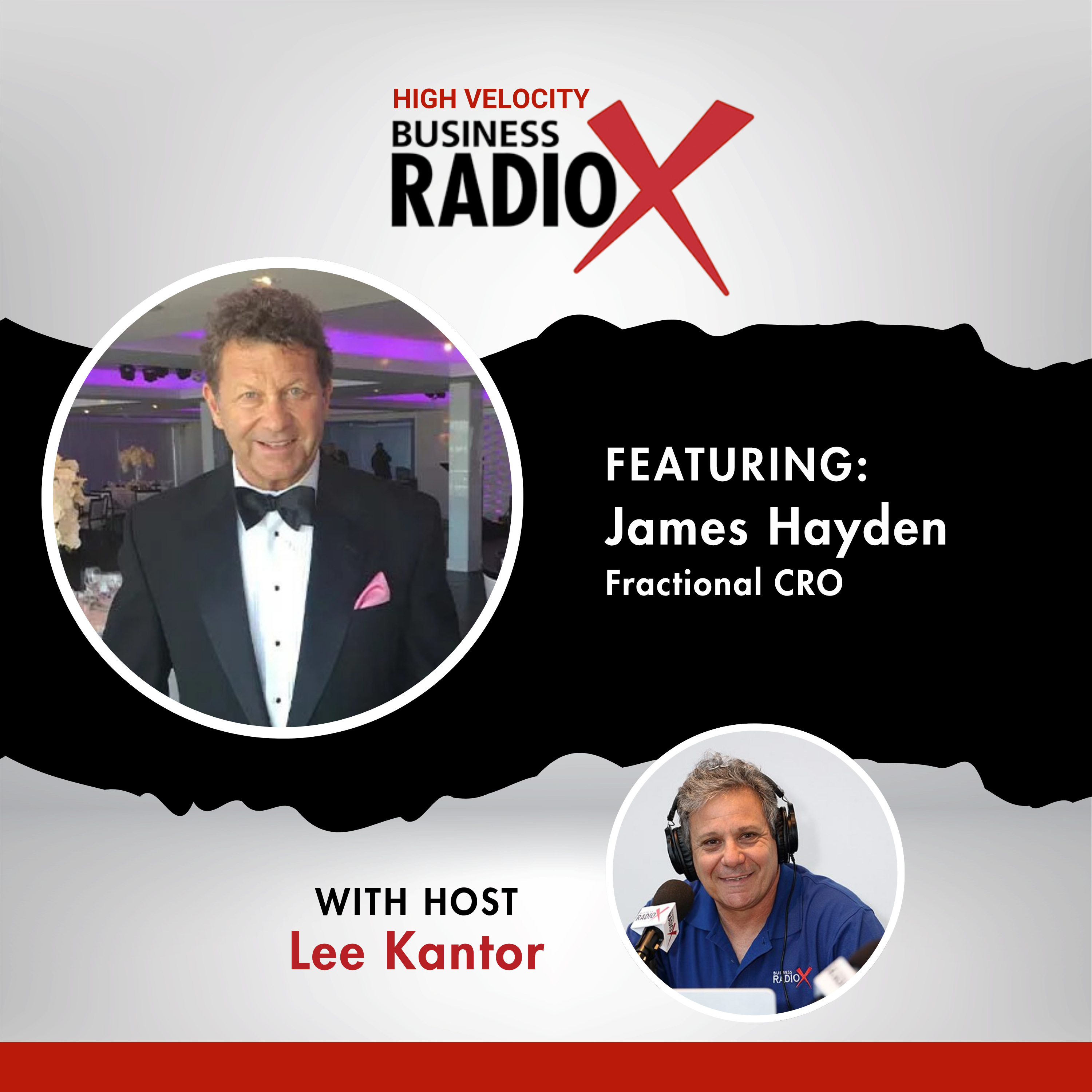

In this episode on High Velocity Radio, Lee speaks with James Hayden, a go-to-market strategist and fractional CRO, about how companies can fix stalled revenue and build scalable growth. James explains the importance of achieving strong product-market fit, identifying ideal customers, and targeting early adopters before expanding to the broader market. He shares how aligning sales with product, operations, and finance is critical to driving consistent results, and why many organizations struggle due to silos, poor processes, or lack of clear revenue focus. Through real-world examples, he highlights the impact of leadership, disciplined sales activity, and the right tools—from CRM systems to sales intelligence platforms—in creating predictable growth. The conversation emphasizes a holistic, hands-on approach to diagnosing problems, building effective teams, and turning underperforming sales organizations into high-performing revenue engines.
 James Hayden is a Go-To-Market strategist and Fractional CRO who has helped 140+ companies drive over $1B in revenue. With 8+ years designing and implementing AI solutions, he specializes in GTM diagnostics, sales enablement, BDR training, and CRM optimization (HubSpot).
He advises founders and leadership teams on building repeatable revenue engines, partner/channel strategy, and AI-powered sales acceleration.
Connect with James on LinkedIn and Facebook.
What You’ll Learn In This Episode
- How to define your ideal customer profile and key buyer personas in complex sales.
- The role of alignment across sales, product, operations, and finance in driving growth.
- Common breakdowns in sales teams, including poor reporting, lack of focus, and unclear expectations.
- Why revenue-generating activity—not just “consulting”—must be the priority for sales teams.
- Practical ways to build predictable pipelines using the right messaging, channels, and cadence.
- How tools like CRM systems and sales intelligence platforms improve visibility and decision-making.
- The impact of leadership, accountability, and culture in turning around underperforming teams.
- Why a holistic, hands-on approach is more effective than applying generic sales tactics.
- How discipline, clear goals, and consistent execution can transform results quickly.
 This transcript is machine transcribed by Sonix.
TRANSCRIPT
Intro: Broadcasting live from the Business RadioX Studios in Atlanta, Georgia. It’s time for High Velocity Radio.
Lee Kantor: Lee Kantor here another episode of High Velocity Radio, and this is going to be a good one. Today on the show, we have James Hayden, who is a go to market strategist and fractional CRO Chief Revenue Officer. And that’s what we’re going to be talking about today. Welcome, James.
James Hayden: Hey, Lee, good to hear your voice.
Lee Kantor: Well, I’m excited to learn what you’re up to. Tell us about your, uh, the services you offer regarding go to market and fractional CRO services.
James Hayden: You bet. So I work with organizations when revenue gets stuck, if you will, a lot of organizations, when they’re launching a new product, they haven’t done the right product to market fit. So I work with organizations On on getting that set up. I’ve worked with a number of organizations on turning around the existing sales teams, and it really means an alignment with a lot of the rest of the organization as well. So in general, I’d say if there’s if there’s a revenue issue in the organization, I come in and work with the teams to fix it. I’ve worked with approximately, it’s just over 140 companies, and I can explain that. It sounds sounds like I can’t keep a job, but that’s. I had a bulk of 80 companies working for the New Zealand government on organizations that were expanding outside of New Zealand as an advisor to them on, on launching their businesses. So I really focus I focus on finding finding the right market. Do they have the right pricing in place? I usually roll up my sleeves with, with the team I, I call myself a practitioner that is steeped in. In the latest knowledge in the industry on how to how to build the businesses. So I go out and do it myself. Then I can knowledgeably go in with the teams and from from there, make sure we have the right people in place and there’s a process to that. Make sure that we have some kind of processes in place in terms of, of reporting and aligning with the rest of the organization around operations, financial part product teams. And, um, we, we go out and build, build new markets.
Lee Kantor: So who is your ideal client? Like, are they startups? Are they already kind of seasoned companies that have just hit a plateau and they need help and like kind of a turnaround situation? Like who, who is ideal for you?
James Hayden: Yeah. Good question. My, for the most part, my ideal audience is startups. And those companies that hit that plateau at about 15 million in revenue and need and want to take it to the next level. So in the venture capital world, that would be the like the series B funded companies and, and startups. I’ve worked with a couple of larger companies and have a bit of large company experience in my background, but the bulk of, of what I do is in, uh, in those types of businesses.
Lee Kantor: So you mentioned early kind of identifying that ideal client fit. If you don’t get that right, foundationally, you’re going to be off into a million rabbit holes. How do you help them? Is there some advice you can give a emerging company to get that ideal client fit? How do you kind of know who the right person is to be talking to.
James Hayden: The right person within the.
Lee Kantor: Or just when you’re when you’re going to market. I say I’m a startup and I think I have a good widget. How do I know who the ideal person I should be talking to to sell this widget is?
James Hayden: It’s it’s really getting, getting out on initially getting out on um, meetings and calls, um, whether that’s meetings by video or if you can face face to face with potential clients and fine tuning that, that value proposition or the hooks to get other businesses interested. And it’s super important in, in building a new market to look at product adoption lifecycle. And that sounds theoretical, but it really, really, really works. Um, and it’s, it’s based in science from crossing the chasm. If, if you’re familiar with that in the technology industry and then the tipping point. And so when you’re launching a new product, it’s important to find the early adopters and innovators, they see the world quite differently than the rest of the market. And it’s the reason you see product placement, for example, in movies because, um, as humans, we look to people who are, who are leaders and then we adopt what they’re doing or what the products are. So finding those early adopters and innovators in the market, the message is different than it is to the mass market. But to get from that point of early adoption to a mass market, you need to get those early adopters in who are driving, driving the market. They’re looking for innovation in the marketplace. They readily, uh, I should say they embrace innovation and technology.
James Hayden: And there’s just some companies that are, that are followers. And so it’s, it’s a very different approach. So it’s, it’s a laser focused identification on who those, uh, who those companies are. Then within, within the organization, it’s about defining the right roles or personas there. I mean, there’s some great technology and data that if I’d had it 30 some years ago when I was beginning, you know, doing individual selling on my own, it would be a dream come true. So defining initially, defining an ideal customer profile, what that what that customer looks like. And again, that needs to be somewhat flexible and it can be iterative what that customer looks like. Then defining the people who will buy. So if you go to sales methodologies or several types of buyers in a complex sale like Miller, Hyman, and in the book I wrote, we talk about economic buyer, user, buyer, technical buyer, and coach defining those markets, developing that persona, using, um, a technology where you can prospect actively with those clients and fill in those gaps of information you have. Like, um, Zoominfo is, is a great product for sales intelligence that I utilize amazing data. I don’t know how to get all the contact information they do. Um, but it’s an incredible way to build a market for companies. I’ve gone through several technology selection, having the right CRM in place for reporting.
James Hayden: Now, that’s a bit of a balance because as you begin in the business and one of the small clients I’m working with right now is looking at $25,000 a year for a CRM package. What we did initially is we, we used Google Docs or like an Excel spreadsheet put in macros. So, so we could build that kind of reporting. And so we’ve got predictability. And what, what you want to get to with any organization is that message that resonates with people. So you’re getting the right message to the right people at the right time. I know that sounds easy. It’s it, it really takes it takes some work digging in. It’s the reason I like to be involved in, in the initial building of that and then messaging people. And there’s several different ways or, or means of messaging people. Um, one of the new ones I know some people are uncomfortable with is text messaging because you can get people’s mobile numbers using an email campaign. It’s still super effective, uh, to, to phone people, get them, get them engaged in a conversation, a very crisp conversation about why you’re calling and the benefits to your business. Um, email, um, you can use, but it’s of those things I mentioned the least effective.
Lee Kantor: So email’s the least effective.
James Hayden: Yeah. The, the open rates and email are about 20%. The open rates of a text are about 95%. Texts are opened in North America within five minutes by 95% of the people. I mean, that’s it’s amazing, but it can be intrusive. And, you know, I, I work with, uh, reps and teams on how to handle that objective of somebody feels it’s intrusive and, um, we’ve turned it around in most cases where, uh, you know, if you’re dealing with an executive and executive, and you talk about the most effective way to communicate with them. And, hey, I got a hold of you. Wouldn’t you want your people, if they’re generating revenue to use the most effective means possible? Um, yeah, last year we turned around a client who was a little bit angry when they first got that message and, uh, proposal and, uh, went right into a proof of concept.
Lee Kantor: So now when you’re working with a client, what’s your first move to understand kind of where they’re at so you can assess if you can even help them.
James Hayden: It’s, yeah, it’s, it’s a bit like going to the doctor. So there’s, there’s a diagnostic, uh, phase, um, with, with questions. And, um, I generally don’t get called in unless they’re stuck in some areas. So, um, where they’re, where they’re stuck is what I, what do I have to, for example, um, one of the, one of the organizations I’m advising brought me in because sales people aren’t reporting on their product. Uh, they’re not reporting in the CRM on the product. So what that does for the organization is the operations team has one picture of the business. The CFO has another picture of the business sales organization has another picture of the business, but they’re, um, the reps don’t, don’t have a cadence to the, to the meeting they’re in. Hence the rest of the organization has difficulty catching up with them. So that’s, that’s one of the issues. So first of all, it’s identifying the, the symptoms and the issues within the organization. And then what, what approach to, to take. But, you know, I mean, just going in, going in with a, with a template for everybody doesn’t, doesn’t make sense. But there are certain things you can see when, uh, when revenue is, is challenged, you know, getting Building. Building a demand for a new product. Depending on what space you’re in. Oftentimes, you need to build category or generic demand for the product, and then you have to answer the question of what. Um, why would they choose your company? So it’s. Why would they choose a solution? Like, uh, the product has. And then the next step is, um, why our company? So it’s, it’s taking a look at that, you know, really understanding the people within the organization and, um, and the structure, the organizational structure of sales, how it’s tied back into the groups, the product group, the, um, the operations group and the finance group getting more connectivity there.
James Hayden: Um, between those organizations. It’s critical. I’ve been, I’ve been involved myself and I can, I’ve got plenty of scar tissue from organizations where product wasn’t connected to sales. So, you know, we’ve gone out ahead of the product team brought in products that product team isn’t able to deliver on. So I’m bringing my, uh, my, my war stories and scar tissue to, to solve some of those issues for, for companies. But it’s really the primary areas are people, you know, do they have the right people in place? Do they have the right processes in place to go after the market? Um, how does the product look? Um, and that may have to be adjusted. So as having, um, having an open discussion and um, dialog with, with the product team and, and building that product to market fit and organizational structure. And then do they have supporting technology to, uh, for, for the sales teams really to ramp the business. And what that looks like today in organizations is good sales intelligence system and, and some kind of good sales reporting system. You know, Salesforce, HubSpot, um, are the, are the real big ones, but there are some other good smaller products depending on the organization too. Or like I said, um, if you’re, if you’re a nimble startup, sometimes a spreadsheet can work while you’re getting, you know, you’re getting your cash flow going and, and ramping up.
Lee Kantor: So it sounds, you’re taking a very holistic approach on this. You’re not just kind of taking a tactic and just forcing it into the company. You’re looking at everything holistically. So every so it’s not as siloed and the information is shared amongst everybody. So everybody can kind of be rowing in the same direction.
James Hayden: Absolutely. One of the organizations I came into, um, there were 32 salespeople and a couple of, um, um, of managers that, that they reported into that had been the poorest performing division in the, in the organization for four years. The founders were looking to recapitalize or essentially get some kind of an exit for the business. That division had been pulling the entire company down. And what what it took or the, the approach I had was I went out and I, I met went on sales calls with each of the 3232 salespeople. And what I came back to was, um, they’d been told by. The, the executive leadership that their job was really to consult with clients, but they weren’t hitting the revenue numbers. So when, when you’re in a revenue generating position, your job is, is generating revenue. So what, what I needed to do was instill in that team that their job was, was about generating revenue. So I gave them a mantra they heard. I probably 200 times during the year, every, every one of the calls we had was, your job is about getting in front of clients in revenue generating activity. Period. The expense reports, the the all the other reporting data do outside of those hours where you can meet with clients. And then what I looked at too was because they’d been taught rather than, than going out and looking for revenue opportunities to consult, which is an easy, you know, kind of an easy, um, conversation is show them how it’s done. So I initially went out with that organization on some of the, some of the key sales calls with each one of the reps and showed them an approach to do it.
James Hayden: Um, we were working in technology and it was when, um, the Wynn Hotel in Las Vegas was, was just opening. Um, we went after that business. That was a big first win that we had. So getting, getting a substantial win to get people talking about, a new approach and a new belief in. They can be the winning team. Like I said, this team had been, um, out of four divisions in the company. They’d been four out of four for five years in a row. And so it was, it was modeling, modeling the right kind of behavior and then instilling that approach about, hey, our job is this now, because they asked me what what I expected from them. And so it, it was a series of things I did. Like we had a mid-year meeting to prepare for the end of the year push, um, in Scottsdale, Arizona. And I had the team on the call and they said, you know what, what attire should we wear for the meeting? And I said to the team, I said, look, because that was that was the focus. Let’s get the revenue up. And, and again, I believe leadership needs to have clear communication. So I said, dress in a way that shows how you’re going to blow out or exceed your number. So we had some crazy things people wore. You know, there were, um, there were people dressed up, you know, Superman, Supergirl.
James Hayden: I don’t know if I could say this on your program, but one was dressed up as a pimp and said it was pumping incremental margin profitably and, um, and, and that, and so I, I came in with a bullwhip and I said, we’re going to whip your clients into shape. And then the E that we had on the team came in with the lasso and we’re going to lasso up the, the revenue. But the point was it was focused. Then what what happened from there was I went to I had the product team in place and the financial team, uh, and I said, you know, we’re going to go off agenda a bit. I want to know anything, anything that could stop you from exceeding your number. This year. We got into a three hour off agenda discussion. And and at the end of it, I said, here are the things we’re going to discuss. I can’t guarantee I’ll solve all of them, but we solved a couple. But I’m going to get back to you on a status on that. And then I asked the team if I did that, that they would make their number. I said, just I want you to envision it. We had a couple motivational speakers in one who had climbed Mount Rainier with me, who was a mountain guide and, and other other people. And I said, you don’t this is not obligatory, but I want I’m committing to you that I’m going to put everything behind it. And I’d like you to shake hands and for you to commit to make that number.
James Hayden: Everybody in the team shook hands, agreed to do it. Um, the end of the year, the team finished number one out of four. It was a very quick, quick turnaround. But it’s that kind of focus. I hope that’s illustrative of Um, the focus, it takes us a little bit different. You know, I’m in a startup is a different focus. You have fewer people and that, but that’s, um, it’s coming in and diagnosing it. And one, one of the things that’s been pivotal for me was, um, there was a sales training group that I utilized to work with. I need coaching to, I, you know, I’m not, I’m not perfect. And I think we have to go back to the basics every year. And the head of that organization, it’s a, it’s an approach that I really, really believe in. I stumbled into it after 17 years. And, um, they, I found out through another executive, um, their approach, um, we became fast friends and he’d asked me to work with him on writing a book, which it, it took four and a half years to, to do it. And what, what he said that got me committed to the book was he said, look, you can come into organizations, you know how to how to turn it around. Can you tell me what you do? And I stopped dead in my tracks. And, um, I said, well, I just come in and I know, you know, to put pieces together. I’ve got some pattern recognition. He said, I’ll tell you what you really you don’t you’re great at doing that.
James Hayden: What you what you’ll get if you write this book with me because he said he was having a hard time doing it, and he needed a practitioner with some case histories to, to do that is you’ll go from a conscious, competent to. Or you’re an unconscious, sorry, you’re an unconscious competent, you’ll go from being a conscious, competent. Yeah, look, I still have I still have plenty of work to do on my own, but it really, really made a difference in, in sitting down and going through that thought process about what I, what I do and figuring that out. So we published the book in 2013. It’s called Real world selling strategies. The Art of selling conversation that’s available on Amazon and actually in audible too. I did the narration on it on the revision of it. Um, so we were, I revised the book because from 2013 to 2023, the world changed a lot and technology had had a big impact. Um, channel channel sales or selling through partners was something we didn’t cover. That’s pretty substantial. Um, in, in technology, Gartner reports 70% of sales come through channel partners, not direct sales. So that’s an important piece of the sales equation too. Um, I also covered how to utilize AI. And we’re, it seems like we’re revising that every day in, in the sales process and have been involved in, in organizations, uh, that sell AI. So anyway, that was, I hope that was a good, uh, good illustration of of an approach.
Lee Kantor: Yeah. Now, if somebody wants to learn more and have a more substantive conversation with you or somebody on the team or get the book, is there a website?
James Hayden: Um, you bet I have. I have a personal website. It’s James B Hayden hayden.com.
Lee Kantor: All right. Well, James, thank you so much for sharing your story today. You’re doing such important work and we appreciate you.
James Hayden: Thank you, thank you. I mean, revenue revenue, uh, is what makes companies, right?
Lee Kantor: If if nobody’s buying anything, nobody’s eating. So it’s a critical component to any successful organization.
James Hayden: Absolutely.
Lee Kantor: All right. Well thank you again. This is Lee Kantor. We’ll see you all next time on High Velocity Radio.















