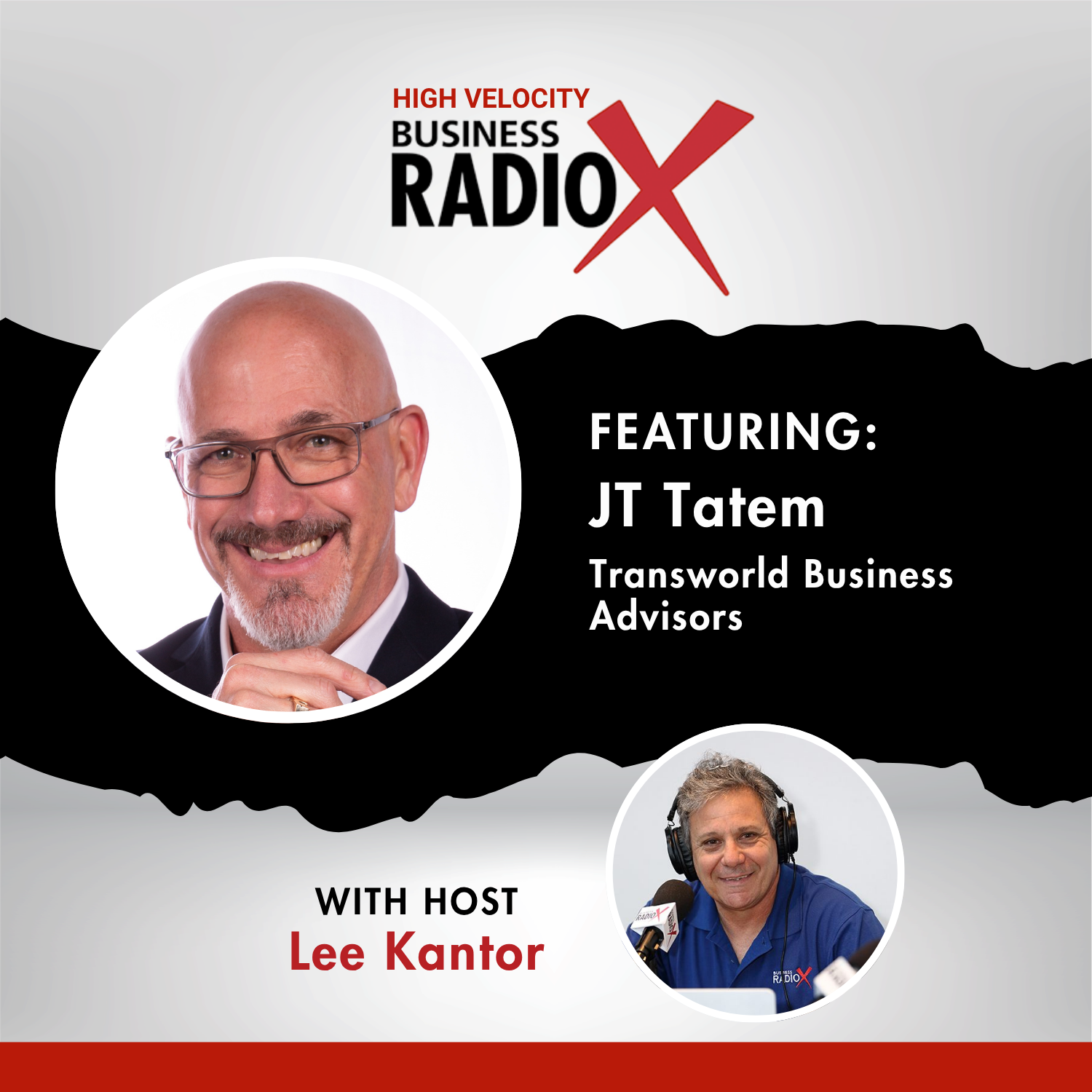

In this episode of High Velocity Radio, Lee Kantor sits down with JT Tatem, President of Transworld Business Advisors, to discuss what it takes to build, prepare, and successfully sell a business. JT shares practical insights into business valuations, exit planning, and why many owners underestimate the value of what they’ve built. He also explains how proper financial preparation, documented systems, and reduced owner dependency can significantly increase a company’s market value and attract qualified buyers.

 Jim “JT” Tatem, President of Transworld Business Advisors. Since 1986, Jim “JT” Tatem has helped more than 3,000 entrepreneurs buy, grow, and sell businesses, building a career that spans nearly four decades of hands-on experience in franchising, business development, and advisory services.
He began his journey with Signarama, the first United Franchise Group (UFG) franchise, which grew under his leadership to more than 700 locations across nearly 60 countries. He served as Director of Training and Support for 15 years before becoming Brand President for 10 years, where he pioneered initiatives such as the first Franchisee-led Advertising Fund, the Franchise Advisory Council (FAC), and the Hall of Fame.
Working alongside UFG’s founding team, he helped develop eight franchise brands that collectively formed the United Franchise Group, where he later served as President for three years.
With more than 40 years of experience in strategic planning, financial review, and business development, he is equally passionate about speaking, training, and coaching, equipping business owners and their teams with the knowledge and tools to perform at their highest level.
A proud Transworld Business Advisors franchisee since 2016, he and his son, Eli Tatem, lead the Western Carolinas team from offices in Greenville and Spartanburg, South Carolina, and Asheville and Hickory, North Carolina.
After serving as both Advertising Fund Vice President and President, he now serves as President of Transworld Business Advisors, the world’s largest business brokerage firm, with more than 1,000 brokers operating across 250 offices worldwide.
Connect with JT on LinkedIn and Facebook.
What You’ll Learn in This Episode
- Preparing a business for a profitable exit well before it’s ready to go to market.
- Building strong financial records that increase buyer confidence and business value.
- Reducing owner dependency to create a more transferable and scalable business.
- Documenting systems and processes to make operations attractive to potential buyers.
- Maintaining business growth throughout the sales process to maximize offers.
- Understanding the differences between Main Street businesses, lower middle market companies, and M&A transactions.
- Navigating the business sale process from valuation and marketing to negotiations, due diligence, and closing.
- Recognizing the hidden value of small businesses as sellable assets.
- Avoiding common mistakes that can reduce business value during exit planning.
- Leveraging Transworld Business Advisors’ expertise to support buyers, sellers, franchisees, and business brokers throughout the acquisition journey.
 This transcript is machine transcribed by Sonix.
TRANSCRIPT
Intro: Broadcasting live from the Business RadioX Studios in Atlanta, Georgia. It’s time for High Velocity Radio.
Lee Kantor: Lee Kantor here another episode of High Velocity Radio and this is going to be a good one. But before we get started, it’s important to recognize our sponsor, Business RadioX. If you’re a business coach who’s tired of being a best kept secret, set up a call with Stone Payton at bookstonephone.com to unlock your perpetual prospect pipeline. Today on the show, we have the president of Transworld Business Advisors, JT Tatem. Welcome.
JT Tatem: Thanks, Lee. Appreciate that. Thanks for having us here and really excited about High Velocity.
Lee Kantor: Well, I’m excited about what you got going on. Tell us about Transworld Business Advisors. How you serving folks?
JT Tatem: Yeah. So, well, you know, for the last 47 years. I guess just kind of getting started. We have been serving business sellers and business buyers, particularly the sellers who may be running a business and thinking about their exit, helping them bring their market, their business to market value, the business the right way, package it, present it to buyers who would be looking to acquire a business, and then finding those buyers, bringing those buyers and sellers together to help get that transaction done. And, you know, that helps the seller be able to move on to the next phase of their career or their life next season, and also gives people the opportunity to come in and maybe stop working for the man and start working for themselves.
Lee Kantor: So now at Transworld, are you helping primarily more sellers than buyers or both sides of the marketplace?
JT Tatem: It’s both sides of the equation. That’s really kind of where we we find our niche is being able to first work with the sellers. So you probably know that there’s a lot of folks out there who own businesses that a lot of talk about the baby boomer generation and the mass exodus over the last five. And now. Moving, moving forward about the next ten years of people who are looking to be transitioning out of the businesses that they probably started 15, 20, 30 years ago. And, uh, and then you have this other group of folks who are the, the buyers that are looking at it and saying, look, I don’t, I don’t want to be like grandpa and work in the same company for 40 years and get a gold watch at the end of it. I want to be my own boss and be able to kind of carve my way, you know, create my own destiny to where I’m going. So we’re working on both sides of the fence. We bring that business to market, as I said earlier, value it, help package it together, and then promote it to find the best possible buyers so that both buyer and seller win when when the transaction is completed.
Lee Kantor: Now, the businesses that you work with, if someone’s trying to sell, could this be any kind of business like a hardware store or a dentist? Or is it like kind of a franchise? Uh, maybe operation?
JT Tatem: Excellent. Excellent question. No. So since since we started in 1979, we cut our teeth on the Main Street business market originally. And that would be the hardware store, the landscaping company, the automotive repair business, the nail salon, the pizza shop, etc. and, uh, but we also have now morphed into what we call lower middle market. So you’ve got the main street business like we just talked about. Those are typically going to go up to about a million to maybe 2 to $3 million in, in enterprise value and sale price. And then you’ve got the lower middle market that’s going to be, let’s say, 5 million to say $250 million in, in, in value. And then you’ve got the M&A version that’s going to go even above that. So as Transworld has grown over the past 47 years, uh, started out in Main Street doing a lot of those Main Street deals, sometimes with some commercial real estate involved at the business owner may also own the building, for example. Uh, but then really morphed into developing our own division of lower middle market and M&A services as well, so we can handle any size business, whether it’s the, you know, Main Street mom and pop business, or it’s that guy or gal who’s built a manufacturing business, a pharmaceutical company, a medical practice, etc., anything that might be in that five to, you know, $250 million range.
JT Tatem: In fact, the last couple of bigger businesses that were sold have been in manufacturing. We sold a Christmas tree farm for over $30 million in the last couple of years. Just had a $62 million deal go through. And that was also in, um, in, uh, pharmaceutical and manufacturing as well. So it’s really any and all types of businesses. And quite frankly, when we first got into this thing, you know, and, and even still today, a lot of people don’t realize that there is such a thing as business brokers. Pretty much everybody knows a real estate broker, but not everybody realizes there’s someone out there that can help people. When it does come time for them to retire or go to that next phase of life. There’s someone there that can help them transition and cash in on what they’ve built over the last, you know, ten, 15, 20 years.
Lee Kantor: Now, a lot of our listeners are, um, business coaches, business consultants, and they may not be kind of the mega firms that you were describing, but they have a practice that they’ve had for many years. Um, you know, maybe they have a small team. Do those people typically have a sale or an exit, or do they just kind of fade away?
JT Tatem: Well, you know, it’s a great point, a great question. A lot of them don’t realize that they can have a sale. You know, they but what they’ve built is if they’ve got a customer base, maybe they have contracts in place or recurring revenue, they certainly have a revenue top line. They probably have a bottom line number. And if they have any assets, you know, maybe they have a small team of people, like you said, that continue on serving the clients that they’ve had. They would have a sellable enterprise. And, uh, because most people don’t realize business brokers like our team at Transworld exist. Being the largest business brokerage on the planet, we’ve got 250 plus offices and 1000 agents and brokers that can help that smaller enterprise, as well as the big guy when it does come for them. Come, come. Time for them to think about making a transition. So yeah, it is sellable.
Lee Kantor: So if they had never say it never occurred to them, which I’m sure there’s a lot of folks out there that that’s true, right. That they, they think that they’re just going to hang up their shingle and then call it a day and go to the beach. But this is a sellable asset. If you have the right team around you to help you sell it. Right?
JT Tatem: That’s right, that’s right. You know, we just did a deal recently with one of the agents in our in one of our offices up in the Carolinas. She met this guy. He’s a electrical contractor guy, 72 years old. She’s marketing winds up making a connection to this guy. And in the conversation, she discovers that he’s thinking his only option is to close it. He doesn’t have a son or daughter. Somebody can take over the business and he the people who are working for him aren’t really in that position to become a business owner. And so in his mind, you know, I’m just going to get to the end and close the door. And she says, don’t do that to your point. You got a sellable asset. You gotta you got a book of business, you got a customer base, you’ve got recurring revenue, you’ve got, you know, some equipment here that are being used. You got a team of people who can go out and service the customers. And less than six months later, she’s got a $500,000 transaction that takes place. He gets the business sold, but also signs on for a year contract with the buyer to remain to help, you know, make the transition go smoothly and introduce them to the clients, etc.. So he continues to be paid for the additional year as an employee, but he also gets to cash in on the business that he built 25 years in the making.
Lee Kantor: So so what let’s try to help that person that you’re describing, the person who isn’t the typical maybe person, but who has a business that they know they’re going to exit? This is the kind of the accidental exit here. How would you advise them to prepare to have a conversation with an expert like one of your people to exit successfully? Like, what are some of the do’s and don’ts and what are some of the things they should be doing today so that maybe in a year or so, they would be ready to have a sellable asset that they could exit with some money.
JT Tatem: Yeah. Well, it’s a, it’s, it’s, there’s a couple of good steps that you can take. And there, as you said, the do’s and don’ts. What things don’t, don’t I do. So I think the first thing is, and most people overlook this because as they’re running their business, they got their head down, nose to the grindstone. They’re doing the thing day after day. And then one day they look up and they realize, my life circumstances have changed. Or my kids graduated from my last kid graduated from college now. And I, I don’t need to keep this thing or my wife and I have decided she’s retired from her job and she wants me to do something different. You know, let’s let’s. What’s what are my options? And so a lot of times we wind up with clients that didn’t think about they didn’t do the preparation. And now it’s, hey, I want to, I want to sell it. What’s it worth? The better scenario would be to start thinking about it early. And in preparation for that, the first thing that you’re going to hear, if you listen to anybody in the industry talk about preparation, preparing to sell, the first thing you’re going to hear is good books and records. Okay? As a seller, you need to have your financials in order. You need to have a good accountant and probably a CPA or bookkeeper that’s helping you prepare the financials that a buyer is going to need to look at to be able to take the business to a bank to get it financed, or to be able to do their due diligence and say, what you’ve told me is verifiable.
JT Tatem: So that means tax returns have to be filed and, you know, taxes paid if needed. Uh, you need good financials, like three years of good record keeping. Those would be your profit and loss statement balance sheet, again, with an accountant or a CPA that will be able to provide all of that to you. That’s number one. Number two, is the business owner dependent because it’s less valuable to a buyer. If you are the business as the seller, you’re better position is to have multiple people on the team so that if you walk away or you’re not there anymore, the business can continue on. And so being able to train people on your team who can do the different roles and responsibilities in the business will set you up for a greater exit. Um, number three would be documenting processes, whatever is in your head, especially if you’re the founder and you’ve been running this business for ten, 15, 20 years. And everything that has to every decision that has to be made has to come through you or all of the processes, or only you’re the only one that knows it. Get that stuff documented. Get it. In a standard operating procedure, there’s lots of software, lots of different systems that can be used today.
JT Tatem: Coaches could probably help with that as well, so that you have something that’s transferable to the buyer, that makes your business much more attractive to the people who are on the other side of the table when that time comes. So get the financials in order. Make sure it’s not owner dependent, make sure all the things that you know how to do in your business are documented. If there’s contracts in place, make sure that those are all documented in one place. The vendor relationships that they’re solid, that they’re in place. And then the fourth thing that most people think about or don’t think about is they take their foot off the gas. They go, okay, now my business is for sale. I’m just going to sit back and wait for the transaction to happen. That would be a major mistake. What buyers want to see is at least continuity in the sales, if not an increase in the sales. So our advice is always going to be to that seller, keep your foot on the gas, go out and get more clients. Go out and get more customers. Go out and get more sales. Keep growing the business as though you weren’t going to sell it. And when the buyer comes in, he or she is going to be willing to compensate you more for that.
Lee Kantor: Now, you mentioned the first thing you said was kind of get your financial documentations in order, your taxes and all that stuff that for some entrepreneurs, especially smaller firm solopreneurs, that’s kind of not how they’ve been taught. They’ve been told to do things, to not pay a lot of taxes.
JT Tatem: Mitigate and minimize their taxes.
Lee Kantor: Right. So which, which means do not show lots of money. So in order to exit though, you have to kind of do the opposite. You have to kind of change your thinking.
JT Tatem: It’s interesting, I was having a conversation just yesterday with a fellow, his he was a partnership. Him and his partner started this small restaurant and the partner passed away last year. So now they’re in the middle of the estate and the kids that are in the estate, they don’t want to take on the business. They were never involved in it. It was just really dad’s idea with this friend, lifelong friend and partner that they’ve, that they’ve, uh, that they started the company. And so now he’s saying, well, if I think about in his case, he has to be thinking about buying out the estate. Okay. The children of the of the partner who’s passed away and everything that they’ve shown to their accountant and to their advisors up to this point of the conversation is really been tax returns and financials that show little to no profit. Okay. Like 2 or $3000 a year is what’s left over after they’ve paid all of the expenses and their salaries and, and, and, and other expenses that they’ve run through the business. And so in that case, it’s, it’s actually going to work out better for him because the valuation that he has to pay to the family is lower, but it’s not good for the family because the business is going to be valued only on the amount of revenue and the amount of profit.
JT Tatem: And so when we were talking about it, I said, so what, what what are they? What do they want? You know, do they just want to be out of it now? Or would you guys be better staying together as partners even though the partner physically is not there, but his family still involved, still owns the business and run it for another year or two. But this time, show all the profit you can show because two years from now, if we put a multiple on your profit and it say 2 to 3 times your earnings, instead of you giving them a check for 65 or $70,000 for their share of the business, you could be selling the business for 3 or $400,000, and they could get 150 or 200 grand out of the deal. Right? So most people running a business today, they’re thinking about limiting my tax burden. And so to your point, they’re going to be running all kinds of expenses through the business, writing off as much as they possibly can. So there’s a little bit left over, if at all.
JT Tatem: And Uncle Sam’s net profit or the bottom line when you go to sell the business, the exact opposite is true. And that is because the buyer is going to need to take those financials to a lending source. Let’s say it’s a local bank or an SBA lender, and the bank is going to look at those tax returns, not the profit and loss statements, not any cash that goes through the business. Just what gets put on that tax return and that net profit number. There has to be large enough to be able to service the debt, which is the loan that the bank is going to make and provide a livable wage to the buyer who’s coming in. So it’s got to show that it’s making enough money. And that’s what a lot of people aren’t prepared to do. To your point, they’ve just been running it and trying to mitigate their taxes. When you’re ready to start thinking about selling, you want to go the opposite direction and be able to show as much profit in the business as possible. You’re going to get the best, the greatest return, the better pay off that way.
Lee Kantor: And this conversation we’re having in that anecdote you just shared, that’s really where some of the value of having a Transworld Business Advisor partner by your side during this time. That’s where it becomes evident, because it’s not like the business owner doesn’t know what they don’t know. And this is stuff you guys deal with every single day. You know where there’s opportunity, you know where there’s danger and you can mitigate a lot of it just by putting things in place a year or two before you need to so that there’s gonna, it’ll pay off down the road. But if you don’t know, you don’t know.
JT Tatem: That’s right. And look, not every business is run that way. There’s a lot of businesses out there that have been run from the beginning with the mindset of my outcome eventually is going to be sell my company. Okay. Many business owners that I speak to when they started from day one, everything that they’ve done, every process they’ve put in place, every system that they’ve designed, every way they’ve gone about building the business has been aimed at an eventual exit, but not everybody does that. And so, you know, we actually have a sister company called Exit Factor. That’s another one of our brands within our organization, and that was born directly out of this need, where we were working with potential sellers of businesses and having those conversations and going through and looking at the financials and coming up with what the most probable selling price in the marketplace would be. And sometimes they were like, great dynamite, I love it. Let’s go. And other times they might be like, oh geez, I thought it was going to be worth a lot more than that. This is my retirement plan.
JT Tatem: I need to get, you know, $3 million for the business, not 1.2. And so the folks at Exit Factor were originally Transworld Business Advisors, um, franchisees and advisors. And they developed an entire process around helping someone prepare to exit down the road. So now they sit down with that franchise, with that business seller and say, here’s what the most probable selling price is. And they go, oh, I need more than that. Great. No problem. Let’s spend the next year or two years putting all of those things that we just talked about into place, getting the financials correct, getting all the processes, documenting, getting everything out from it, being an owner dependent business so that it is more they call it business attractiveness, that it’s a business that is attractive to the buyers because all of those boxes have been ticked. And that’s a whole nother business that we’ve created to help complement or supplement the need for those sellers to get their business prepared before they’re ready to come to market so they can get the best possible return.
Lee Kantor: So now, um, from a Transworld business Advisor standpoint, are you looking for more partners or franchisees around the country? Like, what do you need more of?
JT Tatem: Sure. Well, we need, we need more of a lot of things. So it’s a great question. The first is, yes, we’re always looking for new partners and new franchisees to join the Transworld team. As I said, we started in 1979. That’s 47 years ago. And, uh, originally that was just one office in South Florida, uh, that then grew to multiple offices across the state. And about 16, 17 years ago, we actually partnered with Transworld Business Brokers to create the Transworld Business Advisor franchise model. And that’s allowed us to now have 250 offices and 1000 agents and brokers in about 20 countries around the world. So we’re constantly looking for new franchisees to join the team. There’s a lot of virgin territories, wide open areas that are still available for someone to own a Transworld Business Advisors franchise. That’s number one. Number two, we’re looking for additional international master partners. These are folks who actually invest in the Transworld model and take it to their country and then replicate the model in Poland, Norway, Brazil, Chile, Japan, Canada, etc. the same way we’ve done it here in the United States. And they become basically in their country what we are here in the US, the franchisor. Uh, the third thing we’re looking for always is agents, folks who can join the Trans world team. You’re actually kind of running your own little business inside of that local trans world office, and you become an agent. Think of it like being a real estate agent, except for instead of selling houses or buildings, you’re now selling what goes in the box the revenue, the profitability, the assets, the people, the goodwill, etc., etc. we have a complete training program that teaches our franchisees and their new agents everything that they’re going to need to know to be successful and to be able to really serve their clients very, very well.
Lee Kantor: Now, at that level, do you need any kind of education or certifications, like you mentioned, real estate earlier, and you have to have a real estate license. Is this a similar thing? You have to have a certain licensing in order to be an agent or an advisor.
JT Tatem: Very good. So so we’re going to do the training on our side here at Transworld Corporate headquarters, which is here in West Palm Beach, Florida. That’s where I am today in our studio. And we go through an immersive one week training for the new agents and two weeks for the new owners. Some states in the U.S. today are called licensed states. So what that means is that, yes, you require a real estate license. California would be one of those. Georgia would be one of those. New York would be one of those. You need to be a licensed realtor in order to be able to sell businesses. But not every state. In fact, there’s only about 16 or so U.S. states that do require a license today. However, if you’re going to be a business broker, at some point, you’re going to come across a client who is selling their business and they also own the building. And so you’re going to want your real estate license because without it, you can’t get commission on that sale of the real estate portion of that transaction. And that typically only has to happen to you one time as a business broker. Before you go, you know what? I probably ought to go get my real estate license. So even though it’s not required in each state, it would it would be necessary for you to have that real estate license to be able to handle any part of a commercial real estate transaction and to be eligible to receive any kind of compensation for that part of the commercial, uh, that, that, that transaction, if it has real estate. So if you’re negotiating a lease, for example, or, or getting a new lease for the buyer coming into the location, or in the bigger example, that seller is actually selling the business and the building.
JT Tatem: We just finished a deal like this two and a half weeks ago. It was a cabinet manufacturing business, been around for 20 years, uh, doing a couple million dollars a year in revenue, making almost $700,000 a year in net profit to the bottom line to the seller, the owner at that time, that business sold for $2.7 million, and the factory that it was producing the cabinets in sold for 774 000. Fortunately, we are licensed in the state that that transaction took place in, so we’re able to help on both sides of that transaction, both the real estate and the commercial, uh, the and the business brokerage side, um, as far as other training goes and certifications. There’s not any others needed to be the business broker. You’re going to go through our training program. As I said, it’s a week long for the agents, two weeks for the for the owners. And then there’s continuing education that we do each month as part of the Transworld way, the TBA way we call it. Uh, and then there are other certifications that you can, uh, become licensed in. You can become a CBI that’s a certified business intermediary through the International Business Brokers Association. You can become an M&A person, a mergers and acquisition, uh, has certification as well. Uh, there are other certifications in real estate that you can take. Again, they’re not all required to start as a business broker, but our education track is going to, uh, be taking all of our agents and our owners and heading them in that direction. Because continuing education just means that you’re getting better prepared to serve your customers the right way.
Lee Kantor: So now what’s it like for a business, uh, somebody who wants to sell their business, how does it, what does that engagement look like? So I raise my hands. Okay. I’m ready. Um, so what are the steps that happened? Like do I, is there a fee to have a conversation or is this something that like real estate? Um, you get a.
JT Tatem: Fee up front. No, no fee up front to have the conversation. It’s a, obviously it’s a, it’s a, it’s a free consultation because we want to see a, we want to understand your business. Let’s see if it’s ready to bring to market. Does it qualify to do that? And B, are we the right firm to serve you? Uh, there may be um there may be certain expectations that you have that we go, we just can’t meet that, you know, sometimes, uh, it’s kind of like when someone has a baby, everybody thinks their baby is the cutest baby on the planet, right? Everybody who has a business thinks their business is the best looking business and should sell for the maximum dollar. That may or may not be true, depending on what the financials tell us, the documentation, the seller dependency, some of the things that we’ve already talked about. So but normally what we would do is we’d sit down and say, look, let’s have a conversation. Help us to understand your objectives as the business owner. What are you trying to accomplish? Is it a quick exit? Is it a certain dollar amount you’re trying to get to? Is it. Hey, I want to sell the business, but I’d like to remain on as an electrician I talked about earlier has done. So first, help us understand your why. What’s your motivation? Let’s see if. If those things align with what our goals are and our and our core values, because we want to make sure that there’s good synergy between us and the clients that we’re going to serve.
JT Tatem: That would be number one. Number two, then we would look at the financials and help establish what that most probable selling price is. Uh, many times we have clients that will come to us and they may have spoken to their accountants or maybe some a lender, and they’ve gotten an idea of what they think the business is going to sell for. We can go through a broker opinion of value process with them. It’s kind of like if you were having a, a piece of commercial real estate set for sale, you would have an appraisal done. This is similar to that. You’re looking at revenue, assets, Profitability or net profit of the business. Goodwill of the of the company, etc. and being able to then have comparables of what other businesses like yours have sold for and will generate a report for that. There is an investment with the most broker opinions of value, typically somewhere between maybe 3 to 4 or $5,000. The best part is that when we sell the business, in the end, we typically credit that investment of the broker opinion of value back against the success fee that our firm is going to earn at the end of the transaction, which means that it doesn’t really cost you anything to bring the business to market the right way. That’s that’s the short of it.
JT Tatem: So we would do a broker opinion of value, gather all of the documents that we need, the financials that we talked about earlier. Do you have a lease. Do you have employment contracts etc.. A business history of the company. How did you start? How did it become successful? What are the opportunities that a buyer needs to see? We would engage with what’s called the marketing agreement. That’s where you hire us to be the exclusive seller representative for you as the seller to, to bring the business to market. And then we will create all the marketing materials. So that’s going to be things like what we call a business listing information sheet or one page teaser. We also create what we call a SIM, a confidential information memorandum. That’s really like the, the selling packet on the business. It’s got all that history of the business, the products and services, what the organizational structure looks like. The financials are going to be in there. Three years of financials are typically included in that. And that’s information that we’ll be able to put into a buyer’s hand at the appropriate time to give them a really clear picture of what this opportunity really looks like. All of that marketing materials that gets created, we’re going to create it. We’re going to bring it to you as the seller to make sure that you approve of what we’re going to be putting in front of the buyers. There’s no investment at your level to do that.
JT Tatem: Uh, and then we’re going to bring the business to market and we’re going to promote it across our own T world site, uh, again, 250 offices and 1000 agents and brokers. We’re going to find buyers that may be in your local area. Li those buyers may come from a different part of the country. They may come from a different country altogether. We’ve done many, many deals where we have buyers come in from outside of the US, and they use what’s called the E-2 visa program, which gives them the opportunity to become a US citizen through a business acquisition. So, uh, when we bring it to market, we, we have all the expense there of bearing it and putting it out on the portals, the websites, the different areas. We will do outreach to buyers. We have a buyer database of about 800,000 buyers, uh, people who have expressed interest in purchasing businesses in the past. And we can whittle that down to these people are interested in medical practices. These people are interested in automotive repair businesses. These folks want restaurants, and we can advertise directly to them to find the best possible buyer for, for that seller. And then we’re going to screen the buyers when we have people who inquire. We’re going to take them through the NDA process, a confidentiality agreement, so that they understand that the information we’re sharing with them is confidential in nature, because all of the listings that we bring to market, they don’t say the business name, they don’t have pictures of the location.
JT Tatem: We want to keep it on the down low, simply because the employees don’t need to know that it’s for sale. The other customers certainly don’t need to know for sale. The vendors don’t need to know. So we’re going to we’re going to do that on a confidential basis. We’re going to screen the buyers. We’re going to also look at their financial position to make sure that they’ve got a down payment that’s accessible. Have they gone through funding already and talked to some lenders. And then we’ll bring the buyers and sellers together to introduce the business, have a conversation between seller and buyer, maybe multiple times, perhaps a visit to the actual location to see the business for sale. And then we would guide the buyer through putting their offer together, presenting that offer to the seller, going through a due diligence process, all of the things that the buyer and their accountant and their attorneys are going to want to see. We make that all readily available. And while we’re doing that, the financial folks are working on their side to get the loan approved. And then we shepherd that across the line in closing. So there’s an entire map that we work off of, Lee, that we would sit down with any buyer or seller and kind of explain those different steps that I’ve just laid out for you.
Lee Kantor: Now, is there an approximate window of time? I know every deal is different, but is there kind of a ballpark? Is this something that once I raise my hand and say, J.T., I’m in, let’s begin. And then from there, is it a one year, two year, five year process to get the deal done? Sure.
JT Tatem: Great. Well, you know, if it’s if it’s someone, as we talked about earlier, that’s like, well, I want to start thinking about preparing it. It’s going to be a much longer runway. If it’s someone that the guy was just talking to the other day with the with the partner that passed away, he’s like, look, if I buy these guys out, I’m going to probably want to turn around and sell this thing right now. Okay. That’s fine. Once we get the marketing agreement and the engagement is started, we’ve received all the information that we need from the from the seller to bring the business to market. Typically what you’ll see is the International Business Brokers Association will say the average sale in America today is anywhere between 8 to 12 months. Now, we have had plenty of deals leaked, and I can think of four off the top of my head that have closed in 77 days, 64 days. I was just on the phone with one of our local agents here in Florida, uh, 20 minutes before coming into the interview with you. And, uh, he had a medical staffing business. He got the listing, they had the engagement, put it put together, went to market with it. That took 2 or 3 weeks to get all the materials that they needed from the seller within the first two weeks of having it listed for sale, he had over 20 qualified people looking at the business, and within another week he had two different what they call letter of intent offers on on the on the on the business. And he just closed it yesterday. So he was a total of about 67 days from the time he listed it to the time it was sold. It was a seller finance deal. So the seller was carrying a little bit of the note there acting as the bank. The buyer comes with a down payment amount and they were able to get that deal done and in pretty much record time, less than three months.
Lee Kantor: Now, are there certain industries or niches that are hot or popular right now?
JT Tatem: Well, you know, we, we, we just looking at our 2025 results, I would tell you, it depends on the buyer. Um, we’re very, very, very, very dogmatic on restaurants, construction businesses, home services, businesses, home services being things like Hvac, plumbing, painting, landscaping, etc., etc.. Uh, and actually health and wellness is one of our biggest categories based on the over 1500 deals that were done last year in our network, 15,000 plus over the course of the last ten years, those are the top three. But we are in franchise space Non-franchise space. We do a lot of what they call franchise resales. So for example, I sold three Smoothie King franchises and the guy who owned them was looking to retire. He and his wife were going to go spend some more time together, and we brought that business to market. He had three locations. That’s what we call a franchise resale. So the difference there, which is a little different than maybe an independent business that might be for sale, is you have a franchisor. Now that is also part of the equation. So as the broker, once we have that buyer and seller agreeing on the transaction, we’re going to present that buyer to the franchisor to get the franchise owners approval on the business and the new person coming in.
Lee Kantor: So if somebody wants to learn more, have a more substantive conversation with you or somebody on the team, what’s the website? What’s the best way to connect?
JT Tatem: Yeah, best way to connect is just www.tworld.com, that’s Transworld, tworld.com. Uh, and if anybody needs to get to me, my email, personal and business here is jt@tworld.com, or you can reach me at (864) 315-8998.
Lee Kantor: And you’re looking for people who are interested in selling their business and or buying a business.
JT Tatem: Sell a business, buy a business, be a franchisee, be a master partner, be an agent. Any and all people are welcome. Would love to have that conversation.
Lee Kantor: Well, JT, thank you so much for sharing your story today. You’re doing such important work and we appreciate you.
JT Tatem: Thank you Lee. Thanks for having us on and featuring our brand. We appreciate you too, buddy.
Lee Kantor: All right, this is Lee Kantor. We’ll see you all next time on High Velocity Radio.















