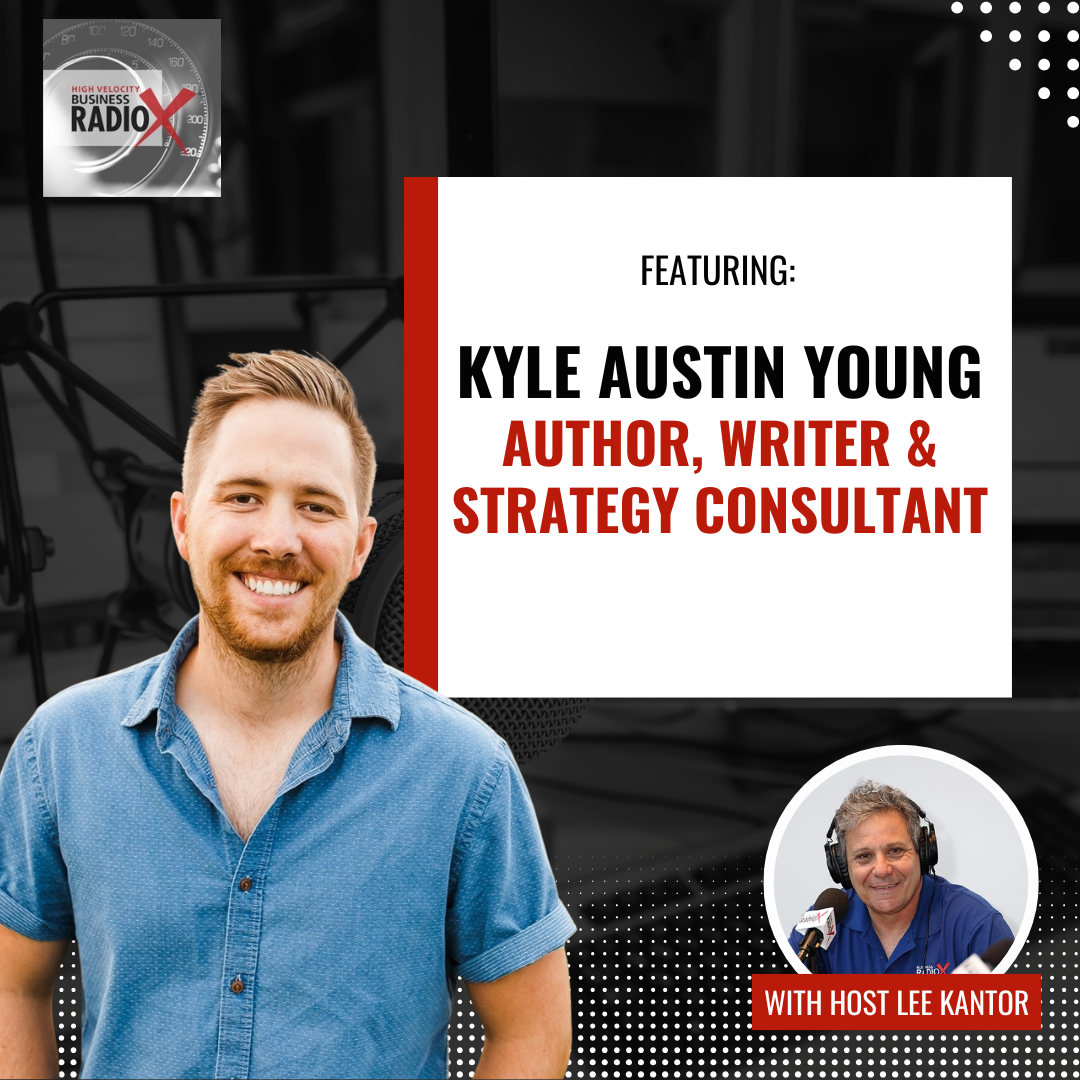

 Kyle Austin Young is an award-winning strategy consultant for high achievers, entrepreneurs, and leaders in a wide range of fields. This work has given him the opportunity to develop and refine a powerful system for accomplishing big, meaningful goals that focuses on understanding and changing your odds of success.
He is a popular writer for Harvard Business Review, Fast Company, The Boston Globe, CNBC, Psychology Today, Forbes, and Business Insider. When he’s not writing, consulting, or spending time with family, you’ll usually find him fishing.
Connect with Kyle on LinkedIn and Twitter.
What You’ll Learn In This Episode
- My book: Success Is a Numbers Game: Achieve bigger goals by changing the odds
 This transcript is machine transcribed by Sonix.
TRANSCRIPT
Intro: Broadcasting live from the Business RadioX studios in Atlanta, Georgia. It’s time for High Velocity Radio.
Lee Kantor: Lee Kantor here. Another episode of High Velocity Radio, and this is going to be a good one. Today on the show, we have Kyle Austin Young, who is a writer, a strategy consultant, and author of the new book Success is a Numbers Game. Achieve bigger goals by Changing the odds. Welcome, Kyle.
Kyle Austin Young: Well, thank you for having me. I’m excited to be here.
Lee Kantor: Well, I’m excited to learn what you’re up to. Uh, before we get into the book, uh, tell us about your strategy consulting practice. How are you serving, folks?
Kyle Austin Young: Yeah, I appreciate that. I am a strategy consultant based in Nashville, Tennessee, and I’m typically working with organizations, entrepreneurs, sometimes just individuals who have a big goal that they’re trying to achieve, and they’re looking for someone who can come in and do everything possible to optimize their odds of success. So over the years, that’s included a doctor out of Harvard Medical who wanted to change the way that Americans talked about cancer. Another example would be a technology company that was leveraging some cutting edge virtual reality software to help people learn new languages, and they wanted to compete in that very crowded language learning niche. I had a bed and breakfast once in a coastal town in Maine that had 12 competitors, and they were trying to find a way to stand out in this small town. I’ve had real estate agents, master gardeners, interior designers, a little bit of everything.
Lee Kantor: So what’s your backstory? How’d you get involved in this line of work?
Kyle Austin Young: You know, I was the operations manager at a couple of different organizations, and through that, I developed a skill of helping businesses grow, helping businesses create systems, helping businesses identify opportunities and make the most of them. And I went through a couple of really untimely layoffs. Both of these were over a decade ago now. In one case, I had just bought my first house, and so that was not a great time to lose my job. And the second time my wife and I were in the process of adopting our daughter and adoption’s a pretty famously expensive process. Not a good time to lose my job there either. So both of those happened over ten years ago, but I got tired of telling my wife that I’d lost my income. And so after the second layoff, I was really fortunate. And, you know, the day after, I had four different offers one day later and I’m very thankful for that. But those were people who were familiar with my work and felt like they had an opportunity to, you know, kind of snatch me up. And so I ultimately went to lunch with a friend, and this friend gave me the advice and said, you know, I hate watching you go through this over and over again.
Kyle Austin Young: What if you took on, you know, fractional roles with each of these organizations? And that wasn’t really something I’d considered at the time, but I did, and that was ten years ago. And over time, that grew into a consultancy that’s allowed me to work with a lot of amazing people. You know, I mentioned a few examples, but the gardening columnist at the New York Times is a long time client, and we have created something called the Virtual Garden Club, where we teach people gardening principles, where she teaches and I moderate and have helped build and structure that program. I have clients who teach people how to write memoir, how to tell your story, especially in the second act of your life. And so I’ve gotten a chance to meet so many interesting people, be a part of so many fun projects. Ultimately, what I’m usually bringing to the table is they have typically a goal of making the most of the business they’ve built, and my job is to identify opportunities to monetize the attention that they have or to, in some cases, grow that attention and serve the customers that they’ve brought in through their writing, their podcasting, or the products they already offer.
Lee Kantor: Now, when you’re doing your consulting, are you is it kind of holistic? Are you focusing mainly operationally marketing wise? Like like how are you approaching, you know, each of these clients?
Kyle Austin Young: I position myself as a highly skilled generalist. Typically you’re choosing between a specialist or a generalist, and typically the generalists aren’t very good at anything, maybe they’re okay. I’m not trying to be dismissive of that, but, you know, they’re not specialized, certainly. And the specialists typically have more skill, but they have it in one area. And so I’ve tried to become someone I’m certainly not the best in the world at everything I do that would be, you know, unachievable. But I’ve tried to become someone who can help in a wide variety of areas. The people who were really specialized. What I learned in consulting is they were always trying to find new clients. They would go in and do their, you know, their one trick, so to speak, and it might be really valuable and they might do an amazing job. But then once they had performed the service that they performed, then that contract was over, you know, it was time to go find more people and just felt like they were always on this treadmill of trying to meet new people. I wanted to become a part of organizations. I wanted to walk with them, you know, over the long term. I wanted to invest in those relationships.
Kyle Austin Young: And so coming from a background in operations management, I was, you know, leading departments at all times. And the reality is, when you’re leading different departments, you have to develop some of those skill sets. So a decade ago I, you know, I got my start in that. And then since then the great thing about consulting work is you learn something every day. And then typically what you learn is applicable on other projects. I had a project recently, a nonprofit, and in a part of the country that has a tremendous amount of need when it comes to homelessness, addiction, human trafficking, poverty, hunger. And they brought me in to try to figure out a mysterious problem that they were having for years. They’d brought in millions of dollars through donations, and it had held really steady or grown for 25 years. And they had, just in the last couple of years, started to see a decline, and they weren’t sure what was going on. About half of their income comes in through thrift stores, and so they still had a way to support the ministry. But the other half comes from these donations and it was hindering their ability to grow. So they brought me in to try to figure out what happened.
Kyle Austin Young: And their theory was that people had just gotten bored with their content, that people weren’t paying attention anymore to the newsletters, the videos that they were putting out there. And that’s what they’d hired a lot of other people to look into. And no one could really identify anything. I came in and actually found a technical glitch that was preventing people from receiving their emails. So no one was getting the content and it looked like they were. And so because of that, I was able to fix that problem, which was a learning curve. And that’s really what I want to illustrate. There was a learning curve there after I had identified the problem, but once I had fixed it and they were able to, you know, resume growth. I was talking to another nonprofit recently that digs wells for people in Africa, and there was the potential of a similar issue, and I was able to take what I’d learned at another project and apply it here. So that’s kind of been the story of my career, is I come in, I find problems, I solve problems, and after doing that for a very long time, I developed a pretty robust skill set.
Lee Kantor: Now, on your website, you have pretty prominently that you don’t spend any money on marketing, and that most of your business or all of your business is word of mouth. Uh, is that what you recommend your clients do as well?
Kyle Austin Young: No, no, not at all. Uh, I’m a I’m a consultant. I’m a single person. So my clients are often people who are selling sometimes physical goods. And it’s incredibly important for them to have a marketing budget. I think it’s very appropriate when they’re selling services like that to poor significance, amount of money into advertising, and then put people often into some kind of a funnel that leads to a purchase and hopefully the loyalty of that customer. In my case, I am not trying to have, you know, a million customers. I’m trying to have an amount that I can manage. And so a little bit of a different approach and integrity is super important to me. So I want to say as a consultant, I have never spent the money on marketing. Now as I launch a book that has changed a little bit, I want to do everything I can to honor the investment that my publishers made in this book. And so there’s certainly some money going into selling this book, which is, again, a little different than selling consulting services.
Lee Kantor: But if you were a business coach or a consultant, you think the best path is not necessarily through marketing and advertising, but through word of mouth and referrals.
Kyle Austin Young: I think that word of mouth and referrals are an absolutely crucial part of a business’s growth of a business’s health. If you aren’t getting word of mouth and referrals, then I would say something is wrong. I would say that you aren’t delighting customers at the level that I would like to see you delighting customers, so I would certainly be paying close attention to that. I think that it comes down to optimizing your odds, and that’s really the focus of my book. But if you see an advertisement on LinkedIn or maybe you see an advertisement on Google, there’s a certain amount of trust that you would give that advertisement. If you get a recommendation from a, you know, a close friend or a colleague, you’re probably going to put significantly more trust in that recommendation than you are in the advertisement. And because of that, word of mouth is just a crucial way to reach people who might not have trusted you in another context. So anytime you’re selling something service based, I think that you should have a really a clear focus on word of mouth. A clear focus on sort of grassroots marketing. But I think to some extent that is a natural byproduct of delighting your customers. So for me, it’s been a pretty natural byproduct. Just as I say, I’ve never spent money advertising my consulting services only maybe once or twice in my career. And these were years and years ago. Have I ever gone to someone asking, you know, is there someone you can recommend me to? Is there someone you can refer me to? That’s happened naturally as a byproduct of the work that I’ve done. But again, if you’re selling, if you’re selling physical goods, word of mouth is still important. You want people to enjoy the product, you want people to talk about it. But there’s typically going to be a bigger emphasis on advertising.
Lee Kantor: Now, is there a way if if we’re buying what you’re selling, when it comes to the importance of referrals and word of mouth and organically having people you know recommend you, is there a systems and processes in place you can put that helps you increase your odds of that happening.
Kyle Austin Young: Sure, absolutely. One of the things that you want to do is you want to provide materials that make it easy to share what you’re doing as an organization, and so that can be creating different digital assets, graphic design, things that make it easy for someone to post something. Sometimes that’s as simple as as prompting them, you know, after someone’s made a purchase, or if they’re in a certain place in your sales funnel, you can give them a button that will pre-populate a message on social media that they could then share very easily if they chose to do that. So you want to make that simple for them as you can. Many people today are building referral programs or building affiliate programs. The technology has never been more accessible than it is right now, which is a great way to reward people and keep your product top of mind as they’re making those recommendations. So there’s definitely ways to put systems in place, and I’m a big fan of doing that to the extent that it’s possible in your organization.
Lee Kantor: What about activities that you should be doing every day to help increase those odds of you being recommended and referred?
Kyle Austin Young: Well, first of all, you need to deliver a great product, a great a great customer experience. That’s going to be a really important part of this in terms of how do I how do I encourage someone to consider recommending me to a friend? I think that it’s wise to still put that idea in their head. I think that, again, having things like referral programs, things that reward people, that create a little bit of that extrinsic motivation can still be a helpful part of that. But typically when someone has a really exciting experience with a product, they want to make the most of it a way that you can, or they want to talk about it. Rather, they want to share it. One way that you can, I guess, make this a little bit more, oh, artificial, scalable is you can kind of take a hybrid approach to word of mouth, which is marketing the testimonials of happy customers. Right? So I could if I had delivered a great experience to you, I could take a testimonial from you, I could take a case study from you, and then I could potentially spend some money on advertising to drive traffic to that case study to get that video to go viral, whatever the case may be, depending on my approach with the goal of then it’s not organic word of mouth necessarily, but it is me taking still a legitimate, you know, legitimate word of mouth testimonial and trying to get it in front of more people.
Lee Kantor: What about, um, creating content, educational material, or maybe getting published.
Kyle Austin Young: Content is incredibly important. And yeah, getting published is a way to do that. One thing that I think a lot of people overlook is when it comes to SEO and search engine optimization. Now we talk a little bit about geo generative engine optimization, showing up in searches like ChatGPT or Gemini, typically the way a referral happens, because I know we’re focusing on referrals to some extent. A lot of times the way that those recommendations happen is you say, you know, I worked with this guy, I think his name was Kyle. Kyle Young, I think he was good. He was good. You should definitely look into that. Well, now, how is that person going to find me? They’re going to go type something like Kyle Young into their browser. And if they have a hard time finding me, that’s going to be a problem. In the case of my own name, it is a problem. There are a lot of people named Kyle Young. I live in Nashville, Tennessee. The director of the Country Music Hall of Fame is named Kyle Young. There was an Ohio State basketball player named Kyle Young. There was a guy who got in some significant political trouble recently and actually went to jail named Kyle Young. I know that because I have Google Alerts set up for my name. None of those people are me. None of those people are me. So I am Kyle Austin Young, and that makes it easier if somebody makes a referral. They say, I had a great experience with Kyle Austin Young and somebody Googles that. They’ll actually end up where they’re supposed to. So it’s important to brand yourself in a way where it’s easy to figure out who you are online. If somebody searches it, they’re not going to be confused.
Kyle Austin Young: Some people, they they’ll find existing brands that have very similar names, but they’re maybe not a direct competitor in terms of the product they’re selling. Maybe you are, you know, a bookkeeping service and they are, you know, any number of things, a landscaping service. But your names are similar, right? Your names are growth or, you know, whatever growth oriented solutions or something like that. Well, that’s often not perceived as a problem by people who realize there’s a different product suite or different things on offer. It is a problem in terms of people finding you and in terms of referrals, because when somebody goes to the internet to try to figure out who you are, it’s going to be trickier if you’re not near the top of those results. So I would encourage people to choose a name that stands out. I would encourage people to create some content on their website to increase the likelihood of people finding them with whatever they might be searching. You know, if somebody looks for Kyle Young Consulting Services, I would hope that they would end up where I would want them to end up. So I do think that’s an important part of this. And as in when it comes to content creation in general, yeah, I’m a huge fan of that. I’m a writer for Harvard Business Review, Forbes, Psychology Today, Fast Company, Boston Globe, CNBC, a number of other websites as well. And that is, again, not something that I pay money to do. In some cases, those sites are paying me money to write there, but it’s certainly an opportunity to get in front of new people who can then come over to my website and potentially become a client.
Lee Kantor: So let’s talk about the book. Success is a numbers game. Achieve bigger goals by changing the odds. What was kind of the impetus to write the book?
Kyle Austin Young: Well, it was born originally out of my consulting career. I again was working with people who had goals, and I realized very early on that I had an opportunity to work with people from a diverse group of backgrounds, people who were pursuing very different things. If I could find a way to optimize them for success, that became the common denominator. That became kind of the through line was they would come to me. I would always start with the question, what’s your goal? And I think all good consultants should do that. It’s not up to the consultant to help you accomplish what they might want to accomplish. It’s their job to help you accomplish what you want to accomplish. So I would always start with the question, what’s your goal? And out of that, my job was to create a plan that had the best chance, likely of ultimately succeeding. And so I did that for years and years. And in the early days of my consulting, I was sometimes working with people who, because I was still getting started, weren’t necessarily the folks that you expected to have big success. And that was, you know, sometimes these were people that other consultants had said no to. At that period in my career, I wasn’t really in a position to be saying no to people. And so I would take on some of these unlikely stories. These unlikely projects do everything I could to optimize them.
Kyle Austin Young: And people were succeeding. People were accomplishing things that nobody expected them to accomplish. And that became my business card, was people watching their friends who maybe they’d kind of scoffed at achieve remarkable things, and all of a sudden they had to stop and say, how did this happen? And my clients in those early days were incredibly generous. And in many cases they said, you need to talk to Kyle. So that was an incredibly helpful thing for me. Out of that, people started to pay attention. I got those requests and opportunities to write for sites like Harvard Business Review and Forbes and Psychology Today and those those content, those pieces of content of the articles, you know, they’re short form, right? I might be lucky to get 1000 words in. And so over time, the questions just shifted a little bit. For years people were hiring me and asking me, what do you think? What do you think about this project? What do you think about this goal? What do you think about how I should approach this. And eventually that changed to how do you think? Why are these people succeeding that we didn’t expect to succeed? That became the focus of my writing on a lot of those websites, and ultimately, the book was a long form opportunity to really unpack the framework that I developed, refined, and battle tested through ten years of doing this.
Lee Kantor: So what were kind of some of the surprises that people were succeeding in ways maybe you hadn’t intended or anticipated?
Kyle Austin Young: Well, they were succeeding in the ways that I intended and the ways that I anticipated. They weren’t necessarily succeeding in the ways that other people anticipated, because initially, they were typically pursuing goals with very low odds of success. And so my job was to come in and develop a plan that would increase their likelihood. And so a few principles that I share from the book. One is that the more things that have to go right in order for you to accomplish a goal, the lower your odds of success are. And sometimes we can find more straightforward paths to a goal that dramatically improve a person’s odds. So that’s incredibly important. But the foundation of my approach is something I call probability hacking. I teach people how to create a success diagram. A success diagram maps out everything that has to go right in order for you to achieve a goal. And then we brainstorm what the potential bad outcomes might be for every step in that process, for everything that has to go right, there’s things that could go wrong. We try to identify what those things are. Probability hacking is just the very fun, creative work of finding ways to systematically de-risk our goals. If there’s something that has the potential to keep us from getting what we want, then we try to attack it and we try to make that less likely to happen. An analogy that I give sometimes that a lot of people can relate to is, let’s say you want to run a marathon and you have only about 90 days notice.
Kyle Austin Young: So you’ve hired a trainer and the trainer says, that’s not a lot of time to get ready for a marathon, but I can get you there. But there’s three prerequisites. I need you to train. The way that I tell you to train, I need you. Need you to eat the way that I tell you to eat. And I need you to sleep the way that I tell you to sleep. If you do all three of those things, I can have you ready on race day. But if you don’t stick with it on such a short timeline. If you’re cheating, so to speak, on these three different things, there’s no way you’re going to be able to complete a marathon on 90 days notice. So let’s take the opportunity to just apply some numbers to that, right? My book is success is a numbers Game. There’s three things that have to go right for us to accomplish this goal. We have to train a certain way. We have to eat a certain way. We have to sleep a certain way. So I’m going to pick up my cell phone. I’m going to open the calculator app and show how easy this can be. Let’s estimate how likely we think we are to stick with each of these three things.
Kyle Austin Young: And since this is a made up example, I’m just going to make up some very easy numbers. I’m going to say it’s 70% across the board. We think there’s a 70% chance that we’re going to stick with the training plan, a 70% chance we’re going to stick with the nutrition plan and a 70% chance that we’re going to stick with the sleep schedule. Now, what a lot of people do in this situation is something called averaging. They look at what has to go right, which most of us do to some extent. Intuitively, I help people do it a little bit more comprehensively, but they look at what has to go right, and we try to get a sense of how likely we are to accomplish that. And then what typically happens is we average it in our heads. We think, I feel good about each of these things individually. 70%, 70%, 70%. Many people would think that they have a 70% chance of accomplishing this goal, even if they don’t think that they’re usually going to feel pretty good about their outlook. But the way we actually find our odds of success, our estimated odds of success, is we have to multiply the likelihood of each of these things happening. All three of these things have to go right for us to accomplish our goal. And if we multiply 0.7 times 0.7 times 0.7, we find that we have a 34% chance of being ready on race day.
Kyle Austin Young: Those are not good odds. We don’t want to show up at the starting line with a 34% chance of success right now. More than likely, we are not going to stick with these three things. So the work of probability hacking is identifying what are the potential bad outcomes that could happen instead of what I want. So let’s take the example that we need to train. We have to stick with a specific fitness routine in order to get ready to run this race. What are some things that might keep us from doing that? Well, maybe we wake up one day that we need to train and it’s raining outside. We can’t go for a run in the rain. We don’t feel safe doing that. What can we do to prevent that or to be prepared for that? Well, we might need a gym membership for the next 90 days at least. We might need a way to train indoors on days when it’s raining. Maybe we need to purchase a treadmill. Perhaps something that could derail our goal is maybe we wake up and we don’t have the motivation to go run, and we’re just specifically talking about one prerequisite step the idea that we need to train. What if we wake up and there’s just no motivation? It’s cold outside.
Kyle Austin Young: I don’t feel like it. I’m tired. I’m in a bad mood. Well, maybe we need to find a running partner. Maybe that accountability could be helpful in getting us out of bed, getting us out the door. What if things typically happen during our day that kind of derail us? Our schedule gets swamped out of nowhere, and all of a sudden we don’t have any time left. Well, maybe we need to train first thing in the morning to try to get ahead of those potential distractions. Maybe we need to buy an extra set of running shoes and keep them in the car, or keep them in our office. And that way, if we do get a gap of time in the day where we feel like we can take some action and train a little bit, will actually have the ability to do that. So with probability hacking we go through the different things that have to go right. I call those critical points the prerequisites to our success. We try to identify the potential bad outcomes, and we try to make them as unlikely as possible. And after doing that, we take a fresh look at how likely we think we are to accomplish these goals. Now that we’ve done everything we can to take the bad outcomes off the table, or to at least minimize the chance that they’re actually going to happen, where do we stand? So again, this is totally hypothetical, but let’s say that after doing this for all three of those things, we’re we’re now 90% confident that we’re going to actually stick with the training plan.
Kyle Austin Young: We’re 90% confident that we’re going to stick with the nutrition plan. We’re 90% confident that we’re going to stick with the sleep schedule. Now, again, we still can’t average. We still can’t assume that we have a 90% chance of success. We need all of these things to go right. But if we multiply them out, we find that we have a 73% chance of being ready on race day. And that’s so much better than we started with. So we now have an estimate that we can work with. We have ways to improve our odds over time. We can make smarter decisions by not pursuing goals. If at the end of that, all of that work we looked and we still were not expected to succeed at this goal, we might want to pursue a different goal. It might be unwise to make big investments in that goal, especially big financial investments, if we don’t expect it to actually work. So this is a gut check, but it’s a gut check that you can work with. It’s a gut check that you can improve and take ownership of, and ultimately do everything you can to optimize your odds of getting a good outcome.
Lee Kantor: Uh, about how many prerequisite steps are there for a typical kind of service professional service business?
Kyle Austin Young: More than three. Now, to some extent, we can always zoom out, right? We could say that we need to have, you know, lead gen. We need to have an offer that’s converting. We could take very a very high level approach. Now, the higher level you go, the lower your odds of success will need to be. Recognizing that each one of those steps has a number of sort of sub prerequisites, so to speak, in order to have, uh, you know, lead gen, for example, we need to be able to get people’s attention. We need to be able to convert people’s attention into maybe a form submission. So it’s going to be challenging. But that’s why probability hacking is so essential is exactly what you’ve just said. For most of our goals, they’re going to be so much more complex than this marathon example where only three things have to go right. How many things do have to go right to start a business? Many things. Many, many things. And when we look at the failure rates in our world, when we look at how often pieces of legislation fail to produce the desired effect, when we look at how often new businesses don’t ultimately succeed, when we look at New Year’s resolution stats, all of the people who said, I’m going to do this this year, I’m going to lose this weight, or I’m going to develop this new skill set, or I’m going to get that promotion. And so many of them have quit by the end of the year, or by the halfway point of the year, or look back at the end of the year. And they haven’t accomplished any of those things.
Kyle Austin Young: It’s because there’s a lot of things that need to go right, and that’s why it’s so essential to do what I call think negative. Everybody tells us to think positive. I don’t think you should think positive. I think you should think negative. I think you should be very intentional about trying to identify the bad outcomes that could keep you from getting what you want, and if you then go to work on making those as unlikely as possible, you have an opportunity to end up with odds that you can feel positive about that you can be motivated by. But when we simply dismiss the risk in our goals, we set ourselves up for failure. Because commitment is not an antidote to uncertainty. How much you want to accomplish something has no bearing on the possibility of it raining. On a day when you need to go for a run to train for this marathon, the amount of commitment that you have won’t prevent shin splints or an injury that could potentially derail your training goals. Stretching might. So there are real solutions to these bad outcomes, but the solutions are not wanting it more. The solutions are not thinking positive. The solutions are not statements like, you know, if it’s meant to happen, it’ll happen. The solutions are ultimately finding ways to take the risk out of our goals. And if we do that consistently and if we take that really seriously, it can in the process or excuse me in the context of a single goal, it can change our outcome in the context of a number of goals. It can change our lives.
Lee Kantor: So how I mean, if you start trying to de-risk all of the potential hurdles or challenges that are part of any kind of mission worth going on, do you find that? I mean, if you’re really that stringent, that it’s going to be very difficult to even choose one thing to really go for? There has to be some element of a leap of faith that you’re going to be able to pull something off because the odds are against you. Like you said, almost every step of the way, in most things.
Kyle Austin Young: There’s a lot of truth in that. Now, there is certainly a faith component. Even if you had a 99% chance of success, there would be a faith component. I tell a story in the book of a woman who her life’s dream was to become a really successful writer. And she got a job at the New York Times that led to some great opportunities. And she was ultimately pursuing this book contract. Got a really big book deal. Wrote the book. And this was poised to become an absolute breakout hit. She tells me when I interviewed her that the day before the book was scheduled to release, it was number 32 in the entire Amazon store. Not in a subcategory, but in the entire store. It’s number 32 the day before its release. It’s still on preorder. Well, the next day is her book’s launch day. She wakes up. Things are going so well that they’ve got these media appearances booked for her and her coauthor, and she’s actually about to head out the door when she gets a call from her husband, who was the editor of the newspaper in that part of the country. And he says, turn on the television. She turns on the television, and she watched as a plane crash into the World Trade Center. She had released this book on September 11th, 2001, which obviously the tragedy out. I mean, it dwarfed anything that she went through individually, and she actually knew people who passed away on that day.
Kyle Austin Young: But it certainly wasn’t a good day to write a book either. So there’s always going to be a leap of faith, no matter how good your odds are. That’s absolutely true. What I tell people in many goals, we don’t know up front everything that’s going to have to go right in order to accomplish it. So in the case of the marathon example, we have a pretty good handle on that. We can estimate our odds of success for a lot of goals. Let’s say that I decide that after a successful career in consulting, I want to go write fiction. Well, I don’t know what all is going to have to go into that. What I can do is I can probably hack one step at a time. I might know what the next step is. The next step is perhaps I need an agent to represent me in fiction. Well, what are the potential bad outcomes that could keep that from happening? So I’m not in any way here to suggest that we are always going to have all the answers up front. It’s totally appropriate to pursue goals that are unlikely. I tell some stories in the book of people who have changed the world by pursuing unlikely goals, because it was just that important that these things happen, but those people still took all the steps they could to have a better impact on their odds. Even the difference between a 17% chance of success and a 47% chance of success.
Kyle Austin Young: Both are predicted failures. But over time, the person who has a 47% chance of success is going to see much better results in their life. Right across 100 attempts, we would expect them to succeed 47 times with those odds. So it’s always worth optimizing your odds of success, even if it doesn’t ever creep into the territory where you expect to succeed. And for some goals, it’s perfectly appropriate to pursue goals that have bad odds because it may not be that costly to fail, right? There’s low risk to some extent. To me, going to a networking event, talking to 100 people and marketing my services. If I don’t come away from that with any new clients, what did I lose like an hour of my time? Right. So? So maybe the odds weren’t great, but it wasn’t necessarily a bad thing that I failed. And so I think that’s an important thing to remember too. What we want to be careful of is when we have a goal with a very low chance of succeeding, we need to invest in that goal very intentionally. That’s not the goal to put your life savings into. That’s not the goal, necessarily, unless it’s a really important cause to wake up every day and spend your entire day working on. Now, for some causes, it is because the causes are just that important. But we want to invest intentionally. We want to put our resources where we have the best chance of seeing a return.
Lee Kantor: Now, you obviously weighed the odds when it came to writing this book. And writing a book is a dicey proposal. A lot of the times for a lot of folks, and success is defined differently. In all the cases that you described, you know, number one best seller, sell a million copies or help enhance your consulting career. Those are all different goals with different outcomes. What kind of when you’re putting together the odds for one of your own projects, what’s kind of the go no go number for you in terms of odds of success?
Kyle Austin Young: I now I’m a little bit different. Again, I’m the person who wrote the book, so you can expect that I would take this more seriously than a lot of people would. The foundation of this, again, is no matter what I’m trying to accomplish in life, I’m always going to do everything I can to optimize my odds of success. I’m going to answer your specific question, but I want to take a moment to acknowledge that a lot of the goals we end up pursuing aren’t even necessarily by choice. I have a daughter who I love more than anything, and I want her to be successful in her education. She’s seven years old. I want her to be successful in her education. So to some extent, that’s not even a goal that I’m choosing. If there’s a conflict with little school where she goes to and my daughter has a disability, she goes to a private school that tries to accommodate that. Let’s say there’s a disagreement with the school. I didn’t wake up and choose that goal, but that goal has been given to me of we need to reconcile with the school, or we need to find a solution that’s going to work for my daughter. So I’m not doing math to decide, you know, if I have a bad OD or bad odds of figuring that out, it’s not.
Kyle Austin Young: Well, you know, I guess my daughter just won’t be educated. We’re always being handed goals that are just responsibilities, but there’s still things that have odds of success. There’s still things that have odds of failure. There’s still things that we can improve. So I don’t in any way want to imply that I only get out of bed in the morning. If I have a 90% chance of success, that wouldn’t be that wouldn’t be accurate. But if I’m going to pursue a goal and I have, you know, a number of opportunities in my life, I’m very fortunate to be in that position, then I would want to be. This is for me not saying this for anyone else. And to some extent it depends on the opportunity for reward, risk and reward. I’m willing to accept more risk with the opportunity for a much bigger reward. Um, but generally speaking, I would love to be, you know, at around 80% that I’m going to accomplish something if I’m going to set out to do it. When it came to this book, by the time that I decided to pull the trigger and I’d wanted to do this, I remember it’s a bizarre memory. I don’t know why this happened exactly, but I was driving home from a funeral when my mother asked me, what do you want to do when you grow up? And I said, I want to write books.
Kyle Austin Young: And we had a conversation about that. That’s that was 11 years old. I’m, I’m much, much, much older than that now. And so I’m in a fortunate position to have been able to do this, but this was something I was pursuing for a very long time when I finally decided to pull the trigger. I, through my consulting work, knew multiple literary agents. I had bylines with Harvard Business Review and Forbes and Psychology Today and Fast Company. I had a message worth sharing. I had an origin story that explained, you know, the foundations of this approach that I’d spent years and years and years battle testing. So by the time I went after this, my odds were pretty good. And another nice thing about this framework is when you have a success diagram, you have a sense of what has to go right. You can identify the steps that are less likely to happen, right? In the case of the marathon, we used very, very simple numbers 70% across the board and many goals. It’s not going to work like that. And many goals. There’s going to be steps that are, you know, you feel pretty good about and steps that you don’t feel pretty good about. Well, in a production mindset, we typically prioritize the longest pole in the tent.
Kyle Austin Young: Whatever’s going to take the longest to complete, we try to start that first. But from a probability mindset, it often makes more sense to start with the step with the longest odds. If we’re going to, for example, need someone’s approval in order to bring a new product to market in the context of the organization where we work. And we think that that’s the most unlikely step in the process, there could, in certain situations, be wisdom and trying to get the approval first, because if we fail at getting the approval, we’re not going to waste a lot of time and money developing a prototype or negotiating a manufacturing agreement. Instead, we’re going to find out up front if this is a goal that’s going to succeed. And if we can take that prerequisite off the table, our odds are going to change measurably and dramatically. Let’s say that we thought there was only a 10% chance we were going to get approval, and we have to have it. Well, that means our overall odds of success are less than 10%, because those other prerequisites are going to further drag our odds down. But if we take that off the table, if we’re able to get it up front, then our odds could potentially be enormously better, and we might want to make a very different amount of investment in that project.
Kyle Austin Young: On the other end, if we fail again, we can reduce our, well, reduce our risk of being so derailed by that unsuccessful event that it takes a long time to ever recover. Failure is going to be a part of life, no matter what. The key is to invest in ways where when things don’t go the way we want, we’re able to quickly try something new. And that’s really the first chapter of the book, actually is just the power of repeated attempts. Something with a 90% chance of failure doesn’t mean you can’t succeed. It means that over the course of ten attempts, we expect nine failures and one success. And there are a lot of people, especially in the entrepreneurship space, who achieve enormous success simply playing the odds, not necessarily trying to beat them, but by going out and starting a large number of businesses in hopes of one day being in the right place at the right time. And many of them do accomplish that. It also happens in a number of other disciplines. I’ll give one example, which is that in classical music, a lot of times we think of names like Mozart and Beethoven, and we typically a lot of Americans could probably name, you know, five Beethoven songs.
Kyle Austin Young: They might even not know the name, but if they heard it, they’d say, yeah, I know that. What many people are surprised to learn is that Mozart composed 600 pieces of music, and Beethoven composed over 700 pieces of music. And if you look at the work of psychologist Dean Keith Simonton, he talks about the fact that in a goal like creating enduring works of art, there’s so much uncertainty because we don’t know what people are going to resonate with, and we don’t even fully understand what it takes for a piece of art to survive through the centuries. And he says, one of the smartest things you can do is be generative, create a large number of solutions, be really prolific or a large number of productions, rather with the goal of ultimately creating something that stands the test of time. So if we can fail fast, we give ourselves more opportunities. And the first chapter of the book I just go through art, science, invention, entrepreneurship, product development. I give even the example of sea turtles who have this enormous baby sea turtle mortality rate, but have been able to persist for so long because they are such prolific egg layers. And I talk about the fact that multiple attempts are going to be a big part of people who want to accomplish unlikely goals.
Lee Kantor: So if somebody out there wants to learn more about the book or about your consulting, what is the website? What is the best way to connect with you?
Kyle Austin Young: If you want to learn more about the book, I would encourage you just to go to any online retailer, Amazon, Barnes and Noble. You can go directly to the Penguin Random House website. Book is called success is a Numbers Game. Achieve bigger goals by changing the odds. I’d be honored if you wanted to order a copy of that. If you want to connect with me personally, you can find me on LinkedIn. Kyle Austin Young you can also go to Kyle Austin. Com you’ll find more information about me, about the book, and about ways that we might be able to collaborate in the future, but we’d love to hear from people.
Lee Kantor: All right. Well, Kyle, thank you so much for sharing your story. You’re doing an important work and we appreciate you.
Kyle Austin Young: Thank you for having me.
Lee Kantor: All right. This is Lee Kantor. We’ll see you all next time on High Velocity Radio.














