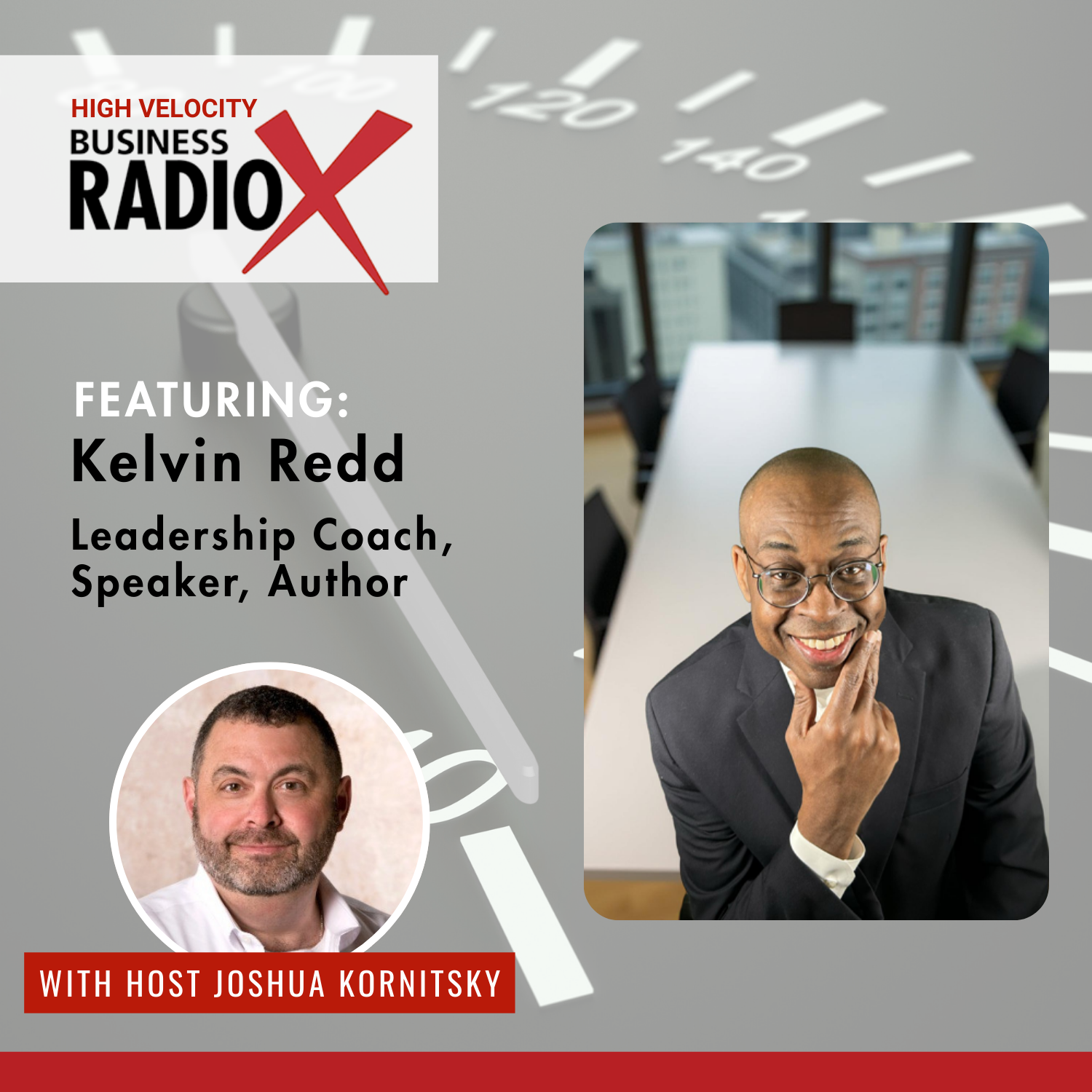

In this episode of High Velocity Radio, Joshua Kornitsky interviews leadership coach Kelvin Redd. They discuss Kelvin’s journey from corporate leadership to coaching, his pivotal role in making Columbus, Georgia the first servant leader city, and the importance of self-awareness in leadership. Kelvin shares insights on servant leadership, the value of personality assessments, and navigating life transitions. The conversation highlights practical strategies for leaders to foster authenticity, purpose, and engagement, while also previewing Kelvin’s upcoming book and coaching course.
 Kelvin Redd is a nationally recognized leadership coach, speaker, and author, known for his work in servant leadership and self-awareness. His work has impacted organizations like Aflac, Southern Company, the U.S. Government Accountability Office, and major universities including Auburn, Spelman, and Wake Forest.
Kelvin is the #1 Leadership Coach in Alabama and Georgia and the author of two books. His first book, Stand Tall: Essays on Life and Servant Leadership (Second Edition), debuted at #35 on the Amazon Business and Organizational Learning List in 2021. His second book, Define Your Destiny: A Self-Awareness Journey Toward Servant Leadership, debuted at #15 on the 2014 Amazon Top 100 Leadership Books List.
He is the only Emergenetics MASTER Associate in Alabama and Georgia. Of the more than 4,000 Emergenetics Associates worldwide, fewer than 60 are MASTER Associates. Kelvin uses Emergenetics—a measurable, proven way to recognize and apply thinking and behavior patterns people regularly use—as a first step in personal development, self- awareness, and servant leadership journeys. 
Kelvin is the former Director of the Center for Servant Leadership, a division of the Pastoral Institute in Columbus, Georgia. While there, the Greenleaf Center for Servant Leadership named Columbus a Servant-Leader City in 2010—the first time in the organization’s history that any city in the world had received such an honor.
For 13 years, Kelvin worked for Synovus Financial Corp., a company voted by Fortune magazine as The Best Place to Work in America in 1999. He held positions in human resources, branch management, customer service, governmental affairs, and relationship management, and was promoted to assistant vice president in 1995.
Kelvin earned a Bachelor of Arts in History from Auburn University and a Master of Science in Management, with a concentration in Leadership and Organizational Effectiveness, from Troy University.
“Kelvin Redd is one of the finest leadership minds in America. He has the rare ability to inspire while delivering practical, results-driven strategies.” — Howard Behar, Former President, Starbucks Coffee Company.
Connect with Kelvin on LinkedIn.
The Emergenetics theory profile and attributes are the intellectual property of Emergenetics International. The views and opinions expressed by me, Kelvin Redd, are my own and do not necessarily represent those of Emergenetics International.
Episode Highlights
- Leadership coaching and its significance in personal and organizational development.
- The concept of servant leadership and its application in communities and organizations.
- The role of self-awareness in effective leadership.
- The impact of personality assessments on understanding individual strengths and behaviors.
- The evolution of leadership perspectives through real-world experiences.
- The challenges individuals face during life transitions, such as retirement or becoming empty nesters.
- The relationship between purpose and productivity in personal and professional contexts.
- The importance of energy dynamics in leadership and team interactions.
- Upcoming projects, including a new book and a coaching course.
- The holistic approach to leadership development that emphasizes understanding oneself and others.
About Your Host
 Joshua Kornitsky is a fourth-generation entrepreneur with deep roots in technology and a track record of solving real business problems. Now, as a Professional EOS Implementer, he helps leadership teams align, create clarity, and build accountability.
He grew up in the world of small business, cut his teeth in technology and leadership, and built a path around solving complex problems with simple, effective tools. Joshua brings a practical approach to leadership, growth, and getting things done.
As a host on Cherokee Business Radio, Joshua brings his curiosity and coaching mindset to the mic, drawing out the stories, struggles, and strategies of local business leaders. It’s not just about interviews—it’s about helping the business community learn from each other, grow stronger together, and keep moving forward.
Connect with Joshua on LinkedIn.
 This transcript is machine transcribed by Sonix.
TRANSCRIPT
Intro: Broadcasting live from the Business RadioX studios in Atlanta, Georgia. It’s time for High Velocity Radio.
Joshua Kornitsky: Welcome back to High Velocity Radio. I’m your host Joshua Kornitsky professional EOS implementer, and today we’ve got a really incredible guest with us, Kelvin Redd. He’s a distinguished leadership coach, an author and a speaker who’s really dedicated his entire career to advancing leadership. He’s guided organizations and communities, most notably leading Columbus, Georgia, to become the first servant. Servant leader city recognized by the Greenleaf Center. He’s got a background spanning corporate leadership roles at Synovus and academic credentials from both Auburn and Troy University. Kelvin’s also the only Emerge genetics master associate in Alabama and Georgia. Welcome, Kelvin. It’s really great to have you here today. How are you.
Kelvin Redd: Joshua? I’m doing great. Thank you so much for having me to.
Joshua Kornitsky: It’s a pleasure to have you. So please, let’s begin at the beginning. Tell me about you and about, uh, how you got to this place in your life.
Kelvin Redd: Wow. Well, I was born in Phenix City, Alabama, which is right across the river from Columbus, Georgia. Sure. And, uh, that whole area, Columbus, Phoenix, Phenix City, the military base and what have you. Uh, right now, it comprises about 500,000 people. And so my father was a a chemistry and physics teacher when I was growing up. And my mom worked in the system, but my father was also our school’s basketball coach. So I found my love of sports and academia. It was all meshed together when I was growing up. I learned a great deal from him. Uh, graduated from Auburn University. I was a history major, and I was all set to go into teaching and had a chance meeting with one of my dad’s former students. And the next thing you know, I end up at Synovus Financial Corp., which is now Synovus, uh, soon to be pinnacle and, um, worked there for 13 years, learned a tremendous amount about leadership. And that’s really when I, I learned a great deal about, uh, leadership visions, mission culture, and what have you. And then after that, I ended up at the Pastoral Institute in Columbus, Georgia, which was to me a godsend to be able to work there. That’s when I learned and fell in love with the deep, deep sense of learning, of, uh, self-awareness. Really, all of that propelled me to where I am right now.
Joshua Kornitsky: Okay. So I know you had shared in the past some about your time at the center. Tell us a little bit about how that shaped who you are, because you shared some stories about its founder with me, uh, that I think people would love to hear.
Kelvin Redd: Well, um, the Pastoral Institute is a counseling and education center. And if you’re not from East Alabama or west central Georgia, you probably have never even heard of it. But it’s a Samaritan center, and it was found about a gentleman by the name of William Bill Turner, and his grandfather was one of the earliest investors of the Coca-Cola company. So Mr. Turner sat on the board for 16 years. Wow. While I was there at the National Institute for ten years, I had a chance to meet with this gentleman for nine and a half years. And on a couple occasions, I actually traveled with him and I learned a great deal from him. He was the one who was incessantly teaching the importance of self-awareness along with servant leadership. But he would also always say that self-awareness was the most important characteristic of a servant leader, and he drummed it into our heads so much that as the director of the center for Servant Leadership, I began to focus my attention not so much on the leadership portion, but the self-awareness piece. And that’s the piece that I think that leaders have to do the inner work. You know, it’s kind of like athletics. You know, uh, people ask me to come in and do, uh, communications workshop, trust workshops, leadership. And I’m thinking, okay, let’s go to football, baseball and basketball. Before the games start. You have to go through the fundamentals. And that’s where that self-awareness piece, you get really good at the fundamentals. You’re going to be a good hitter, good fielder, good basketball player, blocking and tackling in football. Well, it’s the same way in leadership. If you get really, really, uh, and uh, if you get entrenched in this journey towards self-awareness, you’re going to be a good leader.
Joshua Kornitsky: Well, and I do want to dig in much, much more on the self-awareness part, but I want to talk first about leadership, if that’s all right. Now, I know you’ve written, I think, two books on leadership. Okay. And in in the process of creating and directing the thoughts that led you to produce those books, what was a lot of that from Synovus? Was a lot of that from the center. Where where did your view on leadership get molded life? Okay.
Kelvin Redd: You know, I was yeah, I was in a meeting several years ago. And there was a professor, uh, from one of our major institutions, um, in the state of Georgia, and he said, you know, I wish I could get my students to understand servant leadership. And I just kind of blurted out, well, just go tell him. Get a job and work. They will learn right away what servant leadership is, leadership, and whether it’s good or whether it’s bad. So I think life, if you go through life and you observe because Mr. Bill Turner, he did write the foreword to my book, and I’m not boasting, but he did say that Kelvin is a great observer of people. Now, I don’t know if I’m great at it, but I enjoy it. And so I’ve always been one of those individuals. No matter where I am, I’m always observing other people. And that’s that was the impetus, impetus for this book right here. Stand Tall Essays on Life and Servant Leadership.
Joshua Kornitsky: Thank you for sharing that. And that definitely sheds a light onto it. But it makes me ask the question, because life is arguably the best teacher of of all right. Life and time and over time. How has your perspective on your own life and the way you viewed the world, and specifically how you viewed leaders, because you’ve seen it both from like, financial services as well as leadership coaching? How has that evolved and changed over time? Because I know what I thought made a good leader when I was younger versus what I think now is two vastly different human beings.
Kelvin Redd: Yeah, yeah. When I’m observing leaders, you know, and I was also, uh, on the school board here in town, which is a interesting.
Joshua Kornitsky: Oh, that’s a whole different animal.
Kelvin Redd: Yeah, yeah. We were yeah, we were, we were ousted. Um, so it you learn a lot because here’s the deal. I observe people first and then I when I’m observing leaders, I’m looking for certain characteristics. For instance, does that leader no matter which genre education, um, business, financial services, which is business as well. Um, I’m looking to see how often do they preach the mission, the vision and the values, because in some form or fashion, as a leader, you’ve got to be the one to paint the picture. You’ve got to paint the vision so people can see it, and you’ve got to do it clear enough. And so I’m always curious because I’ve always I learned this at Synovus because Jim Blanchard was our chairman and CEO. He talked about the mission, vision and values in some form just about every time he spoke. And so that’s what I look for. And then I look for engagement, because when I’m presenting a workshop, the participants will tell you if they enjoy the if they enjoy working at the at the organization or not, you’ll see body language. You’ll see if they’re smiling and they’re really engaged. They love it. But if somebody just simply goes like that, oh, that’s a cute. Let me let’s let’s pause this or at the break time, let me just mosey over and talk to this individual and say, why? Why did you give me that, that sad ass, so to speak. As young people like to say.
Joshua Kornitsky: That’s I find that fascinating because I feel like and many, many people before me have said, you have to have a level of vulnerability in order to have any level of self-awareness. So let me ask you, how do you encourage when someone approaches you from a business perspective and they say, Kelvin, you know, we really want to work with our leadership team and encourage that self-awareness. How do you do that?
Kelvin Redd: Well, the first thing we got to do is we got to get them to understand the importance of why they’re wired to think and behave the way that they do. And so I always encourage a personality test. Now my favorite is genetics. It’s a brain based personality test that tells you why you think and behave the way that you do. There are a lot of personality tests that are on the market, but the one that I really like is genetics, because not only will you tell you what you’re doing, but it’s telling you why you do it. And a lot of the personality tests there centered around observable behaviors, and that’s fine. But what about the thinking attributes? And that’s what Doctor Gail Browning, who founded Emerging Ethics, earned Doctor Wendell Williams. They decided to separate thinking from behaving. And so I think that is really, really key leaders who don’t understand why they’re wired to think and behave the way they are, what their strengths are. They will typically project their personality onto those that they’re leading. And so if they’re extremely assertive and directing and controlling, they might want to see that out of their leadership team. If they’re more quiet and, um, and peacekeeping and what have you, they may want to see that on their leadership team, not realizing that everybody is wired differently. And so people bring different strengths. If I’m a person who is very process oriented, I might need the creative. You know, if the person who is a creative, um, big picture thinker, they may need somebody like me who is process oriented, who can handle the details and such as yourself as well. Josh.
Joshua Kornitsky: Thank you. And in full transparency, I was part of a leadership program where I met Kelvin and all of the participants in the program in the in the Bartow Cartersville Chamber of Commerce Leadership program. Went through the genetics. And I will I will absolutely tell you, having done no less than six other forms of personality analysis, I’ve never had one that was quite like this, nor, uh, explained as thoroughly as as Kelvin did. But Kelvin, I want to ask you to, to share something about that. And I know we’re talking sort of out of context, but you talk about both how they think and how they act at a very high level. Take us through the process when when you see people that have either, uh, complementary or even opposing, let’s say, traits to keep it generic, um, how do you begin to look at that and analyze it and work with that team.
Kelvin Redd: Well, first of all, I meet people where they are. Each individual. You have a team of 16 people on your leadership, from finance to HR to facilities, what have you. Meet people where they are and once they see their personality profile, explain to them they are as unique as who they are. They’re special who they are and embrace that. Don’t try to change yourself. Use who you are to kind of flex to do the things you need to do. One of the things I’d love to do in my workshops is I point out to people, I said, you know, you have a personality and you have a job description. My job is to help you use your personality to get the job description done.
Joshua Kornitsky: That’s a good perspective. And what impressed me when we had gone through this exercise. And then I’ve had the the benefit of seeing it as a member of the committee now twice for different classes is I love the fact that you’re not trying to get people or you’re informing, you’re not trying to change. You’re not telling them. Well, you know, if you are more introverted, you just need to be more extroverted instead. If I remember, if you would share how you explained how you just sort of lean in, it’s not that you’re not capable of being extroverted, it just requires more effort.
Kelvin Redd: Yeah. More than anything, it’s about energy. Like, where do you where do you where is your energy derived? And so and there are these myths out there about introversion and extroversion or what have you. It really comes down to energy. Are you energized by being alone or are you energized by being around other people? Those are the observable behaviors. We understand that, but meet people where they are. And once you do that, then you can. You get that aha moment when you look around the room and say, ah, now I understand Joshua a whole lot better.
Joshua Kornitsky: So let’s say that you’ve gone ahead and you’ve, you’ve worked with, uh, seven, eight person leadership team and you’ve come to help them first and foremost, foremost pardon me. Understand who they are. What’s the next step to get that team to understand. So if you and I are opposites in certain traits, how do you help them understand how to work better together?
Kelvin Redd: Well, it’s all encompassing because you also have that other self-awareness piece where you talk about your dreams, your goals, your values. And keep in mind there are two types of self-awareness. Um, I know you asked me about team building, but what I typically do, if there are ten steps, I say we’re going to focus on self-awareness. At least 7 or 8 of them before we even attempt to work on the team. And so you there are two types of self-awareness. There’s internal self-awareness, you know, how do I see myself? Like, what are my strengths? What are my gifts? What are my values? What’s my reason for being like? What’s my purpose? Why am I here?
Joshua Kornitsky: Right?
Kelvin Redd: But then there’s also external self-awareness. How do the people in my sphere of influence see me? And I think that’s critical. Critical. Before you do team building, like you have to have an understanding before you work in a team. You got to have an understanding of yourself. And how do those individuals see me? And once you understand that, then that paves the way for team building.
Joshua Kornitsky: Well, so I. And that makes sense to me. I know that you work across the spectrum from professional environments to strictly academic environments.
Kelvin Redd: Religion. I’ve worked you name it.
Joshua Kornitsky: Well, and one of the things that’s hard to quantify is without having gone through the analysis and sort of understanding the process of it, it first and foremost hits you, the individual, in a way that helps you better understand yourself without being critical. And, and I would even argue that there might be a level of, of acceptance with it, because it’s you’re the person who answered the questions to determine the way the profile leans. And more often than not, that’s going to be, give or take maybe 1 or 2 points of of statistical margin. That’s probably who you are. But the piece that always impressed me was the idea to understand that you can work outside of areas that you are not an expert in.
Kelvin Redd: Yes, yes. I mean, for instance, I give you an example, um, when you saw me present, like I was quote unquote on, like I was having a good time, it was I was smiling, I was walking around, I was in, I was trying to be engaged, and I thought I was and I was trying to get to know the participants and what have you. Um, but I’m an introvert, right? I’m an introvert. My energy is derived from being alone, but it’s the same as a teacher. There are so many teachers that I know. My sister’s a teacher and she’s introverted and. But we have a calling, right? And we go to work and we do what we’ve been called to do. And afterwards we’ll have our downtime beforehand, we’ll have our downtime, and on occasion we’ll take some mini breaks, you know, during the day if we can. And so you teach that to people that it’s about energy. And if you pace yourself in that particular, uh, environment. Then you can get the job done. Let’s look at extroverts. They’re energized by being around other people. Sure. What happens if you’re working in a back office somewhere? You know you’re not. You don’t have a lot of people. I had a client one time. Uh, he was used to being. He was a teacher, and he got promoted to being in federal programs, and they moved him to the downtown office, and he was in the back office. And as a principal, he was around students, parents, teachers, cafeteria workers, dignitaries. And he was energized all day long, all week. And then he ends up in a back office and I had to work with him on that. I said, well, here’s one thing you can do when you have certain meetings. If it’s a zoom meeting or a phone call, get in your car and drive across town so you can meet the people, you know, just little things like that that breaks up that monotony throughout the day.
Joshua Kornitsky: Well, and that brings up a really important question. So do you work primarily with, um, organizations, companies, uh, or individuals or both? Who comes who looks to work with you.
Kelvin Redd: It’s about 75 to 80% organizations, and the other 20 to 25% are individuals. I will say that that individual there’s been a demand, um, in the last couple of years for more and more coaching, uh, a really high demand. Uh, and here’s the thing about the 1 to 1 coaching versus the group coaching, which, you know, you might call a workshop, is that, uh, it’s time sensitive. And it’s also, um, it takes a lot. It takes a lot of work with my travel schedule. Sure. And so I told myself, you know, here we are in August that I was not going to do a lot of 1 to 1 coaching toward the end of the year. And I’ve taken on several clients because I didn’t like seeing them in distress. So, uh, it just happens like that.
Joshua Kornitsky: Yeah, it’s it’s a balance for sure. Um, and not to not to pile more on, but to ask the question without obviously, uh, any names or any any identifiable what types of individuals, what type of guidance are they? Are they looking to work with you on?
Kelvin Redd: Um, it’s interesting. A lot of it is purpose. And here’s the deal. I believe that your purpose can actually change in life depending on which season you’re in.
Joshua Kornitsky: I think that’s.
Kelvin Redd: Fair. What happens to the educator who starts teaching at age 22 and at age 52? It’s time to retire. They’ve got their 30 years in. Then what? What are you going to do? You know, some continue to teach, but some don’t. What about the CEO who has been in charge for 20, 25 years as a CEO, and it’s time for him to step aside. And what happens if he’s very extroverted? He loves being around people. What happens? What are you going to do the day after you retire or the week after? Where are you? Where are you going to get your people contact from? As I like to say, you know, so I think I think I’m working with some people who have come to a stage in life where it’s like, okay, things are changing. Um, uh, parents, children graduate from high school, 17, 18 years old. They’re empty nesters. The mom is like, okay, what do I do now? The father’s like, what do I do now? You know, those kinds of things. So I’ve got about five clients right now. About four of them. It is about, um, it’s about purpose. And I would also weave in productivity in there.
Joshua Kornitsky: I think there’s arguably an interdependency, right? If you don’t have purpose, it’s hard to feel or be productive.
Kelvin Redd: Exactly.
Joshua Kornitsky: Um, and does it track back broadly to self-awareness?
Kelvin Redd: I always start there. The first thing you do, I want to see. I want to know who you are and where you come from. And I want to know your strengths, your weaknesses. I want to see where you get your energy from also.
Joshua Kornitsky: And in the process of going through that with people. And again, I have the advantage over anybody listening or watching right now, because I’ve had the opportunity to witness it both as a participant, but also from the outside looking in. The thing that surprised me the most is that I don’t to to my memory, and I think at this point between the three classes, it had to have been close to 100 people together, spread across the three. I don’t believe I saw anybody who said, no, this isn’t me. You know that that that after you took them through the explanation. Because it’s very easy when you don’t understand what you’re looking at to say, of course, that’s not me. But once, once they understood what it all meant. Um, I don’t recall a single person who said, do people ever ask to be reevaluated?
Kelvin Redd: Uh, they do, they do. Probably about 95. In my in my class. Right? Probably about 95 to 97% of the participants. They one of two things happens. They have an aha moment or there’s a confirmation one of.
Joshua Kornitsky: Those two.
Kelvin Redd: And then you have about 2 to 3%. They just stare in wonderment like, is this really me? I want to take it again, that kind of thing.
Joshua Kornitsky: Wow. Well, and having been on the receiving side of it, I can tell you that that there is a lot of introspection that happens once you have an understanding, because the way that it is explained is everything is a spectrum. It’s not black or white. It’s not. You are these things, it’s you tend more towards. This is when it comes to my personality that I lean more towards this rather than that. And it’s not a definitive you are A, B, C, and D, like a lot of other analyzes are, but I think that’s also my understanding of it comes literally directly through you. So I think you did a great job explaining it. But I think for anybody that’s listening that’s curious about, um, the way to apply this, I think it’d be a great idea to talk to you about it. So let me ask, how do we get in touch?
Kelvin Redd: Well, you can get in touch with me. You can go to my website. Or you can email me at com.
Joshua Kornitsky: Well, in.
Kelvin Redd: With an L. My father was a physics teacher and he named me after Lord Kelvin, the famous physicist.
Joshua Kornitsky: So when when when you get to zero degrees, it means it.
Kelvin Redd: It means it. Yes. That’s a good one.
Joshua Kornitsky: Yeah.
Kelvin Redd: Sorry.
Joshua Kornitsky: Old science geek. Um, we also will share all of your contact information, but I want to make sure before we close out. Kelvin, um, anything on the horizon, anything new you’re working on or that people should know about?
Kelvin Redd: Yes. I’ve got a third book that is either going to come out during the holidays or the first of the year, and that decision will be made probably within the next week, right after the this particular holiday. And uh, and then we’ll go full steam ahead with all the marketing, make sure we get the word out. And I’m really excited about it because it’s my first business fable. Uh, that’s the first thing. The second thing is I’m creating a coaching course because I realized that people are calling. They’re asking for 1 to 1 coaching. And I thought, well, why not put this in a course with different modules based upon what I’m hearing or what I have heard over the last several years? Um, whether it’s one on one coaching or, uh, being in a workshop and what I’m hearing from the participants, I’m going to put it all in a course and they can have they’ll be able to go to the website and download it.
Joshua Kornitsky: That’s fantastic. And that’s really something that’ll speak to fulfilling the needs of folks that are reaching out. Uh, I look forward to to reading the book. We absolutely would love to have you back on that. We can talk about it and share it. We can even do a little book club, uh, so we can understand what the fable and the moral to the story is. Um, you know, Kelvin, thank you so much for for giving us this time today. My guest today has been Kelvin Read. He is a distinguished leadership coach and author of two books. Third on the way, a speaker and really someone who has dedicated his career to advancing leadership. I cannot say enough about the holistic approach that Kelvin takes to helping people really understand themselves, but also understand themselves within a larger organization. I’ve had the opportunity to be part of it three times, and can’t say enough how effective it is and how strong an impact it makes. Kelvin, thank you so much.
Kelvin Redd: It’s been a pleasure. I really appreciate this.
Joshua Kornitsky: Fantastic to have you. So this has been Joshua Kornitsky professional EOS implementer and your host here on High Velocity Radio. Thank you for joining us. We look forward to seeing you again next time.














