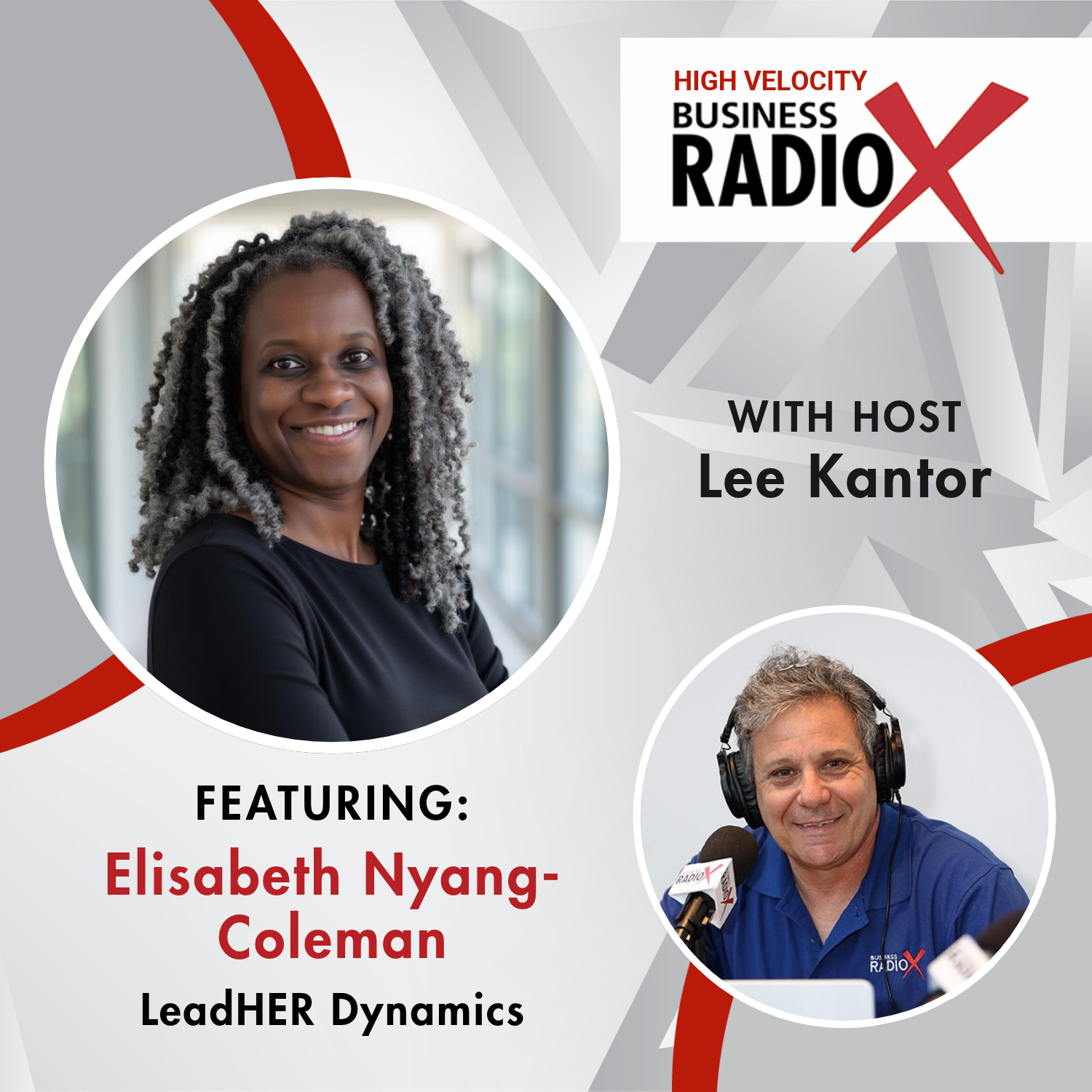

In this episode of High Velocity Radio, Lee Kantor interviews Elisabeth Nyang-Coleman, Executive Coach and Speech-Language Pathologist at LeadHER Dynamics, about helping professional women navigate career transitions, overcome burnout, and create lives aligned with their personal and professional goals. Drawing from her experience as a healthcare professional and serial entrepreneur, Elisabeth shares how her own journey of reinvention inspired her to help others get unstuck, embrace change, and pursue success on their own terms. She also discusses the importance of authentic communication, self-awareness, consistency, and having the courage to take the next step.

 Elisabeth Nyang-Coleman is an executive coach, speech pathologist and speaker who helps ambitious women make consequential decisions about what comes next in their careers, leadership, and lives. She also partners with small organizations through consulting, keynotes, and workshops focused on leadership, transition, and reinvention.
As founder of LeadHER Dynamics, she has developed two core frameworks, The Question Beneath the Question and Stay, Redesign, or Leave. Her approach challenges people to look beyond the immediate problem, examine what is actually driving the decision, and recognize when something that once worked no longer fits.
She brings nearly 25 years of experience as a speech-language pathologist and leader, with a professional foundation rooted in communication. Her own life has been shaped by reinvention across countries, seasons, and definitions of success, giving her work a perspective grounded in both professional expertise and lived experience.
She holds a BS from Boston University, an MS from the University of South Florida, and an Executive Coaching Certificate from the University of Pennsylvania. She is an ICF Associate Certified Coach (ACC).
Connect with Elisabeth on LinkedIn.
What You’ll Learn In This Episode
- Recognizing burnout and identifying when life and career are no longer aligned with personal values.
- Navigating career transitions and embracing new opportunities through executive coaching.
- Understanding the differences between coaching, mentorship, and consulting.
- Using the “Question Beneath the Question” framework to uncover the real challenges behind difficult decisions.
- Building visibility, confidence, and consistency when starting a new business or career.
- Creating space for authentic communication, personal growth, and meaningful connections.
- Taking small, intentional steps toward building a life and career on your own terms.
 This transcript is machine transcribed by Sonix.
TRANSCRIPT
Intro: Broadcasting live from the Business RadioX Studios in Atlanta, Georgia. It’s time for High Velocity Radio.
Lee Kantor: Lee Kantor here. Another episode of High Velocity Radio and this is gonna be a good one. But before we get started, it’s important to recognize our sponsor, Business RadioX. If you’re a coach or a consultant who is tired of selling and ready to lead by serving, set up a call with Stone Payton at brookstone.com to learn how to give local leaders a voice and become a recognized authority in your market. Today on the show, we have executive coach and speech language pathologist with LeadHER Dynamics, Elizabeth Nyang-Coleman. Welcome.
Elisabeth Nyang-Coleman: Hi, I’m so happy to be here today.
Lee Kantor: Well, I’m excited to learn about your practice. Tell us about LeadHER Dynamics. How are you serving folks?
Elisabeth Nyang-Coleman: As you know what, I would love to talk about my business. So Lead Heart Dynamics has been created to it’s twofold. It’s to help professional women who are navigating a major transition. And they feel that up until this point, they were living a life that sounds great in theory, but in reality, they’re becoming burnt out, stressed out, and just not really prioritizing themselves. So I provide executive coaching services to help them become unstuck and help them navigate to creating something that is more aligned with what they want. And in addition, I also work with allied health practitioners who are looking to either build or add on to their private practice.
Lee Kantor: So what’s your backstory? How did you get involved in this line of work? Were you always coach.
Elisabeth Nyang-Coleman: So you know what? No, my my professional background is in speech language pathology, and I earned my masters from University of South Florida way back in 2003. And I have to say, as a speech pathologist, just that career afforded me a life that I never could imagine in the sense that I was able to work in China, Canada, US. I worked in all settings. And just over the years, I’ve really learned a lot about helping others and just live the most quality or highest quality of life. And I really believe that communication is something really important in the sense that it’s important to be able to just express yourself in an authentic way. But unfortunately for me, back in 2024, I had a frozen shoulder and it was just from the stress of being able to run my business. And I started to realize that I was giving too much of myself into my business. And unfortunately, I was prioritizing work, and I just knew that I needed to have a pivot because if I remained on that path, I was just going to be in trouble when it comes to my health. And so what led me to create Leader Dynamics is that I learned that there were many other women out there that had the same experience as me, where they’re quite competent and skilled and their jobs, but they felt that their lives were just no longer aligned with what they want, and they were starting to have a lot of health issues or just dissatisfaction.
Lee Kantor: So is that usually the trigger that there is some sort of, um, your body is telling you maybe something is out of alignment and that maybe I should dig a little deeper.
Elisabeth Nyang-Coleman: Yes. At least for me. So I’m someone that I carry stress on my shoulders and I’m an empath. And most people are. And in healthcare, you know, you really want to put your best foot forward and try to help other people. And I’m not going to lie to you, you know, the frozen shoulder wasn’t the first symptom that I had. I just ignored it. The frozen shoulder was just the first one that debilitated me and impacted my quality of life for the worse. And I, you know, at that time, I was working with babies and even just picking up babies and providing feeding services, it was just a challenge. And I just knew that I couldn’t stay on that path. And as I worked with other women, now they tell me that they also have felt other physical signs, you know, telling them that what they’re doing now is just no longer aligned.
Lee Kantor: So how did you kind of, um, expand your practice to coaching? Like, was that, did you have a coach? And you’re like, oh, I think this will be a good add on to what I’m doing or like what, what got you down that path to serve people in that manner?
Elisabeth Nyang-Coleman: You know what? That’s a very good question, Lee. And so, yes, I did have a coach. I had experience working with a business coach and an executive coach. And, you know, at those two different times, they really helped me be able to build my business. Um, in the sense of finding the right clients to, for, for myself, but they also helped me build the size of my business. And so I knew that with the knowledge that I have, that I can also help other women that are in a similar position. And so it wasn’t just me one day saying, listen, I’m going to become an executive coach. I did go to UPenn and I took their executive coaching program, and I also completed all my hours. And I’m certified through ECC as an ACC coach. And so I completed everything this spring.
Lee Kantor: So, um, once you went through all of those certifications and got the credentials needed to do it, what was it like? Kind of then, you know, getting the word out and saying, okay, now I’m actually doing it after you’ve been so long in this other kind of career. Did you go through any kind of imposter syndrome, or was this something you just kind of dove in head first and said, okay, I can do this. This is just a little different than what I’ve been doing.
Elisabeth Nyang-Coleman: So you know what? I’m so glad you asked that because I, I tell people that I’m a serial entrepreneur. So before I LeadHER Dynamics, I created three other businesses and I was able to not only build something, but they were able over year after year to be, you know, earn multi six figures each of these businesses. But one thing that they all have in common was that I was providing a service that was severely in demand and I didn’t need to be visible. So to answer your question, the challenge that I initially had when I first started LeadHER Dynamics is that I had to learn to show my face and understand that I’m the brand. And as I was building visibility initially, it just felt really difficult because I was not used to, you know, explaining an online presence what I do. And I felt very awkward in the beginning, just knowing that there are people, potentially people out there that may not agree with my approach or they’re just not interested in what I have to say. And that’s okay, because as I started building visibility, I’ve learned actually relatively quickly that there are many people that can relate to me and they like the journey that I’ve been on, just because I’ve lived my life in a way that I call myself the the Queen of reinvention. But what I mean by that is that I made several decisions throughout my life that are a bit unconventional, but I’ve done it because if these things have brought me joy, and that’s one thing that I put into their dynamics as well, is that I just give people the presence to be who who they are.
Lee Kantor: Now when you, um, kind of starting out in the coaching area, did you get some early wins? Was there something that gave you the confidence to say, okay, this is going to definitely work out? I feel good about how this is progressing. Um, you know, I, I can build on this momentum or was it a struggle at first to kind of attract the people you wanted to work with?
Elisabeth Nyang-Coleman: So for me, in the very beginning, I received clients through people that I knew in the sense of other people in healthcare. And they already knew who I was in the sense of what type of services I offered in the past when it came to building a business. And so a lot of people that came to me in the beginning were healthcare professionals who felt stuck in their careers. And they just wanted to have just, you know, forward thinking conversations on what their next steps could potentially be. I found that with me building more online and being visible and also being comfortable with showing a little bit of what’s going on behind the scenes that I’m now getting people from all when I say all walks of life, all different professions who just identify with my journey. But that was not there in the beginning.
Lee Kantor: Did you? So when you put the shingle out to begin And, um, you’re getting people, you know, so that’s encouraging. But when you first attracted that person, you didn’t know, was that that moment where you’re like, okay, this is definitely has legs. This is going to work.
Elisabeth Nyang-Coleman: Yes. So I can tell you exactly when I, the, the first time I thought, okay, this is definitely going to work is when someone booked my call. And, you know, at the beginning of the call, she said, I really want to work with you. And when I asked her, how did you hear of me? She actually said that she put an AI prompt. She typed a a prompt through one of the AI agents and she was looking for someone that is, she literally put in authentic good communicator and help her get unstuck. And my name came up and a few other names came up and she just said that she felt, you know, through the few minutes that we talked that she really liked my energy and she felt like she was ready to move forward. And that was very reassuring to me because I feel like for me to show up through an AI agent, that means that my messaging is what I want in my messaging are consistent.
Lee Kantor: Right. And, and it’s, it’s being seen by the people you want to see it now, um, as your practice has kind of grown and you look back a little bit, even though it hasn’t been that long, but still, if you were looking back, is there any piece of advice that you would give another coach who is kind of launching their coaching career? There’s some do’s and don’ts or some must do’s and must not dos that you’ve learned for sure.
Elisabeth Nyang-Coleman: You know, like I said, I’m a newer coach and I’m still building and I’m proud of the growth that I’ve made. But I also recognize that a lot of coaches, new and more experienced, we always want to put our best foot forward before starting. And my suggestion is just to start. I know is so it can be challenging to operate out of your comfort zone, but I would write down whatever it is that you want to do, you know, choose an objective that’s small and just act on it today. And then the second thing I would suggest is to have an accountability partner. And preferably it would be someone that’s in the same field or an adjacent field that can keep you going, keep you motivated as you’re taking this stuff. And then the third thing is to stay consistent. It is so hard, at least for me. In the beginning, as I was building, I felt that it was like a I heard silence, so I had no idea how I was being perceived. And then, like my ego felt a little offended in the sense that I took it to be negative when in reality it was just me being in my head. So please stay consistent and know that in the beginning you may look like you’re not making any gains, but in reality you are making progress.
Lee Kantor: Now, when you were launching, was there any kind of, um, I don’t want to say debate, but maybe you were like defining what coaching meant to you. Uh, because coaching, it seems, has different definitions to different people. And you mentioned accountability partner that could be coaching, mentoring could be coaching. I mean, even consulting, there’s some element of coaching within consulting. Can you talk about how you were kind of because I know clarity of communication is important in your work. So how do you kind of crisply define each of those things, and how do you explain that to your clients?
Elisabeth Nyang-Coleman: So, you know, that’s a really good question. And I find that even other coaches kind of blend the three. And so for me, when I look at coaching, I define it as partnering with clients and a thought provoking and creative process that will inspire the client to maximize their personal and professional potential. And that’s pretty much aligned with ICF. And so for me, when it comes to coaching, I do not tell the client what to do. I demonstrate active listening. I may ask some curiosity driven questions and offer observations, and I prefer sometimes to offer like non-verbal observations tied to an emotion so they can just examine some assumptions and consider possibilities of what to do next. But it really, you know, it’s a bidirectional feedback, as you know, and it’s important for the client to decide what needs to change and what actions to take. I’m not going to be the driver in that now. And when it comes to mentorship, I go to draw on my relevant experience. And that would be, you know, my experience as a speech pathologist, also as a serial entrepreneur. And I may share my guidance and some lessons or nuggets on the work I’ve already done. And then when it comes to consulting, that’s really more of just assessing a business issue and providing recommendations and on agreed support. So there I am going to tell you what to do and how to do it, but it’s still going to be a joint effort in establishing what type of help is needed. So and you know what the expectations are.
Lee Kantor: And that’s, um, important to get that all kind of talked about up front, right? Because you don’t want the client to think you’re going to roll up your sleeves and do work. If what you’re going to do is just ask them questions and ask them what they’re going to do and, you know, encourage them to do the work rather than you have any expectation that you’re going to do some of the work.
Elisabeth Nyang-Coleman: Yes. That is something that I describe upfront, and I recognize that, you know, many times when someone states that they want to start coaching with me as they’re talking, it doesn’t sound like coaching. It sounds more like mentorship. So then I have to explain the difference.
Lee Kantor: Right. And that’s, um, that’s why I mean, it goes back to what you said at the beginning about just communication is, is so important in today’s world. And a lot of people kind of make assumptions. And if you’re not clear and get everybody on the same page, that’s where frustration happens. That’s where, you know, um, misalignment of expectations happens. A lot of negative things can happen if you’re not clear up front.
Elisabeth Nyang-Coleman: I agree 100%. And then I also feel like right now we’re in. When I say we, I’m just talking about society, period. We’re kind of in this phase. Where is it? I call it an intimacy recession. I did not coin that phrase. I just read it somewhere. But it really fits. And what I mean by that is that people are truly craving connection. And sometimes when you know, when they come to a coach, they may feel the need to share things that go really beyond the scope of what a coach should do and kind of go toward therapy. And when I see that happen, I do tell them in a, in a gentle, professional way that I’m here to support you as a coach, but you may need talk therapy to work out some of these other issues. And we can do that in tandem.
Lee Kantor: Yeah, it’s, it is an interesting time where it’s funny. I think a lot of people don’t give enough grace or give people the benefit of the doubt as easily or quickly as maybe they had in the past. And people are quick to, you know, hold grudges or, or hang on to one thing and, and make it the biggest thing. Um, it’s just a, it’s an interesting time.
Elisabeth Nyang-Coleman: It definitely is an interesting time, but I’m hoping for myself and I feel that one way that I kind of stand out versus other coach coaches is the sense that I really hold space for people and their feelings and emotions. And I just recognize that sometimes people just need five minutes to just, I don’t want to say brain dump, that’s not the right phrase, but just be able to blurt out whatever it is, is on their mind and get that those emotions and feelings out and then be able to focus on to the next thing. I just feel that sometimes society wants to move people along so quickly that people just didn’t button everything up inside, and then they have nowhere else to, you know, to share it, unfortunately. And then, but then it will impact their mood and then it will pass even how they can treat other people in their day. So I feel that for me, being able to just hold space and presence just allows people to feel calm. And that’s one thing that I am kind of proud of is just people say that whenever we talk, whether it’s virtual or in person, that they feel this sense of peace and joy. And I just want to share that with as many people as possible.
Lee Kantor: Now, is there, um, something that is happening in a person’s life that is the kind of triggering event or precipitating event that gets them to call you? Is did something happen? Yeah. Typically that is like, okay, I better get a hold of Elizabeth.
Elisabeth Nyang-Coleman: So I usually when I hear from people, there’s three things. It’s I’m really stressed. And I had a blank. I had a frozen shoulder or some kind of physical ailment, but it’s really serious, a heart attack, something else. And they just realize I cannot continue on this path, but I’m stuck. I feel stuck because I’m earning a high income, or I’m the breadwinner, or I’ve been living in blank City town, and I would love to go somewhere else, but I’m scared and I don’t have the support, so that’s one. Um, the second one is usually because people have seen my journey online and knowing that I’ve lived in many places, they’re like, I would love to live in, insert the country and just say, but I don’t know where to begin. And I, you know, I know I want this, but I, I feel stuck on what the next steps are. And I know that you’ve kind of gone on this journey before While it’s not the same journey, I feel like you can help me. And then the third one is I’m going through. I was just fired. Or I feel like I’m ready for a promotion. And I keep getting passed over and I feel stuck. And I don’t want to continue in this. And but I feel like I have more to offer in terms of my career. How can you help me? Those three things.
Lee Kantor: Now, is there a story you can share that maybe, um, encapsulates how you work with a client? Don’t name their name, but maybe share the challenge they came to you with and how you were able to help them get to a new level.
Elisabeth Nyang-Coleman: Yes. So I will share a story of, I’m going to share one story of someone that I worked with very early on, and this person is a healthcare professional. And they came to me because they had a private practice and they wanted to know whether or not they can raise their rates. And that was, you know, the agreement. You know, should I raise my race and, and whatnot? But I created my own framework and it’s called the question beneath the question. And it really helps people trying to make a decision by examining what’s on like underlying so like, what’s that tension that’s causing you to want to do whatever it is that you want to do? So in her case, she really wanted to raise rates. But what I figured out what the tension was for her, it was a lot of anxiety. And that anxiety was surrounded by the fact that how she was getting paid was due to the fact that most, um, most payments were tied to insurance companies, and unfortunately, she could not dictate when that money would come in. It would come in sometimes late and as late as 3 to 6 months later. And so by using this framework, we were able to identify the tension and then kind of figure out, you know, what she could do. So she was able to determine, you know, whether she wanted to stay in this situation, whether she wanted to diversify the practice. And ultimately, she figured out that for her, closing the practice would be a better bet and taking a sabbatical to regroup and then start again. And so while she came in to me with like, I’m thinking about raising rates, she ultimately closed her business, which is a completely different direction that she had no idea that she was going to go in.
Lee Kantor: Now, how do you deliver your coaching. Is it one on ones? Do you do group? Do you do retreats? Like how how do you deliver?
Elisabeth Nyang-Coleman: So at this time my coaching is solely 1 to 1. I am in the process of thinking about, um, providing retreats, but I feel that 1 to 1 is the best for me right now. And I say that because I do like to use my question beneath the question framework, and I feel that that would be better utilized in a 1 to 1 setting. And so people can book either in packages of three sessions, six sessions or eight sessions.
Lee Kantor: And then do you work with organizations as well, or is that something separate?
Elisabeth Nyang-Coleman: So I as of now, I work with individuals and I do have a couple of contracts with small organizations, but when I say small, there’s like ten people or less.
Lee Kantor: And then what are you doing for the organization?
Elisabeth Nyang-Coleman: So with the with the organizations, I’m providing executive coaching to the head of their departments.
Lee Kantor: But still in that one on one kind of manner. So what do you need more of? How can we help you?
Elisabeth Nyang-Coleman: So what could help me is just really getting my, my name out and my business. I’m like I said, I’m with LeadHER Dynamics, which is www.leadherdynamics.com. And I offer a newsletter that goes out. It’s called Success on Your Terms, where I provide practical insights on executive coaching and consulting. And also I provide some strategies on how to bring audacity in your own life. I am learning just, you know, in my own journey of building this practice, that there’s so many people who want to have the desire and even the ambition to recreate a life on their terms, but they’re so afraid of taking the next step because they feel like they’re going to disappoint someone and they’re just in their head. And so by going to my website and subscribing to success on your terms, you are able to find some strategies on what you can do to add a little bit of audacity in your life.
Lee Kantor: Well, Elizabeth, thank you so much for sharing your story today. You’re doing such important work and we appreciate you.
Elisabeth Nyang-Coleman: Thank you so much for having me.
Lee Kantor: All right. This is Lee Kantor. We’ll see you all next time on High Velocity Radio.