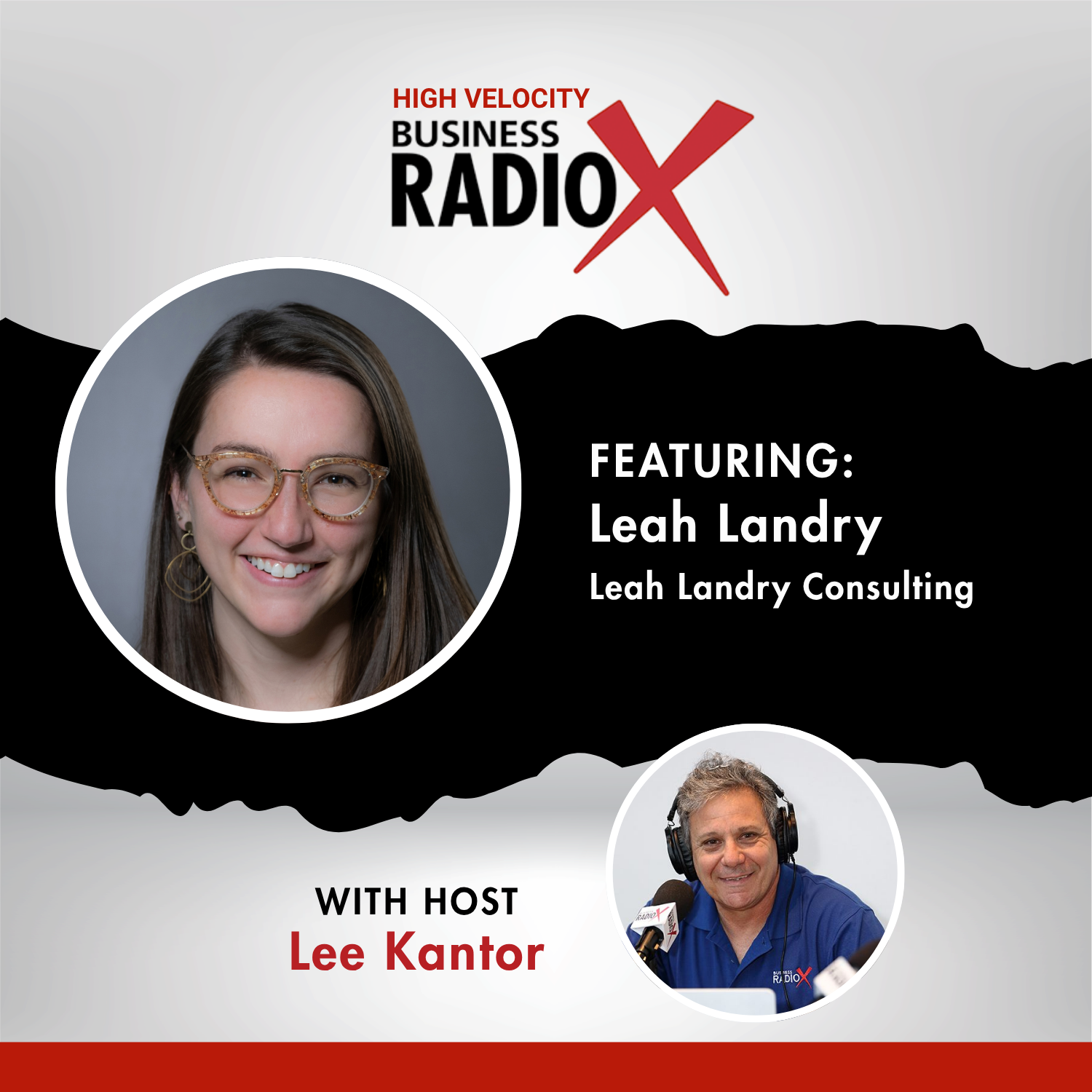

In this episode of High Velocity Radio, Lee Kantor interviews Leah Landry, facilitator and Somatic Coach with Leah Landry Consulting, about the power of reconnecting the mind and body to improve personal and professional performance. Leah explains how somatic practices can help people become more present, manage stress and overwhelm, build confidence, navigate uncertainty, and show up more effectively as leaders. She also shares how body awareness transformed her own career and leadership journey and how these practices can create a positive ripple effect throughout teams and organizations.
 Leah Landry is a somatic coach, facilitator, and consultant who helps mission-driven leaders and teams navigate pressure, build sustainable ways of working, and lead with greater awareness.
Drawing on more than a decade of experience in nonprofit leadership, racial equity, organizational culture, and social justice work, she brings a body-based perspective to questions of leadership, burnout, boundaries, and decision-making.
Her work explores what becomes possible when we pay attention not only to what we think, but also to what’s happening in our bodies.
Connect with Leah on LinkedIn.
What You’ll Learn In This Episode
- Understanding the connection between the brain, body, emotions, and behavior
- Developing greater awareness of physical sensations and emotional responses
- Using somatic practices to become more present and grounded
- Moving beyond overthinking and reconnecting with the body
- Building confidence and courage through greater body awareness
- Managing stress, anxiety, overwhelm, and decision fatigue
- Using movement, breathing, and humming to support nervous-system regulation
- Strengthening leadership presence during times of change and uncertainty
- Setting healthier boundaries to become a more effective leader
- Creating a positive ripple effect by becoming more centered as a leader
- Embracing both positive and difficult emotions instead of selectively numbing them
- Recognizing when somatic coaching is appropriate and when therapeutic support may be more suitable
 This transcript is machine transcribed by Sonix.
TRANSCRIPT
Intro: Broadcasting live from the Business RadioX Studios in Atlanta, Georgia. It’s time for High Velocity Radio.
Lee Kantor: Lee Kantor here another episode of High Velocity Radio and this is going to be a good one. But before we get started, it’s important to recognize our sponsor, Business RadioX. If you’re a coach or consultant who is tired of selling and ready to lead by serving, set up a call with Stone Payton at bookstonephone.com to learn how to give local leaders a voice and become the premier connector in your market. Today on the show, we have facilitator and Somatic Coach with Leah Landry Consulting, Leah Landry, welcome.
Leah Landry: Thanks, Leah. I’m excited to be here.
Lee Kantor: Well, I am excited to be here as well and learn about what you got going on. First, before we get too far into things, define some terms. What is a somatic coach? I’m unfamiliar.
Leah Landry: Great question and I think many people are. So somatics is a methodology of integrating our brains and bodies and listening to all the messages our bodies have to tell us. I don’t know if this has happened to you, but I know for me, there have been many moments where I’ve responded to situations in ways that I was not anticipating or didn’t want to be responding that way. And the more in touch we can get with what our bodies are telling us, the more in choice we can be about how we respond.
Lee Kantor: So how did you kind of discover this type of coaching?
Leah Landry: Yeah, I was working at a, I got a new job actually working at a nonprofit in D.C. I was doing racial equity work as a white person, and I was extremely anxious in this new role. I was very awkward. I was reliving every conversation, and it was pretty ineffective for me and for my team. So one of my friends told me about a somatics course through embodying racial justice. And I started the course was like eight weeks long. And in the first class, I was so shocked to realize that I had a body. I don’t know how I had missed that for so long. Um, but it felt like a whole new world for me. It really shifted how I was able to show up at work in my personal life. I relaxed, I was able to take more initiative, take more risk, and I felt like, okay, if I have been missing this part of social justice work, of trying to build a better world, I imagine many others have been missing the body based practices too.
Lee Kantor: So the somatic coaching in your case was connected to your work, but it’s kind of a standalone thing, right? It doesn’t require you to be involved in, in the work you were doing to understand somatic coaching, right?
Leah Landry: No, not at all. I think really, almost anyone can benefit from trying to reconnect with their bodies or connecting more deeply. Um, but mostly the folks that I work with are in nonprofit spaces, social justice entrepreneurs, community organizers. So yeah, that’s just the community that I’m mostly a part of.
Lee Kantor: Now, when you went through this coaching, what was kind of what happened that gave you that aha? Did something physically happen? Like, did the, the coach kind of unlock something for you that you had never felt or seen before?
Leah Landry: Hmm. That’s a good question. The first thing that really struck me was how the people, the other people in the course were talking about their own sensations and emotions. There was a lot of demos with one on, you know, the coach was or the facilitator was leading one person through different practices. And I was shocked by how much access they had to what was happening in their bodies. Like the coach would ask, where do you feel that sadness? And the person would describe specifically where it was in their body and what the sensation was like and what color it was, and kind of this really in depth answer. And I remember feeling like I, I, I can’t even feel anything below my neck. Like, how Is this person able to access so much? I think that was my first sign that, oh, okay, I’m missing something here.
Lee Kantor: So then when you hear somebody being, um, kind of explaining it so viscerally and you were like, I, I don’t feel green. Like something’s like, is there something wrong with me? Like, how do I get to feel green? Like, like, how did you learn the process to, um, open yourself up, I guess to, um, feeling your body more and connecting your feelings with what is happening around you.
Leah Landry: Yeah. So that this class was every week. And so the practices we would do, there’s this centering practice that I still do every single day. And, and I think the first place I started to notice it was, okay, I can feel when I’m completely in my head, when I’m just spinning in my head and have no access to what’s happening below. And now and then I can also notice, okay, can I feel my feet on the ground? Can I feel my hands? Can I feel my breath in my belly? And that shift from feeling just like I’m spinning in my head to being able to feel the rest of my body? Um, took a few weeks, but I remember it being so impactful. Like, oh, if I could feel my body more often, I would really be able to absorb what’s happening around me easier. I’d be able to connect with people better. I wouldn’t be so anxious all the time, you know? So that was maybe the first, um, the first practice that really helped me was the centering. And then the first sign that I was getting it was, okay, I can feel my feet on the floor.
Lee Kantor: So then, uh, then after you started learning about it, then there was a situation, you were feeling anxious or stressful, and then you were like, it’s not only in my head now I can feel that I’m in this room and my feet are on the floor and there’s a clock and there’s a table. Like you started to become more kind of self-aware about different sensations and not just kind of these thoughts kind of spiraling.
Leah Landry: Yeah. Yeah, exactly. And I remember at one point, really early in the job, I was on this retreat with the rest of the team, and I, I kept feeling my brain go blank. I could not think of anything to say to anyone. Um, during the retreat and then after doing these practices for a while, I was in a similar situation. The entire leadership team was there and I was disagreeing with the CEO in front of the rest of the team, and my brain didn’t go blank. I was able to feel my feet on the, on the ground. I was able to kind of feel that whole, um, my presence more, more acutely. And it gave me the confidence and the courage to be able to speak up in that situation. So not only was the sensation change, but I really started to notice the behavior change in how I was showing up in the role.
Lee Kantor: So why do you think there’s a connection between, you know, kind of feeling the feelings, um, and then being, I guess more either confident or, or just less inhibited to speak up.
Leah Landry: Yeah. So our bodies are communicating with each other all the time, right? We’re picking up on each other’s body language, whether we know it or not. And I think the more we’re able to access our body language, the easier it is for ourselves to pick up on it. So there’s, I think there’s this, you know, research around the power poses. If you take on like a really big pose, you maybe start to feel more confident. And I think that there’s a lot of truth in that if we can, um, be in choice about how our bodies are positioned, if I can really feel my whole length, if I sit up straight, if I take a deep breath. Oh, I’m even noticing it now. I’m starting to speak faster, but if I can notice, okay, I’m taking a breath. I’m responding to Li. I’m here right now. My answers change. My presence change. Um, and then yeah, the confidence kind of comes with that.
Lee Kantor: So these are just kind of human, uh, traits that we have been ignoring, I guess, over time in just the way that we’re going about living our life that we’ve, we’ve become less attuned to some of these signals our bodies are sending us, but we’re just ignoring them or we’re just not seeing them.
Leah Landry: Yeah, exactly. If you’ve spent any time with little kids, they are so in their bodies, you know, they’re feeling anxious. They start to move and wiggle. If they’re feeling sad, they cry and they let it out. I think a lot of this is trained out of us to be aware of what our bodies are telling us. And, you know, because if we can’t be in touch with what our bodies are telling us, we can’t feel satisfied and we’ll consume more, we’ll buy more. We’ll continue to not be able to feel maybe the effects of the harm we’re perpetuating or causing or, or complicit in. So I think there’s a lot of benefit to those in power for us to not be able to feel the rest of our bodies and, and so it takes intentional practice to kind of come back to this. I think it’s a really traditional teaching. There’s a lot of indigenous practices that invite us back into our bodies. And, um, yeah, it’s something we have to relearn.
Lee Kantor: And it’s one of those things, like you said, a child or especially a toddler is not they’re not kind of overanalyzing a situation. They’re just reacting to how they’re feeling in that situation. And you think that just over time, um, whether on purpose or just because people didn’t know, they’ve just been training the individual to ignore the body and focus more on the mind.
Leah Landry: Yeah, yeah. I mean, kids are in school for what, eight hours a day sitting in desks, moving so little. You know, I think our bodies want to be moving. We want to be connecting to them. But we’ve been kind of trained to override all of those sensations.
Lee Kantor: And then we’ve elevated the thinking part of our being to a higher point than the, the moving or feeling part of our body.
Leah Landry: Yeah, yeah. And, you know, our brain is part of our body thinking is not a bad thing. Um, I just think there’s so much more we could be doing if we were listening to more than just the thoughts, the thought messages that our bodies are telling us.
Lee Kantor: So now in your coaching practice, do you find that an individual’s first move is to think rather than to feel?
Leah Landry: It depends on the person. But I would say that probably most of the people that I coach, maybe because it’s my shape, is that, you know, it’s my, um, orientation or was my orientation. They tend to be overthinkers. Um, and often I’ll ask someone, okay, how are you feeling? And they’ll share a thought about the experience. And I have to be like, no, okay, what are, what’s the emotion you’re noticing right now? And then after they share the emotion, okay, where do you feel that in your body and what does it feel like? And really slowing it down to help us get in touch with these other messages.
Lee Kantor: So what are some symptoms or signs that you might be an overthinker?
Leah Landry: Mhm, mhm.
Leah Landry: Um, if you can’t let go of a conversation, if it keeps replaying in your head over and over again, if you notice yourself very, um, like your perspective. Your vision is kind of focused and narrowed, and you can’t take in what’s happening around you. Those are both pretty clear signs. Uh, often there’s a lot of physical signs too, like, oh, my neck is really tight. Oh, I have stomach and gut issues. There’s often a physical consequence of being really stuck in our heads.
Lee Kantor: So if you’re feeling one of those physical consequences, um, is there any advice you can give to maybe giving kind of this somatic, uh, exercises a try in order to maybe alleviate some of that discomfort? Is there some, some easy somatic exercises we all can take part in like right now? Is there something we could be doing and taking action?
Leah Landry: Yeah.
Leah Landry: So I mean, I never want to overpromise. I don’t think we’re going to fix gut issues.
Lee Kantor: We’re gonna fix them. All right. Now Leah there. Yeah. No, this is all this is. This is what the world has been waiting for this moment.
Leah Landry: Yes, exactly. And we can we can change everything right now. But there’s so many practices that I will do in a moment if I’m feeling stressed or often right before a, you know, a meeting or something that I know is going to be a little bit more stressful. And one practice that I really love that we could do right now. If you’re up for it, Lee I’m up is is to hum. So we’ll take in a deep breath and then you release it on a hum. You can pick any note. You don’t have to match my tone or anything. And, uh, we’ll do it three times.
Lee Kantor: All right. Deep breath first, like a full deep breath all the way. Yeah. Not a shallow breath like normal humans do. We want the the professional deep breath.
Leah Landry: Yeah. The professional deep breath. I mean, you don’t have to overdo it, but yeah, let’s start by just taking a moment to feel our feet on the ground, and then we’ll take a deep breath in and release on a hum.
Lee Kantor: All the way until the whole thing’s released.
Leah Landry: Keep going. Keep going. Yeah. And then we’ll do it again.
Lee Kantor: Well, I think one’s good because the listeners, I don’t know how many, uh, they’re going to handle, but that that’s the premise is the, the deep breath and then do the humming for until you release the whole thing. You do that several times.
Leah Landry: Yeah. And even even once can do a lot, but I typically will do it three times just to really feel it in my body.
Lee Kantor: And then so is that, um, is breathing at the heart of a lot of these tools that you learned in the somatic coaching practice.
Leah Landry: Breath is a part of it. But I would say that actually for that practice, the humming is the, uh, maybe the more important part. It’s the vibration that can help regulate your nervous system. And a lot of the practices we do are more movement based. Some of them feel more like a guided meditation, but for the majority, there’s a movement involved in it, and breathing is a part of that, but not the whole thing.
Lee Kantor: So breathing is an element, but the movement or vibration or the feeling of something is an important component.
Leah Landry: Mhm, mhm. Yeah. And there’s a whole lineage of breathwork that I think is helpful and very aligned with somatics, but not necessarily the same methodology.
Lee Kantor: Now, is this a good tool for people who are feeling anxious, stressed, burnout? Like, is there kind of, um, a certain problem this is good to address using somatic coaching or is it kind of a, this is good for everybody to know about?
Leah Landry: I mean, it’s good for everyone to know about. But I think especially if you’re feeling overwhelmed or stressed, it can be a really useful one to access. The other place I’ve seen it be very helpful is in leadership development. How do you take on more, um, how do you become the leader that you really can be?
Lee Kantor: So how does it kind of unlock that potential in a person? Um, how have you seen it work in that area.
Leah Landry: For, for leadership.
Lee Kantor: Right? Like say that I’m now promoted as a leader. Is it something that maybe I’m feeling is, is the, is the heart of it? I’m maybe feeling some imposter syndrome or I don’t know, I’m overwhelmed. It’s the first time in this role. Um, and then these kind of skills just help me feel more physically able to execute. Like what is the, how does it solve that problem?
Leah Landry: Yeah, exactly what you’re saying. There’s a lot of confidence building that goes into leadership. Um, and then there’s also being able to hold more responsibility. I think you have to take on, um, you have to be able to do things differently when you’re taking on a bigger leadership role. And often we’re really stuck in the ways we’re used to doing things. So Somatics can help you make that shift a little bit more comfortably, maybe a little bit more intentionally. And and there’s a lot of practices we do about how do you navigate change and uncertainty. And as a leader, if you’re the one leading that charge, um, other people are, people are regulating towards you. So if you’re really uncentered and stressed about it, your team is going to be if you can be centered in it, even if you’re feeling scared or overwhelmed, um, other people are going to notice that and it’s really going to affect the rest of your team.
Lee Kantor: So it’s one of those things that if you coach a person, um, with this type of methodology, they tend to share it and there’s kind of a ripple effect.
Leah Landry: It’s not even an intentional sharing. People will notice it in your demeanor and the shifting in your own person. So you don’t even have to teach it to other people, which is kind of cool. If you shift as a leader, the people around you will shift as well.
Lee Kantor: And then how have you seen that play out in some of your work?
Leah Landry: Yeah, I think that one, uh, let me see if I can think of a specific example. Um. So I had one.
Lee Kantor: No. Go ahead. I’m sorry.
Leah Landry: Um, I had one leader that was feeling so stressed at work. She was, um, shutting people down really quickly. And, you know, she was like, every people know that if they ask me when I’m stressed, I’m gonna say no. And so after doing these somatic practices, she was able to realize, okay, I have not set clear boundaries for myself and I am not showing up well for my team. So by setting more boundaries for herself, putting more guardrails around her time, she was able to show up for her team without shutting down their ideas. And that helped them be more creative, be able to take on these projects and really address the the work they were doing more effectively.
Lee Kantor: And then is this something that once you learn these practices that you’re. Is it like, oh, I, this is how I start my day? Or is this something that I do throughout the day?
Leah Landry: I both and I start my day with them. But then again, it’s something I try to do throughout the day, especially before something that I know is going to be more stressful, and I can really feel the difference when I enter a meeting if I haven’t done my practices or if I have. And I think the people on the other end can see that too.
Lee Kantor: So now, um, what are the type of clients that are the best fit clients for you? You mentioned some work in nonprofits and, um, kind of social justice and that kind of area. Is that still the sweet spot for your work?
Leah Landry: Yeah. I also work a lot with students with, um, universities and, uh, also open to, you know, mission driven businesses. I’m excited about trying to build a better world in whatever way, shape or form that comes in.
Lee Kantor: So now when you’re working with, um, more entrepreneurial people, are there types of problems they’re dealing with or it’s the same type of problem they’re dealing with in the nonprofits?
Leah Landry: Um good question. I think similar problems. One of the problems I see for entrepreneurs in particular is the overwhelm, the decision fatigue and trying to figure out where to prioritize your time when you’re in charge of your business. And there’s so many avenues you can go, and there’s a couple of practices we’ll do for that that help you really feel for what is aligned with your values and where you want to be moving, as opposed to maybe all the shoulds and all of the outside noise that can get in the way of some of them deciding that.
Lee Kantor: Now, when you made the transition from working with organizations to being your own boss and starting your own consulting firm, did you kind of have coaching to help you get through that, or was this something that you took all that you learned and was able to kind of just hit the ground running?
Leah Landry: No. Luckily, I had a somatic coach through that transition, at least for the first six months. And then I have kind of ongoing supervision, um, once a month for it. And it’s been hugely helpful. I never imagined running my own business. I don’t think I would have been able to do it without all of these body based practices. And, um, yeah, building up my confidence in a way I didn’t even imagine was possible.
Lee Kantor: And then how do you deliver your coaching? Is it one on ones? Is it group? Are you doing trainings and workshops with organizations? Like how does somebody kind of get the benefits of all that you’ve learned?
Leah Landry: Yeah, I do one on one and small group coaching, usually about 6 to 8 people. And then I do some intro sessions for bigger groups. And I also once a month have a free virtual somatic drop in for 30 minutes. So if anyone is kind of like, okay, this sounds interesting, but I still don’t understand what you’re saying. I find that that’s the most helpful way to test it out is actually come and do a practice.
Lee Kantor: So in that 30 minutes, is it the same thing that happens every time you do it? Or is it different each time?
Leah Landry: We do a handful of different practices depending on who shows up and depending on what they’re looking for. Often we’ll do the centering practice, but we have a few others that I like to do with a group of strangers that works pretty well.
Lee Kantor: Is the humming is that a go to or is that just one in a, in a big tool belt that you have?
Leah Landry: Yeah, yeah, humming is my quickest one, so that’s the one I do on the shortest notice. But in the in the 30 minute sessions, we usually do a bit longer practices like 5 to 10 minute ones.
Lee Kantor: So it sounds like this really had a dramatic impact in your life learning this.
Leah Landry: Yeah, yeah. Both in my personal life, my professional life. I’m so grateful that I found it early on in my career.
Lee Kantor: And how did how does it impact your personal life?
Leah Landry: Um, I think the anxiety that I was feeling at work was also seeping into my personal life. And I had just been a very anxious person personally as well. And it made me stop overthinking things as much. You know, in my day to day life, um, I’m also able, I think it kind of sounds cliche, but I really am more present. I’m able to enjoy the day to day of it more than just kind of worrying about what’s next. And, um, yeah, the whole point of somatics is really for us to feel more, feel more of all the kinds of emotions. And I, um, I think there’s something to learn from each of the emotions that I’ve been able to feel more of in my personal life as well.
Lee Kantor: So when you’re feeling kind of the, all the emotions, so that means there’s, you know, the positive, happy joy, emotions, but the, there’s also the sad, you know, I’m traumatized emotions you have to feel in order to do this. You’re accepting all of them, right? Like you can’t just pick the, the joy ones.
Leah Landry: Yeah, yeah. I got trained through the Strozzi Institute and one of the teachers there will often say, we can’t selectively numb our feelings, right? So we can’t just, you know, if we want to feel more joy, more love, more excitement, um, we have to be able to hold more sadness, more grief, more fear. And, and, and I think when we’re centered in those emotions that are less fun to feel, it’s surprising what we’re able to do as opposed to when we try to push them down or not feel them.
Lee Kantor: And when you’re feeling those emotions, those strong emotions, is it something like, does it last for minutes, hours, days? Like how, how do you kind of modulate that? Or do you?
Leah Landry: Yeah, well, there’s actually some practices we do to kind of help that like, oh, this is actually too much. How do I turn it down? Um, it really depends. There’s, I think most often I’m feeling a mixture of a lot of emotions at the same time. So I’m feeling content or excited and sad. You know, they don’t necessarily come on their own. Um, there have been moments in my, my journey where the sadness was really strong for probably a couple of weeks at a time. And I did a session with one of my coaches during that time. And afterwards I felt so much better. I was shocked by how much better I could feel after one hour with her.
Lee Kantor: So it’s one of those things that if, if, if, if it’s lasting a A longer period of time than maybe you thought it would. It might be a good idea to kind of insert somebody in there to help you manage it.
Leah Landry: Yeah, yeah. And I’m trained as a somatic coach, but there’s also somatic therapists. So if someone is really trying to process a trauma or is going through a moment like a season of depression, I would often refer them to a therapist to help them more explicitly with that. But for most folks who maybe just aren’t feeling as fulfilled as they want to be or feeling really stuck, I think somatic coaching can be a really good resource for that.
Lee Kantor: Right. And so that’s interesting that there are kind of levels of this kind of training depending on what it is that you’re dealing with.
Leah Landry: Mhm. Yeah, definitely.
Lee Kantor: And your work tends to be around kind of workplace and, and, uh, that those type of issues.
Leah Landry: Yes. Issues. And I think often coaching is more future oriented, whereas therapy is, is for a particular emotional injury you’re working through is maybe more past oriented. So that’s also how I try to decide if it’s a right fit for me or if it’s really someone that needs to work with a therapist.
Lee Kantor: And then if somebody wants to learn more, is there a website? What’s the best way to connect with you, to learn more and to see if it is a right fit for someone?
Leah Landry: Yeah. My website is leahlandryconsulting.com. It’s Leah, LEAH. And, uh, yeah, there’s the sign up for my drop in is on there. My email is on there. I would love to talk more with folks whenever they’re ready.
Lee Kantor: Well, Leah, thank you so much for sharing your story today. You’re doing such important work and we appreciate you.
Leah Landry: Thanks, Lee. Appreciate you holding the space for it.
Lee Kantor: All right. This is Lee Kantor. We’ll see you all next time on High Velocity Radio.















