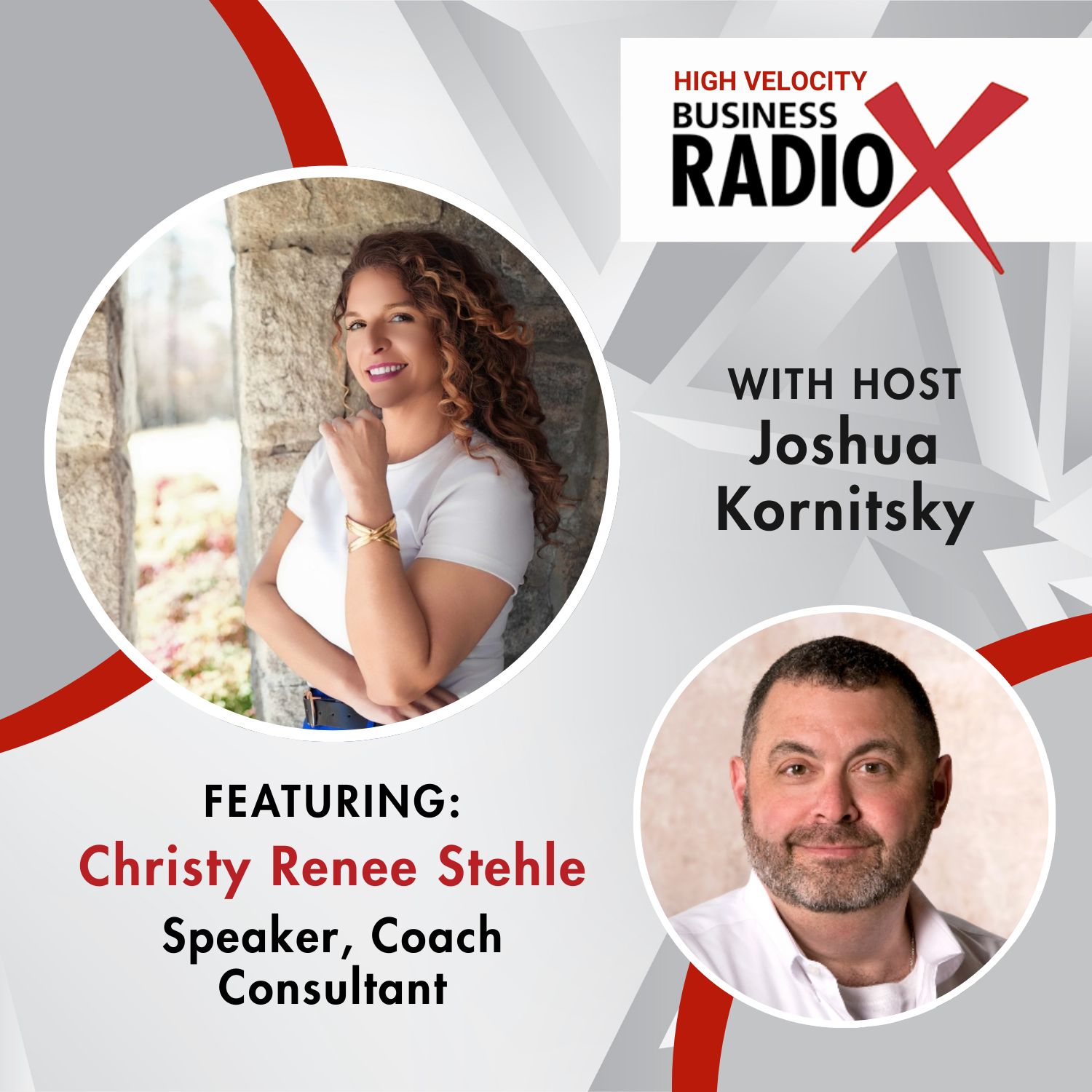

In this episode of High Velocity Radio, Joshua Kornitsky interviews Christy Renee Stehle, an award-winning brand storyteller, strategist, and coach. Christy shares her journey from avid reader to corporate advertising leader, discusses her storytelling framework, and emphasizes the importance of emotional intelligence and alignment in brand communication. She recounts success stories, including revitalizing Claire’s, and offers practical advice for entrepreneurs and organizations.
 Christy Renee Stehle is a dynamic speaker, coach and consultant who specializes in helping organizations stand out and scale through the power of magnetic storytelling and presence.
From chronic illness and spending 5 years traveling across 35 countries to helping organizations find clarity, structure, and consistency of their brand, Christy is a wealth of wisdom and a catalyst for change.
Connect with Christy on LinkedIn and Facebook.
Episode Highlights
- Importance of active listening and emotional intelligence in understanding brand essence
- Development of a unique storytelling framework for brands
- The role of personal stories in connecting with audiences
- Challenges organizations face in achieving communication alignment
- The significance of consistency in brand messaging across platforms
- The impact of mentorship on professional growth and confidence
- Strategies for integrating storytelling into organizational culture
- The evolving nature of consumer expectations and the importance of personal connection
- Resources and methods for entrepreneurs to enhance their storytelling skills
About Your Host
 Joshua Kornitsky is a fourth-generation entrepreneur with deep roots in technology and a track record of solving real business problems. Now, as a Professional EOS Implementer, he helps leadership teams align, create clarity, and build accountability.
He grew up in the world of small business, cut his teeth in technology and leadership, and built a path around solving complex problems with simple, effective tools. Joshua brings a practical approach to leadership, growth, and getting things done.
As a host on Cherokee Business Radio, Joshua brings his curiosity and coaching mindset to the mic, drawing out the stories, struggles, and strategies of local business leaders. It’s not just about interviews—it’s about helping the business community learn from each other, grow stronger together, and keep moving forward.
Connect with Joshua on LinkedIn.
 This transcript is machine transcribed by Sonix.
TRANSCRIPT
Intro: Broadcasting live from the Business RadioX studios in Atlanta, Georgia. It’s time for High Velocity Radio.
Joshua Kornitsky: Welcome back to another exciting episode of High Velocity Radio! I am your host Joshua Kornitsky, professional iOS implementer and in studio today I have a really incredible guest, Christy Renee Stehle, a magnetic brand storyteller, a strategist, a speaker, and a coach. Welcome, Christy.
Christy Renee Stehle: Hey, thank you so much.
Joshua Kornitsky: I’m so happy to have you here. I’ve had the opportunity to to see Christy as part of a panel, and she just made a really, really dramatic impact with the folks in the room. So having you here one on one just makes this all the better. So tell us a little bit about your background and what you do to help folks as both a storyteller, uh, for, for brands, for as a strategist and as a coach. Right. Because it’s multifaceted.
Christy Renee Stehle: Yes. Well, I help brands tell their story to grow their loyal client base. But what I really help brands do is to communicate their essence so that they can really have true transformation, which is really what I’m about. Growth, transformation and communication is all often the biggest sticking point. When companies go to grow. They don’t realize that, but it is okay.
Joshua Kornitsky: So you’re helping them understand who they are.
Christy Renee Stehle: Question mark.
Joshua Kornitsky: Yeah, I, I mean, I, I understand what you’re alluding to, but that must be an incredible challenge to elicit that from folks who are probably very black and white. And this is much more in the creative space than it is in the black and white space.
Christy Renee Stehle: You know, articulating their essence is far less complicated. That comes easy. What is a bit of a challenge, though, is that most brands who need this are what we call problem unaware. They don’t know that what’s sticking them is actually what I can help with. So it’s easy to communicate their essence because through a conversation I can see patterns. I can hear patterns. You know, we often have a blind spot. It’s actually not crazy science. What I do it, you know, if we were having a conversation and you said the word trust 17 times, that’s probably going to be important.
Joshua Kornitsky: That’s a good note to remember just for future interactions with anybody. Right. So people are what it sounds like. What you’re saying is people generally self-identify where their issues are. You’re just tuned to hear it.
Christy Renee Stehle: Yes. Active listening. My background in coaching obviously helped a lot. It really just is a lot of leadership training that allows me to be able to hold the space, listen, have very strong recall. I will say that that is important. Being able to notice that, recall it, and maybe even articulate verbatim what they said. But you can record that. You can take notes.
Joshua Kornitsky: There are ways these days. Yeah, more, more than ever. But let’s talk about that a little. What is your background? What was the foundation for all of this?
Christy Renee Stehle: Yeah, well, you know, I always tell people that I’ve been reading since I was about three years old, and I never stopped, and that’s awesome. Um, people don’t always like that answer because they’re like, no, I want to know exactly where you studied and exactly what you did. And honestly, reading for that length of time and never stopping has been the biggest educator.
Joshua Kornitsky: I’m the son of of a retired now librarian. You don’t have to tell me. Yeah. Um, so it sounds like that constant search for knowledge is, is ultimately the underpinning of of what made you pay more attention or was there more in your background?
Christy Renee Stehle: I mean, it’s definitely it was definitely my first experience with, with the bigger world than the area that I lived in, for sure. But even sentence structure, story structure, paragraph structure, when you’re when it when you’re reading bestselling books. Right. Again and again and again and again, you start to understand that there is a structure to this. And, you know, I have a storytelling framework story. It is used for inspiring trust and motivating action. And it really that was birthed from reading fiction. Yes.
Joshua Kornitsky: I think that’s incredible. Um, did you through your journey to arrive at being the the dynamic storyteller that you are, the magnetic storyteller that you are? Did you have any mentors? Did you have anybody that inspired you?
Christy Renee Stehle: Lots of people throughout the throughout the way, I’ve had so much help. I’m always, you know, for anybody listening that wants to feel inspired to do more with your life, seek help. It does not make us weak. It makes us strong. And one in particular, when I was in corporate advertising to have a middle aged man who had been doing this for decades and decades, always pushed the women to the forefront and give us opportunities where, for instance, directing a national TV commercial, being able to write the full script and I don’t know if I can do this and I don’t know how to do this. He’s like, you got this, really? You’ve got this, Christine. Go! Oh, yeah. And. No. Can you help in this? And there would be feedback in the end, but it was such a great mentor and development to help me trust in my own skills and learn this and then refine my delivery for sure.
Joshua Kornitsky: That’s and as you said, reaching for help doesn’t make you weak or show you that you’re weak. It shows you that you’re strong because the the best of the best all work with people who help improve them.
Christy Renee Stehle: And I think that that’s one of the biggest misconceptions. People don’t like asking for help. They think that it makes them look bad. I should know everything. I should do it myself. Absolutely not.
Joshua Kornitsky: If that was the case, they would already be at the top of everything they attempted and I’ve not met too many people there. Yeah. Um, so you had touched on this briefly about sort of this blend of both precision with data, but also with creativity. Right. And and with your background in, in your experience, can you talk a little bit about how the two overlap, or maybe not overlap. Maybe where they meet?
Christy Renee Stehle: Yes. Well, believe it or not, emotions can be data. And I’ve been using that a lot more recently because yes, the emotions that you feel, the emotions you want to convey, the emotions that your ideal audience feels. That’s what drives our communication. That’s true. So there is precision and in this emotional intelligence. And I think that for me, I’ve always been very detail oriented. That comes naturally to me. But working in corporate advertising, as I just mentioned, helped me develop my high level way of thinking. And I still remember, you know, this goes back to transformation and growth. When somebody asks you to do something. Yes, seek help, but also in certain settings be like, yeah, I totally got this. And I remember the first time I was asked to create concepts for a campaign, and that was actually some high level thinking, and that helped to bridge me into the high level. But when I was asked, Christy, can you make some concepts for a campaign? Sure, absolutely. Of course. Call ended, went to Google. What is concept? What is a campaign and. Figured it out.
Joshua Kornitsky: But it’s incredible because the way that you stitch it together now. I won’t say it’s effortless because clearly there’s a lot of effort in it, but you certainly seem to have honed your craft in a way that that shines through with some of the clients you’ve shared with me that you’ve worked with. Um, anything in that regard that, that without giving away names and companies of things that are obviously protected, uh, you had shared with me about, uh, one company that had grown 51% in a particular period of time that was remarkably short.
Christy Renee Stehle: From bankruptcy, I might add. Yes.
Joshua Kornitsky: Back from the dead.
Christy Renee Stehle: Back from the dead? Yes. At a time when many legacy retailers were going out of business, toys R us, K-Mart, Claire’s was threatened to go out of business as well. They did not have a voice that spoke to the new generation. They did not have consistency between their e-commerce site and their in-store experience, and a lot of brands may not think that that’s as important as it is. But for today’s buyers, if you don’t have that consistency, you’re not even registering in their awareness that you are worthy of them investing their time to check you out.
Joshua Kornitsky: Well, I’ll confide in you. Uh, I now both have a love and hate relationship with you because I have a 17 and a 22 year old daughter. And what you did at Claire’s clearly worked a few years back, because we spent plenty of time and money there. But to your point, they are the growing demographic, right? And all joking aside, if they didn’t see consistency between what they saw online and what they experienced in store, uh, you fall into a situation like the electronics retailer Fry’s. They were two different organizations, and the in-store experience was completely removed from the online experience, and they disappeared literally overnight.
Christy Renee Stehle: It happens. It happens. And, you know, with the voice for Claire’s, we were creating this new voice for the generation. And so the task was or what I helped them see, the task was, is that we need to communicate in a voice where the today’s 15 year olds will not roll their eyes. But then, as that bonus, can we communicate to the millennials that grew up with Claire’s and have them inspired too? Because in a lot of times the parents are the ones doing the buying. So how can you bridge that and speak to everybody and still be very specific and nuanced?
Joshua Kornitsky: And so you’re you’re doing multigenerational communication.
Christy Renee Stehle: Which is how we got here today with the Family Business Association Enterprise Center.
Joshua Kornitsky: Absolutely. Well, you had shared with me that you’re pretty well traveled on this planet of ours. Um, how many countries?
Christy Renee Stehle: 30. 36. Actually, I need to revise it. I went to Canada to two weeks ago.
Joshua Kornitsky: That’s amazing.
Christy Renee Stehle: 36.
Joshua Kornitsky: 36. So I think that leaves you about 45. Give or take a few left, but some of them are smaller, so you can probably hit a few of those in a day. But all joking aside, with that level of international exposure, understanding that not all of those were business trips, in fact, I don’t think many of them were business trips. How does that inform your perspective? Because it’s not just about American consumers. You’re dealing. Some of the clients that that you work with are global brands. Many of them are global brands. So did that inform your perspective?
Christy Renee Stehle: It did. And what I would like to share from that is in the idea of transformation and this idea of impossible growth. No, they were not all business trips. In fact, I had a two year work gap on my resume before I landed a six figure salary with no formal experience. Wow.
Joshua Kornitsky: So you are a really good storyteller.
Christy Renee Stehle: And that was a huge part of it. Yes, being able to leverage yourself as the best candidate in any room using your personal experience. So I went into that interview as the only one who had traveled the world, and instead of showing up and being, um, well, you know, I had a two year work gap and and I was like, no.
Joshua Kornitsky: Look at look at how much I built myself.
Christy Renee Stehle: How much and how I can communicate beyond borders. And I just really sold. I sold that, and by the end of that interview, I was the only choice candidate, because I had put myself in a box that no one could compete with. And I.
Joshua Kornitsky: Pretty strong.
Christy Renee Stehle: Piece again and again and again. And if anybody is listening and you feel inspired, but you’re like, I have not traveled to 35 countries, I can’t do that. That is part of what I help. I know we talked a lot about organizations, but for the entrepreneurs, understanding how to leverage that personal story, maybe it’s a misfired email. Maybe it’s a traffic moment. It doesn’t have to be these life altering stories, but captivating is in the delivery, not in what.
Joshua Kornitsky: Happened when you had shared it. It creates this, uh, my word connection point, right? Where where I can see where the person that I’m, um, talking with to convince of my product or service can see themselves in in the story as I tell it.
Christy Renee Stehle: And that’s really the key. It’s that right there. That’s all it takes today. Yes, there’s a lot that goes into that. There’s strategy. There’s, you know, refinement of, well, I have this big, huge life and I don’t understand how my personal transformation has anything to do with my business acumen. Well, that’s where I come in and that’s really where I help merge. Because yes, if you figure out how to do that, that’s all it takes.
Joshua Kornitsky: That’s fantastic. And in truly that that’s a cheat code to to to connect.
Christy Renee Stehle: You kidding me? I have gotten in the room. I was on the Mind Valley stage, my Mind Valley mainstage university next to visionary leaders like Fish and Lisa Nichols as a nobody. Right? I’ve just.
Joshua Kornitsky: Won. Not a nobody.
Christy Renee Stehle: But not a nobody because I positioned myself. And it’s this quantum leap type of growth that I’ve done again and again. And the rug has been pulled out from under me more times than I can count, and I’m constantly pulling myself up by my bootstraps building a new presence in a new industry. And I’ve used this, this magnetic storytelling method repeatedly for all this growth time and time again.
Joshua Kornitsky: I can you tell us a little bit more about it, because it sounds like it’s something that that absolutely taps into not only a need, but is is deeply in tune with the marketplace?
Christy Renee Stehle: Absolutely. I’ve joke I’ve been waiting my entire life for 2025. This is perfect timing. The world needs what I have to offer. And yes, there’s three parts to this, right? So you have your message, which we talked about a little bit with the previous guest. This is really where the data comes from, the emotional data. And under in order to understand what your message is you have to first understand your audience. Then you position it through that lens, then you have then you have something that I call magnetic presence. Magnetic presence is built through courage. It’s built through energy management, and it’s built through leveraging your story. And then you have story which depending on if we’re a large organization, you may have an evergreen story. You may have a campaign story, but then what nobody is talking about is the individual story. And that’s where I’m training leadership teams in the same way that I’m working with the entrepreneurs. Hey, what is your background? Every time you’re in a customer service interaction or sales interaction, don’t come out of the gate with just like, okay, let’s get down to business. No way.
Joshua Kornitsky: Right.
Christy Renee Stehle: Tell a story about what just happened. And so the person sitting there goes, wow, I’m in such good hands.
Joshua Kornitsky: So you bring up a really interesting point, and I want to make sure that I ask this question. You’re some of the organizations that you work with are really, you know, fortune 100 if and because it’s not my information to share pretty high up on that list in maybe even the single digits. That having been said, are you able to transfer the skills and abilities that you’re talking about? Now with me down to entrepreneurs that are at a local level.
Christy Renee Stehle: Oh yes. Yes, I’m working with entrepreneurs right now. I have one on one coaching clients, whether they’re really what I the translation in that really comes down to, are you the face and voice of your brand? That is what it takes today. So yeah, absolutely. It’s that same kind of thing, that same kind of storytelling training. It’s just on a team level or an individual level. But the the golden thread is really the same.
Joshua Kornitsky: That’s really incredible to know, because it’s the type of thing that, as you alluded to before, it’s a quantum leap if you can harness this ability. And it sounds like it’s sort of like the, the, the colors in the house. Right. The information’s contained in the folks. You just have to help them see it.
Christy Renee Stehle: Yes. And that’s really a lot of the work that I do. And, you know, whether you’re an organization you need to be. So if you’re an organization, you need to be as personable as a human. And if you are a solopreneur, you need to be as omnipresent.
Joshua Kornitsky: As an organization.
Christy Renee Stehle: As an organization. So we have all of these platforms that we’re expected to show up on. And no, you don’t as an entrepreneur, need to be everywhere. Focus your energy on maybe two, but you need your presence there. Because if somebody Googles you or goes to that certain platform and tries to find you and you’re invisible, you’re a ghost. Guess what? You don’t even register. Oh, they’re not real. Right. And that’s the that’s the problem that a lot of brands are having in the market right now, they’re not even aware of is that with AI, with all the scams, with the way the market’s changing, there’s a lot of mistrust and we have a really guarded generation of buyers. And so what we need to do is inspire that trust at a new level. So I know people kind of fear this disruption, but there’s so much opportunity here. And it really comes down to personal connection, telling your story. I mean, I think it’s a great time to be in business.
Joshua Kornitsky: It’s the way you tell the story. It certainly makes sense to me that there’s tweaks and and opportunities to improve just the way people are communicating on a basic level to to make a pretty dramatic impact.
Christy Renee Stehle: Well, you know, think about think about communication at the level in your home. Think about your loved ones or your children. How much of a difference does it make communicating with your wife or your husband from a place of emotion, anger, frustration versus internalizing processing your emotions and coming back with a level head?
Joshua Kornitsky: It’s a completely different experience.
Christy Renee Stehle: How much of a difference in an outcome does it make?
Joshua Kornitsky: Sure. That that, um, it’s a great way to to bring clarity to that. So who usually reaches out to you in an organization? Hoo hoo hoo if someone wants to engage with you? Who is it usually that does.
Christy Renee Stehle: I wish I had a simple answer for you. My life would be a lot more simplistic, but because I do so much public speaking, just like you saw me at the Kennesaw panel that same event, a CEO of a family business. A event organizer for the Kennesaw Super Women’s Conference that I’ll be in this month. That’s great. And a CEO event. And then there was an entrepreneur there that night that was interested as well. So honestly, everybody needs this at this time. And I’ve just been try as I might to say, that’s too many people to serve all at one time. I’m a team of one. Let me pull back every time I go into a new room. This same spread of people seem to be interested. So I’ve refined my approach, and now I’m building a very big and dynamic team so I can scale. And it’s my own medicine, right.
Joshua Kornitsky: Right, right. But but that’s what makes so to to your own point, it has credibility because it is your own medicine. Right? Because your belief in what you’re doing comes through very clearly. And it’s obvious that you believe in what you’re teaching, what you’re eliciting from the folks that you’re working with. And it makes a dramatic impact on how those engagements have to execute. Because when people when you love what you do, it comes through. And it definitely, definitely comes through.
Christy Renee Stehle: Well, you make such a good point. You know, that’s one of my core teachings, is that your energy about something is going to sell more than your words. And it’s just like the age old sales technique or job interview. If you’re not convinced, you won’t convince. If you’re sitting there as a job candidate thinking, man, I’m really trying to convince this person that I’m I’m the absolute right choice, but I’m insecure and I don’t have this. You’re not going to get it. And so if you believe in what you do, that energy, that passion, that conviction, it shines through. And that’s how you can really bring a lot of people in. That is the magnetism that I talk about.
Joshua Kornitsky: So when let’s take a hypothetical, when you walk into a leadership team that’s decided to engage you. Um, question number one is, is how often are they all aligned around and for clarity around who the brand is, what its identity is, what what they’re dedicated as a leadership team towards achieving.
Christy Renee Stehle: That is one of the biggest challenges that I see organizations have is that we are multiple people making up our brand. How do we have one voice? And in family business, you tend to have more alignment between and, you know, one of the CEO that I just mentioned when he said, you know, well, we’ve just been hiring people that are pretty much like us.
Joshua Kornitsky: A tried and true approach.
Christy Renee Stehle: And it and it works, but it still yeah, it it it it will have a hard time continuing to be sustainable in this new. Exactly, exactly. So there’s all different range of alignment. Um, but the I do have an align framework as well. And it was birthed from the fact that when I was in corporate advertising and I was at that director level, I was constantly like a broken record. Hey guys, I need to get the team to align. Can we align before this? So alignment is on a grand scale, but it’s also on a micro level of everyday interactions. You think that you’re saying the same thing. And this is why communication breaks down. And it is that sticking point, because a team will be having a conversation about something and then they’ll go break. And then they all go to execute and then you bring them back. I cannot tell you how many times a creative team delivered their heart and soul on a screen in a project, and the team said, oh, this is great, guys, but it’s not the ask, right? It’s like, who can you please learn how to communicate a little bit better, please? So I got in the habit of just getting into the micro moments of alignment.
Joshua Kornitsky: So, so are you bridging the gap between what I say and what you hear.
Christy Renee Stehle: Often, often. And as writers, our job is to be very literal. So I did train my staff to get into the habit of after everything, then go back. And it’s kind of that active listening thing that we talked about, right? Get in the habit of active listening. So what I hear it. What I hear the ask being what I’m going to go do. Just to clarify, these were certain things that I taught. So really an organization, if they were engaging me for my full services, I would be building you internal communication alignment processes as well.
Joshua Kornitsky: Well, and that makes sense, because if you’ve got five leaders that all have a slightly different interpretation of the goal, everyone in each one of those silos has a slightly different interpretation of the goal. And if you’ve got ten people in five silos, you’ve got 50 people that are marching to different orders. And and that’s going to do nothing but create chaos.
Christy Renee Stehle: And we’re communicating where slack teams as fast as we can in short little bursts of text. Then nobody.
Joshua Kornitsky: Ever, nobody ever misunderstands those ever.
Christy Renee Stehle: Ever.
Joshua Kornitsky: Well, so to me that that leads to a question that I’m curious about. How important is common language because of what you’re talking about?
Christy Renee Stehle: Oh my gosh. Yes. So yeah, I have been I’ve had eyes roll at me like, you’re such a dork. But the first thing that I do is like, we need to have a glossary of terms that we all use because otherwise, you know, especially in today, we’re talking about, okay, there’s no standardize for a lot of marketing lingo, let’s say. Right. If you’re trying to make a campaign on social media, the rules are changing all the time. First of all, you have a graphic designer, you have a writer, then you have an account manager. You have all these people. What’s the art copy on image? Text caption. Right. A lot of times people will say, make the text, say this, make the image this. There’s a lot of other text. If you’re doing paid ads, you have a headline. Is the headline the thing that’s on the graphic or is the headline the specific part that you have to plug in in the back end?
Joshua Kornitsky: So is the framework that you introduced to them. What you help them understand brings the clarity to it.
Christy Renee Stehle: It definitely brings clarity and it really depends on where an organization is and what their goals are. So the first thing that I always do is have a strategic onboarding. We need to know where you want to go and know what’s in the way. And then we can figure out what’s happening. So it’s not always the same. But just like we talked about before there commonalities. There’s patterns. It’s just a little bit of customization into the plug and play if that makes sense.
Joshua Kornitsky: So when you have those dialogs, is that where you begin to use your term? Is that where you begin to unearth the essence of that organization? Is that do you find that it sort of leaks out through the seams?
Christy Renee Stehle: It absolutely does. It absolutely does. It is very you know, I think that emotional intelligence is what equips me to do such a fine job at this. It’s being able to walk into a room and hear some stories, hear some conversations, see how people interact and get a little bit of legacy history and I mean within an hour we could say an hour, whether it’s a strategic workshop where we’re getting together. What I really love to do is team building events. I think that we need it now, that we are hybrid. People are wondering what the future of work looks like. How do we do that? Well, people don’t always like to carve out some time, but guess what? If we’re doing three things at once, right? In that time that we carve out, we are actually creating much more sustainability as we go along.
Joshua Kornitsky: So what are some of the misconceptions, right, that when you walk in the door and you’re talking about creating this alignment and creating this understanding, and even as basic a term as as a glossary of terms, right, to get everybody using common language, what are the assumptions that you have to combat?
Christy Renee Stehle: Mm. Yeah. Great. Great question. I always and one of my principles as well is always handle the objections straight out of the gate. So knowing what those misconceptions would be and being able to deliver them is important. I don’t know that they are always the exact same. I do think that really, as we talked about a little bit earlier, the. Amount of time you have to tell your brand story, I would say is probably the most consistent thing. I get the question of, well, how much time do you have to capture that attention? And it really depends on how good you are at retaining that attention. And I think that, well, we don’t need to tell our brand story because we don’t do a lot of long form content. Okay.
Joshua Kornitsky: Right. But but is I want to frame this as a question rather than a statement. Is is a brand’s story at the highest level? Is it a isn’t it more of an arc or a spectrum than a simple. We make widgets.
Christy Renee Stehle: Yes. And I would take it a step further and say that a brand story at the highest level is an emotion. It is an emotion that you leave others feeling at every touchpoint, whether it’s online, whether it’s a customer service, if you are making others feel taken care of, let’s use chick fil A, for example.
Joshua Kornitsky: I was going to ask for an example.
Christy Renee Stehle: I was perfect exactly. Chick fil A was the only brand that’s ever come across my desk. And you keep asking, no, it’s not protected. I’ve worked with the American Heart Association, chick fil A, sire, LTL free, Claire’s next door, the list goes.
Joshua Kornitsky: I just always have to be respectful because I know.
Christy Renee Stehle: Absolutely. And yes, I can be modest in that way sometimes, so thank you for drawing it out of me. Yes, but chick fil A was the only brand that’s ever come across my desk that had well-developed communication guidelines, so it’s easy to see why they scaled from a handful of locations in the southeast to a nationwide presence that people in New York say, yay, chick fil A got here, right? Why? Because they understand their audience so well. Their audience is primarily working parents, primarily working moms. So the energy that they make you feel at every interaction Is taken care of. You can trust chick fil A to give you a moment of peace in your day of chaos. From the little napkins, from the little flowers, from the smiling faces, from the. My pleasure. Everything they do is to give you the feeling that you are taking care of. That is their brand story.
Joshua Kornitsky: So I think you just touched on another aspect of of. I love this term, essence. Right? Because it isn’t just a leadership team discussion decision and they send it off to marketing. It sounds like it permeates every level of the organization.
Christy Renee Stehle: It should. And unfortunately, sometimes it is just a leadership conversation and it is sent off to marketing. But that is the old way of doing things, and that is not what will get you this huge kind of scalable growth that is possible, this impossible growth, this scaling, this nationwide presence. Yes, it does come from marketing, should be permeated in absolutely everything you do. And so I actually believe hot take here as somebody who came as an agency partner. I think that all. Somewhat.
Joshua Kornitsky: So I’m sorry, you were saying someone coming from an agency.
Christy Renee Stehle: A little bit of a hot take. Is somebody coming from it as an agency partner? I don’t believe that brands should have agency partners in this day and age. I think they need in-house marketing teams trained by expert professionals in how to develop the leadership internally to do this. Why? Because the amount of times agencies are a rotating door or they trade people out, they don’t document brand. No, marketing isn’t everything you do. So get really used to telling that story. Have somebody like me come in, give you the processes, outline the leadership training, teach you how to do it, and then carry it forth yourself.
Joshua Kornitsky: Well, so you mentioned before about sort of this next generation of consumer. Right going. Building directly on what you just said. Are you beginning to encounter next generation leaders? Are you helping sort of train those next generation leaders? Because it seems to me, thinking of the traditional stuffy, uh, leadership team meeting that that I’ve been in a party to and, and borne witness to. There’d be a lot of resistance to that concept.
Christy Renee Stehle: To the concept.
Joshua Kornitsky: Of of of that marketing’s got to be that that marketing’s got to be in-house, that we’ve got to have it permeate every aspect of the business because the, the old, uh, curmudgeon perspective is it has its place as, as part of the holistic organizational structure, but it’s no more important than anything.
Christy Renee Stehle: Else. Good luck. Good luck. But that’s how that’s how so many brands are becoming obsolete today because they’re not adapting.
Joshua Kornitsky: So broadly, what does success look like when When it all hits, when you’ve worked with a client and you’ve gotten them to understand and and extracted and they’ve embraced what their essence is and you’ve gotten it to again, you facilitate them. You don’t do it for them. If you’ve gotten them to understand the value of bringing that essence throughout the organization, obviously, financials one aspect of it, but what are the other impacts on the organization other than success?
Christy Renee Stehle: Success for an organization with their brand story are happy employees, fulfilled employees, top tier talent, a culture that not only your employees love to organically share, but also something that your customers can buy into. So it’s this idea of creating a movement, creating a culture. And truly that is the highest form of success because that is how you do less work and grow faster, because you have what I call walking billboards. People, employees, customers who are just so taken with what you. You do that they go and they share you on Cherokee Business RadioX plugging an automotive alpha and omega community leader who’s taking care of the community. People start talking for you.
Joshua Kornitsky: So what you’re saying, if I can paraphrase, is if you take care of good, if you take excellent care of the of your staff, your staff will take excellent care of your customers.
Christy Renee Stehle: Yes.
Joshua Kornitsky: Huh? Novel concept. I feel like that’s. That is both incredibly obvious and so counterintuitive to the way a lot of legacy business operates, because so many legacy businesses just see like the old Tom and Jerry cartoon, they just see that walking bag of cash when a customer walks through the literal or the metaphor, the metaphorical door, helping them understand that value must be a challenge.
Christy Renee Stehle: Yes. And one of the best projects that I worked on was actually a white paper documenting all of the data of this new generation of buyers. And all of the studies show, whether it’s event attendees or buyers today. They value this personal connection. So legacy brands who are thinking in the way that you suggested or that they’re not reading the data, they’re not reading the statistics that show, hey, we have a new generation of buyers who value things very, very differently. And if you adapt now, excellent, huge growth is in your future. And if you don’t, might be like toys R us I’d be like Kmart.
Joshua Kornitsky: And is that white paper available to people to reach out to you?
Christy Renee Stehle: It actually is.
Joshua Kornitsky: That’s a good.
Christy Renee Stehle: Actually.
Joshua Kornitsky: Yes, yes, I’d like to read that myself.
Christy Renee Stehle: Absolutely.
Joshua Kornitsky: Well, Christye, uh, I can’t tell you how informative I found all of this. Is there anything we didn’t touch on that we need to share? Other than. I do want to ask you, I understand that you’re the recipient very recently of an award, and I. I really believe you should shout it from the rooftops. So please tell.
Christy Renee Stehle: Us. I should be shouting it. You’re absolutely right. I think some of the shock is still wearing off. Fair enough. I’m. I’m in the same room in the same category as four time Olympian athletes and keynote speakers and global heads of event companies. I won a 2025 Smart Meeting Best of Stage award in the Life Changers category, and I am just beyond humbled. I’m beyond honored. This means so much to me. This is going to allow me to get out there and help so many other entrepreneurs and organizations transform, and.
Joshua Kornitsky: It’s well deserved. And I say this from a professional perspective, having having spent some time with Christie, having also seen her on stage in a panel, uh, you light up a room and I mean that in, in a strictly professional sense that people listen to what you say because the way you say it is so impactful.
Christy Renee Stehle: And if anybody wants to learn how to do that.
Joshua Kornitsky: How do we reach.
Christy Renee Stehle: You? Work with me one on one. You can find me at my website, Christina, on all the social platforms. That is exactly what I teach to do.
Joshua Kornitsky: That’s fantastic. Well, we will also share all of your mechanisms of contact, including your Instagram, with your permission. Yes. And make sure that people know how to reach you. Uh, Christina Seeley, unbelievable discussion, unbelievable essence that I’m taking away from this. You are a magnetic brand storyteller, a strategist, a speaker, and a coach. And I am so grateful for your time and for you sharing all that you’ve shared with us and our listeners. Thank you.
Christy Renee Stehle: Thank you so much.
Joshua Kornitsky: This is Joshua Kornitsky, the host of High Velocity Radio. Thank you for joining us. We’ll see you next time.














