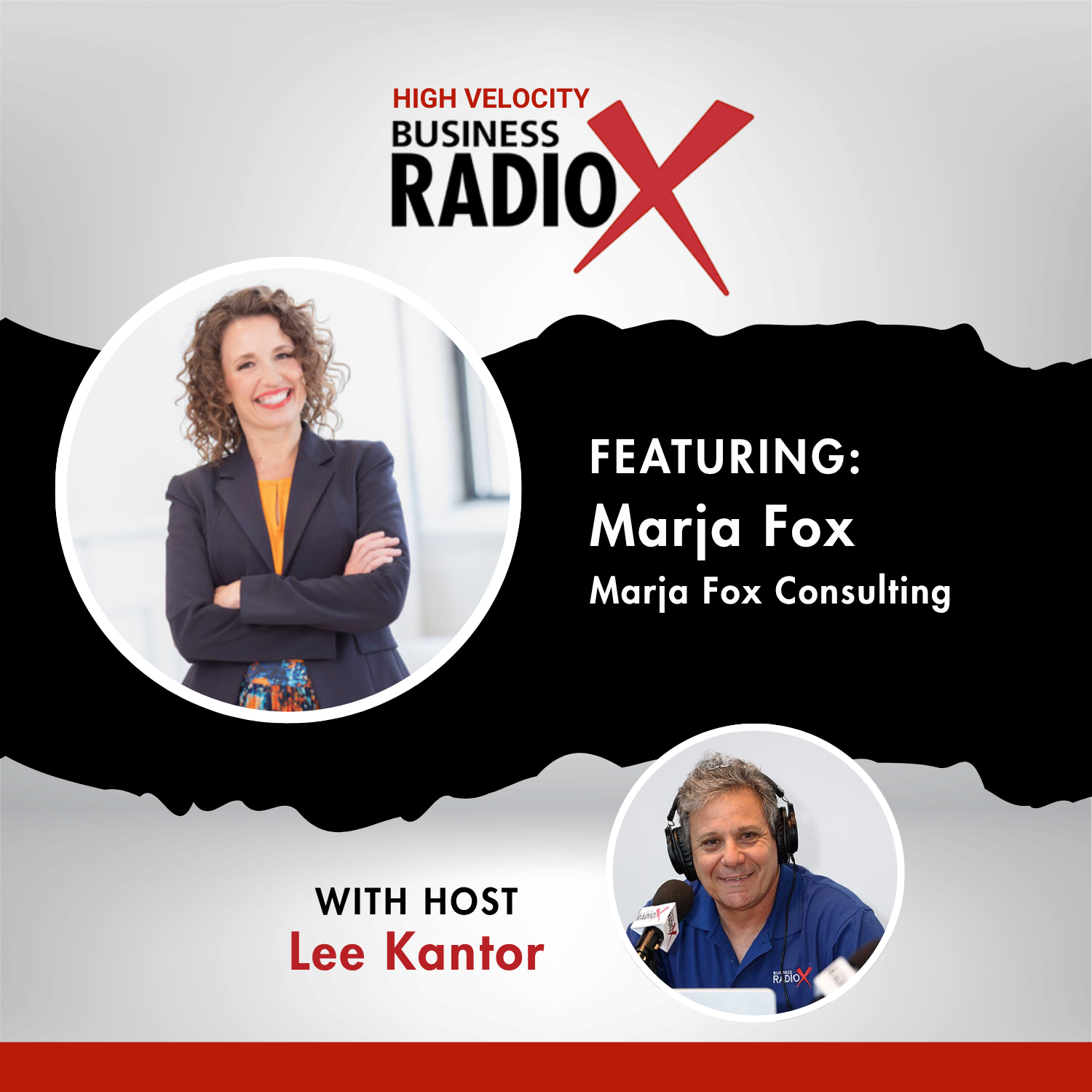

In this episode of High Velocity Radio, Lee Kantor interviews Marja Fox, Owner of Marja Fox Consulting. Marja discusses her unique approach to strategic planning, helping small and mid-sized businesses align leadership teams through facilitated discussions, data-driven insights, and collaborative decision-making. She shares how organizations can navigate uncertainty, improve strategic clarity, strengthen leadership alignment, and turn complex business challenges into actionable growth strategies.

 Marja Fox helps US-based SME executive teams make the strategic decisions they’ve been circling for months.
By combining the hardcore problem-solving of a strategist and scientist with an unexpected twist—the skills of a former thespian—Marja reads a room, manages energy, and improvises to unleash breakthrough thinking.
She’s facilitated over 100 C-suite conversations, navigating what makes us human (and often terrible at decisions) to get her clients unstuck and moving.
Connect with Marja on LinkedIn.
What You’ll Learn In This Episode
- The importance of leadership alignment in developing effective business strategies.
- How facilitated discussions can help teams navigate uncertainty and make better decisions.
- Common signs that an organization needs a strategic planning reset.
- The difference between mission, vision, strategy, and day-to-day execution.
- Why strategic success depends on asking the right questions, not just analyzing data.
- Techniques for overcoming organizational silos and conflicting leadership perspectives.
- The role of data, analytics, and healthy debate in shaping business direction.
- How small and mid-sized businesses can create clear, actionable strategic plans.
- Best practices for building consensus and gaining organizational buy-in for strategic initiatives.
- Real-world examples of how strategic clarity can drive growth, reduce risk, and improve business performance.
 This transcript is machine transcribed by Sonix.
TRANSCRIPT
Intro: Broadcasting live from the Business RadioX Studios in Atlanta, Georgia. It’s time for High Velocity Radio.
Lee Kantor: Lee Kantor here another episode of High Velocity Radio, and this is gonna be a good one. Today on the show, we have the owner of Marja Fox Consulting, Marja Fox. Welcome.
Marja Fox: Thank you.
Lee Kantor: How’d I do with the pronunciation?
Marja Fox: Excellent. And you can tell I need a little creativity as I come up with a business name, right?
Lee Kantor: I don’t.
Marja Fox: Know.
Lee Kantor: I guess you were born with that, or was that a choice?
Marja Fox: Well, it is a unique name, so why not run with it?
Lee Kantor: Hey, I do the same thing. So tell us about your firm. How are you serving, folks?
Marja Fox: I have a small business focused on helping executive teams at small and medium sized companies establish their strategies. And we do that particularly through facilitated debate and discussion. Bring facts and analytics to the table. But I have found that the core of what small businesses need help on is getting their team of great people to have the right discussions, to wade into the uncertainty that comes with strategy, and come out of it with an aligned perspective that they’re ready to go do something about. So my whole business centers around that kind of art of being in the room with a senior team, getting them to have the right conversation at the right level in order to make great strategic decisions.
Lee Kantor: So what’s your back story? Um, what were you doing that had you ready for this kind of a challenge?
Marja Fox: Well, I’m not gonna lie. It’s been a, it’s a, been a wandering and meandering journey to get here. I started off actually, my training is in the sciences. I have a PhD in chemistry. You’re going to wonder right off the bat, what the heck that has to do with facilitating strategic debates at all. And for a long time, I wondered too. There’s a there’s a core underpinning around strategy and around chemistry that’s just around understanding the basics of how does something work. So I’ve got a curiosity just on why. Why do things work the way they work? Why do atoms and molecules and electrons add up to the experience that we have every day as we walk around? Why do the rules of how something makes money? Somebody makes money in a particular industry or a particular value chain impact the choices that we can make in order to to win that way. So chemistry to start with, discovered about halfway through my PhD that probably I didn’t want to be in a dark laser lab anymore. So I went to management consulting. That’s going to sound a little more linear with where I’ve ended up. I spent ten years at McKinsey and company, great big strategy management consulting firm, doing all sorts of things. It’s a great job for people who don’t know what they want to be when they grow up.
Marja Fox: I did do a lot of strategy there, but did commercial operations, pure operations, finance, all sorts of things that have given me a pretty broad view on not just what strategy entails, but what it looks like afterwards to actually go do the strategy. That informs very much how I think about strategy. Now, after my time at McKinsey, I went to Ecolab. That’s a great big fortune 500 here in Minneapolis that focuses on food safety and sanitation. I ran their marketing function for $1 billion business. Through that, I really got first hand experience of what it’s like to not have a strategy, to have a strategy that you can’t execute. And in in pockets where, where that strategy’s really working. Got to see what the difference it made for, for the people on the ground, for the teams that were able to point themselves in the same direction. I left there in order to help my husband at the time try to figure out his own small business. He’s an engineer and inventor. Uh, and so I sort of backed into a place of, uh, of, of small business and entrepreneurship. I became the CEO of a medical device company. As I said, that was more to figure out if his business was worth anything. But it got me the bug of running my own business. So after we closed that one down, a great idea that simply was never going to make money.
Marja Fox: That’s a whole episode on its own. I came back to my management consulting roots startup, started up my own company that was initially really Bringing kind of McKinsey level strategic thinking and process to, to my clients, but very quickly in working with small and medium sized companies, realize that they didn’t need to scale down approach to strategy. They needed a different approach to strategy. And that’s how I’ve come to focus on facilitation. Small and medium sized companies still need facts and data, but they don’t need it the way that these giant organizations do. And so my my approach now is geared towards what is the best ROI on strategic efforts for those smaller and medium sized companies. Like I said, a lot of that really comes down to what happens in the leadership conversation in that room with your senior leaders, having the debates you need to have over what’s the right strategic direction. Um, so that’s, that’s the wandering journey that has led me to this place where I’m using all of these pieces from my chemistry background, from my management consulting background, even from high school theater, standing up in front of a room to facilitate. Uh, so that’s, that is that has become the core of what I do.
Lee Kantor: Now, when you say small to mid-size, um, how are you defining that?
Marja Fox: Great question. It’s a, it’s a wide range. For me, it comes down to organizations that are big enough where, frankly, they can they can afford to hire a third party to help them with strategy. That probably puts them in the million dollar revenue range. And yet small enough that, uh, that they are not in a place yet to invest in dedicated, strategy oriented resources that can be $1 billion company. So it’s a pretty wide range. Um, I would, I should also add at the lower end, um, it’s, it’s somewhat defined by organizations that are big enough where strategic decisions no longer live with a single person. It’s not just the owner, right? The business has gotten big enough that the owner needs their team to be not only deeply understanding the strategy, but invested in it in a way that is only accomplishable by having them be an intimate part of the creation of that strategy. So that also really defines kind of the lower end at where, um, organizations need somebody like me to help them.
Lee Kantor: So what is kind of the, what precipitates a call to you? Like what is there a pain happening? Is there something that has occurred that they’re like, hey, this, I don’t think this is good. We better get some fresh eyes on this. Like, is there a signal or something that says, you know what, maybe strategy is the thing we should be Are focusing more on.
Marja Fox: Sure. Um, this, this signal is, is one of two things, one of which is the, we’ll call it quote unquote easy one. One is the calendar says. So, um, at some point, most organizations get themselves in a rhythm of strategic planning and operational planning on a calendar year. So there are a certain amount of my clients that come to me because the calendar says it’s time to engage in a strategic planning exercise. Fine. That is one of the ways. The second way, and really the more interesting way, and I would argue the way that organizations should evolve towards is feeling that kind of pain. And that pain often manifests itself as a decision you sort of know needs to be made. Um, something has shifted in the market. A competitor is doing something different. Regulations have moved your. You have an idea of what you want to do, and the organization is struggling to understand it. Right. You think you’re clear, but you talk to a frontline person and they they don’t really get it. There’s, there’s a certain amount of just confusion or malaise that seems to sink in to many of the clients who reach out to me, they know there’s a decision to be made. Sometimes they think they’ve made it, but it’s not reaching the organization. Very often. It’s that they seem they feel that they keep having the same conversation over and over again without getting to a resolution. That’s when they know they need me. They need a facilitator because the con because the question is too hard to answer with a spreadsheet. And they need a facilitator because the people in the room, as high functioning as they are, as individuals, as high achieving as they are as a team, just can’t seem to get to an answer that sticks.
Lee Kantor: Now, when you’re working with a team and you’re going through this facilitation, what kind of is the deliverable? Is it like, okay, here’s the three sentences that kind of define our strategy, because I would imagine that these are companies, if they’re generating $1 million a year, every day work’s getting done, things are progressing in some form or fashion. Um, but when you’re talking about strategy, you know, that’s a big term that can mean different things to different people. Um, so what is kind of a deliverable of strategy?
Marja Fox: Yeah. Great question. And you have put your, your finger on something really important. We have done a disservice to the word strategy by using it for everything, everywhere, all the time. Here’s how I think about strategy, the way I’m using it, or strategy from a kind of business perspective. Growth oriented, future looking strategy is a cohesive set of choices that an organization is making under uncertainty. That describes the unique way in which they will create value. And yes, it should be simple. So a, you know, tactically a deliverable that we come out with in for each of my clients is a, usually a deck, sometimes a word document, but some sort of communication document that this team can use to bring the rest of the organization along. That should absolutely contain one page that tells the whole story in. No. No smaller than 18 point font. What is the answer to who you are as an organization that makes you different from everybody else and contains the choices you’re making around? We are going to be this and we are not going to be this. Beyond that, of course, there’ll be some rationale about how you get there as different people in your organization are going to need different kind of motivation and have different standards of, of what gets them to believe you and follow you. But that one pager is really the crux of what a strategy is.
Lee Kantor: So is it different than kind of a mission statement? Is it is it different than your true north?
Marja Fox: Yes, a mission statement. Your strategy needs to align with your mission statement, but a mission statement or a purpose statement or your your expression of your values. Those are think about those as a almost eternal set of conditions, right? That is, that is a fundamental, um, identity choice or purpose choice that over the course of ten, 20, 30 years really ought not to change all the way. On the other end of things, you’ll have kind of operating designs and processes. You’ll have plans. Those are things that, you know, even tactics, right? That can change daily. Your strategy is the bridge between those two. It connects who you are at the most fundamental level with those operating day to day plans. And so it answers questions that exist, depending on your industry more at the sort of three, five, seven year time frame, it can change it. If it does respond to fundamental shifts in the market, fundamental shifts in regulation, in competitors, in technology. But it is over a multi-year time horizon. So your organization has enough stability to build the kind of operational foundation and capabilities required to execute on that strategy. And all three of those things, if we can think of them as just mission and vision values, strategy, tactics, all three of those have to be very much in sync in order to have a truly successful business. And if you’re lacking any one of those pieces, you usually have a problem.
Lee Kantor: Now, what is it like to work with you? What is kind of those first conversations look like? Or even that first time you were with the team? What? So what are you giving us pre-work to do before you meet? Um, what are some of the things you’re asking? Like, I want to know what it feels like to work with you.
Marja Fox: Yeah. Um, so everything I do is always custom to every client. I think that’s one of the grounding principles or the differences in what I did serving fortune 500 versus serving smaller and medium sized enterprises. We don’t have time to waste. We don’t have resources to waste. So there is no blanketed templated process. That or workshop that I’m going to come in and plop into your organization, you know, 40% of which will be valuable and 60% just doesn’t make sense. So everything is very fit for purpose, but there is a kind of overarching approach that gets us to that fit for purpose, which almost always starts with a series of one on one interviews with the most important people in your organization. You know, you as the, as the CEO, your, your leadership team and other key leaders, but also some of your high potentials are often in the mix. Uh, so that you get a lot of input from a lot of different places in your organization. Those one on ones have a, have a fairly concrete deliverable, which is to define 3 to 5 strategic questions that we really need to answer. You know, you’re asking me great questions, Lee, around. What the heck is this strategy? Because it’s too broad. It’s too wide ranging, um, of a, of a, of an objective. So we turn that into something that is far more crisp and concrete.
Marja Fox: Those questions are still hard, but we at least know what they are and they can differ from across organizations. So we’ve already started to customize Dark Secret during those interviews. I also really start to get to know your team and your people. The human side of strategy is an enormously pivotal part of what it takes to do good strategy. And that’s not to say that there’s anything wrong with any of us. We are just people who come loaded with all sorts of biases and habits and deeply held convictions and stories and anecdotes and strategy really makes those come to the surface because we are making decisions in the face of uncertainty, and we have to make assumptions. We have to bring our instincts to bear. Our instincts are helpful, but they are also harmful. And I start to get a real good read on which of the instincts are going to be positive and contributing to our strategy conversations, and where are we going to have to break some things? Where are we going to have to get introspective? Where are we going to have to look at things from angles that we may not be in the habit of. So I start picking all that up through those interviews. After those questions are defined, we’re going to turn that into some clear and crisp data requests and analytical requests.
Marja Fox: My my approach centers on facilitation. That does not mean we do strategy in a vacuum. It does not mean we rely solely on, you know, our kind of common shared knowledge. There are things that need to be tested. Those are there are outside facts that need to be brought in sometimes to shake us up on those very biases that I was just talking about. So we’ll define a real clear set and we’ll sit down with, with my clients teams to say, what do you have? What do you not have? Let’s not make this onerous. How do we get close enough? How do we get to 80% of the answer with, uh, with the right proportional amount of effort to the insight that we’re going to get? So there’s some homework in there for my clients organizations to kind of pull those pieces together. Meanwhile, I will also be working with the CEO or, or a small planning committee to define, uh, the, the approach to the day or two days or two and a half days that we’re going to spend together where the facilitation is going to happen. We’ll work through that based on those questions, based on what I’ve learned about the team, based on where we’re going to be, how many people are there going to be? And we don’t just define an agenda.
Marja Fox: It’s not just a list of topics and times. We spend a lot of time thinking about how will we have that conversation. That’s something that people skip all the time, right? The how of how business people tend to have conversation involves sitting alone around a long, oblong conference table, usually the same one that they always sit around staring at a screen with somebody’s PowerPoint on it. That works sometimes, and it certainly doesn’t work for two and a half days straight. So what are we going to do? Are we going to break into small groups? Are we going to get up at flipcharts? Are we going to role play? What are we going to do to make the conversation happen in the way that we need to have it happen? And often, as I said, I’m getting clients who have tried to have conversations around these topics multiple times before. So we have to do something different to get a different result. Once we’ve, you know, got the pre-work done, people have have a task to read it ahead of time. We’ve planned our day two days, two and a half days. Then we’ll get ourselves usually off site and start to have that conversation. And it will never go exactly.
Marja Fox: The way that I thought it would go. It’s part of why I love my job. I’d be pretty bored.
Marja Fox: If it wasn’t. We. We do preparation. We’re ready for it, but it’ll take the turns that it needs to take. And that’s where I am. That’s probably where I’ve really earned my keep. Right. It’s the it’s the sense of what conversation needs to have, needs to happen when. When is a conversation taking us in a direction that is unhelpful? When do we actually just need to spend more time than we thought we needed to spend, or switch the order of something? We keep. We’ve got the objectives very clearly defined in terms of the handful of questions we need to answer, so we can make those pivots as we go through those days, to make sure that we are actually aiming in the direction that we need to get to go. And once we’ve wrapped up those days, we pull it all together with that kind of document that you asked me about beforehand.
Lee Kantor: Now, when you’re talking to the senior leadership and having those kind of one on one conversations, how often do you find that the different leaders maybe have a different view of the direction, the values, the mission of the organization, that they’re not all kind of on the same page of, of what you know, the language is or what the, what they’re trying to accomplish, what the current strategy even is.
Marja Fox: Honestly, 100% of the time, it is so much more difficult for a team to be truly aligned. Then, then we even realize there is I can’t think of a single time that I came into a client where everybody was in lockstep, even on what they were trying to accomplish today. Now, I recognize that’s a that that is biased in that these are the teams that have come to me for help. Um, but I think we, we often overestimate the extent to which our teams in our organizations understand what is in our head or see things the same way that we do. So we always find differences in the way that leadership teams are seeing the world and seeing their organizations. Sometimes they’re aware of it, sometimes they’re not.
Lee Kantor: But isn’t it amazing that now that you’ve kind of shifted your focus to the small to midsize, you’re seeing kind of the, the challenges with clarity and communication, even at a scope that is so much smaller than these larger enterprise organizations. How do they don’t stand a chance if there’s kind of, you know, if it’s that kind of that old story about, you know, a bunch of blind people around an elephant touching a different part and being positive. They know what an elephant is. How does a large enterprise even stand a chance to have a cohesive strategy. It seems almost impossible.
Marja Fox: Yeah.
Marja Fox: It’s a great question. And what you’ll find in the very largest organizations is that many of them, uh, are operating with multiple strategies. And sometimes that’s, that’s quite deliberate and appropriate, right? We, we will sometimes talk about corporate strategy versus business unit strategies versus functional strategies. And so within pockets of a large organization, they can achieve a reasonable degree of alignment. And then the task or the question is, are these pockets actually in sync with each other at some level or not? And that’s, that’s why you hear stories about, um, the friction that happens pretty much within every large organization where, you know, marketing is not seeing things the same way that sales is and it’s not measured the same way. And so those, those conflicts, um, crop up, you know, throughout the organization, which really do come down to misalignments in strategy and strategy execution.
Lee Kantor: Now, is there any advice for a leadership team? Is there low hanging fruit or is there some kind of baby steps they could take today or this week? When it comes to this, where they can get at least a read on the temperature of the teams and or kind of make a move towards a more productive strategy.
Marja Fox: Yeah. Well, I think one of the things you could do as a leader, right, you know, today, send out a note. Now ask your team or your team’s team, depending on how far you want to go into the organization to write down what what the business strategy is on a page. Have them write it down. Have them submitted anonymously. We don’t actually need to know who it came from, but just see how aligned are those answers and how not read them out loud. It will be both fun and hilarious and absolutely eye opening that the things that you thought you all saw the same don’t and some things that you do right. It won’t be all bad news, but through that exercise I think you bring up, it’s a quick exercise that brings you immediate kind of awareness of the fact that you probably aren’t aligned. And if you want to take it a step further, then pick out 1 or 2 meaningful things that feels like there’s some real tension or confusion over and tackle those. Lay them out over the course of the next two three months and just start picking them up to say, let’s, let’s try to get on the same page on this and and repeat the exercise. Did the answers come out differently after you’ve done that?
Lee Kantor: Now, is there a story you can share that maybe illustrates kind of the impact you can make. Um, don’t name the name of the organization, but maybe share the challenge they came to you with and how you were able to help them get to a new level.
Marja Fox: Sure.
Marja Fox: Um, so I have a manufacturing client that was coming out of a bit of turmoil. Actually. They had, they had been privately owned for forever. Um, and, uh, that owner had made a number of investments really on their own. So think about this as an organization that had grown successfully, but really hadn’t made the shift from an owner that engaged a leadership team, uh, or sorry, to an owner that engaged a leadership team was very much still operating kind of on, on his own. And the organization was order takers, but had gotten themselves in some trouble deeply, deeply in debt. They basically got rescued by a bank. And the conditions of that rescue were a new CEO, um, with, you know, some, some changes to leadership team that come with that CEO and that CEO needed a strategy to rescue themselves and ultimately to pay the bank back. This was a team that had never built a strategy together before, but the CEO knew that he needed them. So we did the things that we just talked about. Right? Took them through that process, spent, um, spent two days together, um, three separate times in order to bring this organization along. That’s what they needed. And they had to wrestle with things around their identity.
Marja Fox: Are we, are we a branded player or are we a private label manufacturer? Like who do we serve? Um, they were very, their book of business was very much dominated by a single customer. What does that mean? What does it mean that we have one highly profitable customer and a whole bunch of kind of laggards? How do we think about that? How do we think about risk? This is a company that was also um had a footprint largely in the US. But but but some business in Europe. And how is the Europe market actually functionally different. Um given who the customer base is, but also given who the competitive base is in those places. So we really wrestled with those things, um, and dealt with some fairly difficult questions. A highlight there would be this, this organization had built up an R&D team and, but through the course of some very difficult exploration, came to realize that’s not the basis of competition in this marketplace. They’re throwing really a lot of money at developing, you know, refined products that they cannot capture value for. So that’s a wasted well, that’s a wasted set of expenditures. So through these difficult Conversations.
Marja Fox: They got to a place where they decided who they were. They decided that they were a private label player. All of the branded work that they’ve done. They had been engaged and got transitioned or moved or stopped. They decided to pick up some co-manufacturing business that would help them diversify their customer base in a way that was more consistent with the capabilities that they had. They unraveled their R&D team. Some people had places to go elsewhere in the organization. Some people moved on to roles that were undoubtedly more fulfilling for them in organizations where R&D really played a meaningful role in the value proposition, and they fundamentally upskilled their leadership team not by changing out people, but by inviting and emboldening leaders who had previously been order takers to step up and own parts of the business. And this client, this is a this is a client who’s been probably now three years past our work together. So I’ve had the privilege of getting to see the results of it. And they recently, um, managed a merger with another private label player. They are a much bigger organization now. They have dramatically shifted their customer concentration and removed that risk. Um, their, their leadership team’s stock options.
Marja Fox: Have done.
Marja Fox: Real well. And it all comes down to this kind of clarity of who they are and where they’re going to play and where they’re not going to play that let them get themselves into that position.
Lee Kantor: Now, do you work with a lot of private private equity or VCs in terms of when there is an acquisition or a merger, that you can come in and maybe have that good conversation with these folks and get everybody aligned as quickly as possible?
Marja Fox: Yeah, it is. I would not say it’s a dominant part of my business, maybe like 20% of my business, but I do find that, um, At PE firms of a of a moderate size have. I’ve developed some good relationships with where um, as you point out, can be kind of at the beginning of a, of an investment in that sort of what getting, getting the PE firm and the leadership team aligned on. Well, you know, we made this acquisition. Here’s what the business case was, the financial model, like, how were we actually going to do that? Right? How do we how are we converting these kind of numerical expectations into the growth plan that actually justifies this investment? Doing that up front is extraordinarily powerful because just like leadership teams are not aligned PE teams and the and the acquired leadership teams are very often not on the same page. And waiting for that to show up is, is a inferior proposition to just getting it done in the beginning. I also have a meaningful bit of work with PE firms. That comes down to those times of tension where where things have drifted, that PE firms need to maintain their relationships or feel, feel, um, feel a danger in risking the relationships with their leadership teams and having a third party come in and, and help to facilitate those strategic conversations and sometimes be the bad guy in both directions, frankly, and is a, is another role that, uh, I have found success in. And frankly, although it doesn’t sound like it rather enjoy because we, um, we get everybody to better places.
Lee Kantor: Now, you mentioned manufacturing. Do you have a sweet spot in terms of industry or is this kind of industry agnostic? I would imagine the work itself. You know, it would be industry agnostic, but I didn’t know if you work primarily in certain industries.
Marja Fox: Yeah, no, it is a good question. You’re right. The work spans all sorts of industries. Um, and every once in a while I’ll have a client who’s like, well, do you know this industry? And well, frankly, given my background, I do have experience across a whole range of things. But here’s what I’d have to say is, um, you don’t need me to be an expert in your industry. You have ten people in the room who are experts on your industry. Um, what you need me for is expertise on how to have a conversation, how to solve problems where you can’t possibly know the answer, how to build alignment. Um, and honestly, sometimes the, the helpful role I play is in not knowing the industry deeply. So I can ask the stupid question that often turns out not to be stupid at all.
Lee Kantor: So if somebody wants to learn more, have a more substantive conversation, what is the website? What’s the best way to connect?
Marja Fox: Well, wouldn’t you know, it’s my name again. So. Marjo fox.com. That’s marjafox.com. There’s a contact form on that. I also have a strong presence on LinkedIn, so you can find me pretty easily. I’m the only Marjo Fox out there, and I write just about every day on topics related to strategy, strategy, formulation, strategy, execution, human decision making, facilitation of difficult conversations. So that’s a great way to to stay abreast as well.
Lee Kantor: Well, thank you so much for sharing your story today. You’re doing important work and we appreciate you.
Marja Fox: Thank you Lee.
Lee Kantor: All right. This is Lee Kantor. We’ll see you all next time on High Velocity Radio.















