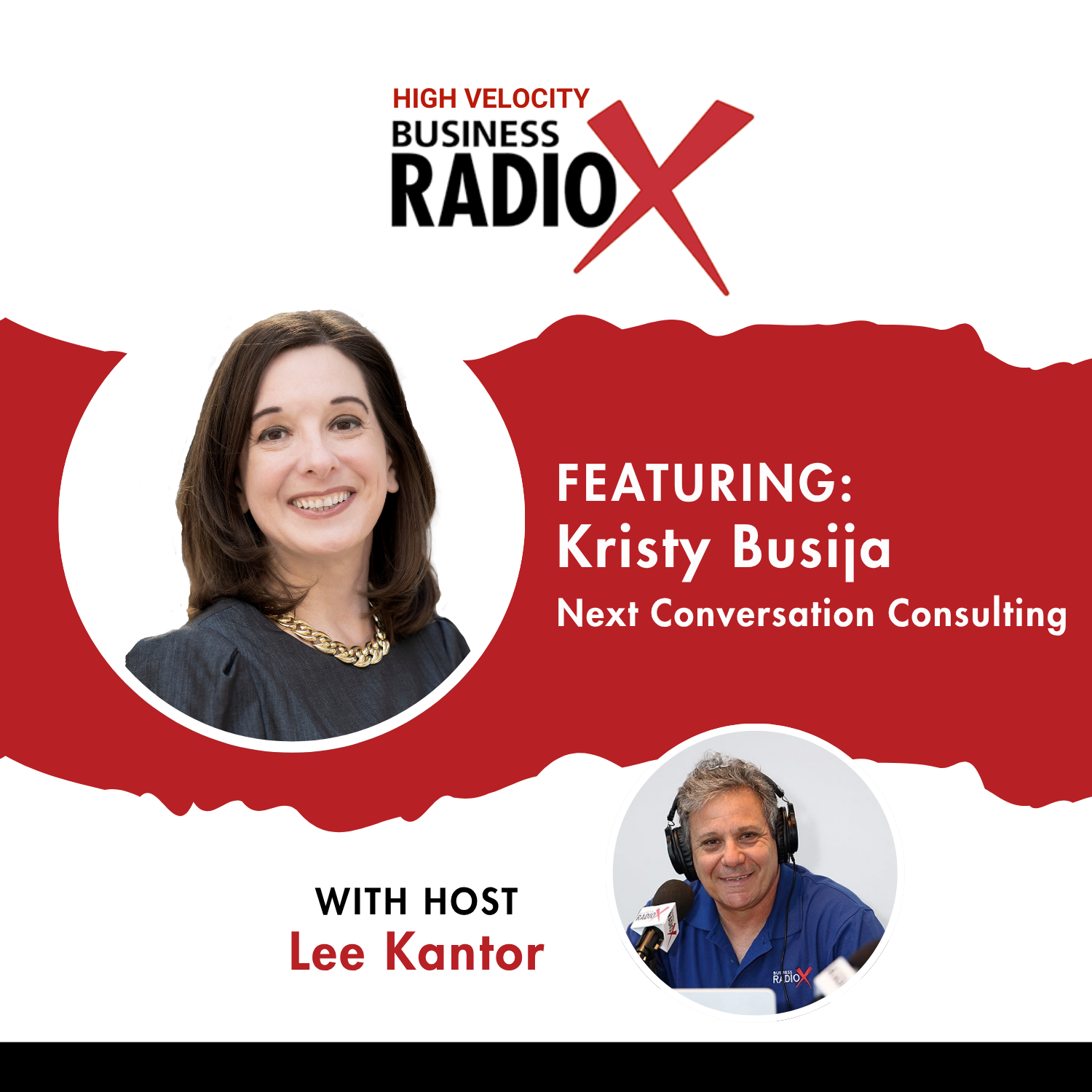

In this episode of High Velocity Radio, Lee interviews Kristy Busija, CEO of Next Conversation Consulting, about building thriving workplace cultures. Kristy shares how her psychology and business background led her to help organizations identify invisible cultural issues, measure abstract qualities like creativity, and improve leadership effectiveness. She discusses her book Hidden in Plain Sight, addressing invisible disabilities affecting 73% of the workforce, and offers practical inclusion strategies. Kristy also advises aspiring leaders to make their contributions visible and encourages a conversational, experimental approach to workplace change.

 Kristy Busija is the CEO and Founder of Next Conversation Consulting and is widely known for one thing: making sense out of chaos. Before becoming an award-winning business owner, best-selling author, and Forbes contributor, clients simply called her when things felt messy, stuck, or unclear—because she has a rare ability to see patterns where others see problems.
With more than 25 years of experience in corporate leadership, talent development, and organizational strategy, she brings a practical, business-minded lens to culture, leadership, and change. She doesn’t speak in theory or buzzwords. She translates complex challenges into clear, actionable steps leaders can use immediately.
She works with organizations across industries to build cultures where people can do their best work and leaders know how to navigate uncertainty without losing momentum. Her work has been recognized with a Gold Brandon Hall Award for Best Unique or Innovative Leadership Development Program, and her insights are frequently sought after by executives, boards, and leadership teams.
Connect with Kristy on LinkedIn and Facebook.
What You’ll Learn In This Episode
- Creating positive workplace cultures where employees thrive.
- The role of psychology in understanding workplace dynamics.
- Addressing invisible cultural issues within organizations.
- Measuring abstract qualities like creativity and strategic thinking.
- The impact of coaching on leadership effectiveness and business outcomes.
- Discussing invisible disabilities in the workplace and promoting inclusivity.
- Practical steps for companies to support employees with invisible disabilities.
- The connection between psychological safety and innovation.
- Strategies for leaders to improve communication and visibility of their contributions.
- The importance of focusing on incremental conversations to drive change.
 This transcript is machine transcribed by Sonix.
TRANSCRIPT
Intro: Broadcasting live from the Business RadioX Studios in Atlanta, Georgia. It’s time for High Velocity Radio.
Lee Kantor: Lee Kantor. Here are another episode of High Velocity Radio and this is gonna be a good one. Today on the show, we have the CEO and founder of Next Conversation Consulting, Kristy Busija.
Kristy Busija: Yeah, it’s good to be here.
Lee Kantor: Well, I am excited to learn more about your work. Tell us about your firm. How are you serving folks?
Kristy Busija: Absolutely. Well, we are at the heart of what we do. We try to help companies create cultures where employees actually love to work, and we can help them prove it.
Lee Kantor: So so what’s your backstory? How’d you get involved in this line of work?
Kristy Busija: Mm. My backstory is I, I’ve always loved psychology and so how people tick, but I also love the business side. And so when I had a chance to go into a field to see how companies can use the most valuable assets, their employees, and really, really help to create an environment that’s going to get help them to thrive and be innovative, which then can help the bottom line and help the company grow. I found my calling.
Lee Kantor: Now, is your work primarily at the organizational level, or do you work with individual high performers?
Kristy Busija: Both. Actually. So even if I work with an individual, that individual is part of a team, part of a department, part, a part of the whole ecosystem. So when I even work with one person, I’m actually looking at the whole system.
Lee Kantor: But when they come to you, or are they coming to you typically as an individual or as a kind of an executive saying, hey, Kristy, we need some help in this area and work with this team.
Kristy Busija: It can be both. It could be both. I could be.
Kristy Busija: Brought in to to work with one individual within a company to coach an individual to help them be more effective or handle difficult conversations, more strategic thinking, things like that. Or it could be they come in, contact us for more of a team. This team needs a little bit of love and care and needs a little help and support. Or it could be the whole system and say, well, we, you know, our culture isn’t where we want it to be. We’re having our numbers are slipping. We don’t know why. Can you help us think that through?
Lee Kantor: So are there kind of signs and signals for an executive to know if their culture is a problem?
Kristy Busija: Absolutely. The biggest sign is if if you’re always if you’re if as an executive, you’re always saying, I don’t know why they’re doing that. We tell them that this is what we do. You now, you know, now you have, um, what we call an invisible programing problem. Something in the system is signaling that what they’re getting is acceptable, not what they want to see. So that’s typically what I tell them to look for.
Lee Kantor: So you’re saying invisible and then something makes it visible. Like what? So the pain is that the executive is like, this isn’t, you know, congruent with how I think things should be or we think things should be.
Kristy Busija: Absolutely.
Kristy Busija: It’s invisible. It’s that fuzzy thing. It’s the I’m not getting what I thought I would get. Why aren’t people, you know, speaking up? Why are we not getting innovation? Why are we not getting X, Y, or Z or whatever that thing is that that ideal that they want to see? And that would be the thing that we would strive to help them get to, but they don’t know exactly what is that trigger or that lever or that thing leading into it. That’s the invisible part. But we come in and we help them. We help them think through and see all the places that they’re they’re quietly teaching people what to expect and how to behave.
Lee Kantor: Now, is this an area that can be measured? Is it like, you know, when you say like, I wish we were more innovative? Like, is that something that you can count?
Kristy Busija: Absolutely. We can. We can take a look at whatever metrics they currently have in place in terms of, um, whether it’s looking at their, their, you know, the, the R&D projects, the schedules or whatever, whatever they have in place, we can help them quantify what they’re doing now and what they want to do different in the future, and then figure out how the path to get there.
Lee Kantor: So how do you help people kind of develop metrics around things like creativity or strategic thinking? Hmm.
Kristy Busija: Well, the, um, very, very good question. We get all the time. Um, we actually, we take it, we boil it down to the simplest of terms and we ask them, we ask them to define what does creativity look like for them in their environment? What does strategic thinking look like for them in their environment? And we try to get as granular as possible with it. So for some companies, strategic thinking is being able to create the three year plan, five year plan. For others, it’s just being able to, to look further, a little further ahead down the road. Um, or, and for even other companies, it’s, it’s more of, um, instead of just looking at how it affects your team, you’re pulling your head up and looking across departments and how that one decision can impact everybody. So when we look at the measurement, we get as granular as we possibly can for them and then help them assess where they are now and where they want to be. And then we think through how they can close that gap.
Lee Kantor: Now, is there an example you can share? Don’t name the name of the organization, but maybe an example along those lines to illustrate how this kind of work can impact a company and get them to a new place.
Kristy Busija: Absolutely. So we were working with one of the executives of a technology consulting firm. And, um, she came to, they came to us and asked us to work with her on strategic thinking. And part of part of that conversation when we dove into it was, uh, she really is a strategic thinker, a strategic thinker. So she is able to see all of the pieces and the parts. But the challenge was not, not necessarily being able to think strategically, but to be able to articulate that and also be able to say how this impacts here, changes impact over there. And then we even dove in a little bit more and found out that the other challenge that was kind of getting in her way was, um, she wasn’t a fan of, um, difficult conversations. So being able to have a conversation about why we should do this or not do that. Why this employee is not performing and how to handle that. That was actually getting in the way of her making the strategic decisions. So fast forward six months of working with her and partnering with her. Um, we actually asked her and her leader, who is the president of the company, to put a number on it and say bye bye. Her leaning into the things that we’ve been working with her. What is the impact to the business? And she line itemed they line item out every single decision that was made and saw over $1 million impact directly into the business for doing the work and building strategic thinking and also the difficult conversations.
Lee Kantor: So that probably helped her review a 100%.
Kristy Busija: So when we’re in that call, we get the we get the thumbs up emoji from the president. I was like, oh my goodness, this is great. Yes, it did help.
Lee Kantor: And that’s, that’s probably good advice for people to to try to quantify as much of the impact you’re having so that when you do have that annual review conversation, that you are equipped with some metrics that matter.
Kristy Busija: Absolutely. Well, also return on investment. So bringing some bringing firms in or bringing consultants or bringing coaches in, you want to actually see those dollars coming back into the business, not just to develop that one person. So absolutely, it helps with the performance, the performance conversations, but it also helps from a from the company understanding the value that they receive from the work that from the investment that they made into the people.
Lee Kantor: So let’s talk a little bit about your, uh, your book Hidden in Plain Sight. How did that come about?
Kristy Busija: Oh, that one came about from my own lived experiences. And then getting a chance to meet Doctor Jessica Hegstad, a leading researcher in the space, and then a good colleague of hers, Danielle Ralston. Uh, so, um, in, you know, invisible disabilities. I had no, up until a couple years ago, I had no idea what those those were and that I had a couple of my own. And they’re just anything that, um, can prevent you from being, maximizing your personal effectiveness in the work environment. And so for me, my personal story is that, you know, I, um, and it’s actually in the book, um, I, it was my worst. I’ll be honest, it was my worst fear come to life where, you know, I, I have reactions to perfumes where my, it makes it hard to breathe. So imagine in a cubicle environment and colleagues wearing perfume and instead of instead of, uh, working with me to help solve the situation, I was, I was literally put into another corner of the building away from everybody instead. And so my, you know, I really want to help companies think through how do we help make more inclusive spaces for those with things that we necessarily don’t necessarily see, whether that’s hearing impairments, whether that’s anxiety, whether that’s, um, autism, learning disabilities, anything that’s invisible that could impact their effectiveness. And I want to create a space, a safe space for them to talk about it, ask for what’s going to help them to maximize their effectiveness without feeling like they are the problem. Uh, for bringing it to somebody’s attention.
Lee Kantor: About how many, like what percentage of a given workforce has some sort of invisible disability?
Kristy Busija: Uh, Jessica. Doctor, Jessica’s research shows 73% of the workforce has at least one invisible disability, which is over double of what the current research is showing.
Lee Kantor: So, um, when you explain that to leaders, are they do their heads explode? That seems like such a high number to ignore.
Kristy Busija: Their well, their their heads don’t explode, per se. It’s just more of wait, what? Wait whoa whoa, wait, there’s that many people. Um, well, it’s more of an education around what exactly is in that bucket, which is anything that’s covered under the Americans with Disabilities Act here in the US. Um, but then more importantly, it’s. Oh, wow. I had no idea is what the typical response I get. And for me, that’s just a jumping off point to say, now that we know, let’s unpack that and see where do we take it from here? Because there are a lot of things that we can do that that are easy. We already have native to what we do in work and our tech stacks anyway, and, and don’t require a lot of extra things or dollar value to, to be able to work with.
Lee Kantor: So what are some of those kind of easy things?
Kristy Busija: Oh, the easy buttons are things that, um, you know, zoom does it teams does it. Um, and a lot of the other platforms do it. Closed captioning is closed. Captioning is one great thing to do. Um, allowing people to to hit the record and the note takers on on, uh, on meetings so that they can go back and take a look at what that look at the transcript or read it on screen at the same time that they’re hearing it. Um, there are, there are, there are so many things. And we even have a partnership with, um, a really great strategic partner, translate live. Their software actually allows you to translate what I’m saying into over 200 languages instantaneous. And then it also shows what I’m saying, um, on screen. So it’s actually, it actually helps when I’m speaking or I’m teaching so people can actually see it, especially if they’re hard of hearing or, um, or they need to, they just need that visual cue as well.
Lee Kantor: Now when you’re having the conversation with the leaders, is this an area where they just kind of like kind of give lip service to it, but don’t actually do something or do once they’re aware of it, do most people take action?
Kristy Busija: It’s it’s a space where we’re, we’re trending. We’re starting to tread lightly because it’s a space that people don’t know what to do. Right? So historically it’s been, oh, I don’t know what to do. I have to make, I have to make an exception. And accommodation for this one person. Oh my goodness, is legal going to get involved. What do I do. So I think we’ve you know, there’s been a lot of fear around this space or and also fear of not knowing what to say or saying the wrong thing. I think that’s the biggest hurdle that we have, which is honestly why Danielle and I wrote the book. The book. It gives very practical. Instead of saying this, try saying this instead. Um, this, this is a good alternative to what we do. Here’s how to, here’s how to have that conversation. Because we, we don’t want to just point out that we’re, you know, we’re doing it wrong because we’re not, we’re just, we just don’t know what to say and what to do. And I think that that’s where leaders get a little hung up.
Lee Kantor: And change is hard in any case. So, I mean, I could see how this is a tricky conversation. Like you’re opening up a Pandora’s box.
Kristy Busija: So yes and no. Yes and no. It’s it’s Pandora’s box in terms of creating more inclusive work environments. Um, which, which honestly, the new generations in the workforce is actually demanding and asking is that we be more inclusive and supportive and bring your whole self to work, which could be your, your messy middle. Um, instead of masking who you are. Um, but it’s, it’s, it’s just what we find is that what will help one person typically helps the majority of the population. So being able to give people the choice to not have to be on camera, um, which is, you know, you can’t, there is something, you know, something as, uh, zoom fatigue or video fatigue. And so allowing people that space to do that without forcing the issue. That does help more than one. And I think that that’s so Pandora’s box. I think in some ways can be a good thing because it’s actually creating a better environment for everybody.
Lee Kantor: Well, I agree, I think it’s I think it’s a positive in the, in the sense that once people are aware of it, I would hope that they get on board and try to serve their people because the people, a lot of them give, you know, say they’re the most important part of their organization. So live in to that. I’m pro that, that’s for sure. But I can see a portion, um, like you mentioned earlier about being fear based, saying, oh, here we go. Now I got to get, you know, HR and that’s illegal. And now there’s compliance. And, and that’s what I was referring to when I said Pandora’s box.
Kristy Busija: Well, absolutely. And we definitely want to make sure that, um, you know, companies feel, feel that we we’re not we’re not sidestepping that conversation. We actually touch about that in, in, in the book as well that it’s, um, absolutely pull in legal because you don’t want to put something in place that’s going to totally get you out of, out of whack in one other don’t over index in one way or another. Um, but I think the question like, at least now we just want to get onto the table. Let’s change some of the language so it doesn’t sound like legal ease of how do I accommodate you? Right. Which sounds like, oh, wow. How do I put you in a little box and make sure that we’re doing things only for you and, and, and make sure that’s that’s all buttoned up. But is there something else in our culture, our environment, our workspaces that could really help everybody else, which doesn’t require legal intervention. It’s just the ways that we work.
Lee Kantor: Yeah. I’m a big fan of bringing humanity back into the workplace. Um, and having human to human interactions that aren’t kind of robotic or, you know, where it’s just a checking a bunch of boxes, like deal with the human beings as human beings. I mean, we’re all unique and we have our own needs and desires and, you know, just try to you want us to be part of the team. So make it so that I can deliver what you’re investing in.
Kristy Busija: Absolutely. That’s absolutely. Talk human to human. Let’s just put the humanity back into it. Not let not have to have people mask and just show up a certain way to be accepted. Allow them to participate however they need to. And I think we’re going to get a lot more innovation, creativity, psychological safety from it.
Lee Kantor: Now, is there metrics that kind of back up that thesis?
Kristy Busija: Absolutely. So doctor Jessica’s research does show does link to all of that. Um I don’t have those handy today. So I can get those to you later into your listeners if they’re, if they’re interested. But yeah, there is a link between psychological safety and innovation. The work of Tim Clark around the four stages of psychological safety shows that direct line, that when you create that safe space for people to be themselves, learn, contribute and challenge, then you will get that, that creativity and that innovation which a lot of companies really want.
Lee Kantor: Now when you’re working with, um, like walk me through what, uh, what it looks like to work with you and your team. So they kind of like, what’s a typical problem they’re coming to you with?
Kristy Busija: Usually what they come to us with, um, is, well, it definitely depends on it depends. Well, it, it, I don’t think there’s any specific things that we, we hit, I think right now lately we get a lot of, um, my team, we have some team problems. This team is kind of not getting along. They’re not productive. We need some team stuff over here. Uh, we also get quite a bit of we, we want to develop our leaders towards the future capabilities, but we have no idea where to start, especially with the, um, the, you know, the, you know, right now we have five generations in the workforce. What do we do with that? How do we lead? What, what capabilities are we going to, are we going to need? Um, but usually there is something that is there burning platform or they just got their engagement scores and they’re not looking as well as they would like to. And they want to, they want to see how they can impact that culture. Those are some of the big ones that people come to us for.
Lee Kantor: Okay, so let’s work on the, the culture element. So somebody calls you in and says, we’re not happy with our culture. Um, so what, so how does it begin? Like, so what, how do you start? Is there assessments? Like, what is some of your framework that you go in and your methodology to deliver an outcome?
Kristy Busija: Absolutely. We can, um, we can do everything from, um, interviewing stakeholders and focus groups in different pockets of the organization to kind of get the voice of the customer from all, from all over the place. If they have their engagement data, we’ll take a look at whatever they have. Um, or we can get even as, depending on how much they really want to really dive in and invest. We could also probably use the human synergistics culture assessments that get us really, really in depth information around what their ideal culture is and what their current culture is. And then we can really map out a clear plan. But regardless, we do really heavy discovery phase. And when I say heavy, I’m not talking months and months and months. It can we can short circuit it, but we really want to go deep and understand what’s really happening. And when we do, we do that. We listen for what’s being said, but also, more importantly, what’s not being said and read between the lines so that we can help them understand What they’re saying is happening and what’s really happening, happening and what’s signaling or what’s driving that. That’s, that’s typically what we do to assess.
Lee Kantor: And then once you come to, um, a realization of what you feel is happening, how quickly can change occur?
Kristy Busija: No change can, um, if the company is ready to put in the work, um, change can change can happen very rapidly. Um, I worked with this, I worked with a, um, an entire nursing leadership team and um, started with the, the, the chief nursing officer. And when we started working together, they had a very, um, as they described, as they described it, a very toxic environment, very fear based environment, um, threats in the parking lot environment in rural America of all places. And we, so we started working with the leaders, started teaching them and working and helping them understand behaviors and the impact and the result you’re getting by the input you’re putting in. And in less than a year, that team became that nursing leadership became so cohesive that other departments were looking at them to say, how do I, how do we become like that? Because that group is so tight knit and, and functioning really well. So that domino can fall really fast, that momentum can pick up super fast, but the leaders have to be willing to go first, be vulnerable and reinforce it and, and start to move the momentum in the right direction.
Lee Kantor: So now we’ve talked a lot about teams. Let’s talk about individuals. Is there, um, any advice for that aspiring leader that maybe isn’t getting, uh, the promotion that they like or they’re not moving up as fast as they’d like to? Do you have any advice for that person in order to, you know, get the momentum they need in their career.
Kristy Busija: Absolutely. So I do quite a bit with leaders that are looking to get promoted or want to move to a in a different role. And it’s, it’s, I’d say 90% of the time, it’s not because they’re not qualified or capable. What I see quite often is that they have a strategic marketing or strategic communication challenge where what got them there is not going to help them get propelled forward. So, you know, as we are, we’re doing work. We, you know, our work does speak for ourselves up to an up to a certain point. And at some point we have to shift into, um, starting to tell people what we’re doing, what our team’s doing. And for a lot of leaders, they, uh, to kind of use some of their language, it feels icky or feels weird, it feels self-promoting. And that’s that mindset. That’s a mindset shift of it’s not self-promoting, It’s just making the invisible visible because people don’t see the work product of leading. Leading is seen through the work and the things that other people do. But the only way to make that visible is you’ve got to tell people about it, and you’ve got to bring it to the light. That’s honestly what I see quite a bit for getting promoted.
Lee Kantor: Now, what’s the, um, why is the name of the organization next conversation. What’s the meaning behind that?
Kristy Busija: Um, it was, it came about from um, not needing to think through your entire, your entire roadmap or everything that you need to do to get from point A to point B, it was, it’s more of, let’s just focus on what is that next conversation we need to have? What’s that critical piece of information we need to talk about and share? Because that’s going to then change and shape what that adventure is going to look like next second, third, fourth and fifth.
Lee Kantor: So do you find a lot of times people are overthinking things.
Kristy Busija: Yeah, yeah yeah we do. We all we typically think, overthink things or, or try to think or try to predict. If I say this, you’re going to say this and this and that, and we can’t. Again, it goes back to that we’re we’re humans working with humans. All bets are off. We have no idea what the other person’s going to say or do, which is why we say start with one conversation, one experiment, one one choice point and see where it goes.
Lee Kantor: How do you help your clients get comfortable with that kind of chaos where a lot of especially leaders, like to be in control?
Kristy Busija: I asked them to to treat everything like a hypothesis and a mini experiment and just say, can you do, can you just for, you know, the next conversation, can you just at least try this and see how and see how it happens, what happens and if it works? And of course, asking them what makes the most sense for them based upon their their personality, their style, and how they want to be perceived and show up. And then from there, they’re like, okay, I’ll try that one thing. And then when they come back and say, oh my goodness, it worked. Then it starts to build momentum like, okay, what else can I try? What? What’s the next thing I can do? And then we start to piggyback on that and habit stack on it.
Lee Kantor: Yeah. If you can take the emotion out of things and frame it as an experiment, I think that that goes a long way for a more less stress and a more productive life.
Kristy Busija: Absolutely. Because there’s no, you know, because when we, when we say experiment, there’s no, we don’t, we’re not saying it’s going to work. We’re not saying it’s not going to work. We’re just going to see what happens and go with it.
Lee Kantor: And no one knows. I mean, it like a lot of things sound good on a whiteboard, but once you know, you hit the market, it’s a different world.
Kristy Busija: Oh, absolutely.
Lee Kantor: Yeah. I think a lot of people stay in their own head, in the safety of the whiteboard, and are afraid to kind of put their things out there for the world to see and hear.
Kristy Busija: Absolutely.
Lee Kantor: So if somebody wants to learn more, have a more substantive conversation with you or somebody on the team, what is the website? What is the best way to connect?
Kristy Busija: They can go to our next conversation, consulting.com, or they can email us at info at next conversation, consulting.com, and we’d be happy to hear from them and schedule some time to for a further chat.
Lee Kantor: Well, Christie, thank you so much for sharing your story today. You’re doing such important work and we appreciate you.
Kristy Busija: Thank you so much for having me.
Lee Kantor: All right. This is Lee Kantor. We’ll see you all next time on High Velocity Radio.















