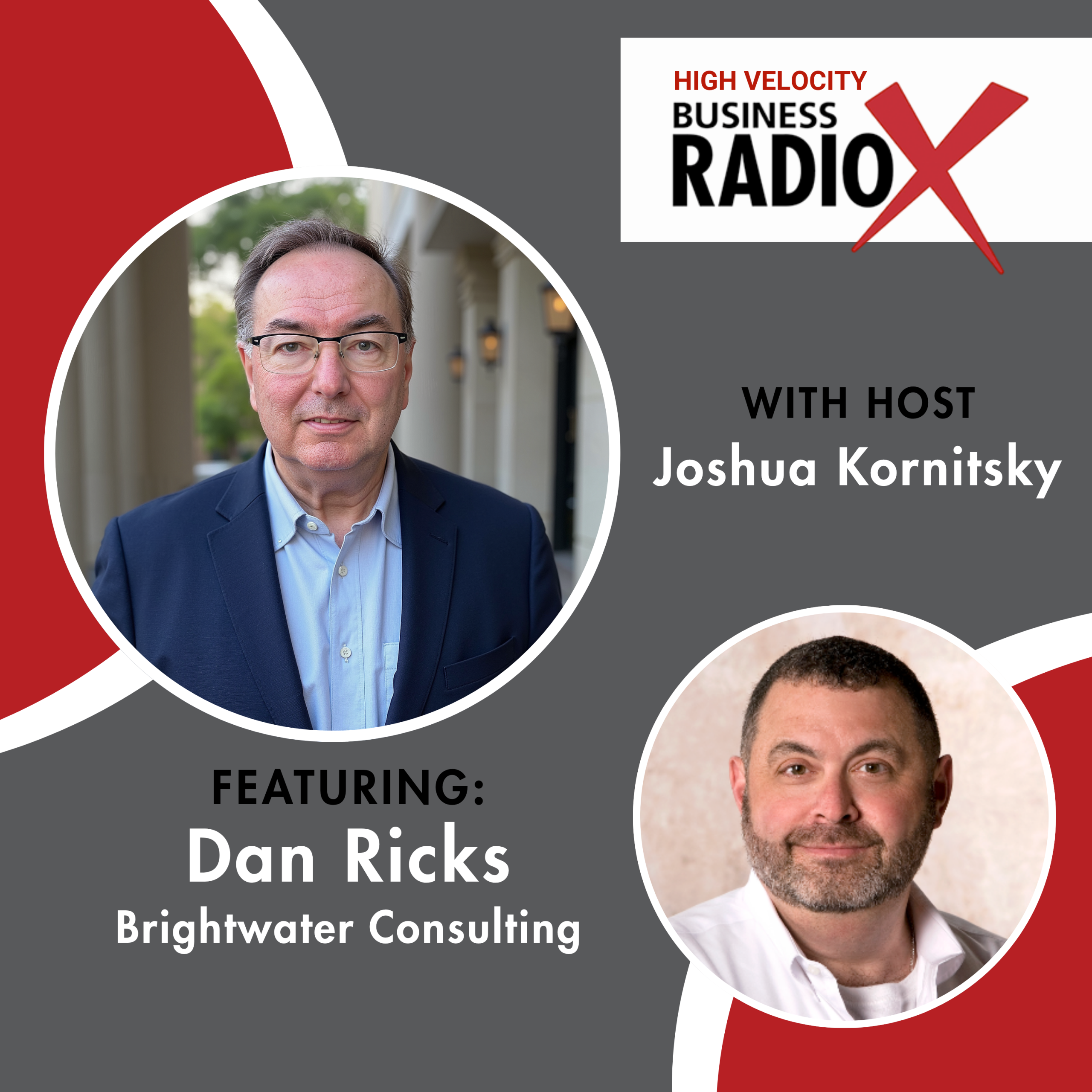

In this episode of High Velocity Radio, Joshua Kornitsky speaks with Dan Ricks, founder of Brightwater Consulting, about why businesses struggle to achieve consistent growth. Dan shares his journey from Coca-Cola to founding his consultancy in 2003, discussing common challenges like poor documentation, unclear core values, and weak communication. He explains his roles as fractional COO and EOS integrator, emphasizing accountability over traditional consulting. Dan also highlights the importance of strategic thinking, change management, and coachability in leadership. The conversation concludes with insights on AI adoption, urging businesses to approach it strategically rather than haphazardly.

 Dan Ricks is Founder and President of Brightwater Consulting, LLC (BWC).
He is an entrepreneur that specializes in operations, management and technology consulting. Dan has performed executive roles such as CIO and interim CIO for several companies. Dan held a successful career at The Coca-Cola Company implementing improved business processes and technology globally.
Afterwards Dan served as Vice President and Business Technology Officer for SunTrust Bank. For the past 23-years (after starting BWC in June, 2003) Dan has provided consulting services to corporations nationwide to help them improve efficiencies, improve business processes, reduce costs & risks, and position themselves to be scalable and sustainable for future growth.
Dan is an executive and business leader with a career consisting of strategic, operational, and tactical experience. Known as “the Problem Doctor” due to his ability to quickly diagnose and resolve problems. Demonstrated success as a trusted advisor focused on building and strengthening teams to lead change.
Connect with Dan on LinkedIn.
Episode Highlights
- Importance of strong operations, leadership, and technology for business success
- Common challenges faced by companies, including lack of documented processes and poor communication
- The role of a fractional COO or integrator in implementing effective business strategies
- The significance of clear core values and alignment within leadership teams
- The necessity of strategic thinking and planning for sustainable growth
- Change management principles and their application in organizations
- Differences in operational strategies based on company size and revenue
- The impact of communication and alignment on organizational success
- The potential of AI in enhancing business operations and the need for a strategic approach to its implementation
- The importance of being coachable and open to outside perspectives for business leaders
About Your Host
 Joshua Kornitsky is a fourth-generation entrepreneur with deep roots in technology and a track record of solving real business problems. Now, as a Professional EOS Implementer, he helps leadership teams align, create clarity, and build accountability.
He grew up in the world of small business, cut his teeth in technology and leadership, and built a path around solving complex problems with simple, effective tools. Joshua brings a practical approach to leadership, growth, and getting things done.
As a host on Cherokee Business Radio, Joshua brings his curiosity and coaching mindset to the mic, drawing out the stories, struggles, and strategies of local business leaders. It’s not just about interviews—it’s about helping the business community learn from each other, grow stronger together, and keep moving forward.
Connect with Joshua on LinkedIn.
 This transcript is machine transcribed by Sonix.
TRANSCRIPT
Intro: Broadcasting live from the Business RadioX Studios in Atlanta, Georgia. It’s time for High Velocity Radio.
Joshua Kornitsky: Welcome back to High Velocity Radio. I’m your host, professional EOS implementer Joshua Kornitsky. I want to introduce Dan Ricks. He’s the founder and the president of Brightwater Consulting, where he helps companies improve operations, management and technology. His career includes executive technology, leadership, operational consulting, and serving as an integrator for companies running on EOS. Dan brings a practical perspective on why companies struggle to achieve consistent growth and how stronger operations, leadership and technology can help create businesses that are scalable and sustainable. Welcome, Dan. I’m really happy to have you here today.
Dan Ricks: Thanks for having me here, Joshua. It’s good to talk to you again. It’s been a while.
Joshua Kornitsky: It’s a pleasure. So I always like to ask kind of what’s your origin story? How did you get from where you started to here?
Dan Ricks: Uh, quick story. I spent the first part of my career working for corporate America, uh, predominantly the Coca-Cola company. Okay. Company traveled the globe, uh, implementing operational and technology consulting. In 2003, I started my own company, uh, Brightwater Consulting. So for the last, I’m sorry, in 2003. Yeah. So for the last 23 years now, we’ve been traveling, traveling all over the country, helping small to mid-market businesses with their operational improvements and making technology improvements.
Joshua Kornitsky: That’s fantastic. So, uh, are there things from your past that sort of helped shape your perspective on the way that you look at these organizations and help evaluate what they need?
Dan Ricks: Yeah, very rigorous approach. Um, I’m also a guy with two college degrees, both in business and finance. So I’m all about, I’m all about what it takes to run a business and how finance and how money is important cash flow, um, that sort of thing. So I’m, when I’m talking to my clients today, I’m always looking at what improvements do they need to make to get to where they want to be in the future? I’ve always got a forward thinking mentality. And what can we do today to help set them up to be successful in the future?
Joshua Kornitsky: Well, so then let’s just jump right in. And let me ask you, you know, why do so many companies struggle to achieve some kind of consistent growth or consistent success?
Dan Ricks: Um, it’s hard and it’s the details, quite frankly, I think especially in the small to mid market business, there could be a many reasons. Joshua. One thing you hear is business owners are good visionaries. They good they’re good thought people. They have an idea, right. But they don’t maybe don’t know how to execute against that idea. And it’s that rigor is that day to day execution of running a business, sales, marketing, finance, operations, HR, legal, all the aspects of running a business that have to come together to truly be successful over time, and the rigor of following a process to get there and having goals or rocks, as we call them in EOS, sure to get there and measuring against those are there.
Joshua Kornitsky: And I understand it depends is the most common answer. But thinking across your your clients that you’ve helped, what are some of the the flashing, let’s call them yellow lights, not necessarily red lights, things that are like, hey, maybe, maybe I need to stop and get some help.
Dan Ricks: Again, several things. Documentation, right. Some small to mid market companies moving so fast, they don’t have time to document repeatable sustainable processes and really improve on those. Sometimes it’s the people, the people thought it was so important. You’ve heard terms like getting the right people on the right bus. Um, and it’s also goals or objectives, uh, core values, right. If companies don’t know, and if the employees of the company don’t know what the core values are, then how do we know that we’re all in alignment about where we’re headed? We. So having all that stuff documented, having it preached, so to speak, down, down the line and across the organization is so important to make sure everybody, the right people on the right bus with the right skills and with the right core values.
Joshua Kornitsky: I always like to ask a leadership team to tell me their core values without looking at a poster or a coffee mug. And if they can’t do that, we know we got a problem.
Dan Ricks: We’ve talked to the same leadership teams.
Joshua Kornitsky: Mouse pad, leadership, mouse pad, core values. Um.
Dan Ricks: And those are just some examples. I mean, it could be anything. The tough part about what I do is, uh, you can’t go in with anything in mind. You have to be open minded. No cookie cutter approach interview people, talk to people, watch people evaluate what’s going on. Then you see what’s truly going on and what areas can be improved.
Joshua Kornitsky: So it sounds like it’s a pretty extensive discovery process as far as I like your term to interview, because if you go in and just tell them these things are wrong.
Dan Ricks: Yes.
Joshua Kornitsky: That doesn’t really help anything.
Dan Ricks: That’s not a good start with a client.
Joshua Kornitsky: So you let them share with you. Well, so just building on that a little bit, do you ask them what’s wrong or do you just ask them kind of talk about their day so that you can piece it together?
Dan Ricks: Show me what you do. Talk about the different processes. I do ask them. I will ask them not what’s wrong, but I’ll say, hey, what issues have you been facing more recently? Because sometimes there is some low hanging fruit, sometimes within a day or a week or a month, I can solve some pretty major things, right? But in most cases, it takes a little bit of time to really unearth what’s really going on. Um, the operating system or methodology I like to use is, you know, a lot of that investigation discovery, right? And then putting together recommendations from what I’ve seen and a roadmap. Sometimes I’ll recommendations may be 40 or 50 different things. Sure. Whether it’s operational things, technology things, finance things. And I don’t want to just dump a listing of 50 things on them and leave. I want to give them a roadmap based upon where you’re headed and where you are. Here’s what you need to do now versus, you know, this year versus next year versus the next to guide them towards that.
Joshua Kornitsky: So you’re putting your finger really on, on what I always see a gap in, which is strategic thinking. But that’s, that’s because they’re focused on the day to day operation, which is what, in a certain sense, they, they need to be. And somewhat what I think you are helping them with is thinking about aspects that they’ve never considered. And that leads me to this question, which, you know, people tend to think, oh, well, if I need help, it’s because my business is failing. But isn’t the opposite true that if you’re if you’re growing, do you leaders outgrow their skills?
Dan Ricks: Um, sometimes, sometimes um, my clients are a half and a half. Joshua. Many of my clients have problems and they hire me because they’re having problems, or they need an outside set of eyes, a third party person, to come in and evaluate and provide those kind of recommendations. And that’s great. And those, those are people that realize they need help to grow. The other half of my clients are people that are being very successful. So a good problem to have. But on the other hand, they’re like, oh, we’re being so successful. How do we know we have the right internal processes, technology procedures, uh, to sustain that growth? So sometimes it’s from a good perspective, sometimes from a bad, my process is the same. I’ll look at it from a 300 zero foot strategic level. And then I also dig into some of the details because I’m that combination of detail oriented, tactical, and also strategic to give them both views of things.
Joshua Kornitsky: Well, in order for them to get the whole view, they’ve got to understand it from all sides. Um, and I think that that brings an awful lot of insight because we do work with a lot of the same types of organizations. And either they’re only looking 20 years down the road or they’re only looking at tomorrow. They often need help looking at those couple of minutes between.
Dan Ricks: A chuckle at the 20 years. Yeah, I have. I never have that problem. Most of my problem is they’re looking to survive this week, this month, sometimes this quarter. And I’m like, as hard as it is, you really need to be thinking five years down the road and then back that to three years or maybe even one year, because you’re never going to truly get to where you want to go. Ios even teaches ten years down the road, but you’re never going to get to where you really want to grow unless you have that vision. Uh, but then you’re never going to reach that vision at the same time, unless you offer operational year by year, quarter by quarter objectives, rocks.
Joshua Kornitsky: And it’s, it’s almost like there’s a recipe.
Dan Ricks: How about.
Joshua Kornitsky: That? I’m saying.
Dan Ricks: Um, an operating system.
Joshua Kornitsky: Is it? Yeah. Exactly. Right. Do you find are there. And again, thinking, thinking about a CEO listening to this, right. Are there solutions that work at 2 million arbitrarily when you’re 2 million in revenue that are that may not fit something as different as 3 million? So and I know that that’s a big gap. Well, that goes without saying. But even in incremental growth, isn’t it possible to outgrow your processes from when you were a $300,000 company?
Dan Ricks: Sure. Absolutely. Absolutely. I mean, a lot of business books talk about getting from 1 million to 2.
Joshua Kornitsky: Right.
Dan Ricks: Most people in the country would think, well, that’s no big deal. That’s just 1 million. But think about us doubling. Like, when’s the last time you doubled your salary? That just doesn’t happen overnight. You have to plan together. You have to work at it. And then when you get bigger to go from 5 million to 10, again, that sounds like it’s just doubling. But that’s that’s a huge transformation for a lot of companies. I wouldn’t know if I wouldn’t say there’s different tools. It’s the same kind of mentality and thinking, right. But at the same time, you have to realize who your audience is. It’s not a $20 million company. It’s a $2 million company. So. So getting to 5 million from two could be just as big as this $20 million company you’re trying to get from 20 to 30 in.
Joshua Kornitsky: And that makes perfect sense to me. And in your experience, again, speaking broadly, what differentiates, um, a company’s ability to grow and scale from those that just never seem to get out of their own way.
Dan Ricks: Again, it depends. A lot of things, a lot of times it’s that six inches between your ears. Either the owner or the leadership team. Um, a lot of, you know, we’re all human. A lot of times it’s just communication. Sometimes there’s a lack of communication between an owner and a leadership team. Or even if those people are on in sync between the leadership team and the next level down. Unless you’re constantly communicating constantly, um, preaching the message of the goals, the core values, the objectives for this week, this quarter. People tend to lose focus. So there’s that in my mind is a lot of things going on. And again, unless you’re really preaching a lot of that, you may have certain people on the leadership team, you know, with their own goals and objectives. So they may be headed one way and the rest of the leadership team a different way. And that’s just not sustainable.
Joshua Kornitsky: Well, and you put your finger on a hot button for me, which is communications, right? Without clear communications, you’re just playing a large game of telephone where you’re turning and whispering to the person next to you and down the line. And by the time it gets down through 2 or 3 layers of management, right? You never quite know what it is that the end message is being delivered. Unless you’ve got that clarity all the way down.
Dan Ricks: The other C word I like to use, Joshua, is change management. And I don’t mean from a strict IT change management process, which is a whole thing in and of itself. But I’m talking about just general human beings. And organizations can typically only handle a certain amount of change at a time without just going crazy. So I may leave them 50 recommendations, but I’m, I’m never going to suggest they start 50 new initiatives at one time.
Joshua Kornitsky: Sure. And do you help them prioritize.
Dan Ricks: And let’s go through again, part of communication is helping the change management so that people know this change is coming about and why it’s important, and getting them on board and getting them trained, getting them to be part of the change.
Joshua Kornitsky: Right?
Dan Ricks: That’s, that’s so important versus just, hey, it’s going to happen tomorrow. Boom. You’re going to come in tomorrow, you’re gonna be doing something different. It’s like, that’s, you got to plan ahead and you got to communicate and, and handle that kind of change. Be there when there’s struggles and when there’s issues, people want to fall back to the old ways.
Joshua Kornitsky: Are there change management concepts that you’re able to help them with? Because when I hear change management, because of my background, I think multi-million dollar enterprise engagement, and it’s not necessarily the case, is it, that that because change management can be done at any size organization?
Dan Ricks: It is that but it’s also just getting from where you were last year to where you need to be this year and how you’re doing your processes. Um, the tools I use again, back to the planning, knowing where, where you need to be by the end of this year, where you need to be by the end of this quarter. And I’m talking about individuals having each individual with their own goals and objectives and metrics and what they’re supposed to be doing. And really, so again, it’s going to be very repetitive today. It’s all about communication.
Joshua Kornitsky: But it’s important you have to say it seven times before anybody hears it the first time.
Dan Ricks: So so is it different size of company. It could be there are these big, huge change management, transformation type initiatives that some companies go through. In most cases. It’s not that transformational or it is, but it is over only over time, 2 to 3 years. But to get to that two to 3 or 5 years down the road, you got to start making those small changes now.
Joshua Kornitsky: And oftentimes it takes someone to get in there and help them see that. So that brings me to to the next subject I want to talk about. We had discussed earlier and mentioned earlier that as as is appropriate, you will occasionally function as a fractional COO, a Chief Operating officer. Yes. Um, for those who don’t know what that is, could you help us understand what is a fractional COO?
Dan Ricks: Well, Chief Operating Officer in general is that person that’s responsible for all of the operational aspects of a company. And the core sense of that is you’ve got the owner of the company, iOS calls that the visionary, but the owner of the company. Then you’ve got all the business functions, sales, marketing, finance, operations, legal, HR, whatever. And between those two, you’ve got to see oh oh type of person. Typically yes, the person reporting to the owner and basically being responsible for the overall operations of the company. Each of the functional leads, the core leaders of the company are responsible for their one function, and theoretically also working with each other to help support each other’s functions because they’re there, because they’re codependent theoretically, but really working, supporting their function. The COO is responsible and accountable for the overall operations of the company, which includes everything. And so just having a feel for all of that, the fractional part.
Joshua Kornitsky: That’s the piece I want to dig in on because.
Dan Ricks: Part of the COO is not necessarily a full time, 40 hour a week worker. And I’m not talking about W-2 employees versus consultant here. I’m talking about a fractional, it could be a day, a week, you know, two days a week, depending on the size of the company, depending on their specific needs. Some of my clients need me a day, a week over time, right? Some of my clients need me two days a week. My larger clients may need me three days a week. By the time you get to four days a week or something like that, then that’s pretty much a full time. And sure, I’d hate to call it a fractional, right? But fractional means I’ll have two or 3 or 4 customers because I’m, I’m spending a fraction of my time with each one of those. And it’s good for the clients. A lot of clients don’t need a full time COO if they’ve got a strong leadership team. They don’t need me full time so they can with less monetary investment, they can get a professional COO on a fractional basis to still play that role, still be accountable for all of those results.
Joshua Kornitsky: And for you, how is that different from traditional consulting when you’re acting as a fractional COO.
Dan Ricks: As a fractional COO? I’m accountable for delivering results. You know, some people, I guess the literal definition of consultant as somebody that gives advice and guidance, right? Right. And I do that, but I also deliver results.
Joshua Kornitsky: Well, yeah, when you’re wearing that hat.
Dan Ricks: I’m actually delivering results. I’m actually executing against that same guidance and advice that I’m giving the owner and the leadership team. I’m holding them accountable, and I’m holding myself accountable to actually delivering those results. And at the end of the day, end of the week, end of the quarter, end of the year, if we’re not meeting our goals or rocks for that quarter a year, I’m the one accountable. I’m the single throat to choke, sort of, so to speak. Got it right on the chopping block. So that’s the difference between a COO and a consultant.
Joshua Kornitsky: And for that type of a role, speaking for yourself, is that something that’s usually immediately evident or you still go through the discovery process to, to sort of determine if that’s a need.
Dan Ricks: With a new client? I, I traditionally always go on an initial through an initial discovery process. Okay. That could be a week, that could be two weeks depending on the size of the company. Um, and then we move on and we start executing against that plan. But even after we move on, there’s a continuous loop. I’m also a Six Sigma guy. So that whole dmaic define, measure, analyze, improve control or the iOS equivalent. You’re constantly reevaluating as you finish a week or quarter a year, reevaluating the plans for the next quarter, the next year.
Joshua Kornitsky: And determining the effectiveness of what you’ve done.
Dan Ricks: So, I mean, it’s silly to think that today I can know exactly what I’m going to do each year for the next ten years. Right. But you at least have to have a plan. And then you, you constantly evaluate against that and new thing, you know, the economy changes supplier, you know, external things happen and change that’s going to impact how you’re doing things.
Joshua Kornitsky: Well, and that, that leads me to a really important question. So regardless of the size and we’ll talk about what later in the in the discussion, I’ll ask you where, what size clients do you typically work with? But just regardless of size, if I’m a CEO listening to this and we both work with CEOs and leadership teams all the time, what are the signs that I need that fractional. See what. Because most CEOs, most entrepreneurial CEOs are used to wearing 11 hats. They’re used to doing everything everywhere, all the time. What are the signs that that you would say, hey, here’s three things that if you’re doing these right.
Dan Ricks: And that traditional CEO role you just described, as is quite often the problem, some of the signs I’ve seen is just the most obvious. One is this the inconsistency to grow and be successful. You know, an example is a person that started a new company and within a year or two, they’re already at 2 or 3 million in revenue.
Joshua Kornitsky: Great, right?
Dan Ricks: Then fast forward to 10 or 12 years later, right?
Joshua Kornitsky: 2 or 3 million in revenue, 3 million in revenue.
Dan Ricks: So, um, unless they’re purposely trying to stay at that same level, they’re not sustaining any growth. Um, and other signs are people leaving, coming in, you know, just chaos within the company communication issues, um, things like that, that I look for that say you really need a process, an operating system. We need to define goals or rocks. We need a plan, and we need to execute against that plan and have a. I keep using the word rigor, but it needs to be a rigorous, metric based, measurable plan to get to get to where you are. It is rigorous, and some people don’t like that, quite frankly. Some people, um, don’t want to be held accountable. But that’s, that’s some of the things I see within the company that has helps me to say that the business owner visionary needs a COO, a fractional COO. And the other, the other thing I alluded to is quite often and the truest definition of the word, the visionary has lots of other things they need to be doing. They need to be planning for the future. They need to do that. True visionary talking to clients, speaking externally about the company being the face of the company, being the visionary and providing the overall vision to the company. They don’t need to be leading. They don’t need to be managing. They don’t need to be have their hand in all the details. Easier said than done. Most of them still have their hand in a little bit, but the more they have their hand into working in the company instead of on the company, um, typically that’s a sign they need a true, a strong CEO.
Joshua Kornitsky: I don’t know who to credit for this statement, but I’ve heard it for many years. Oftentimes we encounter the concept of a genius with a thousand helpers. There you go. And a genius with a thousand helpers is is a CEO or a leader who insists that they have to do everything. And their understanding of delegation is what most people would call micromanagement. Yeah.
Dan Ricks: And I’m talking to a prospective client now. They’re not a they’re not a current client. And they I may not win their business. Uh, but typical thing, this person really needs a coup, a strong coup. They’re actually running on iOS. That’s great, but they’re not running Well, um, and they’ve had some turnover recently at the company, small company, only like seven employees. So 2 or 3 people turn over. That’s pretty big.
Joshua Kornitsky: Yeah. It’s a significant portion of the company.
Dan Ricks: Of this particular owner. Bringing me in to help out is with Dan. I’ve got all these problems I’ve got to solve first, and once I solve all these problems, then I’ll need a, an integrator, a COO. Well, my coaching back to him is, well, you may never solve all those problems. If you bring somebody like me in now, then, then together we work on solving the problem and get it done quicker. But there’s that, you know, I’ll call you when I need you. When I get all my problem solved. You’re never going to have all your problems solved when you’re running a business, they tend to creep up.
Joshua Kornitsky: How important? No, you’re 100% correct. Um, how important for the leaders that you work with is the concept of being coachable.
Dan Ricks: Or strongly important. You know, by definition, my role is not a coach. However, I do a lot of coaching and give. I give guidance and advice. Sure. And I will quite often with that guidance, say why? Here’s what I’ve seen at XYZ company. Similar to yours, similar industry, and here’s how it’s been helpful. Um, so I’ll give that kind of coaching, I’ll give that advice. I’ll try to be a little bit persuasive, but as a COO, again, I’m an execution area guy, right? So ultimately I coach a little bit, but.
Joshua Kornitsky: Well, and I guess to clarify, when I say being coachable, being meaning being open to that advice, being.
Dan Ricks: Listen and absorb and at least think about it and then logically decide, Dan, I think you’re right. We should go with it or even. Dan, I think you’re right. But right now, I don’t think. Now, Tom, let’s do something else. So I’m okay with that. But yeah, I they need to at least be willing to have that conversation and be open to.
Joshua Kornitsky: So there are there. Have you encountered people in your past that you wouldn’t work with? Yes. And I asked that because if they want to bring you in but want to still do it all their way? Yeah. How impactful is.
Dan Ricks: That? Not very many, right. But there have been a couple in the past that just, you know, you know, my way or the highway. You know, I’m the expert. I know what everybody needs to be doing. And, and it’s not listening. So and there are successful companies with that mentality. But I would say there are fewer and far between.
Joshua Kornitsky: I, I would agree with you. There’s a book written for very specific mindset and I love the title, but I have not yet found many people I could give the book to. The title of the book is What Got You Here Won’t Get You There. Yeah. And then the concept behind the book is by sheer force of personality. You may have grown your company to this size, but in order for you to get beyond that sheer for sheer force of personality is not enough. And I’m not saying the word I typically say when I say this, you can only be a jerk so far.
Dan Ricks: And obviously we’re on the same page. Any business owner, including myself, I’m an owner of my own business. Sure, we have to be willing to seek guidance and advice and from others, and not think that we know everything, because there’s a limit to that.
Joshua Kornitsky: The the first step in wisdom is right. The first step in wisdom is knowing how much you don’t know, right? So I must be incredibly wise because there’s a whole lot of stuff I don’t know. Um, but I want to go into as, as we say in my universe, I want to go into the danger a little bit. I want to talk to you about being a fractional integrator. And it’s important at this point for our conversation that though I am a franchised EOS implementer, I don’t want to talk about self implemented versus using an implementer, just a company running on iOS and iOS. For those who don’t know, is is the entrepreneurial operating system based on the book Traction by Gino Wickman? It’s a business methodology, simple tools and and resources that entrepreneurial businesses can embrace. And, and, uh, Dan can tell you all about it. I can tell you all about it. You’ll be able to reach out to either of us, but let’s assume we’re starting from a baseline of a company trying to run on iOS, and I’m going to keep my opinions to myself because I really want to hear how you help. When does a company need a fractional integrator? Coo and integrator are often the same person. Yes, but not always.
Dan Ricks: Sometimes not.
Joshua Kornitsky: Sometimes not. So let’s talk about we understand you did a great job of explaining why somebody needs a COO, and I don’t want to put words in your mouth. Would some of those be the same reasons they would need a fractional integrator?
Dan Ricks: The true definition of the integrator. And I am an officially trained certified integrator for clients that are running on iOS. The integrator role at the chorus definition is that individual that is integrating the iOS operating system in detail throughout the organization, starting with the leadership team and then throughout. So the EOS implementer, which is a different role, starts things with a vision and a strategy. But the integrator, whether they’re given the CEO title.
Joshua Kornitsky: Or whatever the title.
Dan Ricks: Is responsible and accountable daily, weekly for again, the true integrating of iOS throughout the organization. Don’t mean to be redundant. No. Uh, running the weekly L ten meetings, uh, holding people accountable to their measurements rocks the relationship with the visionary being on the same sync, uh, relationship with the leadership team that the integrator. At a minimum, clients need an integrator, whether that person has another role within the organization, director of ops, COO, whatever the integrator could be somebody else on the team with another function within the company, or they could be strictly a 100% professional integrator for iOS, which is what I am, whether I’m 100% with that company or fractional with that company. That’s what I do 100% of my time, and I’m a specialist in that specialist on the tools, specialist on knowing that I’m the one again. Single throat to choke accountable for results. Sure. Um, and have that background as a consultant, uh, across all business functions and knowledgeable about what it takes to run a business and be successful.
Joshua Kornitsky: In, in when you’re functioning in that role as a, as a fractional integrator. Um, how do you align yourself with company A versus company B? So you’re, you’re, let’s say you’re serving in a fractional role for two organizations. How, how do you align yourself to what the needs of each are?
Dan Ricks: Okay. Well, I spend the same amount of time with each one. Obviously, if I’m spending one day or one day there, uh, I treat each one just like they’re my number one client. Um, there are certain hours if they get a day of my time a week, that doesn’t mean Monday, right?
Joshua Kornitsky: It just means a day.
Dan Ricks: There are certain hours throughout the week that are dedicated specifically every week for individual clients. That way they know to run L ten meetings to do certain things, but then the rest of that eight hours or day of their time each week is flexible depending on where they need me. And I’m quite honest, usually working most every day a little bit for each client, just catching up and following up with stuff. So it’s a matter of it’s a little bit of juggling, but it’s what I’ve done for 23 years with water is used to having multiple clients and, and managing those schedules. Um, I’m the kind of guy, although I’m based out of Atlanta, Georgia, my clients are nationwide and I’m okay with working in person. I’m also okay with working virtual via Zoom or whatever, or a hybrid approach of the two. And so either of those work for me also, is that the gist of what you’re asking?
Joshua Kornitsky: Well, that and where I was leaning more towards, how well do you get to know their vto, their vision traction organizer.
Dan Ricks: That I got to know that 100% from the beginning because I’m executing against the vision traction.
Joshua Kornitsky: So that it’s not coming from me. Explain what the vto is so that people.
Dan Ricks: That’s where the overall vision of the company is located. They’re typically ten sections on a Vto. There’s the goals, objectives, the, the rocks, um, the ten year, a little bit of definition, the ten year plan, five year. They’re the major issues that have been defined at a high level that are on the Vto. Um, and then I keep saying goals or rocks of where we need to go to and how we need to get there. The core values, everything’s defined there. That’s the ultimate guide for what you’re trying to hit. Okay. From that comes back, you know, the one year plan, the quarterly plan and all of that. But the Vto was the ultimate what you’re trying to reach to and to be held accountable to. And so, yeah, I get to know that very well. I get to, I get to be ingrained and I am that detailed person. I get to be ingrained into the details of most of the clients I work with because the devil’s in the details.
Joshua Kornitsky: And sure.
Dan Ricks: As an integrator, you have to be involved in the details. And at the same time I have to be high level and senior enough to call BS and the senior leadership team accountable for their result.
Joshua Kornitsky: So one of the differences that I, I’m, I don’t want to assume. So let me turn it into a question. Being a fractional CEO versus a fractional integrator is one of those, uh, more deeply nested and has a deeper understanding of the organization or in different ways.
Dan Ricks: How does it’s just different ways. I think in my definition is they both have the same deep level of understanding of the vto, the rocks where the company is going. Um, as a fractional COO, I would have even more responsibility versus being the integrator. Um, I may be in charge of hiring and firing, right? If HR reports to the upper right. If finance reports to the COO, I’m ultimately ultimately responsible for the books and for the financial success of the company. So yeah, ultimately, a little bit more responsibility for the ultimate success in a different way. It’s weird for me to say that, Joshua, because even as an integrator alone, I feel like I’m responsible for all that stuff. I kicked myself, even if I don’t have a CEO title, if I’m not holding and meeting those rocks.
Joshua Kornitsky: I think to, to fill either of those roles are in many ways, uh, we don’t want to ever give anybody the impression that it’s a prescribed. If you are the integrator, you have to be the COO. You’re not. But the role of the integrator is not dissimilar in what they’ve got to manage.
Dan Ricks: Meeting the EOS.
Joshua Kornitsky: Sure.
Dan Ricks: Rocks and plans and such like that.
Joshua Kornitsky: So there’s one last major thing that I kind of want to talk about. And it was something we only touched on briefly. Uh, and it’s on everybody’s mind, regardless of the role that that they feel within the organization. But most senior leaders, it’s it’s top of mind thought. Let’s talk a little bit around AI.
Dan Ricks: Ai is pervasive and I’m bullish on AI. I think it’s great. I’m coaching, um, most of my clients about AI. I’m very bullish on it. I think it’s good. However, the other side of my process is I want clients just like everything. I want clients to take a planful strategic approach at what they do.
Joshua Kornitsky: You mean don’t fire everybody in marketing and just use ChatGPT.
Dan Ricks: And just go spend $3 million on a bunch of AI technology and throw it at the wall and see what sticks.
Joshua Kornitsky: Have a plan. What a concept.
Dan Ricks: Well, the thing Joshua is any, every specific business function within a company can benefit from AI. Sure everyone can. I could go in tomorrow and give you a strong business case for why marketing and HR and legal On can should use AI to be more successful. The issue is with a lot of my small to mid market clients, they don’t have that much money investment on things like technology or AI. So if they only have a little bit, let’s be strategic about how you use it. Let’s do a little bit of an assessment there and discovery. And if you’ve only got this much money right now, maybe you can spend a little bit on this business function a little bit on that one and get AI going there. And then next year or next quarter or whenever you’ve got more money. I also believe in a crawl when it comes to AI and a crawl before you walk, before you run. Sure. Start using a little bit. Let’s be let’s be assertive. Let’s start using a little bit and then bigger and then bigger as opposed to, again, trying to go for the Big Bang theory to begin with and realize you’ve lost a lot of money. So when I coach my clients just that way, let’s be planful and strategic. Let’s start small, but then grow rapidly as we’re gaining success.
Joshua Kornitsky: Is that a different discovery process to understand those needs? Because I understand in the other one you’re getting sort of holistic business need. And while that sort of is the same thing, it is not necessarily.
Dan Ricks: It’s an offshoot of the first one. Okay. Now what the what the business needs are. And then when you find out there’s investment capital or, or you just, I just discovered that AI, AI can truly help us to get there quicker than if we don’t use AI. I will quite often in my relationship with the visionary, bring up the AI subject, if they haven’t already, and say, hey, why don’t we consider this? Why don’t we consider that even if AI is not specifically in the vto, it’s me bringing ideas to the table as to how to use it.
Joshua Kornitsky: So if you were talking to just a meeting of CEOs, if you were in a group of CEOs, what are some of the behaviors related to AI that they should avoid?
Dan Ricks: Should avoid?
Joshua Kornitsky: Well, because I’ve, I think we’ve both seen 100 wasted nightmare dollars time.
Dan Ricks: I think they should avoid just opening it up to the whole company and let everybody use it, right? I on the one hand, I hate saying that because I believe they can start benefiting tomorrow. Sure. But if you’ve got five different departments using five different tools going at it different. I believe there should be a I think every visionary should start an immediate discovery effort, quite frankly. Joshua. And how they should use AI to be more successful with their business. And some visionaries will come away with. It can help us a little bit. Some of us or some visionaries may say, we’re not going to use it today. Most of them will will find ways they can use it to be successful and to start that path. So I think, you know, I think the coaching, I would say is immediately get a strategic plan or place put in place and then start communicating with the company. We’re going to do it. Start getting ideas from within your, your company. And let’s put a, let’s put a specific plan and start executing against that, irrespective if the leader. I’m sorry if the visionary is not proactively starting that with a company, individual pockets are going to start up and they could have some some success there also. But but there still needs to be a little bit of a wrapper or a plan put around it.
Joshua Kornitsky: Well, I my perception and the question that I have for you is people don’t know what they don’t know. Are you a resource to help them understand what’s possible?
Dan Ricks: Yes. Again, I’m a technology consultant in addition to an operations.
Joshua Kornitsky: Because that’s the piece I think I meet a lot of a lot of CEOs who believe AI is an important thing, in the same way that that they understood that when they were using horse and wagon to deliver their product, they understood this new thing called the truck was important. Right. But they don’t inherently know what it is. And, and I’m sure it will shock you to know there’s a lot of misinformation about AI.
Dan Ricks: We’ve been helping our clients for the last 4 or 5 years with AI solutions. And even before that, with automation, there’s a ton of automation that we’ve done for 20 or 30 years, which was the cusp of AI with robotics and IoT devices and stuff all over the place. Ai is like automation on steroids, so you can get things done so much quicker. And it doesn’t have to be just within it. It can improve the IT organization, but it can also improve, again every functional area. So. So yeah, I’m bullish on that. We’re experts in AI. We can help provide that kind of guidance and support.
Joshua Kornitsky: Well and I think you touching on the fact that you’ve been doing this as an organization for 23 years, is that correct? But also being five years mature in AI advisement does put you ahead a lot of, of a lot of people because that means you really, since it’s been publicly available, it sounds like you’ve been working in it.
Dan Ricks: Yeah, we have. And I can, you know, beyond the generic Claude or ChatGPT or that those kind of terminology, we know specific AI tools that different business functions can use that have been successful so far. And every day there are new tools coming out.
Joshua Kornitsky: Well, and that’s.
Dan Ricks: Just like in the old school technology world. There’s all these tools which one can help us better. So that’s the kind of kind of guidance I can help give my clients.
Joshua Kornitsky: That right there. The fact that that if I were to guess and I’m going to be wrong, if I were to guess, I would say that without much effort, I could probably, and this is not an exaggeration, find 400,000 different tools without trying. Now, sure, a lot of duplicity in there, a lot of irrelevancy in there. But to have someone that can act as a guide in a landscape that’s that, uh, congested is invaluable. And I have to think that that’s a side of your business that’s got to be getting a lot more exposure.
Dan Ricks: And to work with you as your guide to make recommendations. Right. I may not always make as a fractional co operation consultant or technology consultant, I may not always make all the decisions for that business owner or company, but at least I can make recommendations here. Of these 500, these are the three best in the area. They all have their pros and cons. I do the research for them and I help guide them. And ultimately it’s their decision on how to move forward and I can support them with whatever decision they make. Well, just like financial systems or manufacturing ERP systems over the years, there’s always been choices, right? Which choice better fits you, Mr. or Mrs.? Mr. or Mrs. Visionary and your company. Right. What your needs are.
Joshua Kornitsky: Well, and you you touched on this earlier, but I think this is an important question to to get a better understanding on. Are you geographically limited in in any way?
Dan Ricks: No, I am not. My company truly is nationwide. We help clients across the country. Uh, all industries. I did start with the Coca-Cola company and I have a bent towards supply chain manufacturing. It’s just in my blood. Um, but we’ve got experience in healthcare and, uh, higher education finance.
Joshua Kornitsky: So really across the board.
Dan Ricks: Yeah. Most any industry out there, I’m leaving a lot of them on the table. But um, utilities, we’ve helped electric utilities, gas utility companies, the fracking industry. So we’ve helped a lot of industries over time with our technology needs and.
Joshua Kornitsky: Well, and then you put your finger on something that I think I may have misunderstood, particularly as you were giving us, uh, sort of that high level overview. What size organizations are you working with?
Dan Ricks: We talk about 5 million and up.
Joshua Kornitsky: Okay. Quite frankly, because when you say utilities and fracking, you’re talking about usually quite large organizations.
Dan Ricks: I’ll say utility industry. There are a lot of smaller companies or SMB companies that are in the utility industry.
Joshua Kornitsky: Okay.
Dan Ricks: It doesn’t have to be Duke Power or Southern Company, right. Or Wisconsin Energy, we power. It doesn’t have to be those size, but there are a lot of companies in the utility industry supporting utilities. Um, same thing with finance. They could be smaller companies, and that could be the bigger companies within that industry. Same thing with health care. There are big health care conglomerates are smaller. So we can we can help any size company. We typically start with 5 to 10 million in annual revenue, but we’ve had clients up to 300 400 million in revenue.
Joshua Kornitsky: Okay.
Dan Ricks: So my target audience is that SMB, though typically five to 50 or 80 million, give or take.
Joshua Kornitsky: But it sounds like if they have questions, they should pick up the phone regardless. Don’t don’t disqualify yourself.
Dan Ricks: Cost you anything to just have an hour long call with me, get some free advice, and if things click and we like each other and the stars align, maybe we can help each other and I can help provide that guidance and support.
Joshua Kornitsky: So a couple of closing questions that I have. Well, first, before I forget, what’s the best way for people to get Ahold of you or to get Ahold of Brightwater consulting?
Dan Ricks: Um, my email is derek’s at Brightwater consulting.
Joshua Kornitsky: And we’ll publish all of this.
Dan Ricks: And my phone number.
Joshua Kornitsky: Okay.
Dan Ricks: So best way to get in touch with me either email or call. Uh, we do have a website, Brightwater consulting.com, uh, which is being renovated now. It’s a little bit old. Um, but that’s the best way to get in touch with me. I’m on LinkedIn. Okay. If you forget any of this stuff, you want to find Dan Ricks on LinkedIn in Atlanta, Georgia with Brightwater, you can message me that way.
Joshua Kornitsky: And when we publish, we’ll publish those links. So two final questions. And these are questions that I tried to tailor, uh, to, to help best understand you. It’s question number one. And this is out of the blue, so you’re allowed to think about it. If you were going to recommend a book to someone, and I’m not leaning into the books that, you know, I know. Yeah. If you’re going to recommend a book to someone to, to try to get on to a better path for their business, what book might that be?
Dan Ricks: I truly like good to great.
Joshua Kornitsky: Okay.
Dan Ricks: I truly like rocket fuel.
Joshua Kornitsky: Okay.
Dan Ricks: Which is an iOS. Kind of.
Joshua Kornitsky: Sure. But good to great is not that’s Jim Collins, isn’t that correct? Patrick Lencioni.
Dan Ricks: No, not Patrick.
Joshua Kornitsky: Jim Collins.
Dan Ricks: Um, a lot of good books out there, but I truly like those books that really describes, again, how a business owner, a visionary, um, can think outside the box and truly be helped and be more successful through the use of a strong integrator, a strong, you call it a business coach, an integrator, someone that helped them come in and helped operate their business against a strong, uh, rigorous methodology or operating system.
Joshua Kornitsky: All right. And my last question for you is, what should I have asked you that I forgot or didn’t think to ask you to help you explain who you are and what you do? Yeah.
Dan Ricks: Well, the, the question you should have asked is a little bit more about my approach. And we discuss, we discuss a little bit of that with the methodology. And of course, as a as a iOS person, you know, that iOS kind of approach, but we’re very detail oriented. I realize that today’s $10 million manufacturing client versus tomorrow’s $10 million manufacturing client, it all sounds the same, but they’re different. There’s different types of manufacturing. There’s different things that are manufacturing. There’s different ways and target audiences for each company. So truly, I’ll go in completely open ended, agnostic. I ask a lot of questions, drive some owners crazy. But you know, those 21 question routine that really get to know them and what makes them tick?
Joshua Kornitsky: Sure.
Dan Ricks: So to speak. And again, everybody’s goals are rocks for the next 3 to 5 years are a little bit different. Everybody wants to succeed. But how do you define success? Some business owners want to sell, quite frankly. And that’s the goal then um that’s fine. My, my approach to operating the company as a COO or integrator is going to be the same if they’re just looking to grow or if they’re looking to sell. In my case, I’m into the details, into the weeds, to being successful today, this week, this month, this quarter, while keeping an eye on the future. That makes sense.
Joshua Kornitsky: Yeah, it absolutely makes sense. And I think you hit the phrase that resonates the most with me throughout my professional life and with people that have had the opportunity to learn from and work with. Uh, you can’t succeed if you don’t know the definition of success because it’s relative to the organization it is.
Dan Ricks: And you can’t grow a company without getting into the details. You have to really, truly know what’s going on.
Joshua Kornitsky: And it amazes me the level of insight that you’ve brought to this dialog, because I think that’s a direct reflection of your experience. 23 years is a long time to be in a space of, of, um, advisement and, and coaching and integrating and operating multiple different businesses across multiple domains.
Dan Ricks: The most fun I’ve ever had. It’s fantastic.
Joshua Kornitsky: That makes me happy to hear because I would hire you for that alone.
Dan Ricks: What drives me? Right. I get my I get my joys of working myself out of a job, getting a company to the point where they don’t need me anymore. Yep. And knowing. Checking in with them years later and their continued success. That’s what makes me happy.
Joshua Kornitsky: That is everything everybody needs to know. Because if it was just a grudge job to get from A to B, you would be no fun to work with. But I think we’ve had some fun today and I certainly appreciate you coming in. Thank you. It’s it’s been an education for me. I appreciate any time I can benefit from knowledge and experience. Uh, you are going to be someone I’m going to be calling and leaning on. So thank you. Dan. Um, again, my guest today has been Dan Ricks. He is the founder and president of Brightwater consulting where he helps companies improve operations, management and technology. His career includes executive technology, leadership, operational consulting and serving as an integrator for companies running on iOS. Dan brings a practical perspective on why companies struggle to achieve consistent growth and how stronger operations, leadership and technology can help create businesses that are scalable and sustainable. Thank you again, Dan. I appreciate you making the drive and joining us here in person.
Dan Ricks: Thank you. My pleasure. Joshua, thank you for your time.
Joshua Kornitsky: It’s been a pleasure. My name again is Joshua Kornitsky. I am a franchised professional iOS implementer and your host here on High Velocity Radio. Thank you for joining us. We’ll see you next time.















