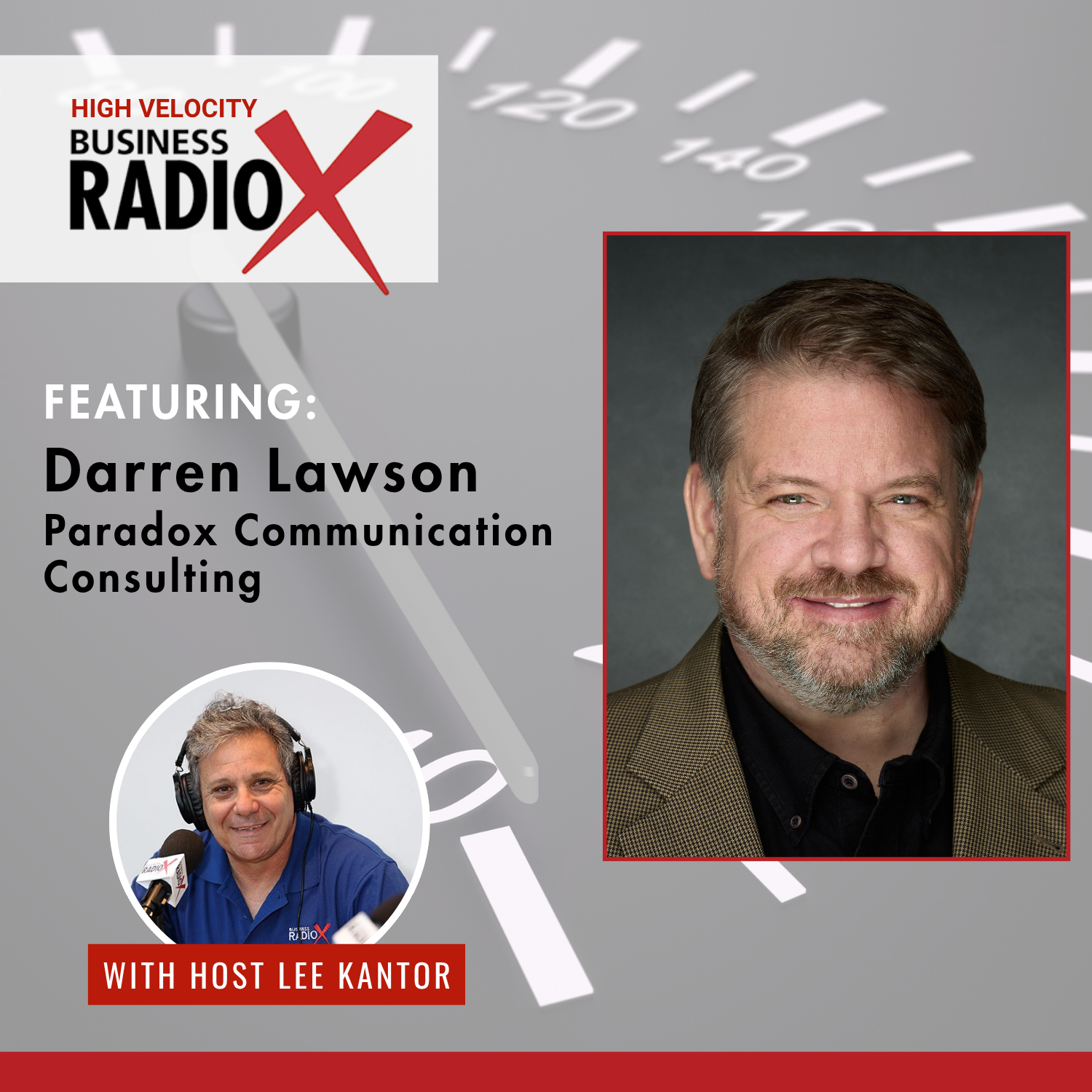

In this episode of High Velocity Radio, Lee Kantor interviews Darren Lawson, Founder of Paradox Communication Consulting. Darren shares why communication should be treated as a core business competency rather than a soft skill, explaining how clear messaging, employee feedback, and leadership alignment can eliminate workplace tension, strengthen organizational culture, and improve overall performance. Darren discusses the hidden costs of poor communication and how misaligned messages often lead to confusion, disengagement, and reduced productivity. He explains his communication assessment process, which helps organizations identify gaps between leadership intentions and employee perceptions, allowing leaders to address issues before they become larger organizational problems.


Darren Lawson, PhD, is a nationally respected communication expert, fractional executive, and founder of Paradox Communication Consulting.
After more than three decades as a dean, professor, and organizational leader, he now helps businesses, schools, and nonprofits strengthen clarity, alignment, and culture.
His work centers on a simple conviction: communication is the operating system of every organization — and when leaders communicate well, everything else becomes easier.
Known for his ability to diagnose unseen dynamics and translate complexity into clarity, he guides teams through seasons of growth, conflict, and transition with a blend of analytical rigor and relational insight.
Through Paradox Communication Consulting, Darren serves clients across the country as a strategic advisor, communication assessor, and leadership coach. He specializes in communication audits, executive alignment, process improvement, and building systems that reduce friction and accelerate performance.
Leaders describe him as a trusted translator — someone who can articulate what a team is experiencing but struggling to express. Whether he’s coaching executives, facilitating strategic conversations, or helping organizations redesign their communication pathways, his goal is always the same: to create environments where people can do their best work.
Follow Paradox Communication Consulting on LinkedIn.
What You’ll Learn In This Episode
- Recognize communication as a core competency that drives organizational success.
- Create clear and intentional messages that reduce misunderstandings across teams.
- Identify communication gaps through employee feedback and structured assessments.
- Align leadership messaging with employee expectations to improve engagement.
- Strengthen organizational culture through transparent and consistent communication.
- Apply perspective-taking to craft messages for different audiences.
- Recognize early warning signs of communication breakdowns before they affect performance.
- Support organizational growth, change initiatives, and mergers with effective communication strategies.
- Build trust through visible leadership and regular employee interaction.
- Improve employee commitment and retention by fostering open, two-way communication.
 This transcript is machine transcribed by Sonix.
TRANSCRIPT
Intro: Broadcasting live from the Business RadioX Studios in Atlanta, Georgia. It’s time for High Velocity Radio.
Lee Kantor: Lee Kantor here. Another episode of High Velocity Radio and this is gonna be a fun one. But before we get started, it’s important to recognize our sponsor, Business RadioX. If you’re a business coach who’s tired of being a best kept secret, set up a call with Stone Payton at bookstonephone.com to unlock your perpetual prospect pipeline. Today on the show, we have the founder of Paradox Communication Consulting, Darren Lawson. Welcome.
Darren Lawson: Thank you very much. It’s great to be with you here this morning.
Lee Kantor: Well, I am so excited to learn what you’re up to. Tell us about paradox. How are you serving folks?
Darren Lawson: Well, we are providing, uh, the ability to kind of come in and discover those communication pain points, those tension points that are keeping people from really functioning in a very efficient and a very effective way. So that’s kind of what we’re doing. Been at this for 36 years now, so a long time, and I’ve been able to see trends over that course of time. And, uh, I really enjoy coming in and just kind of helping people see through those tension points and fix things and then keep moving back to accomplishing your mission and vision.
Lee Kantor: Well, I am intrigued by the concept of communication. I think it is an underappreciated part of doing business. And I think that a lot of people really don’t understand the importance of clarity when it comes to communication. Can you kind of give us a primer on maybe how important communication is in in highly functioning organizations?
Darren Lawson: Yes, absolutely. A lot of folks look at communication, as we’ve always called it, a soft skill. You know, it’s like, oh, this is great. If we have some time, we’ll we’ll spend some money and effort increasing your soft skills. But really communication has to be one of those core competencies that every single employee in your business needs to practice and, and constantly strive to be better. So otherwise you’re going to be shooting in the dark at, well, here’s what I want everybody to do. And there’s no alignment. There’s really no sense of, we understood what you’re saying. And now we’re going to go back and, and do it. I, I often will tell clients that everybody has a pad of sticky notes. And when you get up there and say, here’s our here’s what we’re going to be doing for the next quarter, everybody pulls out their Post-it notes and they write on there what they interpret it as, and they slap that post-it note or that sticky note on what you just said. Now, if you’re not careful, if you’ve got 20 people in the room, you end up with 20 different sticky notes and everybody goes back to their office and says, okay, well, this is what I’m supposed to do. A month later, you’re checking in with them and you realize that this is not what I intended at all. So that’s where communication comes into play. It’s so important that you know exactly what you want to say, and then you do everything possible to get the right sticky notes attached to what you say.
Lee Kantor: Yeah, I, it reminds me of that story that as a child, you hear about the blind, six blind people or five blind people touching the elephant, and they’re each touching a different part, and they’re all positive, 100% positive that they know exactly what an elephant is. And, you know, to me, it’s those kind of misalignments cause so many problems. And, and it causes so much friction, frustration, burnout. Like it’s really at the heart of a lot of the issues, uh, organizations suffer from. And it seems that, um, by investing time and understanding some fundamentals when it comes to communication is going to save you so much heartache, uh, over, over the course of doing business in your career. So what are some kind of fundamentals? What are the building blocks you use to help people communicate more effectively?
Darren Lawson: Okay. So first, if I’m working with an executive team, I will sit down to make sure that the crafting of the messages, um, is going to be as clear as possible. I often will play devil’s advocate and I will say, okay, is there anyone in your audience? So after they’ve they crafted the message, we kind of move into this phase of, um, tell me who your audience is and is there anybody there who will intentionally misunderstand you? Are there people who are, you know, really kind of anti anything you do? Well, let’s talk about that person. What about the person who who’s on their phone the entire meeting? What can you do to grab their attention and keep it? So it’s that process of crafting the message and then taking perspectives of the audience members that are going to be there. And then going back and recrafting the message with those folks in mind that that to me is a fundamental baseline starting point for every leader out there.
Lee Kantor: And it’s probably something that they don’t even consider, right? Like they’re like, this is what I want to say. So I’m going to say it. And then whoever hears it and they’re all everybody in their mind, they think everyone’s going to get it. And then I’ve done my job and I checked my box. Mission accomplished. And then it’s like you said, there’s constituents in there that are contrarians. There’s ones that are your super fans that are going along and yes, yes, ING you and you got a whole variety of people out there. And if you’re not really being mindful of communicating effectively to each kind of group, you’re missing out on probably 70 to 80% of your team.
Darren Lawson: That’s right. And, and, and once you understand that perspective taking, you can then start crafting that message to kind of head off some misunderstanding, uh, to kind of erase some of the sticky notes that they have that they could attach to your message. So it is, it’s so important. And you either spend time, uh, up front taking care of the crafting of the message very carefully, or you pay later when having to fix it. So it’s like, take the time up front and your team’s going to be more efficient than they would have if you had simply just threw it out and said, okay, uh, now I’ve got to fix all these problems coming up. Nobody likes to do that.
Lee Kantor: Now, is that part of when you come in, uh, with an engagement at an organization, are you doing some sort of kind of assessment early on where you take what the leader thinks has been communicated and you just poll the people and say, hey, what do you what’s our, you know, mission statement or what is the objective of this initiative we just completed? And just to show that there is kind of misalignment, I mean, I would imagine that becomes very evident pretty quickly.
Darren Lawson: It does. And one of the first things that I do is let the leadership team know that communication is a multidimensional concept. It’s not just, well, we got to fix our communication. Well, what do you mean? Is that communication with top management? Oh, is it communication with your immediate supervisor? Is it the amount of personal feedback you’re getting? There’s all sorts. There are about ten dimensions that, uh, that I use, and those come from Professor Cal Downs at the University of Kansas, who was my main mentor when I was there doing my doctoral work. So the first thing I say is, okay, I want you as a leadership team to rank order these and tell me what you feel like is the number one problem. Oh yeah. Definitely. I think our people think this and then this and then, oh, we do pretty well at this. So that one’s going to be pretty low on the list. Then I will say, okay, that’s great. We’ve got a starting point. You think these are your top three problems, and then these are the three that you’re doing the best job at. Then I will take it to the employees and ask them. And it’s always so telling when you suddenly see what your employees are actually saying. And so that that misalignment there, those are the tension points. You said you thought it was this. Your people say this and then it’s like, now how can we bring those together and improve on those areas where you are needing improvement? And the way I ask that is, is through this concept of satisfaction.
Darren Lawson: How satisfied are you with your communication with top management? How satisfied are you with communication with your immediate supervisor? And so the employees rank that. And when I run the stats on it, I’ve asked the type of demographic questions that I can say this particular location, this particular geographic location, this particular department, this particular demographic group are having the most trouble. Uh, I was working with a client once and they are spread out. They have offices all over the globe and I’ve got the Asian offices back. The. The scores were extremely low and that’s when I reported it to top management. They said, we have no idea why the. Why they’re so low in our Asian offices. Well, come to find out, someone had left all of the Asian offices off the distribution list on the emails. And so they were not getting any information about the changes that were happening in the organization. So suddenly they were going, oh, here’s where the actual problem is. Now we can spend time, resources, money in this particular area to try to fix where it is. So that’s, that’s basically what I do. I do the assessment, come back and make recommendations for improvements.
Lee Kantor: Now, is there certain industries you tend to work in or niches? Um, or is your kind of, I would imagine the work is kind of industry agnostic, but I don’t know is you. Do you have a specialty like an area that you like to work in?
Darren Lawson: I have worked literally all over the spectrum of types of industries. I’ve done education, I’ve done manufacturing, I’ve done, uh, healthcare. Really the types of problems that organizations have are the same no matter what the industry is. So industry agnostic. That’s a great way of putting it. Uh, I’m happy to come in. I don’t need to be an expert in whatever it is you do, because I’m there just to look at your communication and determine where you can improve.
Lee Kantor: Now, what about if it’s not by industry? Is it by kind of the timing and where they are at as an organization? Like, do you come in as if they’re a startup and they’re just kind of forming kind of these relationships and they’re trying to get their communication right? Or do you come in like maybe after a merger acquisition where there’s some sort of, uh, transition, like, is there a best time for this kind of work, or is this something that should be happening regularly anyway?
Darren Lawson: Yeah, I would say the startups are so sometimes so busy with with business development and all of that that they sometimes aren’t quite yet thinking about communication consultants coming in. Um, where I, where I will enter in often is when, uh, a young startup kind of business is growing so quickly and they’re kind of shifting from the mom and pop kind of, um, organizational structure to, wow, we’ve got 50 employees, we have 100 employees now. And if they still try those things that they were doing at the beginning, they often experience a lot of tension. So I will help organizations doing that. Uh, typically I’ve gone into kind of midsize, uh, companies anywhere from maybe 100 employees, up to 500 employees, that that tends to be a sweet spot in terms of where folks have some issues. Uh, they’ve grown past their complex organization with quite a bit of structure, and they’re having trouble communicating it down to all the different levels of the organization.
Lee Kantor: Yeah. I would imagine when they get to the point where when you’re at the stage when everybody knows everybody or everybody was involved in hiring everybody, and then now you’re on a. Okay, now we have strangers here that I don’t know very well. That’s really where you better be building good systems or else that’s going to bite you.
Darren Lawson: And you also mentioned mergers. That is something else that causes a great deal of conflict in the organization. So you may have, for a period of time, two chief marketing officers or two chief information officers. And so who wins out in that merger is always, um, an interesting process, and much of it has to do with communication. Another thing that I’ve worked with is when a company is rolling out a mass change, maybe a complete change in technology or a complete change in management management structure, maybe a new product is coming along. I will come alongside them and help in that process of change. Um, one of the things that I’ve done in the last couple of years is kind of gotten, uh, training in coaching. And so I’m now a certified executive coach. I must also a certified organizational development coach and finally a certified change management coach. So those are, are, have been very helpful tools in the toolbox to come alongside the organization and say, hey, you know what, let me work with your team here and we’ll work them through that change management process so that they’re communicating clearly and efficiently and effectively throughout that change process.
Lee Kantor: Is there a story you can share that maybe illustrates how you work with an organization? You don’t have to name the name of the organization, but maybe share the challenge they came to you with and how you were able to help them get to a new level.
Darren Lawson: Yeah, I worked with an advertising agency. I’ll just leave it that broad. And they were having some issues. And so we came in and we, we said, let’s talk with management first. That’s always a starting place. We need to make sure that they’re on board. And often I will say, can you, as the CEO, send out a message to all the employees that you’re going to be doing an assessment of communication and that management has to be behind it? So that’s a starting place. Often I will then come in and and do a round of interviews. So I may interview somebody on the management team, I may interview a mid-level manager. I may interview someone on the on the lowest levels of the organization and just find out what some of the other topics are. Then I have a standardized instrument that I use called the Communication Satisfaction Questionnaire, and we put that out to the organization. And then I like to see how the qualitative interview data is aligning with the quantitative statistical data. And, and then I’m able to come back and make recommendations based on what the employees have told me, but also what the stats have told me. This particular organization that I work with, advertising and advertising, they were, uh, least satisfied with communication with top management.
Darren Lawson: So it’s like, okay, now what do we do to fix that? It was a perception problem. They were feeling like top management was off doing its own thing. They had no idea. Decisions that were being made. Well, we found a cheap, inexpensive, actually free solution for them. Their phone system allowed for one person to record a message and send that out as voicemail to all of the extension numbers. So I said, well, let’s, let’s have you come in on Monday morning and as CEO, record a 92nd message that says, good morning, everybody. Uh, we had a great week last week. Here are some things that we’re working on now. These are our priorities for this coming week. I appreciate what each of you is doing. Lasted 90s. He hit send and it went to every single person’s phone. So when they came in on Monday, there was a personal message from the CEO to them telling them what had happened this past week and what they were working on. It completely changed perceptions of top management. So it’s utilizing sometimes technology that you have already and solving it in a way that that addresses the misperceptions that the employees have.
Lee Kantor: And communications really goes hand in hand with culture, doesn’t it? Like these two are almost interchangeable because if you don’t have clear communication, it’s impacting the culture of your organization.
Darren Lawson: Yes. If if you’re top down management style is very classically driven, which is top down, autocratic, it’s my way or the highway that is going to shape the communication culture of the organization. Uh, thankfully we’ve moved away from that in large part, and it’s much more participative. Participative. But it’s still dictated sometimes. And sometimes I have to have a very frank discussion with some top level managers and say, this is how your employees perceive you. Are you comfortable with that perception? And oftentimes the person’s like, oh, I had no idea. I know I’m not comfortable with that. Once they verbalize that, then they’re ready to have a discussion about things that they need to do differently to change that perception, because it’s always changing. People are always attaching different sticky notes to what you’re doing. But absolutely, culture is tied to effective communication within just about every organization.
Lee Kantor: Now, is there any low hanging fruit, any advice you can give a leader right now that is maybe struggling in this area or would like to do better?
Darren Lawson: I think first and foremost, the leaders have to kind of take an approach of, you know what, I may not be doing everything correctly. So they need to be open to feedback from their employees and open to having someone come in and help guide them. Oftentimes, the organization leadership is often part of the problem. And so it’s very difficult for them to fix that. So they need to bring in someone, an objective person from the outside. So I tell them, take a look at that. And are there, is there anything that you need help on that you need to just say, you know what? This is beyond my purview. I need to get some help in here to do that. Um, the other thing is I, I love to tell them to do some management by walking around. Um, I, I was in higher education for, for 36 years, and I was also consulting on the side. So I was doing a little bit of both. It was those days that I just said, you know what, I’m just going to close everything on my desk and I’m going to go walk around the building and listen to what my employees have to say. Wow. Uh, did that ever open my eyes to what perception was on, on the grassroots level in the organization? So those are just a couple of things that, that I recommend that you can do immediately. Get out of the office, walk around, just see how folks are doing. Your presence with them will go a long way in changing some perceptions of you as, as a leader in the organization.
Lee Kantor: And what’s happening in an organization, that it becomes obvious they have to contact you or somebody on the team. Is there a symptom or a signal that a leader can be, you know, paying attention and looking for? So it says, hey, maybe I have a communication problem and I should contact Darren and his team.
Darren Lawson: Yeah, that’s a great question. If you start seeing high turnover rates. If you start seeing frequent lates to the office, leaving early, all of those things, that means your employees are no longer engaged in the business. They in. In academia, we talk about it in terms of organizational commitment. And commitment is when your employees will make a decision that’s best for the organization and maybe not best for themselves. If they’re truly committed, they may set aside their own personal wishes and they’ll stay late or they’ll stay longer with you. So I tell folks, take a look at those turnover rates. It’s they’re like symptoms. Lee. They’re it’s if how do you how do you know you need to go to the doctor? Well, I’ve got a high fever. I feel horrible. I’ve got body aches. I’ve got headaches. Okay. Something’s wrong here. And you’ve tried a few things yourself and you can’t get it. I need to make a trip to the doctor. And so look for those symptoms that are screaming at you. Something’s wrong. And even if you go, I don’t know what’s happening here. There are times I’ve gone in for an MRI. You know, that’s where they do a scan of the whole body. That’s where the an organizational consultant comes in handy. They can help you with an MRI and help you go, you know what? Here’s the problem right here. Let’s address that with whatever treatment is necessary. And and after that, you can get back to work and, and say, you know what? I’m glad we brought someone in who could look at things from a different perspective and tell us, uh, what we could do to improve.
Lee Kantor: So if somebody wants to learn more, have a more substantive conversation with you or somebody on the team, what’s the website? What’s the best way to connect?
Darren Lawson: Oh, the website is theparadoxway.com and my contact information is on there, but my email is darren@theparadoxway.com. I’m happy to to chat. I tell folks, let’s, let’s set up a one hour pro bono meeting where we just talk and, and see what your needs are and see if there’s anything that I can do to help. But I would love to chat with folks, would love to come alongside you, partner with you, and help ease out some of those tension points so that you’re functioning in a more efficient and effective way.
Lee Kantor: Well, Darren, thank you so much for sharing your story today, doing such important work. And we appreciate you.
Darren Lawson: Absolutely glad to be here with you.
Lee Kantor: All right. This is Lee Kantor. We’ll see you all next time on High Velocity Radio.















