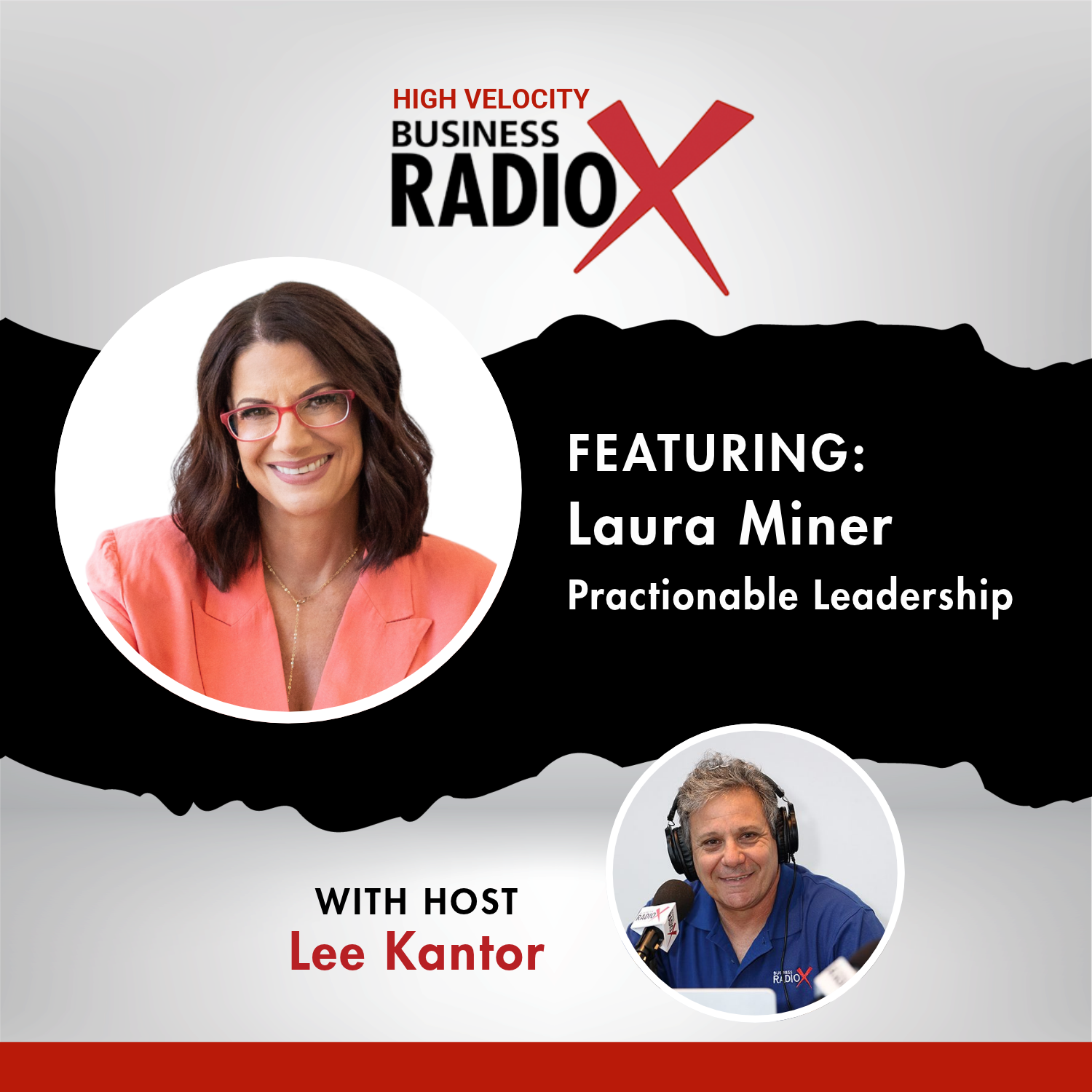

In this episode of High Velocity Radio, Lee Kantor interviews Laura Miner, leader development coach and trainer with Practionable Leadership. Laura shares her approach to self-leadership and explains why developing the person behind the leader is essential to creating meaningful and sustainable impact. Drawing from her corporate experience and PhD in Leadership Studies, she explores how aligning the way we think, act, and motivate ourselves can transform both personal and professional growth. Laura discusses the importance of recognizing personal patterns, overcoming limiting behaviors, and building a culture where individuals take ownership of their actions and contributions.
 Dr. Laura W. Miner is a leader development coach, leadership scholar, and author who helps leaders strengthen the one thing they bring to every leadership moment: themselves.
With a PhD in Leadership Studies, 10+ years of corporate leadership experience, and 15+ years as a coach, Laura brings together the science of self-leadership with the realities of leading in the real world. Her research explores self-leadership, intellectual humility, and how people intentionally develop who they are, not just what they know or do.
 She’s the author of Strengthened: Developing the Leader Within and creator of The Self-Leadership Edge. Grounded in the belief that WHO you are is HOW you lead, Laura helps leaders intentionally develop who they are so they can lead with greater clarity, confidence, and impact.
Connect with Laura on LinkedIn and Facebook.
What You’ll Learn In This Episode
- Understanding the distinction between leadership development and leader development.
- Applying the three pillars of self-leadership: cognitive, behavioral, and natural rewards.
- Aligning personal values, actions, and motivations for more intentional leadership.
- Recognizing patterns that create barriers to personal and professional growth.
- Building organizational cultures rooted in accountability and self-leadership.
- Strengthening team collaboration through shared understanding and communication.
- Developing a mindset that encourages problem-solving, ownership, and innovation.
- Making self-leadership an ongoing practice for continuous growth and lasting impact.
 This transcript is machine transcribed by Sonix.
TRANSCRIPT
Intro: Broadcasting live from the Business RadioX Studios in Atlanta, Georgia. It’s time for High Velocity Radio.
Lee Kantor: Lee Kantor here another episode of High Velocity Radio. But before we get started, it’s important to recognize our sponsor, Business RadioX. If you’re a coach or a consultant who is tired of selling and ready to lead by serving, set up a call with Stone Payton at bookstonephone.com to learn how to give local leaders a voice and become a recognized authority in your market. Today on this show, we have leader, development coach and trainer with Practionable Leadership, Laura Miner. Welcome.
Laura Miner: Thank you so much, Lee. I’m thrilled to be here.
Lee Kantor: Well, I am excited to learn what you’re up to. Tell us about your practice. How are you serving folks?
Laura Miner: Absolutely. So I focus on leader development. You may have noticed you did not say the word leadership development because they are two different things. I had a long and storied life on the leadership side. I learned a lot about the what and the how of leadership development, and leadership development really focuses on the practice of leadership. It gets into those models and competencies, the skills and tools. But it’s all about the what and the how. And I realized that every time there was a gap between how somebody wanted to show up as a leader and how they actually did that resided with the who, the person doing the leading. So I made a shift and I went into leader development specifically with an emphasis on stealth leadership, and that is now how I serve people and how I help them develop their inner leader for outer impact.
Lee Kantor: So can we go back and talk about kind of your career trajectory so we understand how this pivot was made?
Laura Miner: I love that, absolutely. So I spent the first couple of decades of my career in corporate America doing the typical thing. I was in traditional leadership. I was in the tech sector. I was leadership over sales and marketing divisions. And there was an interesting thing that was happening. And I was seeing it both with the organizations that I worked in, as well as the organizations that I worked with. And it was this regular recurring model where people would bring us in our organization as, like I said, in sales and marketing in the tech sector to help them generate more revenue. I would go in, I would see opportunities where I could do that. But the real issue wasn’t actually the systems and structure or the sales and marketing. The real issue was leadership and specifically the leaders executing on it. And I saw so many gut wrenching pitfalls. I had one client that I worked with that I absolutely loved, but the writing was on the wall and the leaders were taking the organization in a direction that was not going to be sustainable. The employees weren’t happy. Their customers weren’t happy. You could see where it was headed, but yet there was no level of interference that could prevent it from happening.
Laura Miner: And I actually had a really interesting conversation with the CEO of that organization because as a sales and marketing executive. When I did try to have the conversation with him, he told me to stay in my lane and in the moment I was angry and irritated and frustrated and sad because like I said, it was it was clear where they were going to go. But when I got on the plane to head home, I realized he was right. I was not in a leader development lane at that point. I was in a sales and marketing lane. And so I made a decision to go back to school to really understand leadership at a very deep level. I, in 2025, finished a PhD in leadership studies with a specific emphasis on self-leadership and leader development. And I made that the direction that I wanted to go because we don’t need more people helping us understand the what and the how. We’ve got that down. We’ve had that down for a long time. We need to focus on the inner leader so that we can create an impact that is sustainable and positive.
Lee Kantor: Now when you’re using the word leader and leadership, um, you’re obviously being very specific. Those aren’t accidental choices. Does leader development and leadership. Um, is it go beyond obviously business? Are the, are these universal principles that work in the home as a parent that work in the community as volunteer? Are these things that work in military, like all those, the different places where they show up? Are the principles the same in each of those places? Because it sounds like at the heart of a lot of this dysfunction is a culture issue where a leader or leadership could really make an impact there.
Laura Miner: Absolutely. It does go beyond the corporate environment, and I’m really glad that you brought that up. One of the things that I often share with people is that regardless of whether you have a formal title or not, we are all needing someone starting with ourselves and how we show up and how we lead has an impact on the world. Whether we are talking globally or we are talking just our small family unit, we have an impact. Who you are is how you lead, and it is the same core principles. The reason that I gravitated towards Self-leadership was because it finally made sense of things that I had long struggled with. It helped me understand that every leader footstep. Again, a leader is anybody who leads anybody starting with yourself. So a leader is everybody but any leader. Footstep starts with the same three foundations, and these are the three pillars of self leadership. There’s a cognitive element which is how you think. There’s a behavioral element which is how you act. And there’s a natural rewards component, which is all about how you motivate yourself. And regardless of whether you’re doing this in corporate in-house, in the volunteer world, no matter where you are bringing this into your life, those three components affect every aspect of your life, how you think, how you act, how you motivate yourself. When those three are aligned, it makes a huge difference.
Lee Kantor: Now, are you seeing these kind of, um, teachings happening at an early age, or is this something that once a person is an adult and maybe enters the corporate world or joins the military or whatever is more in a kind of a more team or organization environment that that’s where it shows up or a person begins. Kind of their educational journey.
Laura Miner: Yeah, I love that. It’s actually not an either or question. The answer very much is a both and. Um, Montessori schools are a really good example where. This type of learning is brought into early childhood. And it’s really important. But it is equally brought into organizations. It is highly leveraged in the military. Um, in fact, there was an Army publication not too long ago. I wrote a newsletter about it where they were talking about the need to bring in Self-leadership deeper and deeper into the army because of the fact that you don’t always have somebody available to give you directions. And we’ve got to think a little bit more deeply and differently than we did at a certain point in time. And we have to take ownership of that journey for ourselves, and it’s really interesting to watch and see where formalized self leadership research is being conducted. It’s it’s been around for over 40 years. So it’s not a new concept, but it’s only now becoming more deeply integrated into different structures. So we’re seeing a lot of research in nursing. We’re seeing a lot of research in corporate. We’re seeing a lot of research in um dispersed teams. How do people better show up for themselves and for the working world if they’re working remotely and they don’t have other people around them constantly. So it’s really neat to see the trajectory of how it’s really moving throughout our, our world.
Lee Kantor: So say I’m all in, I buy what you’re selling. I’m, I, I love it. I want to be the best self leader that I could possibly be. How do I deal with maybe an organization that isn’t on the same page as I am? Is this kind of a a go along to get along situation? Do I leave the organization? Um, how do I deal with that kind of maybe not a perfect cultural fit.
Laura Miner: Yeah. It’s, you know, it’s such an important conversation to have because being in situations where there is a cultural misalignment is unfortunately often more the norm. It’s rarely the exception. And that’s one of the areas where self-leadership can be so powerful. You don’t have to make yourself fit the culture necessarily for self-leadership to be effective for you. Now, would we prefer it if we had a culture of self-leadership? Absolutely. That is actually what my dissertation was about. I interviewed nine different businesses where all of the leaders lead with Self-leadership, and they were very successful businesses. But that’s not always the case. The beauty of Self-leadership is that you are introspectively looking at how do you lead? How do you think, how do you act? How do you motivate yourself so that you can be as successful and effective as you want to be in or outside of work? I’ll tell you one place where Self-leadership really has made a huge difference in my life is actually in my roles as a wife and a mom and a grandmother. Because even in those roles, it helps me to think through the challenges that I’m facing differently so that instead of reacting on autopilot, I’m actually building my life and my work by design instead of by default.
Lee Kantor: Now, you mentioned that leadership is for everybody. Do you do some sort of an assessment so I can see where I’m at maybe on this spectrum of lidar. Um, just so that I can see where there’s opportunities for me to grow or maybe areas that I need to work on.
Laura Miner: Yeah. For sure. So, um, one thing I want to share before I talk about that is that there are phenomenal tools that are available. Like I said, lidar development and Self-leadership has been around and studied for over 40 years. So luckily there is a, what we call in the industry. A psychometrically valid research tool for this. Basically what that means is that it’s not just anecdotal fluff. It’s going to ask you very nuanced questions so that you can get an understanding of. Do you think that you think, well, but actually there’s things in your behavioral patterns that are undermining your success. And these tools, they are very nerdy from one side because you only find them or gain access to them through academia. On the other side, I wanted to make these tools what I call fractional. They are practical, they are actionable, and they are available to everybody. Otherwise, we can’t make a difference in the world. So what I personally have done is I have created a playbook and made the assessment available, both for free, right on the front page of my website, so that anybody who wants to gain a better understanding of who they are, how they lead, what their strengths in terms of self-leadership are, what areas can they strengthen? It is all right there waiting for them. They can lead themselves right through it.
Lee Kantor: Now let’s talk a little bit about your practice. Um, do you have a niche? Do you work with certain types of clients? Uh, is there a kind of an ideal client profile that you’ve discovered over the years?
Laura Miner: Yeah. So my ideal client, my most common client is a business owner, generally a medium sized organization. I’m not typically working with large corporate entities anymore, only because to your point and what you earlier said, often they’re not a cultural fit because they have so much disparity between their different silos. Where I really like to help them go in is with midsize businesses that are still owner led, that haven’t transitioned into a formalized corporate structure where the operations still matter, the people still matter, and they’re really trying to create businesses that make a difference in the world. Because when your people are operating within a culture of self-leadership, it is amazing what the organization Collectively can achieve. And as an example, the companies that I worked with through my dissertation process as well. They all saw that and experienced it. And it was night and day to what disparate, siloed organizations experience.
Lee Kantor: So what’s kind of the problem or issue that an organization or leader is dealing with right before they call you? Is there something that’s happened? Are there signs or signals in the organization that, hey, maybe we should call Laura?
Laura Miner: Yeah. The number one word that I hear is we’re stuck. They’re often stuck, either stuck at a financial plateau that they haven’t been able to get past. They are stuck with how the organization is interacting with each other. They haven’t been able to break through it. When I go in and I meet with a company, I am able to assess and understand. Is this actually a systems issue. Do we have the right people? Do we have the people develop the way we need? But we don’t have the systems to support us. In which case I have other people that I would recommend them to. Or is it that we have not equipped our people yet to be the people who can meet the systems and the tools and everything else that we have? Oftentimes when companies call me, they’ve already brought in more leadership development training. They’ve already done more communications classes. They’ve done all the things. But no amount of tools will make a difference if you’re not equally focused on the people who have to pick up and use those tools. Again, those tools are the who and the what or I’m sorry, the what and the how. That’s the leadership. I am focused on the who using those tools, the leader. And so that’s usually where I come in when people are stuck. They can’t quite figure out why, and we peel back the layers and get it sorted.
Lee Kantor: So how do you deliver your coaching? Are you doing mainly one on ones or group or mastermind like cohorts? How do you deliver the coaching?
Laura Miner: All of the above. So one of the things that makes me unique in how I do this is I have a lot of background experience in one on one coaching, group coaching and masterminds. I’ve also done a lot of stage training, a lot of public and keynote speaking. So when I meet with an organization, we sit down and we figure out what does the organization need? Not what is my style of delivery, but what does your organization need to get the best results based on what it is that you are trying to achieve? So a company that I’m wrapping up a contract with right now is an example. It started where I was hired one on one because the business owner wanted me to just work with them. I did. It was amazing. Then they said, okay, can we extend this? I want to start creating a culture of self-leadership. I want you to work with my entire self leadership team or with their entire leadership team. We did that. Self-leadership became the culture with the leaders. But now the leaders had a different language than all the other teammates. So then we did more of a group coaching where it had some training seminars so that we were actually creating a culture of self-leadership where everybody could have the same dialog. And then it elevates the company as a whole, because now they’re all understanding each other differently. They’re having more understanding for each other’s strengths and areas that could be strengthened. And they’re now working together more collectively because that is what a culture of self-leadership achieves.
Lee Kantor: Is there any advice you would give, um, a leader right now if they’re asking themselves how, how well am I leading myself right now is like, where should they start?
Laura Miner: Yeah, I love that. So if you’re wondering that one of the things that you can consider is the fact that you can’t really develop something that you haven’t yet learned to see and paying attention to our patterns, learning to understand where we are leading ourselves effectively, where we might be getting in our own ways, um, how we’re thinking, how we’re acting, how we’re motivating ourselves. These aren’t questions that we are necessarily use to asking. So being able to take that step back and start asking those questions and looking for the gaps, where are the gaps between what you know and what you consistently do, and where are the gaps between what you understand and what you prioritize versus what you actually do? So I’ll give you a personal example. This goes back a ways before I had self-leadership in my life and before I understood it, I always said that I valued parenthood and I did. I meant it every time I had the conversation. I meant it every time I interacted and engaged with my daughter like it was a very important part of my life. Yet whenever certain business meetings, opportunities, requests from my then corporate leadership would come up, even though prioritizing my daughter was something I said I lived by, she was the first person that got sacrificed when I said yes to doing work after hours, or I said yes to working on the weekend portfolio or I said yes to another travel day in a given work week, and it’s because I wasn’t aligned with how I was thinking, acting and motivating myself.
Laura Miner: And I didn’t even know how to understand that at a deeper level. Now I have tools for it, and those are the same tools I was talking about that I’ve made available on my website. I’ve created a plethora of tools to help my clients be able to navigate through it, because it’s so easy to operate on autopilot and just to do what we’ve always done. Plus, oftentimes, especially if we are high achieving individuals, what we’ve done has genuinely been rewarded, even if it’s also had a significant cost. Me saying yes to work things was rewarded financially. It was rewarded with promotions. It was rewarded in so many different ways, but it had a cost that I could not understand at that point in time. And these tools help a leader to understand that better. Plus, we’re always modeling the way for others, be it our families, our employees. What we do makes a difference and what others around us do. And so Self-leadership helps you be more mindful of that and take deliberate steps that walk you through it.
Lee Kantor: Is there a story you can share that maybe illustrates what it’s like to work with you? Don’t name the person or the organization, but maybe share what challenge they came to you with and how you were able to help them get to a new level.
Laura Miner: Yeah, absolutely. Wow. So I have okay, so I have a client right now who I think she, I’d have to go back and check. This is either year three or year four that she every six months is wrapped her contract with me. And it’s because when we first started working together, she was not yet a business owner, which is not traditional for me. Like I said, that’s generally who I work with. But she was making the transition from employee to entrepreneur. She wanted to build a legitimate consulting business, and she wanted some help and support in doing so. And really, the biggest things that were in her way. Yes, there’s all the nuance of how do you set up a business? How do you do all that? And I do have that experience, but that’s not what my role for her was. It was more about what is getting in your way before you take every step. She was stuck. She couldn’t build the business that she wanted to build because her thinking was out of alignment. That led to her actions being off kilter. When both of those things were going sideways. It’s really hard to keep yourself energized and motivated around what you are doing.
Laura Miner: So fast forward, she just renewed her contract again, and it is because she now has a very big and thriving practice. And as you grow, the challenges that you face grow. They’re different. You’re not the same person you were. You’re more equipped to deal with them. But as those challenges grow, you have to continually change so that you can step up and meet those challenges as well. So one of the things that I always share with people is that self-leadership is not a bandaid. It’s not a one time fix. It’s not the blue pill. It’s not any of that. It is an ongoing practice. It’s something that as life hands you, changes, challenges, whatever may be coming your way. Self-leadership is the thing that you can always rely on to help you grow and meet the next moment. And that’s one of the reasons that I fell in love with it so much was because not only did I see its impact on my life, but I saw its impact on every client that I have worked with over the years as well.
Lee Kantor: And it’s one of those things where once you see it, you can’t unsee it, right? Once you’ve kind of got a taste of this, you’re it kind of grows up amongst itself, right? It just expands.
Laura Miner: 100%. And I’ve one of the things that I sometimes will do when I feel like I need to get myself refocused is I actually will go back through and read all the testimonials that I’ve collected over the last couple of years. And that’s basically what the testimonials point to is the big reason that these tools, this approach Self-leadership in general gets people unstuck is because once they see it, they can’t unsee it. So it gives them the solution for every other problem going forward. It makes it really easy to look at a challenge, even a really stressful challenge, and say, okay, what’s my part in this and what do I need to evaluate? Is it my thinking that’s off? Is it my behavior that’s off? Is it how I’m energizing and motivating myself? Is it a combination of all three? What do I need to do to lead myself through it? And then if I do that correctly, what is the impact that will have on others? And I’m sure with that statement, you can see when you create a culture of self-leadership and everybody is moving through things in that way, then you all of a sudden wind up with an organization and a dynamic where you’ve got problem solvers instead of problem creators. And there’s a lot more innovation that happens within the organization.
Lee Kantor: And then once you teach the leaders uh, this methodology. Then everybody has a common language and communications gets clearer and crisper and change can happen faster.
Laura Miner: Absolutely. In fact, there was a study that was done that was really interesting about the fact that when change initiatives are brought into organizations, the rate of failure, or I should say long term adoption is pretty high, depending on the study. It’s anywhere from 70 to 80% of change is just lost after the first couple of weeks, if it even takes hold for that long. So they did a study and they found that when you lay the groundwork for Self-leadership first, then it actually maximizes the adoption rate of those change initiatives after. And it’s because people have the tools, they have the mindset, they have the language, they are looking through a different lens and they have a different level of ownership and responsibility that allows them to move through it together.
Lee Kantor: So if somebody out there is stuck or frustrated and wants to learn more about your practice, what is the website? What’s the best way to connect?
Laura Miner: Go to laurawminer.com, that’s MINER and it is right there. I’ve got the assessment and the playbook for free right on the home page. It’s easy to book a call with me. So I would love to hear from anybody who would like to connect.
Lee Kantor: Laura, thank you so much for sharing your story today. You’re doing such important work and we appreciate you.
Laura Miner: Thank you Lee.
Lee Kantor: All right. This Lee Kantor we’ll see you all next time on High Velocity Radio.