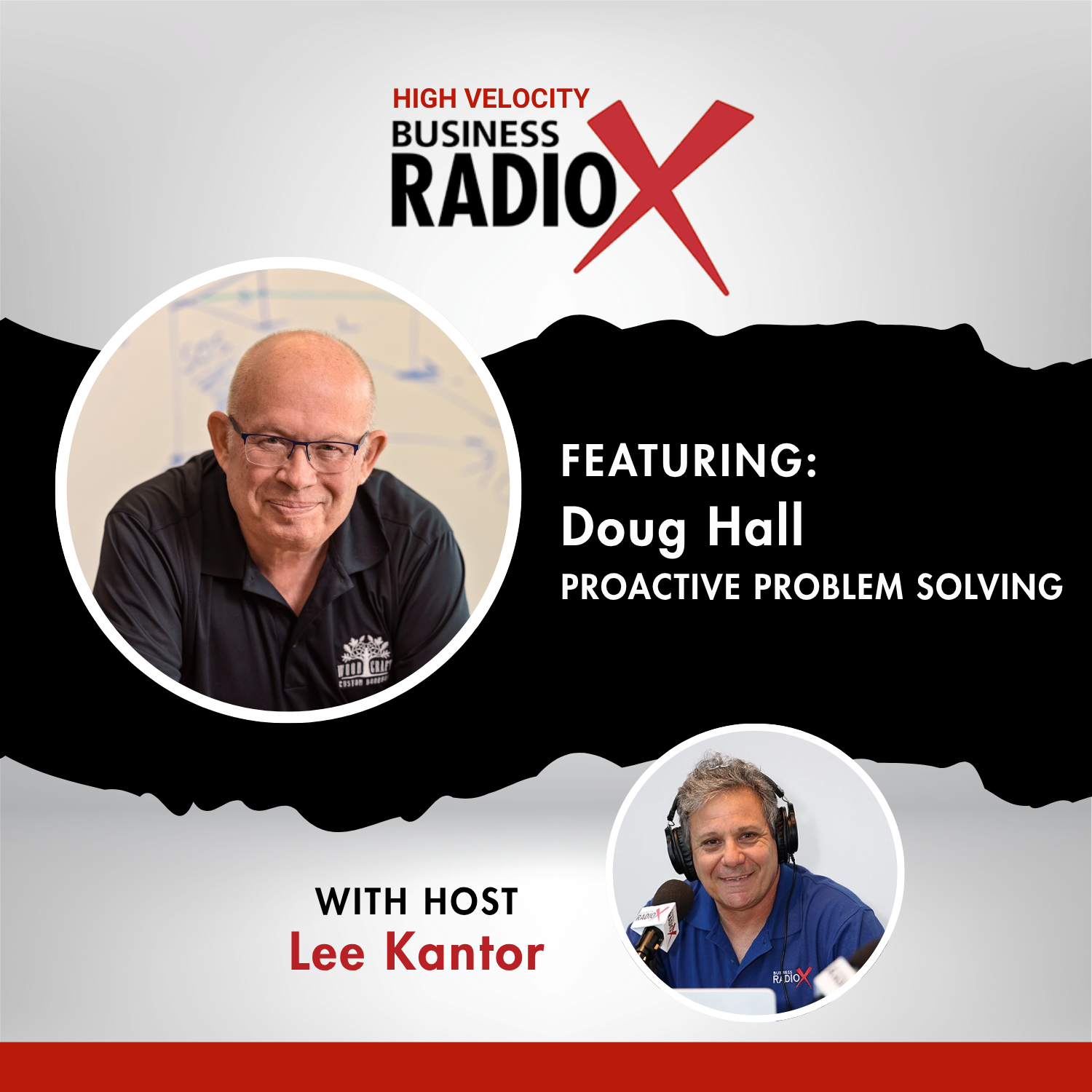

In this episode of High Velocity Radio, inventor and author Doug Hall discusses his new book, Proactive Problem Solving. Drawing on decades of experience, Doug shares how organizations can foster innovation by creating meaningfully unique products and embracing a culture that learns from failure. He emphasizes the importance of engaging entire teams, using systematic approaches, and overcoming resistance to change. Doug offers practical advice for leaders seeking to boost creativity, collaboration, and business success.
 Doug Hall, author of PROACTIVE Problem Solving, is the founder of Eureka!Ranch and Brain Brew Distillery. He has been named one of America’s top innovation experts by Inc. magazine, The Wall Street Journal, Dateline NBC, CNBC, and CIO magazine. A hands-on inventor, he helps businesses, governments, and nonprofits find, filter, and fast-track big ideas.
His earlier books include the bestselling Jump Start Your Brain, Driving Eureka!, andJump Start Your Business Brain. A chemical engineer by education, her was Master Marketing Inventor at Procter & Gamble – shipping a record nine products in twelve months.
For his pioneering work in innovation, Hall was awarded a Doctor of Laws from the University of Prince Edward Island and a Doctor of Engineering from the University of Maine.
Connect with Doug on LinkedIn.
What You’ll Learn in This Episode
- How using the process of Proactive Problem Solving leads to higher engagement and job satisfaction
- How Doug used Proactive Problem Solving at Brain Brew Distillery
- What role fear plays in preventing effective problem-solving, and how leaders can create an environment that encourages innovative thinking
- How organizations can balance the need for systematic problem-solving with the pressure for quick fixes
 This transcript is machine transcribed by Sonix.
TRANSCRIPT
Intro: Broadcasting live from the Business RadioX studios in Atlanta, Georgia. It’s time for High Velocity Radio.
Lee Kantor: Lee Kantor here. Another episode of High Velocity Radio, and this is going to be a good one. Today on the show we have Doug Hall, inventor, speaker, entrepreneur, innovation catalyst, and author of the new book PROACTIVE Problem Solving. Welcome, Doug.
Doug Hall: Hi. It’s great to be with you.
Lee Kantor: Well, I’m excited to learn what you’re up to. Uh, why don’t we get started with a little bit of your backstory? Can you tell us a little bit about how you got to where you are?
Doug Hall: Well, it’s been a long journey. 52 years I’ve been inventing at age, uh, 13, I invented it. Merlin’s learn to juggle kit and booboo balloon animal kits. And and I haven’t stopped creating new products, new ideas and new work systems. Uh, since then, I got a degree in chemical engineering, went into marketing at Procter and Gamble, where I led the Procter and Gamble Invention team, where I pioneered the use of systems, applying the work of doctor W Edwards Deming, famous for Lean and Six Sigma. Such things to the world of innovation and how we work together. And then I created the Eureka Ranch, wherein we work with companies Nike, Disney, American Express, and thousands of small and mid-sized companies as well, because they’re just as important and actually oftentimes more fun to work with. And, uh, and, uh, so this is my eighth book, actually. And it came about because in the inventing of ideas, which I love, I just love the creation of something that’s new, something that helps companies make more money, something that turns it from sales being a slog to customers pulling it from you when you have something that’s truly, meaningfully unique. And what I found as I did it, because I’ve done a lot of research work with academics, of publishing academic journals, etc.. Was that one of the problems with new ideas that are really different? The kind of ideas that will make a difference is that as you’re trying to put them together and implement them. You got to have the team helping you. If the team is resistant to change, the idea tends to get compromised. And but if they become proactive problem solvers, it makes a difference. And that’s why I wrote the book. And that’s why we’ve developed a new training course and a system to help companies create proactive problem solving.
Lee Kantor: So when you’re saying the team who are the the members of the team.
Doug Hall: Pretty much the whole organization, because they all will touch it when you’re doing something that is a meaningful difference, whether it’s an internal work system, you’re going to transform your sales system. A common thing in these days. People have not made the transition to digital. They’ve not made the connection to this new digital world. They think it’s the old world where you go out and play golf with people to sell them stuff, and it’s not the way it works anymore. I mean, it’s still a little, but they have not made the change. All the people that are going to be touched. And yes, it might be if you’re a product company, the engineers and the technology people in the manufacturing, but it’s also going to be finance. It’s going to be it. It’s going to be human. You’ve got to work together as a team if you’re going to make it. And so you need a system. As Deming famously said, 94% of problems are because of the system. 6% are because of the worker. It’s the system, stupid. And so you need a system, a new system for sales, a new system for making people proactive, a new system for creating meaningfully unique ideas that turn your customers into raving fans.
Lee Kantor: So. So how does a company or an individual begin creating that system that makes their product or service, uh, you know, more desirable rather than pulling teeth. Getting people to know that it exists.
Doug Hall: Um. The beginning. You have to have something that is a difference. That means something to people. Or, as I say, meaningfully unique. It has to be kind of what we’ve learned when we do the research is that most offerings of companies are pretty much the same old stuff as everybody else. And that would also be called a commodity. I mean, in the, you know, in the meat business, it’s like selling pork bellies. They’re all about the same. When you are meaningfully unique, when you offer something that makes a difference to the customer, that truly makes a difference to the customer, that excites the customers. Then you set off a chain reaction. People tell other people about it. Word of mouth. I mean, the data is clear. The word of mouth goes up by a factor of five. That’s not 5%. That’s 500%. Um, if it’s a retail product, retailers are more willing to take it because they want to have this because there’s nothing else like it on the shelf. Um, the media talks about it because it’s news. It’s newsworthy. And so you have to take your idea and your offering, whether it’s a service or product, and you have to make it that next level, that thing that people go, oh my God, I wish I’d thought of it. Or the way I think of it is think of it as an idea that your competition says, damn, I wish we had that.
Lee Kantor: But how does, like, say, a person in professional service say they’re a business coach and you know, they somebody like you, that you came from business, you had your you started your own thing. How do you kind of create, um, something that is that, um, worthy of that much attention?
Doug Hall: So when you’re in a service like that, which many people are, Um, a way to think about it is the claims that you make. We’re going to help you make more money. Or how many more hundreds of people are going to tell me they’ll get me sales leads? You know, it’s mind numbing when you’re making claims. Your benefit you’re offering, it’s. And it’s an exciting benefit. But people don’t believe you. So oftentimes in services, it’s not so much the benefit that you’re offering, but it’s the proof of by what method will you accomplish that. That it is something different than what people have tried before, seen before, heard before. And and also you’ve got. Factual data that shows it makes a difference. Let me give you an example. Um, you know, we we sell a technology, um, in the proactive problem solving book, I tell a lot of stories about our brain brew distillery. I created a bourbon distillery and it’s gotten out of control. And it has a technology called Woodcraft Finishing that we invented. And this technology allows you to take, um, 1 or 2 year bourbon and turn it into a 95, 97, 98 point world class as good as anything else in the world. And you can do it. Your cost for the whiskey is half what it would be versus a six year whiskey, because of the difference in interest and angel share and, um, insurance and storage, etc. but even more importantly, it reduces your capital, the working capital you need by 90%, 90%. Well, that is meaningful, unique. That is something that is transformative. Cutting your capital by 90% and cutting your cost by 50%. When I say I’ve got a system and it’s delivered these kind of benefits. Now I’ve got your attention.
Lee Kantor: So at the beginning of that, like, okay, so you come up with this amazing new, uh, innovation. So what’s the. So now you you have that, and now you want the world to know about it because you want to sell more cases of bourbon. So what do you do next to kind of evangelize this new discovery? To start at the beginning, where there is no trust, they don’t know who you are from a hole in the wall. How do you kind of begin the process and get that escape velocity that gets you up to the 100,000 cases you’re selling now from a few when you started?
Doug Hall: The good news is, is that all of the various marketing methods we have, the method of reaching people, be it email, be it advertising, be it LinkedIn, be it what? Social media? Whatever it is, all of the marketing methods become more effective when you have a meaningfully unique message. So think of it as the mediums that you. The medium is fine. They’re all fine. The problem isn’t the medium. It’s what we’re putting into it. If you put nothing in and you get a million people to see nothing, you still have nothing. You’ve got to focus on the fundamentals. What is something that’s such a while? Your customers would be willing to pay more money for? I’m not saying they have to pay more, but if you’ve got an offer, a service that is such a blow. So, for example, with our Eureka Ranch, we do a lot of work right now. One of the big problems that companies have is they get a lot of ideas, but they don’t know which ones to do. And so there is a thing that I describe in the practical problem solving book called A Business Opportunity Recommendation, which is a thing at the front where you focus and literally in a week you go from I need something, I get an idea, and I have a business opportunity recommendation that deals with all of the fundamental risks so I can make a decision. Well, that’s transformative for a company to be able to do it. Now, I can execute depending upon who my customer is. I look to see who what are the mediums that are more powerful to get to that type of customer? I’m sorry. This is so basic. It’s so fundamental. But I’m an old Procter and Gamble guy. Procter gamble became it. Was this because it did the fundamentals better. Now we’re looking for tricks and gimmicks and we’ve forgotten the fundamentals of what we need to do.
Lee Kantor: And then the the fundamental that linchpin a place to start is having a solution that is unique and memorable.
Doug Hall: Meaningfully unique. It has meaning to the customer and they can’t get it anywhere else. It’s that simple. I mean, think of yourself when you go to the store. Do you spend money on the same old thing and pay extra for it? No. So because I say if you’re not meaningfully unique yet, damn well better be cheaper. And of the two meaningful, unique offerings are, the research shows 500% more profitable than low price offerings.
Lee Kantor: So but in most companies kind of portfolio of services or products they sell, should every product be meaningfully unique or just a couple? Like, like, how is this all you should be thinking about 24 over seven is to just create that meaningfully unique product. And that’s it.
Doug Hall: Well, I will say that you should be working on meaningful uniqueness never ending because because competition is always going to keep moving. So this is something one has to do on a continuous basis. However, you don’t need every offering, and the best example I’ve got is I was, uh, fortunate to work with the Andrew Jergens Company on a product called Biore. You may have remembered it from years ago, when you put on your nose and you could take it off and clean the little nose strips that’s cleaned off and the Biore Strip. They had a lot of troubles. They’d failed on it 3 or 4 times, and we happened to come up with some ideas which are beyond the scope of this, but some ideas that fixed it became the number one selling health and beauty aid at Walmart. But what happened was that product actually didn’t make a lot of money because it was very expensive to make. But the cleaner and the toner, the liquid that they sold right beside it on the shelf was extraordinarily profitable. It’s always profitable to sell something that’s mostly water. And so, as it turned out, the meaningful, unique beauty strip got their attention, got the customer. And what the customer did is when they’re buying that, they also added a cleaner, a cleanser, you know, that they wanted to have with it. And that was massively. And it made the whole product a thing. But you had to think differently about it. So you can have in some of the accessories and elements, things that are very profitable. But the flagship is not as much, especially if you have to spend more, especially in the beginning as you’re starting production and that kind of stuff. Um, so there is a balance, but you’ve got to have some leads. You got to have some lead things.
Lee Kantor: So is there a system that you would recommend in developing this meaningfully unique service or product? Is there steps you take to identify where I should be focusing my time and energy to build out this meaningfully unique offering?
Doug Hall: Okay, first, I’ll give you the flippant answer. That’s the book before this one called Driving Eureka. The details it. So that’s the cheapest way to do it. Just read the book. Um, the driving Eureka book. But, um, seriously, the way you do this is, um, it starts out with what we call stimulus mining, because to create these kind of ideas, there are three elements. And this is described in Practical Problem solving. Two because it’s the same. How to create the way you create the big ideas is the same way you get employees engaged and being proactive problem solvers. And it’s three things to get to that solution or that meaningful, unique idea. You need stimulus. Most ideas are feats of association. And this includes patent mining because, you know, 95, 98% of the patents are free. And they’re basically blueprints on how to solve problems. And you can just take them and use them at no cost. It’s amazing. Um, wisdom mining with experts looking at them. Where are things going? What are the trends? Um, insight mining on the customers. What are their problems? What kind of problems? What are big problems that happen infrequently? Small problems that happen very frequently. This problem surveys that you can run, um, market mining. What’s competition doing? Future mining. I mean, there’s a number of mines, and you use this stimulus and you bring it together and ideas of features of association and one plus one creates three. Now, to amplify that stimulus, we bring in diversity and diversity. Mathematically when we’ve modeled this it is not additive. It’s not like if you add two people you get twice as much.
Doug Hall: No. And it’s not, you know, two times two, 4 or 2 times three is six. It’s not multiplicative. It’s exponential. It’s literally you bring six people in the room and it’s ten to the sixth power. It’s ten times, ten times, ten times. You get what I’m saying. That’s the potential of what you can get. Stimulus and diversity stimulus and then people reacting on it. But there’s a problem. And the problem is fear of change is epidemic. It’s just a fundamental it’s part of the human condition. And so to realize the potential of the stimulus and the diversity. You must. Drive out fear and you drive out fear by doing rapid research. Fast and cheap research. You also drive it out by using what we call the Deming Cycle Plan. Do a study. You may be familiar with check, but plan, do, study, act or fail. Fast. Fail. Cheap cycles of learning. You make a little cell a little. You run some little experiments and little. And that each time you run them, you learn a little bit more. You learn them a little bit more. When we make a whiskey, we made our first whiskey that work to make the tech prove the technology. Joe Gaga, my co-founder, and I, we made, uh, 5000 whiskeys. 5000. Now, we made only a bottle at a time, and and it took forever. But then when we figured it out, we got it. And so now that’s either we’re just stupid or we’re just playing persistent. But we just kept at it and at it and at it until we figured it out.
Lee Kantor: Are there some clues that are telling you you’re on the right path, that you should continue to do the 5000 attempts?
Doug Hall: Well, most aren’t 5000. That was compulsively ridiculous. Um, of course. But, um, generally what I find is if it’s still pulling you, if it’s still pulling you towards it, if you’re still curious about it. You know, you look at something, you go, I know there’s a way to figure this damn thing out. I know there’s a way I know this. I know there’s a way to do this. I know that’s something that we’re missing. And when you get it inside you, it comes intrinsically within you. Um, and and so just to make it great, it has to come from within. It has to come from within. Now, that said, we can also be blind to it. So part of what you have to do is to show it to people. And when you show people a meaningfully unique idea, you know No, they get it. Their eyes light up. They get excited about it. Um, if they sit there and say, I don’t get it, then you didn’t get it right. You’re not right yet. Um, you’ll know it. And I hate to say that. It’s like you’ll know it when you see it. There’s test reasons. And. And in the book, Proactive Problem Solving, I actually lay out the test methods one uses and the types of scores you need to get to do it. Because we’ve done enough research, we know. And we basically ask potential customers how, how likely are you to buy it and how new and different is it. And then we wait the purchase intent 60% and the new indifference score 40%. And that gives us a meaningful, unique score. So there’s actually a quantitative way as well to do that.
Lee Kantor: Now what do you recommend to cultures that on one hand are saying we need you to be innovative, everybody. We need you to take risks. But then they’re quick to, you know, I don’t want to say punish, but not exactly reward, kind of the failure that’s necessary in order to find kind of the the great idea.
Doug Hall: Well, we need to educate. We need to educate. Um, and and we have to, um, that goes on. Uh, I mean, of course, of course it goes on. Um, in which case, I tell employees, I said, give them a half dozen chances, and if they don’t want to do it and you want to be a change agent, then I think you need to change your job. I mean, that’s you. The only thing you can really do is with your feet, walk out the door and leave. There’s plenty of companies right now, and there’s plenty of companies that are going through transformation. Plenty of companies, as the baby boomers are going out and younger people are taking over. They’re looking for change and they know they’ve got to reinvent it. There are plenty of places that want to do it. And, uh, now that said, my preference is to educate the management because how could they know? How could they know this any other way to do it? When they were brought up, they were probably crap beat out of them. And they think that’s the way you’re supposed to do it. Well, that’s not the way it is in today’s world. And that’s why it’s so much better today. Because at places that get this transformation happens. I was in a meeting, um, four days ago with the CEO of a company who has a way of creating business opportunities that’s been very successful for 26 years, and his son is now the president of the company, and his son is looking at it and saying, that’s fine when it’s him.
Doug Hall: But if I want to keep growing this company, we’re going to have to have a system and engage more people. And so he had me coach a half dozen of his people on a team to put together a business opportunity recommendation. And four days ago we sat in the boardroom and we presented it to his dad, who’s the CEO. And frankly, everybody was a little bit apprehensive. How’s it going to go? And our concern was needless when he saw it, when he saw the proposal, when he saw the ideas, when he saw the math and he saw the all of the we taking care of the market risks, the technology risks, the organizational risks. We’d estimated all of those numbers and put it all together. When he saw the whole thing, he said, now I get it. You guys have been talking to it, but I didn’t understand it. But you made me a prototype. I get it now. Then what he did is he said, this is so awesome. We need another one of these. Now, it had taken us 3 or 4 weeks to put this together because people have other jobs. And he said, I need it at the end of this week. I’m like, oh, well, that’s going to be kind of tough. But the team was so excited that he was engaged in this new way of working that, uh, we’re doing it tomorrow. We’re going to do it tomorrow. It’s amazing. It’s amazing.
Lee Kantor: So who is the customer for proactive problem solving? Like, is it the leadership? Is there people, certain people in the organization who who should read this?
Doug Hall: Um, first off, the leader of a team, a department or the company, because that’s the person who you’ve got people working for you. And frankly, you know, you hired people to help. Are you getting the help you wanted? Well, maybe it’s the system. And my suggestion to you and the way we always start, people say, I want to do this whole organization, so I won’t do it for the whole organization. I will only do it with a test. We’ll start with one group, and then what we’ll do is we’ll customize it for your culture. You may have certain names you call things, and if you go in with a training that doesn’t match the words that they use, that’s just causes chaos. And so I believe in customizing. But and we have a separate training program for team members, team managers and for leadership because they each have a different role in the process.
Lee Kantor: Now what are some of the symptoms maybe a dysfunctional, um, organization is having that could benefit from working with you or somebody on your team? What what how is this showing up in their kind of day to day life?
Doug Hall: Um, high turnover, um, employee surveys that show low engagement. Most organizations have a 30 or 40% engagement level. I mean, that’s just the reality. Um. Slowness to get things done. Things just take forever. Um, leaders tell me oftentimes I can’t get anything done. And so I come up with a strategic plan to do something great. And all I hear is that’s not realistic. And so I have to compromise and make it down to a plan that really isn’t going to make a difference. So it helps leaders be able to be the kind of leader that they dreamed they would be when they got there, only to find out they got this giant battleship that they can barely turn and barely do anything with.
Lee Kantor: So if somebody wants to learn more, get Ahold of the book or get Ahold of you or somebody on your team, what’s the website? What’s the best way to connect?
Doug Hall: Hey, uh, doug.com is the easiest. That’s that’s the simplest. And then that can take you over to Eureka Ranch. Um, and we can learn more. I would just start with the book. Um, the book is a simple, quick way to get get a sense on it. Um, I think I’ve got the intro up on the website. You can download it right now. Right now you can go there and download it and read it and see if it makes sense to you. It’s about systems thinking. It’s about a reliable, reproducible system that can make your job easier and makes the employees jobs more fun.
Lee Kantor: Well, Doug, thank you.
Doug Hall: That’s what it’s going to give you.
Lee Kantor: Well, Doug, thank you so much for sharing your story today. You’re doing important work and we appreciate you.
Doug Hall: Well, thank you. Thank you so much as well.
Lee Kantor: All right. This is Lee Kantor. We’ll see you all next time on High Velocity Radio.














