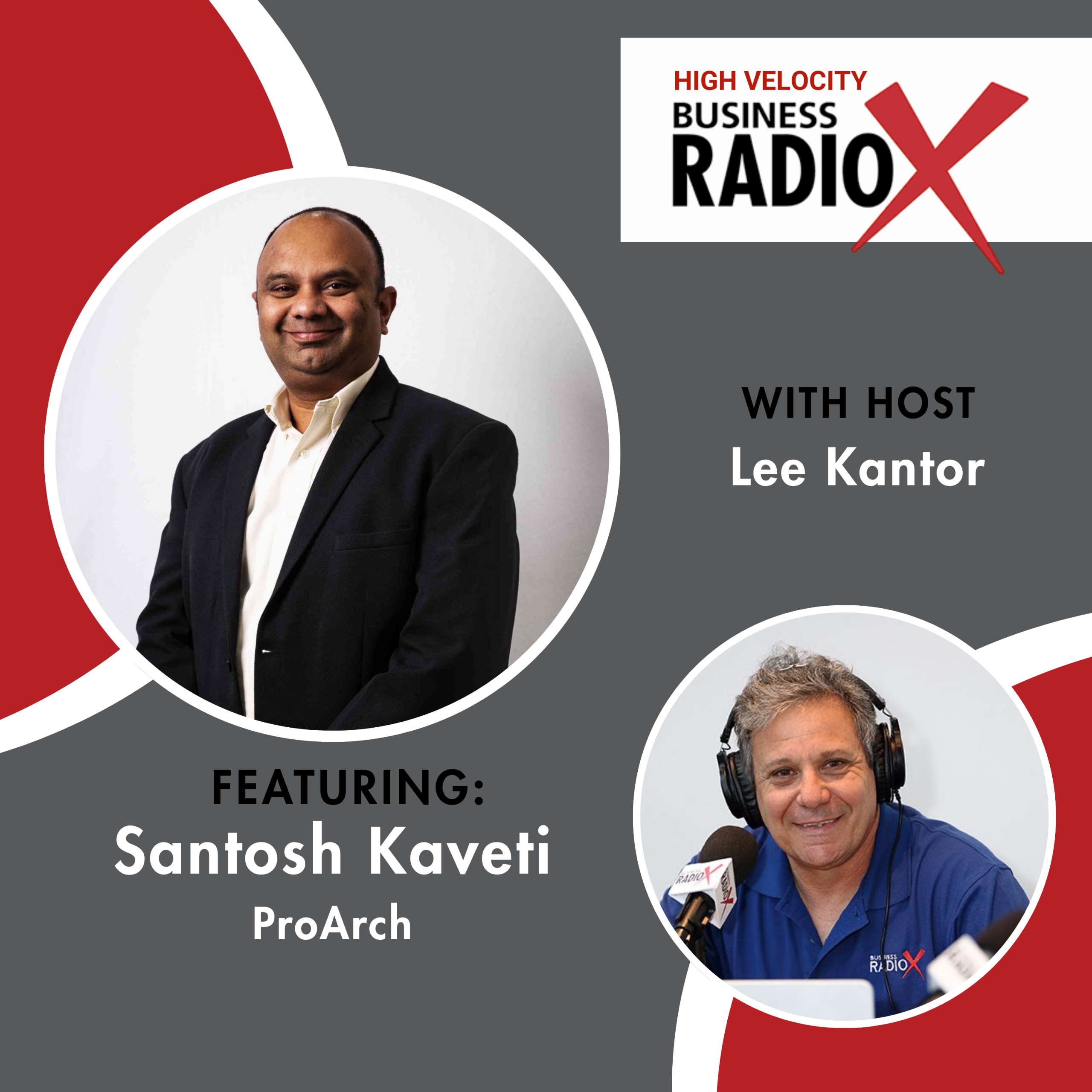

In this episode of High Velocity Radio, Lee Kantor interviews Santosh Kaveti, CEO of ProArch, about helping organizations operationalize AI with a secure and scalable foundation. Santosh explains why successful AI adoption starts with strong data governance, cybersecurity, and compliance before organizations deploy AI across departments. He also shares real-world examples from healthcare, manufacturing, and energy, demonstrating how businesses can reduce risk, improve operational efficiency, and achieve measurable ROI through a strategic AI roadmap.

 With over 18 years of experience as a technologist, entrepreneur, investor, and advisor, Santosh Kaveti is the CEO and Founder of ProArch, a purpose-driven enterprise based in Atlanta, GA, that accelerates value and increases resilience for its clients through consulting and technology services—enabled by cloud, guided by data, fueled by apps, and secured by design.
Today, he is leading ProArch’s evolution into AI-driven enterprise transformation, helping organizations design, deploy, and securely scale AI solutions, including intelligent agents and automated workflows embedded within core business systems.
His vision and leadership have propelled ProArch to become a dominant force in key industry verticals such as Energy, Healthcare & Lifesciences, and Manufacturing, where he combines deep operational expertise with a forward-looking approach to AI adoption—ensuring innovation is both impactful and responsibly implemented.
Connect with Santosh on LinkedIn and follow ProArch on Facebook.
What You’ll Learn In This Episode
- Building a secure data and governance foundation before implementing AI.
- Aligning AI initiatives with business goals while managing risk and compliance.
- Identifying practical AI use cases that deliver measurable business value.
- Improving operational efficiency through predictive AI in healthcare, manufacturing, and energy.
- Controlling AI costs while maximizing long-term return on investment.
- Treating AI as a business transformation initiative rather than simply a technology upgrade.
- Creating collaboration between business leaders, IT, data, and security teams for successful AI adoption.
 This transcript is machine transcribed by Sonix.
TRANSCRIPT
Intro: Broadcasting live from the Business RadioX Studios in Atlanta, Georgia. It’s time for High Velocity Radio.
Lee Kantor: Lee Kantor here another episode of High Velocity Radio, and this is gonna be a good one. But before we get started, it’s important to recognize our sponsor, Business RadioX. If you’re a business consultant who’s tired of being a best kept secret, set up a call with Stone Payton at bookstonephone.com to unlock your perpetual prospect pipeline. Today on the show, we have the CEO with ProArch, Santosh Kaveti. Welcome.
Santosh Kaveti: Thank you so much for having me, Lee.
Lee Kantor: Well, I’m excited to learn what you’re up to. Tell us about ProArch. How are you serving folks?
Santosh Kaveti: So, you know, we’re actually celebrating our 20th anniversary this year. We primarily help our customers in making sure that they can operationalize AI, but do it the right way. And that’s the key. And we have solutions across various verticals or industries, but we mainly focus on critical infrastructure such as power generation, healthcare and manufacturing. Again, our goal is to help them through their AI journey.
Lee Kantor: So being around 20 years, have you always been following this path or is this now a pivot to AI?
Santosh Kaveti: Well, we’ve always been a technology partner for our customers. We bring full stack in and, and of course, yes, this was a evolution. I don’t know if I’ll call it a pivot, but definitely an evolution for us as Jen. Jen. Ai took traction. Really brought in our entire full stack, meaning bringing the data, cloud, AI, and security together. That was our strength and it was natural for us to, to then start talking about how can we really help our customers with AI. And as you know, AI has been around for a while and we’ve been doing AI work even prior gen AI came through, but definitely an evolution for us.
Lee Kantor: And then what was kind of how were you working with your customers to kind of reframe putting AI at the forefront?
Santosh Kaveti: Um, so, you know, customers are different. Customers are in different path and different maturity curve and different journey being a full stack technology provider. We kind of understand where they are. We can come in where they are at their maturity level. I’ll give you a few examples. Some of our customers basically, hey, we are experimenting with AI. Yes, we’ve installed a few AI tools, but we really don’t know where to go from here. You know how to build our AI use case inventory. How to improve our readiness as a company from top to bottom. How and then how to go on the journey and how to measure success. How do we really ensure that we are getting the proper ROI? And more importantly, how do we do this securely? Because AI is going to amplify good, bad and ugly and accelerate that amplification. Um, and they’re really concerned about, you know, if something goes wrong, unlike before, things were manageable. They will not be manageable. So how do we do it with the right security and the governance foundation?
Lee Kantor: Now, isn’t AI kind of a blunt instrument in that it’s so broad, like AI in it and working through the IT teams might be different than AI and the accounting team and AI in the marketing team. So how do you kind of create a holistic policy that or, um, execution so that it’s doing what, you know, the leadership, the C-suite leadership intends it to do? Because each team, I would think is kind of on its own adventure.
Santosh Kaveti: I could not agree with you more. Every team is on their own journey. Um, but fundamentally though, what cuts across everything is their, their, their readiness. One, two. Um, do they have the secure foundation to go on this journey? It’s one thing to say I’ve installed a tool like a copilot or cloud or open AI. It’s a totally different ballgame when you try to put an AI into a workflow or a set of processes across multiple applications, people and functions. And that’s where we come in. Uh, the fundamental blocks. I mean, it’s not lack of technology. The technology is there. It’s just a matter of understanding what is that they’re trying to accomplish and making sure that from infrastructure perspective, tooling, perspective, visibility, perspective, control perspective, that they have what they need and they understand the risks as well. Because not just it’s not that they are trying to use AI. All of their third party applications are beginning to say, hey, I have AI now. What does it really mean from a risk perspective? So understanding the risks is super important to them. So there are things that cut across all the departments and that’s what we that’s where we start. We create a solid, secure foundation like data.
Santosh Kaveti: Data security is super important. If you really want to go on, you know, AI journey, a number of our customers come to us and say, hey, we want to use this, you know, AI in this particular use cases. And we know this is going to work when we sit with them and start talking about how they want to leverage AI. We realize very quickly that the data quality that they have, data governance and data security posture that they have is simply not ready for them to start leveraging AI or applying AI. So we start with that. So that’s the fundamental thing is we make sure that at first across all of their functions, departments, applications, infrastructure, there is a baseline security that’s in place and governance that’s in place. And then of course, from that point forward, um, you know, every, every department can go on a different journey. Um, what I’m finding interesting is that, you know, unlike before, when it comes to technology, primary conversation drivers, where it, you know, CIO or CISOs, um, now it’s business owners, they really want to use account, as you rightly said, accounting, marketing, sales, they really want to use AI, but they need help doing it the right way.
Lee Kantor: So it sounds like before they even begin, it’s important to foundationally have kind of the cybersecurity questions, the compliance questions, all of those things have to be answered to build that solid foundation. So then it can be deployed, um, company wide.
Santosh Kaveti: Absolutely. They definitely need to understand their infrastructure risks because of AI, their application risks, their data risks, and then apply proper controls and processes in place. Um, and, and we can do it. It’s, this is not, I mean, the technology is there. Uh, for example, we, we partner with Microsoft. Um, and we leverage their technology ecosystem, you know, broadly across our customer base and the technology is there. It’s just that most customers don’t know where to start, what to use, how to use them, how to do it the right way. And also, you know, not not a surprise, not be surprised by the bill, you know, and of course, as, as as you know, AI, AI, billing mechanisms and cost mechanisms are changing, you know, from monthly fees to completely, you know, token maximization and so on. So we help them through all of that as well, making sure that they are cost conscious and they can see the ROI as they are implementing AI across their business functions and, and all their, all of their use cases.
Lee Kantor: Now, are you typically coming in right now after they’ve kind of tried something and messed it up and you’re there to triage it? Or are they actually including you in a proactive manner to get everything right before they really kind of go all in?
Santosh Kaveti: I love that question. So both some customers, um, they have started their journey in between. They’re stuck somewhere and there’s a blocker blocker could be, hey, we saw this security exposure here. Can you all come in and be a healthcare customer? Compliance is a big deal for us, and we want to make sure that everything we do, we are not in noncompliance. In some cases they are. Most of them have started the journey. You know, by now they said, hey, we deployed copilot individually. People are using it. But you know, we know that’s not that’s not enough. There’s, there’s more we could do with AI. Can you all come in and help us, uh, like ground up. So we, we go in both ways. And some of them bring us in for advanced use cases like a, of a manufacturing or floor plan running. I want to optimize, I want to make sure that I reduce my downtime. And these are the use cases that I want to implement AI for. Can you all come in and help? Uh, this is now advanced AI applications, creating custom AI applications for them and so on. So we come in wherever they are in their journey.
Lee Kantor: Now because you work with such diverse client base, have you kind of is there some best practices you can share? Maybe low hanging fruit? That’s a good starting point for organizations when they’re kind of getting into AI or they’re, you know, some some easy wins for them.
Santosh Kaveti: Absolutely. So most organizations for their collaboration, um, use some type of a platform in our case, uh, Microsoft ecosystem, like teams, copilot outlook. Um, so our recommendation always is leverage tools like purview as your starting point, your starting point should not be, I’m going to implement copilot Co-work across the organization. The starting point should be a. Before I go on this co pilot and copilot cowork journey, let me actually leverage purview to understand, you know, where you know, where my data sets the visibility and the risks and the exposure that I have. Make sure that you have controls in place and then, you know, the proper identity management. You have to treat AI, especially AI agents, as people are now beginning to create agents, as some of these tools are allowing them on the fly. To create agents, you have to treat every agent as a human being. That’s super important. And you have to make sure that when something happens, you actually have visibility and you can you can go back and auditability essentially go back and say, hey, I can trace this and see this is why it happened. Those are the important things. And to put it simply, to answer your question, start your journey with something like a purview, an excellent tool that will give you a really good start, worth the investment. And then of course, after that, you can go on the journey.
Lee Kantor: Now, is there a story that you can share that might illustrate how you work with your clients. Um, maybe don’t name the organization, but maybe the challenge that they came to you with and how you were able to help them get to a new level.
Santosh Kaveti: Yeah, we’d love to. So, um, in, you know, in, in one case or one example, this healthcare customer, um, they’re on the CMS base, um, Medicare and they have, you know, for them, human labor allotment is super important. They want to leverage AI. They are about 2000 team members. They have 2000 employees, um, in the northeast. Um, and they want to go on this AI journey. Um, but very quickly we realized that, which is great. And they want to solve this through AI. They want to apply AI to make sure that their labor is allocated Efficiently. They saw a lot of inefficiency and leakage. Um, and that’s what they really wanted to do. But then when we worked with them, it was very clear that the data that they had and the quality of the data and of course, the security exposure of that data from compliance purposes, simply they were not ready. So we had to go back to the basics, establish data governance practice, establish who owns the data and how they can be accountable for the data. What’s becoming in this AI era is that every function, every department is producing data and data is becoming a product now. And that data now is used by, um, enterprise level AI across their systems. So the governance and the quality of that data becomes super important. So we picked one domain. We made sure that there is proper governance, security in place, uh, leveraging our teams and our tooling. And once that was in place, then they were able to implement that particular AI use case.
Santosh Kaveti: Then later on, we extend that, that same practice to another domain. When I say domain, it could be accounting, it could be, you know, um, labor, it could be human resource and so on. That’s when we propagated across across different functions and different different domains. Another example, um, you know, we work with power plants and we picked some high value, um, equipment within their OT systems. And we are able to predict certain events way ahead or well ahead of what, you know, they would have manually or with, with the data tools that they were using manually leveraging AI, of course. And when I say these, these events could lead to, you know, six figure losses if they are not managed correctly. We were able to apply AI to a set of very critical path equipment and reduce the downtime, catch the events early, or even predict the events early, and even prescribe and say, hey, you probably ought to start doing this now. This particular equipment’s, you know, this equipment is not working correctly as it’s supposed to. We’re noticing this and our recommendations are and so on and so forth. And the beauty of this is this is very this is done very intuitively. Like unlike before, you don’t have to go through a lot of data and dashboards. They can just talk to the AI and go into details and then, and then get the recommendations and then act on them.
Lee Kantor: So now you mentioned health care and power plants. Is there other kind of industries that you primarily work in. Is your work pretty industry agnostic at this point?
Santosh Kaveti: Um, we mainly focus in, in, uh, power gen or energy in general healthcare and manufacturing. Um, outside of that, you know, most of our technology can be applied to any industry, but when I, when I look at our customers and segment them, we have a lot of, uh, you know, banking customers, mainly credit unions. Uh, and we also have a lot of ISVs, meaning companies that are building software and products. As you know, that entire software industry is changing and we’re now helping our customers how they can adopt AI and, and be a lot more AI native in their approaches to building products. Unlike before, what used to take months or years to build something has now taken weeks. Uh, but again, doing it the right way, making sure that they are not falling into this trap of AI, slob or technical slob and all actually producing the quality of code that they need to produce. And that’s also secure. That is something that helps a lot of issues. But our main focus verticals are, as I said, energy, manufacturing and healthcare.
Lee Kantor: So what is kind of the pain that your clients are having right before they call you?
Santosh Kaveti: Um, so maybe three categories. Uh, one is, um, uncertainty. Um, they’re, they’re worried about the cost exposure of AI, the risk exposure of AI. That’s probably, you know, those two are the important ones, uh, that they are unsure that they’ve seen, they’ve read many, many cases where AI is going to become, it has become very expensive for many organizations as they went on the journey. So they’re very cognizant of that. And of course, as I said, the risk risk is The second biggest pain point uncertainty over how do we how do I manage this risk? Because they know that they’re beginning to now learn that once they leverage AI, let’s say an incident happens. It may not be manageable unlike before, because as I said before, AI is going to amplify the bad and the ugly as just as it amplifies the good part. These are the two, you know, really the big concerns. The other concerns is how can they break organizational structures that they’ve built over the years to leverage AI efficiently? We see this time and again. Um, AI is changing business models, but it’s also acting like a catalyst to redefine the work to redefine how people collaborate, how they think about work. I think in. Many are struggling to figure out, okay, so how do we structure ourselves around what’s called as an AI native frontier company? So these, these three are the big pain points.
Lee Kantor: Now, when you, uh, you mentioned the evolution of your company now, um, emphasizing AI, what was kind of one of some of the biggest surprises when you were leading your organization when it comes to AI, what maybe things, some of the good and some of the bad when it came to your evolution in this area?
Santosh Kaveti: Oh, that’s a great question. Uh, for us, it was a very deliberate, uh, decision. The choice was we saw AI getting very disruptive. So our choice was to be disrupted as it was changing all facets of our business. You know, historically we as I said, we have very strong, very full stock, full stock pattern partner. So we have app dev data, cloud, AI, security practices. All of those practices were getting disrupted at an alarming pace. And we noticed that and say, okay, so this is going to be a disruptive technology and the adoption is going to be it is scale unlike before. So our choice was to be disrupted or to take advantage of this. And then we disrupt in a positive way, way, meaning we create an opportunity for ourselves by doing it the right way. So our teams have done a fantastic job of, of saying, look, this, while this could affect. Does this also creates an opportunity And we brought everything, you know. Essentially what was happening was for a long time, we were able to run our practices independently. There was a data practice, there was AI practice, there was security practice, there was a cloud practice, and we noticed everything was converging very fast. So we brought teams together, we converged them. And any AI conversation that we go to today, we have an infrastructure architect, we have a data architect, we have AI architect, we have a security architect working together to design how a program of work should be. So that and then of course, what are the appropriate tools and how do we prove the value that we’re delivering? So for us, it was that deliberate choice. And we made a choice to now we’re going to not only build the resilience, we’ll build opportunities so that we can continue to thrive by helping our customers, and that’s what we chose. And our teams have done a fantastic job.
Lee Kantor: So if somebody wants to learn more and connect with you or somebody on the team, what’s the website? What’s the best way to connect?
Santosh Kaveti: Yeah, so we’re very active. Uh, our marketing team does a fantastic job. Uh, our LinkedIn, uh, Pro Arch and website proarch.com, proarch.com. Uh, I’m very active on LinkedIn as well. Uh, Santosh Kaveti, you’ll definitely find me there. Those are the best channels.
Lee Kantor: Well, thank you so much for sharing your story today. You’re doing important work and we appreciate you.
Santosh Kaveti: Thank you so much for having me. Appreciate that.
Lee Kantor: All right. This is Lee Kantor. We’ll see you all next time on High Velocity Radio.















