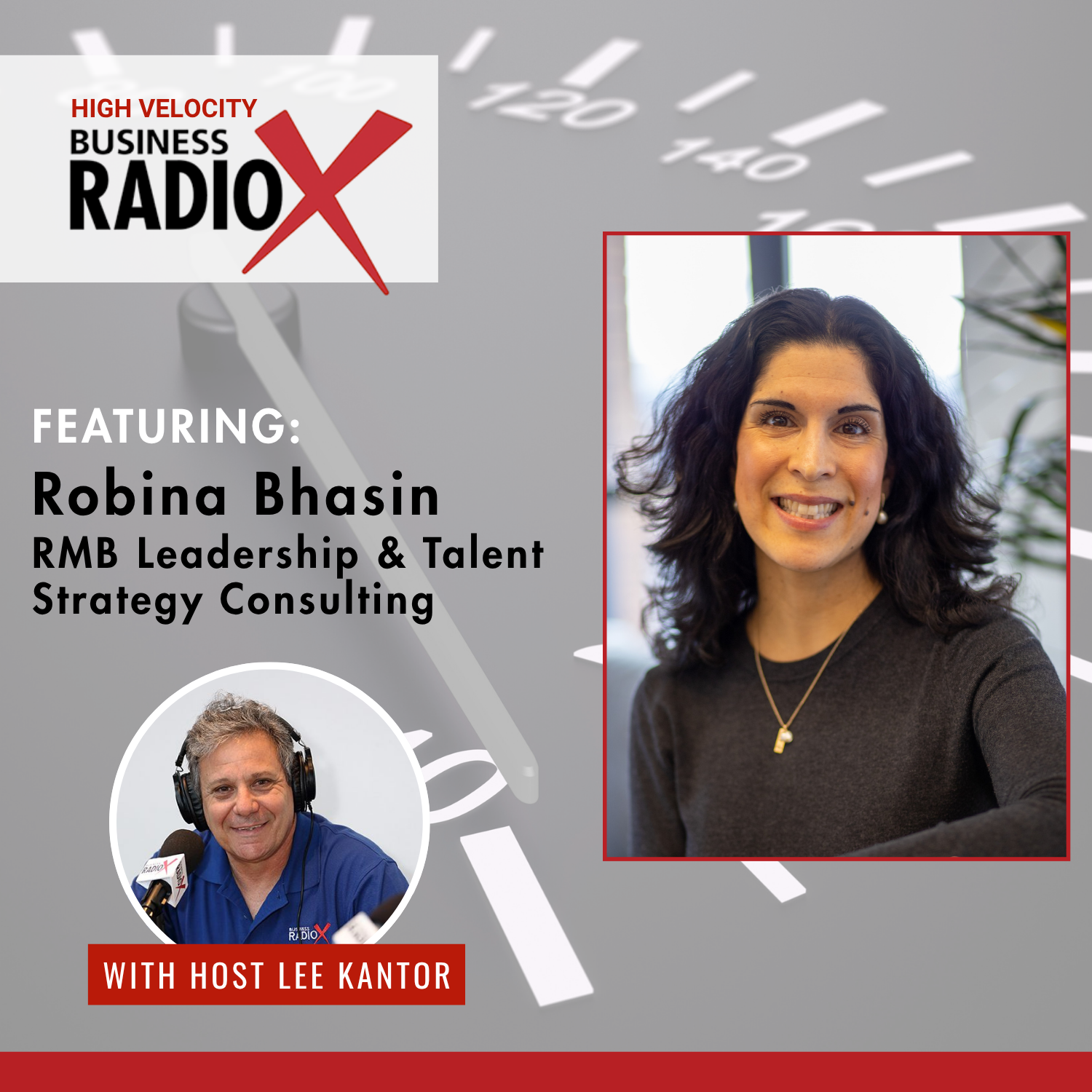

In this episode of High Velocity Radio, Lee interviews Robina Bhasin, founder of RMB Leadership & Talent Strategy Consulting. Robina shares her journey into leadership coaching, shaped by her multicultural background and 20+ years of experience across industries. She discusses the importance of building a culture of continuous learning at all organizational levels, not just for executives. Through real-world examples, she illustrates how coaching helps leaders overcome blind spots, empower their teams, and improve workplace dynamics. She concludes with advice to practice curiosity and extend grace to others in professional settings.

 Robina Bhasin is a certified coach and talent leader with more than 20 years of experience developing leaders and building high-impact organizations across five continents. She partners with individuals and organizations to strengthen leadership capability, foster inclusive and empowering cultures, and design programs and systems that enable people to reach their full potential, thrive in their roles and find meaning in their work.
Her approach integrates evidence-based leadership frameworks with emotional and cultural intelligence, grounded in practical application.
She has supported leaders and led teams across the private and nonprofit sectors, including finance, tech, healthcare, life sciences, and higher education, helping them navigate complexity, overcome challenges, and create sustainable, people-centered success.
Robina is an Associate Certified Coach (ACC) through the ICF, a Certified Professional Co-Active Coach (CPCC), a TypeCoach Certified Professional, and a Center for Creative Leadership 360 facilitator.
She holds a Bachelor’s degree in International Relations from Tufts University and a Master’s degree in International Education Policy from the Harvard Graduate School of Education.
Connect with Robina on LinkedIn.
What You’ll Learn In This Episode
- Leadership coaching and its significance in organizations
- Evolution of coaching practices over the past 20 years
- The importance of creating a culture of ongoing learning and development
- The role of leaders in modeling coaching and feedback behaviors
- The distinction between coaching as a remedial tool versus a developmental resource
- The impact of coaching on individual leaders and organizational dynamics
- The importance of self-awareness and reflection in leadership
- The universality of leadership challenges across different industries
- Balancing organizational consulting with individual coaching
- Actionable advice for leaders on curiosity and empathy in communication
 This transcript is machine transcribed by Sonix.
TRANSCRIPT
Intro: Broadcasting live from the Business RadioX Studios in Atlanta, Georgia. It’s time for High Velocity Radio.
Lee Kantor: Lee Kantor here. Another episode of High Velocity Radio and this is gonna be a good one. Today on the show, we have the founder and leadership coach with RMB Leadership and Talent Strategy Consulting, Robina Bhasin, welcome.
Robina Bhasin: Thank you so much and beautiful pronunciation, lee.
Lee Kantor: Thank you, thank you. That’s that’s the hardest part for me. Well, I appreciate that. Well, before we get too far into things, tell us about your practice. How are you serving folks?
Robina Bhasin: Thanks. Yeah. Well, first of all, thank you so much for having me. Pleasure to be with you and with everyone who’s listening. So the work that I do, yeah, leadership coaching, a lot of it is really focused on supporting leaders within organizations. I really have chosen to focus on this space because I feel like leaders have such an outsized impact on our experience at work. Um, and because in all my years of working in different countries, sectors, organizations, I’ve never actually come across anyone who’s intentionally trying to be a bad leader. You know, just we all have blind spots and often no one’s really helped us to figure out how we want to show up and be leaders. So I do a lot of work partnering with organizations to support leaders and also to support teams to help leadership teams often think about how they want to be showing up with each other, and how they want to collaborate to really bring out the best in each other. So most of my practice focuses in those areas.
Lee Kantor: So what’s your backstory? How’d you get involved in this line of work to begin with?
Robina Bhasin: Yeah, well, I would say the starting point was like way, way back. I would say I was born in the US to immigrant parents from two different countries. And then I grew up here. So I’m in a third country, and I only share this as a part of the story because I think it instilled in me from a really early age or from, you know, as far back as I can remember, a real love of bringing people from different backgrounds and spaces together to be able to kind of connect with each other. I always have felt like there’s like a magic in that space. And so I have worked in talent and leadership development throughout my career, and it’s always really been about creating spaces for people to be able to connect individually or in groups, just, you know, to be able to learn from and with each other. And so I did this initially more internationally with ministers of health and doctors from post-conflict countries. And then I worked with teachers in the Middle East and North Africa, and then in the US with physicians and scientists and university setting and with with leaders in companies, in tech and finance. And so I think that piece of connecting with people, not just talking to them, but like the real connections and conversations that, that, you know, kind of bring up candor and honesty and vulnerability that space is so energizing for me, and I find people and organizations fascinating.
Robina Bhasin: So coaching and particularly coaching leaders has been an integral part of my work forever, really, for as long as I’ve been working, which is over 20 years now. A little shocking for me, but and then I took the step to become a certified coach after being inspired by an external coach that I ended up bringing in when I was leading talent and a tech company. And I thought she was such a brilliant facilitator and able to create such valuable containers for people to share openly and draw out great insights. And I just thought, if this is what it means to be a coach, then I want to learn how to do it. And so I’m not sure I ever if I’m as good as she is, she, she really is brilliant in what she does. But, but that was the impetus for me to sort of get into this space to, to be able to pursue the certification myself. And so this shift into being a coach officially, not just as an informal part of my in-house roles, that just felt really like a natural progression of what I’ve been doing over the last 20 plus years.
Lee Kantor: Now what what was coaching like kind of throughout your career? Was coaching very important in the different places you worked? Was it not there at all? Like what was like? How have you seen it evolve over the 20 years you’ve been in this kind of world?
Robina Bhasin: Yeah, I know it’s such a great question. So I don’t, I, it actually was not a formal part of any of the organizations I was part of, except for that one that I was mentioning. That was like a hand more than a handful of years ago. That was an ed tech company where we actually did go out and hire external coaches to support some of our leaders. But otherwise, I would say that the work that I was doing was like, it included so much coaching because I was meeting with leaders on a regular basis. I was meeting with people on a regular basis to really help support them with whatever challenges were going on. So, um, you know, when I was working in an academic setting, it was working with the faculty who were trying to figure out, well, okay, I’m in this place in my career and where do I go from here? Or, you know, I have this team that you know, that I’m working with. And this is always astounding to me. It was these brilliant doctors who could be having such challenging conversations with their patients, but then they were leading a team, and that felt extraordinarily difficult to figure out how to hold people accountable and get feedback. And so I was supporting them to think about how they could go about doing that. So it wasn’t necessarily that they were like, oh, I need to get coaching. And they were coming to me. It was more that in the roles I was in, I was like a natural sounding board and thought partner for them. And so they would look for guidance and support. And I just found that I really enjoyed being in those spaces. Um, so yeah, that’s been how I have integrated it into the work that I’ve been doing over these years.
Lee Kantor: So it was kind of informally there and you were doing kind of coaching things, but it wasn’t in a structured coaching way that it’s being done nowadays.
Robina Bhasin: Exactly, exactly. And eventually I realized like, oh, this is a thing that I could go and get certified in and actually do. And so now, um, I actually do both. I do some consulting to really help organizations think about, you know, how either, how they, uh, how they’re thinking about what’s important to them organizationally as a culture and really serving as like a sounding board and thought partner for some of their senior leaders and sometimes a little bit, yeah, more structured in terms of, you know, I’m here and I’m trying to get there and I’m looking for some support to be able to get there. And then we have like a more structured coaching relationship.
Lee Kantor: So you’ve been on kind of both sides of the desk now. Is there like if you were, um, kind of in the executive role in an organization, how would you kind of build that ideal coaching culture? Um, like in a given organization, you must have some thoughts on this, because you have seen both sides of this and how it could work and how people could benefit. So do you mind sharing kind of a maybe a dream scenario of how you. Yeah.
Robina Bhasin: Like how do you do this as an organization? Right? If you’re in the leadership role, how do you create a culture like this? So I would think about it a little bit less as a coaching culture and more a culture of ongoing learning and wanting and sort of normalizing the fact that we all have space to continue to improve and grow. And what coaching offers is a space for greater self-awareness and reflection, and being thoughtful about how we really want to be showing up with each other, with our teams. And so I think from the organizational standpoint, the ideal is that from the very top, there’s open talk about this is something that we all seek out, right? This is a normal part of what it means to be great at our jobs is seeking out support, training, ongoing learning in the form of coaching and other ways. Right? It doesn’t just need to be in the form of coaching, but this is a part of what it means for us to really do great work is not just to sort of say, oh, I’m good, so I’m going to just stick with this. But continuing to look for the kind of feedback that we need to continue to get better and for opportunities to grow. Does that make sense?
Lee Kantor: Yeah. And would you say that, um, kind of a healthy organization would have this type of thinking and culture trickle down to all levels of the organization, or should it stay kind of at the, the higher level?
Robina Bhasin: Absolutely. Thank you for drawing that out. Yes, for sure. I sort of say it starts at the top because I think that modeling really matters. But I think absolutely, ideally, this is something that is in all parts of the organization. I think sometimes it’s interesting. I’ve seen coaching treated in a couple different ways, either that it’s sort of something that is only for the executives. You know, it’s like this exclusive sort of idea or something that’s done for the people who are a problem, right? So it’s like remedial coaching, right?
Lee Kantor: Like fix fix, Bob.
Robina Bhasin: Yeah. Right. Exactly, exactly. And I would say I find the latter to be more, um, challenging. It’s not typically the work that I’m doing. There are situations where there are people that, you know, they have been successful, they bring so much value and they have some blind spots. And there’s a desire to help them sort of gain some greater awareness around those and maybe like broaden their toolkit of the things they’re working with so that they can show up a little more effectively. But I think often we think about it as like, either it’s this exclusive thing or it’s like a remedial thing. And I think the ideal is that it’s really normalized. It’s like, this is a part of what we all do to continue to get better in our roles and, you know, in who we are as professionals.
Lee Kantor: Yeah. I think it’s a way that an organization can kind of lean into that mission statement. They always say that their people are their most important asset. Exactly. It’s like, okay.
Robina Bhasin: 100%.
Lee Kantor: Let’s upskill all of our people then. Like that should just be part of the DNA of the organization.
Robina Bhasin: Yeah, absolutely. And I think a part of the work that I do, I mean, I used to always say that what I do is think about how do you create great places to work. And I think this is a part of it. And I’ve chosen to really kind of lean in on this. But for many years, I was focused across like, what are all the pieces that go into creating a great place to work? And for sure, investing in your people is a huge part of it. And thinking about like, what’s the environment that they’re operating in? Right? And how do we think about how we set that? And so things like this where we say we’re normalizing ongoing learning and sort of saying that this is a part of what makes us great is, um, is essential to that.
Lee Kantor: So now what’s it like to work with you? Are they coming in to triage a situation typically when they call you, or is it something that they’re being more proactive?
Robina Bhasin: Yeah. You mean like how why are people coming in?
Lee Kantor: Yeah. For that, that like the first call, the, the reason why they’re, uh, having a conversation to begin with.
Robina Bhasin: It really varies. So I would say I’m trying to think, I’ll give you a couple examples. It varies from, um, you know, someone in the organization. So often I am working with my initial contact in an organization is someone who sits in the C-suite. So, you know, could be CEO, could be chief people officer, could be COO, but someone who’s sort of saying, hey, you know, there’s, there’s stuff here that we think like needs some support. And so it could be an individual that they’re saying we’re seeing someone who’s like, great in many ways struggling in certain ways. We have someone who’s looking for, you know, who’s at a certain point in their career where they’re looking for some for some additional kind of inspiration and space to be able to think about where they’re going. Or it could be someone who’s newly promoted into a leadership role and wants to be able to have some support as they navigate that so they can be intentional about what they do. Um, and then sometimes it’s about a whole group, right? Sometimes it’s like, hey, this is like a program that I’m doing right now. It’s like there’s a set of managers, um, you know, that the company has gone through some changes and some through new leadership and they’re saying, we have a whole set of people that we really want to be able to upskill and sort of shift the way that they think about what it means to show up as a leader, um, and help them with some skills and help sort of create this conversation as something that’s happening. Um, on the team across our, you know, various functions.
Robina Bhasin: And so we’ll create something like that that serves what they’re looking for. So it, it really looks a bit different depending on the organization. And I think my approach similarly is that it’s not that there’s like one thing that I would do in every situation. I, for me, probably the one thing I do do in every situation is to figure out where are people at, right? Like, where are they? What’s drawing them to coaching? Is it something that someone else asked them to do? Is it something that they wanted to do? Um, and like, what do they hope to get out of the experience? What, what do they want to be different on the other side of our work together? And so from there, we just do some self exploration about, you know, what they feel is getting in their way, what’s important about it to them, um, understanding sort of what are the mindsets or beliefs that are behind whatever is going on. And I think, um, you know, what they think would better serve them. So I think helping them have some greater awareness and tools that are going to help them be able to navigate things differently going forward is the goal. But I would say it’s not that there’s one specific way to get there. I think it really is about understanding where that person is at. And, um, you know, often I talk about like holding up a mirror to help someone better understand themselves by asking them lots of questions to uncover what’s truly important to them. And, you know, the wisdom that they already hold about how they want to go forward.
Lee Kantor: Now, as your work kind of industry agnostic, because that challenge sounds industry agnostic, even though that your background is kind of specific. Are you working in similar areas you worked in previously, or have you expanded kind of to be industry agnostic at this point?
Robina Bhasin: So in a way, I’ve always been industry agnostic in that. I always say people are people, and I’ve been struck by how the challenges that we struggle with look very similar. Whether we’re in a tiny nonprofit and working more globally, or we’re in a huge organization that, you know, is in tech or in finance or in education or in health. Like I think, um, because the work I’ve done has always been focused around like the people and talent side of things, but I’ve done it in so many different kinds of organizations and that continues to be true. Um, yeah, it really, it’s, I am currently working with organizations that are in tech and the nonprofit and health services. Um, and in finance, I’m trying to think, um, but yes, in education, so there’s, there’s like a nice spectrum, but at the end of the day, you know, some of the jargon is different. The specifics to some of the things people talk about are a little different. And so yeah, it’s helpful to have a little understanding of that and understand some of the acronyms they use in their world. But and, you know, the hierarchies and challenges that exist, but I think, um, the, the real crux of what it is to work and show up together, we’re all humans and we all tend to struggle with similar things. And so, um, I, it is really sector agnostic.
Lee Kantor: Now is your work, like, how would you describe the split between helping an organization versus helping kind of an individual person that might have plateaued and needs help kind of getting to a new level?
Robina Bhasin: Yeah. Um, it varies a little bit depending on the moment in time right now. Uh, I’m trying to think what the split would be. Maybe, um, 30, 70, the 30s, organizational and 70s with um, individuals or teams. Um, but it, you know, that it changes a little bit depending on just the set of, of clients that happen to be working with at the time. Uh, I love both. And I think actually part of what I feel so grateful to do is to be able to do work in these different spaces. It certainly keeps it interesting, um, because the day is filled with all kinds of different engagements and working with people in different capacities, sometimes as teams, sometimes as individuals, um, and sometimes really just being able to help be like a thought partner on what’s going on in an organization and what else can be done to help make things better.
Lee Kantor: Is there a story you can share that may be, um, kind of illustrates that on how you work with an organization, don’t name the name of the organization, but maybe share the challenge that they had and how you were able to help them get to a new level.
Robina Bhasin: Yeah, sure. Um, so the first thing that comes to mind is because I was on a call with them earlier today. Um, so an organization that has really wonderful leadership, um, senior leaders and executive team that’s been working together for a long time, really solid working relationships. And they have, um, they have a set of leaders that work directly under them in, um, in roles that all have the same sort of level, right? They’re all director level people, but the day to day looks quite different because of the different kinds of roles they have, and they have come into the organization at different times. And part of what’s been going on is that despite all kinds of efforts to, you know, really create a great working environment and have a space where people feel like they can show up and, um, you know, their psychological safety and all that. There’s still some stuff that is getting in the way. There’s sort of underlying dynamics and challenges that are going on across this team that is making their collaboration more difficult and is leading to. So one, you know, they’re not working at the level that they could be. And, um, and you know, what happens, like then there’s like undercurrents and back channeling and gossiping and sort of things being said behind people’s backs instead of really coming out.
Robina Bhasin: And so, you know, when you’re in those spaces, like everyone senses that something’s not quite right, but no one’s really having the conversation. And so, um, they have asked me to help them sort of figure out what’s going on and how this team can work more effectively together. And we’re in process of this. But I think it started for me with really trying to understand where each person was at and you know, what’s going on and how they see things, right? What is, what does the world look like through their lens? And then bringing the team together to think about how they want to be showing up with each other, doing some work with individuals where there’s particular attention and supporting the team overall to uncover like how what is important to us, right? How do we want to be showing up together? And what are some tools that we can use to have some of the conversations that we’re not currently having because we’re all just a little afraid to have them? Um, so yeah, that’s like, that’s an example of, of the kind of work that I would be doing with an organization. Right? Working with a team, but, um, helping surface what’s not being said, um, and helping them identify how they want to be together and have some tools to actually do it.
Lee Kantor: So let’s change gears to the individual. Can you share a story about how, uh, maybe an individual came to you with a challenge and how you were able to help them?
Robina Bhasin: Uh, yeah, let’s see what’s a good one. Um. So, um, let’s see, I’m trying to think of what’s going to be a good one to share. I had an individual that I was working with who, um, had been extremely successful in his, in his career and his ascent. He had done super well within this company. He was reporting into the CEO at the time that we started working together and he was hitting some sort of bump. You know, it was like for as smooth as things had been and as well as he had done and has respected as he really was in the organization. There was something that was kind of getting in his way. He was starting to get less positive feedback from his team. And, um, and he was starting to get a little discouraged. He was kind of like, I don’t, you know, he was looking to take the next step, you know, advance even further and feeling like he was getting blocked. And I think in situations like this, and it was certainly true with him. It’s tricky because sometimes when we’ve been so successful, we lean very heavily on the strengths that got us there. Right? So in this case, he was a brilliant he is a brilliant engineer who grew and had the success he did because he knew a ton and was in the weeds on everything.
Robina Bhasin: And what was happening over time. What we uncovered was that because he was so tied to that notion that being in all the weeds and knowing everything that was happening was so essential for the team or for him to be successful. He wasn’t letting go and he was disempowering his team in some way. And, you know, in the meantime, over these years, he had grown quite a large team, some really, really bright people with, you know, fantastic backgrounds, some who had skills that surpassed his in certain areas. And yet he wasn’t necessarily letting the team have the space to really shine. And, and he was unintentionally, um, sort of, yeah. Demotivating a bit, right? And not giving them the space to do the work they really could do. And that was holding him back. It wasn’t allowing the team to be as successful as it could, and it was creating a little, you know, a lot of frustration, I would say, in the organization and like on his team. And then it was kind of filtering out. And so helping him be able to see that. And there was, you know, more complexity to it than just this. But I think just that uncovering of the fact that something that he had, he was doing because it had led him to be so successful in the past, was now actually getting in his way, in some way.
Robina Bhasin: Um, that that discovery made a huge difference for him because it made him realize like he could step back and think a little differently about how he engaged the team. He was exhausted too, because he was working all the time. So I think just having that space to recognize what was going on, recognize the patterns, see the underlying beliefs that were leading him to show up the way he was. Um, and to think about, you know, just to be more intentional about how did he want to be showing up with his team. All of that allowed him to make some real shifts in, in the way that he engaged his team and the way that he developed people and the way that he appreciated them and in the space that he gave them to really shine in their own right to it, pretty drastically turned around. Um, what was going on in his team, the impact they were having, how his team felt about him, how this team felt at work generally, um, you know, a lot greater levels of retention. Um, and yeah, it was just, it was a, it was a great sort of turnaround story for him to be able to get over. Um, this bump that was really had become quite a barrier to him being able to continue to thrive in his career.
Lee Kantor: That’s a great example of the power of coaching. And the impact that can have is having fresh eyes on, on, um, on a situation and having a sounding board that’s a safe place to share. The impact is real. I mean, there’s definitely a trickle down effect of once you kind of get that aha moment with your clients, you can see the impact it could have throughout that individual and the organization.
Robina Bhasin: Yeah, exactly. And that’s so much of the reason that I enjoy working with leaders specifically is because the trickle down impact impact or effect is huge, right? It’s like our, our experience at work is so shaped by the leaders that we, that we report to, you know, in positive and negative ways. And so where you can help people really show up as the leaders they want to be, it makes a huge difference in, in how they feel at work. And it definitely changes the experience of their teams as well.
Lee Kantor: Now, is there any advice you can share? Maybe something that’s actionable today or in the short term when it comes to leadership? Um, is there anything that comes to mind that, um, might be useful for our listeners.
Robina Bhasin: You know, there’s two things that I think of. Um, I one is around curiosity. I think it’s so easy for all of us leaders or not, but, but certainly when you’re in a leadership role, maybe more so. It’s so easy to look at situations and assume that we know what’s going on. You know, what might be going on with another person or why they’re showing up the way they are. And I think I really, I try to practice this in my own life. And, and I certainly talk about this with so many of my clients and, you know, colleagues over the years to approach situations and people with curiosity, to genuinely seek to understand what’s going on for them, what their perspective might be, what might be getting in their way, and to then use that as the starting point for figuring out how to solve whatever the issue is that’s going on. Um, versus listening to the narrative that we often have in our own heads, right? Which is like, wow, it must just be lazy, must not care. It must be prioritizing other things. You know what all kinds of other things that we come up with, but to to really understand what might be going on for someone else. Um, and I think the other one, which is potentially related, I don’t know, is, um, just to give each other grace. You know, I, what I have found in all my years of work is that everyone’s really showing up doing the best they can, right? We’re all, we’re all trying. And so taking time to like, listen and understand each other just so that we can work together a little more easily. Um, and with, you know, a little bit more compassion, it just, it’s worth it to, to give people that space and grace.
Lee Kantor: Yeah. Empathy is an important component of life. And I think the sooner people realize that than the less stressful and happier they end up being.
Robina Bhasin: Yeah. Right. It feels like it lets us all kind of live with a little more ease, feel like, okay, they’re doing the best they are. And frankly, I, I should apply it more in my personal life, but it’s something that I, in my wiser moments, think about as well, you know, with with my husband or with my kids or with other family members where you might be getting frustrated and you’re like, you know what? They’re doing the best they can, and I’m doing the best I can. And let’s just figure out how we can just sort of have a little bit more compassion and empathy for each other, right?
Lee Kantor: It’s the you give the benefit of the doubt to your friends, but you don’t give it to like acquaintances or strangers as quickly.
Robina Bhasin: Yeah. True. Exactly. Yeah. And sometimes I’m even harder on the people like my immediate family. But, but I think being able to sort of step back and recognize like we’re all trying. Right. And, um, and then approaching things from that lens helps us just engage with each other a bit better, right?
Lee Kantor: I read something that it’s kind of the beginner’s mindset is just look at everybody as if we’re all in training.
Robina Bhasin: I love that. Yeah. Beautiful.
Lee Kantor: So if somebody wants to learn more, have a more substantive conversation with you. What’s the website? What’s the best way to connect.
Robina Bhasin: Yeah, well, I’m happy to share that information. Um, it’s a, the website in itself is a little long. I’m happy to say it out loud if it’s useful, but it’s r m um, so yeah, you’ll have the letters, but RMB talent consulting.com so you can see more about me and um, schedule time if anyone’s interested in just like a complimentary get to know you session. Um, and, uh, and you can find me on LinkedIn as well.
Lee Kantor: Good stuff. Well, thank you so much for sharing your story today. You’re doing such important work and we appreciate you.
Robina Bhasin: Thank you so much, Lee. Thank you for taking this time and for this opportunity.
Lee Kantor: All right. This is Lee Kantor. We’ll see you all next time on High Velocity Radio.















