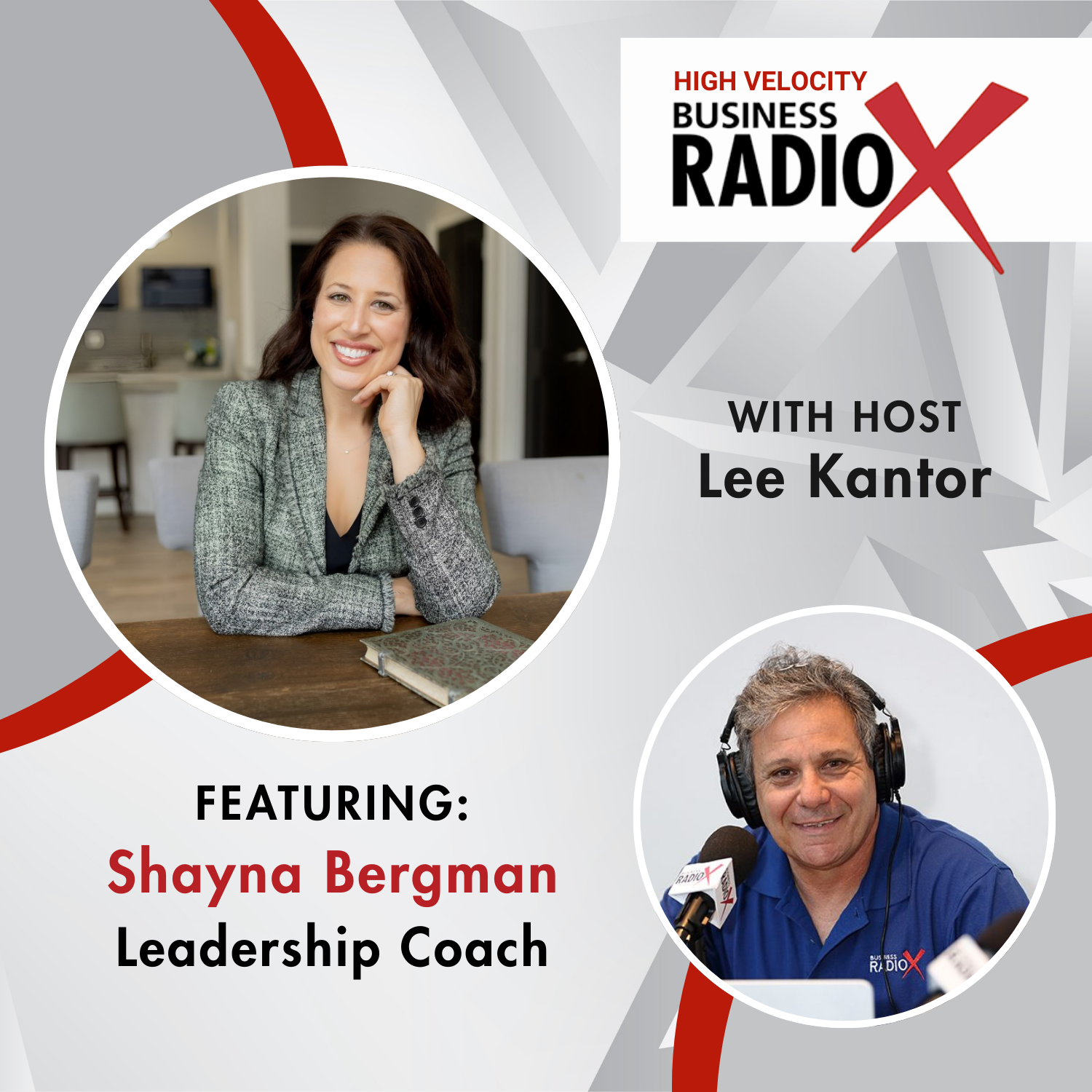

In this episode of High Velocity Radio, Lee Kantor interviews Shayna Bergman, founder of Shayna Bergman Coaching. Shayna discusses her journey from corporate HR to executive coaching, focusing on helping parents in leadership roles achieve success with less stress. She shares her personalized coaching approach, the importance of redefining success, and strategies for balancing work and family. Shayna emphasizes self-awareness, shifting mindsets, and aligning goals with personal values. She encourages listeners to seek support, highlighting the transformative impact coaching can have on individuals, families, and organizations. Listeners can connect with Shayna via her website and social media.

 Shayna Bergman is a passionate, results-oriented leadership and executive coach who empowers motivated individuals to unlock their potential. She has a proven track record of helping people to achieve deeper meaning and fulfillment in their personal and professional lives through authentic leadership and clarity of purpose.
With a focus on parents in executive and leadership positions, she challenges her clients to look deeply at themselves by reflecting on their values, dreams, limiting beliefs and inner critics. She then helps them create an action plan that inspires breakthroughs and leads to sustainable change.
Known for her perceptiveness, insights and ability to speak the truth to leaders at all levels, her most successful clients are those who are dedicated to evolving their best selves and fostering that growth in others.
Connect with Shayna on LinkedIn and Facebook.
What You’ll Learn In This Episode
- Journey into this work and the inspiration behind it
- Rethinking work-life balance for leaders and parents
- Challenges of being present at home—and strategies to reconnect
- Redefining success beyond traditional milestones
- Leadership lessons we can learn from kids
- Shifting from time management to energy management
 This transcript is machine transcribed by Sonix.
TRANSCRIPT
Intro: Broadcasting live from the Business RadioX studios in Atlanta, Georgia. It’s time for High Velocity Radio.
Lee Kantor: Lee Kantor here. Another episode of High Velocity Radio, and this is going to be a good one. Today on the show we have Shayna Bergman, who is the owner and founder with Shayna Bergman Coaching. Welcome.
Shayna Bergman: Thanks. Thanks for having me.
Lee Kantor: Well, I am excited to learn what you’re up to. Tell us about your practice. How are you serving folks?
Shayna Bergman: Yeah, so I help parents in leadership roles who are trying to figure out how can I have more success. What does that even mean? But do it with a lot less stress, given that they are usually pulled in a million different directions. And so I work with people in a lot of different ways, but mostly working with them one on one. I do some group workshops, I do leadership retreats and trainings, and then various guest appearances and stage speaking as well.
Lee Kantor: So what’s your backstory? How’d you get involved in this line of work?
Shayna Bergman: I have always been fascinated by how people function, and particularly how we can get in our own way. I grew up with entrepreneurial parents who used to listen to Tony Robbins on cassette tape, and I would be in the back of their 1985 Oldsmobile station wagon listening to Tony Robbins, too. Even though I didn’t want to be because I was just a kid, but something about it kind of sunk in where I started to realize, gosh, people have such powerful potential, and they so often let fear run their lives. They let you know other people’s expectations run their lives. And so throughout my life, I went the route of studying people, studying human resources, studying psychology, studying organizational sciences. And so while I spent the majority of my career in corporate human resources, over time I realized I could be a lot more help if I step outside of this and really help people who are in these types of roles, just like I was leading people and feeling pulled in a million directions, particularly if they are both leading at work and leading at home if they have a family. And so, having lived that life myself, I realized, gosh, I can really translate these skills into helping people in a different way. And so I went back to school again, got further certified so that I could become a leadership and executive coach and come into these types of places and work with individuals in this type of way to help them really get a grasp on how they want to show up as a leader, both at work and at home.
Lee Kantor: Now, did you kind of land on a methodology that you liked or philosophy that you liked, or is this kind of the Shayna Bergmann methodology?
Shayna Bergman: That’s a good question. It’s probably a little bit of a lot of different philosophies. I am trained in what is called core energy coaching, and what that really means is getting kind of underneath the hood of what kind of mindset has to be in place in order for certain things to happen, certain goals to be achieved. It’s one thing to tell somebody, you know, go get promoted, go be different. Go stand in front of people and speak confidently. But telling them what to do and not getting behind what is going on in their minds that’s preventing them from doing that. That’s really where the magic is, and that’s where sustainable change happens. So I’m trained in that core energy methodology. But, you know, through the years, even though that’s my my training, I sort of put my Shane a signature touch on it. And so my clients will often tell you, you know, I’m a little bit of like loving and nurturing and also a little, a little hard too. And so they’ll say, you know, I will I will love them and high five them. And I will kind of kick their butts at the same time. So that’s kind of where my signature comes in.
Lee Kantor: Now when you’re going about your work, how did you land on the parents of, you know, the parent leader combo?
Shayna Bergman: Yeah. I mean, the truth of it is I can coach anybody. But having been in a leadership role myself, raising little kids, being a high performer and a high achiever, I really saw what that pull looked like. I mean, I was living it day to day. I was on the hamster wheel that so many people are on. You know, running to work in the morning, dropping my kids off at school, you know, feeling like I’m totally frazzled, then going to work and having, you know, important meetings with important people and presentations and leading strategies and leading a team. In the meantime, I’ve got, you know, stuff coming in from my kids that I’ve got to handle. Then I’ve got to go home, get off the hamster wheel, get them fed, get them bathed, get them into bed, go back to work at night. I mean, it was like this constant, uh, constant hamster wheel. And so once I kind of realized, gosh, if I think about who I really want to help, it is the people that are living a life that I once lived because I understand it. And so for me to be able to say, I found my way off of it, and it doesn’t mean everybody has to leave corporate.
Shayna Bergman: Certainly not. In fact, most of my clients don’t. But I was able to step back and reflect and hire my own coach and redefine what do I want out of my life? What do I want it to look like? And for me, that meant taking some steps that were different than what I had always been doing. And so knowing that I have done it myself, it gives me such joy and fulfillment to be able to give back to people that are living it. And so again, they don’t all leave. That’s not necessarily the goal, but to help them redefine what does success for them look like and how can they in many ways have it all but within realistic expectations with this season of life that they’re in? That is why I decided to to really target that population. Although I have clients that span the gamut, I have non-parents, I have people in all different types of industries. Um, but that is really my my bread and butter for sure.
Lee Kantor: Now, when you’re speaking to that, uh, the core group that you work with, the parents, the leaders, the, you know, the people that are the high achievers. How do you help them kind of manage their own expectations of excellence in each of the, you know, quadrants of their life? How do you kind of I don’t know if balance is the right word. I don’t know if harmony is the right word. Um, but how do you help them just kind of understand there’s limitations to what you can do in each aspect of your life.
Shayna Bergman: Yeah. So I don’t I don’t believe in the word balance because to me that indicates that things should be equal in some way. Right. When you think of a balance of a scale, things are equal. And what I really believe and I tell people I don’t believe in balance, I’m very upfront about it. But I do believe you can have it all for what you need in that moment. And so one of the ways that we start to get at that is having somebody reflect and redefine what do they want out of each of those components of their lives. And so I actually have a tool that I use, um, where we look at each of the components of their lives. And look, even though I am very professionally focused. For me, your home life bleeds into your work life and vice versa, whether or not we want to admit it. It does. And so we’ll look at things like your health. We’ll look at things like family. We’ll look at things like, um, flexibility, uh, career aspirations, spiritual obligations, uh, volunteer work. I mean, we look at every piece of somebody’s life that is important to them, and we actually reflect on kind of where are they now? And in fact, there’s sort of a scale that I use, but where are they today? If they were to kind of grade themselves on it or rate themselves on it, and where would they like to be? And many times we find, you know, when people are in sort of the throes of raising, let’s say, little, little kids, family is very important in those moments.
Shayna Bergman: Not that it’s not important as kids get older, but the need for them to be as hands on starts to change. And so we see that that type of, um, reflection point sometimes lets people say, gosh, I don’t need to be as involved as I used to be. I need to relearn what success there looks like or vice versa. At work. It could be somebody who’s been a really high performer. High achiever. They want next and next and next and next because that’s what they’ve been told is success. And sometimes they look at it and they say, you know what, I actually am really good where I am right now. I don’t want to have a bigger team. I just want to be a better leader for the people that I have and give in other ways in my life. And when they sometimes articulate that and realize it well, gosh, now we’ve released a little bit of pressure there. Um, and so to have somebody be able to just even step back and reflect sometimes is enough for them to realize I’m chasing something I don’t even want.
Shayna Bergman: Um, so that’s one way. Another way that we will look at that is what are your values? You know, a lot of people don’t really know what they care about. They have values that were passed on to them from their parents, from society, from their workplace, and it doesn’t really align with who they are. And a lot of times, in fact, I just had a client go through this last week. She realized I am working somewhere that is completely against so many of the things that I stand for. No wonder I hate being here every day. And so now we’re relooking at okay. Well, now that we know what really drives her, let’s see if we can find a role that fits her a lot better and allows her to grow in a way that that’s more fulfilling to her. So there’s a lot of different tools that I bring in. But you can imagine for people who are busy at work and busy at home, they don’t have those moments to stop and have somebody hold space for them, objectively, hold space who’s not a spouse and not a friend, and be able to say, all right, let’s reflect on where you are and where you want to be. And sometimes just that in and of itself helps people take really big leaps forward.
Lee Kantor: Now, when you do the exercise of kind of, um, identifying their values, and then I would imagine, um, at least ranking them, prioritizing, you know, say which value is more valuable to you at this moment. Um, is that kind of can you walk me through what that looks like? Because I would think that when you start, you know, writing things down or at least, you know, moving this to the, the forefront and you say, okay, my family’s the most important thing. And it’s like, okay, then that means then your work is not the most important thing. And then are you behaving in a manner that is congruent with those values? Like when you start holding them accountable to some of the things that they say they aspire to or want want to do? What are those conversations look like?
Shayna Bergman: So first of all, I have them define let’s use the values. For example I have them define what it means. So for somebody to say um, let’s say it’s personal development is a high value for them. I know what that word means. You know what that word means. But for somebody, they have their own definition of what that means for them. So first we get at like what does that really look like for you. If you were to say, all right, if I feel like right now, let’s say it’s on a scale of 0 to 10 and they say, right now I feel like my personal development is a two. I don’t put a lot of effort into it. I take a training that I have to take every once in a while, but I feel like I’m not growing. I would say to them, okay, given what we know about what’s important to you, you’ve got your work promotion that you want. You’ve got wanting to coach your son’s baseball team and you’ve got professional development up there. What do you feel like is reasonable to get to out of ten from a two right now in this season of your life? And somebody might say, all right, well, I feel like I’ve got a little bit more to give at work. Maybe I could get to a four. Okay. Well, let’s talk about what is a four look like? What does that mean? Are you taking more trainings? Are you taking more? Um, you know, going on retreats that that you feel like that’s giving you the development that you want? What does it look like? And so we start to really define what is that now to take somebody from, let’s say a two to a 4 or 5 or a six sometimes feels like a huge leap for somebody.
Shayna Bergman: So I’m a big fan of breaking it into really bite sized pieces. So for example, I might say to them, okay, if a two is you’re taking the mandatory trainings you have to take at work, what is a three look like? And they might say, okay, well, for a three I’d like to at least be able to like for one weekend a year. There’s this person I follow and I would really love to go hear them speak. Okay. When are they speaking? And so we look at like, what is a tiny bite sized step? And what people often find is they push beyond what they think they can do once they put a little focus and effort behind it, and it doesn’t mean the other things are falling behind. It just means in that moment we’re making a different choice. We’re prioritizing differently. This is why I say I don’t believe in balance, because I think different things come up in different parts of your life, and you have to respond accordingly or be even better, be intentional accordingly. I’ll give you an example. Let’s say somebody is, you know, they want a promotion at work and they’re also really pulled at home. They maybe they’re a single parent and they’re raising, you know, children.
Shayna Bergman: And they have to sort of figure out, how do I do both of these things? Well, both are important to me. Well, if they have, you know, an important interview coming up at work that they need to prep for. That might be one of the nights that they say, I’m going to have a friend come over and give the kids dinner and put them to bed so that I can prep. Even though normally bedtime is really important to me, in this moment, I need to focus on this one thing. And when we can say that’s okay, and we can remove the guilt and the shame that people have, and this idea that there’s balance and we need to be able to do it all, all of a sudden we can breathe a little deeper and we have some permission to say, it’s okay for me to put this thing first. Right now, it doesn’t mean it’s every single moment of every single day, but I’m willing to look at what is important to me right now and prioritize accordingly. And it’s a little bit of like a, a ping pong ball, you know, it’s back and forth all the time. But if you know what you stand for and you know what’s important, then all of a sudden it becomes a little bit easier to release the guilt and the stress and the expectations of what everybody else says is important because everybody else is not you.
Lee Kantor: Now, you mentioned seasons and you mentioned, um, like, how are you defining seasons? Is that something that’s a moving target? Because I would imagine, uh, any given moment or time, any given, um, you know, disappointment or achievement. Your clients are constantly in flux, and sometimes when especially high achievers are in flux, they move the goalposts. So at one point in one one world that they lived in, that might have been, oh, I’m high fiving that, but later on it might be that was not what I wanted. Um, can you talk a little bit about how you help your clients, you know, kind of appreciate what’s happening when it’s happening and not kind of be constantly moving goalposts so that it seems like they’re never, you know, making any progress.
Shayna Bergman: Yeah. And this is hard to do because we are in a culture where more is more. And so, um, let me take your, your question into a couple parts. The way that I think about seasons is there are different times in our life where we’re pulling different levers depending on what needs attention. So for example, I have clients that are right out of school and they are looking to build their careers, and their focus is like, how do I build my career? They’re not building a family. They are focused on career. That’s the season they’re in. I have other clients who are, you know, have new, new babies. They have young kids. They’re in a season of life, of a lot of juggling where their career may still be important, but it can’t be late nights all the time, and it can’t be happy hours every day because they have kids getting home and they’ve got to be able to be with their families, too, if they want to be. Then I have people who are where their kids are a little bit older, and they can kind of put more effort back at work, and that’s a bit of an identity shift that’s happening, as you can imagine, with all of these seasons. How do I let my kids be a little bit more independent and know that they can be, and I’m allowed to focus a little bit more at work then I have people that are nearing retirement.
Shayna Bergman: Their kids are in college or maybe on their way, and they get to almost redefine, what do I even want out of the second part of my life? So those are the way that I think about seasons now because of that. To your point, goals are always shifting. The goalpost is always moving. Now, one thing that I talk to my clients about ad nauseam is the idea that there really is no failure. So let’s say you have some particular goal. I’m going to use promotion as an example. You want to get promoted and somebody else gets picked, or you want a new job and there’s another candidate that gets the job. A lot of times we turn inward and we say, what is wrong with me? They beat, we beat ourselves up. We we get upset. We we say we didn’t do enough. I’m not enough. And the truth of it is, it’s simply data. It is feedback. And when we can look at it as an opportunity to learn or to pivot or to tweak, all of a sudden we’re not spending so much energy self-flagellating and now we’re putting the energy back into, okay, how do I tweak this goal? How do I tweak my approach? What does it mean? How can I learn from this opportunity? And it becomes a new way to look at the goal.
Shayna Bergman: And so it puts less pressure on the thing that we’re trying to achieve. I’ll also say, given the goalposts comment that you made, a lot of times we think we’re going after a certain goal. I want the promotion. I want to be a better leader. I want to find more ease in my life. I want to be more successful. I want more money, whatever it is. And the truth of it is, it’s actually never about the goal. And we have been, I think, misled a lot to think that that, that that’s what it is. And that’s why when people get the promotion, they look around and they say, I’m not any happier than I was yesterday. Well, the reason is because we’re actually searching for a feeling. And so the feeling may be something like, um, recognition. It may be something like, um, financial security. It could be something like love. It could be something like ease. It could be something like confidence. When we are changing our mindset from getting a particular goal to how do I take steps to get at the feeling I want? The goal no longer matters, and that’s why the goal post moving starts to feel different, and we start to become present to the feeling that we’re after.
Shayna Bergman: And that is why with a lot of my clients, they come to me and they say, I’m a high achiever. I’ve got every trophy, every award, all the recognition in the world. I’m published 8000 times and I’m, you know, a head person at this place and I’m miserable. Well, it’s because it was never about those things. They’re still not feeling whatever they’re really after. And so a lot of the work we do is getting at what is the feeling that they’re searching for, and what are ways that we can get at that. And all of a sudden, this is why people start to feel better when they go on this type of journey. They’re still growing and achieving and they’re they’re meeting their goals. But the the energy behind it is very, very different. And this is why I have clients that stay with me for so long is because they’re going through these seasons of life. They’re going through these transformations. They’re realizing, wow, it feels really good to release the thing that’s on the surface and get at the thing that’s underneath, because the thing behind the thing is what they were really after all along anyways.
Lee Kantor: Now, how do you help? Um, when you’re dealing, when you’re focusing on some of your clients you mentioned focus on the outcome. And that was just, you know, they didn’t get the the emotional feeling that they wanted to get when they achieved that outcome. And, and when you focus on the process and kind of let go of the outcome because there’s things in the outcome that you can’t control. Like you said, I didn’t get picked, or especially in situations where somebody gets picked and somebody doesn’t get picked, it might have nothing to do with you at all, um, for that to occur. So it wouldn’t have mattered anything you would have done, you wouldn’t have gotten it. So how do you help people kind of reframe that? Um, when when you’re relying, especially in corporate, in a lot of professions, you’re relying on someone else to pick you. So how do you kind of make peace with that in a way that you can keep pushing and being the best you you can be, but not, um, maybe feel as disappointed when it doesn’t go your way?
Shayna Bergman: Sure. And I think, look, we’re human. So I think it’s normal to have disappointing feelings if something doesn’t go the way that we want it to go. So I want to normalize it, that that makes sense. That is a very normal human response. And when we decide that somebody else naming us with a new title is the definition of success, that is why we are putting a lot of our effort and our joy in in somebody else’s decision about what success means. And so this is why there’s a lot of work behind really, really getting underneath. What is it really? What does it really look like to be successful for you? What does that really mean? And if for somebody, success means having something like a title. Then we have to talk about expectations around that. What is within your control and what is not? And if you are the one that wasn’t picked, for example, you know, we we tend to tell ourselves a lot of stories. We make up stuff because our brains are always searching to make sense of things that we don’t understand. And so a lot of the work that I do with my clients is getting underneath what I call the blocks that get in our way. And so it could be things like, what are the limiting beliefs that we have? You know, maybe it’s, um, you know, moms in these roles never get promoted because they’ve got families.
Shayna Bergman: And so I’m not even going to try. Well, okay. Have we seen that in writing somewhere? Is there some law that says that that would be an example of a limiting belief? It could be an assumption. It could be. Well, I know five other people that look just like me on paper and they didn’t get promoted. And so that’s why I didn’t get promoted. Well, if we don’t have proof of that, then we’re making something up. And that’s not reality. It could be something like an interpretation. It could be. Well, when I had the interview, they were giving me a really weird look and they probably thought that I was dumb. And when I said that thing that it really threw them off and they didn’t like me. Well, that’s an interpretation. That means, like, maybe somebody just had something in their eye. Doesn’t mean that they were looking at you weird because of something you said. And then and then lastly is really like that inner critic that we have that is so noisy and gets really noisy in those moments when we don’t get what we want or when we feel like we’re not doing a good job, and it tells you essentially you’re not good enough. You weren’t tenured enough, you weren’t experienced enough, you didn’t go to the right college.
Shayna Bergman: You don’t have the right. You don’t have the right people on your team. Whatever it is, these are blocks that get in our way. And when we can start to identify all of those stories that we make up and live by as if they’re our truths, we can get kind of underneath the hood of getting rid of all of that stuff and getting some of the actual real dirty data of what is actually going on. And maybe that means you’re having a conversation with a hiring manager and saying, hey, I’m really curious. I thought I was a shoo in for this. I would love to understand, you know, what can I do better so that I have a shot at it again next time? Now we’re living in an actual reality, and we’re dealing with things that we can control versus our letting ourselves spin out, which is what we’re really good at. We’re really good at letting our brains run away with stories, because that’s what our brains want to do, is find an answer that’s not a great use of energy. A better use of energy is, let’s actually see if we can learn a little bit about what happened so that we can deal with real facts, and then we can figure out where to go from there that we can control.
Lee Kantor: Now, is there a story you can share, maybe, of somebody that you work with? Don’t name their name, but maybe the challenge they had and how you were able to help them get to a new level.
Shayna Bergman: Sure. So I have a client right now that I’m working with, um, she is a mother and she is, you know, very high level, uh, in her, her organization. And one of the things that she wanted was indeed, it was a promotion, but what she really came to me for initially was just like burnout. She’s just burnt out. She’s, you know, chugging away at all hours of the day and night at work. And then she comes home and she’s got several kids. She’s pulled in a lot of directions there. She’s very involved with her church. She’s very involved with her friends as well. She’s a good friend, and she just felt like, I don’t know how to step off of this wheel. I am totally exhausted. I am totally stressed out, and I’m trying to get this promotion at work, and I don’t even know if I have a shot. Well, what happens a lot is people come to me with what they think they want to get at, which for her was solving burnout and promotion. And now we’ve been together for it’s probably been about maybe eight months at this point. And now one of the things that she’s uncovering is like, who am I really? And what do I really care about? And one of the things that happened along the way was she did get promoted. And even in that promotion, just like a lot of people, she said yesterday, is no different than today. And now I have this title and I’m still miserable and I’m still pulled in a million directions.
Shayna Bergman: And I’m glad that I got a little recognition. But like, now, when do I get the next promotion? And so we’re having to undo a lot of like that being the definition of success for her. Now, I will say people move at different speeds for her. One of the things that she has started to realize is maybe this isn’t the happy home for me, because if I feel like it’s never enough and I’m not really fulfilled day to day, is it worth this grind that I’m putting in every single day? And so she’s actually starting to look externally and have other conversations. And even that process for her has been very eye opening for her to see that this little microcosm of a corporate world that she lived in was just one way. And there are a lot of different ways, and there are a lot of different people, and there are organizations that lean into other parts of who she is that are important to her, other organizations that have, you know, take your Kids to Work month where you can bring your kids, like anytime during that month. And one of her kids is very little. So she was really excited to be able to do that. One of the organizations she’s looking at was more faith based, and so that was important to her. And so she’s exploring what else it could be. Now, along the way, she has learned how to take better care of herself, how to prioritize sleep and not work, how to prioritize being at her kids games and not work, how to put work first when it needs to be because there’s a big client deliverable and she’s running it.
Shayna Bergman: And how to tell her kids, mommy’s got this other thing today and daddy’s going to be there instead, or your nanny’s going to be there to support you. So she is sort of in this like playground where she’s testing out different ways. And along our journey, she has I mean, I think I asked her the other day, like, you know, I think we started at like a three in terms of kind of how she felt. And she’s like at an eight right now, which is farther, way farther than she thought she was ever going to get. So she’s like, right now icing on the cake in terms of her journey, just because she’s realizing what’s actually important to her. And by the way, she’s still incredibly successful at work. She’s still getting all the recognition. People are respecting her even more because she’s setting boundaries and she’s showing her team what it looks like to lead at home and to lead at work. So there’s all these benefits that happen when you’re willing to let go of the person that you were and step into this other type of person that you can be that feels more fulfilling and shows people what’s possible, including yourself. Um, and so as you can hear it, like I get excited talking about it because I see this kind of stuff every single day, no matter what the situation is.
Lee Kantor: Now, can you share some advice for our listeners when it comes to maybe, what are the buckets that should be prioritized in your I’m assuming it’s a 1 to 10 kind of, uh, is that your rating system that you’re using?
Shayna Bergman: It can be sometimes I use that. Yep. Sometimes.
Lee Kantor: So so what are the buckets that a listener right now could start going. Okay. These are the 582 whatever. They are buckets that define my life. And I’m going to rate, you know, where I’m at today in each one and where I’d like to be, you know, In a few months.
Shayna Bergman: Sure. So I don’t know if I’m allowed to do this. Lee. I have a tool. Like I have an actual worksheet that anybody who wants to reach out to me and say, I heard you can I have this worksheet, I’m happy to send it to them. But for those who don’t want to do that, I will try to explain it. Um, so I actually have a worksheet. It’s a wheel. It’s like a circle with pie pieces in it. And every pie piece is a part of your life. And so somebody might want to look at things like health. They might want to look at things like spirituality. They might want to look at things like professional achievement. Um, family. Um, it could be, uh, friends and relationships. It could be personal, you know, professional relationships, intimate or social relationships. Um, they might look at financial stability. Um, so those are some examples. But think about what is important to you in your life. You know, for me, like health is very important. And so I think of that in terms of sort of my physical health. But I think of that in terms of my mental health. And I look at those two things differently.
Shayna Bergman: Um, but if anybody would like that pie chart, I am happy to send it to them. And that might be sort of a start for them to see where am I on this pie chart and where would I like to be? And look, the goal is not to be at a ten in every place. That would be unrealistic. And that’s why I say there’s no balance. But to say right now in this season that I’m in, if I could just, you know, be at like a five in terms of my, um, ability to give time to my friends, that would be better than I am right now because I don’t see them at all. And I’d like to see them more. And so a five would mean maybe I do one happy hour every month with them. Maybe that means I, I walk and I get to talk to a friend. And so now I’m getting at two of the pieces on my pie chart. Um, and so that’s the way that I like to think about it. If somebody wants to get started just having some of that self-reflection.
Lee Kantor: And baby steps not we’re going to get from a two to a ten. Like that’s not realistic, like 2 to 3, Three. 2 to 2 and a half.
Shayna Bergman: Yeah. And you know what you find. Even when you make one tiny change and you hold yourself to it, or you have an accountability buddy or a coach or somebody that can help you hold yourself to that and sustain it, momentum starts to pick up because you show yourself, wow, I can do better than I thought. What else can I do? And that’s the fun part is somebody says, I only want to get to a two from a zero, and then they’re like at a three and they’re like, what else can I do? And then they’re at a five and all of a sudden it picks up. And then eventually they say to themselves, I’m so much further than I ever thought I could be. This is incredible. Where else can I do this in my life? But it takes having that moment to stop and reflect, which is what most of us don’t really get a chance to do or allow ourselves to do.
Lee Kantor: Yeah, I think it’s so important. Um, I think coaching is so important. Um, even, like you said, just as an accountability partner, because people break promises to themselves every day, but they usually keep appointments.
Shayna Bergman: Mhm. I love that. 100%. That’s very, very true. And it’s amazing how we prioritize everybody else instead of what we’ve told ourselves is important.
Lee Kantor: But you can use that to your advantage by hiring a coach and showing up, and you’re going to improve your situation like that. Like use that and kind of for you, for you, for you instead of against you now?
Shayna Bergman: Absolutely.
Lee Kantor: What is something that’s happening in your clients right before they contact you?
Shayna Bergman: I mean, it really spans the gamut. I think a lot of them, um, maybe don’t even realize that there’s a problem. And all of a sudden something happens at work or at home and they say, I don’t I don’t like who I was in that moment. I don’t like that I snapped at my team member. Um, I’m finding myself doing that a lot. Or it could be I feel like I never see my family in time is flying by. We just celebrated another birthday. It could be I am so strung out that I am so reactive everywhere and I don’t. I don’t know how to prioritize anything. I feel lost, it could be I don’t even know who I am anymore. I’m. I’m just like this robot who wakes up and goes to work. And then I come home and I see my kids, and I put them to bed, and I do it again the next day. Um, I’ve got people that are really burnt out or on the verge of it. I’ve got people that want something like a promotion, or they want to pivot careers, or they want to be more organized in how they think about their day to day. Um, so it’s usually something has shifted for them for a lot of them. A lot of my business is based on referrals. So it’s just another friend talking about the successes that they’re experiencing. And somebody saying, where’d you get that? I want some. Um, and so I get people in a lot that way or somebody, you know, maybe they hear something that I say and it strikes a chord with them and it opens up. Gosh, I think I need help.
Shayna Bergman: But we are. So I think, um, accustomed to especially, especially women parents to doing everything ourselves, we are so reluctant to ask for help and get help and like, this is a helping profession. You know, I’m not a therapist, so I’m not looking backwards. I’m not I’m not, you know, undoing things or diagnosing or anything like that. But to be able to say to somebody, what do you want? And to help them go from where they are today to what they want. And maybe further, that is what I do and anybody can have it. And that’s it’s like I want to sometimes scream it from the rooftops because this is not it’s hard work. But there are people like me who are trained to do this, and I am living proof. I’ve done it myself. I did it with the help of a coach. I still have a coach, and I’m far beyond where I ever thought I could be, personally and professionally. Um, but it’s just incredible to know that this exists for somebody to get help. So lean into it like a lot of people have this ability to to do it, and they don’t because they just want to stay stuck. Well, if you want to stay stuck, then you’re not going to get a lot of the things that you want because stuck is comfortable. It’s fine. It’s easy. Um, but it’s probably not working for you. And so to be able to say, gosh, if I really examine my life and say there are certain things I know I could be doing better and I could be more fulfilled, we’re here for you. We’re happy to do that.
Lee Kantor: So if somebody wants to learn more, have a more substantive conversation. What is the website? What’s the best way to connect?
Shayna Bergman: Yeah, so they can come find me at Shayna bergman.com. It’s s h a y b e r g a.com. I’m also on LinkedIn. I am on Instagram and Facebook at Shayna Bergman Coaching, and I put stuff out in all the different places pretty regularly. I also send a weekly newsletter and it is purely like pouring information out and helpful tips and tools. That’s what I send every single week. Um, I probably should charge for it because it’s literally like out of my head what I’ve learned and experienced and seen. And so but I’m happy to share it because it impacts people. So if you want that, you can sign up for that on my website. I have freebies on my website, giveaways, and if anybody just is curious how I can help them, they can just send me an email to, um, Shayna at Shayna Bergman Comm. I’m very accessible. I don’t want anybody to be afraid. We can just talk about it and see if it’s even a fit. If not, I’m happy to find somebody else for you or send you on your way. And hopefully our conversation sparks something. Um, so I want people to feel like this is this is maybe I’m the person that that they feel comfortable talking to, just to even explore it. I would love to be that if everybody could be a better version of themselves. To me, I believe in the ripple effect. When you do that, you impact your family. You impact your community, your neighborhood, your organization, your team, and you impact the world. And so if I can play a little role in helping you do that, please reach out. Please don’t be afraid. I am happy to talk to anybody.
Lee Kantor: Well, Shaina, thank you so much for sharing. Uh, today, it it’s just such important work. And we appreciate you.
Shayna Bergman: Thank you. Liz. My pleasure. Thanks for having me.
Lee Kantor: All right. This is Lee Kantor. We’ll see you all next time on High Velocity Radio.














