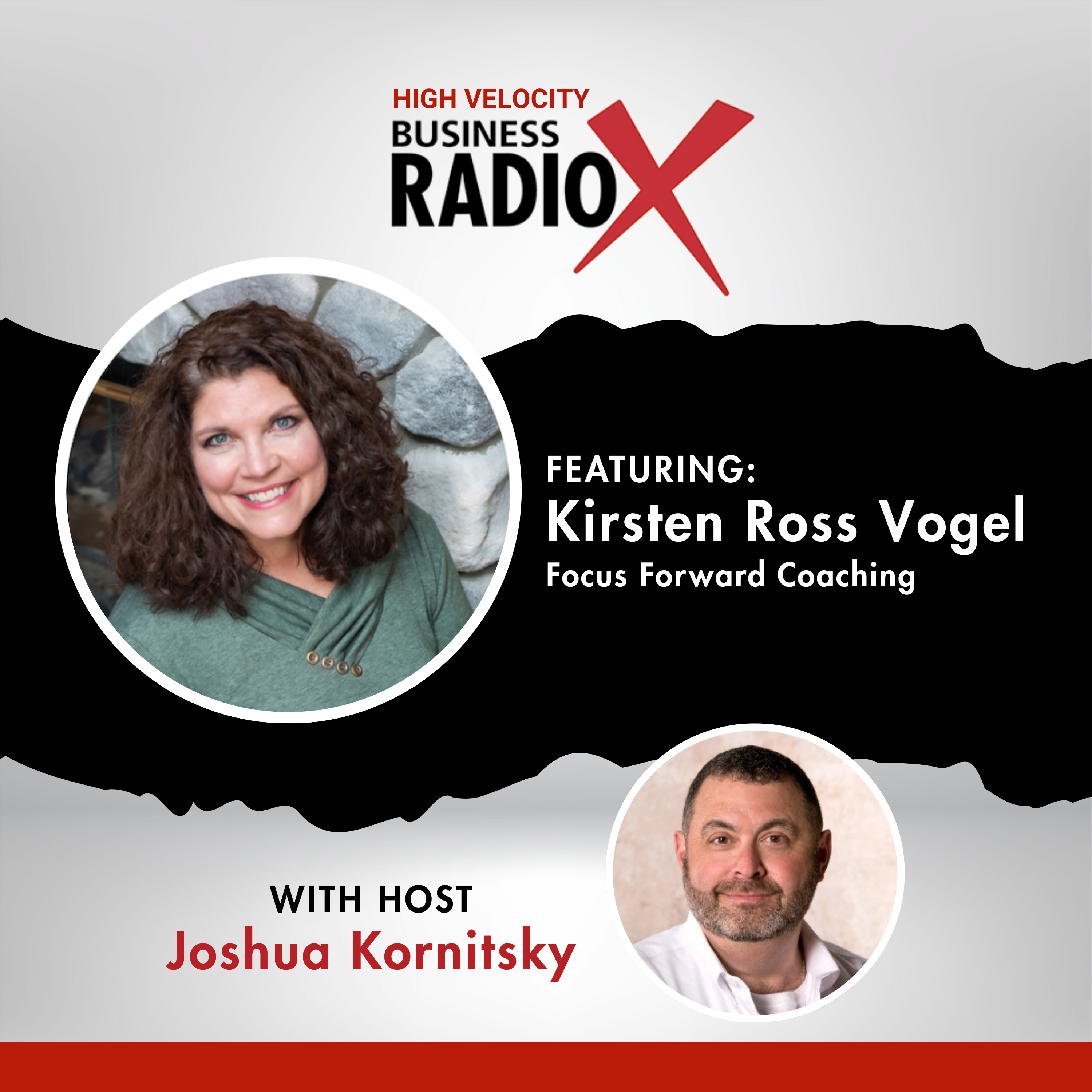

In this episode of High Velocity Radio, Joshua Kornitsky interviews leadership coach and author Kirsten Ross Vogel. Kirsten shares her journey from a 35-year HR career and personal adversity to coaching leaders, especially in EOS and family businesses. She discusses overcoming internal barriers like fear and guilt, the importance of clear communication, and navigating difficult conversations. Kirsten emphasizes the human side of leadership, normalizing vulnerability and conflict, and offers practical strategies for building trust and objectivity within organizations. She also highlights her resources for leaders seeking to improve their communication and leadership effectiveness.

 Kirsten Ross Vogel coaches leaders to build high performing teams and eliminate the friction that can happen while scaling….or working with family.
Gain from the knowledge & proven strategies she’s shared with thousands of leaders for more than 30 years working with passionate leaders in privately held companies, family businesses and non-profits.
You are closer than you realize to the business and team of your dreams!
Tired of feeling that you’ll never get your employees to do what you need? Frustrated with employee bickering and backstabbing and all the customer complaints? Today is your chance to transform that forever.
Kirsten Ross Vogel, is known to many as the “Drama Free Queen”.
She’s the Author of “Defeat Team Drama Now” and “From People Problems to Productivity” and has been featured as an expert for media such as: NBC Nightly News, Fox 2 News, National Public Radio and for publications such as Entrepreneur Magazine, Working Mother Magazine and Crains.
Kirsten shares simple, actionable leadership, communication & selection strategies that help leaders generate a clear direction, defeat employee drama and focus their teams on productivity and great service.
Rosemary Batanjski, Business Owner Says: “I had a difficult time with staff compliance and expectations. By implementing Kirsten’s strategies I got my team on board and working well together. Customer service has improved dramatically and our profits are up!”
And, according to Gino Wickman, top selling author of Get a Grip and Traction, “Finding a great coach is a difficult task but Kirsten is one of those great ones.”
For more than 30 years Kirsten has helped leaders generate focused, motivated, teams that work well and produce more.
Proud owner of Focus Forward Coaching, a leading coaching and culture correction firm, she launched her business more than 16 years ago and generated success as a single mom to two young boys.
Kirsten is the undisputed expert on how to move from Resigned, Resentful and Overwhelmed to Focused, Engaged and Empowered.
Episode Highlights
- Transition from a career in human resources to leadership coaching.
- Personal experiences influencing coaching philosophy, including overcoming an abusive marriage.
- Importance of clear communication in leadership and overcoming internal barriers.
- The role of fear and guilt in leadership and how to navigate difficult conversations.
- The significance of normalizing feelings of fear and uncertainty among leaders.
- Focus on working with EOS businesses, family-owned companies, and privately held businesses.
- Challenges unique to family businesses, including communication and relationship dynamics.
- The importance of objectivity in feedback and communication.
- The role of language in shaping interactions and perceptions in leadership.
- The value of conflict in leadership dynamics and the need for healthy disagreement.
About Your Host
 Joshua Kornitsky is a fourth-generation entrepreneur with deep roots in technology and a track record of solving real business problems. Now, as a Professional EOS Implementer, he helps leadership teams align, create clarity, and build accountability.
He grew up in the world of small business, cut his teeth in technology and leadership, and built a path around solving complex problems with simple, effective tools. Joshua brings a practical approach to leadership, growth, and getting things done.
As a host on Cherokee Business Radio, Joshua brings his curiosity and coaching mindset to the mic, drawing out the stories, struggles, and strategies of local business leaders. It’s not just about interviews—it’s about helping the business community learn from each other, grow stronger together, and keep moving forward.
Connect with Joshua on LinkedIn.
 This transcript is machine transcribed by Sonix
TRANSCRIPT
Intro: Broadcasting live from the Business RadioX studios in Atlanta, Georgia. It’s time for High Velocity Radio.
Joshua Kornitsky: Welcome back to High Velocity Radio. My name is Joshua Kornitsky. I’m a professional implementer of iOS and your host here today I am joined by a friend and an incredible guest, Kirsten Ross Vogel. She’s a leadership team coach and an author who has worked with individuals and organizations navigating growth, complexity, and change. Her work really focuses on helping leaders communicate clearly, build credibility, and create meaningful impact. Kirsten brings a thoughtful, grounded perspective shaped by deep experience in leadership development and coaching, and she’s really known for her her blend of practical insight and human centered leadership. She’s worked with EOS, with EOS implementers, and with our community since literally the beginning of EOS. So welcome, Kirsten. I’m deeply honored to have you here, I really am.
Kirsten Ross Vogel: Thanks so much for having me. And I love that we’re getting to do this today. I know we got I got to see you in Detroit. It’s been a little over a year ago now, so.
Joshua Kornitsky: It’s good to see how the time flies for sure. Um, well, let’s begin at the beginning. Would you share your origin story? Tell us where what brought you to the world that you now function in and, and maybe even a little bit of the ancient lore of EOS.
Kirsten Ross Vogel: Oh, goodness. Okay. Um, well, so my story is maybe a little outside of what you normally expect with someone starting a business, but, um, so my background team and resources, master’s degree, senior certified human resource professional over 35 years. I hesitate to say, but, um, you started.
Joshua Kornitsky: At age three?
Kirsten Ross Vogel: Yeah, exactly, exactly. But, uh, this business actually was born out of my need to get out of an abusive marriage, um, over 25 years ago. And so I, you know, I’d always had an entrepreneurial spirit. I had been working for others for a period in human resources. But as part of the kind of the trajectory of that difficult marriage, um, I was not working, and I needed to. I had two small boys, and I knew I needed to get out. And so during that period, I checked with some of my trusted advisors and said, what is it that you see in me that I might not be seeing in myself? And over the course of that first week of exploring with trusted advisors, I had several people tell me I should be a coach. Now, keep in mind this is the early 2000, so coaching wasn’t well known at that point and I had not heard of it. So I had to hit Google, right? Uh, but once I did that and saw the descriptions of what coaches did. I realized that I had been accidentally coaching people my whole life. Um, to date myself even more. Um, you know, Ann Landers, if anyone knows.
Joshua Kornitsky: I know who she was.
Kirsten Ross Vogel: Um, they used to call me the Ann Landers of the high school, because people would come to me with their issues and their problems and their communication snafus, and I would help encourage and motivate, etc.. And so, um, anyway, when I saw the description, I knew that this was that thing I’d been yearning for. Um, I knew it was my purpose. And so, uh, I took a coaching class, read a book Co-active coaching, and took on a couple of just freebie clients to test the waters they made transformation. And that was it. I created my website, you know, the name focus for coaching, created my website and launched my business. And I was able to file for divorce about six months or so later.
Joshua Kornitsky: Wow. So it really did begin your life anew.
Kirsten Ross Vogel: It really did. And so that’s what I mean. Like, it’s probably not the optimal time, um, to start a business. I was definitely kind of beaten down. And, you know, again, it’s been a number of years, so a lot of healing has happened. But it was great because it, you know, it gave me the opportunity to be there for my two boys and, um, you know, and make a living to support us and provided the flexibility that I needed to help them heal and help myself heal.
Joshua Kornitsky: Well. And I know one of the things, obviously, with that human resources background, you you have a different perspective than most people will when looking at, uh, what I would describe as as human related challenges. Right. But communication is really your strength. How how did that skill, how did the communication skill evolve to impact on the HR side of things? And and really, I guess that’s the birth of your coaching, right. Because you’re bridging gaps.
Kirsten Ross Vogel: Yes, absolutely. And, you know, the underlying issue and kind of everything with human dynamics is our communication. And it starts with, you know, it’s not just how we’re communicating to others, but also what are we communicating to ourselves. And that’s really kind of at its core, our mindset. And so, um, it was really born out of continuing, you know, and from human resources, a human resource perspective. Um, you know, I can tell someone, you know, have a progressive discipline process or a good attendance policy. But the problem is, many leaders are have barriers to actually utilizing those tools. They’re good tools to have. But so the coaching is how do you communicate clear expectations. How do you, um, have correction conversations with employees? And one of the big stop gaps for leaders in, uh, engaging in those conversations is they have fear and guilt. And so the internal barriers that they have are stopping them from doing the things that they need to do. So the coaching really is helping people maneuver through their own fears and guilts of engaging in what they find to be uncomfortable conversations. And, um, so what they’re telling themselves internally, which also creates our nonverbals, um, and how to strategize about really engaging in whether it’s, you know, a huge negotiation that you’re going to into or just having a conversation with an employee. How do we show up as leaders, feeling fully empowered? Because we’re we’re leading with our strengths, we’re focused on our intentions, and we realize that we’re not ultimately responsible for the reactions that others have about the conversation as long as we’re showing up well.
Joshua Kornitsky: So I think you’re bringing to light, uh, an assumption I had made. Right? Which means lots of people make, because my assumption was that the bridge you were building was. Hey, executive. Hey, VP. Hey, director, let me help you learn the skills you need in order to do these things. But it sounds like you’re starting at a much more foundational level of. Let’s make sure you understand that what you think you are alone in feeling is pretty normal, is. I ask that as a question, right?
Kirsten Ross Vogel: Yeah. Yes. And sometimes that’s part of it. We can normalize it. So now, you know, I certainly don’t want my clients to or anyone listening. Don’t beat yourself up about the things that, you know, stand in the way of you showing up. Well. Et cetera. In conversations or allowing yourself to avoid difficult or uncomfortable conversations. Um, I say that people often create, um, reasons that excuses that feel like valid reasons, but really aren’t. But yes, it’s so normal. The number of times that I have worked with a high level leader and to overcome their people pleasing, um, you know, who would thunk? Who would have thunk, right?
Joshua Kornitsky: Well, and it really is kind of eye opening for you to share that because, you know, the, the veneer, the the outward facing appearance is all confidence and confidence in Polish. Right? And it’s somewhat, um, really humanizing to understand that behind the veneer, there might be a little bit of sweat and some knocking knees, all.
Kirsten Ross Vogel: Kinds of stuff.
Joshua Kornitsky: Yeah. And you’re telling me that’s normal?
Kirsten Ross Vogel: Yeah. I mean, and I don’t even think the goal is to remove that. The goal is to have that, not stop us. And so I, you know, we can’t shut down our brain in those uncertainties and, and, you know, but we work the muscle and we get more and more confident in going and having what we find to be uncomfortable conversations. But yet my work is definitely a combination of teaching strategies. Um, either, you know, HR kinds of things or strategies I’ve created over the decades, um, or I’m a bookaholic, you know, information coming out of that. But then to me, the coaching piece is, is all the internal barriers. So we need to bust those, um, so they can utilize the strategies that I’m teaching.
Joshua Kornitsky: I think that that’s a really insightful, uh, footnote to something that’s a much bigger deal. Uh, and I say that because, truthfully, it’s sort of an eye opener for me because I think, like a lot of people, we assume at some level magical confidence comes. Right. That that when I am leading XYZ organization or this many people that I, I know how to do that and it doesn’t make me sweat and it doesn’t bother me. And I think that it does help anybody that hears this to know that that not only is it normal, but there are other techniques, there’s tools, there’s resources that you can help them understand better how to cope with. And somebody long, probably before books were even written, said something to the effect of, you know, courage isn’t the absence of fear. It’s it’s understanding the fear and doing it anyway. Right. Is acknowledging that I’m afraid and doing it anyhow.
Kirsten Ross Vogel: Yes. And don’t waste energy beating yourself up for something that is normal that so many people go through. It’s just don’t be stopped. Now, I don’t know if this is folklore, um, but I believe it to be true. Um, Barbra Streisand, who we all, you know, well, I think everyone still knows. Maybe certain people who are much younger might not know her, but, like, you know, um, the Queen, uh, on huge stages. Well, I’ve heard that she actually has huge stage fright and would become physically ill before going out on stage.
Joshua Kornitsky: Wow.
Kirsten Ross Vogel: So what are some of the things that separate her from those who don’t get on big stages. Is that not that she didn’t have the fear that she overcame it and she just did it anyway.
Joshua Kornitsky: That’s, uh, we’ll have to look more into that one.
Kirsten Ross Vogel: Yeah.
Joshua Kornitsky: The one don’t know. The one that I know for sure, because I’ve heard it from his own mouth in interviews, is that Harrison Ford is, like, painfully shy, despite the fact that he always plays these very up front characters. If you see him in an interview, he’s uncomfortable as can be.
Kirsten Ross Vogel: Yeah. And I think it was one of the Backstreet Boys or something. Again, I don’t follow the boy bands, but like one of, you know, one of them was also very, you know, had a lot of stage fright and anxiety, etc..
Joshua Kornitsky: So and I guess they worked through it with folks like you. That’s fantastic. So let me ask at a high level, Kirsten, what types of groups and organizations and people do you typically work with?
Kirsten Ross Vogel: Um, I work largely with, uh, businesses running on iOS. Uh, so part of my story is. Yeah, is, uh, I’ve actually known Gino Wickman since before it was iOS, and worked with a number of the clients in the book traction. One of my first clients was actually in that book, and that’s how I met him originally was because the client said, we’re working with this guy, and we that’s all he was back then, you know this guy. So we need you to know and understand his process. But, uh, so, uh, you know, through that, that’s kind of the start of my business was, you know, Gino.
Joshua Kornitsky: That’s great.
Kirsten Ross Vogel: Starting to refer me business. Um, and other EOS implementers now. But, um, I love working, um, in and around the nooks and crannies of EOS running businesses, but really, any privately held, uh, business and a lot of family businesses, uh, anywhere where leaders are having difficulty, there’s just clunkiness issues, barriers to executing on what they’re trying to make happen in their business. And, uh, the people side of that can just add an extra complexity. And certainly in family business, uh, the relationship slash communications slash discomfort in conversations and decisions that can ignite. So I do a lot of work with family businesses. You know, Uncle Charlie’s wreaking havoc in the. Sure. And you don’t know what to do about it. Uh, visionaries. Integrators really having a lot of friction. Um, yeah. So that’s that’s how I work with.
Joshua Kornitsky: Well, and leaving names out of it. I even brought you, uh, asked you to talk with one of my clients in a family business because, um, let’s just say the the dynamics of every family business, in my experience, are wildly different. Uh, and they were having a fairly common problem. And their problem was it’s hard to draw a line between doing right by the business and doing right by your family. I think is a good way to sum that issue up. And and is that a common? Is that a common engagement for you where where people are sort of torn?
Kirsten Ross Vogel: Absolutely. And, you know, sometimes it’s I know what the right things are to do, but I just am too afraid to do it. I mean, we’re going to get back to that fear thing again. Um, you know, have those conversations and, uh, make some difficult decisions, prepare for the, the discussions that need to happen, etc.. But yeah, lots of family business. You know, there’s more at stake, uh, you know.
Joshua Kornitsky: Because.
Kirsten Ross Vogel: You want to still have things Thanksgiving together.
Joshua Kornitsky: Right in, in in the words of, of one of my family clients. Yeah, I know, I, I might need to fire the this person or that person, but when the sun comes up the next day, it’s still my brother or my sister or my cousin. Right. And and that doesn’t change. Even if it’s for the best. For the business.
Kirsten Ross Vogel: Yes. You know, I can share just a recent example of a family business that I’ve been working with. And, um, it was a little unique one because it was actually a son owned the business and the father was working there. But, um, you know, in this scenario, initially, the person I was coaching was taking lots of things personally versus being objective. So I had to coach around, um, building objectivity and how they were perceiving circumstances. And thank goodness that we did that work, because ultimately, um, some shifts happened in the business and they had to make some difficult decisions. And, you know, I don’t want to go into the specifics too much, but thank goodness that the family was able to be objective and realize they were business decisions that were difficult and they didn’t need to impact the family relationships.
Joshua Kornitsky: Well, and you hit a great word there, right? Because it’s in you’ve got to treat it as an objective situation, not an emotional situation. And and without asking you to to share anything private of any of your clients, what’s, what’s an example maybe of of that type of a Transformation. How do you what I know that the ultimate answer and I say this all the time is it depends. But in a in a scenario you can think of, what are some of the ways that you might 1 or 2 of the ways you could help them change that perspective, to not take it personally, because I would say that’s the biggest bucket I encounter is where where legitimate iOS centered, uh, constructive feedback is, is not heard as feedback is not heard as constructive. Um, it’s an attack. Um, and it’s not ever meant to be an attack.
Kirsten Ross Vogel: Right. So, um, so in coaching clients who are worried about someone perceiving it as an attack, the difficult conversation that I keep referring to, um, one of the things I coach around is making sure that, um, we don’t take responsibility for someone else’s response to the conversation, so I can’t dictate whether or not someone’s going to take it personally when I’m being objective. The only thing I can do is lean on my good intentions for the business. Now, of course, yes, there’s more at stake, and we want, and we hope that someone in our family can can see it as objective and not personal or consequences or punitive or any of that. So all we can do is, um, focus on how we’re communicating in terms of though, if I’m working on with the person who is taking things personally, it is a shift. Tell yourself a different story, um, about the the information that you’re taking in and see it as fact based, um, how it’s it’s really a mindset thing. And the story we tell ourselves is, is what I’ll say, um, about what we’re hearing. Um, and so I’m trying to think of a way to um, so in those scenarios, uh, yeah. The person communicating don’t be stopped by the, the fear of how someone might react if they have a tendency to take things personally, just know like that’s on them, that’s their emotions to modulate and deal with and and all of that. But if you can stay up on this sturdy platform as you communicate, uh, versus getting defensive, etc., when someone’s taking it personally, um, you’re leaving the door open for hopefully more constructive communication going forward. Um, but so.
Joshua Kornitsky: I mean, thank you that, that I think that says a lot and, and the logical question and I’m a word geek. I can’t help it. My mom’s librarian retired.
Kirsten Ross Vogel: Yeah.
Joshua Kornitsky: Uh, how important is language and the right language in those types of dialogs?
Kirsten Ross Vogel: 100%. I mean, I was just helping someone prepare for a big negotiation, and we so I when I’m coaching, like, I love humans, they’re they’re hilarious. And so we got laughing though because the words that he was planning on using worse, you know, would have ignited so much, probably defensiveness and frustration and the person he was about to communicate with. Um, we need to focus on the words were, again, words we’re communicating out, but also internally, you know, I’ll share about if I have time. A very quick story about this was a number of years ago, but I was working with a client who, um, had a really difficult job because she was, um, she was working with children who had very high physical and mental challenges and often had to work with the schools to try to get these children resources. And she came to me and said, it’s an injustice. It’s an injustice. She was, in her mind, dealing with injustices multiple times a week. Most of us will not deal with an injustice over a lifetime, sure, but when you’re using that word internally, how are you showing up to those conversations? You’re in battle. You have your gear on. You’re defensive. You’re pushing. And so the fix was for her to shift the words that she was saying. I pointed that out. That’s a huge, huge word. What if you could come from a different perspective that they just have limited resources, that they want to help these kids just as much as you do? They want to lock arms with you. And, you know, so you’re to find creative solutions to getting these resources. By the next week, she had already had dramatically improved interactions with all the schools that she had dealt with in that previous week, just because she was showing up better. And the good news is that’s within our control.
Joshua Kornitsky: Absolutely. Well, and I think the what you just put your finger on that again, I think is is incredibly helpful for, for anyone that that takes the time to listen to you express this to them, is that reframing of the internal monologue really is critical because, as you said, your body language if Injustice. Using your example is such a strong word. You have to physically manifest if that’s what you think it is in here. Your body language is going to be, I imagine, pretty aggressive.
Kirsten Ross Vogel: And what does that ignite in the other person you’re talking to? They also have to protect. Right. And now we’re not really communicating. Yeah. Yeah. We’re both through our swords in the sand and you know and we’re both stuck. We’re not actually having a conversation.
Joshua Kornitsky: So do you ever do any type of and this is my term. But like de-escalation of those situations because I’ve seen organizations grind to a stop at the leadership team level. Shockingly. Right. Because A wants this and B wants that. And you know, there’s no they I use the terminology bridge all the time and there’s no bridge between them because one of them usually sometimes both of them have no interest in building it.
Kirsten Ross Vogel: Yep. I have done several situations like that just in the last year. Yes, absolutely.
Joshua Kornitsky: So there is hope is what you’re really saying?
Kirsten Ross Vogel: 100%. There is. Yes. Um, and it’s either, um, you know, the best way for me to work on that help with that is to meet individually with those who are stuck. Again, I’m the kind of the puppet masters behind the scenes, like helping them different perspectives strategize about how to show up different ways to communicate. A lot of times that can fix it. If not, I will facilitate. Um, in in over 30 plus years of facilitating, I’ve never lost control of a conversation. So I can say with confidence that they will reach a resolution in whatever topic we choose. Um, and that’ll be a real life topic that they’ve been stuck on. But also I will communication coach along the way and have them make commitments for how they’ll communicate in the future.
Joshua Kornitsky: A lot of what you’re sharing Resonates with me as an EOS implementer because, uh, at the risk of of making a connection, whether it’s there or not is so much of it is that that openness and honesty that’s that’s critical to EOS. And forgive me, I just came back from doing three different annuals. It all goes back to the Lencioni trust pyramid and vulnerability based trust, but it really is. If if there’s no trust, there’s not going to be healthy conflict and.
Kirsten Ross Vogel: 100%.
Joshua Kornitsky: And is conflict. Let me ask you this so that people can hear it from someone other than than Patrick Lencioni and myself. Is conflict always a bad thing?
Kirsten Ross Vogel: No. If you’re not having conflict, you know, when you think about the integrator visionary, how many times have we all seen a visionary integrator getting along swimmingly? No. Getting along swimmingly. Guess what’s happening? Either that business is going in too many directions too quickly, or moving way too slow. They should both be uncomfortable because they need to be moving through the discomfort and negotiating to the middle ground of visionary and integrator. So we’re not moving as quickly as the visionary wants to go. We’re not moving as slowly as the integrator wants to go. Um, and so that middle ground is perfection. And so yeah, if you’re not having disagreements people are silent. And that’s also not good.
Joshua Kornitsky: That that resonates with me in particular, coming out of the annual season and the fact that, um, I will run into a visionary integrator duo where the the integrator has given up, meaning that that the visionaries, irrespective of gender, the visionaries forcefulness. Because let’s face it, it was that forcefulness that pushed that organization into being correct. But sometimes the integrators just give up. And I always try to suggest that. What you know, you know, if you don’t believe that’s the right path. Go to that vto go to that blueprint. Right. And if the blueprint says we all agreed not to do this, then your answer is that’s the hill you got to die on.
Kirsten Ross Vogel: Right? And the problem is that some time, you know, the the sometimes that visionary often that visionary is in the CEO seat and, or they’re the business owner. And so they have like on paper a lot of power and from experience a lot of power. But if you’re going to fully implement, uh, EOS, they have to give away some of that power to that integrator, because ultimately that integrator is a very important part of the equation. And if you’re still doing what you were doing in the visionary seat, right. The integrator. Yeah, the integrators got that deciding vote. They’re the ones that are operationalizing and bringing reality into the decision making equation. Like you have to give them power.
Joshua Kornitsky: So I want to ask how and I’ll, I want to be sensitive to your time, but I want to ask this question because it it it is born from what we were just discussing, iOS or not, iOS always helps, right? But iOS or not, is there an inherent power dynamic when you have an owner dealing with anybody who’s not an owner?
Kirsten Ross Vogel: Well, not inherent, but it’s a leadership skill that they like a muscle. They may need to work because, you know, in lots of privately held businesses, I mean, my favorite place to play is like the crazy entrepreneurs that are so passionate about either the business, you know, the service or the whatever they’re selling, whatever they’re selling, they’re passionate about that. And they muscled their way through the beginning, um, and maybe hired some family members to, you know, minimize that gap, you know, and because that’s who they trust and we love one another and all of that. Uh, but so there’s a way that you lead, though, when it’s when you’re just muscling your way through, uh, the communication can be clunky. You can move in a lot of directions, but as you get bigger, you have to transform how you’re leading. And so some will do that, but most need some help.
Joshua Kornitsky: And that’s a perfect place for me to ask Kirsten, how do people get Ahold of you?
Kirsten Ross Vogel: Um, well, I would love to hear from people who listen to this podcast. And, uh, you can go to my website, Focus Forward Coaching. Com is my website where you can find, um, you know, if you want to grab do a little virtual coffee, you can grab a spot on my calendar. Um, that’s probably the best way. I’m on LinkedIn, too. Is Kirsten Ross Vogel. Uh, I do also have, um, my Impact Academy, which is, uh, a place where I have, you know, over the decades. I have lots of, you know, video, audio, PDF downloads, etc.. And so, uh, if you want to just go in there and access all of that, you can go to defeat the drama.
Joshua Kornitsky: Which is also, I think, the name of your book, isn’t it?
Kirsten Ross Vogel: Oh, one of my books is Defeat Team Drama. Now and then, the other ones. From people problems to productivity. The health professional’s guide to leading well.
Joshua Kornitsky: Yeah, and those are both on Amazon if anyone wants to buy them. Yep. Fantastic. Well, I can tell you that I certainly learned a couple of things today because it being in the US implementer means you have to exist outside of an organization. You, no matter how much you care about them, no matter how much you want their success, you are not part of that team on a day in, day out basis. And while I have my own background and experience, knowing that I can now move forward, telling the leadership teams that I’m working with that what they’re feeling is normal and that there’s some help and some hope. That’s a big deal. So thank you. That was a that was a pretty invaluable piece of information that I hope everybody takes to heart. Um, it’s been an absolute joy chatting with you. Thank you so much. Um, let me just remind everybody that today my guest is Kirsten Ross Vogel. She’s a leadership coach and author who works with individuals and organizations. You heard how she navigates growth, complexity, and most importantly, leadership and communication. Uh, I think that anybody who runs into a problem in a family business and a non-family business, uh, that that has a communication roadblock should reach out. Kirsten, I can’t thank you enough for your time.
Kirsten Ross Vogel: Well, thank you so much for having me.
Joshua Kornitsky: It’s been an absolute pleasure. Thank you for joining us here on High Velocity Radio. I’m Joshua Kornitsky professional EOS implementer and your host. We’ll see you next time. Thank you.














