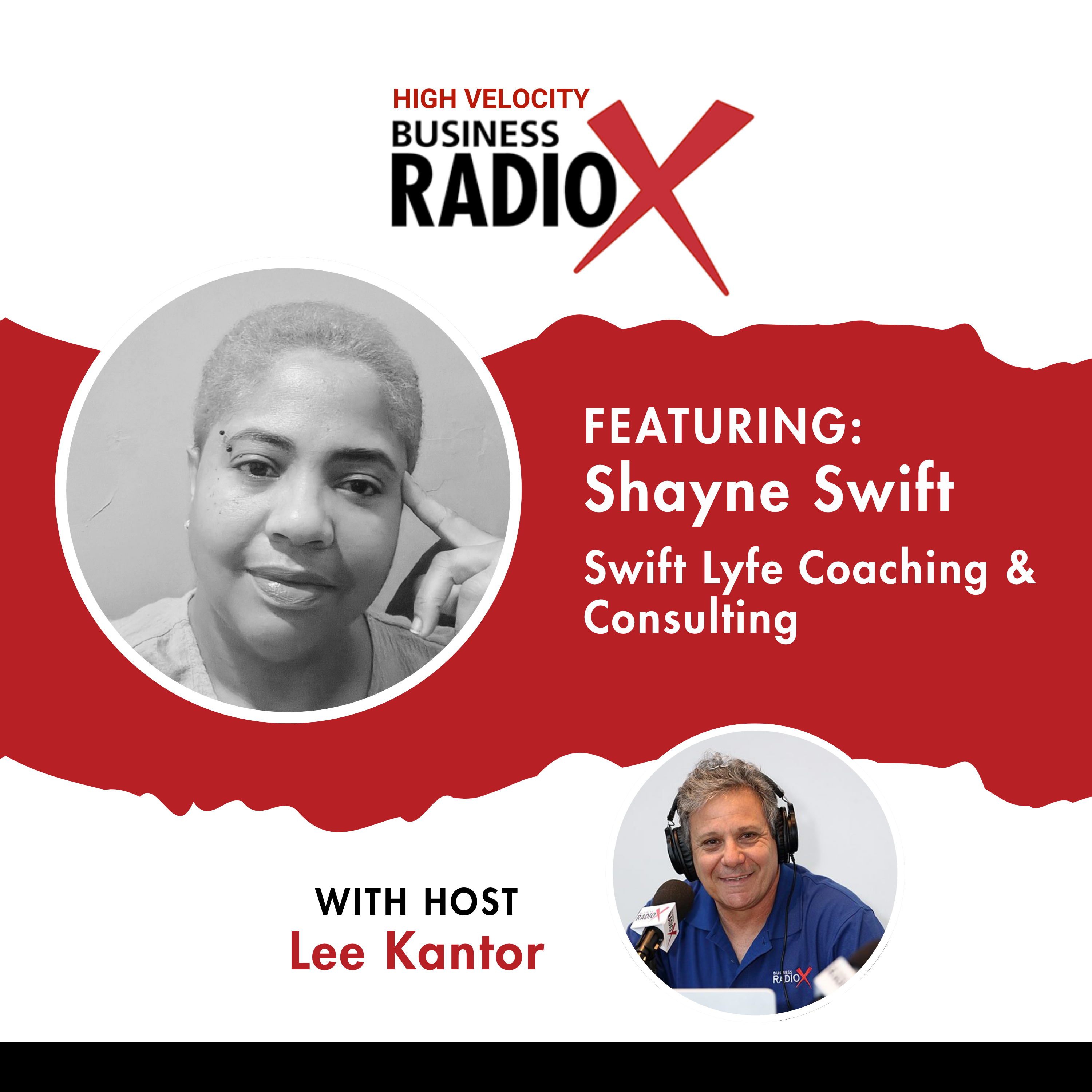

In this episode of High Velocity Radio, Lee Kantor is joined by Shayne Swift, an ADHD coach and expressive arts facilitator with Swift Lyfe Coaching and Consulting. Shayne shares her late ADHD diagnosis at 38, her journey from educator to coach, and how she supports clients nationwide through virtual sessions. She discusses creative strategies, including art and community-building, to help clients manage ADHD. Shayne also introduces her workbook, designed to guide individuals through the emotional stages of diagnosis, and highlights the importance of self-advocacy and connection.
 If ADHD were a superpower, Shayne Swift would be its wise and witty mentor. Diagnosed at 38, Shayne transformed her whirlwind experiences—think “Chatty Cathy meets postural sway champion”—into a thriving career as the Founder of Swift Lyfe Coaching and Consulting.
With credentials as impressive as her ability to juggle a million ideas (hello, ACC certification and a Master’s in Curriculum and Instruction!), she specializes in ADHD coaching, life coaching, and education consulting. She’s on a mission to help clients turn their “scatterbrain” moments into strategies for success.
Her approach is a delightful mix of empathy, expertise, and hilarity. She doesn’t just “get it”—she’s lived it. From navigating her own ADHD challenges to raising a daughter with the same diagnosis, she’s the real deal. Whether it’s demystifying ADHD in the BIPOC community or sharing her adventures of body doubling and DMV escapades, Shayne knows how to turn struggles into relatable, actionable insights.
At Swift Lyfe, she creates spaces where clients are seen, heard, and equipped with tools to thrive. Her coaching isn’t just about managing life—it’s about embracing your quirks, unlocking your potential, and laughing along the way.
Ready to take your journey from chaos to clarity? Shayne’s your guide, cheerleader, and (when needed) a dose of tough love. Dive into the Swift Lyfe experience and see why ADHD isn’t a flaw—it’s your greatest asset.
Connect with Shayne on LinkedIn, Instagram and Youtube.
What You’ll Learn In This Episode
- How do creativity and art unlock new pathways for neurodivergent individuals—especially those with ADHD
- About the Chaos2Clarity community
- What are the biggest misconceptions about motivation, and what tools actually help people get started
- Her book Grieving Differently.
 This transcript is machine transcribed by Sonix.
TRANSCRIPT
Intro: Broadcasting live from the Business RadioX studios in Atlanta, Georgia. It’s time for High Velocity Radio.
Lee Kantor: Lee Kantor hear another episode of High Velocity Radio and this is going to be a good one. Today on the show, we have Shayne Swift, who is with Swift Lyfe Coaching and Consulting. Welcome.
Shayne Swift: Thank you. Thank you so much for welcoming me. Nice to meet you.
Lee Kantor: Nice meeting you. I am so excited to learn about your practice. Tell us a little bit about your practice. How are you serving folks?
Shayne Swift: So I am an ADHD and, uh, coach and expressive arts facilitator, and I serve clients nationally because all of my coaching is virtual and I enjoy supporting people with managing their ADHD, getting a better understanding of how their brain works, and helping them implement strategies in their lives so that they can be more fulfilled, more purposeful, and more successful.
Lee Kantor: So what’s your backstory? How did you get involved in this line of work?
Shayne Swift: Well, at the age of eight, I knew I learned very differently from other people, but I had no idea why. Fast forward 30 years later. I’m 38 years old and getting an ADHD diagnosis myself, so I consider myself the help that I never had in school. And in my first in the start of my professional career and want to be that support for other neurodivergent.
Lee Kantor: Now, in your practice, how do you go about getting clients? Is this something that you have to work with? Practitioners who have identified this in their patients and they say, hey, maybe you should talk to Shane.
Shayne Swift: And that is a way that I get clients as a referral, but usually people find me on ADHD coaching directories because consumers know that we’ve been vetted if we are a part of the directory. And so usually that’s how people find me. So through attitude magazine, echo, which is the ADHD coaches organization. So people find me typically through those means or they find me on LinkedIn.
Lee Kantor: And is ADHD. Is it being found in people sooner than I mean, in your case? Obviously it was much later.
Shayne Swift: So basically, women seem to be diagnosed later than men because of the way it manifests itself. So, for example, um, as an elementary school student, I was the proverbial Chatty Cathy. And that is an underlying symptom for girls with ADHD, but I was just told I was talking too much, and it wasn’t until I was 38 that all of the dots were filled in and put together that the way that my ADHD was manifesting itself in elementary school is a bit different. So there’s a lot more light shedding on girls getting earlier diagnoses based on, um, this new set of criteria that we’re able to look at.
Lee Kantor: And then once you kind of understood that, how was that like what then what became actionable that you were able to, um, see things differently or do things differently?
Shayne Swift: Yeah. So first I had to get over being diagnosed. Um, because there are things that come up like shame and fear and anger. Um, so once getting over that, I knew that I had to do things very differently for myself. So I am a slave to my calendar. And so if it is not on my calendar, it is probably not going to happen. So I schedule time blocks and things like that. I have several reminders on the back of my Google calendar, so I get like seven reminders per event that goes on my calendar. Um, and I stretch them out to like two weeks before the event is supposed to start, so that I’m getting reminders in case there’s something I need to prepare, um, prior to the arrival of that particular date. Um, another example would be using an Eisenhower matrix. Um, on Sunday nights, I typically do this. Um, and that helps me prioritize the things that I need to do for the week. So what’s urgent? What can be scheduled? Is there anything I can delegate to someone else? So those are some of the strategies that I use to support myself and share with clients.
Lee Kantor: So how did a kind of your artistic expression fall into this?
Shayne Swift: Um, that’s a great question, honestly. Um, after 30 years in education and being burned out. Um, from the classroom to being a school founder, uh, it was a really difficult decision for me to leave, um, the school that I co-founded. And I found myself needing to resort to something to help me heal. Um, because I was going from being in a community of people all day. Teachers, students. You know, it’s fairly busy at a high school to working remotely. And that was really challenging for me. Um, so I got into AI art. Um, to kind of work through that and then realize that other things were happening with me, such as, um, my ability to regulate my emotions as an ADHD er was changing as a result of this, um, daily art practice. Um, I, uh, felt more creative. Um, um, as I did that and also my blood pressure was lowered as a result of doing the art. So I said, you know what? Something something is happening with me that I think I need to be able to share with other people. And so I decided, because I’m a serial learner. Um, I decided to, um, take an expressive arts courts to get that certification. And I use it with my clients now, and I, I love it. My clients love it.
Lee Kantor: So what? What? So you kind of stumbled into this? I art like it was just you were curious about it, and you’re like, let me see if I can do it. And you started playing and all of a sudden you’re like, I have an aptitude for this.
Shayne Swift: Yeah, absolutely. That’s that is exactly how it happened.
Lee Kantor: So what was your first kind of things you were experimenting with with the AI because it’s changing so rapidly? I mean, they have new, uh, you know, new improvements almost on a daily basis nowadays.
Shayne Swift: Yeah. So my first few pieces honestly were about expressing, um, how I feel as an ADHD, or so you know, some days or, you know, smooth and other days are really rough. And so I would create these characters that had these different facial expressions on them. Um, and that helped me to be able to unmask and explain ADHD to other people very differently. So I can actually give you an example, um, something that I had been struggling with for years. My my sister and her husband have these, um, big barbecues at their house. And, um, I would always say I was going to come and and then somehow I would find my way out of not coming. And, you know, people started to think that I was a bit flaky. But honestly, being around that, you know, such a big group of people and the sounds and the smells and, you know, there’s a couple dogs and I found it to be very overwhelming, um, as an ADHD. So, you know, like places like Chuck E Cheese and Dave and Buster’s, um, I can’t tolerate being in those environments. But for so long because of the sensory overload that I experienced. And so I finally, after, you know, having done this art practice and really sharing, you know, who I am as an ADHD, I was able to say to my sister, hey, I just I just want to come to your house when nobody else is there. Um, because I get really overwhelmed and I find myself, like, retreating to the bathroom or to a corner. Um, you know, just to kind of take a breath and and and reset myself.
Lee Kantor: And your art has progressed to the point where now it’s on sale. I was on your website. It’s beautiful.
Shayne Swift: Yes. Thank you. Yes. Um, so I said, well, why not monetize it? Um, and this is how I’m able to keep a couple of pro bono, um, coaching clients. Um, by, um, supplementing my income with my art practice.
Lee Kantor: And so you find that art, or at least creative expression, is useful for folks that are suffering with ADHD or living with ADHD.
Shayne Swift: Absolutely. Um, because we’re non-linear thinkers, and traditional forms of communication or self-regulation may not work for us. Um, we feel, uh, very deeply, a lot more than other people. And so movement and color and sound and story, um, our ways to kind of bypass shame and access, like our personal truths, so to speak. Um, and it’s a great way for clients to, like, externalize their emotions. Um, find patterns of behaviors that they may want to work. Work on or process certain experiences in their lives.
Lee Kantor: Now, you mentioned earlier, coming from, uh, education background. Um, it sounds like community is super important, uh, for you and, and even now in your work today, you have the chaos, the clarity community you’re building. Can you talk a little bit about that?
Shayne Swift: Yes. So I’m really excited about the chaos, the clarity community because my belief is, um. Navigating ADHD is not a solo mission. Uh, it requires, um, being able to share experiences with other people who are going through the same thing. So, um, we talk about so there’s there’s a course in there called Kickstart Coach where, um, you know, if you’re not 1 to 1 coaching with me but want support, you know, you’re learning how to navigate, um, procrastination by using the task initiation strategies that are a part of the course. Um, we talk about wellness. Um, we talk about, um, self-advocacy in our community. And I also provide body doubling. So body doubling is an opportunity for people to virtually co work um together. And it works. So I hop on and some of my clients or others in the community may jump on as well. Um we set our goals at the beginning of the session, and people will let us know if they want to check in or not, you know, while they’re on and people work, I put on some focus music. Um, typically I, you know, take into consideration like which clients, um, show up and cater the focus music. There it’s usually in it’s always an instrumental, um, that I play and it is an opportunity for people to just get stuff done. So I’ve had people clean their pantries. I’ve had people wash dishes, cook, um, worked on their LinkedIn profile, uh, work on their resume. Um, some of the clients that I have are entrepreneurs, so they’ll work on their, um, tasks that they have. So it’s a really cool way to, um, support each other and hold each other accountable. Um, and it’s without pressure. It’s just, um, connection. And it’s an opportunity for people to really, like, unmask, um, in the community.
Lee Kantor: Now having a background in education and working with young people. Do you have, um, is that your target audience for your coaching, or do you coach people of all ages?
Shayne Swift: Yeah, I actually have, um, three types of clients I coach, so I do coach, um, high school, uh, clients in college, college students. Um, so that’s one bracket. Then I have, um, folks that are in their 30s, um, who usually want to change careers, um, or they’re in some kind of transition. And then I have the late diagnosed, um, people like me. So, like, my oldest client is 59 and just recently diagnosed a year ago, a woman. Um, and so I have different, different kinds of clients. Um, so typically the clients that are my age are burned out, um, and ready to move on to like what I call the encore career. Um, my millennial clients typically, um, are transitioning and want support for the work that they’re currently doing. And then, of course, our focus with teen clients and college students are more on supporting them through their academic journey.
Lee Kantor: Now, is there any kind of clues for a person that might be listening and maybe hasn’t been diagnosed, but maybe they are ADHD? Is there some things that are kind of I don’t want to say symptoms, but at least signals that maybe that you are ADHD.
Shayne Swift: Yeah. So I think one common thing is, um, sleep. It’s very difficult. Um, sometimes it’s very difficult for people to go to sleep that have ADHD or stay asleep. Um, sometimes we find ourselves up ruminating. So that is, uh, one thing. And And we’re definitely, um. We definitely have FOMO. You know, so by the time you come home, you’re ready to unwind and do finally do something for yourself. And so people find themselves up late on their phones or playing video games or watching television. Um, we’re fairly creative people, and we don’t like following rules. Um, so a lot of, um, ADHD or ADHD ers find themselves as entrepreneurs, um, for that reason. Um, another thing is really, um, being able to start on a task, um, without external motivation. So that’s a challenge for people with ADHD. So we typically need novelty interests and a deep why to get started. So we literally need to trick our brains. Um, to get started with tasks that aren’t that interested in us. Like, um, you know. Opening mail is not very interesting. So, you know, how do I do that and get it done? Because I know there are bills in there. Um, maybe I’m playing music. Maybe I’m going to a different setting, um, to do it. Maybe I’m talking on the phone with a friend while I’m opening mail, because that’s a form of body doubling. Um, so those are the types of things that we usually see. Um, with folks with ADHD. But there are a lot of strengths as well. We’re very creative people, very empathetic, um, people. And so those are the, the other things that come to mind. Um, that kind of signal, um, that someone may have ADHD.
Lee Kantor: Now are they’re like, how do you get diagnosed? Do you have to go to a doctor, or is this something that there’s assessments or on the internet, like websites you can go to to check if maybe you are. How do you even kind of identify.
Shayne Swift: Yeah. So my process, um, because it was some time ago was, um, to see a psychiatrist, and the psychiatrist did a fairly, um, in-depth intake. And basically, the goal is to see that if do these things happen across different settings, so does the, you know, is am I being affected in my personal life, my, um, my work life, um, any other settings that I’m in, um, that the symptoms may happen. Um, there is testing, neuropsychological testing that people can get done. It is very expensive and insurance companies may or may not cover it. Um, and so the best way, you know, the, the greatest way to get the diagnosis is, is, of course, in grade school where you can have, um, the support of the school, um, doing the assessment and pick up the tab for it. Um, so when you’re an adult with ADHD, you know people may tend not to move forward with diagnosis because of the cost.
Lee Kantor: So now to work with you, obviously you don’t have to have kind of an official diagnosis if you’re feel like you are ADHD. You’ll work with those folks too. Right.
Shayne Swift: Absolutely. I’ve had a couple of people who have said they’re there. They are not officially diagnosed, but they believe they have it. Um, and I’ve been supporting them, just like I would support, um, any of my other clients.
Lee Kantor: Now, is there any kind of tools for somebody who might be suffering, like, is there low hanging fruit that a person could do right now? Something actionable that, hey, if you have this, this might, uh, you know, give you more comfort or relieve some suffering or just make you feel better.
Shayne Swift: Yeah. So, um, emotional regulation is a challenge for people with ADHD. Um, and so. Easy things to do. Are developing a meditation practice. Now, a lot of folks with ADHD would tell you that meditation is hard, but I think we need to reframe what it means to meditate. It could be journaling, um, quiet journaling. It could be just protected time for yourself. Um, where you’re checking out of, you know, technology and you just have time to think. Maybe it’s a walk. Um, maybe it is a guided meditation. Um, but those things are really helpful. Mindfulness is is super helpful for people with ADHD. Um, especially if they have challenges with emotional regulation. Um, the other thing is just doing a brain dump, like at the, you know, at the beginning of your week, um, all the things that you need to get done, but not with the goal of overwhelming yourself, doing the brain dump and then separating Doing what needs to be done immediately from what needs to be done. What could wait until later on in the week? Or perhaps the following week? Um, that’s an easy go to strategy. Um, that someone could could do.
Lee Kantor: Now, in addition to your coaching and the community building and your art, you also found time to, uh, write a book, grieving differently. Uh, can you talk a little bit about that?
Shayne Swift: Yeah. So actually, um, I had done a form of pictures initially, and I. And I left it sitting for months, and then I had a client who inspired me to move forward. I actually lost him as a client. Um, I lost him as a client because everyone is not ready for coaching, and he was grappling more with the diagnosis than anything else, And he chose to move toward therapy. And I said, you know what? I would like to develop this thing that I’ve been working on more so that I can support people through the first part of their diagnosis. Because I remember my time, um, being diagnosed, I was shocked. Um, and I was very angry, especially at my mom, because she had been, um, she has a bachelor’s degree in elementary education. And I said, Ma, you know, you kept calling me scatterbrained and clumsy and this, this, that and the other. And, you know, like, I had a nickname called The banana Queen because I would always wait tomorrow to do something I said, and it was ADHD. And she said, well, I didn’t know, you know. So I wanted to make something that could support the old me that went through that process and this, um, client that I lost as well, so I started playing. The images were already made and so I decided, okay, well, what kind of text could go with this? And because I had just finished the Expressive Arts course, I just kind of blended everything together. So really, it’s a workbook that takes you through the different stages of grief, but through an ADHD lens. So what it’s like to feel shame with the diagnosis? Um, there’s fear with the diagnosis, but the last part of the book is really about the New horizons, um, that can come out of this because you learn, um, you know, that you’re not broken. Your brain is just wired differently. And then the very last stage is advocacy, you know, getting to a point where you can either self advocate or start advocating for others with ADHD.
Lee Kantor: Well, Shane, it has been a delight chatting with you today. If is there a website or a place to connect? If people want to learn more about your coaching, your book, your art, um, all the things that you have got going on. Is there a kind of a central location for all this?
Shayne Swift: Yeah. So the central location would be my website. That’s w ww dot swift life. So s w t l y f e.com.
Lee Kantor: Well, Shane, thank you so much for sharing your story today. You’re doing such important work and we appreciate you.
Shayne Swift: Thank you. Lee, thank you so much for having me on and I appreciate our time together. Thank you.
Lee Kantor: All right. This is Lee Kantor. We’ll see you all next time on High Velocity Radio.














