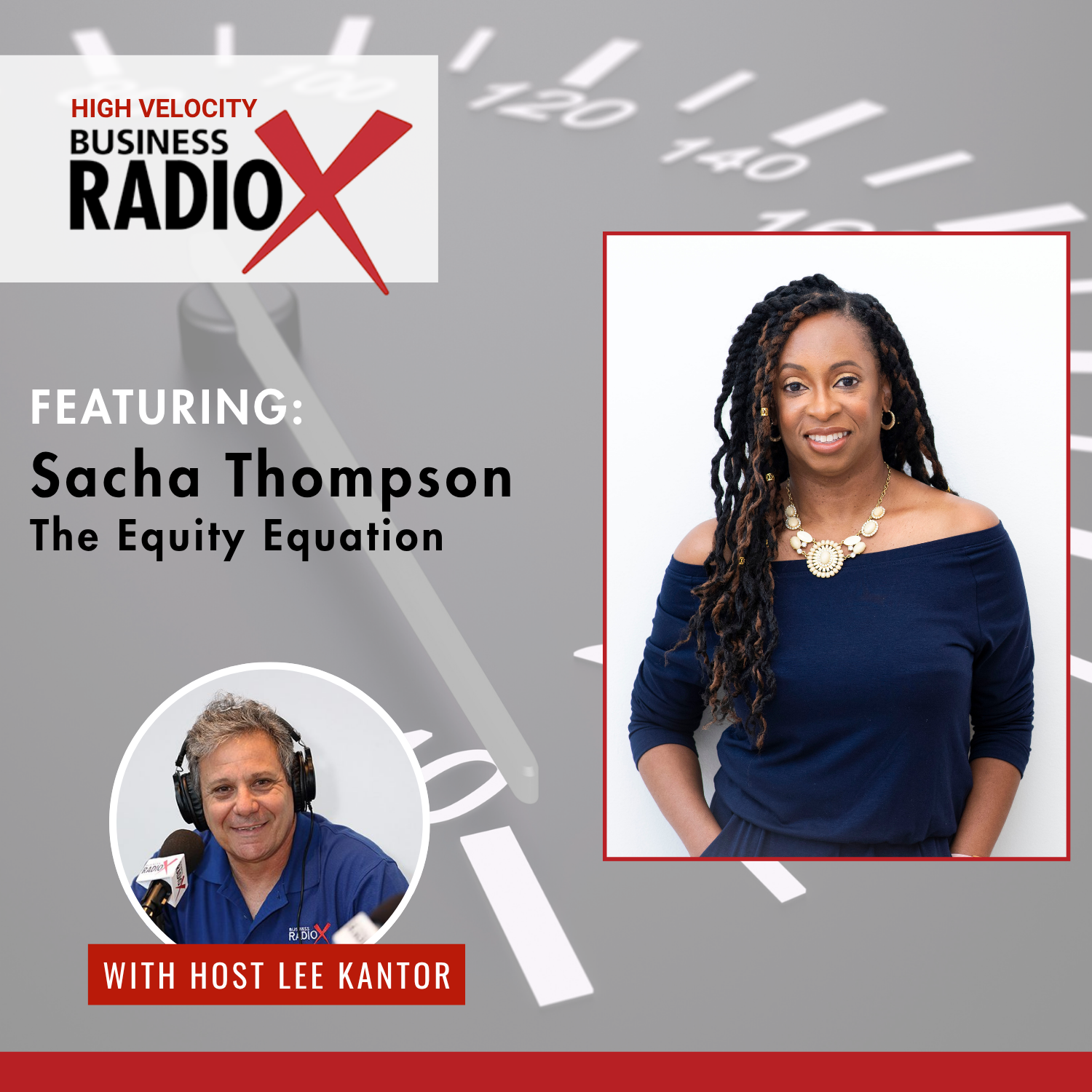

In this episode of High Velocity Radio, Lee Kantor interviews Sacha Thompson, founder of The Equity Equation, a Washington, D.C.-based consultancy. Sacha shares how she helps organizations build psychologically safe, authentic workplace cultures by focusing on behaviors and outcomes rather than jargon. She discusses common challenges like leadership-employee misalignment, lack of transparency, and values incongruence. Sacha offers practical advice, including defining core values through observable behaviors and maintaining transparency during organizational changes. She also highlights AI’s growing workplace impact and shares a success story from a cancer center where psychological safety scores nearly tripled through targeted interventions.

 Sacha Thompson is the founder of The Equity Equation, a leadership development and organizational culture consultancy focused on helping organizations build psychologically safe, high-performing workplaces.
With over 20 years of experience across education, nonprofit, and technology sectors, Sacha partners with leaders and teams to strengthen trust, improve communication, and navigate complex workplace dynamics. She is an ICF Associate Certified Coach, Certified Psychological Safety Coach, Maslow Certified Leadership Coach, and Maslow Certified Executive Culture Coach.
She has been featured in Forbes, Newsweek, and Business Insider, appeared on MSNBC’s The Cross Connection, and hosts the DEI After 5 podcast.
Connect with Sacha on LinkedIn.
What You’ll Learn In This Episode
- Importance of creating authentic and psychologically safe workplaces.
- Focus on fostering cultures of care where employees feel valued and connected.
- Challenges organizations face, including misalignment between leadership and frontline employees.
- Emphasis on outcomes and behaviors over jargon in discussions about psychological safety and inclusion.
- Strategies for defining and aligning organizational values with actual behaviors.
- The role of transparency in building trust within organizations.
- Addressing generational differences and technology shifts in workplace dynamics.
- Actionable steps for leaders to improve organizational culture and psychological safety.
- The impact of AI on employee perceptions and the need for transparent communication.
- Signs that indicate an organization may need assistance in improving culture and psychological safety.
 This transcript is machine transcribed by Sonix.
TRANSCRIPT
Intro: Broadcasting live from the Business RadioX Studios in Atlanta, Georgia. It’s time for High Velocity Radio.
Lee Kantor: Lee Kantor here. Another episode of High Velocity Radio and this is gonna be a good one. Today we have Sacha Thompson, who is with The Equity Equation. Welcome.
Sacha Thompson: Thanks for having me. This is wonderful.
Lee Kantor: Well, I am excited to learn what trap two tell us about the equity equation. How are you serving folks?
Sacha Thompson: Sure. So we are a boutique consultancy based in the Washington, D.C. area, and we focus on helping leaders create more authentic and psychologically safe workplaces. So we want people to get beyond just the the words that are out there and like, how do you create a culture of care? How do you create an environment that people want to come to work and they enjoy the work and they want to be a part of that community. And so that’s what we help leaders do.
Lee Kantor: So what’s your backstory? How’d you get involved in this line of work?
Sacha Thompson: Oh, goodness. So I’ve always had some aspect of inclusion work within my career. And when I started the equity equation back in 2020, my primary focus was psychological safety. And the more and more I worked with organizations, what I realized they were getting caught up on those words, psychological safety. And when I would talk to employees, they would talk about, you know, oh, well, I’m having a difficult time, you know, getting to understand what my manager is trying to get me to do or, you know, I just don’t trust, you know, one of my colleagues, whatever it was. No one was talking about. I don’t feel psychologically safe. They were talking about what they were experiencing every single day. And so I just kind of evolved a lot of the work that I had been doing around inclusion, and my background is in marketing as well too. So kind of pulling all of that together and getting to, okay, who’s the audience and what is it that you want to communicate? And so really simplifying it and making it something that everybody could understand and everybody could get behind. We all want to create an environment where people feel valued, seen, heard, and connected. And so kind of taking away the academic, uh, wording behind a lot of what we’re feeling. And that’s just, that’s the work. And so I’ve absolutely loved doing it for the last several years.
Lee Kantor: Now it’s interesting you bring up your marketing background because a lot of people in this space don’t have a marketing background. And I think it makes you kind of uniquely qualified to elevate the conversation away from some of the semantics or the words and focus in on the outcomes and just create kind of a dialog and a communication Around the outcome rather than this is what we call it. And then the your client may not be comfortable with that word, but you’re able to just get them refocused on, okay, what is the outcome you desire? Let’s work on that. And then we can do all of that and get what you want. And I don’t have to call it what I learned, you know, in certification class.
Sacha Thompson: Exactly, exactly. It’s what’s the end goal? What’s the end result? Um, what are the behaviors that you want to see shifted or changed that I think is so much easier for people to get behind than, as you said, the semantics of it. Um, because that’s kind of where a lot of organizations get caught up. Oh, how are we defining this? What does this, you know, um, we want to make sure that this sounds good to our stakeholders, but when I walk into an organization and I talk to the employees, um, you know, one of the things that I love to say is, you know, the culture is what you experience every single day. It’s not what’s written on the cafeteria wall. And so when I ask people, you know, well, what does that look like? What does that feel like? What does that sound like? Um, that’s where they get caught up. And so there’s so much time and effort put in, put into making sure we’re saying the right things, but it doesn’t translate into the day to day.
Lee Kantor: Right? And culture is one of those things that it’s happening, whether you’re being proactive and building it or not. Because it’s like, I’m sure, you know, in marketing, branding of a, of a brand is happening whether the company wants to or not. These things just happen. The marketplace will speak and they will have opinions. So you can either go along for the ride and just take what they give you, or you can be proactive and nudge it in the direction you want it to go.
Sacha Thompson: Right. You want to be in charge of that narrative. Um, and so that’s what often happens within these organizations. They have all the right words. But then the day to day is just very much the opposite, or the actions aren’t aligning with the words. And so that’s when you start to get a lack of trust in the organization. So we really help them unpack what that looks like and clearly define, um, not necessarily so that it’s written down in documentation, but again, that look like, feel like, sound like, um, within an organization so that we are aligned in our behaviors and expectations of each other.
Lee Kantor: Right? There are so many organizations that give lip service to some of these, um, you know, foundational elements. And they’re not, their behavior just says something different. It’s incongruent and the, and the, their client, or in this case, their employee, it’s obvious. And then in two seconds, they pick it up and they’re like, okay, you’re saying this, and then you’re doing that. And it’s just, you know, I don’t believe you. I mean, that’s the bottom line. So I’m just going to be here cashing my check. Doing what I got to do to just, you know, stay alive here and then.
Sacha Thompson: Yeah, exactly.
Lee Kantor: I’m looking. I got one foot out the door because I’m looking to make a move if it’s available to me.
Sacha Thompson: Exactly. Um, you know, and it’s, it’s so interesting because, you know, one of the things that we do, we do a lot of assessments. And it’s always fascinating to me that the expectation or the experiences of leaders is so very different than the experiences of their frontline employees in particular. Um, and they’re not quite sure why there’s a disconnect. And so helping them unpack that and realize, you know, your experience is not the same as the folks that are just starting their careers or have been here for a while and are frontline managers. It’s a very different experience. And so having them step back and realize, okay, wait a minute, what’s shifting here? What has shifted, especially for folks who have been within an organization like the tenure is long. They’ve been there for a long time, and they think that they know all of the nuanced pieces, but they there weren’t they did not start their careers during a time where there was technology to the same degree that we have it now, or even some of the generational shifts and differences that we’re seeing right now. So it’s a very different lens. And to have those aha moments happen with leaders as they’re unpacking, like what is important to them when it comes to culture may not resonate with others, you know, of a different generation or that may be in a different place in their careers as they are.
Lee Kantor: So now when you’re having these conversations, what are some of the things that you’ve learned over the years that are maybe actionable to our listener? Are there some low hanging fruits when it comes to having these conversations that create more of those aha moments? You know, maybe faster than just having the person go through the slow learning curve and then bumping into it.
Sacha Thompson: Yeah. You know, it’s the act like, look like sound like. Right. Just if there’s one statement that you all constantly, you know, make or these are the values. The next question should be, you know, what does that look like? Sound like, feel like? And that’s where you’ll start to see that people are defining things in very different ways, right? So when I say trust, that might mean something very different to me than it does to you. Lee. Right. But we’re both saying the same word. And so it’s really getting a better understanding of it, even even within your team asking that question. Right. So if there is an issue, how should we respond? Right. What does that look like? What does that sound like? What does that feel like? Everybody will probably have a different answer to that. And I think that that’s a very easy, um, conversation to start with, to start having some quick aha moments and, and discussions around. Oh, okay. So let’s see where we can align quickly on this so that we’re all on the same page and have the same expectations.
Lee Kantor: So is, um, a lot of organizations, you know, say, oh, ah, people are most important, uh, asset. Um, and then the frontline people may not agree with that based on, you know, oh, we’re having a reorg every, you know, nine months or six months, you know, it’s like, hey, maybe there are people aren’t the most important. Um, but the leadership is going, hey, we’re trying to get the best team here. So that’s why we’re doing things like, you know, like, to them it makes sense. But to the frontline person that they’re, it’s not landing as in the same manner, but how do you kind of like, I understand, okay, we have to kind of all sing from the same song sheet, right? We have to. When I’m saying one word, it has to trickle down to mean the same thing throughout all levels of the organization. How do you enable that to happen so that when the leadership has a mission statement of people are our most important asset, the frontline people understand that they believe it.
Sacha Thompson: So our people are our greatest asset. How, why? What does that look like? Right. And so there should be it shouldn’t just be that phrase. What does that actually look like day to day? Are you investing in their professional development? Are you ensuring that they have the best opportunity, whatever it is that that like, understand or explain the what that looks like? So that again, people are clear. So when decisions are made, it can go back to those things and decisions are made based on those things versus it seeming like it’s this, um, Arbitrary decision that did not align with our people are our greatest asset. And I think that’s what often happens is the statements are made. It’s not clear as to what that looks like. Um, so that there’s a misalignment when something happens that seems like it is running counter to that. So I think that that’s a big piece of the puzzle. The other part of that is understanding that transparency is probably one of the top challenges that I see within organizations. So if a riff is happening, if you know, layoffs are coming down the pike, um, there’s a limit on what can be shared. And I understand that because I, I worked in HR for a hot second. Um, but at the same time, if you want your employees to trust you, they need to have a better Our understanding of the whys behind some of the decisions. And that’s part of what is often hidden. And that’s where that mistrust comes in. And again, if it’s happening, but you’re countering that with, oh, but our people are our greatest asset. There’s a misalignment.
Sacha Thompson: And so, um, being as transparent as possible in the process, I think is another critical piece that leaders often miss out because they don’t want to be judged. They don’t want to, you know, do anything to put the organization in jeopardy. Et cetera. Et cetera. So understanding, what does that look like, where we can do this in a way that is human centered, but also our value aligns with our values as an organization. Another piece that just came to me that I haven’t seen in a long time is when organizations or I worked with an organization several years ago where they knew the, Um, riff was coming and they just didn’t know who within the organization. And they made the decision to, regardless of where you were in the organization, did a professional, almost like a professional audit of, you know, if you’re here, these are kind of the past, but if you decide to go elsewhere or, you know, if there’s, um, if you are part of this riff, here’s some things that you can do. And so was this very human centered, proactive way where people felt that regardless of what happened, they did not feel abandoned by the organization. And I think that that was a huge undertaking. But at the same time, the folks that remained felt that the people that left or were asked to leave were not just put out to the wolves, right? They felt like, okay, there were some supports that were in place so that they didn’t feel abandoned. And that meant so much to everyone that was involved. And I think again, that’s, um, something very few organizations do.
Lee Kantor: Yeah. And you’re seeing it now with kind of the integration of AI into organizations. You know, to think that, um, your employees aren’t reading these headlines about how AI is going to replace them. And then you start implementing AI. And if you think they’re not connecting dots that they’re on the front lines training their replacement, you know, to a robot. You know, I think you’re kind of missing something. But I think that what you just said is a great example of how, um, if they were transparent and authentic and human and said, hey, look, AI is coming. We know we’re going to do, we’re going to train everybody on AI. So no matter what happens here, then you’re going to have a move to make as an employee. But we’re trying to, you know, as as stakeholders, we have a responsibility to our stakeholders. We’re doing what’s best for the organization and an AI, you know, the genie’s out of the bottle. It’s not going to be like, there’s not going to be AI next year. It’s only going to get more of it. So, um, you know, if you give the frontline people of, hey, this is why you should learn about this, this is ways that you can leverage it for yourself and for the organization. Most people aren’t going to be replaced by AI. They’re going to be replaced by somebody who knows how to leverage AI.
Sacha Thompson: Exactly. And I think that that’s a critical component to this. It’s AI can only do so much, right? There needs to be a human behind, um, at least the data aspect of it, making sure that the data is, you know, unbiased and clean and all of that other stuff. And so It’s how do we ensure that there’s a human element still in the process? Um, and that’s where I think the organizations that are very focused on being human centered will be able to leverage AI, but also do so in a way where employees feel like they’re valued, seen, heard, and connected.
Lee Kantor: Right. I remember interviewing someone many years ago. He said something that really resonated with me when it came to training and coaching the employees of frontline people. He said, do you want to invest money in, you know, kind of leveling up your people, or do you not want to do that in the fear that they’re going to learn all this stuff and then leave? Is it better that you don’t, you know, would you rather them not learn this stuff and stay like, you know, the point is that investing in your people, whether they stay or don’t stay is is worth it. I mean, that should be part of the culture of a kind of a growth oriented, lifelong learning organization, because you want the people to be kind of best in class and you want to, if you chose them to be part of your team, you should invest in them to be the best they could be.
Sacha Thompson: Absolutely. Absolutely. I think, you know, like I said, I, when I started my company, I was doing a lot of psychological safety assessments and working with organizations. And one of the challenges or one of the conversations that we had was around, you know, there was an organization that sent their folks to conferences and all of this professional learning, and it was just great. They just felt that there was so much investment. And then they would come back from these conferences and learnings and try to implement what was happening. And they were like, oh, no, we can’t do that here. Like, this is the process we’ve always done. And so I was like, what’s the point of sending us to these, you know, conferences or to learn when we can’t? Excuse me, even implement what we’re learning. Um, and so it’s, it’s really making sure that there’s two sides to that coin. Yes. We need to do that investment. But the flip side of that is making sure that that education that you’re investing in can actually be utilized within the organization. If not, it’s just I wouldn’t say it’s a waste of money, but you’re not going to, um, your company will be stuck where it’s always been.
Lee Kantor: Yeah. And it’s funny because there’s so many people in leadership that are all this, I believe in meritocracy and they use sports as kind of the model for this. But most sports teams are investing tons in their employ, their players, they’re giving them coaching, they’re giving them nutritional help. They’re doing all kinds of things to make that player the best player they can possibly be. They’re not just saying, oh, we hired you. So you figure it out, you know? Yeah, go forth and prosper. Like they’re they’re really investing a ton of resources in making them the best they can be. But, uh, business organizations just kind of give lip service to this or it’s more kind of performance art around a lot of these things that we’re talking about rather than really kind of digging in and just kind of leaning into, I believe in my people and I want my people to be the best they can be, and I’m going to do whatever I can to level them up.
Sacha Thompson: Right. You hired the person for a reason, right? Out of how many hundreds of people that apply for that position, why wouldn’t you want to invest in their success?
Lee Kantor: Right? Like it’s almost like they think that it’s like, I just bought, you know, a piece of equipment and now I just plug it in and it starts working for me.
Sacha Thompson: Mhm.
Lee Kantor: And I don’t have to do any maintenance. I just keep it plugged in and it just does what it does. And that’s not how humans operate.
Sacha Thompson: Not at all. Not at all.
Lee Kantor: So now is there a story you can share about maybe don’t name the name of the organization, but maybe share what the organization hired you for and how you were able to help them get through some of this or get to a new level.
Sacha Thompson: Oh yeah. Actually, um, I had, I worked with a cancer center, uh, a few years ago, and they initially hired me to do some, uh, training, diversity training with them. And the more and more I would have conversations with the two leads that kind of brought me in, I was like, you know what? This is not that’s not what you need. That’s a band aid. Um, you all this is some psychological safety challenges that are happening here. And so I ended up doing an assessment with their entire team, uh, to see kind of what the issues were. And over a course of about 12 months, we did some facilitated sessions. We did some one on one coaching. We did some group coaching. Um, we did some behavioral behavioral change work, um, as well. And at the end of our time together, we did a post assessment and their scores nearly tripled. And what ended up happening, there were a couple of things, key pieces that came out of that one. There were two teams that made up this one team. Um, one team did not feel as if they were valued. Um, but they wouldn’t necessarily say that. And so it just kind of manifested, um, in them having conversations amongst themselves. Or if there was an issue or a challenge, it wasn’t necessarily coming up to the full team as something that they can solve. The other thing, they had too many communication channels. And so things were getting lost in, in space, um, and understanding, you know, what needed to be communicated when and where. Um, the other thing that came out of it with the leader, the head of the entire department, she was the one. This was her baby. Like this.
Sacha Thompson: She pulled this team together, created this team, um, over a couple of years and was still very much in the weeds. And so what ended up happening was the two leads that she had for each of the smaller teams, she moved into a role where she was more of a mentor to them and allowed them to lead the teams versus her somewhat micromanaging. Um, and so the time and the work that we did, it really shifted the culture, it shifted how they operated, it shifted some of the norms that they had so that they could fully show up for each other. And so it went beyond. This isn’t just a training, a check the box training, this is how do we shift how we work so that we can fully show up for each other, um, and communicate in ways that are meaningful to us. And so I think that group, um, was actually one of the more interesting groups because we really had to push them to stop being nice, if that makes sense. They were overly nice to each other and never really wanted to challenge each other. And so we had to work through, um, you know, how do you challenge with care? You know, how do you push back? How do you get your voice out there? And so sometimes a lot of the work is just behavioral changes and shifts and overcoming what you assume to be quote unquote professional, um, versus being communicative. So I think that’s one example, um, that, you know, shared what they came in for was absolutely not what they needed. Um, and we really worked toward getting them to a place where they could function 100 times better as a team.
Lee Kantor: Now, do you have kind of an ideal client that you like to work with, like a sweet spot? You mentioned nonprofit. You mentioned a variety of different organizations, but do you have kind of a favorite or one that you really seem to resonate with in terms of getting the most out of them?
Sacha Thompson: Um, you know, it’s, it’s fascinating. I’ve covered pretty much every industry at this point. It feels like, um, my sweet spot tends to be a two really, uh, member organizations. So associations that have members, um, because then we could do the work at the board level, at the staff level and at the member level. Um, and I’ve been doing that with several organizations for the last few years. Also, I’ve had a lot of, uh, what I would call health care. So hospitals, um, I said, you know, I mentioned the cancer center just now. That tends to be another sweet spot. Um, and the third I would say would be anywhere in education. So I’ve worked with school systems staffs within school systems, but also in higher education. My career actually started in higher ed. So I come at it from that perspective, um, as well. But those tend to be the top industries that I’ve worked with. But again, I’ve worked across the board, I’ve worked in the music industry, I’ve worked in, um, goodness. Financial services tech, you know, all, all across the board.
Lee Kantor: Now, is there a pain that your prospective clients are having right before they hire you? Is there something that’s happening that’s a signal that something might be amiss, that, hey, maybe we should contact Sacha and her team.
Sacha Thompson: Mhm. Um, I would say the most common reason And this is going to sound interesting to some folks, but the most common thing that I hear is something just doesn’t feel right. And when I dig a little bit deeper, this is often after some type of shift that has happened in the organization. So be it a riff or layoffs that have happened or, um, after an acquisition, they’re trying to get the teams to work more closely together. But nine times out of ten, it is a senior leader and it’s not necessarily HR that reaches out to me because they feel like there’s something off with our team, and we just want to make sure, um, that we can continue to function well. The other thing that I often hear is there was an employee survey of some sort and psychological safety was low or there was a challenge in psychological safety. And so they come because they know that that’s kind of the area that I really focus on. Um, and they also know just from the work that I, I’ve put out there that I’ve moved, I moved beyond actions. Like, I mean, I move beyond words into action. How do we make this actionable? What is it that we need to do? Um, so it’s not just a training where you’re just getting education, but let’s figure out the steps that we need to do in order to change this. Um, and so that tends to be the second biggest request, um, is after some type of employee survey or engagement survey.
Lee Kantor: It does, um, is kind of turnover or maybe difficulty in hiring for a position. Is that also a possible signal that maybe this is, uh, an area they need to think about?
Sacha Thompson: Um, you know, I’ve been brought in. I was brought in to actually what I mentioned, the music industry. I was brought into a music label where they had one particular team where there was a mass exodus and they didn’t want to pinpoint that particular team. So we did safety evaluations across the organization, and we were able to find some other challenges and issues, why other people were having issues too, and but not in the same way as that particular team. But we have seen that be a call for action as well for us.
Lee Kantor: Yeah, I guess if you’re a leader, that is that kind of gut feeling that, hey, something’s up here. I just, I can’t put my finger on exactly what it is, but I would imagine if an entire department leaves, that would be something that would get their attention.
Sacha Thompson: Well, yeah. And hopefully they will see it before the department. Right?
Lee Kantor: I would hope so. Yeah. That they didn’t miss any of the signs prior to that.
Sacha Thompson: Yeah.
Lee Kantor: But if somebody wants to learn more and have more substantive conversation with you or somebody on the team, teams, their website. What’s the best way to connect?
Sacha Thompson: Absolutely. So you can go to w w w dot equity equation llc.com and you can contact me there. You can follow my blog that’s there as well. Get our newsletter. We send out something at least once a week to help leaders, um, hone in on some of the challenges that they may be facing. Uh, you could also connect with me on LinkedIn. Um, and it’s just backslash. Sacha SACHA Thompson.
Lee Kantor: Well, Sacha, thank you so much for sharing your story today. You’re doing such important work and we appreciate you.
Sacha Thompson: Thank you so much for having me.
Lee Kantor: All right, this is Lee Kantor. We’ll see you all next time on High Velocity Radio.















