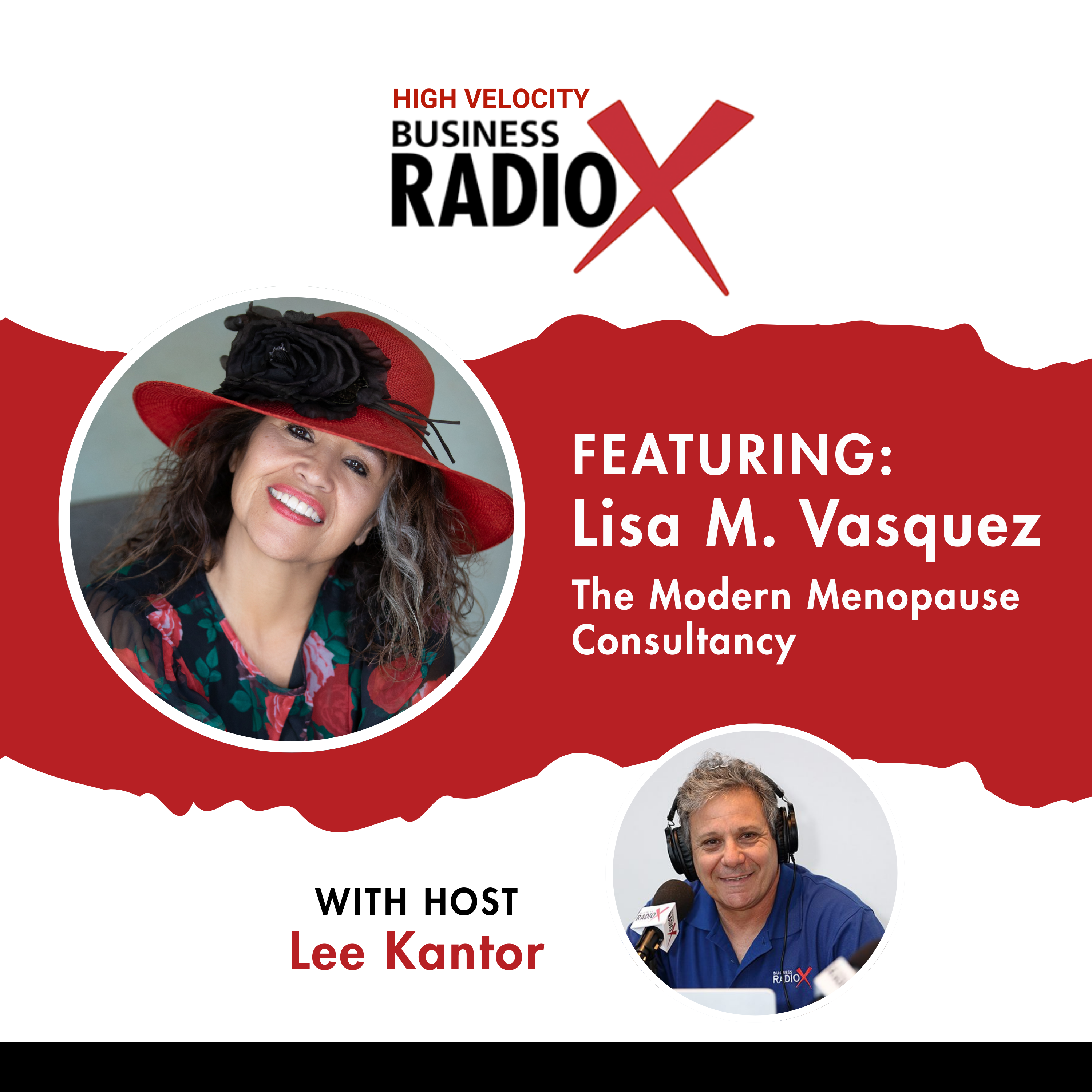


 Lisa M. Vasquez is a Licensed Menopause Champion, certified health coach, podcast host, author, and founder of The Modern Menopause Consultancy. After 40+ years in breast health and radiology, she now guides women through hormonal transitions, chronic pain, and identity shifts—blending science, storytelling, and emotional literacy.
Her podcast and coaching programs spotlight invisible struggles like burnout and workplace exclusion, helping women reclaim energy, balance, and legacy. She’s also the author of Girl in the Red: Your Hormones Are Showing, a humorous and heartfelt puberty guide that empowers girls to understand their bodies with clarity and pride
Connect with Lisa on LinkedIn and Facebook.
What You’ll Learn In This Episode
- Her new book—Girl in the Red.
 This transcript is machine transcribed by Sonix.
TRANSCRIPT
Intro: Broadcasting live from the Business RadioX studios in Atlanta, Georgia. It’s time for High Velocity Radio.
Lee Kantor: Lee Kantor here. Another episode of High Velocity Radio, and this is going to be a good one. Today on the show we have Lisa Vasquez. She is with the Modern Menopause Consultancy. Welcome, Lisa.
Lisa Vasquez: Hi. Thank you so much. Today High Velocity Radio show. This is very exciting and I really appreciate having a voice here. Thank you.
Lee Kantor: Well, we’re excited to learn what you’re up to. Tell us about the modern menopause consultancy. How you serving folks?
Lisa Vasquez: Well, this is all, um, coming from groundwork of the past five years, but the history comes from 45 years of working in radiology. I specialize in breast cancer, breast health, and mammography. I was a technologist. I recently retired a year and a half ago, and so my biggest, what I really wanted to express was amplifying the voice of all the women behind closed doors that wouldn’t go through a lot of pain to uncaptured hormonal changes, things that lab work doesn’t really justify when they’re still feeling terrible. And so because of that, and then besides the seen through the lens of disease and destruction in radiology for 45 years, the changes of the decline in women’s health, you know, when I started was the 80s. So we had a little bit more nourishment in our soils, environments, and, you know, things were happening, but not to the extent of where we are today. So this is where that started from.
Lee Kantor: So how does the practice actually work? Like what are your clients coming to you to help them with?
Lisa Vasquez: Well, so my consultancy will be about hormones testing, you know, taking higher levels of a test besides what general insurance provides, so that we get the overall look of inflammation and different changes that are happening in the body. But aside from that, I actually just joined a global wellness company, partner Co and this is like over 100 excellent nutrient replacements for our body because I found through statistics and uh, interviewing women, a lot of women do not do vitamins. And I didn’t understand that. And the beauty about this company is something I’ve searched for a long time, was the fact that I grew up in the when I was 15, a noxzema girl. And, you know, the the slogan then was, you know, be an all natural, clean, you know, beauty girl, whatever. Anyway, so that’s where my all natural started. And as I developed on my path getting into radiology, growing up with women who became like a human library through all their challenges and things, this is what led me to create this program. And so I am also certified as a breast health certification. So I am creating a bootcamp for breast cancer awareness program because we are entering that month with International Menopause Day, and this bootcamp will be speaking on the grounds of or having a high rise in women under 5040s, higher rates of breast cancer that are occurring. And so, you know, I want you to be the best at your breast. And so this is where the consulting will come in because hormones are, you know, the weight loss, the mood swings, the different feelings and changes that a woman, uh, goes through in her cycle and her cycle, I should say.
Lee Kantor: So, um, have you started, uh, actually having clients working in this area, or is this something that you’re working towards?
Lisa Vasquez: This is something I’m working toward for 2026. So after all the groundwork of the groundwork during while I was working my full time job. This was all in a creation state. And so now it is evolving into the next level. And this brings me the excitement because, uh, I’m an author. So I created my first solo book I’ve been in for. But this is my solo called girl in the Red. Your hormones are showing. So this is taking us all back to kind of zero and empowering young little ladies who are entering this, uh, hormonal, uh, kayak waters, I call it, because the shifts in the waves and how these all change. But our generations have never had real stories about menstrual cycle and what it all means. And driving that lane and being there without proper nourishment and, um, processing every stage of these changes. This is what has been breaking women, um, on the road to, you know, their longevity through the workplace. So I also support women now to date in the workplace with these conversations? Because there’s so many structures there that haven’t changed, and women’s hormonal changes really have a bigger effect in their repairing their changes of coming from maternity, all these different things. So this is just a big thing of hormones that really, uh, is the identity of a woman.
Lee Kantor: So are you available to do speaking at companies uh, to to work with some of the women and educate them about this subject?
Lisa Vasquez: Yes. These are the doors that I really want to break down, because this is where the women are really behind, um, pain behind closed doors. And, you know, with the different, uh, cultures with different disabilities, these are women that kind of hide in shadows because they don’t want to provide a look of weakness, but they’re trying to be productive, as, you know, normal and, you know, hearing about the programs that you host with your company, with the boat rides for the disability. This was I was so fascinated by that, to come into this community and understand this world. But, you know, it’s not just about, you know, women. It’s we’re all hormonal men, women. But those changes that affect us in the workplace have really put a big damage on us. And these are the women that I would see in the mammography room that were presenteeism going to work, not really being there, you know, had no sleep the nights before. Uh, you know, just all kinds of different changes, you know, the nourishment, the hair loss that was starting to appear. There were so many things that started changing. So, yes, bringing education into the corporate world is the goal, because this is where we need to really open up. And that’s where the women are, you know, to really capture them. That’s where the journey is. Those are the paths they have to cross.
Lee Kantor: Now, a lot of folks out there would like to write a book, but you obviously have written a book and been involved in other books. Can you talk about, um, how you go about the book writing process when you wrote your book, The Girl in the Red? Uh, your hormones are showing. What was your process in kind of coming up with the concept and actually getting, you know, words down and actually, you know, then actually publishing it. Do you mind sharing a little bit about your author journey?
Lisa Vasquez: Oh, no, not at all. Because this is what’s so exciting is because where I stand today, I had five year goals my whole life. So looking back at the trail, when the menstrual started at 11, I had very bad cramps. Went through a lot, you know. But we don’t know this as young girls, you know, it’s just a process. These are things. As all women, this is where all our pain starts. We have to push through it. We have to go to school. So that was the journey, finding little girls who who discover their menstrual. And this is talking to women in my generation who were hidden in the restroom when they got this sign that appeared while they were in school, scared to come out. Mother picks them up. They’re just led to be given a pad. And, you know, here’s the new hygiene way you’re going to take care of yourself. And that’s the end of the conversation. So today we have period poverty where our women and women and young girls, they don’t have the, uh, um. Skins that we use, the sanitary pads or any of that. This is a limited, but we don’t know that it could be our own friend, but she’s not going to tell us. So, uh, my my menstrual started in Mexico, my first journey there in fifth grade. And there I was, hearing the story from my sister and why she picked that moment, I don’t know. And next thing you know, I went to the restroom and there I was. I screamed and oh my gosh. And now I’m in Mexico. Love, love Mexico. My my culture, my history. But at.
Lisa Vasquez: The time.
Lisa Vasquez: Back then in 72, 1972, there was no support. There wasn’t no place to, you know, plumbing for me where I was at in the little, uh, place I was little town and, uh, you know, pads were not easy to access. So I had the experience of what that could be like. And today, to even know that this this happens to children, women. It is very sad because back then, we didn’t look at it as though I had to decide if we were going to have dinner, or were they going to buy me my pads. And today it’s a different story. And again, not nourishing correctly. I want this next generation to really evolve in health and in their wealth of health. But it all starts with understanding how to nourish this in all those spaces.
Lee Kantor: So when you had the idea and you wanted to reflect on that past and then help the younger generation deal with what you had to deal with, um, how did you kind of come up with the tone? You did this with a bit of humor. You wanted to be, you know, educational, but you wanted to cover the topic in a way that’s accessible. Can you talk about why that was the path you decided to take?
Lisa Vasquez: Well, because the first part of it all starts with when I speak, I’m never alone. I carry all the thousands of women that I’ve served in the special touch in the mammography room. Their stories is what’s created all of this in me. And so I dedicated that book with them intentionally. And then I created my characters to bring hormones into Lady Estrogen, lady testosterone and Lady Progesterone. And they all have a conversation with me because our hormones are speaking. We’re just not listening. So to really bring that out, that was the most fascinating part. There’s scripts in there. And then back then, mother and Daughters, we separate and we didn’t know. But I discovered and through what I’ve studied and seen, our distance comes because I’m on a full tank and my mother’s, you know, declining in her hormonal fuel. So we’re not seeing eye to eye. I’m puffier and she’s, you know, bleeding out differently, but we don’t know that. And she’s in a different mood from where I’m at, so we’re never going to clash. So what I want to bring back is that mother daughter story. Because of the pain that I’ve seen of these separations, even when you’re 15. These hormones are like wild mustangs, and they make you think you don’t need your mother. But we need a hug from her all the time. We need to share a moment with her and have a movie and popcorn just to see what’s happening with each other. And so I talk about that. I have skits in there with her father joining in a conversation, because I have a lot of dead girls out there. And, um, how do they start? Where do they start? You know, like, oh, no, she’s got, you know, I mean, it’s just a hard conversation. And now I made it so easy. And I’m happy to hear the reviews of people really enjoying this because there is that science education. But there is my own anecdotes of life that come out of what happened to me at 1112, you know, up until 14. Next book will be different, but that’s part of what happened in this book.
Lee Kantor: Now, are there any challenges you can share when you’re building a consultancy, like you’re doing? Um, and you’re starting from kind of ground zero, you have all this experience, but to then go out into the world and find your own path, uh, do you mind sharing some of the challenges and how you’ve overcome them?
Lisa Vasquez: Well, the first part was I came across a program that had that was created in the UK. It’s called The Menopause Experts. And, um, they had a program, so that just came. Perfect timing for me and the education. The support is global, you know, so you hear everything and all kinds of stories. So that was a big part of really kicking off this foundation. The next part of breaking down those walls is when I started the conversation of breast cancer back in the 80s. Those walls had to be broken down. Mammography wasn’t being used. People were afraid of it. They didn’t understand it. We started bringing out education, having more and more about it. So we evolved to a point where we’re at. But unfortunately now we’re having a bigger another high rise in women, young women coming with this issue. So we’re taking that education and those steps that I took to create that I spoke on, that I do speak on that still today is where I’m doing with menopause because the subject, it’s a one day issue, it’s not a disease and it comes at any age. I mean, you could be 28 and have a full, uh, full hysterectomy and be in menopause.
Lisa Vasquez: So it’s not an age thing, but when you say that, they think, oh, that’s not me yet, but it’s all of us. Again, we have hormones. There’s people we need to understand what these phases of menstrual, peri and menopause and then especially post-menopausal women, they have a conversation of believing that there’s nothing else they need to do. You know, I’m done with that. That’s it. You know, I’m good, but there’s not. There’s this drive to go for optimal health within you because one out of seven women will live to be 100. And I don’t believe in that. My list, because my father just passed away a year ago at 98 full, you know, fully loaded. He was a great guy. And, uh, so I kind of feel like my uncle, his cousin 101, just passed away this year. So it’s a it seems like my life is going to last a little longer, but who knows? You know, we want to keep the quality. We don’t know. I mean, we don’t know how long the quantity is. Where it’s going to end up with the quality is what’s important to carry on.
Lee Kantor: So is there any advice you can give a woman right now who might be dealing with menopause? Is there are some do’s and don’ts on how you would, um, kind of manage menopause?
Lisa Vasquez: Well, there’s a lot of different ways. I mean, first of all, it’s really knowing and getting chemistry baselines of your hormones. We are not taught to do this. We are not trained to do that. People find out their chemistry when they’re already in menopause. And that shouldn’t have been because just like a mammogram, we need baseline studies, and we read every year and every other year to really do a comparison study, to see the travels of where you’re at. This is what hormonal chemistry panels can do for us. Give us. I use it like a printing cartridge, right. We know when the pink and the blues are running out. We need to see that as we evolve in our life and when we see small symptoms start to show up, we kind of confuse them that maybe that’s just, you know, I’ve been up all night because my, you know, I just had a baby or something, but could there be a hormonal shift in there? There’s small aches and pains that happen, but they all mean something when they start to develop. So 20s and 30s fully loaded. We’re doing good. Uh, 40s. We start walking on eggshells because that’s when the Perry pause comes in and all a lot of signs start to come up. 50s we become, we start to come into, um, more chronological by 60 or chronologically coming into age disease. We really want to capture 50 and really bring the wellness into our nutrition, our life, you know, throughout your life. But, you know, these are the years because we’re a little late behind us. So I have the new generation growing into this, but it’s the women in my generation today They that really need this awareness.
Lee Kantor: And so you think it’s important for women of all ages to kind of know what their hormonal situation is, so they can kind of keep an eye on it as they age.
Lisa Vasquez: Yes. Because we understand today a lot of signs come from these young girls when they’re having cramps, when they’re having different, uh, things happening during the beginning cycles of their menstrual cycle. So really teaching them, just as we are taught, you know, at a point, this is your doctor at a point and go to the gynecologist really teaching them young what this all means with education. And that’s what I’m hoping that my book is going to provide is make them more curious. But it’s really empowering to really, uh, trust and self love and self care for yourself.
Lee Kantor: So if somebody wants to learn more about your practice and get Ahold of your book, or maybe book you for speaking or some consulting. What is the best way to connect with you?
Lisa Vasquez: Um, currently through my email help my well-being at gmail.com.
Lee Kantor: And do you have a website or do you have are you on social media?
Lisa Vasquez: Social media? Facebook? I have a Facebook group called The Modern Menopause Evolution. Uh, Instagram. Female forward evolution. That was for my younger group, for my book and, um, just my social page. Lisa Vasquez.
Lee Kantor: Uh, Lisa Vasquez. They can, uh, look you up that way. And so there’s no kind of central website.
Lisa Vasquez: Uh, Lisa, Chico, this is under construction, but it still has access to come into my group. And, um, everything that’s going to be added to that is under construction right now. But it’s Lisa who see that, and it’s very interesting. It’s a new ride for me and I’m very excited about this and especially the opportunity to really talk to the world.
Lee Kantor: Well, congratulations on all the momentum. It sounds like you’re heading, uh, to an exciting adventure here. And congratulations.
Lisa Vasquez: Thank you, thank you. It is. It really is. It’s it’s a dream come true. Helping out about women. You know what they’ve given to me. You know, just giving it all back now. Fully loaded with. With answers and solutions and, you know, making moves and proving energy. And it’s just great.
Lee Kantor: Well, thank you again for sharing your story. You’re doing important work and we appreciate you.
Lisa Vasquez: Thank you.
Lee Kantor: All right. This is Lee Kantor. We’ll see you all next time on High Velocity Radio.














